Our Location:
No. 99, Jiazi Road, Chengdu

 authorChris Lee
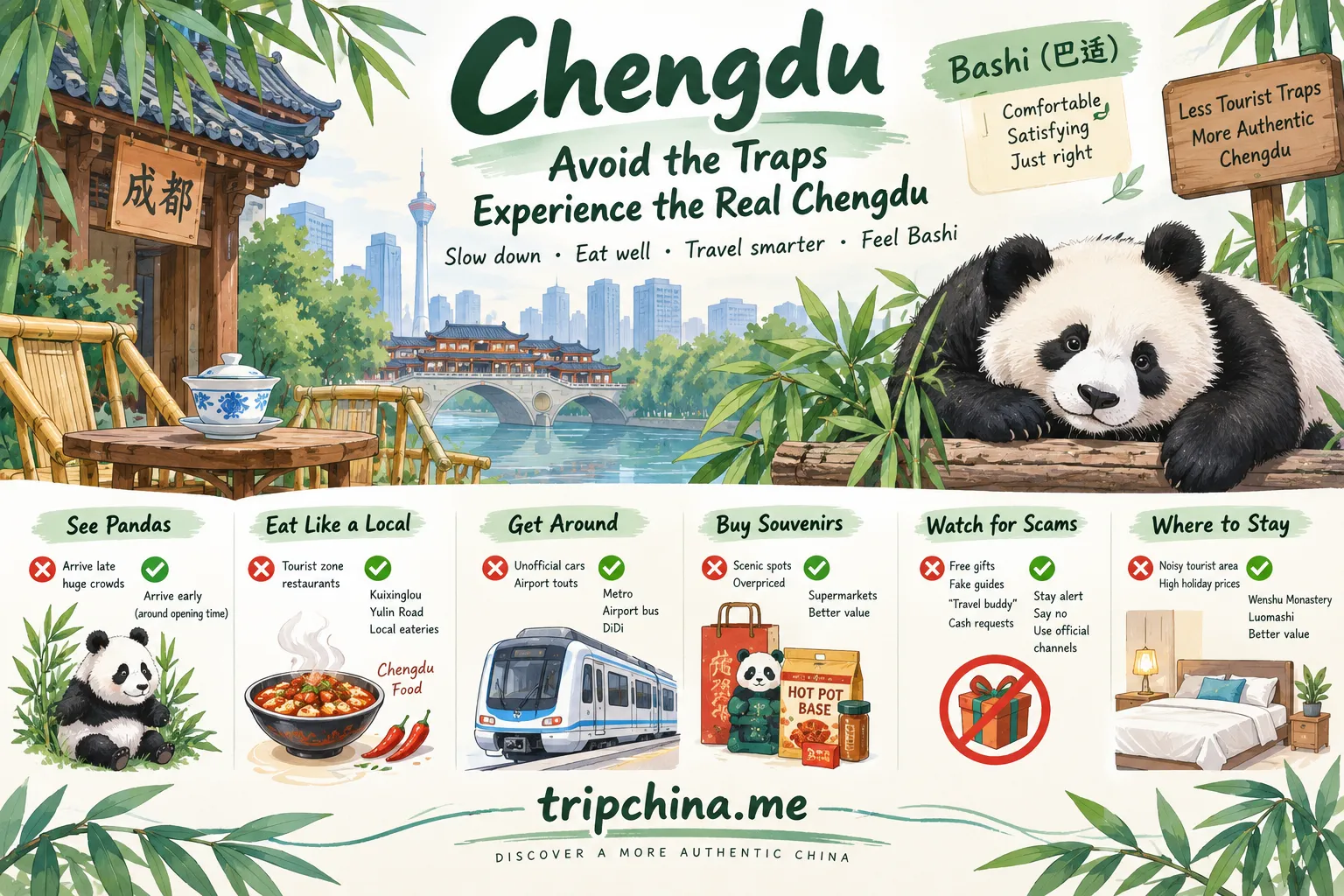
To understand Chengdu, you need one word: Bashi (巴适). It means comfortable, satisfying, just right. The real Chengdu is sitting in a teahouse for three hours, eating a cheap bowl of noodles, and watching the city go by. The tourist version is rushing through crowded attractions, overpaying for mediocre food, and falling for services you never needed. This guide helps you tell the difference.
The biggest Chengdu tourist traps are not usually dramatic scams. They are small decisions that waste money or time: eating every meal inside tourist zones, arriving at the Panda Base too late, buying souvenirs at scenic-spot exits, taking unofficial airport cars, or accepting an unsolicited “free” service.
For a better trip:
If this is your first visit, our Chengdu citywalk guide is useful for building neighborhood-based days instead of racing between attractions.
| Scenario | Higher-Risk Tourist Choice | Better Local Strategy | Main Trade-Off |
|---|---|---|---|
| Where to eat | Eating every meal in Kuanzhai Alley | Kuixinglou Street, Yulin, neighborhood restaurants | Tourist-zone pricing and generic food |
| Viral snack streets | Choosing stalls only because they are photogenic | Compare busy stalls with strong local turnover | Long queues and inconsistent value |
| Souvenirs | Scenic-spot exits and impulse purchases | Supermarkets and established retailers | Higher tourist-zone prices |
| Seeing pandas | Arriving late morning | Arrive near opening time | Larger crowds and less animal activity later in hot weather |
| Airport transport | Unofficial private-car touts | Metro, airport bus, or DiDi | Unclear pricing |
| Accommodation | Booking only for a famous address | Compare convenience, noise, and metro access | Higher holiday prices and street noise |
| Ear cleaning | Street-side vendors | Skip it or choose an established provider | Hygiene and unexpected add-ons |
| Hotpot | Ordering by your home-country idea of “mild” | Start with 微辣 and adjust carefully | Chengdu mild can still feel very spicy |
Chengdu runs on Bashi, a Sichuanese expression for something that feels comfortable, satisfying, and just right.
It is not about seeing everything. It is about enjoying what you do see.
One of the easiest ways tourists waste money here is the “since we’re already here” mindset. You eat a mediocre meal because it is directly outside an attraction. You buy a souvenir because you are already standing in the shop. You add another sight because it is famous, even though everyone is tired.
The rule I use is simple:
Before spending money, ask yourself, “If I came back to Chengdu, would I choose this again?”
If the answer is no, keep walking.
That small shift gets you surprisingly close to the way Chengdu is actually enjoyed.
Most trips to Chengdu are uneventful, but a few low-value sales tactics and reported street scams are worth recognizing before you arrive.
Someone may hand you a flower, bracelet, lucky charm, or sample and then ask for money once you accept it.
The easiest response is not to take unsolicited items from strangers. You do not need to argue; simply decline and keep walking.
Be cautious when someone approaches you outside an attraction and offers an unofficial tour or shopping help.
If you want a guide, use an official attraction service or a guide you deliberately booked in advance. Never let a stranger redirect your itinerary into a shop you had not planned to visit.
Very cheap day tours may recover part of their cost through mandatory or heavily encouraged shopping stops.
Before booking, check whether the itinerary includes jade, silk, tea, traditional-medicine, or souvenir stores and how much actual sightseeing time is included.
For trips outside the city, planning independently with our Dujiangyan travel guide and Mount Qingcheng guide gives you much more control over the day.
As of September 2026, recent Sichuan consumer-complaint records describe cases where travelers met online as travel companions (known locally as dāzi, or “travel buddy”), who then steered visitors toward designated shops for overpriced purchases.
The practical rule is simple: meeting someone socially is one thing; letting a newly met online “buddy” choose where you shop is another. Pick stores independently, compare prices, and leave if the outing suddenly turns into a shopping trip.
Recent Chengdu complaint records have also described strangers approaching people around transport hubs or commercial areas with stories about frozen bank accounts or not having enough money to buy a ticket home.
Do not hand over cash. If someone genuinely needs assistance, direct them to station staff, police, or an official service counter.
The mistake is not visiting the Panda Base. It is visiting it at the wrong time and assuming every ticket seller is legitimate.
Pandas often become less active as temperatures rise, so early morning generally gives you a better chance of seeing more activity. During March through October, the official morning entry period begins at 7:30 AM; from November through February, it begins at 8:00 AM. Animal behavior is never guaranteed.
Opening hours are subject to temporary adjustments during holidays or extreme weather, always verify on the official mini-program before your trip.
For a detailed route, gate choice, and Hua Hua strategy, see our Chengdu Panda Base guide.
If Hua Hua is your priority, check the current enclosure information and plan around the South Gate route.
If your priority is simply seeing pandas with a potentially smoother arrival, the West Gate can be useful during busy periods. Official holiday notices have specifically recommended the West Gate when South Gate crowds are heavy.
Important: the West Gate has no self-driving parking lot. If you are driving, plan your parking before arrival; otherwise, public transport is the easier option.
As of September 2026, adult admission is CNY ¥55, and tickets can be reserved online up to 14 days in advance. The official system uses real-name ticketing, and foreign visitors can use passports as valid entry documents.
Book through the official WeChat account or WeChat mini-program “成都大熊猫繁育研究基地,” or an officially authorized platform such as Meituan, Trip.com, Douyin, or Tongcheng. The Base explicitly warns visitors not to trust paid “fast entry” claims.
If the WeChat booking process is confusing, our Panda Base ticket guide for foreign passport holders walks through the process in more detail.
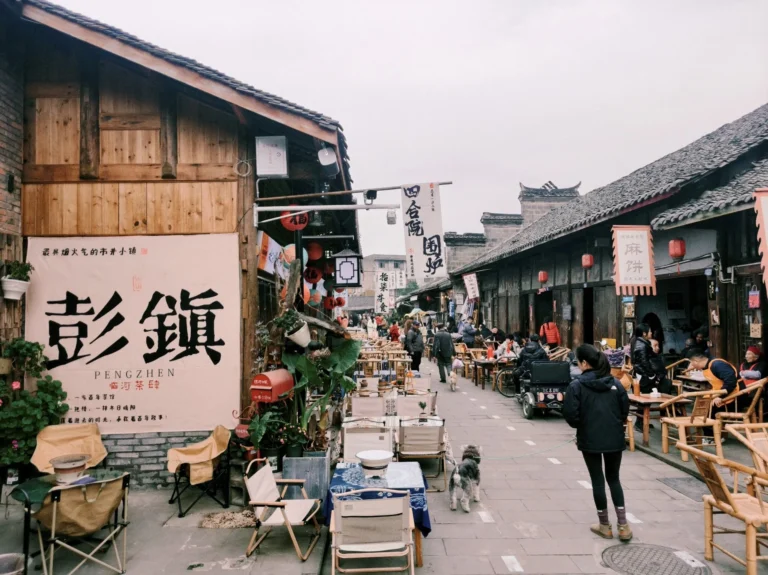
Kuanzhai Alley is worth seeing. I just would not automatically make it your main food destination.
The area is designed for visitors, so some restaurants and snack shops prioritize convenience, presentation, and tourist traffic over value.
A better plan is to walk through Kuanzhai Alley for the architecture and atmosphere, then move toward Kuixinglou Street or another local dining area for dinner.
Our Kuanzhai Alley guide explains how to visit without turning the entire stop into a shopping trip.
No — but understand what it has become.
Once a beloved local snack hub, Jianshe Road is now heavily commercialized and shaped heavily by social media. It hosts many chain-run stalls with massive queues, though a handful of long-standing local vendors still operate here.
If you go, look for stalls with strong local turnover rather than automatically joining the longest influencer-driven queue.
For a more neighborhood-oriented food experience, compare Yulin and places in our Chengdu night market guide.
Scenic-area shops are convenient, but convenience often comes with higher prices.
For packaged items such as hotpot base, Pixian doubanjiang, Dengying beef, tea, and local snacks, compare prices at supermarkets such as Hongqi Chain rather than buying everything at Jinli or immediately outside an attraction.
Be more cautious with products sold as “handmade” embroidery, rare wood, antiques, jade, or other materials whose authenticity is difficult for a visitor to judge.
For more shopping options beyond tourist streets, use our Chengdu shopping guide.
Ignore unsolicited drivers approaching you inside or outside arrival areas.
Use official taxi queues, the metro, airport buses, or DiDi instead. With app-based transport, you can see the vehicle details and expected fare before departure.
For a complete comparison of CTU and TFU transfers, see our Chengdu airport-to-city guide.
Shuangliu International Airport (CTU) is much closer to central Chengdu than Tianfu International Airport (TFU), but the actual time difference depends on traffic, your destination, and the transport mode.
Do not use a fixed “60 minutes closer” rule when choosing flights.
If you land at Tianfu late at night, you are not automatically stranded. Tianfu International Airport Bus Line 1 connects the airport with Chunxi Road and operates 24 hours; published schedules describe the route as a roughly 80-minute trip under normal road conditions.
Do not assume “Chengdu Station” and “Chengdu East” are interchangeable.
Check the exact station printed on your ticket before leaving your hotel. Chengdu East, Chengdu South, Chengdu West, and other stations serve different routes, and current railway operations can change as the network develops.
For intercity rail trips, our China train ticket guide for foreign travelers explains 12306, Trip.com, passport booking, and station procedures.
Official taxis are legitimate, but if a driver refuses to use the meter or tries to negotiate an unclear flat fare, do not continue the ride.
DiDi is often easier for foreign visitors because the destination, vehicle plate, and estimated price are shown in the app. Read our DiDi guide for foreigners before arrival if you have never used it in China.
During busy periods, the Chengdu metro is often the most predictable way to cross central Chengdu.
Foreign map services can be less useful in mainland China than local mapping apps, and positioning or POI data can sometimes cause confusing walking directions.
Save the Chinese name and address of your destination, and use a China-focused map when possible. Our guide to navigation apps for foreign tourists in China explains the options.
Chunxi Road and the Kuanzhai Alley area are not “bad” places to stay. In fact, their biggest advantage is convenience.
The trade-off is that popular central locations can become expensive during major holidays and some rooms face busy streets. If you stay there, check recent room reviews, ask for a room away from the main road, and compare holiday rates before booking.
For better value and quieter streets while remaining close to central Chengdu, Wenshu Monastery and Luomashi can work well.
Our Chengdu accommodation guide compares the main areas in more detail.
For China generally, also check our hotel booking guide for foreign travelers before booking a small hotel, guesthouse, or private stay.
If you are sensitive to chili, start with 微辣 (wēi là, meaning mild spicy) and tell the server:
“我不吃太辣。”
Wǒ bù chī tài là.
“I don’t eat very spicy food.”
Chengdu’s classic oil dip usually combines sesame oil and garlic, with optional oyster sauce, scallions, or cilantro. It can soften the sensation of chili for some diners, but it does not medically “protect your stomach.”
Sesame paste is common in northern-style hotpot but is not the classic Chengdu dipping style.
For ordering, broth choices, ingredients, and local hotpot etiquette, see our Chengdu hotpot guide.
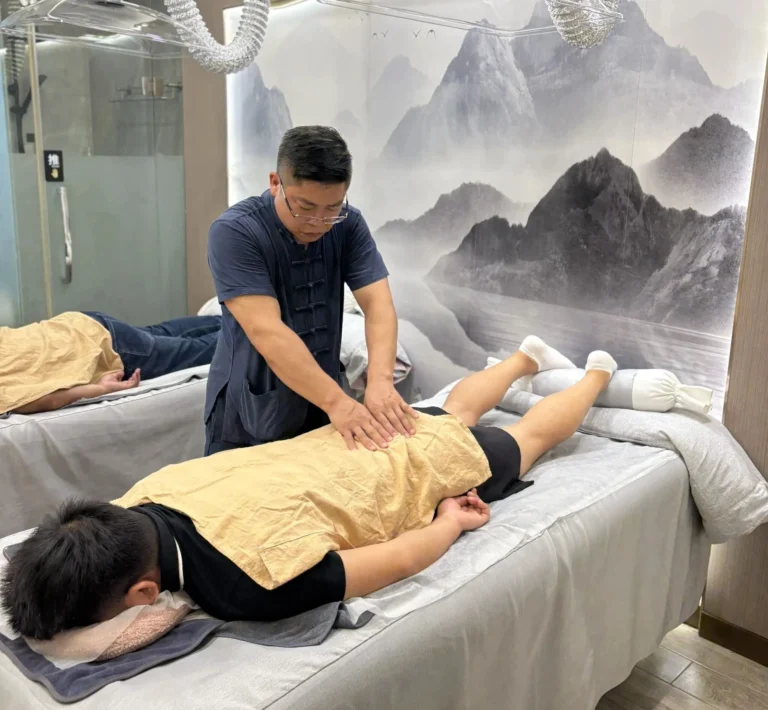
Traditional ear cleaning, or cǎi’ěr (采耳), is part of Chengdu’s leisure culture, but it carries real health risks and is not for everyone.
Avoid street-side operators where hygiene practices are unclear. Even at an established teahouse or shop, confirm the price before the service begins and remember that inserting tools into the ear canal carries a risk of irritation, infection, or injury.
If you mainly want the Chengdu teahouse experience, you do not need ear cleaning at all. A pot of tea and an afternoon doing nothing is already very Chengdu.
Our local Chengdu teahouse guide covers better ways to experience that culture.
Free tea tastings, photos, gifts, bracelets, or informal services can sometimes turn into sales pressure or unexpected payment requests.
That does not mean every free sample in Chengdu is a scam. The practical distinction is whether you deliberately entered a legitimate business or whether a stranger approached you and created an obligation you did not ask for.
If you are unsure, politely decline and keep walking.
One useful distinction: Jinli itself is an open commercial street, while nearby Wuhou Shrine is a separate attraction with its own admission arrangements. Do not assume the two share one entry system.
Instead of trying to collect attractions, organize your trip around one or two strong experiences each day.
7:30 AM: Chengdu Panda Base during the March–October opening season; check seasonal opening time if traveling from November through February.
12:00 PM: Wenshu Monastery and the surrounding neighborhood.
Late afternoon: Walk through Kuanzhai Alley for architecture and photos.
Evening: Dinner around Kuixinglou Street or another neighborhood restaurant.
Morning: Wuhou Shrine if Three Kingdoms history interests you.
Midday and afternoon: People’s Park for Gaiwan tea and unstructured time.
Early evening: Jinli after the lights come on.
Night: Jiuyanqiao or another nightlife area if you still have energy.
Take an early train toward Dujiangyan and visit the irrigation system first.
If your pace and transport connections allow, continue to Qingcheng Mountain. Trying to rush both sites can make the day feel less Bashi than the rest of this itinerary, so travelers who prefer a slower pace should choose one as the main focus.
Independent day-trippers should book return train tickets in advance, especially on weekends and holidays.
Use our Dujiangyan travel guide and Mount Qingcheng guide to plan the route before leaving Chengdu.
A little digital preparation prevents many of the “traps” that are really just China-specific travel friction.
Set up mobile payment before you arrive. Our guide to paying in China as a foreigner covers Alipay, WeChat Pay, international cards, and cash.
Make sure your phone will work after landing. If you are choosing connectivity now, compare a China travel eSIM with a local SIM. If you arrive and discover you have no usable internet, follow our no-internet-after-landing troubleshooting guide.
And if you rely heavily on Google, WhatsApp, or other international services, understand the connectivity situation before departure with our China internet access guide.
This article is part of the Chengdu Travel Guide Hub.
Generally, choose busy stalls with high turnover, food cooked thoroughly in front of you, and places where ingredients are not sitting unrefrigerated for long periods. A crowded local stall can be a better signal than a photogenic storefront, but no street-food choice is risk-free.
Yes — for the architecture, atmosphere, and an easy central-city walk. You do not need to avoid it; just separate “worth seeing” from “best place to eat or shop.”
Bashi means something close to comfortable, satisfying, or “just right.” In practical travel terms, it means leaving enough time to sit in a teahouse, eat slowly, and skip an attraction when your schedule is already full.
If you paid via Alipay or WeChat Pay, you can sometimes dispute the transaction through the app’s complaint function. For tourist-related scams, call 12345 (Chengdu government hotline) or 12301 (National Tourism Service Hotline). The Chengdu Culture and Tourism Bureau’s special rectification campaign has resulted in 1378 valid complaints handled and ¥2.37 million refunded as of July 2026-1. File a report with screenshots of the transaction, the shop location, and any chat records. For cash payments, recovery is much harder — which is another reason to use digital payment.
No — the scam targets people who are actively looking for a travel companion online. If you’re not searching for a travel companions (known locally as dāzi, or “travel buddy”) on Xiaohongshu, Douyin, or travel forums, you’re not the target. The practical rule: if you meet someone online and they immediately suggest specific shops, that’s the red flag. Meeting someone socially is fine; letting a newly met online acquaintance choose your shopping destinations is not.
DiDi provides driver, vehicle, and route information inside the app, which can make ride details easier to verify. Check the license plate before entering, sit in the back, and use the app’s available trip-sharing or safety functions when appropriate. Apply the same late-night precautions you would use in another major city.
Stick to pick-up points in well-lit public areas, avoid isolated side streets.
Do not negotiate an unclear fare. Leave the taxi if it is safe to do so and use another official taxi or DiDi. Record the vehicle information if you intend to make a complaint.
For travelers, the safest approach is to drink bottled, filtered, or fully boiled water; avoid drinking tap water directly. Hotels commonly provide bottled water or kettles, and bottled water is widely available in convenience stores.
Yes. Arriving early improves your chances of cooler weather, smaller crowds, and more panda activity, but pandas do not follow a tourist timetable. If you prefer a different experience, compare the Chengdu Base with Panda Valley and other options in our Chengdu panda base comparison guide.
The best defense against Chengdu tourist traps is not suspicion — it is having a plan.
Know where you want to eat, use official transport and booking channels, question unsolicited offers, and leave enough empty time to enjoy the city. Chengdu rewards travelers who stop trying to “complete” it.
That is Bashi.
Sichuan Online Complaint — New Type of Scam in Chengdu Harms Public Interests ("Travel Buddy" Scam)
Sichuan Daily — "Black Cars" Posing as Bus Group Staff Solicit Passengers at Chengdu Chunxi Road
Last researched in September 2026. This guide cross-checks the Chengdu Panda Base’s current ticketing and holiday notices, Chengdu airport-bus information, and recent Sichuan consumer-complaint records. Time-sensitive claims are dated or hedged where appropriate. Prices, crowd levels, restaurant popularity, and neighborhood conditions can change, so they are treated as practical observations rather than guarantees. Official attraction, transport, and booking notices should take priority when policies change.
TripChina.me creates practical China travel guides shaped by real local experience, helping independent travelers navigate transport, payments, food, neighborhoods, and the cultural details that make traveling in China easier and more meaningful. Find the guide for your destination at tripchina.me.