Our Location:
No. 99, Jiazi Road, Chengdu

 authorChris Lee
Chengdu's shopping areas may look interchangeable on a map, but they serve very different purposes. Choose the wrong one and you can lose half a day crossing the city for stores that don't match what you actually want. This guide compares nine major shopping areas for luxury brands, Sichuan souvenirs, outlets and local finds, plus current tax-refund rules and the practical shopping mistakes foreign visitors should avoid.
For most first-time visitors, Chunxi Road + IFS + Taikoo Li is the best overall shopping area.
All three are concentrated in the same central district, giving you mainstream shopping, luxury brands, restaurants and one of Chengdu's most recognizable urban scenes without wasting time crossing the city.
• Best overall: Taikoo Li + IFS
• Best mainstream shopping: Chunxi Road
• Best Sichuan-style souvenirs: Kuanzhai Alley + Wenshu Fang
• Best designer outlet: Florentia Village Chengdu
• Best ultra-luxury shopping: Chengdu SKP
• Best antiques and collectibles: Songxianqiao Antique Market
• Best shopping + evening atmosphere: Jinli
2026 tax-refund update: Eligible overseas visitors generally need to spend at least RMB 200 at the same participating tax-refund store on the same day, subject to the other eligibility requirements. Chengdu now has more than 790 departure tax-refund stores, including more than 300 refund-upon-purchase locations.
| Shopping Area | Price Level | Best For | Typical Time | Tax Refund |
|---|---|---|---|---|
| Taikoo Li | High | Luxury, dining, architecture | 2–3 hrs | Many participating stores |
| IFS | High | Luxury, panda landmark | 1–2 hrs | Many participating stores |
| Chunxi Road | Low–Mid | Mainstream shopping, variety | 1–2 hrs | Varies by store |
| Kuanzhai Alley | Low–Mid | Souvenirs, crafts, photos | 1–2 hrs | Varies |
| Jinli | Low–Mid | Small gifts, atmosphere | 1–2 hrs | Check merchant |
| Wenshu Fang | Mid | Traditional crafts, quieter browsing | 1–2 hrs | Check store |
| Chengdu SKP | Very High | Luxury, architecture, design | 2–3 hrs | Many participating stores |
| Florentia Village | Mid–High | Designer outlets | 3–5 hrs | Services available |
| Songxianqiao | Variable | Antiques, collectibles | 1–2 hrs | Not the main reason to visit |
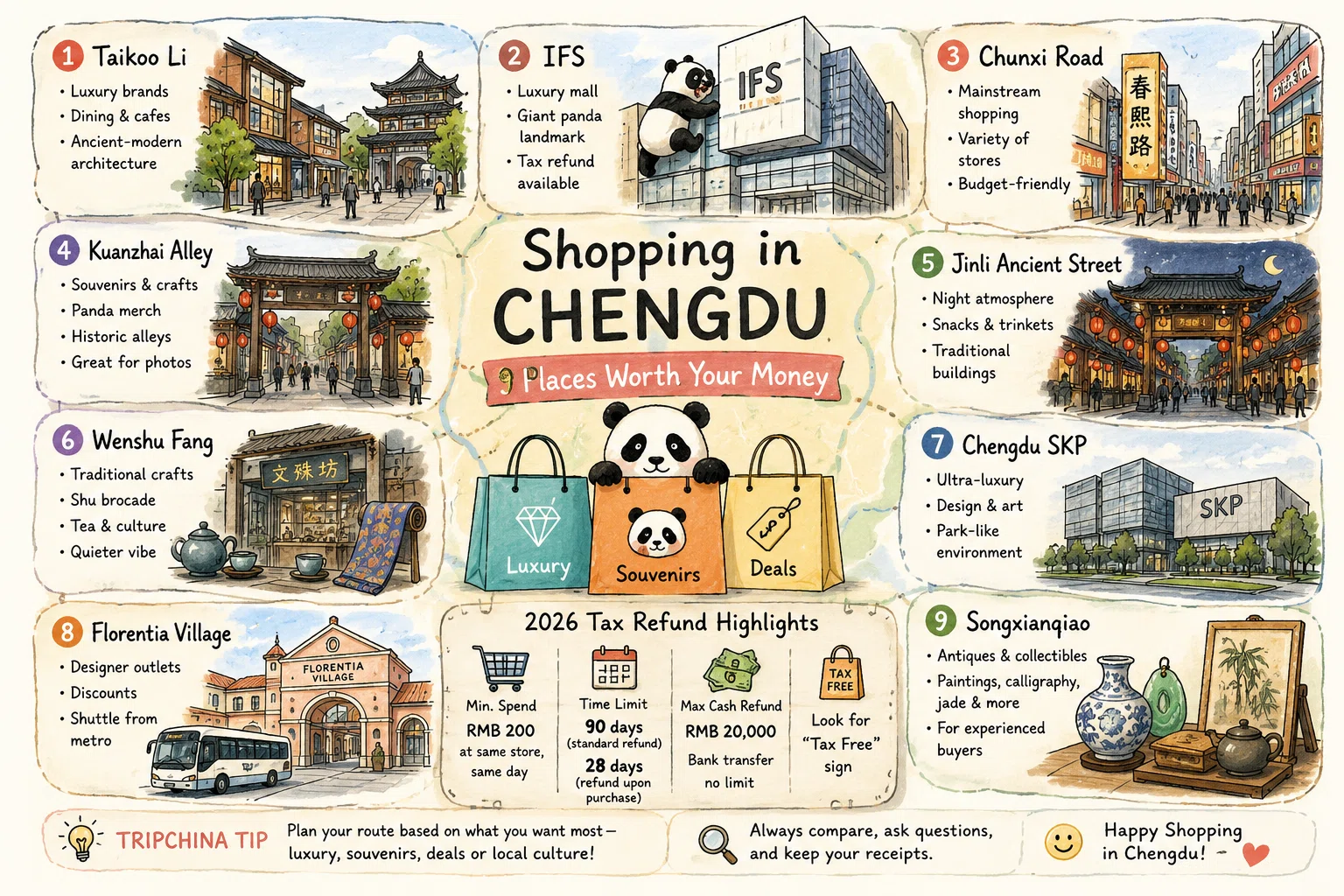
TripChina Verdict: If you only have half a day, don't try to sample Chengdu's entire shopping scene. Use:
Chunxi Road → IFS → Taikoo Li
It offers the broadest shopping mix with the least transportation.
For most international visitors, the Chunxi Road–IFS–Taikoo Li district is where shopping fits most naturally into sightseeing.
You can browse mainstream retail, see Chengdu's famous climbing-panda installation, explore luxury brands, eat, and experience the contrast between modern commercial Chengdu and the historic Daci Temple area without repeatedly taking the metro.
Think of these less as three competing attractions and more as:
one central shopping cluster.
The area's importance for foreign shoppers is also increasingly visible in Chengdu's tax-refund network.
As of July 2026, Taikoo Li, IFS and SKP together had 222 departure tax-refund stores, around 30% of Chengdu's network at that point, while those locations accounted for approximately 92% of the city's tax-refund sales value.
Best for: Luxury brands, Chinese designer labels, restaurants, architecture and people-watching
Location: Zhongshamao Street, Jinjiang District
Metro: Lines 2 or 3 → Chunxi Road Station
Typical visit: 2–3 hours
Price level: High
Taikoo Li is an open-air retail district built around lanes and courtyard-style architecture beside Daci Temple.
That historic-modern contrast makes it more interesting to many travelers than a conventional enclosed shopping mall.
International luxury labels sit alongside Chinese brands, restaurants, cafés and lifestyle stores.
TripChina Local Insight: If shopping is secondary to sightseeing, Taikoo Li still works because you can combine retail, food, architecture and central Chengdu street life in one stop.
If you want more casual local food afterward, see TripChina's Chengdu Night Market Guide.
Yes.
They are close enough that there is little reason to treat them as separate trips.
Best for: International luxury brands, convenient central shopping and Chengdu's panda landmark
Location: Hongxing Road Section 3, Jinjiang District
Metro: Lines 2 or 3 → Chunxi Road Station
Typical visit: 1–2 hours
Price level: High
IFS feels more like a conventional high-end shopping mall than Taikoo Li.
Even travelers who buy nothing often stop for the giant climbing-panda installation and rooftop viewing area.
If you plan to claim a VAT refund, confirm participation directly with the retailer before checkout.
Chunxi Road is better described as mainstream central shopping than a true bargain district.
The commercial street dates to 1924 and remains one of Chengdu's best-known shopping areas.
Today, you'll find:
• fashion
• sportswear
• cosmetics
• food
• chain retailers
• everyday brands
across a broad range of prices.
Best for: Mainstream brands, casual fashion, snacks and browsing
Metro: Lines 2 or 3 → Chunxi Road Station
Typical visit: 1–2 hours
Price level: Low–Mid depending on retailer
Its biggest advantage is location.
Start here and walk toward IFS and Taikoo Li instead of making a separate cross-city trip simply for less expensive shopping.
The wider Chunxi Road–Taikoo Li area has also become one of Chengdu's strongest tax-refund zones, with more than 200 refund-upon-purchase stores reported across key central shopping areas in 2026.
Panda merchandise is the obvious choice.
But Chengdu and Sichuan offer much more distinctive gifts than panda keychains.
Shu brocade, Shu embroidery, lacquerware, tea and packaged Sichuan foods are all worth considering.
| Souvenir | Where to Look | Typical Budget | Why Consider It |
|---|---|---|---|
| Panda merchandise | Kuanzhai Alley, malls, attraction shops | RMB 20–500+ | Recognizable Chengdu gift |
| Shu brocade / embroidery | Wenshu Fang, specialist shops | RMB 100–several thousand | Traditional Sichuan textile |
| Chengdu lacquerware | Specialist cultural shops | RMB 100–2,000+ | Traditional craftsmanship |
| Sichuan tea | Established tea retailers | RMB 50–500+ | Easy to carry |
| Hotpot base | Supermarkets, food shops | RMB 15–80 | Cheap and distinctly Sichuan |
| Cultural accessories | Wenshu Fang, Kuanzhai | RMB 30–500+ | Easy to pack |
Prices vary considerably according to materials, craftsmanship and brand, so treat these as planning ranges rather than fixed prices.
For edible souvenirs, check your destination country's customs and biosecurity rules before packing them.
Pay particular attention to hotpot bases containing beef tallow, meat extracts or other animal-derived ingredients. Import restrictions differ by country, and a packaged product being legal to buy in China does not automatically mean it can be brought through your home country's border.
Yes, particularly if you want to combine shopping with sightseeing.
Kuanzhai Alley centers on Kuan Alley, Zhai Alley and Jing Alley and mixes historic architecture with restaurants, souvenir retailers, boutiques and cultural experiences.
Best for: Panda gifts, small cultural products, crafts and photography
Metro: Line 4 → Kuanzhai Alley Station
Typical visit: 1–2 hours
TripChina Local Insight: A historic setting does not make every product sold there rare, handmade or locally produced.
For expensive lacquerware, embroidery or art, ask about the:
• maker
• materials
• manufacturing process
• craftsmanship
before buying.
For a full visiting strategy, see TripChina's Kuanzhai Alley Guide.
Wenshu Fang works better for travelers who prefer a quieter cultural shopping environment.
Located beside Wenshu Monastery, the district focuses more on traditional-style architecture, tea culture, crafts and cultural products than Chengdu's major commercial malls.
Best for: Traditional crafts, tea-related gifts and slower browsing
Metro: Line 1 → Wenshuyuan Station
Typical visit: 1–2 hours
For higher-value Shu brocade, embroidery or lacquerware, compare materials and workmanship before buying.
There can be a huge difference between inexpensive souvenir versions and specialist craft pieces.
Visit Jinli for atmosphere first, shopping second.
The pedestrian street beside Wuhou Shrine is more memorable as an evening cultural stop than as a destination for serious retail.
Traditional-style buildings, lanterns, food and small souvenir shops make it easy to combine with Wuhou Shrine.
Best for: Small gifts, snacks, photography and evening atmosphere
Typical visit: 1–2 hours
Price level: Low–Mid
You'll find panda-themed gifts, paper-cutting, decorative crafts and inexpensive souvenirs.
For high-value traditional crafts, specialist shops elsewhere are easier to compare.
Alipay and WeChat Pay are widely used, although individual small merchants can still differ.
Don't rely on old claims that Jinli is universally “cash-only.”
More broadly, Chengdu has developed a payment system built around cards for larger payments, QR payments for smaller transactions and cash as a backup, and official city reporting says more than 90% of key commercial districts support international cards.
That doesn't mean every individual stall accepts every foreign card.
For Jinli, mobile payment plus some RMB backup is still the most practical combination.
The most efficient way to visit is to combine it with TripChina's Wuhou Shrine and Jinli Afternoon-to-Evening Route.
SKP makes the most sense for travelers who genuinely enjoy:
• luxury retail
• contemporary architecture
• commercial design
Its landscaped public space and largely underground retail environment distinguish it from Chengdu's more conventional malls.
Best for: Luxury brands, architecture and contemporary shopping design
Typical visit: 2–3 hours
Price level: Very High
For a first-time visitor who only wants to browse international luxury brands, Taikoo Li + IFS is usually more efficient because that district fits much more naturally into central Chengdu sightseeing.
Go to SKP when the space itself interests you—not simply because you want another luxury mall.
For serious outlet shoppers, yes.
For casual browsing, probably not.
Florentia Village Chengdu is in Pidu District, outside Chengdu's main tourist center.
Its official site currently lists more than 260 premium brands, with discounts advertised as reaching substantial reductions depending on store and promotion.
Address: 888 Yinxing Road, Pidu District
Metro: Line 6 → Wangcongci Station → Exit D → shopping shuttle
Regular hours: Approximately 10:00–21:00
Typical visit: 3–5 hours plus transport
Best for: Designer, luxury and sportswear outlet shopping
Its official brand directory includes major international labels and sports brands.
As of September 2026, the official shuttle timetable lists services between Wangcongci Metro Station and the shopping village during the daytime.
Because these schedules can change, check the current official timetable before traveling specifically for the shuttle.
If you miss the free shuttle, use DiDi or another ride-hailing service as your backup rather than assuming another shuttle will arrive quickly.
TripChina Local Insight: Don't travel across Chengdu simply because you see “up to 80% off.”
Check first whether several brands you actually want are currently listed.
Outlet discounts depend on:
• brand
• collection
• product
• season
• promotion
Tax-refund facilities are available.
Confirm individual-store eligibility before paying.
Songxianqiao is the most niche option in this guide.
It is better for travelers interested in paintings, calligraphy, jade, collectibles and the experience of browsing an antique market than for someone looking for predictable tourist souvenirs.
Best for: Antiques, collectibles and market browsing
Price level: Highly variable
Typical visit: 1–2 hours
The key distinction is:
browsing ≠ authentication
Something being described as:
“old”
“antique”
“jade”
or
“collectible”
does not independently prove its age, composition or value.
If you lack specialist knowledge, inexpensive finds can still make browsing enjoyable.
Treat expensive antiques or jade as a different kind of purchase that may require independent expertise—and remember that some cultural relics can face export restrictions.
This is the part of older Chengdu shopping advice most likely to be outdated.
China changed the departure tax-refund system substantially in both 2025 and 2026, while Chengdu has rapidly expanded the number of participating stores.
Since April 27, 2025, an eligible overseas visitor generally needs to spend at least:
RMB 200 at the same participating tax-refund store on the same day
on qualifying goods.
The previous threshold was RMB 500.
China also increased the maximum cash refund amount from:
RMB 10,000 → RMB 20,000
Bank-transfer refunds are not subject to the same RMB 20,000 cash limit.
Under China's departure tax-refund rules, overseas visitors include eligible:
• foreign nationals
• Hong Kong visitors
• Macao visitors
• Taiwan visitors
who meet the applicable stay and departure requirements.
The system generally applies when the visitor has stayed in mainland China for no more than 183 consecutive days before departure.
Purchases must also satisfy the other tax-refund conditions.
There are two different time periods, and they should not be confused.
| Refund Type | Relevant Time Window | What It Means |
|---|---|---|
| Standard departure tax refund | Within 90 days of purchase | Eligible goods generally need to leave China within this period |
| Refund upon purchase | Within 28 days | Applies to the advance refund service |
The 28-day period is not the general validity period for every departure tax refund.
China's 2026 policy standardized the departure period for refund-upon-purchase transactions at 28 days.
Several changes took effect from July 1, 2026.
For eligible refund applications involving goods valued below RMB 10,000, customs shifted to proportional random physical checks instead of requiring physical verification for every application.
Applications of RMB 10,000 or more continue to receive item-by-item physical inspection.
The 2026 policy also expanded:
• paperless processing
• electronic invoice and refund-form verification
• cross-regional refund-upon-purchase recognition
• digital information services
From September 2026, further digital processing allows participating stores and refund agencies to transfer more identity and application information electronically.
“Refund upon purchase” (即买即退) lets eligible overseas visitors receive an advance payment corresponding to their expected departure tax refund while they are still shopping.
That is more convenient than waiting until the airport for all the money to be processed.
But it is not the end of the refund procedure.
You still need to satisfy the departure requirements.
The service generally uses a credit-card pre-authorization guarantee.
You must still take the required documents and eligible goods through the relevant departure procedures.
If the refund ultimately fails to meet the requirements, the refund agency can recover the advance payment through that pre-authorization guarantee.
So do not treat an advance refund as permission to:
• consume the goods
• discard documentation
• skip departure verification
before the process has been completed.
Chengdu has also promoted local digital refund services often described as “码上退”.
At participating locations, overseas visitors can submit required purchase and identity information digitally and, where applicable, receive the refund-upon-purchase advance more quickly.
Local Chengdu reporting in 2026 says some such transactions can be completed within several minutes.
Do not confuse this with the national Departure Tax Refund Service Code.
The nationwide service code is designed to let overseas visitors pre-enter information, access refund documents and invoices electronically, retrieve information during customs/refund processing and check refund progress.
The exact workflow available to you still depends on the retailer and refund service being used.
This is one of the fastest-changing numbers in this article.
Earlier in July 2026, Chengdu reported 734 departure tax-refund stores and 283 refund-upon-purchase stores.
By July 31, 2026, the network had already expanded further.
| Chengdu Tax-Refund Network | Latest Verified 2026 Figure |
|---|---|
| Departure tax-refund stores | 790+ |
| Refund-upon-purchase stores | 300+ |
| Jan–Jun refund business volume growth | +377% YoY |
| Jan–Jun tax-refund sales growth | about +46% YoY |
These figures show why older Chengdu guides can become outdated very quickly.
Do not treat 790 or 300 as permanent ceilings—the network continues to expand.
Core commercial districts dominate.
As of July 2026, Taikoo Li, IFS and SKP had 222 departure tax-refund stores, accounting for about 30% of the city's total at that point.
Even more strikingly, those stores accounted for roughly 92% of Chengdu's tax-refund sales value.
That is why the central luxury districts are usually the easiest place for an international traveler making a substantial eligible purchase.
Use this checklist:
Do not assume every store in IFS, Taikoo Li, SKP or any other participating mall provides exactly the same refund service.
As of 2026, departure tax-refund services operate at both Chengdu Tianfu International Airport (TFU) and Chengdu Shuangliu International Airport (CTU).
Shuangliu's upgraded tax-refund service point reopened in Terminal 1's international departure area in July 2026, creating what Chengdu describes as a “two airports, two service points” system.
That means overseas travelers departing internationally through either Chengdu airport can use the appropriate airport refund process.
Arrive earlier than you would for an ordinary domestic flight.
Even with paperless processing and small-claim spot checks, you may still need customs verification, document checks or additional processing depending on your purchase.
| Your Goal | Recommended Route | Why | Main Trade-Off |
|---|---|---|---|
| First-time visitor | Chunxi Road → IFS → Taikoo Li | Three styles in one district | Mostly modern retail |
| Traditional souvenirs | Wenshu Fang → Kuanzhai Alley | Crafts + broad souvenir choice | Kuanzhai is tourist-oriented |
| Luxury shopping | SKP → Taikoo Li → IFS | Strong luxury selection | More travel |
| Outlet shopping | Florentia Village only | Enough stores for dedicated trip | Long round-trip; plan half a day |
| Antiques & culture | Songxianqiao → Kuanzhai | Market + cultural district | Authentication needs caution |
Use:
Chunxi Road → IFS → Taikoo Li
Allow roughly 3–5 hours.
Start with mainstream retail around Chunxi Road, continue to IFS for luxury shopping and the panda landmark, then walk into Taikoo Li for architecture, shopping and food.
This is the highest-efficiency option for most first-time visitors.
Instead of repeating the same central route in a separate full-day timetable, simply extend the half-day plan according to your interests.
After Chunxi Road → IFS → Taikoo Li, add one of the following:
Kuanzhai Alley — for accessible souvenir shopping and historic atmosphere
Wenshu Fang — for quieter cultural products and traditional crafts
Jinli — for evening atmosphere and inexpensive souvenirs
SKP — for more luxury shopping and contemporary design
Trying to add all of them in one day turns shopping into a transportation exercise.
Use:
Wenshu Fang → Kuanzhai Alley
Start with quieter craft and cultural shopping around Wenshu Fang, then move to the larger and busier Kuanzhai Alley.
If antiques interest you more than general souvenirs, substitute Songxianqiao for Kuanzhai Alley.
Treat Florentia Village as a dedicated half-day excursion.
Don't squeeze it between downtown attractions.
Check the current:
• brand directory
• business hours
• shuttle timetable
before leaving central Chengdu.
The biggest risk is not always getting scammed. Far more commonly, visitors pick the wrong shopping district, misjudge what they’re buying, or waste hours traveling to shops that don’t fit their goals.
Treat them cautiously.
If a taxi driver, unlicensed guide or stranger actively pushes you toward a specific tea, silk, jewellery or souvenir store, research the shop independently before making a high-value purchase.
Not every local recommendation carries a commission.
But avoid expensive purchases made under external pressure.
Only if you understand what you're buying or have independent specialist help.
A seller's description, appearance and price are not proof of:
• material
• age
• origin
• authenticity
• value
Potentially valuable cultural relics can also face export restrictions.
No.
Both are tourism-oriented districts, so comparing prices makes sense.
But blanket claims that everything is overpriced or poor quality are not useful.
For inexpensive souvenirs, buy something because you like it.
For expensive crafts, compare specialist stores.
Yes—but don't turn one unusual fruit or snack into a universal “Chengdu scam.”
A more useful rule is:
if the seller cannot clearly explain the product, ingredients, weight or total price, don't make a high-value purchase.
Established supermarkets and specialty food stores also make packaged souvenirs easier to compare.
No.
Chengdu has improved foreign-card acceptance significantly, with more than 90% of key commercial districts reported as supporting international cards.
But this does not mean every individual merchant has the same terminal or accepts every card network.
Major malls are much more predictable than small street vendors.
Set up Alipay or WeChat Pay and keep some RMB as backup.
See TripChina's Alipay Guide for Foreign Visitors for setup details.
Yes.
Outlet inventory can include:
• older collections
• outlet-specific lines
• promotional merchandise
Discounts also vary by brand and item.
Check the:
• exact product
• size
• condition
• return policy
instead of assuming every outlet item is defective—or assuming every discount is automatically a bargain.
Weekday late mornings and early afternoons are generally easier if you prefer smaller crowds.
Major malls usually open around late morning and remain open into the evening, although individual shops vary.
Historic pedestrian areas may remain physically accessible even after some retailers close.
During Chinese public holidays, places such as:
• Chunxi Road
• IFS
• Taikoo Li
• Kuanzhai Alley
• Jinli
can become substantially busier.
If one specific store is essential, verify its opening hours before making a special trip.
Metro is usually the easiest option.
The greatest advantage of the Chunxi Road–IFS–Taikoo Li cluster is that you only need to reach the district once.
Much of the shopping can then be done on foot.
Kuanzhai Alley and Wenshu Fang are also straightforward by metro.
Florentia Village is different: it requires substantially more travel and works better as a standalone excursion.
Use TripChina's Chengdu Metro Guide for routes, transfers and payment.
Yes—but you don't need to visit all nine areas.
For a first trip:
Chunxi Road + IFS + Taikoo Li
gives you the strongest introduction to modern Chengdu shopping with minimal transportation.
Add:
Kuanzhai Alley or Wenshu Fang if you want Sichuan-related gifts.
Go to:
Florentia Village because you genuinely want outlet shopping.
SKP because luxury retail or modern commercial design interests you.
Songxianqiao because you enjoy antique-market browsing.
Treat Jinli as an evening cultural experience where shopping is a bonus, not as somewhere you need to visit exclusively to buy souvenirs.
The best Chengdu shopping itinerary is not the one with the most malls.
It's the one that matches:
what you actually want to bring home.
This article is part of the Chengdu Travel Guide Hub.
Can I return or exchange something I buy in Chengdu?
Policies vary by retailer and product and may differ from what US travelers expect. Before a high-value purchase, ask about the return window, receipt requirements, product condition rules and whether completing a tax-refund transaction changes your return eligibility.
Will Chengdu shopping malls have English-speaking staff?
It varies. Luxury boutiques and stores serving international customers are more likely to have English-speaking staff, while smaller shops may not. Keep a translation app available for materials, sizes, warranty terms and return conditions.
Can Chengdu stores deliver purchases to my hotel?
Some larger retailers can arrange local delivery. Ask your hotel first whether it accepts guest parcels, then confirm the recipient name, Chinese phone number requirements and expected delivery time with the store.
Are Chinese clothing and shoe sizes the same as US sizes?
No. Sizing and fit vary substantially by brand, and conversion charts are not always reliable. Try clothing or shoes on whenever possible, especially when returning the product after leaving China would be difficult.
Where can I process my departure tax refund in Chengdu?
Departure tax-refund service points operate at both Chengdu Tianfu International Airport and Chengdu Shuangliu International Airport for eligible international departures. Complete any required customs verification before the final refund processing step, and arrive early enough that refund procedures do not put your flight at risk.
State Taxation Administration — Departure Tax Refund Policy
State Taxation Administration — 2026 Tax Refund Service Update
Chengdu Departure Tax Refund Guide
Florentia Village Chengdu — Official Website
Last researched: September 5, 2026. This guide was checked against China's State Taxation Administration, current Chengdu tax-refund and international-consumer information, airport service updates, and Florentia Village's official visitor information. Key updates include Chengdu's 790+ tax-refund stores, 300+ refund-upon-purchase stores, dual-airport refund services and 2026 national digital-refund reforms. Store participation, retail tenants, shuttle schedules, opening hours and tax-refund services can change, so time-sensitive details should be confirmed before a special trip or high-value purchase.
TripChina.me creates practical China travel guides shaped by real local experience, helping independent travelers navigate transport, payments, food, neighborhoods, and the cultural details that make traveling in China easier and more meaningful. Find the guide for your destination at tripchina.me.