Our Location:
No. 99, Jiazi Road, Chengdu

 authorChris Lee
Chengdu has two airports, and choosing the wrong one can turn a simple transfer into a long cross-city trip. This guide compares Shuangliu Airport (CTU) and Tianfu Airport (TFU), including metro, DiDi, airport buses, late-night options, airport-to-airport transfers, and the practical details foreign visitors usually discover only after landing.
Updated: September 2026
For airport travelers, metro services generally begin around 06:00, while useful last-train times are around 23:30. Exact last trains vary by station and route, so check the Chengdu Metro schedule on the day you travel.
All fares and operating times below are current as of September 2026 unless otherwise stated. Airport transport schedules can change, so check official airport or Chengdu Bus information before travel.
This is the first thing to confirm before planning your transfer.
Chengdu Shuangliu International Airport (CTU) is the older airport and sits roughly 14–16 kilometers from central Chengdu.
It operates two terminals. Terminal 1 reopened on February 24, 2025 after renovation, restoring CTU's dual-terminal operation.
Current airport flight listings show Sichuan Airlines and China Southern-operated flights using T1 in many cases. Codeshare flights can display several airline numbers for the same service, so always check the terminal on your current booking or boarding pass rather than relying only on the marketing airline name.
For most tourists, CTU's biggest advantage is simple: it is much closer to downtown.
Chengdu Tianfu International Airport (TFU) is Chengdu's main international gateway and lies far southeast of central Chengdu.
Many international travelers will arrive at TFU, but do not assume every international or regional flight uses it. Following airport adjustments in 2026, some Hong Kong, Macau and Taiwan services also operate through CTU.
TFU is modern and well connected, but distance is the trade-off: reaching central Chengdu normally takes around an hour or more once terminal walking and transfers are included.
The mistake that matters most is confusing CTU and TFU. If you have a departing flight, check the three-letter airport code before leaving your hotel—not just the word “Chengdu.”
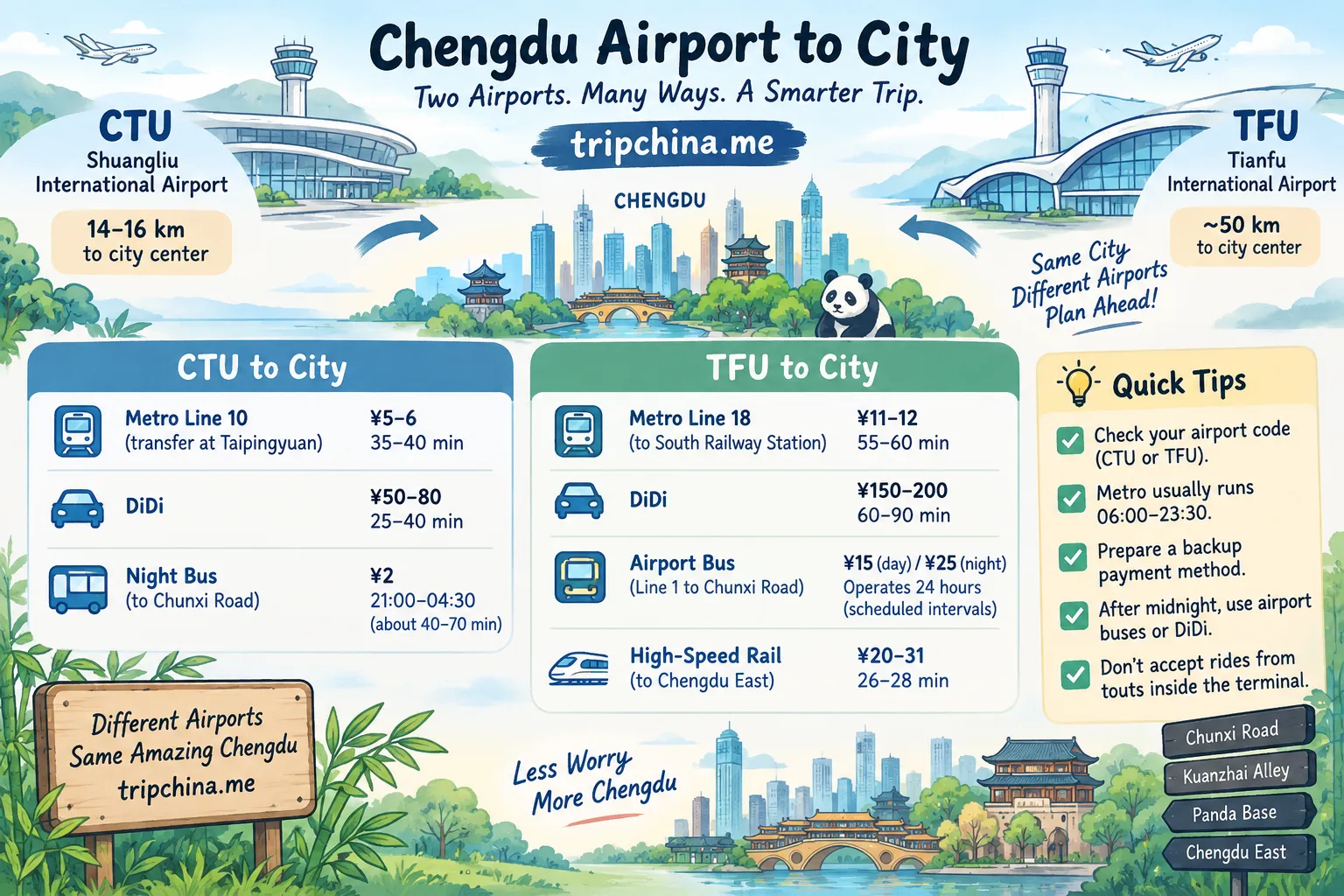
| Option | Airport | Typical Fare | Typical Time to Central Chengdu | Best For | Main Drawback |
|---|---|---|---|---|---|
| Metro | CTU | About ¥5–6 | 35–40 min | Solo travelers, light luggage | Transfer required |
| Metro | TFU | About ¥11–12 | 55–60 min | Budget daytime arrivals | Long airport and transfer walk |
| DiDi | CTU | About ¥50–80 | 25–40 min | Families, luggage | Traffic |
| DiDi | TFU | About ¥150–200 typical | 60–90 min | Groups, late arrivals | Can reach ¥240 at busy times |
| Night bus | CTU | ¥2 | About 40–70 min | Very low budget | Low frequency |
| Airport bus | TFU | ¥15 day / ¥25 night | About 60–100 min | Late arrivals, budget travelers | Slower, fixed stops |
| Shared/minibus transfer | Varies | Variable | Variable | Solo late arrivals | Booking and pricing vary |
| High-speed rail | TFU | About ¥20–31 | 26–28 min to Chengdu East | Rail connections | Not useful for most downtown hotels |
For most daytime arrivals, yes.
Take Chengdu Metro Line 10 from the airport and transfer at Taipingyuan. Line 3 is convenient for central destinations such as Chunxi Road and the Wuhou area.
A typical airport-to-Chunxi Road journey costs about ¥5–6 and takes roughly 35–40 minutes, although your exact journey depends on your starting terminal and transfer waiting time.
The main disadvantage is luggage. Transfers at Taipingyuan involve walking, and dragging two large suitcases through a metro interchange is noticeably less convenient than taking a car.
If this is your first time using the system, our Chengdu Metro Guide for Foreign Travelers explains tickets, apps, airport stations and payment options.
A major upgrade for foreign visitors arrived in July 2025: Chengdu Metro now allows supported bank cards to be tapped directly at station gates across the network.
As of September 2026, supported cards include UnionPay and foreign-issued Visa, Mastercard, American Express, Diners Club and Discover.
Before traveling, enable contactless and small-value password-free payment on your card and make sure you have sufficient balance or credit. Some overseas banks block small-value foreign contactless transactions by default, so it is worth checking your bank's overseas-payment settings before departure.
This means many international visitors can enter and exit the metro without buying a physical ticket or setting up a Chinese transport QR code.
DiDi is usually the easiest option if you are traveling with children, several people, or large suitcases.
A typical trip into central Chengdu is around ¥50–80 and often takes 25–40 minutes outside heavy congestion. Prices vary with destination, traffic, vehicle category and demand, so treat this as a planning range rather than a fixed fare.
Foreign-issued cards can work with DiDi when successfully linked, but do not make one foreign card your only payment plan. Set up Alipay or WeChat Pay before arrival and keep some RMB as emergency backup.
Our DiDi guide for foreign visitors covers registration, payment setup and pickup problems in China.
Road traffic matters much more than it does on the metro. Friday evening and other peak commuting periods can add substantial time, so check live traffic before choosing a car over Line 10.
Yes, but most foreign visitors will find the metro simpler during the day.
The unusually useful option is the overnight bus between Shuangliu Airport and Chunxi Road.
As of September 2026:
The route serves T2 and T1 before continuing toward central Chengdu.
Because service is infrequent, do not assume a bus will leave immediately after you reach the stop. Check the current timetable when you land. Schedules are subject to minor operational or seasonal adjustment, so confirm the latest departure information on arrival.
Chengdu's public transport system widely supports card and QR-based payments. Carrying a small amount of RMB is still a useful backup for late-night travel.
TFU is the airport where transport planning matters most. It is modern, but it is far enough from central Chengdu that the wrong choice can easily add both time and cost.
Line 18 is normally the best daytime option.
Follow signs from the terminal toward the Ground Transportation Center (GTC) and Metro Line 18.
There are regular and faster services. Do not stand on the platform assuming the next train will be the express you want; check the electronic departure board. The Chinese sign “直达” indicates a direct/express service.
A Line 18 journey to South Railway Station generally takes roughly 35–50 minutes depending on service pattern. From there, transfer to the Chengdu metro network for your final destination.
For Chunxi Road, budget roughly:
Line 18 generally operates from around 06:00 to 23:30, but the last useful departure from your specific station can differ slightly. Check the current Chengdu Metro timetable if your flight lands late in the evening.
One thing guidebooks underestimate is walking. TFU is huge. Even when the train ride itself looks fast on paper, allow time to walk through the terminal and GTC.
Sometimes—but mainly for convenience.
A typical TFU-to-central-Chengdu DiDi fare is around ¥150–200. Late-night, high-demand or farther-city trips can rise toward ¥240.
Highway tolls, traffic, vehicle category and real-time demand all affect the final price.
Travel time is typically around 60–90 minutes.
For one traveler with a backpack, paying several times the metro fare rarely makes sense. For three people with four suitcases after a long international flight, the calculation is very different.
TFU DiDi is therefore best treated as a luggage-and-convenience option rather than the default airport transfer. Check the live in-app quotation after landing rather than relying on a fixed online fare.
Airport buses are especially useful when you arrive after the metro has finished.
Airport bus fares generally use time-based pricing:
Line 1 operates 24 hours between TFU and Chunxi Road and is especially useful for first-time foreign visitors staying downtown. It uses Mandarin and English stop announcements.
“24 hours” means the route has scheduled service through the night—not that buses depart continuously every few minutes. Overnight waiting times can be longer, so check the next departure after landing.
Current services and stops can be adjusted, so always check Chengdu Bus information or the airport service desk on the day you travel.
Useful routes include:
| Route | Useful Destination | Typical Use |
|---|---|---|
| Line 1 | Chunxi Road | Downtown / central hotels |
| Line 2 | Kuanzhai Alley area | Western central Chengdu |
| Line 3 | Panda Base area | Northern tourist area |
| Line 4 | Chengdu East Railway Station | Train connections |
| Night Line 5 | CTU via Global Center | Airport-to-airport transfer |
| Line 6 | Haichang Road, Tianfu 3rd Street, Global Center | Southern business / tech districts |
Line 6 is particularly useful for late arrivals staying in southern Chengdu. It runs from TFU toward Global Center via Haichang Road and Tianfu 3rd Street, with published operating hours of 23:30–05:15, a fare of ¥25 and a scheduled journey of about 80 minutes.
If your hotel is around Kuanzhai Alley, our Kuanzhai Alley guide can help you decide whether that part of the city is actually a practical base.
Yes. TFU has its own railway station connected through the Ground Transportation Center.
This option makes the most sense if you are going to Chengdu East Railway Station or continuing by train to another city. It is usually not the easiest way to reach Chunxi Road, Taikoo Li or other central sightseeing districts.
Follow the high-speed rail signs from arrivals into the GTC. The physical distance is not enormous, but airport wayfinding, security and platform access add time.
A sensible planning allowance is:
The train itself can take roughly 26–28 minutes to Chengdu East, with fares commonly around ¥20–31.
If you are continuing beyond Chengdu, read our China train boarding guide for foreign travelers before booking a connection.
Do not improvise this transfer after walking out of arrivals exhausted.
Your practical choices are normally:
If your hotel is around Chunxi Road, Airport Bus Line 1 is usually the obvious budget option. It operates through the night and costs ¥25 during the night-fare period.
If you have children, large bags or a hotel far from an airport-bus stop, DiDi may be worth the extra cost.
Before you fly, make sure your mobile payment works. Our guide to paying in China with Alipay, WeChat Pay, cards and cash covers the setup foreign visitors need most often.
Do not make Google Maps your primary transport tool in mainland China.
Its transit and local mapping information can be less useful or less current than domestic mapping services.
As of September 2026, Amap Global supports English and provides local route planning, public transport information and navigation. It is worth installing before landing.
Baidu Maps can also be useful, but its English experience may be less straightforward depending on platform and version.
For this trip, a practical setup is:
Our China navigation app guide explains why Google Maps is not the app to depend on for a China trip.
Payment is much easier than it used to be, but a backup is still useful.
The easiest option for many international visitors is now a contactless bank card.
As of September 2026, Chengdu Metro accepts UnionPay and foreign-issued Visa, Mastercard, American Express, Diners Club and Discover cards directly at all metro station gates.
Tap the same card when entering and exiting. Before travel, enable contactless and small-value password-free transactions and make sure your card has sufficient balance or credit.
Some foreign banks disable small overseas contactless transactions by default. Check your bank settings before departure if you plan to rely on direct card tapping.
Physical single-journey tickets remain available as a fallback.
A linked international bank card may work inside DiDi, but bank authentication or card restrictions can occasionally cause failures.
Having Alipay or WeChat Pay as a second payment method reduces the risk of being stuck after a late flight.
Official airport-bus tickets can be purchased through Chengdu Bus channels and service counters, with digital payment widely supported.
China is overwhelmingly mobile-payment oriented, but RMB remains useful when technology fails.
Carrying around ¥50–100 in small notes after landing is enough for most transport-payment emergencies without carrying unnecessary cash.
If you discover that you have landed at one Chengdu airport and depart from the other, do not underestimate the transfer.
Metro Line 19 provides the most predictable rail connection between the two airport areas.
The train portion can be fast, but airport walking at both ends means your real terminal-to-terminal transfer takes longer than the railway journey shown in a route planner. Do not build a tight flight connection around the train's scheduled running time alone.
The airport-bus service between TFU and CTU is more useful.
The current overnight Line 5 operates via Global Center, with published service around 00:00–05:00 and a ¥25 fare.
A road transfer between the two airports can still take around an hour or more.
If the connection involves two separate tickets, collecting luggage, immigration, re-check-in or an international departure, leave a substantial buffer. Missing a flight will cost far more than spending an extra hour at the airport.
Always check the airport code. This is the single most expensive airport mistake you can make in Chengdu.
Express services are not a continuous shuttle. If a regular train is leaving sooner, it may get you downtown earlier than waiting for the next express.
Official taxis, DiDi pickup areas and airport buses have established pickup systems. Ignore drivers who approach you inside the terminal offering an informal “special price.”
Landing time is not station-entry time.
Immigration, baggage claim, customs and terminal walking can easily push you past the final useful train. If your flight arrives near the end of metro service, have a bus or DiDi backup before landing.
Foreign bank cards are much easier to use in Chengdu than they were a few years ago, but payment failures still happen.
Keep a second payment method available and remember that supported foreign contactless cards can now be used directly at Chengdu Metro gates.
For more first-trip mistakes beyond the airport, see our Chengdu tourist traps and common mistakes guide.
TFU is a good airport. The problem is where it is.
Locals often joke Tianfu Airport is “天远地远”—literally, “sky-far, land-far.” The airport's facilities are excellent, but traveling to or from northern or western Chengdu can turn your airport transfer into a whole extra trip.
That matters when choosing accommodation. A hotel that looks only a few kilometers farther north on a map can add meaningful airport-transfer time.
If you have an early TFU departure, staying one final night closer to the south side of Chengdu—or at the airport—can sometimes be more comfortable than leaving a central or northern hotel before dawn.
Compare the practical trade-offs in our Where to Stay in Chengdu guide.
TFU also provides rest facilities for overnight passengers. Published airport information lists landside rest areas around T2's L2 arrivals level and airside rest areas for eligible passengers.
The airport also provides a 24-hour international transfer lounge near T1 Gate 115 for qualifying passengers whose onward international flight departs within 48 hours; facilities include rest areas and showers.
Eligibility depends on your itinerary, so ask airport staff before relying on it as your overnight plan.
Yes. Use the official taxi queue and meter rather than accepting a ride from someone approaching you inside the arrivals hall. Keep your destination written in Chinese. If you prefer an app-recorded route and an estimated fare before departure, use DiDi instead.
Generally, yes. Normal airline luggage can be taken on the metro subject to metro security and size restrictions.
The bigger issue is convenience. Long station walks and transfers become tiring with several large bags, especially at TFU and interchange stations.
If your Apple Pay or another mobile wallet is linked to a supported bank card such as Visa or Mastercard, you can try tapping your phone at the gate.
Compatibility can vary by device, wallet and card issuer, so a physical contactless card remains the more reliable backup for international visitors.
For a short trip, an eSIM activated before landing is often simpler because mobile data can be available as soon as you arrive.
Physical SIM availability and airport counter hours can vary, especially late at night. Do not depend on buying a SIM after a midnight arrival if you need immediate access to DiDi, Amap or mobile payment.
Usually not.
Immigration, baggage collection and customs times are unpredictable, especially after an international arrival. It is usually easier to request a DiDi after collecting your luggage and confirming that you are ready to walk to the designated ride-hailing pickup area.
Usually not. Airport buses use fixed stops rather than door-to-door hotel drop-offs.
Check whether your hotel is within reasonable walking distance of Chunxi Road, Kuanzhai Alley, Global Center or another airport-bus stop. If not, you may still need a short metro, taxi or DiDi ride at the city end.
Chengdu Bus has offered airport-bus ticketing through service counters and digital channels, including channels with English support.
If the app or mini-program interface is difficult to use, the airport service counter is usually the simplest option for a first-time foreign visitor.
Yes. Save the hotel's Chinese name and full Chinese address before landing.
It helps with taxi drivers, DiDi pickup problems and navigation apps, and a screenshot remains usable even if your mobile connection fails.
CTU + daytime: Take Metro Line 10 unless you have heavy luggage.
TFU + daytime: Take Line 18; choose DiDi mainly for groups or large suitcases.
TFU + after midnight: Use Airport Bus Line 1 for value, or DiDi for door-to-door convenience.
The simplest rule is to plan around three things: your airport code, arrival time and luggage.
Check CTU or TFU before leaving, keep one backup payment method, and decide your late-night option before your flight lands.
Planning more of your Sichuan itinerary? Browse our Chengdu travel guides for accommodation, food and sightseeing tips.
Chengdu Shuangliu International Airport — Airport Transport & Night Bus Services
People's Daily Sichuan — CTU Terminal 1 Reopening
People's Daily Sichuan — Chengdu Airport Bus Network & Line 6
Sichuan Online — Chengdu Metro Foreign Bank Card Acceptance
This guide was rechecked in September 2026 against Chengdu airport flight and transport information, Chengdu airport-bus updates, and Chengdu Metro payment changes. Variable road fares and travel times are shown as planning ranges rather than guarantees. Terminal assignments, airport-bus departures and late-night services can change, so travelers should confirm same-day information through the airport, airline, Chengdu Metro or official Chengdu Bus channels.
TripChina.me creates practical China travel guides shaped by real local experience, helping independent travelers navigate transport, payments, food, neighborhoods, and the cultural details that make traveling in China easier and more meaningful. Find the guide for your destination at tripchina.me.