Our Location:
No. 99, Jiazi Road, Chengdu

 authorChris Lee
Most Chengdu guides simply tell first-time visitors to stay around Chunxi Road. That works for many trips — but not all. If you are a light sleeper, coming mainly for pandas, searching for real local food, or catching an early flight, another neighborhood may make much more sense.
This guide compares Chengdu's most useful hotel areas by price, metro access, noise, airport convenience, food, and the problems travelers usually discover only after checking in.
For most first-time visitors, Chunxi Road / Taikoo Li is the easiest base because Metro Lines 2 and 3 meet here and the central location reduces travel time.
Tianfu Square / People's Park is better if you want a central location without quite as much nightlife and street noise.
Yulin is my pick for travelers who care more about real Chengdu food and neighborhood life than shopping malls.
Jianshe Road / Dongjiao Memory works especially well for budget travelers and anyone planning an early Panda Base visit.
Kuanzhai Alley is worth considering for atmosphere, but I would not choose a cheap guesthouse there if you have heavy luggage or need a quiet room.
Before booking, do not rely only on the neighborhood name shown in the listing. Check the actual walking distance to the metro and confirm that the property can smoothly process your passport check-in.
As of September 2026, Chinese authorities no longer support treating an alleged lack of “foreign guest qualification” as a blanket reason for hotels to reject overseas travelers. In practice, however, some smaller properties may still be unfamiliar with passport registration procedures. Confirm directly before paying for a non-refundable room.
If this is your first hotel booking in China, read TripChina's foreigner hotel booking rules in China and the separate guide to hotel and private-stay registration rules before choosing a small guesthouse or apartment.
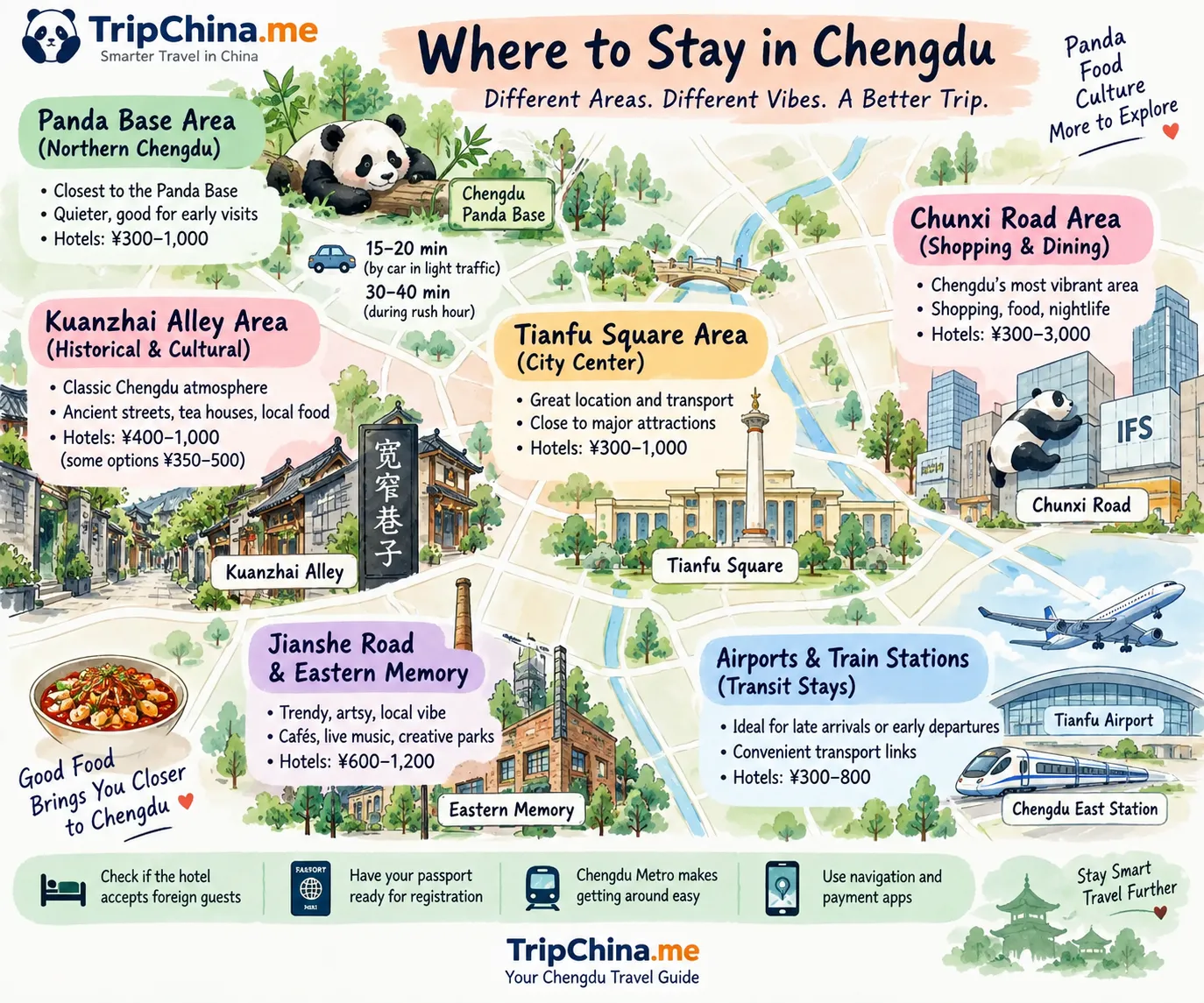
Typical non-holiday planning ranges as of September 2026:
| Area | Best For | Typical Price | Metro | Noise | Panda Base | Main Risk |
|---|---|---|---|---|---|---|
| Chunxi Road / Taikoo Li | First trip, short stays | ¥200–3,000 | Lines 2, 3 | High | About 30 min | Noise and misleading “near Taikoo Li” listings |
| Tianfu Square / People's Park | Families, light sleepers | ¥180–1,800 | Lines 1, 2 | Low–Medium | About 35 min | Traffic-facing rooms |
| Kuanzhai Alley | Atmosphere, courtyard stays | ¥200–2,000+ | Line 4 | Medium–High | About 40 min | Stairs, thin walls, nightlife noise |
| Wuhou Temple / Yulin | Local food, nightlife | ¥190–1,500 | Lines 3, 5 nearby | Medium | About 40 min | Long trip to Tianfu Airport |
| Jianshe Road / Dongjiao Memory | Budget, pandas, younger travelers | ¥150–1,200 | Lines 7, 8 area | Medium–High | 15–20 min by taxi in light traffic | Longer city-center commute |
| Airport / East Station | Overnight transit | ¥180–800 | Transport hub | Usually Low | Not practical | Weak location for sightseeing |
Hotel rates in Chengdu are highly date-sensitive. Public holidays, major events and high-demand weekends can push the same room well above its normal rate, so use these numbers as planning ranges rather than fixed prices.
For a short first trip, usually yes.
Chunxi Road is Chengdu's main commercial center. IFS, Taikoo Li, shopping, restaurants and two useful metro lines are concentrated within a compact part of the city.
Chunxi Road Station connects Lines 2 and 3, which makes this one of Chengdu's easiest bases if you have only one to three days.
If Chengdu's metro is unfamiliar, TripChina's Chengdu Metro guide explains ticketing, payments, airport connections and how foreign visitors can navigate the system.
Typical non-holiday rooms:
Budget: ¥200–400 per night
Mid-range: ¥400–800
Luxury: ¥800–3,000
The biggest downside is not price. It is noise.
Weekday pedestrian and traffic pressure is strongest around 08:00–10:00 and 17:30–20:00. On weekends, the commercial core can stay crowded roughly from 15:00 to 21:00, and street-facing rooms can remain noisy well into the evening.
If you stay here and sleep lightly, request a higher-floor room away from the main road.
The other trap is the phrase “near Taikoo Li.”
Some apartment listings use the Taikoo Li name even when the property sits more than a kilometer away inside an older residential compound. Do not judge by the listing title. Paste the address into a Chinese map app and measure the actual walking route to Chunxi Road Station.
TripChina's guide to the best navigation apps for foreign tourists explains why this is more reliable than judging Chinese hotel locations through Google Maps alone.
For families and light sleepers, I often prefer it.
Tianfu Square is one of Chengdu's main transport nodes, with Metro Lines 1 and 2 crossing here. People's Park sits just west of the square, and the surrounding streets generally feel calmer than the Chunxi Road retail core.
Typical non-holiday rooms:
Budget: ¥180–350
Mid-range: ¥350–600
Luxury: ¥600–1,800
This location works particularly well for a four- or five-day stay because you are still central without having shopping-center crowds outside the hotel every evening.
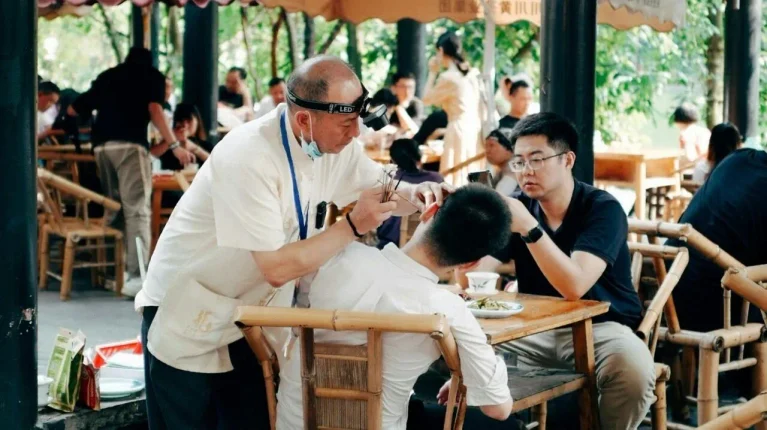
In the morning, walk toward People's Park and experience the city at a slower pace. If you want more than the first tourist teahouse you see, TripChina's guide to authentic Chengdu teahouses explains several different local tea experiences.
The trade-off is nightlife. There are fewer late-night restaurants and bars than around Chunxi Road or Yulin.
Also check which side of the building your room faces. Rooms directly facing major roads around Tianfu Square can still pick up substantial traffic noise during rush hour.
For light sleepers, a high floor plus a room facing away from the main road matters more than the difference between two hotels a few hundred meters apart.
Stay here for atmosphere, not efficiency.
Kuanzhai Alley is one of Chengdu's best-known historic districts. The surrounding area has courtyard-style hotels, older architecture and direct access to Metro Line 4.
Typical non-holiday accommodation:
Budget guesthouses: ¥200–500
Mid-range courtyard hotels: roughly ¥400–1,000
Higher-end courtyard stays: often ¥1,000–2,000 or more
Some well-reviewed mid-range properties can fall into the ¥350–500 range on quieter non-holiday dates, so always compare your exact travel dates rather than assuming courtyard accommodation is automatically expensive.
The problem is that a beautiful exterior does not guarantee a comfortable room.
Some low-cost properties occupy converted older buildings with narrow stairs, no elevator, weak sound insulation, limited natural light or noticeable dampness. These issues are much more important if you are carrying a large suitcase.
Weekend nightlife is another consideration. Parts of the district sit close to bars, and bass travels easily through older walls.
The location itself is not bad. The mistake is paying a premium for a mediocre guesthouse simply because “Kuanzhai Alley” appears in the property name.
If you are deciding whether the atmosphere justifies the cost, read TripChina's Kuanzhai Alley guide before booking accommodation nearby.
For food, do not assume the busiest pedestrian street offers the best Chengdu meal. Walk out into surrounding local streets instead of automatically eating beside the souvenir shops.
For food-focused travelers, it is one of the strongest choices.
The broader Wuhou Temple / Jinli / Yulin area contains three very different experiences.
Wuhou Temple is the historical attraction. Jinli is a visitor-oriented pedestrian street. Yulin is a living residential neighborhood with restaurants, hot pot shops, noodle places, skewers and bars that serve local residents every day.
Typical non-holiday rooms:
Budget: ¥190–400
Mid-range: roughly ¥400–750
Upper mid-range and garden hotels: roughly ¥700–1,500
I would stay around Yulin rather than directly beside Jinli if food and evening atmosphere are priorities.
A good day from here is Wuhou Temple first, Jinli afterward, then Yulin for dinner. TripChina's Wuhou Temple and Jinli combined route explains the most efficient visiting order.
Yulin is also more convenient for Shuangliu Airport than many northern or eastern parts of Chengdu.
Its biggest disadvantage is Tianfu International Airport.
Depending on traffic and the exact starting point, a road transfer can take well over an hour. Do not book Yulin purely for local atmosphere if you have a very early TFU departure the next morning.
This is one of the most underrated choices for the right traveler.
Jianshe Road has a young local food scene, while Dongjiao Memory occupies a converted industrial area east of the center. Accommodation here is generally cheaper than around Taikoo Li, and the northeastern location reduces the road journey to Chengdu Research Base of Giant Panda Breeding.
Typical non-holiday rooms:
Budget: ¥150–300
Mid-range: ¥300–600
Design and higher-end hotels: roughly ¥600–1,200
From this area, the Panda Base can be around 15–20 minutes away by car in light traffic. If you leave during the morning commuting period, especially around 08:00–09:00, allow roughly 30–40 minutes instead. The real advantage is avoiding a longer cross-city journey from the western or southern parts of Chengdu.
That matters because a Panda Base visit rewards an early start. From March through October, the current official entry period begins at 07:30, and visitor numbers usually build as the morning progresses.
TripChina's Chengdu Panda Base guide covers gates, timing and route planning.
The trade-off is simple: you save time for the pandas, but add time to central attractions. Kuanzhai Alley or Wuhou Temple can require roughly 30–40 minutes of metro travel depending on your exact hotel and connections.
Jianshe Road can also be noisy at night. Weekend food queues, scooters and street activity make a street-facing budget room much less peaceful than the listing photos may suggest.
Before booking, check how far the hotel actually is from the nearest metro entrance. A “Jianshe Road hotel” can still sit 15 minutes on foot from the station.
Only when the transport connection itself is the reason.
Shuangliu Airport and Chengdu East Railway Station both have practical chain and transit hotels. They work for late arrivals, early departures and tight train connections.
Typical non-holiday rates:
Chain hotels: ¥180–400
Airport-oriented or higher-spec transit hotels: ¥400–800
For sightseeing, however, these areas are poor bases. Dining choices are more limited, the immediate surroundings are functional rather than atmospheric, and you will spend unnecessary time traveling back into central Chengdu.
One useful exception is price: international-brand or higher-spec hotels outside Chengdu's core tourist districts can sometimes be cheaper than comparable properties around Chunxi Road or Taikoo Li. If brand standards matter more to you than walkability, compare off-center rates before booking.
Tianfu International Airport requires even more care because it is much farther from central Chengdu than Shuangliu.
Before deciding to sleep near either airport, compare your actual arrival or departure time with the transfer options in TripChina's Chengdu airport transfer guide.
For airport hotels, confirm three things directly with the property: whether your passport check-in can be processed smoothly, whether the airport shuttle is actually free, and what hours that shuttle operates.
Do not assume “airport shuttle” means 24 hours.
Some airport hotels near Shuangliu provide English-speaking staff or translation tools, but this is not something to assume at budget transit properties. If English assistance matters to you, search recent reviews for specific mentions of “English,” “English-speaking staff,” or “翻译” before booking.
If a taxi or DiDi is part of your arrival plan, set up payment before landing. TripChina's China payment guide for overseas travelers covers Alipay, WeChat Pay, international cards and cash. For ride-hailing setup and pickup procedures, see the DiDi guide for foreign travelers.
The legal rule and the practical reality are slightly different.
Chinese authorities have stated that accommodation businesses and booking platforms should not use “foreign guest qualification” as a blanket barrier to accepting overseas travelers.
Hotels that accommodate foreigners are responsible for recording passport information and submitting the accommodation registration information to public-security authorities.
In practice, some small hotels, guesthouses or independently operated properties may still have staff who are unfamiliar with the process. Some individual listings may also state that they accept only guests holding identification issued in mainland China. That is why checking the property's current “guest eligibility” information and confirming directly before paying remains useful.
As of March 20, 2026, Sichuan is also one of seven pilot regions where foreigners staying in accommodation other than hotels can complete the required accommodation registration online through the National Immigration Administration.
Foreign visitors or their hosts can use the NIA Government Service Platform, NIA 12367 App, or the official WeChat and Alipay mini programs to complete eligible non-hotel accommodation registration.
That system concerns accommodation outside hotels. It does not replace the hotel's own registration responsibility when you stay in a hotel.
For a normal hotel stay, bring the physical passport or other accepted original travel document for check-in. The hotel needs it to verify your identity and process registration, but you should not use your passport as a room deposit or leave it as collateral.
Do not book a “near Taikoo Li” property without opening the map. A listing can borrow the district name while sitting one or two kilometers away.
Do not choose the cheapest Kuanzhai Alley guesthouse without checking elevator access, room photos and recent reviews about noise or dampness.
Do not assume “Jinli hotel” means the hotel is inside Jinli Ancient Street. Most accommodation is on surrounding streets, and some locations become extremely busy at night.
Do not choose a hotel solely because its map pin looks close to an attraction. In Chengdu, being five minutes from a useful metro entrance is often more valuable than being geographically closer to one sight.
Do not leave foreign-passport check-in questions until midnight at a tiny independent property. Message the property in advance if the booking platform description is unclear.
And do not eat every meal on the main tourist street. Kuanzhai Alley, Jinli and Chunxi Road all become more interesting once you walk into surrounding side streets.
For a one- to three-day first visit, choose Chunxi Road / Taikoo Li unless you are especially sensitive to noise.
For a four- or five-day city stay, Tianfu Square / People's Park offers a better balance of transport and everyday comfort.
For food-first travel, stay around Yulin.
For an early Panda Base visit, Jianshe Road / Dongjiao Memory can save meaningful morning travel time.
For atmosphere and courtyard accommodation, choose Kuanzhai Alley — but spend enough to avoid the weakest converted guesthouses.
For a single overnight connection, use an airport or railway-station hotel. Do not base an entire Chengdu trip there.
Travelers staying several days sometimes combine the city with Dujiangyan, Qingcheng Mountain or other Sichuan trips. In that case, choose your Chengdu base for the majority of your city days rather than moving hotels simply to save 20 minutes on one excursion.
This article is part of the Chengdu Travel Guide Hub.
Yes, but confirm reception hours before you book. Many mid-range and major chain hotels have staffed late-night or 24-hour reception, while smaller independent properties may not.
If you reach Chengdu late and want to enter the Panda Base around its morning opening period, Jianshe Road / Dongjiao Memory can reduce your morning road journey. Also confirm luggage storage and breakfast hours if you plan to leave the hotel very early.
Often, yes. Popular central hotels can charge noticeably more on Friday and Saturday nights, although the difference varies by neighborhood, hotel and season.
The bigger increases occur during Chinese public holidays and major local events, when the same room can cost far more than its normal weekday rate and good inventory disappears early. Always compare your exact dates rather than relying on an average nightly price.
Stay at or near Tianfu Airport unless you have a strong reason to reach the city immediately.
At 01:00, regular metro service from the airport has already ended. Central Chengdu is roughly an hour away by road under normal late-night conditions, and a taxi or ride-hailing trip can approach or exceed ¥200 depending on your destination, tolls and the applicable fare.
For most travelers, an airport-area hotel with a confirmed late-night shuttle is the easier option. Check the shuttle timetable before booking — “free airport shuttle” does not automatically mean 24-hour service — then move to your central Chengdu hotel the next morning.
The same logic applies in reverse if you have a very early TFU departure: compare the first available metro with your airline's check-in deadline rather than assuming you can leave central Chengdu before dawn.
There is no single “best” Chengdu neighborhood.
For the easiest first visit, Chunxi Road / Taikoo Li remains the safest all-round choice.
For quiet without leaving the center, choose Tianfu Square / People's Park.
For local eating and evening life, choose Yulin.
For pandas and lower hotel prices, consider Jianshe Road / Dongjiao Memory.
And if a courtyard hotel around Kuanzhai Alley is what you picture when you imagine Chengdu, stay there — just choose the property carefully rather than buying the cheapest historic-looking room.
The most important booking habit is simple: check the exact map location, the room's noise exposure and the property's ability to process your passport before you pay.
National Immigration Administration — Online Accommodation Registration Pilot, March 20, 2026
National Immigration Administration — NIA 12367 Online Registration Channels
Chengdu Research Base of Giant Panda Breeding — Official Ticket Information
This guide was updated on September 13, 2026 using current Chinese government guidance on foreign guest accommodation, the National Immigration Administration's Sichuan online-registration pilot, official Chengdu Panda Base visitor information, transport geography, recent accommodation pricing and TripChina's local Chengdu field guides. Hotel prices and driving times are planning ranges rather than fixed figures because they vary by date, property, traffic and demand. Local neighborhood character was also cross-checked against TripChina's latest Yulin and Chengdu citywalk research.
Planning your China trip? TripChina.me provides practical travel guides covering transport, food, neighborhoods, and local experiences. When you are ready for a smoother journey, our Premium Travel Guides offer ready-to-follow plans designed for independent travelers.