Our Location:
No. 99, Jiazi Road, Chengdu

 authorChris Lee
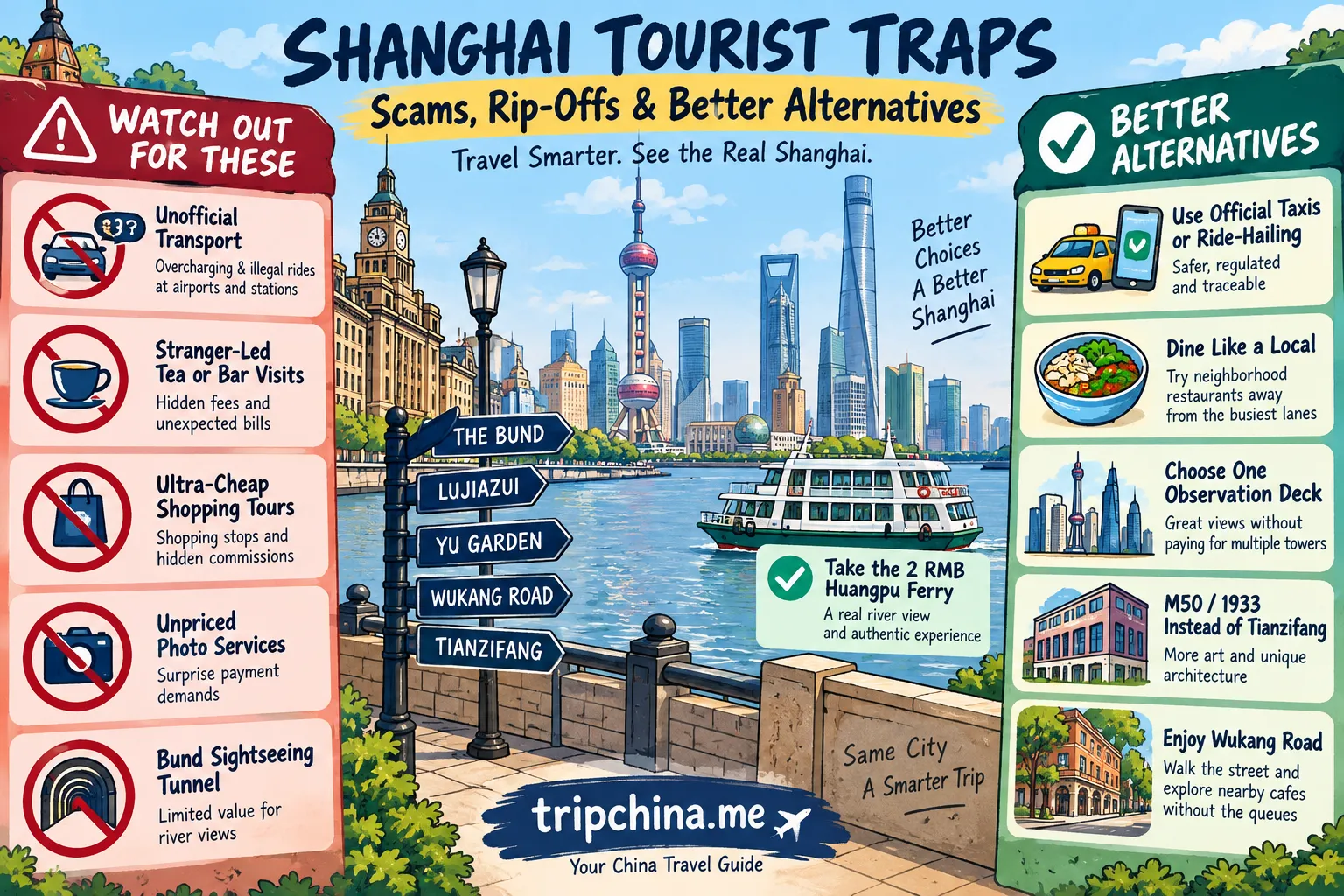
Shanghai is generally straightforward for international travelers, but it is still easy to waste money on unofficial transport, unclear prices, tourist-oriented businesses, and attractions that do not match the experience you expected.
This guide separates genuine scams from merely poor-value tourist experiences—and shows you what I would do instead.
As of September 2026:
The Bund, Yu Garden, Wukang Road, Tianzifang, and Lujiazui are not “scams” simply because they are popular. What matters is what you are buying, what you expect, and whether the price makes sense.
The most useful distinction is simple: deception and forced overcharging are genuine risks; a crowded or expensive attraction that disappoints you is usually just poor value.
| Experience | Main Issue | Risk | Better Approach |
|---|---|---|---|
| Unofficial airport/station ride | Illegal operation or overcharging | High | Official taxi queue or legitimate ride-hailing |
| Stranger-led tea/bar visit | Unexpected or inflated bill | High | Choose the venue yourself |
| Ultra-cheap shopping tour | Shopping pressure or hidden incentives | Medium–High | Check itinerary and recent reviews |
| Unpriced photo service | Surprise payment demand | Medium | Confirm price first |
| Bund Sightseeing Tunnel | Limited value for river views | Low | 2 RMB Huangpu ferry |
| Multiple observation decks | Repetitive views and extra cost | Low | Choose one tower |
| City God Temple food lanes | Tourist-oriented pricing | Low | Compare restaurants outside the busiest lanes |
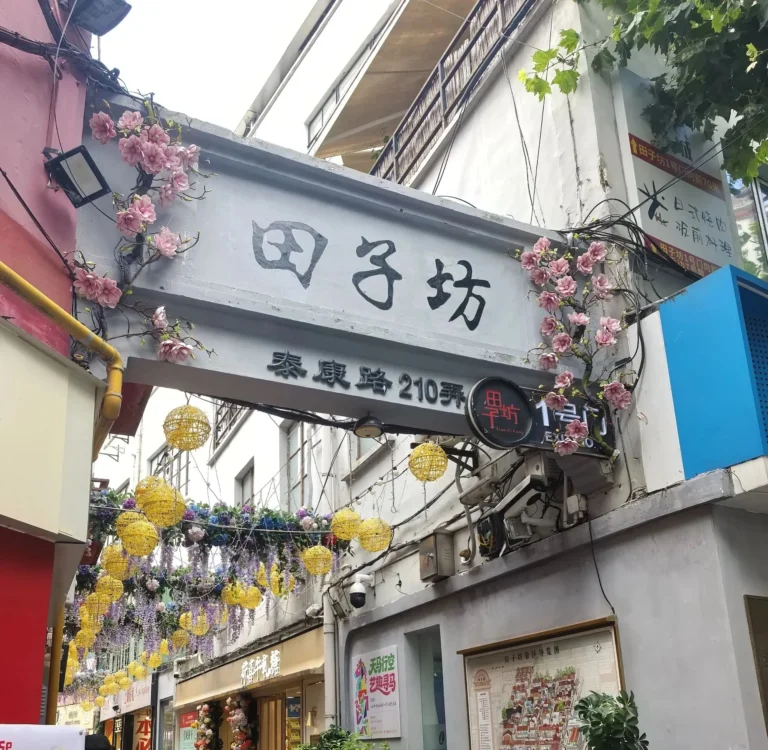
| Tianzifang | Crowds and commercialization | Low | Visit selectively or consider M50 / 1933 |
| Viral Wukang Road shops | Queues and premium pricing | Low | Enjoy the street; eat or drink nearby |
Yes.
The warning sign is not friendliness. It is someone you have only just met—in person or online—quickly steering you toward one particular tea house, bar, restaurant, or “cultural experience” that you did not choose.
The usual risk is an unexpectedly large bill after tea, drinks, snacks, or other services have already been consumed.
A useful on-the-spot test is to suggest another venue yourself. If the person strongly resists or immediately loses interest, I would leave.
Before ordering anywhere unfamiliar, look at the menu and prices rather than relying on verbal explanations alone.
If a bill dispute becomes coercive or threatening, preserve the receipt, payment screenshots, chat messages, venue name, and exact location.
Shanghai's 12345 public-service hotline operates 24 hours a day and supports 18 foreign languages, including English. The city typically aims to respond to complaints or suggestions within 24 hours; simpler cases may be handled within five days, while more complex matters can take longer.
No.
At Pudong Airport, Hongqiao Airport, railway stations, and other transport hubs, use the designated taxi queue or a legitimate ride-hailing platform. Do not follow someone offering “no waiting,” “special price,” or an off-platform car.
This is not theoretical.
In a January 2026 Shanghai police enforcement case, one passenger was charged 153 RMB for a journey that normally cost around 60 RMB. Another expected a fare of about 30 RMB but ultimately paid nearly 100 RMB after extra charges were added.
Shanghai authorities continued enforcement in 2026 against illegal passenger solicitation, unlicensed transport, taxi refusal, meter-related violations, and overcharging. Conditions at the airports have improved, but that does not make unsolicited street or terminal offers worth the risk.
For legitimate arrival options, compare metro, taxi, Maglev, and other transfers in TripChina's Shanghai Airport Guide for Pudong PVG and Hongqiao SHA.
If you plan to use app-based cars after arrival, TripChina's DiDi guide for foreign travelers explains how to set it up and use it without relying on drivers soliciting passengers in person.
Look at whether the advertised price makes sense.
If transportation, guide time, admissions, and operating costs seem impossible to cover at the quoted price, inspect the itinerary carefully.
Watch for stops involving:
Before booking, check whether those stops are optional or mandatory. Read recent detailed reviews rather than relying only on the overall score, and look for repeated mentions of shopping pressure or unexpected purchases.
For central Shanghai, most major sights are easy to reach independently by metro, taxi, or ride-hailing. TripChina's Shanghai Metro and Transport Guide explains the main options.
Only after the price is clear.
Around popular visitor areas, you may encounter informal photographers, performers, or people offering photo services. Most encounters are harmless, but misunderstandings can happen when a visitor assumes something is free and payment is requested afterward.
Before the photo is taken, ask:
“How much?”
If you do not want the service, “No, thank you” and walking away is enough.
It depends on what you expect.
The Bund Sightseeing Tunnel connects the Bund side with Pudong underground. The experience is built around lights and visual effects inside the tunnel. It is not a Huangpu River sightseeing ride.
If your goal is to see the river and skyline, I would choose the public ferry.
As of September 2026, Shanghai's official visitor information lists the pedestrian ferry fare at just 2 RMB and identifies the Dongjin, Dongfu, and Taigong lines as economical ways to experience the river.
For the particularly convenient Dongjin Line:
| Direction | Ferry Pier | Operating Hours |
|---|---|---|
| Pudong → Puxi | Dongchang Road Ferry Pier | 07:00–18:15 |
| Puxi → Pudong | East Jinling Road Ferry Pier | 07:15–18:30 |
As of September 2026. Ferry schedules can change, so check the official Shanghai Ferry WeChat account “上海轮渡” shortly before traveling.
The Dongjin Line is pedestrian-only and works particularly well for travelers moving between the Bund and Lujiazui while getting a genuine river-level skyline view. The Dongfu Line runs later and can be more convenient for an evening crossing.
For ferry piers, Bund walking routes, and how to combine the crossing with Lujiazui, see TripChina's complete Bund and 2 RMB ferry guide.
Choose based on the experience you actually want.
| Choice | Best For | Main Drawback | Best Fit |
|---|---|---|---|
| Oriental Pearl | Iconic Shanghai landmark experience | Often busy and tourist-oriented | Landmark fans |
| Shanghai Tower | Very high panoramic city view | Visibility depends heavily on weather | Most first-time visitors wanting one deck |
| Jin Mao Tower | Architecture and special experiences | Less essential on a first trip | Architecture enthusiasts |
| Street-level Lujiazui | Skyline photography | No aerial view | Budget travelers and photographers |
Ticket products and prices change, so confirm current information before purchasing.
More importantly, check visibility before committing. Haze, fog, low cloud, or poor weather can turn an expensive observation-deck ticket into a very limited view.
If skyline views are not a major priority for you, street-level Lujiazui can be surprisingly rewarding because you are actually looking at the towers rather than standing inside one.
The historic area itself is not a scam.
The mistake is assuming every restaurant and snack counter around the busiest Yuyuan and City God Temple lanes represents the best of Shanghai food.
The area combines genuine history and architecture with one of the city's busiest commercial visitor zones. Higher foot traffic naturally means more tourist-oriented restaurants, souvenir stores, queues, and widely varying value.
Come for the architecture and atmosphere.
For xiaolongbao, shengjian, noodles, and everyday Shanghai cooking, compare restaurants beyond the busiest lanes before choosing where to eat.
One thing I pay attention to in Shanghai is the customer mix. An ordinary neighborhood restaurant filled with families, office workers, and older local residents usually tells me more than a giant “Must Eat in Shanghai” sign.
TripChina's Shanghai local food guide covers the dishes worth trying and where to look beyond the most tourist-heavy storefronts.
Yes, for the right traveler.
Tianzifang still offers narrow lanes, shikumen-style architecture, cafes, small shops, souvenirs, and easy casual photography. It is also heavily commercialized and can become crowded.
If you enjoy busy lanes, browsing, and photography, it can still be worth an hour or two.
If contemporary art is your main interest, consider M50 Creative Park instead. If unusual industrial architecture appeals to you more, 1933 Old Millfun offers a very different experience.
The road itself is worth walking. The hype around individual viral shops is where expectations can get distorted.
Wukang Road's real appeal is its architecture, plane trees, historic residences, side streets, and the wider Former French Concession atmosphere.
My approach is simple: walk slowly, look at the buildings, turn into the side streets, and keep moving if a famous cafe, dessert shop, or ice-cream store has an enormous social-media queue.
There is usually another good option nearby.
For a longer walk through this part of the city, TripChina's seven self-guided Shanghai City Walk routes go well beyond a single viral street.
| Instead of… | Try… | Why |
|---|---|---|
| Bund Sightseeing Tunnel for river views | Huangpu public ferry | 2 RMB and a real river crossing |
| Several Lujiazui observation decks | One carefully chosen tower | Avoid paying repeatedly for similar views |
| Every meal around Yuyuan | Neighborhood restaurants | More variety and easier comparison |
| Tianzifang for contemporary art | M50 Creative Park | More art-focused |
| Tianzifang for unusual architecture | 1933 Old Millfun | Distinctive industrial setting |
| Viral Wukang Road food queues | Nearby side-street cafes | Less waiting |
| Unofficial airport ride | Official taxi / legitimate ride-hailing | Regulated and traceable |
| Tourist-street souvenir stalls | Established stores / supermarkets | Easier price comparison |
A morning walk along the Bund is free.
Walking through the Former French Concession is free.
The Huangpu public ferry costs just 2 RMB for pedestrians.
Shanghai Museum East is another strong option for culture-focused visitors.
As of September 2026, individual visitors to Shanghai Museum East generally do not need an advance reservation. Bring an original valid ID, pass security, and enter through the B1 East Gate near Dingxiang Road.
Opening hours are:
10:00–18:00
Last entry: 17:00
Closed: Tuesdays, except national holidays
The Digital Gallery and The Curio-City still require separate advance reservations, so “no reservation required” does not apply to every experience inside the museum.
The Shanghai Museum on People's Square follows a different schedule:
09:00–17:00
Closed: Mondays, except national holidays
As of September 2026, individual visitors generally do not need an advance reservation there either.
The People's Square venue is also hosting the paid special exhibition “On Top of the World Tree: Ancient Civilizations of the Americas” from July 9, 2026 through November 14, 2027. It occupies the 1F–3F exhibition areas and has its own ticket conditions.
So if you are reading an older Shanghai guide, do not assume that “Shanghai Museum” refers to one building with one admission system.
For collections, entrances, venue differences, and practical visiting advice, see TripChina's Shanghai Museum East guide.
Timing can matter as much as the attraction itself.
The Bund: Go early in the morning if you want easier walking and cleaner architecture shots. After dark gives you the classic illuminated skyline, but crowds are much heavier, particularly on weekends and holidays.
Wukang Road: Morning is better before cafe queues and day-trippers build.
Yu Garden area: Arrive early rather than joining the midday visitor wave.
Tianzifang: Earlier is generally easier if you want to walk through the lanes without peak crowds.
Observation decks: Check real-time visibility before buying a ticket.
Chinese public holidays can transform a normally manageable attraction into a completely different experience. If your dates are flexible, check TripChina's China public holiday and crowd guide before locking in your sightseeing schedule.
Do not judge a restaurant only by its proximity to a famous attraction.
Prime tourist frontage costs money. That does not automatically mean the food is bad, but you may be paying partly for location.
When practical, walk one or two blocks away, compare menus, check recent reviews, and see who is actually eating there.
I particularly notice ordinary restaurants with a mixed crowd of families, office workers, and older residents. That is often a more useful local signal than a storefront covered in tourist recommendations.
You do not have to buy something the moment you see it in a tourist street.
Many Shanghai specialty foods, packaged products, and established brands are also available in supermarkets, malls, food stores, and neighborhood branches where prices are easier to compare.
If you find something interesting, photograph the product name first. You can compare the exact item elsewhere before leaving Shanghai.
I would keep a local alternative.
Amap (Gaode) and Baidu Maps can be more useful for local businesses, building entrances, metro exits, and domestic routing.
TripChina's China navigation app guide explains which options are most practical for international visitors.
One small thing I would do before leaving the airport: save your hotel's Chinese name and full Chinese address as a screenshot.
That screenshot is useful when showing your destination to a taxi driver, asking for directions, or dealing with a weak internet connection.
For a first China trip, it is also much easier to install your main navigation, payment, transport, translation, and communication tools before departure. TripChina's essential China travel apps guide covers the basic setup.
Avoid turning a payment dispute into a physical confrontation. Preserve evidence first.
Keep:
For tourism-service disputes, overcharging complaints, or public-service assistance, call Shanghai's 12345 hotline.
It operates 24/7 and supports 18 foreign languages, including English. Shanghai's published service targets generally aim for an initial response within 24 hours, with simpler matters handled within five days and more complex cases potentially taking up to 15 days.
Visitors can also access 12345 through online and WeChat-based services. An English-language mini-program service for international users was introduced in 2026, making written submission more practical for travelers who would rather not explain a complicated dispute by phone.
Prepare the business name or vehicle information, location, payment records, and a concise explanation of what happened before submitting your complaint.
For coercion, threats, suspected criminal activity, or immediate safety concerns, call police at 110.
Shanghai police also specifically advise passengers facing suspected forced transactions involving illegal transport to report the incident promptly and retain evidence.
This article is part of the Shanghai Travel Guide Hub.
There is no universal rule. Malls, supermarkets, museums, chain stores, and most formal restaurants generally use fixed prices, while some independent market stalls may allow negotiation.
Ask or confirm the price before buying a product or accepting a service rather than assuming either that bargaining is required or that every displayed tourist-area price is negotiable.
The useful distinction is not “touristy versus authentic.” It is the attraction itself versus everything being sold around it.
Use regulated transport. Choose your own restaurants and bars. Confirm unclear prices before accepting informal services. Check weather before paying for skyline views. Compare tourist-area prices when something feels expensive.
Shanghai's famous sights are famous for a reason. The goal is not to avoid them—it is to make sure your time and money go toward the parts of Shanghai that are actually worth experiencing.
Shanghai Municipal Government — 2026 Police Transport Enforcement
International Services Shanghai — Huangpu River Ferry
International Services Shanghai — 12345 Public Service Hotline
Shanghai Museum — Official Website
Updated September 2026. This guide combines TripChina's local editorial experience with Shanghai government, police, transport, public-service, and museum information. Time-sensitive details—including enforcement cases, ferry fares and schedules, museum access, exhibition dates, and complaint channels—were checked against current sources. Attraction tickets, ferry schedules, opening hours, exhibitions, and individual business conditions can change, so verify critical details shortly before visiting.
TripChina.me creates practical China travel guides shaped by real local experience, helping independent travelers navigate transport, payments, food, neighborhoods, and the cultural details that make traveling in China easier and more meaningful. Find the guide for your destination at tripchina.me.