Our Location:
No. 99, Jiazi Road, Chengdu

 authorChris Lee
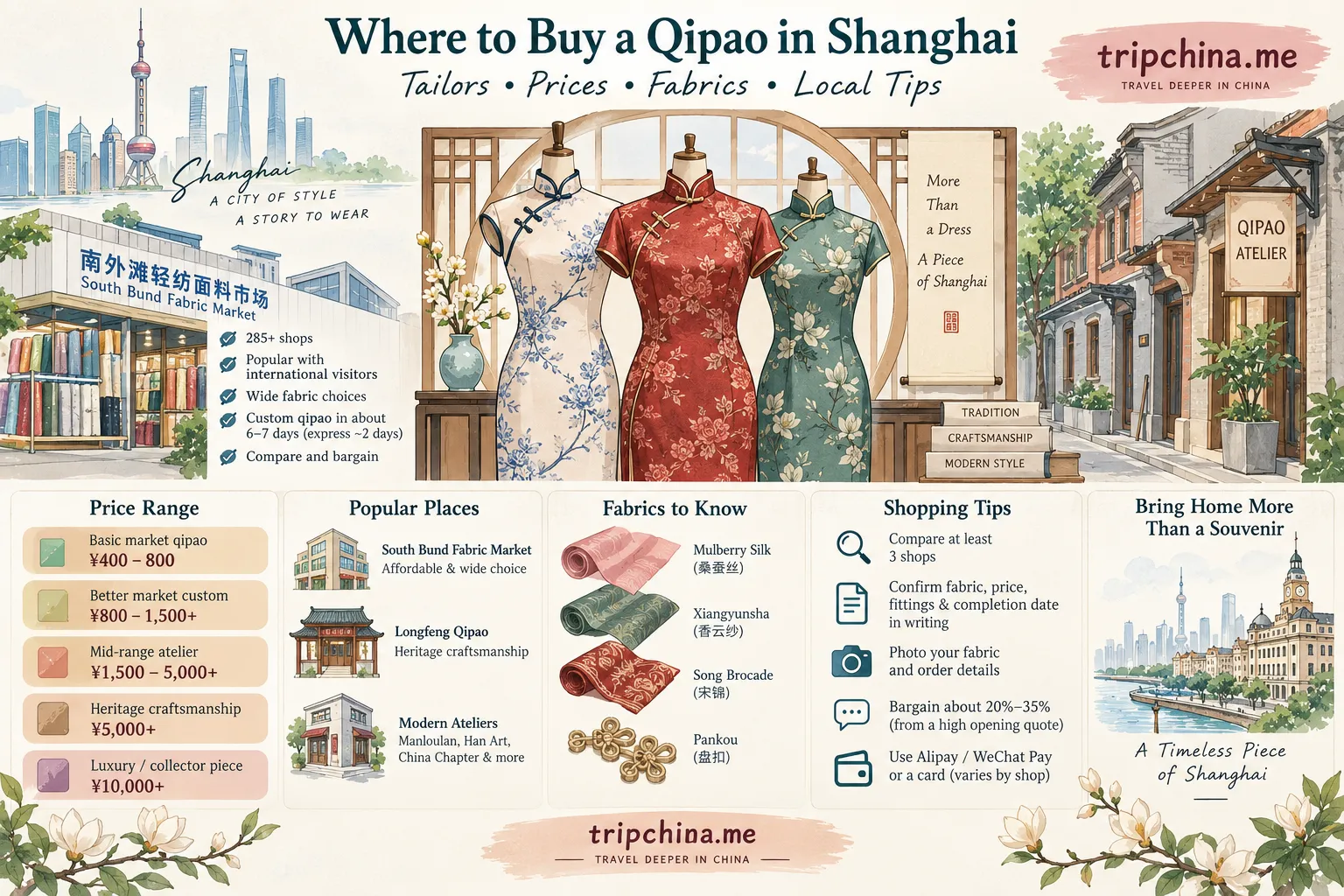
Buying a qipao in Shanghai can mean very different things. You can order a relatively affordable made-to-measure dress at South Bund Fabric Market, spend several thousand yuan on a traditionally handcrafted piece, or choose a modern atelier making qipao for everyday wear. The mistake is choosing a shop before deciding your budget, timeline, and what you actually want to take home. This guide compares the main options by price, turnaround time, craftsmanship, convenience, fabric, and fit.
Updated: September 2026
TripChina Local Note: Prices in this guide are practical shopping ranges, not fixed quotations. Custom qipao prices vary significantly by fabric, embroidery, construction, tailoring complexity, fitting requirements, and rush service. Confirm the final price and completion date before paying.
For most international travelers, South Bund Soft Spinning Material Market (南外滩轻纺面料市场) is the easiest place to start. It puts hundreds of tailoring businesses in one building, makes comparison shopping easy, and is accustomed to serving overseas customers. As of September 2026, standard production is typically around six to seven days, while many shops offer paid express service that can reduce turnaround to about two days. Very simple rush orders may sometimes be completed faster, but 24-hour production should never be assumed.
If craftsmanship matters more than speed, consider Longfeng Qipao (龙凤旗袍) on North Shaanxi Road. Its traditional qipao-making craftsmanship was added to China’s national-level intangible cultural heritage list in 2011.
For a more polished contemporary experience, Shanghai also has established studios such as Manloulan (蔓楼兰), Han Art (瀚艺旗袍), China Chapter (庄容定制中心), Bowang Qipao (博旺旗袍), and Jin Zhi Yu Ye (金枝玉葉).
| Your Priority | Best Starting Point | Typical Positioning | Time to Allow | Why Choose It |
|---|---|---|---|---|
| Lowest budget | South Bund Fabric Market | Budget–mid-range | 2–7 days | Huge choice and negotiable pricing |
| Very short trip | South Bund Fabric Market | Budget–mid-range | Express service may take about 2 days | Best chance of fast custom tailoring |
| Traditional craftsmanship | Longfeng Qipao | Premium | Allow several weeks when possible | National-level intangible heritage craftsmanship |
| Contemporary Shanghai style | Maoming Road / modern ateliers | Mid-range–premium | Several days to several weeks | More polished retail experience |
| Everyday modern qipao | Contemporary studios | Mid-range–premium | Varies | Easier-to-wear modern cuts |
| Collector or special occasion | Heritage / premium ateliers | Premium–luxury | Several weeks or longer | More handwork and complex construction |
TripChina Pick: If this is your first qipao and you are visiting Shanghai for only a few days, start at South Bund. If you already know that craftsmanship and heritage matter more than price or speed, skip the market and visit Longfeng or another established atelier.
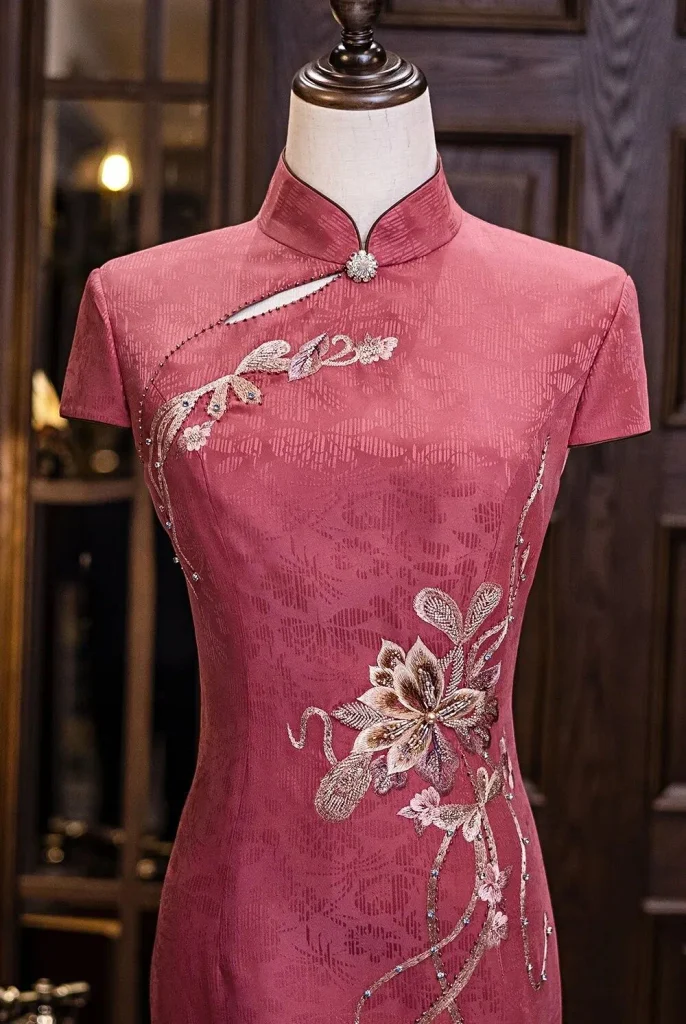
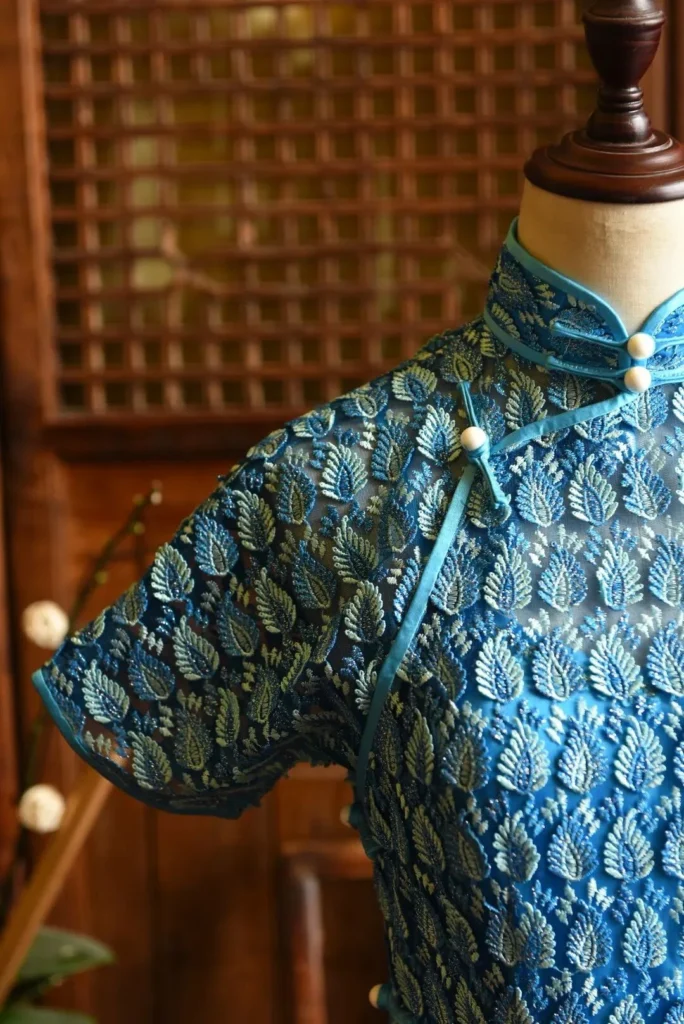
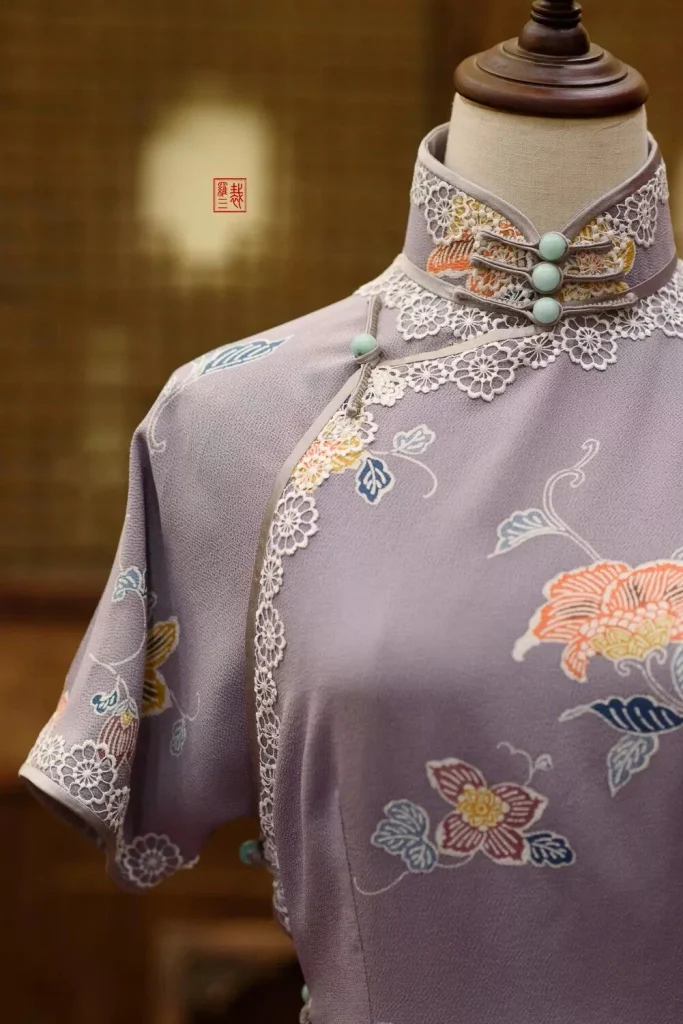

There is no single “Shanghai qipao price.”
A simple market-made garment and a fully handmade heritage qipao are effectively different products. As of September 2026, the following ranges are useful for planning rather than guaranteed shop quotations:
| Qipao Type | Approximate Budget | What You Are Mainly Paying For |
|---|---|---|
| Basic market qipao | ¥400–800 | Polyester or polyester-blend fabric, simple construction, fast production |
| Better market custom | ¥800–1,500+ | Better fabric and customization; some silk-blend options |
| Mid-range atelier | ¥1,500–5,000+ | Better fitting, design, fabric, and finishing |
| Heritage craftsmanship | ¥5,000+ | Handwork, traditional techniques, and detailed fitting |
| Luxury / collector piece | ¥10,000+ | Premium fabrics, embroidery, extensive handwork, and brand value |
These are market estimates rather than official price lists. The final quote can change dramatically depending on mulberry silk, brocade, embroidery, handmade pankou, complex piping, lining, individual pattern-making, and rush production.
Be especially careful with the word “silk.” A low-priced garment described simply as “silk” may be a silk blend or synthetic satin rather than 100% mulberry silk. Do not judge fiber composition from the English sales description or price alone — ask for the composition in writing and inspect the material label or supplier information.
A higher price does not automatically mean a better choice for a traveler. A relatively simple qipao that fits well can be far more useful than an elaborate piece you rarely wear.
Tax refund for international visitors: Some premium qipao stores participate in Shanghai’s departure tax-refund program. Manloulan’s Jinjiang Dickson store received both “departure tax refund store” and “buy-and-refund-on-the-spot” qualifications in 2025; reporting on that store described the refund as roughly equivalent to a 10% discount for eligible overseas shoppers. Ask whether the specific store offers the service before paying, confirm current eligibility requirements, and bring your original passport.
If you plan to pay by mobile, read our guide on how to use Alipay in China before shopping, and keep a backup payment method available.
For most first-time international visitors, yes.
The South Bund Soft Spinning Material Market is at 399 Lujiabang Road (陆家浜路399号), Huangpu District.
As of September 2026, the three-floor market has 285 shops. Current official Shanghai government data puts foreign visitors at around 30% of overall market traffic, while the market‘s deputy general manager has described foreign customers as stabilizing at 50%–60% of custom-tailoring customers specifically. Some popular individual shops report foreign-customer shares of 70% or more. The practical implication is the same: this is no longer a market where international visitors are unusual.
The practical implication is important: this is no longer a market where international visitors are unusual. English signage is widespread, and many tailors have experience with overseas measurements and reference photos. Some shops have staff who can communicate in English, French, Italian, or Spanish — though availability varies by stall, so a translation app remains a useful backup.
The biggest advantage is choice.
Instead of committing to one boutique, you can compare fabrics, styles, prices, samples, and workmanship across several tailors before ordering.
It is especially useful if you want:
• a first qipao;
• a wearable Shanghai souvenir;
• a lower budget;
• fast turnaround;
• several fabric choices; or
• a tailor accustomed to foreign visitors.
Some businesses here use individualized patterns rather than simply altering a standard size. Shanghai’s official qipao shopping information, for example, has highlighted Bowang Qipao at Room 185 for its individualized “one person, one pattern” approach.
Third-party validation: In 2026, the market ranked second on Tripadvisor’s Shanghai ‘Top Attractions’ list, behind only the Bund. For international visitors deciding whether the trip is worth it, that is a strong signal that the market has become a genuine destination rather than just a shopping stop.
Sometimes, but do not plan your trip around it.
Shanghai’s current official visitor guidance says standard production at South Bund typically takes about six to seven days, while many shops offer express production within two days. Requests for next-day collection do occur, especially among overseas visitors with departing flights, but this is rush service rather than the normal production cycle.
A very simple qipao may occasionally be completed within 24 hours when the fabric is already available and the construction is straightforward. Complex embroidery, difficult fabrics, extensive hand finishing, or a busy order queue make that much less realistic.
If fit matters, leave time for at least one fitting before leaving Shanghai.
Do not buy from the first stall immediately.
Walk through the market first and compare at least three shops. Show each tailor the same reference image and ask for quotes based on the same fabric, lining, construction, and finishing requirements.
Before paying, confirm the total price, exact fabric composition, lining, whether pankou and piping cost extra, number of fittings, completion date, alteration policy, and shipping arrangements if the garment will not be ready before departure.
TripChina Tip: Photograph the selected fabric and your written order details before leaving the shop. This gives you a visual record if there is confusion later. Always ask for the fabric composition in writing; vague descriptions such as “Chinese silk,” “silky,” or simply “silk” are not proof of 100% mulberry silk.
For a broader overview of common retail problems outside the tailoring market, see the Shanghai tourist-trap and shopping mistake guide.
South Bund has been expanding services specifically for overseas shoppers. Current reporting notes foreign-currency exchange facilities and international logistics capable of shipping finished garments to more than 170 countries and regions.
In 2026, Shanghai also began pushing more standardized service and quality requirements across the city’s custom-tailoring sector. Reporting on South Bund says its 280-plus businesses previously had inconsistent order formats and after-sales standards, while the market now uses unified quality requirements for delivered products.
If your qipao will not be finished before you leave Shanghai, ask about international shipping before the tailor cuts the fabric. Confirm the courier, shipping fee, destination address, estimated delivery time, customs responsibility, and what happens if the finished garment needs further alterations.
Payment methods still vary by stall. Alipay and WeChat Pay are widely useful in China, while card acceptance can differ from shop to shop. If you need help setting up mobile payments before shopping, our guide to paying in China as a foreigner covers Alipay, WeChat Pay, cards, and cash.
Bargaining is normal at South Bund, but there is no official market-wide “foreign tourist discount” or fixed percentage that every shop follows.
Visitor reports and independent market guides commonly describe opening quotes substantially above eventual negotiated prices, sometimes by 30%–50%. Treat that as a negotiation observation, not a guaranteed markup. A practical approach is to compare three like-for-like quotes first, then negotiate roughly 20%–35% from an obviously high opening quote when the fabric and construction are genuinely comparable.
Anecdotally, some repeat shoppers say they have found better-value quotes on the upper floors than at more visible ground-floor stalls. This is not a guaranteed floor-by-floor pricing rule, but it is a good reason to walk all three floors and compare like-for-like quotes before deciding. Current reporting also confirms that established tailoring businesses operate on the third floor rather than only at the busiest lower-level locations.
Do not bargain only on the headline number. A ¥600 quote with cheap lining, synthetic fabric, no fitting, and no alterations may be worse value than an ¥850 quote that includes all four.
The most important rule is simple: agree on the final price before the fabric is cut. Premium and heritage ateliers generally operate much more like fixed-price boutiques and may not negotiate at all.
If heritage craftsmanship is your priority, Longfeng Qipao (龙凤旗袍) is one of the most important names to know.
Address: 207–209 North Shaanxi Road (陕西北路207–209号), Jing’an District.
Longfeng’s qipao-making craftsmanship became a national-level intangible cultural heritage project in 2011. Its traditional decorative techniques include inlaying, edging, piping, embroidery, hollowing, carving, and handmade knotted buttons.
Shanghai’s official qipao guide notes that Longfeng follows a continuity-based custom process: the same tailor can remain involved from fabric selection and measurement through cutting and production.
That is fundamentally different from rapid market tailoring.
Longfeng makes the most sense if craftsmanship matters more than speed, the qipao is for a wedding or important event, you want a long-term garment rather than a souvenir, or you are genuinely interested in Shanghai clothing heritage.
Do not arrive expecting a ¥500 souvenir or guaranteed next-day service.
To explore more of the city’s traditional craftsmanship and local culture beyond qipao shopping, start with TripChina’s Shanghai Travel Guide 2026.
Not every traveler wants a heritage piece.
Shanghai’s current qipao scene also includes studios that combine traditional Chinese elements with contemporary tailoring.
Address: 135 South Maoming Road, Huangpu District.
China Chapter focuses on Shanghai-style qipao and incorporates traditional Chinese visual elements into contemporary formalwear. Shanghai’s official listing highlights more than ten traditional techniques used by its tailoring team.
Best for: travelers wanting a polished Shanghai-style atelier experience.
Address: 70-1 South Maoming Road, Huangpu District.
This Shanghai brand combines traditional motifs and silhouettes with modern tailoring and three-dimensional cutting.
Best for: buyers who want a qipao that feels Chinese but less restrictive and easier to wear.
Address: 1F, 271 Anhua Road, Changning District.
Han Art combines embroidery with high-end qipao tailoring and uses a more elaborate multi-stage construction process.
Best for: premium buyers interested in detailed embroidery and craftsmanship.
Manloulan is one of Shanghai’s established Chinese-style clothing brands. Its current design approach combines traditional details such as frog buttons and Suzhou embroidery with contemporary decorative techniques.
Best for: luxury-oriented buyers who prefer a formal boutique environment over a fabric market.
After-sales service: Manloulan publicly promotes lifetime free alterations. Current reporting says its custom garments leave about 1.5 cm of extra allowance at the relevant seam so the fit can be adjusted later as a customer’s body changes. For a qipao intended for long-term wear, that after-sales support is a meaningful difference from fast market tailoring.
Addresses and store locations can change. Verify the current location with the business before making a special trip. This guide to the best navigation apps for foreign tourists in China explains why a China-focused map is useful.
Small neighborhood workshops still exist, but they are less predictable for a short international trip. The useful comparison is the trade-off rather than the romantic idea that a hidden workshop is automatically more “authentic.”
| Lane Workshop Advantage | Possible Drawback |
|---|---|
| More personal experience | Difficult to locate |
| Potentially lower price | Little or no English |
| Neighborhood atmosphere | Limited fabric selection |
| Direct contact with tailor | Less predictable turnaround |
| Interesting local story | Limited online information |
For international travelers, treat lane workshops as an optional local experience rather than the default place to buy a first qipao.
Choose based on where you will actually wear it.
A traditional fitted qipao can be beautiful for weddings, formal dinners, photography, and special occasions, while contemporary designers increasingly produce shorter, looser, and less restrictive versions for everyday life.
Traditional full-length qipaos tend to require more precise hip, waist, and bust measurements because the silhouette leaves little room for fitting errors. Modern relaxed, cropped, or low-slit designs are often easier to fit and more practical for casual travel wear.
| Feature | Traditional / Heritage Qipao | Modern Qipao |
|---|---|---|
| Silhouette | More structured | Usually easier to move in |
| Details | Greater emphasis on traditional elements | Contemporary cuts |
| Handwork | Often more | May use modern construction |
| Occasions | Formal events | Daily and casual wear |
| Fitting | Usually more demanding | Often easier |
| Main value | Heritage and craftsmanship | Practical wearability |
Shanghai’s official guide notes that even heritage makers have developed shorter or less restrictive designs for modern wear.
If this is your first qipao, wearability should matter more than ornamentation.
Understanding a few Chinese fabric terms makes shopping much easier.
Mulberry silk is one of the classic premium choices for qipao.
The Chinese term to recognize is:
桑蚕丝 — sāng cán sī — mulberry silk
Ask specifically for the fiber composition rather than accepting the generic English word “silk.” If a seller claims a fabric is 100% mulberry silk, ask to see its composition label, hangtag, or supplier information.
Do not use price alone as a “silk test.” Very cheap garments described vaguely as silk deserve extra scrutiny, but there is no universal retail price below which a fabric automatically becomes fake.
The practical red flag is an unwillingness to state the fiber composition clearly.
Xiangyunsha is a traditional silk textile known for its distinctive finishing process and breathable feel.
It can be a beautiful warm-weather fabric, but care requirements depend on the exact textile and finish. Ask the maker for written washing instructions rather than assuming an ordinary silk-care routine is safe. For a travel garment you plan to wear frequently, a simpler silk blend may be easier to maintain.
Song brocade is a traditional Chinese woven textile characterized by intricate patterns and a more structured appearance.
It works particularly well for formal garments or buyers who prefer a richer historical aesthetic.
Pankou are the decorative knotted fastenings strongly associated with traditional Chinese clothing.
Handmade pankou require substantially more work than mass-produced closures, so ask whether the quoted price includes handmade or machine-produced fastenings.
It means the tailor creates or adapts an individual pattern around your measurements instead of relying primarily on a standard factory size.
For serious custom tailoring, this is one of the most useful questions to ask.
The difference is not simply “cheap versus expensive.”
| Feature | Fast Market Qipao | Heritage / Premium Custom |
|---|---|---|
| Primary goal | Speed and value | Fit and craftsmanship |
| Production | Faster, mixed machine/hand work | Greater handwork |
| Pattern | Varies by tailor | More individualized |
| Fittings | Usually limited | More detailed |
| Traditional techniques | Limited–moderate | Greater emphasis |
| Turnaround | Often days | Often weeks |
| Price | Hundreds to low thousands RMB | Several thousand RMB and up |
| Best for | Travelers / souvenirs | Weddings / collectors / long-term wear |
A ¥500 market qipao and a ¥5,000 handmade qipao should not really be judged as two versions of the same product.
One prioritizes speed, price, and appearance. The other prioritizes pattern-making, fit, handwork, and craftsmanship.
Use this checklist before the fabric is cut.
First, confirm the fabric composition. Do not rely on descriptions such as “silky,” “Chinese silk,” or “premium silk.” Ask what percentage of the fabric is actually silk.
Second, get the final price in writing. Confirm whether it includes fabric, lining, tailoring, pankou, piping, embroidery, fittings, alterations, rush service, and delivery.
Third, confirm the completion date. “Two days” and “ready before your flight” are not the same promise. Write down the actual pickup date.
Fourth, ask how many fittings are included. Fit matters enormously with qipao because the silhouette can be unforgiving. If possible, schedule at least one fitting before final collection.
Finally, decide whether you really need heavy embroidery. Elaborate embroidery adds cost, weight, and production time. For a first qipao, a simpler fabric and cleaner design can be much easier to wear repeatedly.
The first mistake is buying from the first shop you see. Compare several South Bund stalls before ordering.
The second is choosing fabric only by appearance. Ask what the material actually contains, especially when a salesperson uses “silk” as a broad description.
The third is prioritizing speed over fitting. A beautiful fabric cannot compensate for a poorly fitted qipao.
The fourth is ordering too late in the trip. Visit the tailor near the beginning of your Shanghai stay rather than on your final afternoon.
The fifth is assuming “handmade” means the entire garment is handmade. Ask which parts are hand-finished: pattern-making, pankou, piping, embroidery, stitching, or all of them.
And the last is choosing an elaborate design you will never wear. Your first qipao does not need to be your most complicated one.
Start at South Bund Fabric Market.
Take Metro Line 4 to Nanpu Bridge Station (南浦大桥站) and walk to the market. Allow around two to three hours for browsing, comparing fabrics, discussing designs, and being measured.
Do this early in your Shanghai trip so you have time for a fitting and alterations. You can use the Shanghai Metro and transportation guide to plan the trip, then plan the rest of your 3–5 day Shanghai itinerary around your fitting and pickup dates.
Combine:
North Shaanxi Road → Changle Road → Maoming South Road
This route gives you a better sense of how Shanghai qipao ranges from traditional craftsmanship to modern Chinese fashion.
It is better suited to travelers interested in fashion, architecture, and Shanghai cultural history than someone simply trying to find the cheapest dress.
If you want to turn the shopping day into a broader neighborhood experience, combine it with one of TripChina’s self-guided Shanghai city walks.
For most travelers, start at South Bund Fabric Market.
It gives you the widest range of budgets and styles, lets you compare several tailors in one building, and offers the best chance of completing a custom garment during a short Shanghai trip.
But South Bund is not automatically the “best qipao in Shanghai.”
If you care more about heritage craftsmanship than speed, Longfeng deserves serious consideration. If you want something contemporary and easier to wear at home, explore Shanghai’s modern qipao ateliers instead.
The better question is not simply “Where is the best qipao shop in Shanghai?”
It is: “What kind of qipao do I actually want to take home?”
This article is part of the Shanghai Travel Guide Hub. Browse more Shanghai local shopping and custom tailoring guides.
This article is part of the Shanghai Travel Guide Hub.
For practical trip planning, budget roughly ¥400–800 for a basic market qipao, ¥800–1,500+ for better market custom work, and ¥1,500–5,000+ for a mid-range atelier. Heritage and luxury work can rise well above ¥5,000 depending on fabric, embroidery, fitting, and handwork.
Choose ready-to-wear if convenience matters most and the available size already fits you well. Choose custom if you need a better bust-waist-hip fit, want a particular collar or fabric, or are buying the garment for an important event.
Yes, some can. South Bund now has logistics services capable of shipping finished garments to more than 170 countries and regions, but you should confirm courier fees, customs responsibility, delivery time, and alteration arrangements before leaving China.
Not necessarily. A lower price often reflects synthetic or blended fabric, faster production, fewer handmade details, and a simpler fitting process rather than a “fake” garment. What matters is whether the tailor accurately describes the fabric and construction you are paying for.
Generally, yes. Qipao is the Mandarin term, while cheongsam comes from Cantonese usage and remains common in Hong Kong and many English-speaking overseas Chinese communities.
Ask for the exact fiber composition in writing and request the material label or supplier information if a seller claims the fabric is 100% mulberry silk. Do not assume sheen equals silk: polyester satin and silk blends can look convincing under shop lighting.
Do not assume a custom garment is returnable once the fabric has been cut. Alteration and remake policies vary by tailor, so agree on them before paying; if fit is important, schedule a fitting before final collection rather than relying on after-sales corrections.
They can be, but quality varies widely by stall, fabric, construction, and deadline. A straightforward design with good fabric and careful fitting can last well, while an ultra-fast rush order with elaborate details leaves less time for fitting and finishing checks.
There is no single “qipao body shape.” For easier everyday wear, ask to try a slightly relaxed silhouette, moderate collar, mid-calf length, or lower slit rather than assuming a very tight full-length cut is required. A competent custom tailor should adapt the pattern to your measurements instead of forcing your body into a standard silhouette.
Yes. Translation apps are useful for prices, measurements, fabric terms, and simple questions, but reference images are often even more effective when discussing design. Do not rely on finding public Wi-Fi when you need it; keep mobile data available and download any translation tools you need before visiting.
Raise the problem before leaving the shop and compare the garment with the written design, measurements, fabric, and details agreed when you ordered. Custom-order return policies vary, but fit problems are often handled through alterations rather than a full refund, which is why you should agree on the alteration policy before production begins.
Sometimes, but not automatically. South Bund tailors already source fabric through established suppliers, so buying fabric separately may not save money. If you have a specific fabric of your own, ask the tailor in advance whether they accept customer-supplied material and whether its width, pattern, and structure are suitable for the qipao you want.
Follow the garment’s care label and the maker’s instructions because silk construction, lining, embroidery, and finishing vary. Some silk qipaos may require professional dry cleaning, while others permit careful hand cleaning; avoid assuming that one washing method is safe for every garment. Xiangyunsha and heavily embroidered pieces can require particularly careful treatment, so ask for written care instructions before leaving the shop.
For most first-time visitors, South Bund is the practical starting point: many tailors in one place, broad price ranges, comparison shopping, and fast production. Longfeng and other established ateliers make more sense when craftsmanship, heritage, or a special occasion matters more than speed.
The most important qipao-shopping decisions happen before the tailor cuts the fabric: compare shops, verify the fiber composition, agree on the final price, confirm the pickup date, and leave time for a fitting.
The best Shanghai qipao is not necessarily the most expensive or the fastest one. It is the one that fits properly, matches what the seller promised, and is something you will actually wear.
Shanghai Official — Where Visitors Get Clothes Made: Inside Shanghai’s South Bund Market
People’s Daily Online — Shanghai Tailoring Hub and Overseas Visitor Data
People’s Daily Online — 海派旗袍店迎来海外“扫货客”
Huangpu District Government — “上海定制”:解锁新内涵
Last researched in September 2026. This guide cross-checks Shanghai government information, People’s Daily reporting, official heritage records, and current market reporting. Key verification points include South Bund’s 285-shop scale, roughly 60% foreign-customer share, fast-tailoring timelines, international visitor services, and Manloulan’s tax-refund and long-term alteration services. Price, bargaining, and floor-by-floor differences are treated as practical market observations rather than guaranteed rules because quotes vary by tailor, fabric, design, workload, and season.
TripChina.me creates practical China travel guides shaped by real local experience, helping independent travelers navigate transport, payments, food, neighborhoods, and the cultural details that make traveling in China easier and more meaningful. Find the guide for your destination at tripchina.me.