Our Location:
No. 99, Jiazi Road, Chengdu

 authorChris Lee
Most first-time visitors choose a Shanghai hotel by price or one famous landmark. That can be an expensive mistake: in a city this spread out, saving ¥100 on a room can mean losing an hour a day to the metro.
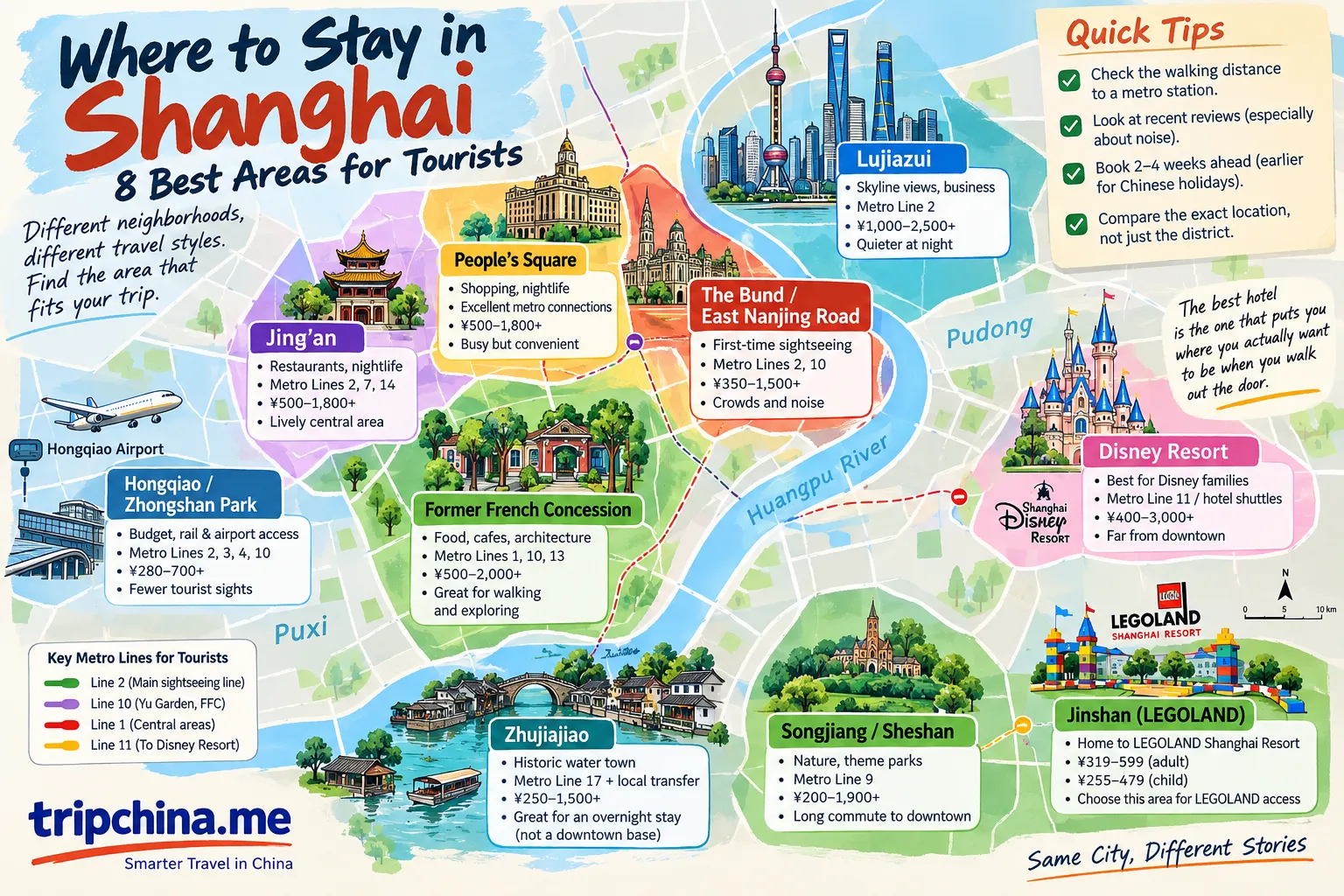
This guide compares eight practical bases for foreign travelers—by sightseeing efficiency, atmosphere, transport, price, nightlife, noise, and the kind of trip each area actually suits.
For most first-time visitors, People’s Square, East Nanjing Road, or the Bund area is the safest choice: central, well connected, and close to Shanghai’s classic sights.
Former French Concession is better for cafes, food, architecture, and slower neighborhood exploration.
Lujiazui works best for skyline views and business trips, but feels quieter after dark.
Hongqiao or Zhongshan Park gives budget travelers a better balance than booking a much cheaper hotel deep in the suburbs.
Disney Resort makes sense when Shanghai Disneyland is a major part of your itinerary.
One simple rule matters more than almost anything else: check the walking distance from your hotel to a useful metro station before checking the room size.
| Area | Best for | Typical room range* | Metro / access | Main trade-off |
|---|---|---|---|---|
| Bund / East Nanjing Road | First-time sightseeing | ¥350–1,500+ | Lines 2, 10; nearby interchange options | Crowds and noise |
| Former French Concession | Food, cafes, slow travel | ¥500–2,000+ | Lines 1, 10, 13 depending on location | Fewer major sights on foot |
| Lujiazui | Skyline views, business | ¥1,000–2,500+ | Line 2 | Less street life at night |
| People’s Square / Jing’an | Shopping, nightlife, convenience | ¥500–1,800+ | Excellent central connections | Busy commercial environment |
| Disney Resort | Disney families | ¥400–3,000+ | Line 11 / hotel shuttles | Far from downtown |
| Hongqiao / Zhongshan Park | Budget, rail and airport access | ¥280–700+ | Lines 2, 3, 4, 10 depending on area | Fewer tourist sights |
| Zhujiajiao | Water-town overnight stay | ¥250–1,500+ | Line 17 + local transfer | Poor base for downtown sightseeing |
| Songjiang / Sheshan | Nature and theme parks | ¥200–1,900+ | Line 9 | Long downtown commute |
*Indicative accommodation ranges, as of September 2026. Hotel rates vary significantly by weekday, exhibition schedule, Chinese public holidays, room type, and booking platform.
For most first-time visitors, yes.
The Bund (外滩), East Nanjing Road (南京东路), and the People’s Square side of this central corridor put you close to many of the places first-time travelers actually want to see.
Depending on the exact hotel location, you can walk to the Bund waterfront and Nanjing Road, while Yu Garden is either a longer walk or a short metro/taxi ride away.
If the Bund itself is one of your priorities, TripChina’s complete Bund sightseeing guide explains the waterfront, historic buildings, ferry, and walking strategy.
The biggest advantage here is not luxury. It is time.
A central hotel can easily save 30–60 minutes of transport over a full sightseeing day compared with a cheaper property much farther west or south.
Noise and crowds.
East Nanjing Road and streets immediately around major attractions remain busy well into the evening. A hotel can have a perfect map location but still be unpleasant if your room faces a major road.
When booking, ask for:
Typical nightly range: budget chains ¥350–500; mid-range ¥500–800; upscale and luxury properties roughly ¥800–1,500+, with premium Bund-view hotels often much higher.
TripChina insight: For a first Shanghai trip of only two or three nights, paying somewhat more for this location often makes more sense than saving money in an outer district.
The Former French Concession is one of the best choices if your idea of Shanghai is walking rather than checklist sightseeing.
Wukang Road (武康路), Anfu Road (安福路), Hengshan Road (衡山路), and the surrounding neighborhoods combine tree-lined streets, historic villas, lane houses, bookstores, independent shops, cafes, bars, and restaurants.
This is where Shanghai starts to feel less like a collection of landmarks and more like a city you can wander through.
The trade-off is that the area is spread out. There is no single “French Concession station,” so two hotels both marketed as being in the Former French Concession can have very different transport convenience.
Before booking, check the exact pin rather than trusting the neighborhood label.
If you have three days and want to squeeze in the Bund, Yu Garden, museums, Pudong, shopping, and multiple attractions every day, a more central metro hub may work better.
But if you want coffee, photography, architecture, neighborhood restaurants, and unplanned walks, this is hard to beat.
TripChina’s Shanghai City Walk routes can help you judge whether this style of Shanghai matches your itinerary.
Typical nightly range: boutique hotels ¥500–900; upscale hotels ¥900–2,000; high-end restored villas and heritage properties can exceed ¥3,000.
TripChina insight: Don’t choose this neighborhood because a guide says it is “romantic.” Choose it because you genuinely want to spend part of your trip walking without a destination.
If the view is the priority, Lujiazui (陆家嘴) is one of the strongest choices.
This is Shanghai’s financial district, home to the Oriental Pearl Tower, Shanghai Tower, Jin Mao Tower, and some of the city’s best-known luxury hotels.
From the Pudong side of the Huangpu River, many rooms face west toward the historic Bund skyline.
Metro Line 2 also makes the district much more convenient than its futuristic skyline suggests. People’s Square is only a few metro stops away.
The difference becomes obvious after dinner.
Lujiazui is polished, modern, spacious, and business-oriented. But compared with central Puxi, many parts have less street-level dining, casual nightlife, lane-house architecture, and spontaneous wandering.
Do not assume that staying beside the river automatically gives you a Bund view, either. Check the actual room category. “River view,” “city view,” and “Bund view” can mean very different things.
Typical nightly range: upscale hotels ¥1,000–2,500; premium skyline properties often ¥2,500+.
TripChina insight: Lujiazui works especially well for a business trip or a one-night skyline splurge. For a longer leisure trip, many travelers will find Puxi more interesting once they step outside the hotel.
Choose this central-west corridor if you want transport convenience without living directly inside the Bund tourist zone.
People’s Square (人民广场) is one of Shanghai’s most useful transport hubs. Jing’an Temple (静安寺) puts you farther west but closer to upscale shopping, restaurants, bars, and nightlife around Nanjing West Road.
The two are not identical neighborhoods, but they solve a similar traveler problem: you remain central without making the waterfront the center of every day.
People’s Square is better for maximum sightseeing efficiency.
Jing’an is better if you want more nightlife, restaurants, shopping, and a slightly more lived-in central-city experience.
Typical nightly range: mid-range ¥500–800; upscale ¥800–1,800; luxury ¥1,800+.
TripChina insight: For travelers who find East Nanjing Road too tourist-heavy but still want easy transport, Jing’an is one of Shanghai’s best compromises.
Only if Disney is important enough to justify being far from central Shanghai.
Shanghai Disney Resort is in Pudong, well outside the historic city center. Staying nearby removes the unpleasant early-morning cross-city commute and makes an afternoon hotel break much easier for families with young children.
That convenience matters because a downtown-to-Disney journey can take roughly 45–60 minutes or more depending on your starting point, transfers, and walking time.
As of September 2026, Shanghai Disneyland uses dynamic tiered pricing. The current official structure keeps the lowest one-day tier at ¥475 and the highest at ¥799; the exact price depends on the selected date, so check the resort’s live calendar before buying.
For the park itself, use TripChina’s Shanghai Disneyland first-time visitor guide before deciding whether you really need a resort-area hotel.
Do not automatically stay beside Disney for the entire trip.
If you have four or five nights in Shanghai but only one Disney day, a better strategy is often:
Downtown Shanghai → Disney-area hotel → park day → onward travel
That avoids commuting from Disney back into central Shanghai on every non-park day.
Typical nightly range: local themed guesthouses roughly ¥400–700; mid-range resort-area hotels ¥700–1,200; official Disney hotels commonly ¥1,500–3,000+ depending on date.
TripChina insight: Disney is one of the rare Shanghai attractions where changing hotels for one night can actually save time rather than create more hassle.
Yes—particularly if your alternative is a dramatically cheaper room much farther into suburban Shanghai.
Zhongshan Park (中山公园) sits on Metro Line 2 and also has access to Lines 3 and 4. Hongqiao is especially convenient for Hongqiao Railway Station and Shanghai Hongqiao International Airport.
That makes this western corridor useful for travelers arriving by high-speed train, taking an early flight, or trying to reduce hotel costs without disconnecting themselves from central Shanghai.
TripChina’s Shanghai airport guide explains the very different roles of Hongqiao (SHA) and Pudong (PVG), which is worth checking before choosing a hotel based only on the word “airport.”
Expect roughly 20–30 minutes or more of metro travel to many central attractions depending on your exact starting station and destination.
Typical nightly range: chain hotels ¥280–450; better mid-range options around ¥450–700+.
This is where budget travelers often make the wrong calculation.
A hotel that saves ¥100–150 per night can look attractive until you discover that it requires a bus plus metro transfer and an hour-long commute each way.
For a standard sightseeing trip, metro proximity matters more than district-level hotel price.
TripChina insight: Zhongshan Park is often a better budget compromise than going deep into Minhang or Songjiang just to find the cheapest room.
Yes—but as an experience, not as a Shanghai sightseeing base.
Zhujiajiao (朱家角) is a historic Jiangnan water town in Qingpu District, southwest of central Shanghai. Its canals, stone bridges, old lanes, waterside houses, and traditional architecture feel very different after the day-trip crowds leave.
The ancient-town streets themselves are free to enter. As of September 2026, an optional ¥60 attraction package covers selected paid sights; individual access arrangements can change, so check locally before buying.
Metro Line 17 makes Zhujiajiao accessible from Shanghai, but getting from the old town back to central attractions still takes around an hour or more once transfers and walking are included.
That makes it a poor choice for someone planning to visit the Bund, museums, Pudong, and central shopping districts every day.
Typical nightly range: guesthouses ¥250–600; boutique stays ¥600–1,500; high-end courtyard or resort properties can exceed ¥1,500.
TripChina insight: If you stay overnight, the reward is not transport convenience. It is seeing the canals in the evening and early morning after most day visitors have gone.
Songjiang and Sheshan make sense for a specific suburban itinerary, not as a cheap substitute for central Shanghai.
The area includes Sheshan (佘山), Shanghai Chenshan Botanical Garden (上海辰山植物园), and Shanghai Happy Valley (上海欢乐谷). Metro Line 9 connects Songjiang with central Shanghai, but repeated sightseeing trips downtown quickly become tiring.
One important correction: LEGOLAND Shanghai Resort is not in Songjiang.
The resort opened in 2025 in Jinshan District (金山区). As of September 2026, its dynamic one-day adult ticket structure ranges from ¥319 to ¥599, while child tickets range from roughly ¥255 to ¥479, depending on the date.
If LEGOLAND is the primary reason for your suburban stay, choose accommodation based on Jinshan / LEGOLAND access, not simply because a hotel is marketed as being near Songjiang attractions.
Typical Songjiang/Sheshan nightly range: budget roughly ¥200–400; mid-range ¥400–800; upscale resorts roughly ¥800–1,900+.
TripChina insight: Shanghai’s suburban attractions are spread across different districts. “Outside downtown” does not mean they are all close to one another.
For a typical visitor, Line 2 deserves first priority.
It runs through major transport and sightseeing nodes including Hongqiao, Jing’an Temple, People’s Square, East Nanjing Road, and Lujiazui, and continues toward Pudong Airport.
Line 10 is particularly useful around Yu Garden and parts of the Former French Concession, while Line 1 remains useful through several central commercial and transport areas.
For exact routes, fares, payment methods, and current operating information, see TripChina’s Shanghai Metro guide for foreign travelers.
But the line number alone is not enough.
A hotel advertised as “near Line 2” may still require a 15-minute walk. Do that twice a day, add summer heat, rain, luggage, or tired children, and the bargain starts looking less attractive.
For sightseeing, I use a simple rule: try to stay within about a 10-minute walk of the metro unless the neighborhood itself is the attraction.
Metro services generally run from around 5:30 AM to 11:00 PM, with some lines extending past midnight on weekends. Check the current timetable for your specific line.
The most common mistake is booking by district rather than by exact map location.
Shanghai districts are enormous. Two hotels in the same district can produce completely different trips.
Before paying, check four things:
Metro walking time: Verify the actual walking route to the station entrance, not the straight-line distance.
Room direction: On Nanjing Road, Huaihai Road, and other busy streets, an inner-facing room can matter more than a slightly larger room.
Recent reviews: Be cautious with listings that have very few recent guest reviews or where photos and room descriptions are inconsistent.
Foreign-guest check-in: China has moved toward equal accommodation access, but operational problems can still occur at individual properties. Before booking a small guesthouse or unfamiliar property, confirming that it can correctly process an overseas guest’s registration can prevent trouble at arrival. TripChina’s China hotel booking guide for foreign travelers explains the issue in detail.
For an ordinary travel period, two to four weeks ahead usually gives you a reasonable choice of locations and room types.
For major Chinese holiday periods, book substantially earlier.
May Day, National Day, Spring Festival, major exhibitions, and popular weekends can produce sharp demand changes. Rather than assuming every holiday behaves the same way, check China’s current public-holiday calendar before locking in accommodation.
For high-demand dates, one to two months ahead is a safer planning window for popular central hotels.
Hotel prices in this article are therefore reference ranges—not guaranteed rates.
Generally, yes, but check the property’s accepted payment methods before arrival.
Shanghai’s official guidance states that foreign travelers staying in hotels can register using passports, Foreign Permanent Resident ID Cards, or other recognized valid identification documents. Hotels handle the accommodation registration for hotel guests.
Do not rely on a phone photo of your passport as your normal check-in document. Bring your original valid passport or other officially accepted travel document.
Payment acceptance varies by property. International Visa and Mastercard cards are common at larger mid-range and luxury hotels, while some smaller properties may rely more heavily on Alipay, WeChat Pay, Chinese bank cards, or cash.
TripChina’s foreign visitor payment guide explains how cards, mobile payments, and RMB cash fit together.
If you are staying in a private residence rather than a hotel, different accommodation-registration procedures apply; in Shanghai, overseas guests staying outside hotels generally need to register within 24 hours.
For a first Shanghai trip of two to four days, I would choose People’s Square, East Nanjing Road, or a nearby central Puxi location. You are paying for time, not just a room.
For food, coffee, photography, and neighborhood atmosphere, choose the Former French Concession.
For nightlife and shopping without the heaviest Bund crowds, look around Jing’an.
For skyline views or business travel, choose Lujiazui.
For a tight budget, start with Zhongshan Park or the Hongqiao–Line 2 corridor before pushing farther into the suburbs.
For Disney, stay near the resort only for the portion of the trip when you actually need to be there.
And for Zhujiajiao, Songjiang, Sheshan, or Jinshan, book there because the suburban destination itself is part of your itinerary—not because the room looked cheaper on a map.
In Shanghai, the best hotel is rarely the cheapest one. It is the one that puts you where you actually want to be when you walk out the door.
This article is part of the Shanghai Travel Guide Hub.
Yes, especially if you value restaurants, nightlife, polished streets, and central Puxi access. It is usually more expensive than a basic People’s Square stay, so it makes more sense for travelers who will actually use the neighborhood’s dining and evening scene.
Only when your departure time makes a downtown transfer inconvenient or risky. Pudong Airport is far from central Shanghai, so an airport hotel is usually a poor sightseeing base but can be sensible for a very early departure or late arrival.
Central Shanghai is generally straightforward for ordinary nighttime travel, but normal big-city precautions still apply. Choose well-lit routes, use licensed taxis or established ride-hailing services, and keep your hotel’s Chinese name and address available on your phone.
Not necessarily. Large hotels usually have more English support, but translation apps make smaller properties much easier to use than they once were. For foreign travelers, correct passport registration and a reliable front desk matter more than perfect English.
Not automatically. A quieter hotel eight minutes from a useful station can be better than one directly above a busy commercial interchange. Compare the station, exit location, walking route, noise, and the places on your actual itinerary rather than simply looking for the smallest distance.
Shanghai Disney Resort — Official Ticket Pricing Update
Shanghai Municipal Government — LEGOLAND Shanghai Ticket Pricing
Official Shanghai Tourism — Zhujiajiao Admission and Ticket Information
Shanghai Municipal Government — Accommodation Registration for Foreign Visitors
Updated September 2026. This guide was reviewed against current Shanghai government, official tourism, Shanghai Disney Resort, and attraction information, with particular attention to accommodation registration, theme-park locations, and ticket pricing. Hotel prices are indicative ranges rather than fixed rates because Shanghai accommodation prices vary by date, room type, exhibition schedule, holidays, and booking platform. Transport times are practical estimates and can vary by exact hotel location, station exit, transfers, and traffic.
TripChina.me creates practical China travel guides shaped by real local experience, helping independent travelers navigate transport, payments, food, neighborhoods, and the cultural details that make traveling in China easier and more meaningful. Find the guide for your destination at tripchina.me.