Our Location:
No. 99, Jiazi Road, Chengdu

 authorChris Lee
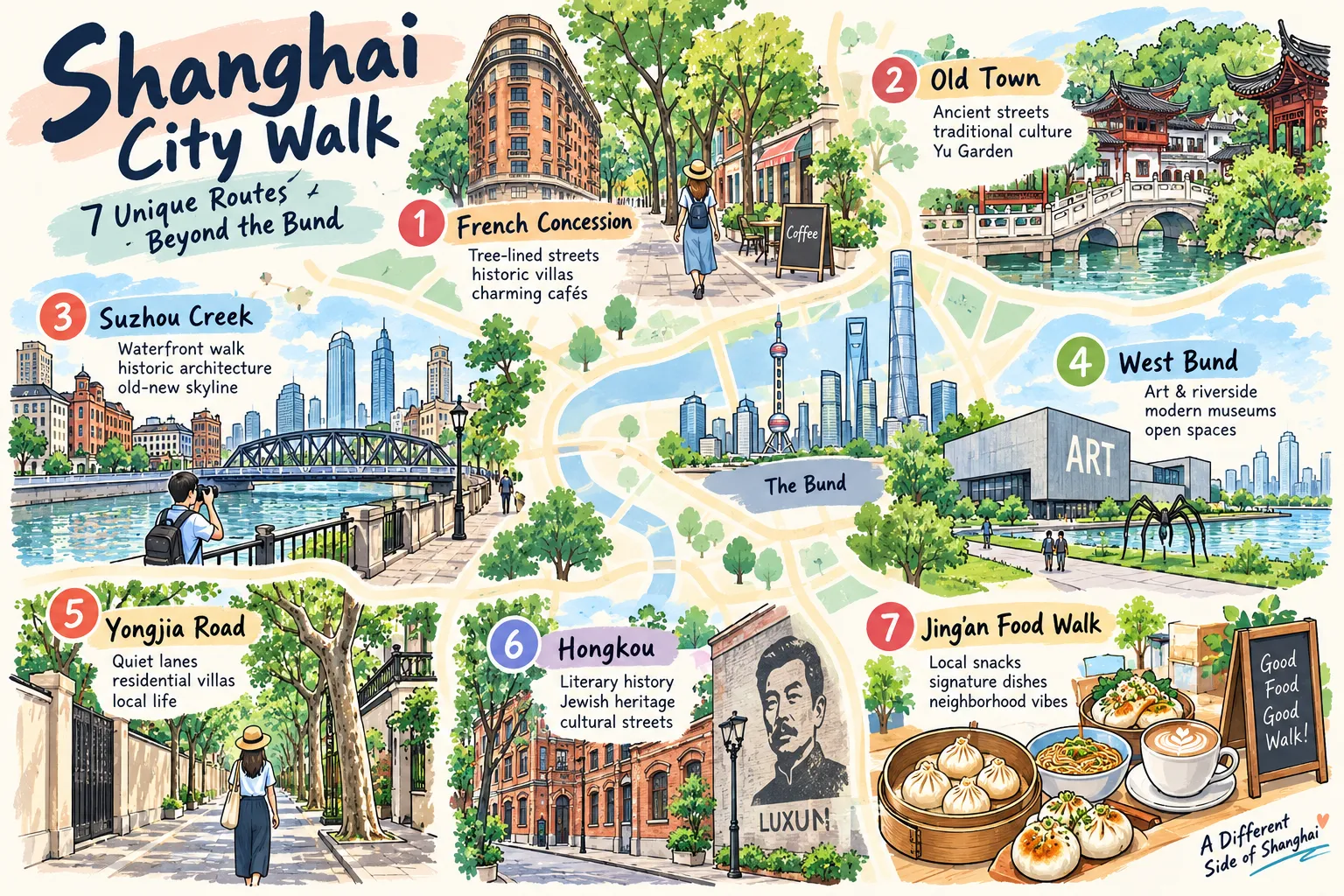
Search for a Shanghai walking route and you will usually get the same Bund–Nanjing Road–Yu Garden loop. Shanghai deserves better. These seven self-guided walks take you into tree-lined former concession streets, Suzhou Creek architecture, Old City history, West Bund art and literary Hongkou—so you can choose the Shanghai you actually want to experience.
For most first-time visitors, start with the French Concession or Suzhou Creek.
• Choose the French Concession for historic architecture, leafy streets, cafés and neighborhood atmosphere.
• Choose Suzhou Creek for waterfront views, early-20th-century architecture and one of Shanghai’s best old-versus-new skyline contrasts.
• Choose Yongjia Road when you want somewhere quieter and less attraction-driven.
• Choose Hongkou for literary history and Shanghai’s Jewish refugee heritage.
• Choose West Bund for contemporary art, open waterfront space and an easier, flatter walk.
As of September 2026, Shanghai continues to actively develop and promote City Walk experiences, including Suzhou Creek waterfront routes and new literary walks in Hongkou.
| Route | Approx. Time | Best For | Crowd Level | Main Experience |
|---|---|---|---|---|
| French Concession | 2–3 hrs | First-timers, architecture, cafés | Medium | Tree-lined historic streets |
| Old Town Heritage | 2.5–4 hrs | History, traditional Shanghai | Medium–High | Old City + Yu Garden |
| Suzhou Creek | 3–4.5 hrs | Photography, architecture | Low–Medium | Waterfront + historic buildings |
| West Bund | 3–5 hrs | Art, families, slow travel | Low on weekdays | Museums + riverside |
| Yongjia Road | 1.5–2 hrs | Quiet wandering | Low | Villas + residential streets |
| Hongkou Heritage | 3–4 hrs | Literature, modern history | Low–Medium | Lu Xun + Jewish refugee history |
| Jing’an Food Walk | 3–5 hrs | Food travelers | Medium | Neighborhoods + local food |
TripChina Pick: If you have time for only one walk, choose the French Concession for classic Shanghai atmosphere or Suzhou Creek for the most varied scenery.
The problem is not the Bund.
The problem is that too many routes send everyone to the Bund, Nanjing Road and Yu Garden at approximately the same time.
You photograph the same skyline from the same railing, follow the same shopping street, and leave with Shanghai’s postcard version rather than any real sense of its neighborhoods.
Shanghai becomes much more interesting when walking has a purpose.
The city works particularly well for three kinds of wandering: historic residential streets where architecture matters more than attractions; waterfront routes along Suzhou Creek and the Huangpu River; and neighborhoods with layered history where individual buildings make more sense when connected on foot.
That is the principle behind the seven routes below.
Best for: First-time visitors, architecture, cafés, photography
Walking time: About 2–3 hours with stops
Difficulty: Easy
Best time: Weekday morning or late afternoon
The former French Concession is one of Shanghai’s easiest areas to enjoy without a sightseeing checklist.
The mistake is spending the entire walk on Wukang Road.
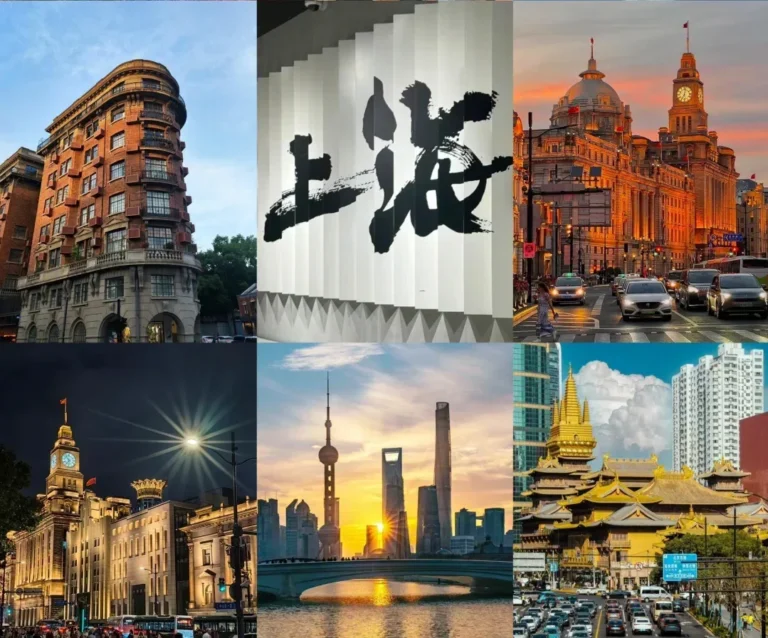
Start around Wukang Building (武康大楼).
The distinctive ship-shaped apartment building, designed by architect László Hudec and completed in 1924, is one of Shanghai’s most recognizable historic residential buildings.
It is worth seeing.
But don’t spend the next two hours following the crowd and photographing every storefront on Wukang Road.
Use Wukang Building as the gateway, not the entire walk.
Continue along Wukang Road briefly before turning toward Wuyuan Road (五原路). Wuyuan Road still has cafés and small businesses, but once you move away from the main photo zones, its residential character becomes much easier to notice.
Continue toward Hunan Road (湖南路).
This is where the walk becomes less about “things to see” and more about Shanghai itself: mature plane trees, compound walls, historic residences and long stretches with relatively little commercial activity.
The atmosphere also changes dramatically by season. Spring brings new leaves, summer creates dense shade, autumn warms the streets with color, and winter reveals architectural details normally hidden behind foliage.
Yes—but understand what you are going there for.
Anfu Road (安福路) is no longer a secret neighborhood street. It is fashionable, highly photographed and especially busy on weekends.
That doesn’t make it worthless.
It simply works better as the energetic ending to a quieter walk rather than as your definition of the entire former French Concession.
| Street | Character | Best For | Typical Crowd |
|---|---|---|---|
| Wukang Road | Iconic, photogenic | Architecture | High |
| Wuyuan Road | Residential, mixed-use | Slow walking | Low–Medium |
| Hunan Road | Leafy, quieter | Atmosphere | Low |
| Anfu Road | Trendy, commercial | Cafés, people-watching | High on weekends |
Local strategy: Don’t try to photograph every famous building. Pick one or two landmarks, then spend the rest of the walk looking down side streets.
If cafés are part of the reason you’re exploring this neighborhood, pair the walk with TripChina’s Shanghai Coffee Guide.
Best for: History, traditional architecture, first-time cultural visitors
Walking time: About 2.5–4 hours
Difficulty: Easy
Best time: Weekday morning
Shanghai’s Old City is often reduced to Yu Garden.
That misses the point.
The more interesting story is how a walled Chinese city gradually became part of modern Shanghai.
Start around Dajing Pavilion (大境阁) and the surviving section of Shanghai’s old city wall.
Shanghai’s Old City was once enclosed by a defensive wall built during the Ming era. Most of the wall disappeared as the city modernized, leaving only limited surviving sections.
That makes Dajing Pavilion interesting less because of its size than because of what it represents: a physical reminder that Chinese Shanghai existed here long before the skyline most visitors associate with the city.
Do not build your route around entering Shanghai Wenmiao (上海文庙) without checking its current status first.
The Shanghai Confucian Temple closed for a major renovation project in October 2021. Older travel guides may therefore describe visitor experiences or the old-book market that no longer reflect current conditions.
As of September 2026, I would treat entry as something to verify shortly before visiting rather than as a guaranteed stop.
You can still walk through the surrounding Old City neighborhood.
Yes—but don’t arrive expecting an untouched ancient district.
Shanghai’s Old City has undergone extensive redevelopment, restoration and neighborhood renewal.
Treat this section as a walk through layers of old and new Shanghai rather than as a perfectly preserved “ancient town.”
That expectation makes the route much more interesting.
Yes.
But make one distinction before you arrive:
Yu Garden (豫园) is the historic classical Jiangnan garden.
Yuyuan Bazaar and the surrounding commercial streets are the busy shopping, restaurant and tourist district around it.
They are not the same thing.
If Yu Garden itself is your priority, I prefer visiting the garden earlier and then walking outward through the Old City. It reduces the chance that the busiest attraction on your route falls right in the middle of the day.
For current admission details and visiting strategy, see TripChina’s Yu Garden Shanghai Guide.
Best for: First-time visitors, photographers, architecture
Walking time: About 3–4.5 hours with stops
Difficulty: Easy
Best time: Afternoon into early evening
If the French Concession shows Shanghai through residential streets, Suzhou Creek shows it through water and architecture.
This is the route I would choose for someone who wants recognizable Shanghai without spending the entire walk inside the Bund’s busiest pedestrian corridor.
Start at Tiantong Road Station (天潼路站) and walk toward the Shanghai General Post Office Building and Shanghai Postal Museum.
The General Post Office Building was completed in 1924 and now houses the museum.
As of September 2026, the official Shanghai tourism listing gives the museum’s public opening schedule as:
• Wednesday, Thursday, Saturday and Sunday
• 9:00 AM–5:00 PM
• Last admission at 4:00 PM
This is worth checking because older Shanghai guides frequently list museum schedules that no longer match official visitor information.
If you arrive on a closed day, the building itself is still worth seeing from outside.
Walk eastward along the creek.
Warehouses, bridges, former commercial buildings and early-20th-century architecture appear one after another.
Unlike the main Bund promenade, the visual rhythm keeps changing.
One moment you are looking at an older façade. A few minutes later, modern Pudong appears behind a historic bridge.
Shanghai’s current waterfront plans continue to improve walking and cycling connections, public spaces, cultural venues and visitor services along Suzhou Creek.
One of my favorite sections is around Zhapu Road Bridge (乍浦路桥) and the approach to Waibaidu Bridge (外白渡桥).
Here, older architecture, Suzhou Creek and the Pudong skyline can appear within the same view.
Continue to Waibaidu Bridge and you have an easy choice: turn south toward the Bund or continue exploring the Hongkou side of the waterfront.
That flexibility is one reason I prefer this route to simply walking up and down the Bund.
If you still want the classic waterfront afterward, continue with TripChina’s Bund Shanghai Guide rather than making the Bund your entire walk.
Best for: Contemporary art, architecture, families, cycling
Walking time: About 3–5 hours depending on museum visits
Difficulty: Easy and largely flat
Best time: Weekday afternoon
West Bund feels almost like a different city from the former French Concession.
There are fewer intimate lanes and more open spaces: converted industrial sites, major cultural buildings, lawns and long Huangpu River views.
A practical sequence is:
TANK Shanghai → West Bund Museum → riverside public space → Long Museum West Bund → surrounding waterfront
The important thing is not to treat every museum as compulsory.
Pick the exhibition you actually want to see and use the waterfront itself as the connection between venues.
A useful new addition is the West Bund Wander Line.
The electric sightseeing shuttle began trial operations on August 1, 2026, initially covering an approximately 800-meter demonstration section between Start Museum and Long Museum West Bund.
As of September 2026, the trial operates from 1:00–5:00 PM Tuesday through Sunday, with free rides requiring advance reservations through the “Life WestBund” (西岸生活) WeChat mini program. The announced trial runs through the end of October, so visitors traveling later should check whether the service has changed.
You do not need the shuttle to complete the walk.
But it can make the area easier for families, older travelers or anyone who wants to alternate between walking and short rests.
Museum exhibitions, admission prices and opening schedules rotate, so check the specific exhibition you want rather than relying on a fixed “West Bund museum price.”
Best for: Slow travel, solo walking, neighborhood atmosphere
Walking time: About 1.5–2 hours
Difficulty: Easy
Best time: Morning or late afternoon
Yongjia Road is the antidote to an attraction-heavy Shanghai itinerary.
There isn’t a dramatic “must-see” moment.
That is exactly why it works.
Expect old apartment buildings, villas, garden walls, plane trees, neighborhood businesses and glimpses of everyday residential life.
Some buildings have historical associations, but many remain private residences.
That creates an important etiquette rule: admire residential architecture from public streets and do not enter private compounds simply because a building appeared on Instagram, Xiaohongshu or a travel blog.
Shanghai’s historic neighborhoods are not outdoor museums.
People still live here.
Choose Wukang Road when you want recognizable architecture and a lively street scene.
Choose Yongjia Road when the point of the walk is simply walking.
If you have already spent a day chasing Shanghai’s headline attractions, this is the route most likely to make the city feel slow again.
Best for: Literature, history, repeat visitors
Walking time: About 3–4 hours
Difficulty: Easy
Best time: Weekday
Hongkou deserves more attention than it usually gets on first-time Shanghai itineraries.
It brings together two particularly important historical layers: the experience of Jewish refugees in Shanghai during the 1930s and 1940s and the modern Chinese literary world associated with Lu Xun.
Begin around Tilanqiao (提篮桥).
During World War II, the district became a refuge for Jews fleeing Europe. The protected Tilanqiao historical area contains dozens of Jewish heritage sites, and the Shanghai Jewish Refugees Museum centers on the former Ohel Moishe Synagogue.
This is one of those Shanghai neighborhoods where walking between places matters almost as much as the individual attractions.
Continue toward Lu Xun Park (鲁迅公园) and North Sichuan Road.
Lu Xun spent the final decade of his life in Hongkou, and many locations associated with his daily life and literary world remain concentrated here.
In August 2026, Hongkou introduced new “Meet Mr. Lu Xun” City Walk itineraries. One official route links Lu Xun Park, the 1927 Lu Xun & Uchiyama Memorial Bookstore, Lu Xun’s Former Residence, Zhapu Road, The Inlet and North Suzhou Road.
This is a rare case where a good independent walking route now overlaps naturally with a newly promoted official City Walk.
Shanghai Literature Museum officially opened to the public on August 27, 2026.
Located in Hongkou, it combines a new main building with three protected historic buildings and explores Shanghai literature through permanent and temporary exhibitions.
For travelers interested in literary Shanghai, this makes Hongkou significantly more compelling than it was even a year ago.
Best for: Food travelers, repeat visitors, people tired of sightseeing checklists
Walking time: About 3–5 hours with meals
Difficulty: Easy
Best time: Morning
This route has a different rule:
The restaurants are stops. The neighborhood is the route.
Don’t build your walk around trying to hit five viral restaurants in a row.
Shanghai restaurants change opening hours, reservation rules and sometimes locations much faster than historic buildings do.
Instead, use Jing’an, Yuyuan Road, Fumin Road and the western former concession as your framework.
Look for Shanghai food categories rather than one compulsory restaurant:
• xiaolongbao — soup dumplings
• shengjian — pan-fried buns
• wontons
• scallion-oil noodles
• Shanghai-style braised dishes
• seasonal pastries and breakfast snacks
Queues are not proof that a restaurant is better.
I would choose two substantial food stops and one snack rather than spending half the walk standing in lines.
For current restaurant ideas and dishes, use TripChina’s Shanghai Food Guide rather than turning a walking route into a fixed restaurant checklist.
| If You Want… | Choose | Why |
|---|---|---|
| One route on a first trip | French Concession | Best balance of architecture and atmosphere |
| Photography + skyline | Suzhou Creek | Historic foreground + modern Shanghai |
| Traditional Chinese Shanghai | Old Town | Old City history + Yu Garden |
| Contemporary art | West Bund | Museums + open waterfront |
| A quiet neighborhood | Yongjia Road | Walking itself is the attraction |
| Deeper modern history | Hongkou | Jewish refugee + literary heritage |
| Food as the main event | Jing’an | Easy to connect food stops on foot |
| Traveling with older family | West Bund / French Concession | Flat and relatively easy to shorten |
| Already visited Shanghai | Hongkou / Yongjia Road | Less repetitive than headline sights |
Do not try to finish three or four full routes.
A better combination is:
Morning: French Concession
Take the metro.
Late afternoon: Suzhou Creek → Waibaidu Bridge
That gives you two very different Shanghais without wasting hours walking through less interesting connecting streets.
You can.
That doesn’t mean you should.
Shanghai is enormous, and a technically walkable connection is not automatically an interesting walk.
Use the metro between neighborhoods and save your legs for the parts of Shanghai where walking actually reveals something.
Spring and autumn are generally the easiest seasons for long outdoor walks.
March through May usually brings greener streets and many comfortable walking days.
Tree-lined neighborhoods such as the former French Concession are particularly attractive, although rain is possible, so a compact umbrella is useful.
Summer can be hot, humid and stormy.
Schedule longer walks in the morning or later afternoon rather than around midday, and check official weather warnings before committing to a long waterfront route.
If a typhoon, thunderstorm or extreme-weather warning is active, change the plan rather than trying to “complete” the route.
October and November generally offer an appealing combination of more comfortable temperatures and attractive street scenery.
The former concession’s plane-tree-lined roads are particularly photogenic during this period.
Yes.
Shanghai is much milder than northern Chinese cities, although damp wind can make waterfront areas feel colder than the thermometer suggests.
Winter also has one advantage for architecture lovers: bare trees reveal façades that are partly hidden during summer.
Absolutely.
Do not measure Shanghai only in walking distance.
The city is huge. The metro lets you create a day made of several good walks instead of one endless walk.
Yes.
Keep both English and Chinese names for important stations, streets and landmarks.
For example:
Wukang Building — 武康大楼
Waibaidu Bridge — 外白渡桥
Lu Xun Park — 鲁迅公园
Tiantong Road Station — 天潼路站
This makes searching local map apps and asking for directions much easier.
Treat them as dynamic.
Museums may have unusual weekly closing days, and temporary exhibitions can follow different schedules.
The Shanghai Postal Museum is a perfect example: its current official schedule is Wednesday, Thursday, Saturday and Sunday—not the standard Tuesday–Sunday pattern many travelers expect.
Check important indoor stops again shortly before setting out.
A beautiful historic villa is not automatically a tourist attraction.
Many buildings in Shanghai’s historic districts remain private homes.
Photograph them from public space unless visitor access is clearly permitted.
Yes.
A City Walk is a framework, not a reservation.
In heavy rain or extreme heat, replace a long Yongjia Road or waterfront walk with a museum-heavy area such as West Bund, or shorten the outdoor section and use the metro.
Do I need a local guide for these Shanghai City Walks?
No. All seven routes can be done independently if you are comfortable using the metro and a map app. A guide becomes more valuable for travelers who want detailed architectural, Jewish heritage or modern Chinese literary interpretation rather than basic navigation.
Can I bring luggage on a Shanghai City Walk?
It is possible, but not recommended for routes involving residential lanes or several hours outdoors. Shanghai has expanded luggage-storage services at cultural and tourist sites, but availability differs by location, so check your starting area before relying on it.
Are Shanghai City Walks suitable for children?
West Bund is usually the easiest choice because of its open waterfront spaces and flexible distances. The French Concession can also work well, but children may find architecture-focused sections less engaging unless you combine the walk with food, cafés or parks.
Do I need cash for a self-guided Shanghai walking day?
It is sensible to carry a small backup amount, but mobile payment is widely used in Shanghai. Set up your preferred payment method before starting a long walk so you are not troubleshooting payments when you want a drink, snack or metro ride.
Can I photograph people during a Shanghai City Walk?
Street photography from public spaces is generally part of the City Walk experience, but avoid intrusive close-up photography of residents without permission. This matters particularly on Yongjia Road and other residential routes where everyday life—not a staged tourist attraction—is part of what you are seeing.
There isn’t one route that wins for everyone.
But there are two unusually safe choices.
Choose the French Concession if you want the Shanghai many travelers imagine before arriving: historic façades, mature trees, cafés and streets made for wandering.
Choose Suzhou Creek if you want something more cinematic—the contrast between industrial and early-20th-century Shanghai and the modern skyline.
And if you have already seen both?
Walk Hongkou.
The expansion of Shanghai’s official City Walk routes and the opening of the Shanghai Literature Museum in 2026 reinforce something travelers often discover only after their first visit:
Shanghai becomes more interesting once you stop treating the Bund as the center of every walk.
Shanghai Municipal Government — Shanghai City & Tourism Information
Shanghai Municipal Government — “Meet Mr. Lu Xun” City Walk
Official Shanghai Travel Website — Shanghai General Post Office Building
Shanghai Municipal Government — West Bund Wander Line
Last researched: September 5, 2026. This guide was cross-checked against current Shanghai municipal government and official tourism information, with particular attention to 2026 changes affecting Hongkou, Suzhou Creek, West Bund and museum visits. Time-sensitive details—including the Shanghai Postal Museum schedule, the West Bund Wander Line trial and the opening of Shanghai Literature Museum—were rechecked against current official sources. Museum hours, exhibitions, construction projects and temporary transport services can change, so important stops should be verified shortly before visiting.
TripChina.me creates practical China travel guides shaped by real local experience, helping independent travelers navigate transport, payments, food, neighborhoods, and the cultural details that make traveling in China easier and more meaningful. Find the guide for your destination at tripchina.me.