Our Location:
No. 99, Jiazi Road, Chengdu

 authorChris Lee
Riding the Beijing Subway is easier than many first-time visitors expect. If you have an eligible contactless international bank card, you can tap directly at the fare gate—without buying a separate ticket or setting up a subway payment app.
The mistakes that waste tourists' time usually happen elsewhere: a failed payment, the wrong station exit, an inconvenient transfer or an airport route that does not match their destination.
Here's what foreign visitors actually need to know about subway payments, English maps, fares, airport connections and reaching Beijing's major attractions.
The simplest option for many foreign visitors is to tap an eligible contactless bank card at the entrance gate and use the same card when exiting.
Beijing's rail transit network supports eligible contactless cards from five major payment networks:
Card eligibility depends on the issuing bank, card configuration and payment network. A supported logo does not guarantee that every card will work.
If you cannot tap directly, buy a single-journey ticket or use a supported mobile transit-payment option.
Before your first ride, remember these essentials:
| Tourist Question | Quick Answer |
|---|---|
| Can foreigners use credit cards on the Beijing Subway? | Yes, eligible contactless cards are supported |
| Do I need Alipay or WeChat Pay? | No, not if your supported card works directly |
| Do I need a Chinese phone number? | Not for direct physical-card tap-to-ride |
| Can I buy a regular subway ticket? | Yes, from available ticket machines or station counters |
| Is there a Beijing Subway map in English? | Yes, English route information is available |
| What is the normal starting subway fare? | ¥3 for journeys up to 6 km on regular urban rail |
| Can I use the subway from Beijing's airports? | Yes, both PEK and PKX have rail connections |
| Can I bring luggage? | Yes, within official size and weight restrictions |
| What is the most common navigation mistake? | Leaving through the wrong station exit |
TripChina Verdict: Start with a compatible contactless bank card, keep one backup payment method and check the correct station exit before you arrive. You do not need to master the entire network before your first journey.
Foreign tourists now have several practical ways to pay for Beijing's subway.
The easiest method depends on whether you have a compatible contactless card, prefer a physical ticket or already use a mobile payment app in China.
Yes. Foreign visitors can use eligible contactless international credit or debit cards directly at Beijing Subway fare gates. Supported payment networks include Visa, Mastercard, American Express, JCB and UnionPay, subject to card and issuer eligibility. A separate subway ticket or payment app is not required when direct card payment works.
The five supported payment networks are China UnionPay, Mastercard, Visa, JCB and American Express.
Beijing's official guidance confirms that the payment system supports direct gate access as well as eligible ticket purchases and top-ups.
For Beijing Subway Visa and Mastercard payment, the process is simple. If your card is eligible for contactless travel, you can tap directly at the gate without first activating a transport QR code.
Use one payment credential consistently. If you enter with a physical bank card, do not assume tapping its digital-wallet version at the exit will create the same travel record.
A foreign-transaction fee or currency-conversion charge may still be applied by your bank.
Important: The system supports five payment networks, but eligibility differs by card product and issuer. Carry an alternative rather than relying on one card exclusively.
No separate ticket or subway app is needed when your eligible contactless bank card works at the gate.
This is particularly useful for short-term visitors who do not want to register for multiple local services just to take a few subway journeys.
| Payment Method | Best For | Main Limitation |
|---|---|---|
| Contactless international bank card | Most short-term visitors with compatible cards | Individual card or issuer may not work |
| Single-journey ticket | Travelers wanting a straightforward backup | Requires purchasing a ticket |
| Alipay transit QR code | Visitors already using supported mobile transit features | Activation and account restrictions may apply |
| WeChat-based transit option | Travelers with an eligible transit account | Availability can vary by account and service |
| Yikatong or other supported transport card | Frequent riders or travelers preferring stored value | Additional setup or purchase |
For general shopping, dining and mobile-payment preparation, see our China payment guide for foreign visitors.
You can use the Beijing Subway without setting up Alipay or WeChat Pay if you have a compatible bank card for direct contactless entry.
Riding the Beijing Subway without a Chinese phone number is possible when you use an eligible physical contactless bank card. Direct card entry does not require registering a Chinese mobile number, although some mobile transit apps and QR-code services may have their own account requirements.
This does not mean every Beijing transport service uses the same payment system. Subway fare gates and city buses can have different payment arrangements.
If you plan to travel throughout China, mobile payments may still be useful for shops, restaurants, taxis and other services.
Some compatible NFC-enabled mobile devices can be used for subway payments, subject to the underlying card and wallet configuration.
However, do not assume every Apple Pay, Google Wallet or smartwatch setup works simply because a physical card from the same payment network is supported.
For your first ride, carrying a compatible physical contactless card is a sensible backup.
If the mobile device fails or runs out of battery, seek help at the station rather than attempting to leave through the gate with an unrelated card.
Alipay transit QR functionality can be useful if it is available for your account and already works reliably.
However, foreign visitors should not assume that linking a foreign bank card to Alipay automatically activates every local transportation QR feature.
The regular Alipay payment QR code and a city's dedicated transit QR code may serve different purposes.
If your goal is simply to ride Beijing's subway, direct contactless card payment may be a simpler option.
For more information about account setup, see how foreigners use Alipay in China.
A failed card tap or QR code does not necessarily mean you cannot ride.
The best solution depends on where the payment failed.
| Problem | Possible Cause | What to Do |
|---|---|---|
| Foreign card rejected at entrance | Issuer, contactless or card eligibility issue | Try another supported card or buy a single-journey ticket |
| Alipay transit QR will not activate | Account eligibility, verification or service restriction | Use a compatible contactless bank card or ticket |
| QR code does not appear | App, connection or account issue | Restore connectivity or switch payment method |
| Gate does not read phone wallet | Wallet or NFC compatibility issue | Try an eligible physical card or ask station staff |
| Exit gate will not open | Entry record or fare issue | Go to the station service counter |
| Phone battery dies during journey | Mobile transit credential unavailable | Ask station staff to resolve the journey |
| Wrong card used on exit | Entry and exit credentials may not match | Stop and request assistance rather than repeatedly tapping |
First, check that your card supports contactless transactions and that your issuing bank permits the payment.
If it is rejected, do not repeatedly tap the same card without understanding the problem.
Switch to another eligible card or purchase a single-journey ticket.
Station staff can help with payment and gate issues.
Do not confuse general Alipay merchant-payment functionality with a working subway transit code.
If the transport function is unavailable or cannot be activated, try a supported contactless bank card or use the station's ticket-purchase options.
You do not need to solve an Alipay account problem before making an ordinary subway journey.
Ask station staff for help.
The problem may relate to the recorded entry, the payment credential or an unsettled fare.
Avoid switching from the physical bank card used for entry to a different mobile wallet or bank card unless staff instruct you to do so.
Single-journey tickets remain useful when direct bank-card entry is unavailable or when you prefer a separate ticket.
Beijing's official visitor guidance describes ticket machines with an English-language option and staffed ticket counters.
At a machine:
Supported payment methods may include cards, Alipay, WeChat Pay or cash, depending on the ticket machine and station arrangements.
If a machine is unavailable or does not accept your payment method, ask at the staffed service counter.
The Beijing Subway ticket price starts at ¥3 for regular urban rail journeys of up to 6 km. Fares increase with travel distance, while airport express services have separate ticket prices.
| Travel Distance | Regular Subway Fare |
|---|---|
| Up to 6 km | ¥3 |
| Over 6 km to 12 km | ¥4 |
| Over 12 km to 22 km | ¥5 |
| Over 22 km to 32 km | ¥6 |
| Beyond 32 km | Generally +¥1 per additional 20 km |
These are regular urban-rail fare bands. Airport express lines use separate fares, and special services may have different pricing.
For most tourists, ordinary subway trips are inexpensive compared with long taxi journeys.
The published Beijing Subway one-day pass price is ¥20, but it is not automatically the best deal for tourists. A pass only makes sense if your planned eligible subway journeys would otherwise cost more. Check current purchasing availability and validity conditions before relying on it.
| Pass Duration | Published Price |
|---|---|
| 1 day | ¥20 |
| 2 days | ¥30 |
| 3 days | ¥40 |
| 5 days | ¥70 |
| 7 days | ¥90 |
Check current purchase availability and validity conditions before relying on these passes. They are not automatically valid for airport express services.
For many short-stay tourists, paying for individual journeys can be simpler and cheaper than buying an unlimited pass.
Not necessarily.
A stored-value transport card may be convenient for frequent rides or travelers who prefer to keep a separate transport payment method.
However, if your international contactless bank card works directly, buying an additional card solely for subway entry may offer little practical benefit.
Choose based on the services you will actually use, rather than purchasing a transport card automatically.
Beijing's subway network is extensive, but foreign visitors do not need to memorize every line before arriving.
English station names, route information and navigation apps make ordinary journeys relatively straightforward.
For an official English-language network map and first/last train information, use the Beijing Subway official English website.
Because the network continues to change, avoid relying on an old downloaded map without checking whether it includes recent extensions and transfer changes.
For each journey, identify five things:
Starting station → Destination station → Line direction → Transfer station → Exit
The direction matters as much as the line number.
Before boarding, compare the next station displayed on the platform with the next station shown in your route planner.
On loop lines or routes with multiple transfer options, boarding in the wrong direction can add unnecessary travel time.
One of the easiest mistakes to make is arriving at the correct station but leaving through the wrong exit.
Large Beijing subway stations can have multiple exits on different sides of major roads, intersections or commercial complexes.
Before leaving the paid area:
The closest exit on a map may not always be the easiest walking route.
Amap is generally a useful option for local subway directions, transfer choices and station-exit information in mainland China.
Baidu Maps can also provide detailed local navigation.
Google Maps should not be your only navigation reference for Beijing.
For setup and practical alternatives, see our navigation app guide for foreign travelers in China.
The most useful subway station is not always the one geographically closest to an attraction.
Large attractions can have separate entrances, security arrangements and long pedestrian approaches.
| Beijing Attraction | Useful Subway Station | Line | What to Know |
|---|---|---|---|
| Forbidden City / Palace Museum | Tian'anmen East or Tian'anmen West | Line 1 | Check current access restrictions and walk toward the permitted Meridian Gate approach |
| Tiananmen Square area | Tian'anmen East / West or Qianmen, depending on destination | Lines 1 / 2 / 8 | Security and pedestrian access arrangements may change |
| Temple of Heaven | Tiantandongmen (Temple of Heaven East Gate) | Line 5 | Convenient for the east entrance |
| Summer Palace, North Palace Gate | Beigongmen | Line 4 | Match the station to the entrance you plan to use |
| Summer Palace, East Palace Gate | Xiyuan | Line 4 | Different approach from Beigongmen |
| Qianmen Street | Qianmen | Lines 2 / 8 | Useful for the historic shopping and pedestrian district |
| Nanluoguxiang | Nanluoguxiang | Lines 6 / 8 | The hutong area is best explored on foot |
| Universal Beijing Resort | Universal Resort | Lines 7 / 1 | Follow the resort approach and current station signage |
This table is a planning reference, not a guarantee that a particular exit or pedestrian corridor will always be available.
To reach the Forbidden City by Beijing Subway, Tian'anmen East and Tian'anmen West on Line 1 are useful starting points. However, the Palace Museum's main visitor entrance is the Meridian Gate (Wu Men), not the subway exit itself. Allow time for walking and any required security checks or access restrictions around the Tiananmen area.
However, the Forbidden City's principal visitor entrance is the Meridian Gate (Wu Men), and reaching it may involve additional walking, security arrangements and restrictions around the Tiananmen area.
Do not assume that reaching the nearest subway station is the same as reaching the museum entrance.
If you plan to visit the Palace Museum, check the Forbidden City ticket-booking and passport guide before travel. Subway access does not replace any required attraction reservation.
You cannot take an ordinary Beijing Subway train directly to the visitor entrances at Badaling or Mutianyu. These Great Wall sections require different transport arrangements, such as intercity rail, buses or road transfers. The best route depends on which section you choose.
Badaling and Mutianyu require different transport plans.
For Badaling, a rail journey using the appropriate railway service may be an option, but the ordinary urban subway itself does not run directly to the Great Wall entrance.
For Mutianyu, travelers typically need a bus, road transfer, organized transport or a combination of services.
The best choice depends on which section you intend to visit.
Compare the two major choices in our Badaling vs Mutianyu Great Wall guide.
For the Temple of Heaven's east entrance, Tiantandongmen station on Line 5 is a practical option.
The complex is large, so choose the entrance based on your planned walking route rather than simply selecting the first station suggested by a map.
Our Temple of Heaven visitor guide explains the attractions, entrances and suggested route in greater detail.
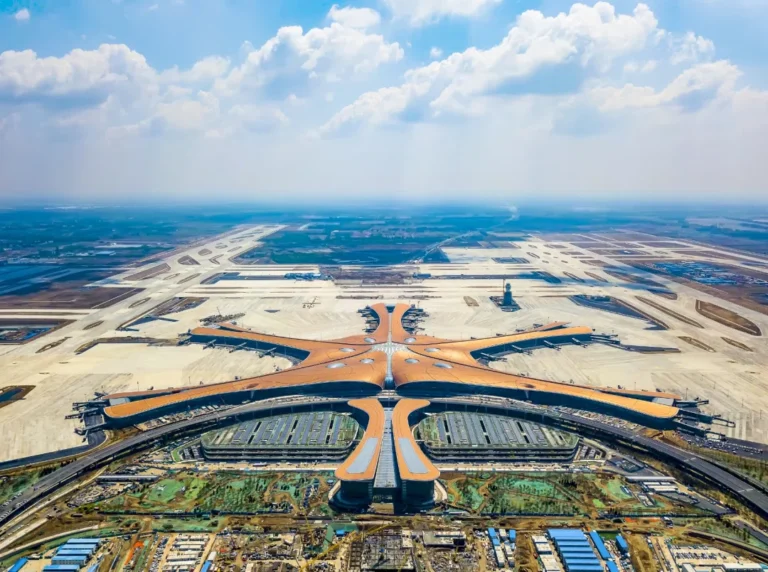
Beijing's airport express subway connections serve two different airports: Capital International Airport (PEK) and Daxing International Airport (PKX). The Capital Airport Express and Daxing Airport Express follow different routes and have separate fares, so choosing the correct airport line is essential before planning your transfer.
Do not assume that the route serving Capital Airport also serves Daxing Airport.
| Airport | Rail Connection | Main Planning Point |
|---|---|---|
| Beijing Capital International Airport (PEK) | Capital Airport Express | Compare transfers at the city end with your hotel location |
| Beijing Daxing International Airport (PKX) | Daxing Airport Express | Connects toward Caoqiao; onward city transport is usually needed |
The airport express lines are part of Beijing's broader rail transportation network, but they use separate fares and operating arrangements.
Eligible contactless payment cards are supported on the airport rail services covered by the official tap-to-ride system.
For solo travelers with manageable bags, an airport rail connection may be convenient.
For families with several suitcases, travelers with mobility limitations or hotels requiring awkward transfers, a direct taxi or DiDi ride may be preferable.
Compare the whole journey, including airport terminal walking, rail transfers and the distance from the final station to your hotel.
Our Beijing Airport to City Center transport guide compares PEK and PKX, airport rail, taxis and other transfers.
Beijing subway operating hours vary by line, station, direction and service schedule.
There is no single last-train time that applies to every subway journey.
Some lines start early in the morning, while last trains may run at different times depending on the direction and station.
For time-sensitive trips, check the official first-and-last-train tool rather than assuming that all routes run until a fixed hour.
Pay particular attention when:
Temporary extensions during busy travel periods should not be treated as permanent operating hours.
Yes. Normal tourist luggage is generally permitted within the official passenger restrictions.
Beijing's published rules specify a maximum carried-item weight of 30 kg, length of 1.8 m, and width or height of 0.5 m.
Even when your suitcase meets those limits, carrying large bags through crowded stations may still be uncomfortable.
If you have several heavy suitcases, consider a taxi or ride-hailing service.
Yes. Passengers and their belongings are subject to security screening before entering subway stations.
You may need to place your bag on an X-ray conveyor and follow staff instructions.
Allow extra time at busy transport hubs and during major travel periods.
Do not assume an item allowed on an international flight will automatically be permitted on Beijing's subway.
Selected Beijing subway stations have introduced luggage-storage services, but these are not available everywhere.
Availability, locker sizes, service hours and operating arrangements can vary.
Check the specific station before planning to leave luggage there while sightseeing.
The subway is often efficient for urban sightseeing, but it is not automatically the best choice for every journey.
A car may be more comfortable when:
A taxi or DiDi may save walking and transfers, although road congestion and variable fares can offset the advantage.
The useful comparison is not simply subway versus taxi.
It is total cost, walking distance, luggage, transfers and real door-to-door travel time.
If you want to use ride-hailing, see our DiDi guide for foreigners without a Chinese phone number.
| Common Mistake | Better Approach |
|---|---|
| Believing a Chinese bank account is required | Check direct tap-to-ride with an eligible foreign card |
| Assuming every foreign card will work | Carry a backup payment option |
| Activating too many transit apps | Start with the simplest supported payment method |
| Confusing merchant QR codes with transit QR codes | Use an eligible dedicated transport function |
| Entering and exiting with different credentials | Use the same card or payment credential |
| Using an outdated subway map | Check the current official network |
| Leaving by the wrong station exit | Verify the exit letter and walking route |
| Assuming the subway stops at the Forbidden City entrance | Allow for walking and security access arrangements |
| Treating the subway as a direct route to every Great Wall section | Plan intercity and road connections separately |
| Assuming PEK and PKX have the same airport train | Confirm the correct airport express service |
| Carrying several large suitcases during rush hour | Consider a car or a less crowded travel time |
| Assuming every line has the same last train | Check route-specific operating hours |
TripChina Tip: The most effective preparation is a working payment method, a reliable navigation app and the correct destination address—not memorizing dozens of subway lines.
Yes. Eligible contactless Visa, Mastercard, American Express, JCB and UnionPay cards are supported. Individual card and issuer restrictions may still apply.
No Chinese phone number is required when using an eligible physical contactless bank card directly at the gate. Some mobile-payment and transit-code services may have separate account requirements.
Each traveler should use a separate valid tap-to-ride payment credential. For another traveler without one, purchase an eligible ticket rather than repeatedly attempting to enter with the same card.
Try an eligible contactless bank card or buy a single-journey ticket. If the problem involves a journey already in progress, ask station staff for assistance.
Compatible NFC-enabled mobile devices may work, depending on the underlying card and payment configuration. Carry a physical card or another payment method as a backup.
Generally, yes. Major station signs and route information are bilingual. A locally integrated navigation app is especially useful for directions, transfers and exit selection.
Published regular ticket rules include a four-hour maximum within the paid area for a single journey. If you encounter an unusual delay or fare issue, consult station staff.
Ordinary luggage is permitted within official restrictions, and stations conduct security checks. The main practical difficulty is carrying large bags through crowded trains, stairs and long transfers.
It depends on the number and distance of your journeys. For many tourists, ordinary pay-per-trip fares are inexpensive, and airport express services are excluded from the regular multi-day pass arrangements.
No single ordinary urban subway ride reaches the popular Great Wall visitor entrances. Badaling and Mutianyu require different onward railway, bus or road arrangements.
This guide was developed for independent international travelers using Beijing Municipal Government, Beijing Subway and official visitor information. Priority was given to direct foreign-card payment, practical payment backups, station navigation, tourist connections, airport transfers and passenger rules. Card eligibility, operating hours, route access, payment services and station facilities can change, so check official information before time-sensitive journeys.
TripChina.me creates practical China travel guides shaped by real local experience, helping independent travelers navigate transport, payments, food, neighborhoods, and the cultural details that make traveling in China easier and more meaningful. Find the guide for your destination at tripchina.me.