Our Location:
No. 99, Jiazi Road, Chengdu

 authorChris Lee
Your Beijing trip starts the moment you leave baggage claim. Choose well and rail can get you into the city without touching Beijing traffic; choose badly and a simple airport transfer can become a long, expensive first evening.
This guide compares PEK and PKX by Airport Express, airport bus, taxi, DiDi and rail, with practical advice for foreign visitors, families, late arrivals and passengers carrying large luggage.
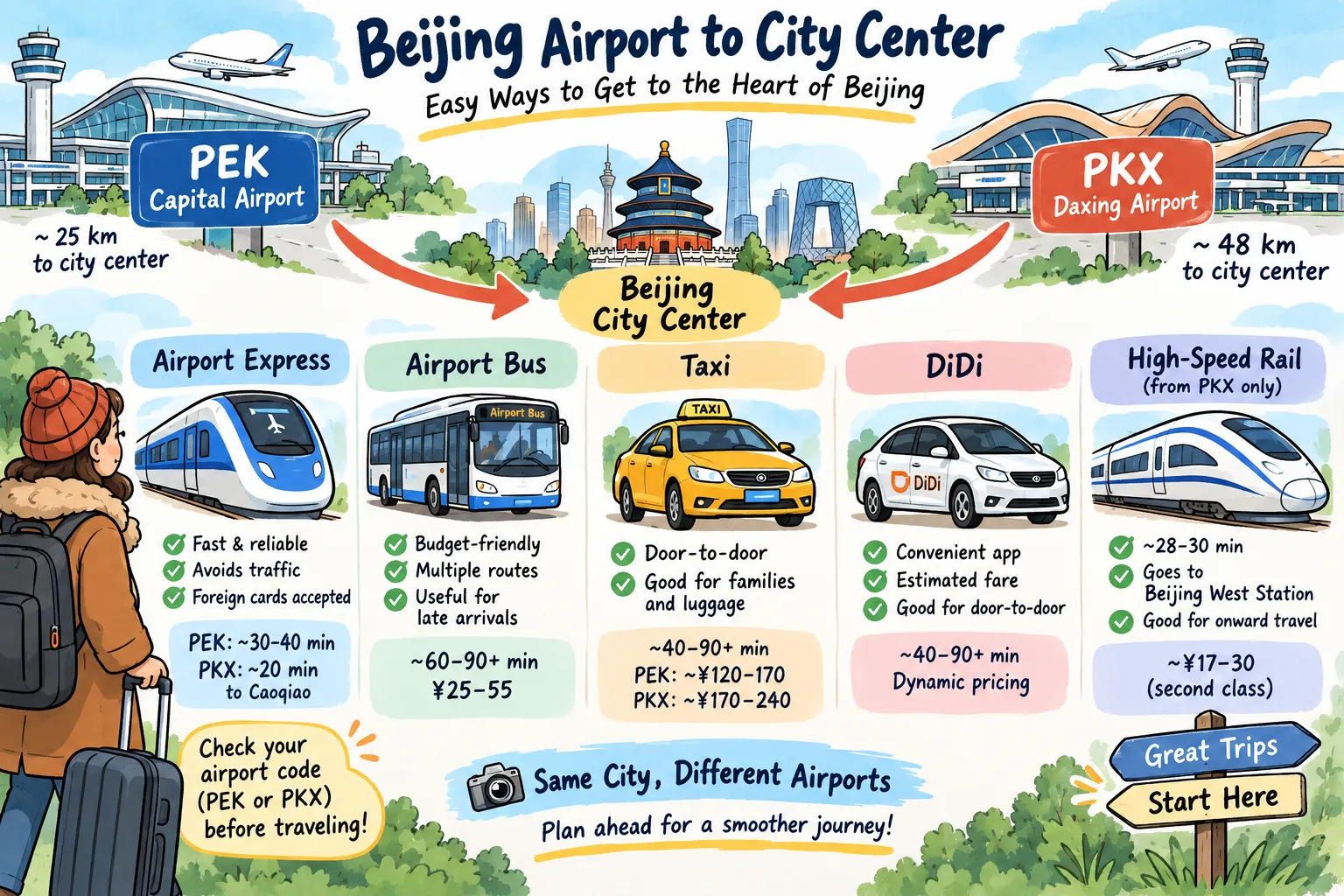
Two airports, two strategies. Beijing Capital International Airport (PEK) lies northeast of central Beijing and is roughly 25 km from the Wangfujing area. Beijing Daxing International Airport (PKX) lies much farther south, roughly 48 km from central Beijing, but its Airport Express reaches Caoqiao in about 20 minutes.
Always check the three-letter airport code on your ticket before planning transport. PEK and PKX are not interchangeable.
| Option | Airport | Typical Price | Travel Time | Best For |
|---|---|---|---|---|
| Airport Express | PEK | ¥25 | ~30–40 min | Solo/duo travelers, light luggage |
| Airport Express | PKX | ¥35 standard | ~20 min to Caoqiao | Fast, traffic-free transfer |
| High-Speed Rail | PKX | ~¥17–30 | ~28–30 min | Beijing West Station / onward rail |
| Airport Bus | PEK | ~¥25–55 | ~60–90+ min | Budget travelers near a bus stop |
| Airport Bus | PKX | ~¥25–55 | ~60–90+ min | Budget travelers; some international arrivals |
| Taxi | PEK | Often ~¥120–170 | ~40–90+ min | Families, luggage, late arrivals |
| Taxi | PKX | Often ~¥170–240 | ~50–90+ min | Families, luggage, late arrivals |
| DiDi | PEK / PKX | Dynamic | ~40–90+ min | App users wanting door-to-door travel |
For Airport Bus, budget roughly ¥25–55; for High-Speed Rail, budget roughly ¥17–30 in second class.
All prices and durations are planning estimates. Actual fares and travel times shift with traffic, exact destination, tolls, vehicle type and ride-hailing demand.
TripChina Verdict: For most first-time travelers with manageable luggage, use the Airport Express. Choose a taxi or DiDi when door-to-door convenience matters more than price—especially with children, several large suitcases or a very late arrival. Airport buses are increasingly useful in 2026 because Beijing has expanded late-night and 24-hour services.
If you are arriving by road on Friday from roughly 17:00–19:00, allow extra time for heavy expressway congestion. When practical, the Airport Express is usually the safer choice during that window.
For the regular subway after your airport transfer, see TripChina's Beijing Subway Guide for Foreigners.
Usually, yes.
The Capital Airport Express connects Terminal 3 and Terminal 2 with Sanyuanqiao, Dongzhimen and Beixinqiao.
As of September 2026, the official Capital Airport information lists:
Best for: one or two travelers with ordinary luggage, especially if your hotel is near a convenient metro line.
Trade-off: the Airport Express does not take you directly to Wangfujing, Qianmen, Sanlitun or most hotels. You usually need one additional subway, taxi or short DiDi ride.
If you have several large suitcases, a stroller or young children, that extra transfer may matter more than the ¥25 fare saving.
Yes—this is one of the biggest improvements for foreign visitors.
As of September 2026, Beijing's rail network supports contactless tap-and-go payment at fare gates using eligible UnionPay, Mastercard, Visa, JCB and American Express cards. The coverage includes both airport express lines.
You do not need to buy a single-journey ticket or set up Alipay or WeChat Pay first if your eligible contactless card works.
For an arriving foreign visitor, the simplest PEK rail sequence can now be:
collect luggage → follow Airport Express signs → tap eligible overseas card → ride
Keep another payment method available in case your particular card is declined.
Take the airport bus when a current route stops close to your hotel or when you arrive too late for the Airport Express.
Beijing significantly expanded airport-bus services during 2026. From July 31, the Capital Airport–Beijing West Railway Station route became a 24-hour service, while buses to Beijing South and Fengtai stations were extended to 02:00 (check current times for your travel date).
This makes old advice such as “after 23:00 you only have taxis” increasingly inaccurate.
Best for: budget travelers whose destination is genuinely close to an airport-bus stop.
Trade-off: buses are traffic-dependent and are not door-to-door. Check the current stop list before boarding instead of choosing a route simply because its name contains “Beijing Station” or another familiar district.
The official airport-bus hotline is 010-64378900.
An official taxi is one of the easiest options when you have children, several bags or a hotel that requires awkward subway transfers.
Use only the designated taxi queue.
For planning, a central-city ride often falls roughly in the ¥120–170 range, although congestion, exact distance, nighttime pricing and other charges can change the fare.
Before getting in, save:
hotel name in Chinese + complete Chinese address + hotel telephone number
Take a screenshot as well. If mobile data fails, you can still show the driver the address.
If paying cash, carry smaller notes rather than depending on a driver to break a ¥100 bill.
DiDi is useful when you want an estimated fare, app-based destination entry and a digital trip record.
Set it up before you actually need the ride. Do not wait until you are standing in an airport parking structure with weak connectivity and several suitcases.
TripChina's How to Use DiDi in China Without a Chinese Number explains the foreign-user setup process.
You should also have working mobile data. TripChina's China eSIM vs SIM Card Guide compares the main connectivity options for international travelers.
Trade-off: airport ride-hailing pickup areas can be less intuitive than the official taxi line. Follow the current pickup instructions in the app and airport signage rather than an old blog telling you to stand at one permanent pillar or parking bay.
For reaching Caoqiao without road traffic, yes.
The Daxing Airport Express connects the terminal with Daxing Xincheng and Caoqiao, where you can continue into Beijing's urban subway network.
The standard fare from Daxing Airport to Caoqiao is ¥35, while business class is ¥50.
For most passengers, the key advantage is not merely the approximately 20-minute train ride. It is avoiding road congestion entirely.
Best for: solo travelers, couples and anyone whose destination connects conveniently from Caoqiao.
Trade-off: the airport train gets you to Caoqiao—not directly to Wangfujing, Sanlitun, Qianmen or your hotel.
Do not treat “19–20 minutes to Caoqiao” as “20 minutes to my hotel.”
After arriving at Caoqiao, you still need to transfer into Beijing's urban metro network or use a car.
The interchange can involve a meaningful walk. If you are traveling at peak time with large luggage, a stroller, young children or an older relative, the fastest train on paper may not be the easiest trip in practice.
In those cases, compare:
PKX Airport Express + metro transfer
with:
airport bus / taxi / DiDi directly toward your district
A family of four with four full-size suitcases may reasonably pay more to avoid the transfer.
Only when Beijing West Railway Station actually helps you.
The Beijing–Xiong'an intercity railway connects Daxing Airport with Beijing West Railway Station, with the airport run typically around 28–30 minutes.
This option is especially useful if:
It is not automatically the best option for travelers staying around Wangfujing, Sanlitun, Dongcheng or eastern Beijing. You may save time on the airport leg only to add another transfer afterward.
Foreign passengers can purchase China Railway tickets using a valid passport through the 12306 English website/app or railway ticket counters.
For the full booking process, see TripChina's China Train Tickets for Foreigners: 12306 vs Trip.com.
For qualifying international and regional arrivals, yes—but it is a temporary campaign with specific rules.
Until October 31, 2026, passengers arriving at PKX on international flights or flights from Hong Kong, Macao or Taiwan can receive a free ride on six designated airport-bus routes.
The process is:
The free service is available during the published promotion period and subject to route and ticket availability.
Free seats are not guaranteed during peak or holiday periods.
Older route numbering is no longer reliable.
An official March 2026 notice said the Daxing Airport–Beijing South Railway Station Night Line 2 would stop operating from April 7, while Night Line 1 to Zhongguancun was extended.
Later in 2026, Beijing reorganized parts of the Daxing airport-bus network again, including expanded overnight services.
The practical rule is:
Do not rely on an old route number or an old “Night Line 2” destination. Check the current airport-bus board or official platform on the day you arrive.
For families and heavy luggage, often yes.
PKX is much farther from central Beijing than PEK, so road transfers usually cost more and take longer. But the trade-off is simple: you avoid Caoqiao, metro transfers and carrying luggage through stations.
Use the official taxi area for a street taxi, or follow the current app pickup instructions for DiDi.
If your hotel is in Wangfujing, Sanlitun or another central/eastern district and you have several large suitcases, compare the total family cost before automatically choosing rail.
Late arrival no longer automatically means “take an expensive taxi.”
As of September 2026, Beijing has expanded airport buses substantially:
That means a solo late-night traveler should compare the current airport bus before paying for a taxi.
For a family with children or heavy bags, an official taxi or DiDi may still be worth the premium.
If your flight lands extremely late and you are exhausted, staying near the airport is also a legitimate choice. There is little value in saving ¥100 if it turns your first night into a two-hour luggage transfer.
| Mistake | Why It Causes Problems | Better Approach |
|---|---|---|
| Confusing PEK and PKX | Airports are far apart | Check the airport code before booking |
| Following an unsolicited driver | Fare and vehicle status may be unclear | Use official taxi / DiDi / bus / rail |
| Assuming PKX Express means “20 min to downtown hotel” | Train ends at Caoqiao | Add transfer time |
| Taking PKX high-speed rail for any central hotel | It goes to Beijing West Station | Use only when Beijing West helps your trip |
| Using an old night-bus route number | Routes changed several times in 2026 | Check current airport-bus information |
| Not saving your hotel address offline | Data may fail after landing | Screenshot Chinese hotel name + address |
| Assuming Alipay is required for Beijing rail | Eligible overseas cards can tap directly | Use contactless card at fare gate |
| Relying on one payment method | Individual cards can fail | Keep a second card or RMB backup |
| Booking taxi/DiDi Friday 17:00–19:00 | Airport expressways can hit heavy gridlock and journeys may stretch well beyond normal | Take Airport Express when practical; otherwise allow a large buffer |
| Arriving at Caoqiao with too much luggage | Transfer becomes exhausting | Consider bus, taxi or DiDi |
Do not accept a ride simply because someone approaches you in the arrivals hall saying “Taxi?” Follow official airport signs instead.
For broader arrival preparation—including mobile data, payments and your first hour after landing—see TripChina's China Airport Arrival Guide for Foreigners.
Yes. Eligible contactless Visa, Mastercard, JCB and Amex cards work directly at Airport Express fare gates as of September 2026. Alipay and WeChat Pay are not mandatory; keep a backup payment method in case your card is declined.
Yes, through October 31, 2026, for qualifying passengers arriving on international or Hong Kong/Macao/Taiwan flights. Six designated routes participate, but eligibility and seat availability should be confirmed at the Beijing Service counter after arrival.
For most visitors, the ¥25 Capital Airport Express is the best low-cost choice because it avoids road traffic and connects directly to Beijing's metro network. Cheaper local buses exist in airport-area suburbs, but they usually make little sense for first-time tourists heading downtown.
Check the current airport-bus service first. Beijing expanded overnight airport-bus coverage in 2026, while taxi and DiDi remain the easiest door-to-door backups. For extremely late arrivals, an airport-area hotel can also be a sensible option.
PEK is closer geographically. PKX is farther south, but its dedicated Airport Express reaches Caoqiao faster than the PEK Airport Express reaches its central interchange stations. Your best airport-transfer strategy therefore depends on your final destination, not distance alone.
China's 2026 National Day holiday runs from October 1 through October 7.
If you are arriving around that period, expect both airports, railway stations and road connections to be busier than on ordinary weekdays.
Airports, railway stations and airport expressways typically see much heavier demand during major national holidays, so rail is usually the more predictable choice when your luggage and hotel location make it practical.
For taxis and DiDi, allow extra pickup and road time rather than planning a tight dinner reservation, train connection or attraction entry immediately after landing.
Because 2026-specific traffic controls may be announced closer to the holiday, check the latest Beijing traffic and airport notices shortly before departure.
If you are reading this in September, note that October 1 is less than four weeks away—plan your airport transfer strategy now.
| You Want | Choose | Planning Cost | Planning Time | Key Reminder |
|---|---|---|---|---|
| Traffic-free from PEK | PEK Airport Express | ¥25 | ~30–40 min | Tap eligible overseas card directly |
| Traffic-free from PKX | PKX Airport Express | ¥35 standard | ~20 min to Caoqiao | Add transfer time after Caoqiao |
| Budget + suitable bus stop | Airport Bus | ~¥25–55 | ~60–90+ min | Check current stop before boarding |
| Door-to-door family transfer | Taxi | ~¥120–240+ | ~40–90+ min | Use official taxi queue |
| App-based door-to-door | DiDi | Dynamic | ~40–90+ min | Set up app and data before arrival |
| PKX → national rail | High-Speed Rail | ~¥17–30 | ~28–30 min | Best for Beijing West / onward trains |
| Late arrival | Current night/24h airport bus | Route-dependent | Variable | Do not rely on old route numbers |
Save these before departure:
Your hotel: Chinese name + Chinese address + telephone number
PEK: follow airport signage for the Capital Airport Express
PKX: Airport Express station is integrated into the terminal transport area
Offline backup: screenshot your hotel address and this table
Useful numbers
Police: 110
Medical emergency: 120
Capital Airport Bus: 010-64378900
Daxing Airport Bus: 010-81698565
For most solo travelers and couples, the Airport Express remains the easiest first choice from either airport because it is predictable and unaffected by road traffic.
Choose a taxi or DiDi when luggage, children or a late arrival make transfers more trouble than they are worth. Use the PKX high-speed railway when Beijing West Station genuinely fits your itinerary. And in 2026, do not underestimate airport buses: expanded overnight and 24-hour services have made them much more useful than many older Beijing travel guides suggest.
The main rule is simple:
Choose based on your final destination and luggage—not just the fastest airport-to-first-station number.
Beijing Municipal Government — Overseas Bank Card Tap-and-Go on Beijing Rail Transit
Beijing Capital International Airport — Capital Airport Express Operating Information
Beijing Municipal Government — 2026 Airport Shuttle Bus Service Updates
Beijing Municipal Government — Free Airport Bus Rides for International Arrivals at Daxing Airport
Last reviewed September 6, 2026. This guide was checked against Beijing municipal transport notices, Capital Airport information, China Railway guidance and 2026 Daxing airport-bus updates. Key revisions include foreign-card tap-and-go access on both airport express lines, expanded overnight airport buses, the temporary PKX free-bus campaign and changing night-route designations. Fares and road-transfer times remain planning estimates. Route changes and temporary adjustments may occur at short notice; always cross-check critical schedules on official airport websites before travel.
Planning your China trip? TripChina.me provides practical travel guides covering transport, food, neighborhoods, and local experiences. When you are ready for a smoother journey, our Premium Travel Guides offer ready-to-follow plans designed for independent travelers.