Our Location:
No. 99, Jiazi Road, Chengdu

 authorChris Lee
The moment you step off the plane in China, three things vanish: your usual internet, your usual payment apps, and your usual sense of control. This guide is your 60-minute fix. Here is exactly how to get online, get cash, and get to your hotel without getting scammed.
What is the first thing I should do when I land in China? Direct answer: Get a local SIM card at the official airport counter. Everything else, payment, navigation, ride-hailing, depends on having a working internet connection. Do not leave the arrival hall until your phone shows a signal.
What is the best way to get from a Chinese airport to the city? Direct answer: Metro during daytime with light luggage; official taxi for late arrivals, heavy luggage, or groups. The metro costs ¥4–35 and takes 25–50 minutes. A taxi costs ¥80–300 and takes 30–60 minutes. Airport buses are a middle option at ¥15–35 but can get stuck in traffic.
How much cash do I need as a foreign tourist in China? Direct answer: Exchange ¥100–300 at the airport ATM for emergencies. Most places accept Alipay or WeChat Pay, but small street vendors and some taxi drivers still prefer cash. Do not exchange large amounts at airport counters, the rates are poor.
表格
| Option | Price | Time | Luggage | Best For | Risk |
|---|---|---|---|---|---|
| Metro | ¥4–35 | 25–50 min | Light | Solo/duo, budget, daytime | Peak hour crush, late shutdown |
| Airport Bus | ¥15–35 | 40–70 min | Heavy | Families, direct route | Traffic, limited schedule |
| Official Taxi | ¥80–300 | 30–60 min | Any | Late arrivals, groups, heavy luggage | Meter scams, language barrier |
| Didi (Ride-hailing) | ¥80–300 | 30–60 min | Any | Tech-savvy, price transparency | Finding pickup point, app setup |
TripChina Pick: Metro for daytime solo/duo travelers with light luggage. Official taxi for everything else.
TripChina Verdict Best overall path: Airport SIM card → ATM cash (reject DCC) → Set up Alipay → Take the metro (daytime, light luggage) or official taxi (night/heavy luggage). This sequence solves network, payment, and transport in the right order. Follow it exactly and you will be in your hotel within 90 minutes of landing.
Chinese airports are efficient machines, but they expect you to solve three problems, network, payment, transport, in the right sequence. Here is the exact order.
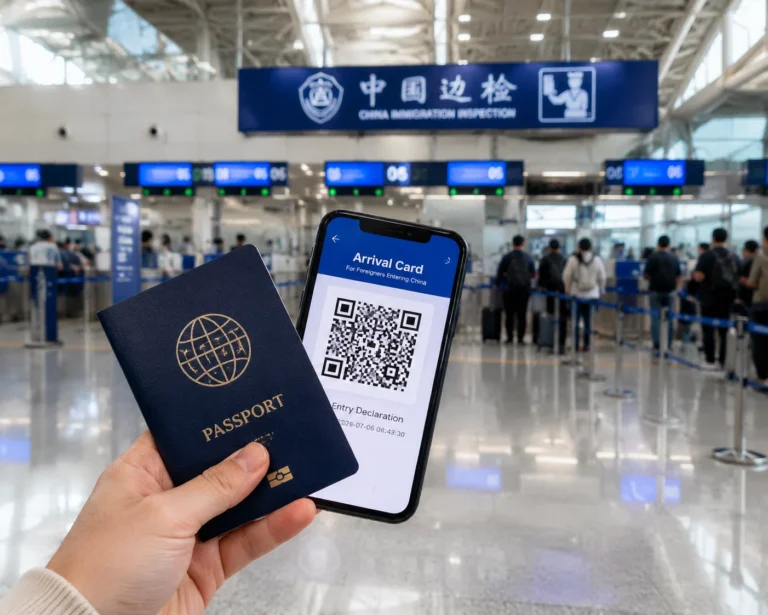
China has fully digitized its entry process. You no longer fill out a paper arrival card. Instead, complete the Customs Passenger Finger Tip Service health declaration on your phone before landing. The QR code is valid for 24 hours.
At immigration, follow the Foreigners Entry signs. Do not queue at the Chinese Citizens Channel. Staff will ask for your passport, visa or visa-free transit approval, and fingerprints (ages 14–70). The process takes 3–8 minutes per person on a normal day, 15–45 minutes during holiday peaks.
Mobile phone use is restricted inside immigration halls; staff will ask you to put your device away.
After immigration, collect your luggage and choose the Green Channel (nothing to declare) or Red Channel (goods to declare). Items banned from entry include fresh fruit, meat products, seeds, unapproved medication, and large quantities of e-cigarettes. Cash exceeding RMB 20,000, or foreign currency equivalent to USD 5,000, must be declared in writing to customs. High-value goods worth over RMB 20,000 may also require declaration, subject to category and customs rules.
This is your most important step. Without internet, you cannot navigate, pay, or book a ride.
Best option: Official airport SIM counter. Every major airport has counters for China Mobile, China Unicom, and China Telecom in the arrival hall. Prices are standardized:
The staff will insert the card and wait for your phone to show signal before letting you leave. Make sure they activate it at the counter. Do not walk away until you see data working.
Alternative: eSIM. Activate before your flight. You will have data the moment you land. The trade-off is no local phone number, which some apps require for verification. Good for short trips of 3–5 days. Some travel eSIM providers may offer virtual Chinese numbers, so confirm details before purchase. For deeper comparisons of travel‑friendly data plans: China eSIM Guide for Foreign Travelers
Backup: Airport WiFi. Free but often requires a Chinese phone number to receive a verification code. This creates a chicken-and-egg problem: you need internet to receive the verification code, yet you need the code to access internet. Use WiFi only as a temporary bridge while waiting at the SIM counter.
Do not buy from airport touts or unlicensed kiosks. These sell expired cards, overpriced plans, or cards that stop working after a day. Only buy from official branded counters.
You will not need much cash. 95% of restaurants, shops, and transport accept mobile payment. But you need ¥100–300 for emergencies: a taxi driver who does not take cards, a street food stall, or a small convenience store.
Best option: Airport ATM. Use your foreign debit card at an ATM inside the arrival hall. The exchange rate is the best available.
Critical: Reject DCC (Dynamic Currency Conversion). The ATM will ask if you want to be charged in your home currency or in yuan. Always choose yuan. DCC typically adds a hidden 2–8% markup, marketed to users as a convenience service. Say no.
Do not use airport currency exchange counters. Their rates are worse and they charge higher fees. Do not exchange money with strangers in the airport, this is a common scam involving fake bills.
Do not exchange large amounts at your hotel. Hotel exchange counters typically offer the worst rates.
With your SIM card working, download Alipay or WeChat Pay using the airport WiFi or your mobile data. Both apps accept international Visa and Mastercard for setup.
Alipay is simpler for foreign users. The app has an English interface and a Travel Wallet feature that does not require a Chinese bank account or binding a local card. You can top up with your international credit card. Note: Your card issuer may still charge international transaction or currency conversion fees. See our full walkthrough: How Foreigners Pay in China. These fees are separate from Alipay’s own cross-border processing charges, if applicable.
WeChat Pay is more widely used by locals but has a less intuitive setup for foreigners. Start with Alipay.
Beijing bonus: Download the Go Beijing mini-program inside Alipay International. It offers 39 services in 16 languages, including an AI assistant called Jingjing. The Travel Wallet by Alipay and China Construction Bank supports users from 40+ countries with no domestic transaction fees.
This is the biggest decision. Your choice depends on time, luggage, budget, and how tired you are.
Price: ¥4–35. Airport express lines (like Beijing Airport Express or Shanghai Metro Line 2) cost ¥25–35. Regular metro lines cost ¥4–10. Time: 25–50 minutes to city center. Hours: Most airports run metro from 06:00 to 23:00. After 23:00, the metro stops. Best for: Solo or duo travelers with light luggage arriving during daytime. The metro is punctual, cheap, and not affected by traffic. Stations have bilingual signs and English announcements. Risk: Peak hours (07:30–09:00 and 17:30–19:00) are crush-loaded. Trying to board with a large suitcase during these hours is a genuine mistake. Some older stations lack elevators, meaning you carry your luggage up stairs. Large suitcases may not fit on escalators at older stations.
Beijing specific: Beijing was among the first cities in China to support tapping international Visa, Mastercard, and other major cards directly at metro turnstiles. No ticket purchase needed. Following Beijing, other Chinese cities such as Shanghai, Guangzhou, Chengdu, and Hong Kong have also rolled out the service.
Critical Update (June 2026): Forget the old guides telling you that foreign credit cards don't work on Chinese metros. If you are landing in Chengdu, you can tap your physical foreign contactless credit card directly at the turnstiles!
Beijing,Shanghai, Guangzhou, Chengdu, and Hong Kong Metro has fully upgraded its gates. It now supports the 6 major international card networks:
表格
| City | Supported Card Networks | Coverage | Notes |
|---|---|---|---|
| Beijing | Visa, Mastercard, American Express, JCB, UnionPay | 29 metro lines + S2 Line, 523 stations | Full network coverage |
| Shanghai | Visa, Mastercard, UnionPay (American Express and JCB not explicitly confirmed) | 21 lines, 517 stations | Rollout ongoing; some suburban stations may not support contactless foreign cards |
| Guangzhou | Visa, Mastercard, American Express, JCB, UnionPay | Nearly 400 stations, ~9,000 turnstiles | Full network coverage |
| Chengdu | Visa, Mastercard, American Express, Diners Club, Discover, etc. | Entire metro network | Supports Diners Club and Discover |
| Hong Kong | Visa (primary; others not specified) | (station count not provided) | First city in the Greater Bay Area to launch the service |
Important caveat: Even in supported cities, older turnstiles may lack contactless readers. Always keep a backup payment method ready. Support can also be limited on suburban or branch lines.
How to use it: Just make sure your card has the contactless symbol. Enable small-value password-free payment if required. Tap it at the gate, and it bills you at the regular local fare. No local app setup required for your first ride!
TripChina Pick: Metro is the best value option for most travelers. Just avoid peak hours with luggage.
Price: ¥15–35. Time: 40–70 minutes, depending on traffic. Hours: 07:00–22:00 for most routes. Some airports have overnight buses for late arrivals. Best for: Families, travelers with heavy luggage, or anyone whose hotel is on a direct bus route. Buses have luggage compartments and more comfortable seats than the metro. Risk: Traffic jams can double travel time. Schedules are less frequent than the metro. Not all routes run late. Where to buy: Official ticket counters or self-service machines in the arrival hall. Do not buy from touts offering “private buses” or “shared vans”, these are unlicensed and overpriced.
Price: ¥80–300 depending on city and distance. Shanghai to city center is typically ¥150–250. Beijing to city center is ¥100–200. Guangzhou is ¥80–150. Time: 30–60 minutes. Hours: 24 hours. Best for: Late arrivals after the metro closes, groups of 3–4 people, or anyone with heavy luggage who wants door-to-door service. How to use: Follow the Official Taxi signs to the designated queue. Do not take a taxi from drivers who approach you inside the arrival hall. These are unlicensed black cabs charging 2–3 times the meter rate.
At the taxi stand: Show the driver your hotel address in Chinese. A screenshot with the hotel name, address, entrance photo, and phone number works best. Say “Da biao” (by meter). If the driver says “Yi kou jia” (fixed price), say “Bu yong” (no thanks) and wait for the next taxi.
If the driver refuses to use the meter: Note the driver information card on the windshield and mention you will call 12345 (government service hotline). Most drivers will then use the meter.
Tipping is not customary in China. Do not tip taxi drivers.
Price: Same as taxi, ¥80–300. Prices are transparent in the app. Time: 30–60 minutes. Hours: 24 hours. Best for: Tech-savvy travelers who want price transparency and do not want to negotiate with a driver. How to use: Download the Didi app (or use the ride-hailing feature inside Alipay). Set your pickup point; each airport has a designated ride-hailing zone. Follow the signs. Risk: Finding the correct pickup point at a large airport can be confusing. The app shows a map, but first-time users sometimes walk to the wrong floor or terminal. Allow 10 minutes to locate your driver.For tips on navigating the app with a foreign account: Didi Guide for Foreign Travelers in China
TripChina Pick: Didi is excellent once you are familiar with the airport layout. For first-time visitors, the official taxi queue is simpler.
Price: ¥50 single trip, ¥40 with a same-day flight ticket. Time: 7 minutes from Pudong Airport to Longyang Road station. Speed: 430 km/h. Best for: Travelers heading to Pudong or Lujiazui who want a unique experience. The maglev is the fastest commercial train in the world. Risk: Longyang Road is not central Shanghai. You still need to transfer to the metro or a taxi to reach most hotels. Only worth it if your destination is on the east side of the city.
Do not accept rides from drivers who approach you inside the arrival hall. They charge 2–3 times the meter rate. Only use the official taxi queue or a ride-hailing app.
At the ATM, always choose to be charged in yuan. Reject the offer to be charged in your home currency. This saves 2–8%.
If a taxi driver says “fixed price, no meter,” say “Bu yong” and move to wait for another taxi. They will often agree to use the meter once you refuse.
Do not take the metro with a large suitcase between 07:30–09:00 or 17:30–19:00. The trains are packed and you will struggle to board.
Metro service ends around 23:00 at most airports. The 22:30 rule is a practical buffer, as immigration and baggage claim can easily take 30+ minutes after landing. If your flight lands after 22:30, plan for a taxi or bus. Holiday schedules may differ, so check airport transport information before arrival.
Do not exchange large amounts of cash at your hotel. The rates are the worst available.
Only buy SIM cards from official branded counters. Street sellers and small kiosks sell expired or overpriced cards. If you are preparing for your full Beijing itinerary, review our key warnings: Beijing Travel Scams & Pitfalls Guide (2026)
Use the Beijing Service counter at the international arrival hall. It offers one-stop help with SIM cards, payment setup, and transport questions. These airport service counters have assisted nearly 2 million international visitors since launch.
The Go Beijing mini-program inside Alipay International covers 39 services in 16 languages. The Travel Wallet feature lets you pay without binding a Chinese bank card.
Beijing metro supports tapping international Visa and Mastercard directly at turnstiles, no ticket purchase needed.
The maglev train is worth doing once for the speed. Buy the discounted ¥40 ticket by showing your same-day flight booking.
Metro Line 2 and the maglev both connect Pudong Airport to the city. Line 2 is cheaper (¥6–8) but takes 50 minutes. The maglev takes 7 minutes to Longyang Road, then transfer.
Baiyun Airport has a Foreigner Service Center at Terminals 2 and 3, staffed 24 hours. They provide free WiFi passwords (scan your passport at a machine) and real-time translation devices supporting 140+ languages.
Follow the color-coded signs in the terminal. The system is clear and consistent.
👉 Explore more essential travel tips in our China Basics Hub.
No. China has fully digitized its entry process. Complete the health declaration through the Customs Passenger Finger Tip Service mini-program on your phone before landing. The QR code is valid for 24 hours.
This article is part of the China Basics travel hub. Explore all China Basics travel guides here → https://tripchina.me/china-basics-hub/
Yes, but international roaming is expensive and you will need a VPN to access Google, Instagram, WhatsApp, and other blocked services. A local SIM card is cheaper and gives you a Chinese phone number needed for some apps and restaurant bookings.
Yes. You can use foreign contactless credit cards (Visa, Mastercard, Amex, etc.) directly on metro systems in Beijing, Shanghai, Guangzhou, Chengdu, and Hong Kong. Just tap your card at the turnstile – no ticket or app needed. Make sure your card has the tap‑to‑pay symbol and sufficient funds. A temporary hold is taken, then the final fare is deducted. However, not all Chinese cities support this yet, so carry a backup payment method.
Use an ATM in the arrival hall. The exchange rate is the best available. Reject Dynamic Currency Conversion (DCC) when prompted, choose to be charged in yuan to avoid a hidden markup. Exchange only ¥100–300 for emergencies.
Yes, if you use the official taxi queue. Follow the signs to the designated stand. Do not accept rides from drivers who approach you inside the terminal. Show the driver your hotel address in Chinese and say “Da biao” (by meter).
No. Uber does not operate in China. Use Didi or the ride-hailing feature inside Alipay. Didi is the dominant platform and works similarly to Uber.
The metro stops around 23:00 at most airports. Your only options are the official taxi queue or a ride-hailing app. Taxis run 24 hours. Airport buses may have limited overnight routes; check the schedule at the information desk.
Updated June 19, 2026, revised July 9, 2026. This guide was cross-checked against official border control rules, airport operator announcements, metro contactless payment notices and foreign visitor service documentation. Policies, opening hours and payment support may change without prior notice; always verify details from official sources before travel.
Sources:
TripChina.me creates practical China travel guides shaped by real local experience, helping independent travelers navigate transport, payments, food, neighborhoods, and the cultural details that make traveling in China easier and more meaningful. Find the guide for your destination at tripchina.me.