Our Location:
No. 99, Jiazi Road, Chengdu

 authorChris Lee
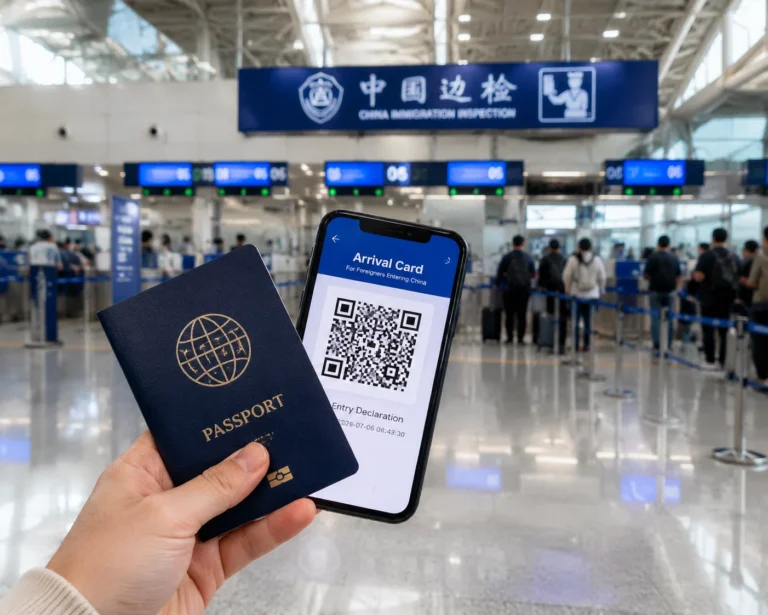
Landing in China is easier when you know which desk does what. Immigration checks you and your entry eligibility; Customs checks what you are bringing into the country. As of September 2026, the online foreigner Arrival Card is available nationwide, while the old routine Customs health-declaration QR code was discontinued in November 2023 and is no longer part of the standard arrival process. This guide walks you through the process and the mistakes most worth avoiding.
Before flying, check whether your passport actually needs a visa in TripChina's China visa guide for foreign travelers.
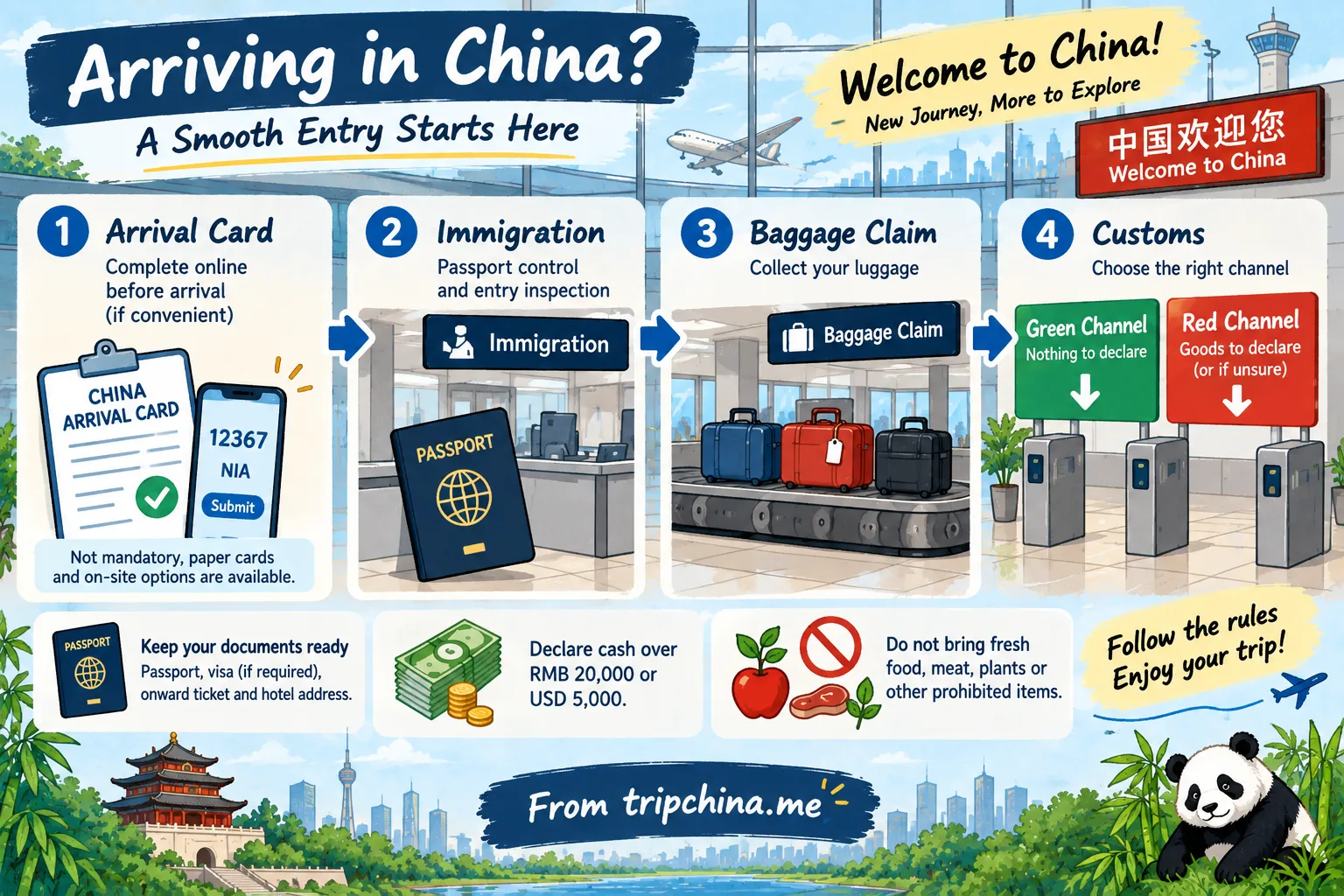
A one-minute pre-departure check prevents most avoidable arrival problems:
| Check | What to Do |
|---|---|
| Passport | Make sure it is valid for your entry basis and intended stay |
| Visa / visa-free status | Confirm your nationality and travel purpose |
| Arrival Card | Complete it online before travel if convenient |
| Accommodation | Save your first address offline |
| Onward travel | Keep your return or onward itinerary accessible |
| Customs | Know whether anything in your luggage requires declaration |
For travelers applying for a Chinese visa, official Chinese Visa Application Service Centers generally require at least six months of remaining passport validity when applying. However, China's unilateral visa-free FAQ states that an eligible ordinary passport must remain valid for the intended stay, so six months should not be presented as a universal rule for every visa-free traveler.
Two different systems are often confused in older China travel advice: the Arrival Card handled by immigration and the former health declaration handled by Customs.
They are not the same thing.
For most foreign travelers entering China, you need to provide Arrival Card information—but it does not have to be completed online before departure.
Since November 20, 2025, the National Immigration Administration has offered online Arrival Card filling through official channels including:
If you cannot complete it beforehand, you can fill it after arrival using port smart devices or a paper Arrival Card.
The official service is free. NIA has specifically warned foreign travelers about fraudulent paid Arrival Card websites.
For the actual filling sequence, see TripChina's China online Arrival Card guide.
Certain categories are exempt from Arrival Card filling, including some permanent residents, qualifying group travelers and eligible direct-transit passengers. Check current NIA instructions if you fall into a special category.
No. China discontinued the routine Entry/Exit Health Declaration Card on November 1, 2023. It is no longer part of the standard arrival process.
If you have symptoms associated with an infectious disease, such as fever, cough, breathing difficulty, vomiting, diarrhea or rash, or have been diagnosed with an infectious disease, report this to Customs and follow the instructions given at the port.
However, passengers with symptoms such as fever, cough, breathing difficulty, vomiting, diarrhea or rash—or those diagnosed with an infectious disease—must proactively report this to Customs and cooperate with health-quarantine procedures.
Keep the essentials somewhere you can reach easily:
I also keep the hotel name, address and phone number saved offline on my phone. You may never be asked for them, but showing an exact address after a long flight is much easier than trying to search for one at the counter.
If this is your first trip, TripChina's China airport arrival guide for your first 60 minutes covers internet, cash and onward transport after you clear the formalities.
Immigration—or border inspection—is where officers verify your passport and whether you qualify to enter China.
⚠️ A warning before you even board your flight: never carry a package, medicine, envelope or any unknown item into China for someone you do not completely trust. You are legally responsible for what is in your luggage, and prohibited or controlled substances can carry severe criminal penalties.
Have your onward ticket and accommodation information ready, but answer the questions you are actually asked.
Typical questions are straightforward:
| Officer May Ask | Clear Answer |
|---|---|
| Purpose of visit? | “Tourism.” |
| Where are you staying? | “Hilton Beijing.” |
| How long are you staying? | “Ten days.” |
| Do you have an onward ticket? | “Yes.” |
The goal is not to memorize a rigid script.
A better rule is: be brief, specific and consistent with your documents.
If you are actually staying with a friend, say so and have the address ready. Do not invent a hotel simply because it sounds easier.
There is no reliable nationwide fixed time.
For a normal airport arrival, roughly 20–60 minutes for the full immigration-and-arrival clearance process is a reasonable planning range, but busy international arrivals, secondary inspection or baggage delays can make it longer. The source drafts similarly treated queue length as the main variable rather than a guaranteed clearance time.
Do not schedule an onward train or domestic flight as if you will be outside the terminal 20 minutes after landing.
Avoid vague or contradictory explanations about your travel purpose, accommodation or length of stay.
Your stated purpose must match the entry basis you are using. China's visa-free policies cover specified short-term purposes but do not authorize work, study or journalism that requires prior approval.
Follow all posted restrictions concerning photography and phone use inside controlled border-inspection areas.
After immigration, follow signs to baggage reclaim.
Check the baggage tag before walking away with a suitcase that looks like yours. If your bag is missing or damaged, report it to the airline or airport baggage desk before proceeding to Customs.
Keep passports, cash, important documents and expensive electronics in your carry-on luggage whenever practical.
Once you have your bag, the next stage is Customs—and this is where the Red versus Green Channel decision matters.
China Customs uses two basic passenger channels.
Table: China Customs Red Channel vs Green Channel
| Situation | Green Channel — Nothing to Declare | Red Channel — Goods to Declare |
|---|---|---|
| Ordinary clothes and personal belongings | Yes | Usually unnecessary |
| Goods requiring declaration | No | Yes |
| Cash above declaration thresholds | No | Yes |
| Animal/plant products requiring declaration | No | Yes |
| Commercial samples / separated baggage | No | Yes |
| Unsure whether an item must be declared | Not recommended | Ask Customs / use Red |
China Customs' official advice: If you do not understand the declaration rules or do not know which channel to choose, use the Goods to Declare / Red Channel.
That is more useful than trying to memorize every possible product category before your flight.
Current Customs passenger guidance requires declaration when carrying:
If you are above the applicable threshold, declare it.
Do not split excess cash between different bags or pockets in an attempt to avoid declaration. Deliberately concealing declarable currency can expose you to Customs penalties.
For normal spending after arrival, TripChina's guide to paying in China with Alipay, WeChat Pay, cards and cash explains the practical options.
Official passenger guidance includes categories such as:
Passenger-value rules differ according to traveler status and the nature of the goods, so do not use “anything worth more than ¥5,000” as a universal rule for every foreign visitor.
Do not reduce China's quarantine system to “all food is banned.” That is too broad.
High-risk categories include fresh fruit, meat and animal products, plants, seeds, soil and other products covered by animal and plant quarantine controls.
The practical rule is easier:
Do not casually carry fresh fruit, jerky, sausages, plants or similar agricultural products off the plane and through Customs.
That half-eaten apple from the flight is not worth a border discussion.
China Customs lists prohibited or tightly controlled categories including:
Prescription medicine is more nuanced. If you are carrying medicine that may contain a narcotic or psychotropic ingredient, verify the exact active ingredient and applicable Chinese rules before departure rather than relying on a generic internet list.
The FAQ below gives a practical medication checklist.
Once you leave the secure arrival area, two immigration-related details still matter.
If you stay at a hotel, the hotel handles accommodation registration with the public security authorities.
If you stay somewhere other than a hotel—such as a friend's home or private residence—you or your host must complete accommodation registration within 24 hours after arrival at that residence.
Since March 20, 2026, online non-hotel accommodation registration has been piloted in:
The traditional in-person route remains available.
Failure to register as required can lead to a warning and a fine under China's exit-entry law; it should not be described as a universal fixed “¥500 per day” penalty.
TripChina's hotel vs private-stay registration guide explains the process in more detail.
Yes.
Before you move too far from the immigration area, check the entry stamp or other entry endorsement in your passport and make sure the date looks correct.
If something appears inconsistent with the permission you expected, ask border-inspection staff before leaving the controlled area.
As of September 2026, China's unilateral 30-day visa exemption applies to ordinary-passport holders from 50 countries.
Eligible purposes include tourism, business, visiting family or friends, exchange and transit. Work, study and other activities requiring prior approval are not covered.
The current MFA timetable states:
Because nationality eligibility can change, check the current MFA list before departure.
This point is important because many older explanations get it wrong.
China's current Ministry of Foreign Affairs FAQ says an eligible traveler may stay from the date of entry through 24:00 on the 30th natural day. The entry date therefore counts in the 30-day calculation.
Do not automatically add 30 days starting from the following morning.
For the main eligible-country scheme, no. It has been expanded to 240 hours—10 days.
As of August 20, 2026, the 240-hour visa-free transit policy covers 57 countries, 65 ports and permitted areas across 24 provincial-level regions.
You must:
For example:
USA → China → Japan may potentially qualify.
USA → China → USA does not satisfy the third-country/region transit requirement.
The current NIA policy requires a valid ordinary passport, but its published 240-hour rules do not state a universal six-month remaining-validity requirement. Do not confuse the six-month passport rule commonly used for Chinese visa applications with the official transit-policy wording.
Only if your itinerary enters a designated border management area.
China began using electronic Border Administration Area Permits on April 15, 2026, replacing newly issued paper permits. This does not mean every trip anywhere in Tibet, Xinjiang, Yunnan or Inner Mongolia automatically requires the same permit.
Foreign nationals cannot use the fully online application route available to eligible mainland residents. They must apply in person at a county-level-or-above public security exit-entry administration office or designated police station.
If your route enters a sensitive border area, verify the exact permit requirement with 12367 or the destination authority before traveling.
This article is part of the China Basics Travel Guide Hub.
For most common non-controlled personal medicines—such as many blood-pressure or cholesterol medicines—keeping them in original labeled packaging together with your prescription or doctor's letter is the sensible baseline.
If a medicine contains codeine, morphine or another narcotic or psychotropic controlled substance, verify the specific medicine with Chinese Customs or the relevant Chinese authority before travel. Such medicines may be subject to additional controls or approval requirements. Do not assume that holding a foreign prescription automatically makes every controlled medicine legal to import.
For antibiotics or any other prescription medicine, also bring only a reasonable personal-use quantity and keep the packaging that identifies the active ingredient.
A visa or visa-free eligibility does not guarantee admission.
If border authorities refuse entry, they determine the applicable procedure and the carrier may be required to transport you out of China. Ask for instructions from border inspection and request consular assistance where appropriate.
Bringing a personal drone into China and legally flying it after arrival are two separate issues.
If you are uncertain how Customs will classify the drone or related equipment, declare it through the Red Channel and ask the officer rather than relying on the Green Channel.
Civilian drones are also subject to Chinese real-name registration, aviation rules and local restricted-flight areas. Never assume that because Customs allowed the drone into the country, you may fly it anywhere.
12367 is the National Immigration Administration's immigration-service hotline.
It is the most useful official contact for questions about Arrival Cards, visa-free policies, accommodation registration, transit rules and border-area permits. NIA's 2026 guidance repeatedly directs travelers to 12367 when they need policy clarification.
Before you fly, confirm your visa or visa-free eligibility and complete the official Arrival Card online if convenient.
Keep your passport, onward itinerary and first accommodation details accessible. At immigration, answer clearly and consistently. After collecting your luggage, choose the Customs channel according to what you are actually carrying.
Once outside the airport, your immediate problems usually shift from immigration to internet access, payment and transport. TripChina's first-hour China arrival guide covers those next steps.
For most ordinary tourists, entering China in 2026 is less complicated than many older guides make it sound.
There is no routine health-declaration QR code to complete, the foreigner Arrival Card can now be filled online before travel, and Customs still follows the familiar Red Channel / Green Channel system.
The parts worth getting right are simple: use the official Arrival Card platform, make sure your entry purpose matches your visa or visa-free status, declare goods when required, and complete non-hotel accommodation registration within 24 hours.
If you are unsure about a changing immigration rule, use current NIA guidance or call 12367 rather than relying on an old screenshot or social-media post.
If you take nothing else from this guide: fill the Arrival Card online before you fly, use the Red Channel if you're unsure about any item, and register your accommodation within 24 hours if staying outside a hotel. Those three habits prevent many of the avoidable entry problems first-time visitors run into.
National Immigration Administration — Online Arrival Card Filling
General Administration of Customs — International Passenger Customs Clearance Guide
Ministry of Foreign Affairs — FAQs on Visa-Free Entry into China
National Immigration Administration — 240-Hour Visa-Free Transit Policy
Updated September 2026 using current NIA, MFA and China Customs material. The current unilateral visa-free list contains 50 countries, and the official MFA calculation counts the entry date within the 30-day stay. The former 144-hour transit scheme is now 240 hours for 57 eligible countries. Routine health declaration ended in November 2023, while nationwide online Arrival Card filing began in November 2025. Visa-application passport requirements were kept separate from visa-free and transit rules to avoid applying a six-month rule where the official policy does not state one.
TripChina.me creates practical China travel guides shaped by real local experience, helping independent travelers navigate entry procedures, transport, payments, food, neighborhoods, and the cultural details that make traveling in China easier and more meaningful. Find the guide for your destination at tripchina.me.