Our Location:
No. 99, Jiazi Road, Chengdu

 authorChris Lee
Chongqing food has a reputation for being brutally spicy. But heat is only half the story. Its signature is mala—chili heat paired with the tingling sensation of Sichuan peppercorns.
This Chongqing food guide shows first-time visitors what to eat, how to order, where to start, and which restaurant mistakes are easy to avoid.
For a first trip, don't try to prove how much spice you can handle. Try to understand the city through a few classic foods instead.
If Chongqing is one stop on a larger trip, our Chongqing Travel Guide for First-Time Visitors covers transport, neighborhoods, attractions, and trip planning beyond food.
As of September 2026, prices and waiting times below should be treated as practical ranges rather than fixed rates. Popular restaurants can become significantly busier on weekends and public holidays.
| Restaurant / Food | Type | Spice Level | Typical Price | Best For | Main Catch |
|---|---|---|---|---|---|
| Peijie Old Hotpot | Hotpot | Medium | ¥80–150/person | First hotpot experience | Popular; queues possible |
| Chen Yanjing Hotpot | Hotpot | High | ¥60–120/person | More local experience | Stronger flavors |
| Huangjie Hotpot | Hotpot | Very High | ¥40–80/person | Serious hotpot fans | Long waits |
| Pangzima Salted Duck | Snack | Low | ¥20–40 | Quick non-spicy snack | Takeaway-style stop |
| Shiweixuan Lamb | Specialty | Low–Medium | ¥50–100/person | Spice break | Small local restaurant |
| Wangpai Claypot Rice | Rice | Low | ¥20–40 | Families, mild lunch | Less distinctly Chongqing |
| Weiyi Old Claypot Rice Noodles | Noodles | Medium | ¥15–30 | Cheap local meal | Hidden upstairs location |
TripChina Pick: For most first-timers: noodles for lunch, Peijie for your first hotpot dinner. If you have a second night and want the real deal, queue for Chen Yanjing.
Chongqing food is not simply "very spicy."
Locals often describe the balance as qi fen la, san fen ma (七分辣、三分麻)—roughly "seven parts spicy, three parts numbing." It isn't a scientific formula. It's a useful local way of describing the flavor.
The ma comes from Sichuan peppercorns. Instead of ordinary chili heat, they create a tingling, buzzing sensation around your lips and tongue.
That catches first-time visitors off guard.
If your lips start tingling after a few bites, don't immediately assume the dish has suddenly become much hotter. That's the huajiao doing what it's supposed to do.
Start with:
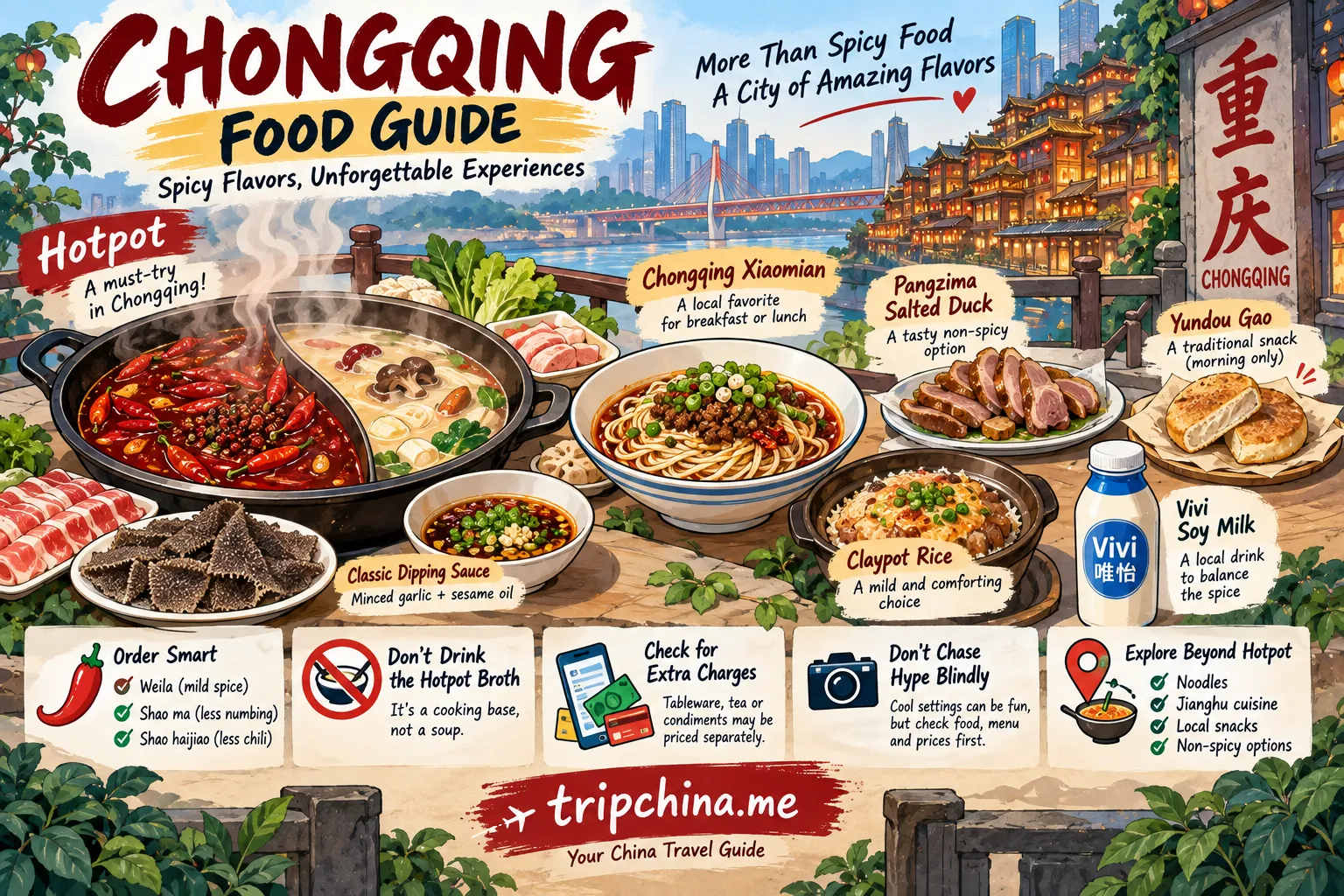
Weila (微辣) — mild spice.
If you also want less Sichuan peppercorn, add:
Shao ma (少麻) — less numbing.
A useful phrase is:
“Weila, shao ma.” (微辣,少麻。)
For noodles, shao haijiao (少海椒) means less chili.
Don't assume "mild" means Western-style mild. Chongqing kitchens vary enormously, and one restaurant's weila can feel much hotter than another's.
Vivi Soy Milk (唯怡豆奶) is a familiar sight at Chongqing hotpot restaurants and a very local pairing.
If the chili becomes uncomfortable, dairy milk can help because milk proteins and fat interact with capsaicin more effectively than plain water.
Soy drinks are also a pleasant accompaniment.
Most importantly, slow down. Chongqing hotpot is a long social meal, not a spice challenge.
The classic Chongqing combination is:
Suan ni + xiang you (蒜泥 + 香油)
Minced garlic + sesame oil
Then add vinegar, cilantro or chopped scallions if you like.
If you're used to Beijing-style hotpot, your instinct may be to reach for thick sesame paste. That's not the classic Chongqing approach.
The sesame oil also cools freshly cooked ingredients before you put them in your mouth—which matters when you've just pulled a piece of tripe from a violently boiling pot.
No.
This confuses some foreign visitors because clear Chinese hotpots can look like soup.
Traditional Chongqing red broth is a concentrated cooking base loaded with chili, Sichuan peppercorns, spices and, in many traditional versions, beef tallow. It's designed for cooking ingredients, not for drinking by the bowl.
Your first hotpot is not the time to test your pain tolerance.
Use the mild-spice phrases above. You can always add more heat later; you cannot easily reverse a pot that is already too hot.
This needs some nuance.
Chongqing genuinely has hotpot restaurants inside converted air-raid shelters and other unusual spaces. These aren't automatically fake tourist inventions. Underground spaces are part of Chongqing's urban history, and the city has actively redeveloped some of them as cultural and commercial venues.
The better rule is: don't pay a premium for scenery without checking the food, menu and prices first.
A cave hotpot, rooftop hotpot or residential-building restaurant can be fun. Treat the setting as part of the experience, not proof that the food is better.
Around heavily visited areas, especially near Jiefangbei and major tourist streets, you may encounter restaurant promoters trying to pull pedestrians inside.
That doesn't automatically mean the restaurant is bad, but I wouldn't choose a hotpot simply because someone shouted you into it.
Check the menu, prices and recent local reviews first.
For a wider list of first-trip problems beyond restaurants, see our Chongqing travel mistakes guide.
Some restaurants separately charge for packaged tableware, tea, condiments or similar extras.
Don't assume every small charge is a scam—but don't assume it's mandatory either.
As of September 2026, Chongqing price rules require restaurants to clearly display charges and prohibit collecting fees that were not disclosed.
If something appears on your bill that you didn't expect, ask:
“Zhe ge shi shenme feiyong?” (这个是什么费用?)
“What is this charge?”
This is better than memorizing a supposed universal "cover charge," because restaurant practices vary.
If you're still setting up mobile payments for your trip, our guide to paying in China with Alipay, WeChat Pay, cards and cash explains the options before you arrive.
Chongqing xiaomian (重庆小面) is one of the easiest ways to understand the city's everyday food culture.
Hotpot gets the Instagram photos. Xiaomian is what feels like breakfast.
Some of my favorite noodle-shop experiences in Chongqing are exactly what visitors tend to walk past: plastic stools, steam pouring out of a tiny kitchen, no English sign, and a room full of locals eating quickly before work.
Useful ordering terms:
For a first bowl, try wanza mian (豌杂面)—noodles topped with peas and minced pork sauce.
Another easy choice is niurou mian (牛肉面), beef noodles.
Expect roughly ¥10–20 for a basic bowl at an ordinary neighborhood shop, though prices vary.
Where to start: Huashi Wanza Noodles (花市豌杂面) around Jiaochangkou is an accessible introduction. After that, I'd encourage you to try whichever neighborhood noodle shop looks busy at breakfast.
Chongqing hotpot is the city's defining communal meal.
Traditional Chongqing-style red broth is strongly associated with beef tallow, dried chilies and Sichuan peppercorns.
Together they create the deep, aromatic flavor that makes the style distinctive.
But don't overthink the Chongqing-vs-Sichuan distinction. Recipes vary across restaurants and cities, and "Sichuan hotpot" covers many styles.
What matters at the table is knowing what to order.
Mao Du (毛肚) — Beef Tripe
One of the essentials.
You'll hear locals describe the cooking technique as qi shang ba xia (七上八下)—moving the tripe repeatedly through the boiling broth rather than leaving it sitting there until it turns rubbery.
The goal is crisp and springy.
Ya Chang (鸭肠) — Duck Intestines
Another Chongqing classic. They cook quickly and should retain a slightly crisp texture.
Lao Rou Pian (老肉片) — Pork Slices
A forgiving option for first-timers and easier to cook than tripe or intestines.
Hao'er Yu (耗儿鱼) — Filefish
A very Chongqing hotpot ingredient with firm white flesh.
It may contain tiny residual bone fragments, so chew carefully.
Gong Cai (贡菜) — Dried Stem Vegetable
Crunchy even after cooking and one of the best texture contrasts in a spicy pot.
Su Rou (酥肉) — Fried Pork
Eat it immediately while crisp, or drop a few pieces into the pot later.
Dinner gets busy from roughly 18:00 onward, with popular restaurants often busiest around the conventional dinner period.
If a famous restaurant matters to you, arriving around 17:00–17:30 is a sensible strategy.
Exact waits are unpredictable, especially on Friday nights, weekends and Chinese public holidays.
If you're traveling during a national holiday, check our China public holiday and crowd calendar before locking in your itinerary.
Best for: First-time visitors who want a central, well-known introduction.
The Jiaochangkou branch remains easy to reach from the Jiefangbei area. It's a sensible first hotpot rather than a quest for the city's most obscure neighborhood pot.
Typical budget: around ¥80–150 per person, depending heavily on what and how much you order.
Because branches, menus and prices can change, verify the current location in Amap or another current Chinese map app before going.
If you haven't set one up yet, see our navigation apps guide for foreign travelers in China.
Best for: Travelers who have already tried hotpot and want something more local.
Address: 134 Changjiang 2nd Road, Yuzhong District (渝中区长江二路134号)
Chen Yanjing traces its history to 1994. In 2025 it appeared on Dianping's annual Must-Eat List (必吃榜) for the second time—not the Michelin Bib Gourmand, which is a different restaurant award.
Typical budget: roughly ¥60–120 per person.
Best for: Spice-tolerant travelers who care more about old-school atmosphere than comfort.
This is the sort of place locals call a cangying guanzi (苍蝇馆子)—a humble, no-frills neighborhood restaurant where food matters more than décor.
Expect strong flavors and potentially long waits. If Huangjie is a priority, arrive early rather than building your evening around an exact queue estimate.
Hotpot shouldn't be your only Chongqing dinner.
Jianghu cai (江湖菜) is bold, informal cooking associated with generous portions, strong seasoning and dishes designed for sharing.
Try:
Laziji (辣子鸡): small pieces of fried chicken buried in dried chilies and Sichuan peppercorns.
Suancai Yu (酸菜鱼): fish with pickled mustard greens. The sourness gives the dish a very different profile from hotpot.
Shuizhu Roupian (水煮肉片): despite the literal "water-boiled" name, expect pork in an intensely seasoned, chili-oil-rich broth.
One option around Jiaochangkou is Fan Jianghu (饭江湖).
A shared Jianghu meal is especially useful if you're traveling with friends because everyone can try several dishes rather than committing to another full hotpot.
These are some of the best non spicy food in Chongqing for travelers who need a break from mala heat.
Pangzima Salted Duck (胖子妈正宗盐水鸭) is a good break from chili.
Look around Bayi Road (八一路) near Jiefangbei. Order salted duck, duck tongue, duck liver or duck feet according to how adventurous you feel.
Budget around ¥20–40 for a snack-sized purchase.
It's salty and aromatic rather than chili-heavy, which makes it useful between spicy meals.
Shiweixuan Lamb Restaurant (食味轩羊肉馆) is around Wenhua Street in Yuzhong District.
Try braised lamb, steamed lamb with rice flour, lamb offal soup, and linzhi doufu (淋汁豆腐).
It's a small, old-school local restaurant and a particularly good choice in cooler weather.
Budget roughly ¥50–100 per person.
Yundou gao (熨斗糕), literally "iron cake," is one of those foods I like recommending precisely because it isn't a polished tourist product.
The small rice-based cake is traditionally cooked in an iron mold and comes out lightly crisp outside and soft inside. It's mild, slightly sweet and easy to eat while walking.
You may find it around Shihuishi Market near Jiaochangkou, usually for only a few yuan.
But don't make a cross-city journey based on an old social-media pin. These stalls are far less predictable than chain restaurants.
Local tip: individual vendors can move, stop trading or operate irregularly. Many traditional street vendors also trade mainly in the morning, so go earlier rather than planning it as an evening snack.
Ask someone nearby—or your hotel front desk—whether the yundou gao vendor is currently active around Shihuishi Market before making a special trip.
Wangpai Claypot Rice (王牌煲仔饭) is useful when your stomach wants a day off.
A tomato-and-egg combination is mild, familiar and inexpensive. Expect around ¥20–40 depending on your order.
Weiyi Old Claypot Rice Noodles (唯一老砂锅米线) is another old Chongqing option at Zhonghua Lane near Jiefangbei.
The shop is upstairs and easy to miss. The current listed location is around 15 Zhonghua Lane, Annex 1, second floor (中华巷15号附1号2层).
Expect roughly ¥15–30 for most basic noodle orders.
No.
There are plenty of mild options, and the smarter approach is alternating intensity rather than eating three heavy red-oil meals in one day.
Salted duck, claypot rice, lamb dishes and adjustable noodle orders make it easy to give your palate a break.
Yes.
Use the same mild and spice-light phrases explained earlier. Restaurants are accustomed to customers having different spice tolerances.
If your group needs a divided hotpot with a non-spicy section, ask whether the restaurant offers yuanyang guo (鸳鸯锅).
Not every traditional Chongqing hotpot restaurant does, so check before sitting down if that's essential.
No.
Hotpot is highly visible because it's social, dramatic and closely tied to Chongqing's identity.
Daily eating is much broader: noodles, rice dishes, stir-fries, soups, home cooking and simple neighborhood restaurants.
If every meal on your Chongqing itinerary is hotpot, you're actually seeing less of the local food culture, not more.
Definitely not.
Good Chongqing hotpot should give you aroma before punishment. Beef tallow, toasted spices, chili and Sichuan peppercorn should build into a layered smell and taste.
A pot that delivers nothing except aggressive throat-burning heat isn't automatically more authentic.
And don't try to diagnose the ingredients from the burn alone. You cannot reliably determine whether a restaurant uses chili extract simply by tasting it.
If you're staying around Jiefangbei or Jiaochangkou, you can build a food day without wasting half your time in taxis.
Before choosing a hotel, compare the neighborhoods in our Where to Stay in Chongqing guide.
| Time | Stop | What to Eat | Why It Works |
|---|---|---|---|
| 7:30–9:00 | Jiaochangkou | Wanza xiaomian | Start with everyday Chongqing |
| 11:30–13:00 | Jiefangbei area | Claypot rice | Mild lunch before hotpot |
| 15:00–16:00 | Bayi Road | Pangzima Salted Duck | Easy walking snack |
| 17:00–17:30 | Jiaochangkou | Arrive for hotpot | Beat part of dinner rush |
| 21:00+ | Bayi Road / Jiefangbei | Bingfen or another dessert | Easy late-night finish |
Morning: Start with wanza noodles near Jiaochangkou. If you're worried about spice, ask for less chili rather than removing every seasoning—the seasoning is what makes Chongqing noodles Chongqing noodles.
Lunch: Take a break with claypot rice. Don't schedule another major spicy meal here.
Afternoon: Walk toward Jiefangbei and Bayi Road for salted duck.
Dinner: Head back toward Jiaochangkou early for hotpot. Order mild, build a garlic-and-sesame-oil dipping sauce, and start with tripe, pork, gongcai and fried pork.
Late night: Explore Bayi Road (八一路) near Jiefangbei, the same area where you stopped for Pangzima earlier. Look for hongtang bingfen (红糖冰粉), a cold jelly-style dessert with brown sugar.
If you want to keep eating after dark rather than follow this exact route, our Chongqing Night Markets Guide covers more local evening-food areas.
Yes, but hotpot requires more attention than it appears.
A pot full of vegetables may still use a beef-tallow broth, and seemingly vegetarian dishes can contain meat stock or animal fat.
If you don't eat meat, show the restaurant:
“我不吃肉,也不吃动物油。请问有清汤或素锅吗?”
“I don't eat meat or animal fat. Do you have a clear or vegetarian broth?”
For strict vegetarian or vegan diets, confirm the broth rather than judging only by the ingredients you put into it.
Yes. RMB cash remains legal tender, although mobile payment is much more convenient in everyday restaurant situations.
For small noodle shops and street-food stalls, having Alipay or WeChat Pay ready makes life easier. Our Alipay guide for foreign visitors explains the setup.
Keep some RMB cash as backup.
No.
Tipping is not part of normal restaurant culture in mainland China. Pay the amount on the bill; you don't need to calculate an additional 15–20%.
Not at the local restaurants that are often the most interesting.
Large chains and tourist-oriented restaurants may have picture menus, but small neighborhood shops frequently don't.
Use camera translation, keep Chinese dish names from this guide handy, and screenshot anything important before heading out.
Reliable mobile data matters more than people expect, so sort out your China eSIM or SIM card setup before landing.
Yes, but it isn't the ideal format.
Traditional Chongqing hotpot is designed for sharing, and ordering several ingredients alone can quickly become too much food.
Solo travelers may find skewers, maocai (冒菜), xiaomian or small individual hotpots easier.
If hotpot is a must, ask whether half portions are available.
Yes—but don't spend the whole trip chasing famous restaurants.
Eat one proper hotpot. Have xiaomian in a tiny neighborhood shop. Try Jianghu cuisine with friends. Grab something mild on Bayi Road. Leave enough room in the itinerary to walk into a place you hadn't planned.
That's often where Chongqing becomes memorable.
Food here still feels woven into ordinary life: breakfast stools on the sidewalk, bubbling red broth after work, old shops hidden upstairs, and tiny snacks that may disappear when the person making them finally retires.
Come hungry—but don't turn it into a chili competition.
Chongqing Municipal Commission of Commerce — Chongqing Hotpot Industry Development Regulation
Chongqing Municipal Culture and Tourism Development Commission — Chongqing Food
Chongqing Municipal Administration for Market Regulation — Price Display and Price Fraud Rules
Chongqing Government — Chongqing's Underground Consumer Spaces
This guide was reviewed and updated in September 2026 using Chongqing government, commerce, tourism, and market-regulation sources, alongside current restaurant listings and local reporting. Restaurant prices, queues, opening hours, branches, and individual street vendors can change quickly, so ranges are intentionally approximate. Local ordering language and food recommendations are retained where they provide practical first-hand value, while health claims, restaurant awards, tourist-trap generalizations, and mandatory-fee claims were tightened where the available evidence did not support absolute wording.
TripChina.me creates practical China travel guides shaped by real local experience, helping independent travelers navigate transport, payments, food, neighborhoods, and the cultural details that make traveling in China easier and more meaningful. Find the guide for your destination at tripchina.me.