Our Location:
No. 99, Jiazi Road, Chengdu

 authorChris Lee
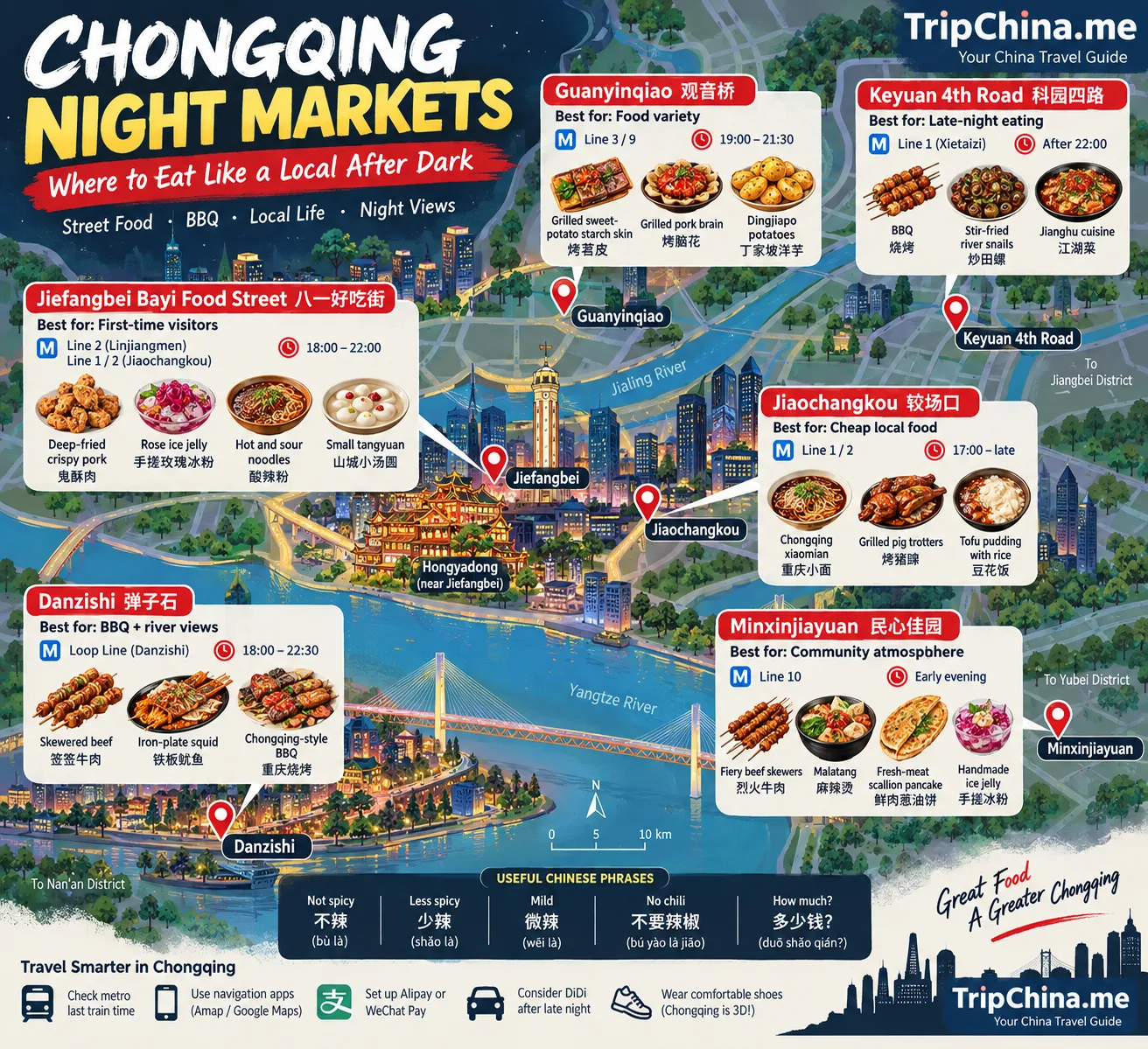
Chongqing’s famous food streets are easy to find. The harder part is knowing which ones are actually worth your evening. This guide compares six Chongqing night-market areas by food, atmosphere, price, convenience and local character—plus Jiujie for travelers who want nightlife after dinner.
As of September 2026:
• Guanyinqiao is the best all-around choice if food variety is your priority.
• Jiefangbei Bayi Food Street is easiest for first-time visitors combining dinner with Hongyadong.
• Jiaochangkou offers better value and a more everyday local atmosphere near the city center.
• Danzishi works best for barbecue plus riverside scenery.
• Keyuan 4th Road is better for genuinely late-night eating.
• Minxinjiayuan is the most community-oriented choice, but the night market moved to the Huimin Building area in 2023.
| Night Market | Best For | Typical Food Budget | Best Time | Main Trade-Off |
|---|---|---|---|---|
| Guanyinqiao | First-time food explorers | 50–90 RMB | 19:00–21:30 | Busy and commercial |
| Jiefangbei Bayi | Convenience | 40–80 RMB | 18:00–22:00 | Tourist-heavy |
| Jiaochangkou | Cheap local food | 30–60 RMB | 17:00–late | Narrow, crowded streets |
| Danzishi | BBQ + river atmosphere | 60–100 RMB | 18:00–22:30 | Farther from central Yuzhong |
| Keyuan 4th Road | Late-night eating | 50–80 RMB | After 22:00 | Few tourist-oriented services |
| Minxinjiayuan | Community atmosphere | 20–50 RMB | Early evening | Far from major attractions |
| Jiujie | Bar hopping & nightlife | 80–200+ RMB | 21:00–late | Drink-focused; food is secondary |
A snack-only visit at a cheaper community market may cost less.
These prices are practical planning ranges rather than fixed tariffs. Individual stalls, portions and opening hours change.
If sightseeing is your priority, choose Jiefangbei. If food variety is your priority, choose Guanyinqiao.
| Jiefangbei Bayi Food Street | Guanyinqiao | |
|---|---|---|
| Best for | Food + Hongyadong sightseeing | Food-focused evening |
| Atmosphere | Central, tourist-friendly | Bigger, younger, busier |
| Food variety | Very good | Excellent |
| Transport | Excellent | Excellent |
| Tourist crowds | High | High, especially weekends |
| Best choice if | You are already in central Yuzhong | You have a full evening for food |
Jiefangbei works better as part of a sightseeing route. Guanyinqiao works better as a destination in its own right.
📍 Open in Amap — 解放碑食街📍 Open in Amap — Guanyinqiao Night Market (观音桥好吃街)For travelers spending their first evening around Jiefangbei, Bayi Food Street is the easiest introduction to Chongqing street food.
Metro: Line 2 to Linjiangmen Station, or Lines 1/2 to Jiaochangkou Station followed by a short walk.
Navigation: Search 八一好吃街 in Amap before leaving your hotel. Chongqing’s multilevel roads make a place that looks nearby on a map surprisingly confusing on foot.
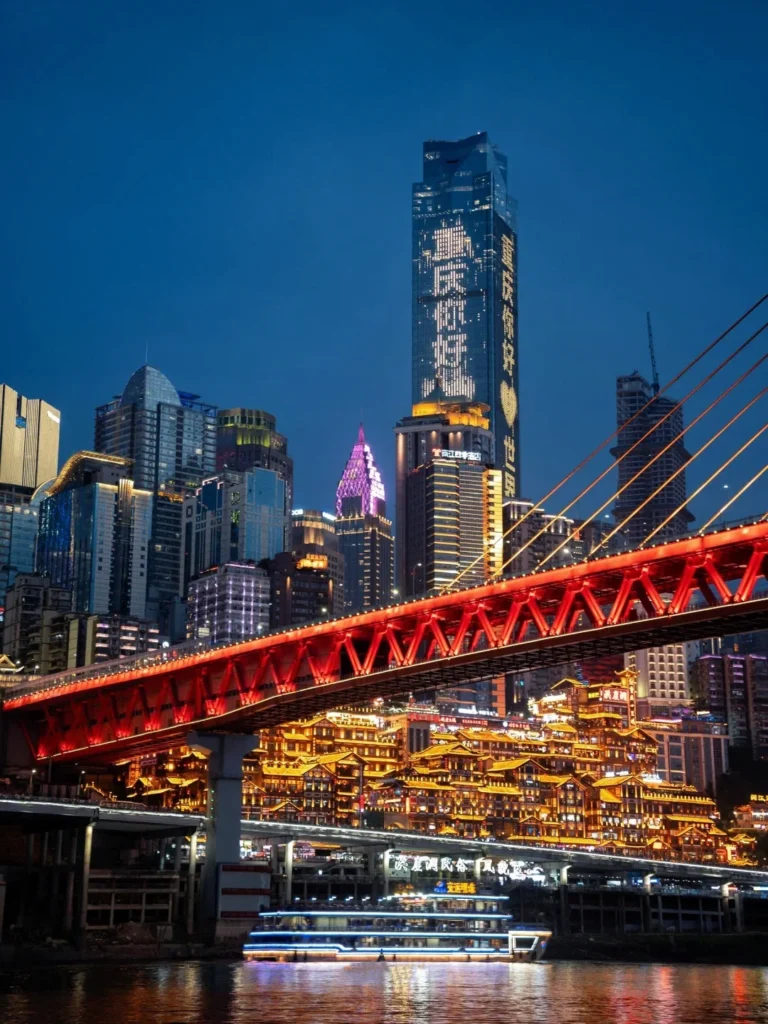
It sits in the heart of the Jiefangbei commercial district and puts dozens of recognizable Chongqing snacks within a compact area. More importantly, you can combine dinner with Hongyadong instead of spending half your evening crossing the city.
If Hongyadong is part of your plan, read the TripChina Hongyadong Chongqing Guide before going. The entrances, viewpoints and crowd flow are more confusing than the map suggests.
Four easy first-time choices are:
Deep-fried crispy pork (鬼酥肉, guisurou)
Expect roughly 15–20 RMB per serving depending on the shop. Freshly fried versions are crisp outside and tender inside, usually with a light Sichuan peppercorn aroma.
Handmade rose ice jelly (手搓玫瑰冰粉, shoucuo meigui bingfen)
Usually around 8–12 RMB. This cold jelly dessert often comes with brown-sugar syrup, rose, hawthorn or other toppings.
I particularly like it after something aggressively spicy—it gives your mouth a break.
Hot and sour sweet-potato noodles (酸辣粉, suanlafen)
Often around 10–15 RMB for a basic bowl, depending on toppings and location. Thick sweet-potato noodles sit in a sour, spicy broth seasoned with chili and other aromatics.
Shancheng small tangyuan (山城小汤圆)
Small glutinous-rice balls served in a sweet soup, often flavored with osmanthus. This is one of the easiest non-spicy choices at a Chongqing food street.
Food prices change by shop, portion and toppings. Use these numbers as reference points rather than fixed citywide prices.
Don’t automatically join the longest queue.
At a heavily visited food street, the stall you see everywhere online may simply have better social-media exposure. Smaller established shops nearby can be just as good and sometimes cheaper.
Ignore touts selling “fast-track” Hongyadong tickets. You do not need a normal paid skip-the-line pass just to visit Hongyadong.
Drinks and generic souvenirs inside the busiest tourist sections can also be noticeably more expensive. Unless convenience matters more than price, buy them elsewhere.
Jiaochangkou is the better choice if you want inexpensive food and a less polished atmosphere without traveling far from central Chongqing.
Metro: Lines 1 and 2, Jiaochangkou Station.
Depending on where you start around Jiefangbei, the food streets around Jiaochangkou are roughly a 10–15 minute walk away.
This is where the experience starts feeling less like a tourist snack checklist and more like an ordinary Chongqing evening: plastic stools, crowded tables, loud conversations and people stopping for dinner after work.
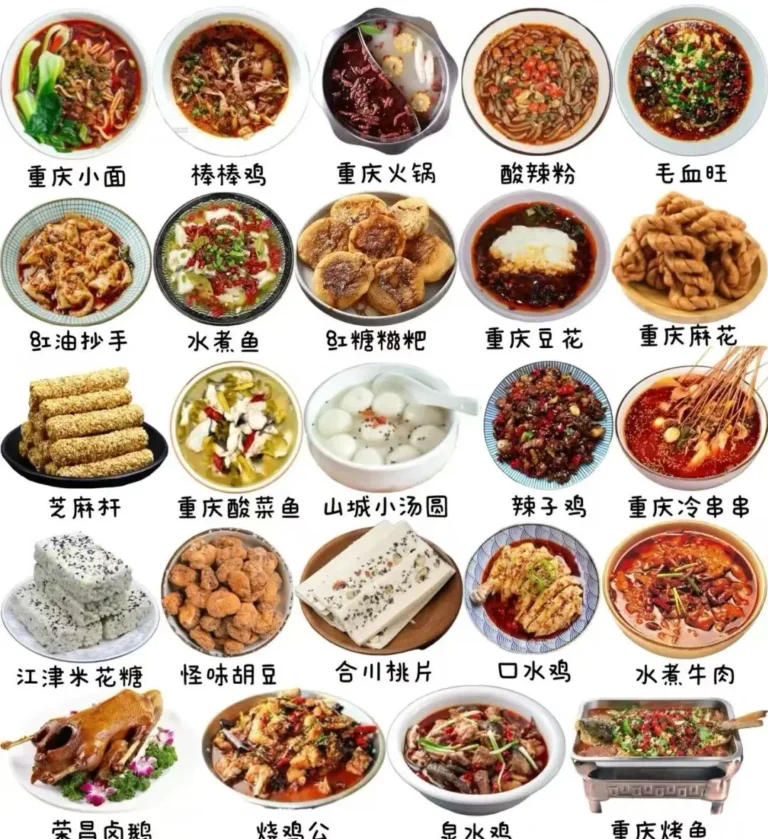
Chongqing xiaomian (重庆小面)
One of the most basic Chongqing meals—and one of the easiest ways to understand local flavor.
A typical bowl combines noodles with chili oil, Sichuan peppercorn, preserved vegetables, scallions and seasonings. Prices vary substantially by shop and toppings, so avoid relying on an old citywide “8 RMB bowl” rule.
Grilled pig trotters (烤猪蹄)
The outside is grilled until slightly crisp while the inside stays soft and gelatinous. Chili powder, cumin and other spices are commonly added.
Tofu pudding with rice (豆花饭)
Soft tofu served alongside rice and a strongly seasoned dipping sauce. It is less of an Instagram snack and more of an everyday local meal.
If you see a packed local restaurant and cannot read the menu, looking at what nearby tables are eating and pointing is perfectly normal.
For more help understanding the dishes, see TripChina’s Chongqing Food Guide.
Choose fixed shops or stalls with clearly displayed prices whenever possible.
Temporary mobile vendors can be less consistent about pricing.
The narrow lanes become crowded after dark, so keep your phone and wallet secure rather than leaving them exposed in an open pocket.
The trade-off is simple: you lose some of the polished, photo-ready environment of Jiefangbei and Guanyinqiao, but you gain cheaper food and more everyday local character.
Some businesses around the wider Jiaochangkou area continue serving food well past normal dinner hours. Late-night schedules vary considerably from one vendor to another.
If food is the main purpose of your evening, Guanyinqiao is one of the strongest choices.
Metro: Lines 3 or 9 to Guanyinqiao Station.
Save 观音桥好吃街 on your navigation app before leaving the station because the surrounding commercial district is large.
Guanyinqiao combines an enormous food selection, shopping, convenient transport and a young, busy evening atmosphere.
It is more commercial than a neighborhood street market, but that is also its advantage: facilities are better, ordering is easier and a group of travelers with completely different tastes can usually find something within a few minutes.
As of September 2026, published visitor information commonly lists the main Guanyinqiao Food Street itself as operating roughly into the late evening. Individual restaurants and the wider Guanyinqiao/Jiujie area may operate later, so treat 19:00–21:30 as a good visiting window rather than a guarantee for every stall.
This is where I would try some dishes that look intimidating but are very Chongqing.
Grilled sweet-potato starch skin (烤苕皮, kao shaopi)
A chewy sheet made largely from starch, grilled until slightly charred and usually filled or topped with chili, pickled vegetables and seasonings.
If you have never had it before, the texture is the interesting part—chewy rather than crispy.
Grilled pork brain (烤脑花, kao naohua)
Yes, it is really pork brain.
It is usually cooked with chili, garlic, Sichuan peppercorn and other strong seasonings until soft and creamy. Not every traveler will want it, but it is a genuinely Chongqing-style night snack.
Dingjiapo potatoes (丁家坡洋芋)
Potatoes tossed with chili, spices and seasonings. Much easier for cautious first-time eaters than pork brain.
You will also find noodles, barbecue, desserts, bubble tea and large numbers of sit-down restaurants.
One practical advantage: parts of the main food-street complex are indoors, air-conditioned and relatively flat. That makes Guanyinqiao easier than hillside markets for families traveling with children or strollers.
Drinks and desserts in the busiest pedestrian areas can carry commercial-district pricing.
You may also encounter promotional staff offering a gift in exchange for scanning a QR code or following an account. There is usually no reason for a traveler to scan an unknown QR code.
Weekend evenings get substantially busier.
Yes—if you want drinks or nightlife afterward.
Jiujie is better understood as a nightlife district than another food market. Bars, restaurants, live entertainment and late-night barbecue extend the evening beyond dinner.
Do not overplan it.
Eat around Guanyinqiao first, then move toward Jiujie after about 21:00 if you still want drinks or live music.
The detailed nightclub-by-nightclub itinerary belongs in a Chongqing nightlife guide, not a night-market guide.
📍 Open in Amap — Jiujie (九街)Danzishi is the strongest choice when atmosphere matters almost as much as dinner.
Metro: Take Chongqing Rail Transit’s Loop Line toward Danzishi Station. Check the latest exit information before departure because construction-related access changes can occur.
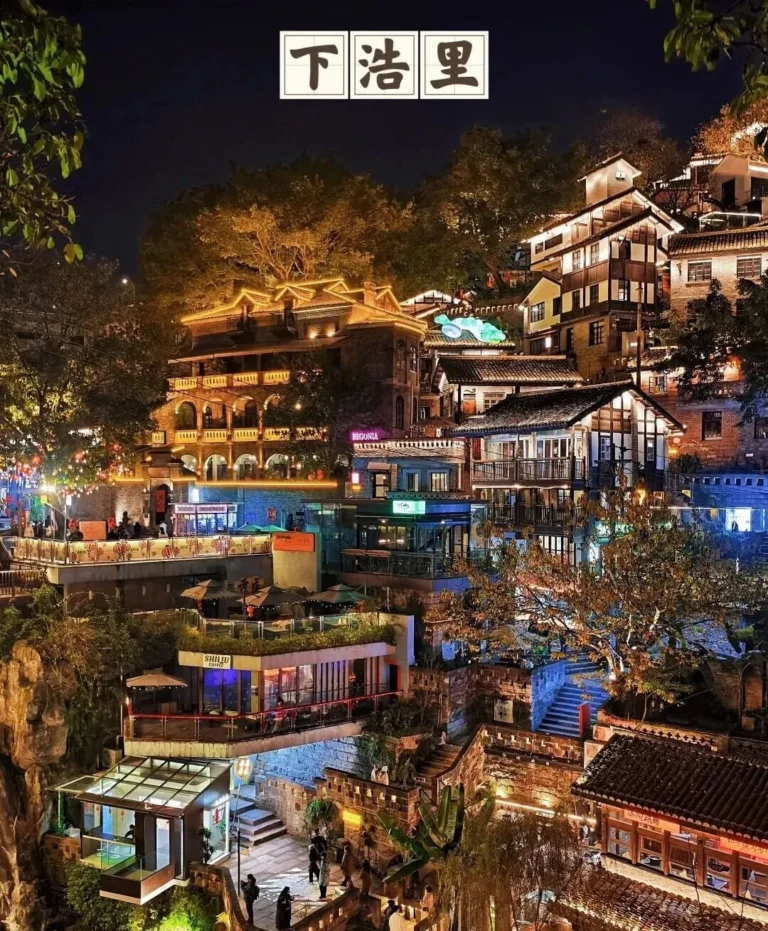
Danzishi Old Street and its riverside area in Nan’an deliver a very different evening vibe compared with Jiefangbei: barbecue, hillside streets, modernized old-street architecture and views toward Chongqing’s central skyline.
The old Yangren Street amusement park, often linked to outdated Danzishi travel guides, closed years ago during urban redevelopment. Do not rely on old itineraries built around it.
Barbecue is the obvious answer.
Skewered beef (签签牛肉)
Small pieces of seasoned beef cooked on skewers. Prices depend heavily on serving size and restaurant.
Iron-plate squid (铁板鱿鱼)
Squid cooked quickly on a hot metal plate, usually with chili, cumin and sauce.
Chongqing-style barbecue (烧烤)
Sit-down barbecue restaurants are a better choice if you want a full meal rather than grabbing two or three skewers while walking.
Yang Pangwa Barbecue (Yangpangwa Shaokao) is one local name you may encounter, but I would not build the entire evening around one restaurant. Look at current queues, pricing and what appears fresh.
Some nearby commercial or creative-market areas may also have small hands-on experiences or souvenir activities. Treat those as optional extras—the barbecue and riverside setting are the reasons to come.
📍 Open in Amap — Danzishi Night Market (弹子石夜市)Before you start filling a tray, ask how the food is priced.
Barbecue can be charged:
• per skewer
• per plate
• per portion
• occasionally by weight
This matters more than it sounds. Twenty small skewers can become a much bigger bill than expected if you misunderstood the pricing system.
Arriving around or before the main dinner rush also helps. Popular places can develop significant queues later in the evening.
After dinner, Danzishi’s location is part of the payoff. TripChina’s Chongqing Night View Guide compares places to see the skyline after dark.
Keyuan 4th Road—around the wider Nanfang Huayuan late-night dining area—is one of Chongqing’s established spots for barbecue, stir-fries and drinking food after normal dinner hours.
Metro: Line 1 to Xietaizi Station, then continue toward Keyuan 4th Road.
This is not where I would send someone looking for polished food courts, English menus or iconic photo locations.
That is also why it is interesting.
📍 Open in Amap — Keyuan 4th Road Night Market (科园四路夜市)Late-night barbecue (烧烤, shaokao)
Meat, vegetables, tofu and sometimes offal grilled with chili, cumin and Sichuan peppercorn.
Stir-fried river snails (炒田螺, chao tianluo)
A classic drinking snack. The fun is partly in picking the meat from the shells while sitting around the table with beer.
Expect it to be strongly flavored.
Jianghu cuisine (江湖菜, jianghu cai)
This is not one specific dish.
“Jianghu cuisine” broadly refers to bold, informal Chongqing-style dishes built around chili, oil, garlic and intense seasoning. It is the opposite of delicate fine dining.
Cold side dishes (凉菜, liangcai)
Often ordered alongside beer and heavier hot dishes.
This is food designed for a long, noisy late-night meal rather than a quick sightseeing snack.
English menus are less common here than around Jiefangbei or Guanyinqiao.
Use photos, a translation app or simply point to something another table is eating.
Choose restaurants with clearly displayed prices.
Opening hours vary widely by business. Some venues stay open very late, but do not assume every shop continues until 04:00.
Older descriptions that simply call the area “rough” are increasingly outdated.
Local authorities have strengthened late-night policing, including one-click alarm devices connected with police and patrol teams. Public reporting in 2026 described significant improvements in the number of disputes and other incidents in the area.
Normal late-night precautions still apply: keep valuables secure, stay aware of your surroundings and use established businesses with clear pricing.
This matters if you are coming here specifically for a midnight meal.
Many Chongqing rail services finish during the late evening, often around the 22:30–23:00 period depending on the line, station and direction.
There is no single system-wide “last train at 23:00.”
Check your exact station + direction before sitting down for dinner.
If you plan to eat well past 22:00 at Keyuan 4th Road or drink late around Jiujie, assume you may need a taxi or DiDi back to your hotel.
Minxinjiayuan is the most interesting choice on this list if your priority is everyday neighborhood life rather than sightseeing.
Metro: Line 10 to Minxinjiayuan Station, then continue toward the Huimin Building Comprehensive Market area.
The important detail here is location.
The original Minxinjiayuan street-market setup was reorganized in 2023. The night market moved to the nearby Huimin Building Comprehensive Market area, where the new location began trial operations on April 26, 2023 and formally opened on May 1.
So if you find an old guide pointing you toward informal roadside stalls inside the residential area, it may be sending you to an outdated location.
The reorganized site still serves the surrounding community rather than functioning purely as a tourist attraction.
📍 Open in Amap — Minxinjiayuan Night Market (民心佳园夜市)This is one of the best sections of the article for abandoning the “must-eat tourist snack” mentality.
Look at what local people are buying.
Fiery beef skewers (烈火牛肉, liehuo niurou)
One of the market’s better-known styles of snack: strongly seasoned beef skewers cooked quickly over high heat.
Malatang (麻辣烫)
Choose your own meat, tofu, mushrooms, vegetables or noodles and have them cooked together.
The exact system varies. Some shops charge by weight, some by portion and some price ingredients individually.
Check before filling your basket.
Fresh-meat scallion pancake (鲜肉葱油饼)
Crisp outside with a savory meat-and-scallion filling. This is an especially useful choice if your travel companion is tired of noodles.
Handmade ice jelly (手搓冰粉)
Sweet, cold and refreshing after chili-heavy food.
The market also has other everyday snacks such as grilled squid, fried skewers, potato dishes, drinks and desserts.
The atmosphere matters just as much as the menu: families, students and workers come here to eat and shop after work.
Not automatically.
This is exactly the sort of place travel guides often oversell as a “hidden gem.”
If you have only one or two evenings in Chongqing, I would not spend a large part of one night traveling here purely to collect another night market.
Go if you genuinely want to see a community market or if you are staying nearby.
That is when it makes sense.
Spring and autumn are generally the easiest seasons for spending several hours outside.
Summer is a different experience.
Chongqing can be intensely hot and humid, and an outdoor night market at 18:00 may still feel uncomfortable in July or August. Starting later can make walking and eating outdoors considerably easier.
At the same time, summer is one of the liveliest periods for Chongqing’s nighttime economy. Food, shopping, entertainment and evening activities continue well after sunset.
Winter is cooler and often easier for eating hot food, but smaller outdoor markets may have fewer temporary vendors.
Save this section on your phone.
| What You Want | Show the Vendor | Pronunciation |
|---|---|---|
| Not spicy | 不辣 | bù là |
| Less spicy | 少辣 | shǎo là |
| Mild / slightly spicy | 微辣 | wēi là |
| No chili | 不要辣椒 | bú yào là jiāo |
The two most useful phrases are:
Not spicy
不辣
bù là
Less spicy
少辣
shǎo là
If the vendor does not speak English, enlarge the Chinese characters on your phone and show the screen.
That is often more reliable than trying to pronounce Mandarin over shouting, traffic and cooking noise.
Not always.
This is one of the most important Chongqing-specific things for foreign visitors to understand.
Some broths, marinades, chili oils, sauces and prepared ingredients already contain chili. The vendor may be able to stop adding extra chili without being able to make the whole dish genuinely non-spicy.
If you have very low tolerance, show:
不要辣椒 — No chili
Then point to the dish and confirm before ordering.
If you genuinely cannot tolerate chili, easier fallback foods include:
• ice jelly
• sweet tangyuan
• some pancakes and breads
• plain rice dishes
• simple desserts
A busy stall is often a useful sign.
Look for places with high customer turnover, where ingredients are being cooked continuously rather than sitting around for long periods.
For a traveler with a sensitive stomach:
• Prefer food cooked hot and served immediately.
• Be more cautious with raw items or cold dishes sitting uncovered.
• Look for clean preparation surfaces and utensils.
• Avoid food that appears to have been sitting at room temperature for a long time.
• Drink bottled or properly boiled water rather than untreated tap water.
Carry tissues and hand sanitizer as well. Community-market facilities can be much more basic than those in a shopping mall.
Yes.
At Jiefangbei and Guanyinqiao especially, a combination of translation apps, photos, pointing and mobile payments is usually enough.
For smaller neighborhood markets, save these three phrases:
不辣 — Not spicy
少辣 — Less spicy
多少钱?— How much?
You can show 多少钱? to a vendor before ordering when a price is not displayed.
Also save a screenshot of your hotel name and address in Chinese.
If you stay out after the metro closes, having the Chinese address ready makes it much easier to confirm a taxi or DiDi destination.
Yes, particularly markets that rely partly on temporary vendors.
Friday and Saturday evenings generally bring:
• more visitors
• more active stalls
• longer queues
• more nightlife activity
Weeknights are usually easier for walking and ordering, but some smaller vendors may not appear every night.
At commercial food streets such as Jiefangbei and Guanyinqiao, the biggest difference is usually crowd size.
At community markets, the vendor mix itself can change.
Treat published opening hours as a planning reference, not a guarantee that every stall will be operating.
For a normal dinner, roughly 18:00–20:00 is the easiest window.
You arrive after stalls and restaurants have become active but before the deepest part of the evening rush.
Popular areas often become busiest around 20:00–22:00, especially on Friday and Saturday.
For Danzishi, going earlier is particularly useful if you want a popular barbecue restaurant plus river views afterward.
For Keyuan 4th Road, the whole point is different: go later if you specifically want Chongqing’s after-midnight food culture.
For a first evening, I prefer a compact route rather than trying to cross Chongqing for several night markets.
| Approx. Time | Stop | What to Do |
|---|---|---|
| 18:00 | Jiefangbei | Start with 2–3 small snacks |
| 19:00 | Hongyadong | Walk over for evening views |
| 20:00 | Qiansimen Bridge area | Photograph the skyline |
| 21:00 | Jiaochangkou | Finish with a proper local meal |
From Jiefangbei to Hongyadong is a relatively short walk, and Jiaochangkou keeps you within the same broader central area rather than sending you across the city.
Chongqing is famously 3D.
A route that looks short on a map may include steep stairs, hills, overpasses and unexpected vertical detours.
Wear comfortable shoes.
For a longer walking evening, TripChina’s Chongqing Citywalk Routes provides alternatives built around different parts of the city.
Yes, but I would replace Jiaochangkou rather than trying to squeeze both into the same evening.
As of September 2026, standard Two Rivers night-cruise products generally fall around 138–158 RMB, depending on the sailing, season and seat tier. Classic cruises are commonly around 45 minutes.
Choose one:
Food-focused night:
Jiefangbei → Hongyadong → Qiansimen → Jiaochangkou
Night-view-focused night:
Jiefangbei → Hongyadong → Qiansimen → Two Rivers Night Cruise
Check the exact pier, sailing time and ticket terms before booking.
Mobile payments make the whole experience far smoother.
Small vendors commonly use QR-code payments, although RMB cash remains legal tender.
Setting up Alipay or WeChat Pay before you arrive removes a lot of friction when you are buying a 10–20 RMB snack from a busy stall.
TripChina’s How Foreigners Pay in China Guide covers mobile payments, international cards and cash.
For a very late night, the DiDi Guide for Foreign Travelers is useful because you may be returning after the metro has stopped.
Reliable mobile data also matters for translation, navigation and payments. The China eSIM vs SIM Guide explains the main connectivity options.
For more Chengdu travel tips, visit our Chongqing Travel Guide Hub.
Yes, but do not assume something is vegetarian just because you cannot see meat.
Broths, sauces, cooking oils and seasonings may contain animal ingredients. Use a translation app to confirm ingredients before ordering.
Yes.
RMB cash is legal tender, although QR payments are much more common in everyday transactions. Carrying some small-denomination cash is a sensible backup if your phone, foreign card or mobile-payment setup fails.
No.
Tipping is not expected at ordinary street-food stalls or casual local restaurants. Pay the displayed or agreed price.
Usually, yes.
Wide photographs of food displays and market scenes are generally unremarkable. If you want a close-up portrait of an individual vendor, asking first is the polite choice.
Do not block customers while trying to get the perfect shot.
Carry the exact allergy information written in simplified Chinese and show it before ordering.
Cross-contact can be difficult to rule out in small kitchens because grills, oil, pans and utensils are commonly shared.
Travelers with serious allergies should be more cautious than someone who simply dislikes an ingredient.
Do not rely on untreated tap water for drinking.
Use bottled water or water that has been properly boiled. A bottle of water is also useful when you are experimenting with Chongqing’s aggressively spicy food.
You do not need to visit three or four night markets to understand Chongqing’s food culture.
Choose according to the evening you actually want: Jiefangbei for a convenient sightseeing combination, Guanyinqiao for maximum variety, Jiaochangkou for a more everyday central-city meal, Danzishi for barbecue and scenery, or Keyuan 4th Road when dinner starts after most tourists have already gone back to their hotels.
What makes Chongqing’s night markets memorable is not simply the number of stalls.
It is dinner spilling into the street: steam rising from noodle pots, barbecue smoke drifting between tables, plastic stools on the pavement, loud conversations and people still eating long after the conventional dinner hour.
That messy mix of food and everyday city life is the real experience.
Choose one market that fits your route, arrive hungry and leave enough time to wander instead of racing between checklist stops.
Chongqing Municipal People's Government — Minxinjiayuan Night Market
Chongqing Municipal Urban Management Bureau — Chongqing Night Markets
Updated September 2026 using the original TripChina draft, Chongqing government information, local reporting and current transport and night-economy sources. The Minxinjiayuan relocation was verified as April 2023, with trial operations beginning April 26 and formal reopening on May 1. Keyuan 4th Road safety descriptions and other time-sensitive details were updated conservatively. Travelers should double-check metro exits, construction changes, last-train times and individual stall hours before arrival.
TripChina.me creates practical China travel guides shaped by real local experience — helping independent travelers navigate transport, payments, food, neighborhoods, and the cultural details that make traveling in China easier and more meaningful. Find the guide for your destination at tripchina.me.