Our Location:
No. 99, Jiazi Road, Chengdu

 authorChris Lee
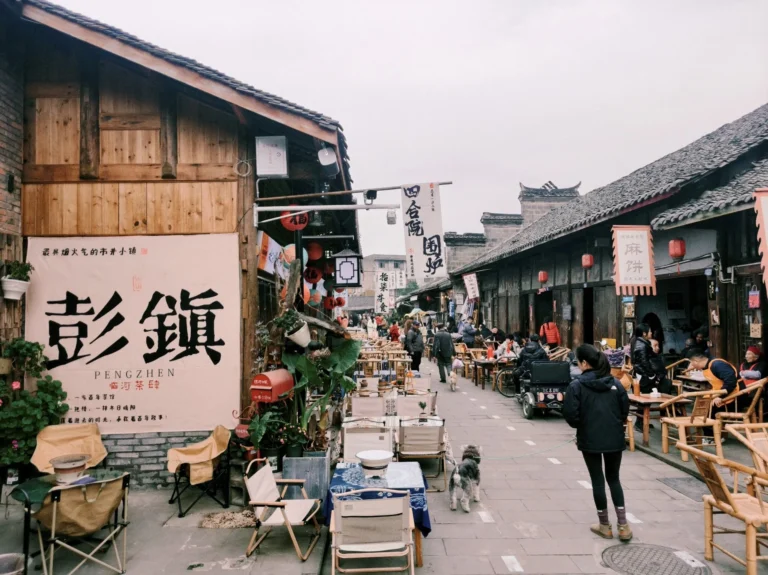
Jinli shows visitors a polished version of old Chengdu. Fuqin is where you can still sit on a small stool, follow the smell of barbecue down a side lane, and eat alongside neighborhood residents.
After a major 2026 upgrade, Fuqin is cleaner and more organized than before—but it has not lost its local-food character. Here is how to visit it without wasting your evening or ordering blindly.
Yes—especially if food and everyday neighborhood life matter more to you than traditional architecture or souvenir shopping.
| What to Know | Fuqin Night Market |
|---|---|
| Best for | Local street food and neighborhood atmosphere |
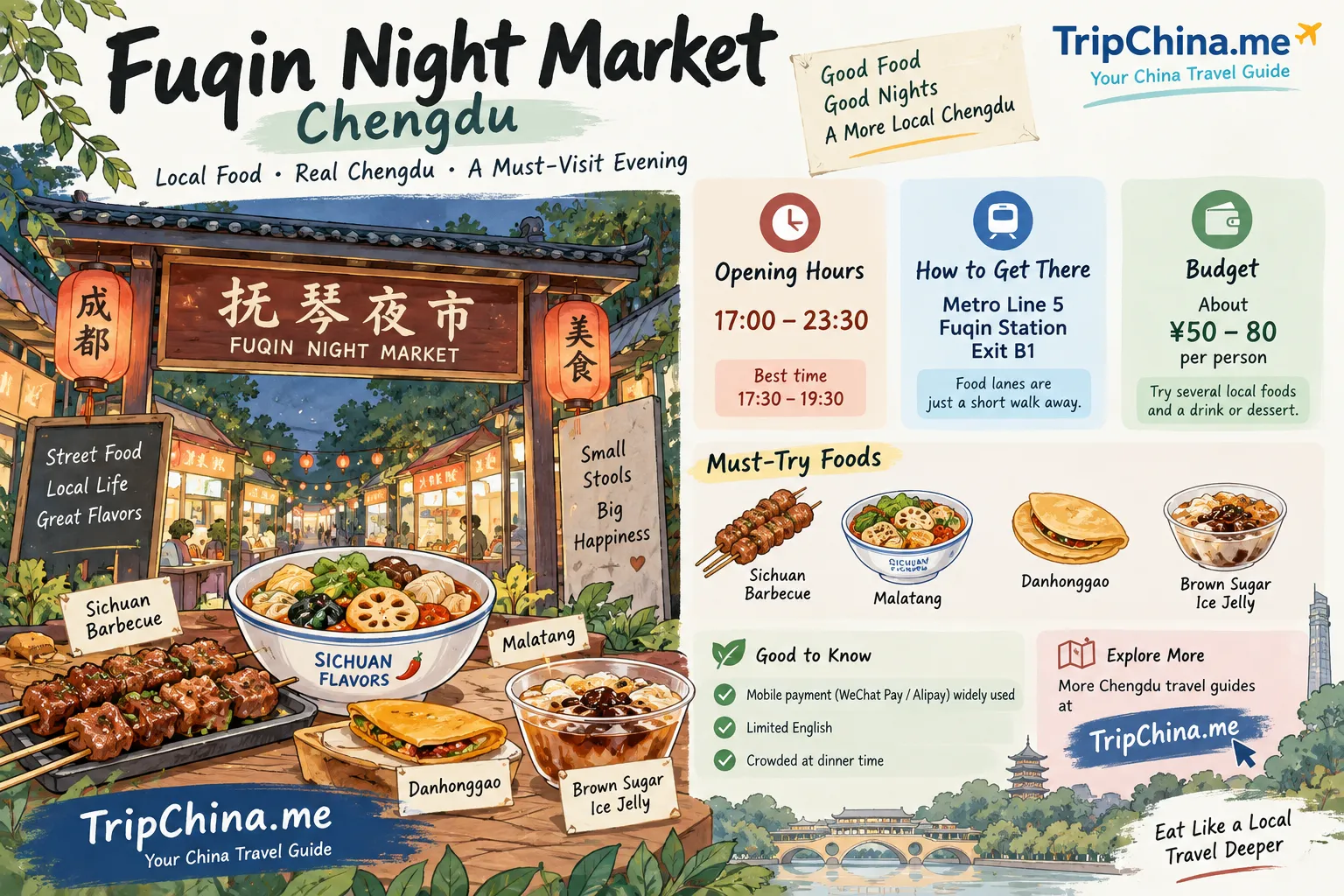
| Main hours | Roughly 17:00–23:00 |
| Best arrival | 17:30–19:30 |
| Peak crowds | Roughly 18:00–21:00 |
| Entry | Free |
| Food budget | About ¥50–80 per person |
| Metro | Line 5, Fuqin Station, Exit B1 |
| Walk from B1 | Immediately at exit; food lanes begin within a short walk |
| Time needed | About 1.5–2.5 hours |
| English | Limited |
| Payment | WeChat Pay / Alipay widely used; cash useful as backup |
| Main downside | Crowds, smoke, limited English and casual seating |
Regular snacks commonly cost around ¥8–15, more substantial specialties around ¥15–25, and desserts or drinks around ¥5–10. Individual stalls set their own prices, so treat these as practical budget anchors rather than fixed tariffs.
If you are comparing several evening food areas, see TripChina’s Best Chengdu Local Night Markets Guide.
Fuqin Night Market sits in Jinniu District, northwest of Chengdu’s central tourist core.
Unlike Jinli or Kuanzhai Alley, Fuqin was not originally built as a visitor attraction. Its food scene grew around neighborhood restaurants, street stalls and the kind of small, unpretentious eateries Chengdu residents sometimes call cāngyíng guǎnzi (苍蝇馆子), literally “fly restaurants.”
That background still matters—but Fuqin is no longer quite the rough-edged street market described in older travel posts.
On February 11, 2026, an upgraded “Fuqin Night Market 2.0” officially opened. Heavy-smoke operations such as barbecue and hotpot-skewer stalls that had occupied space beneath residential buildings were reorganized, with affected vendors moved into a designated corner of the Xinan Street parking lot.
The change was designed to reduce cooking smoke, noise and obstruction around residential buildings while freeing street space. It did not mean that every barbecue restaurant in Fuqin moved into one parking lot: long-established brick-and-mortar eateries remain scattered through the surrounding neighborhood lanes.
The upgrade also transformed the former open-air tea area into Danglu Tea House (当垆茶肆), with Sichuan-style architecture and a performance stage that adds a cultural layer to the evening food scene.
Fuqin therefore remains a network of connected neighborhood streets rather than a purpose-built market hall. There is no conventional attraction entrance or ticket checkpoint—you simply enter the food lanes and explore.
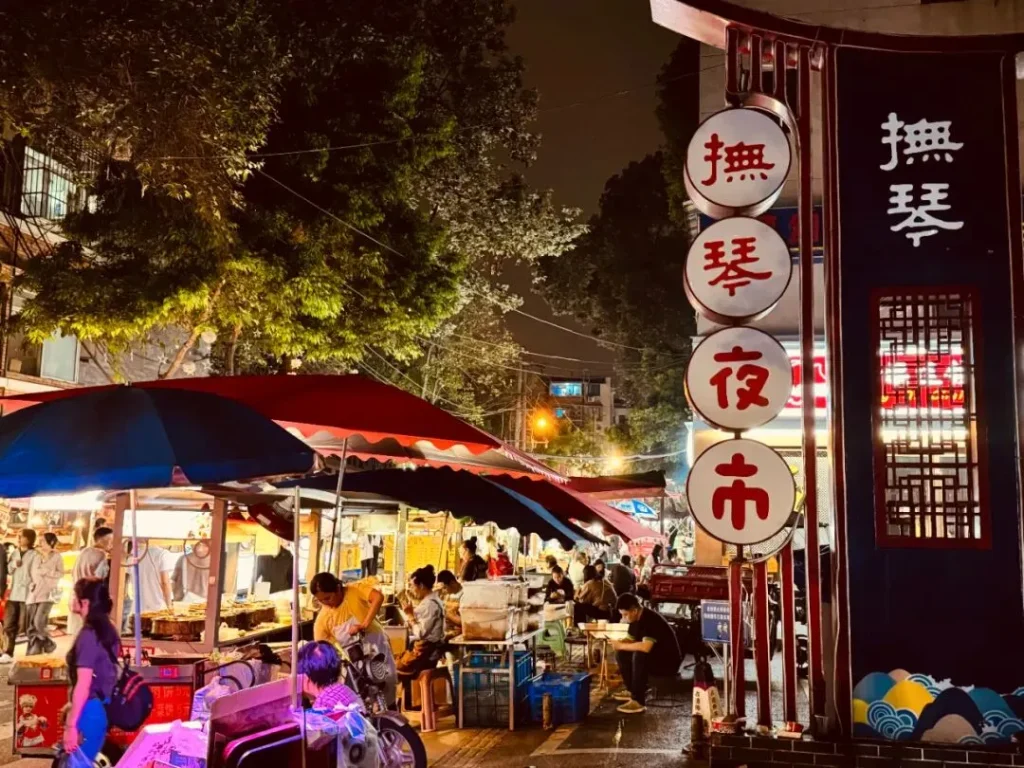
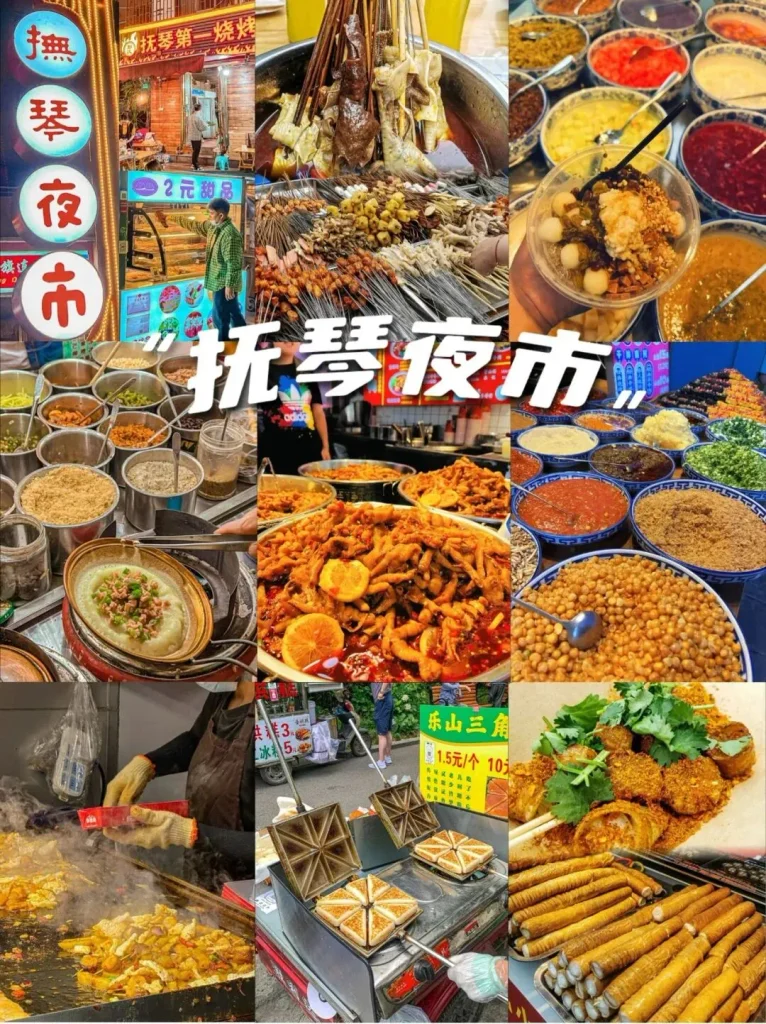
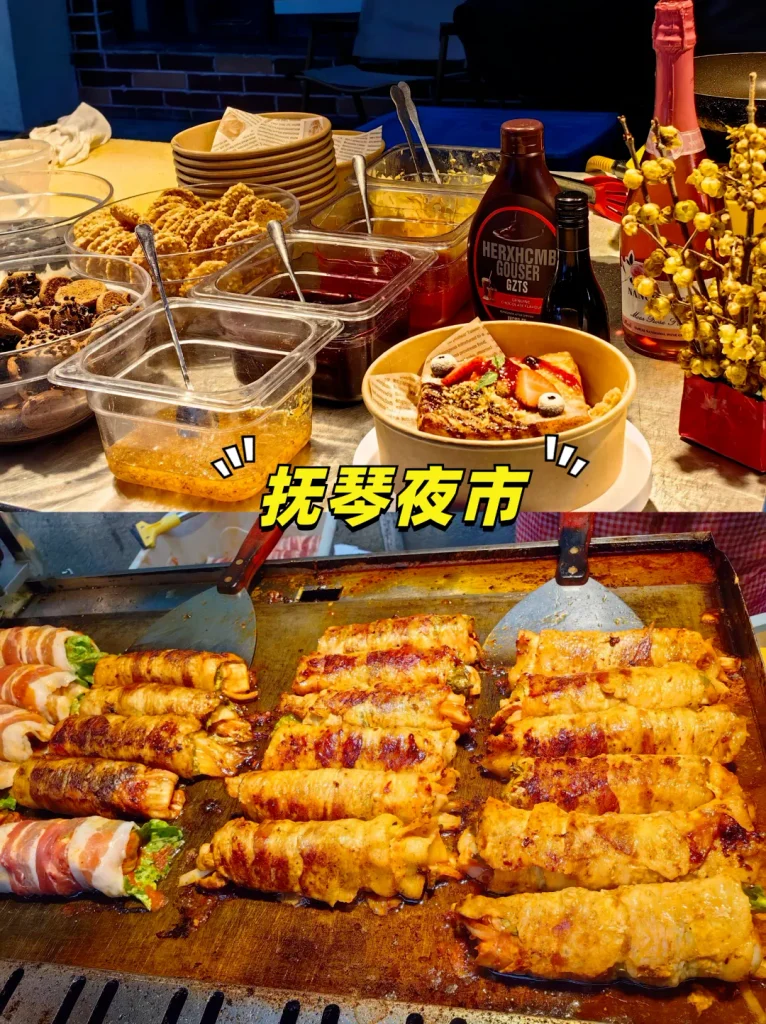
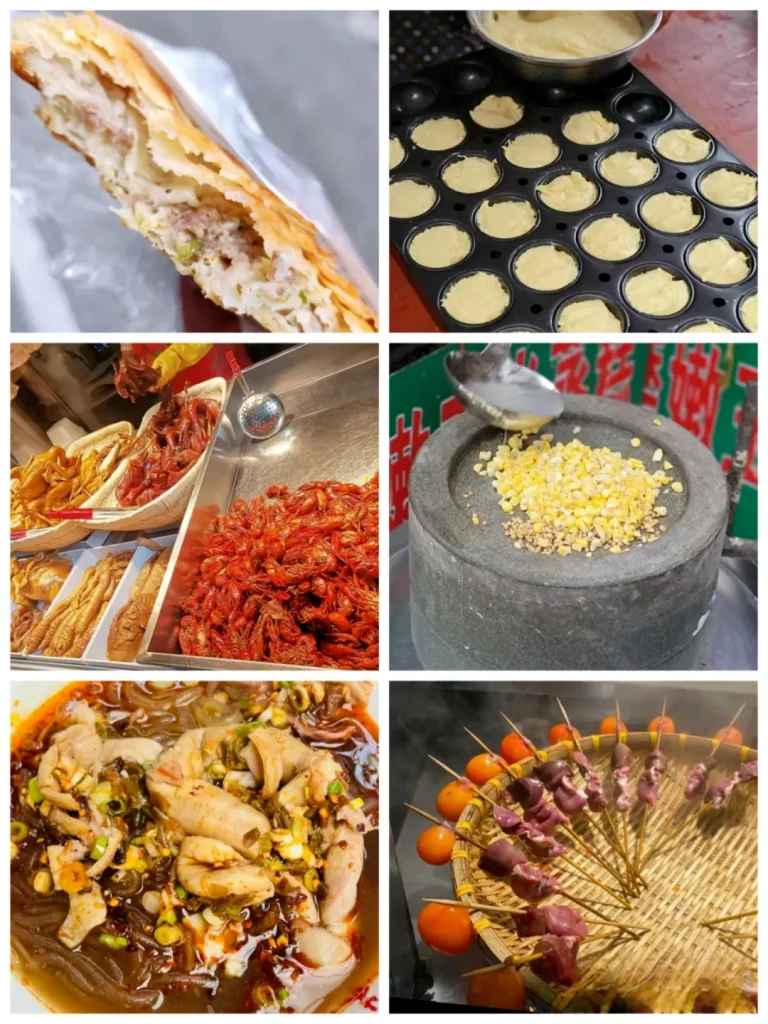
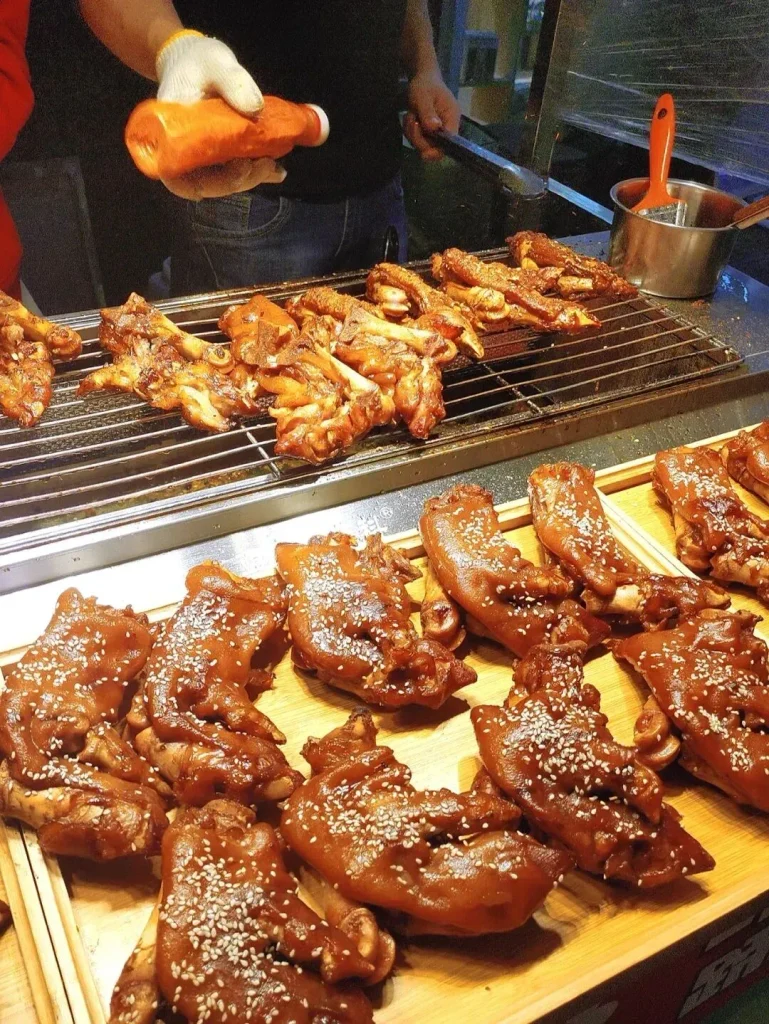
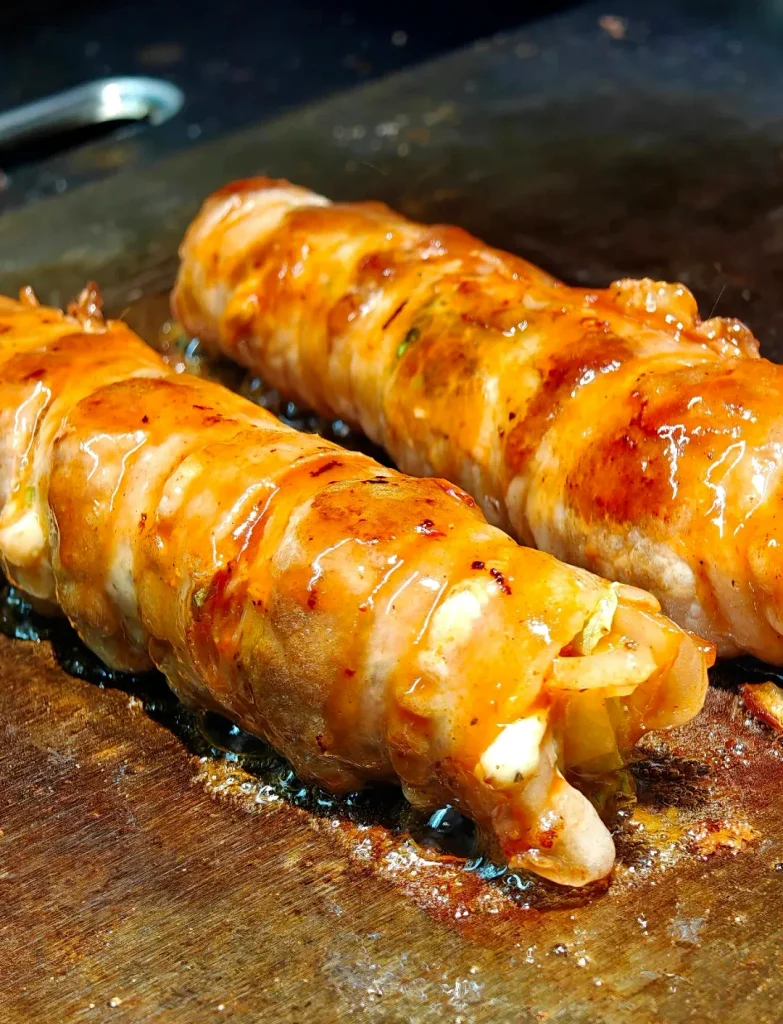
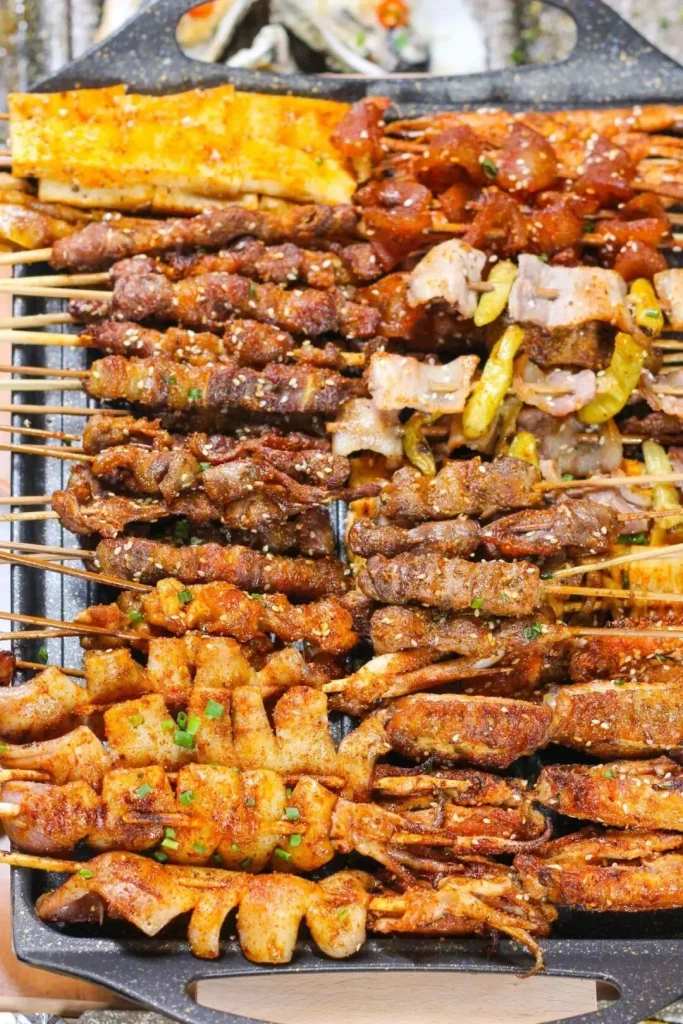
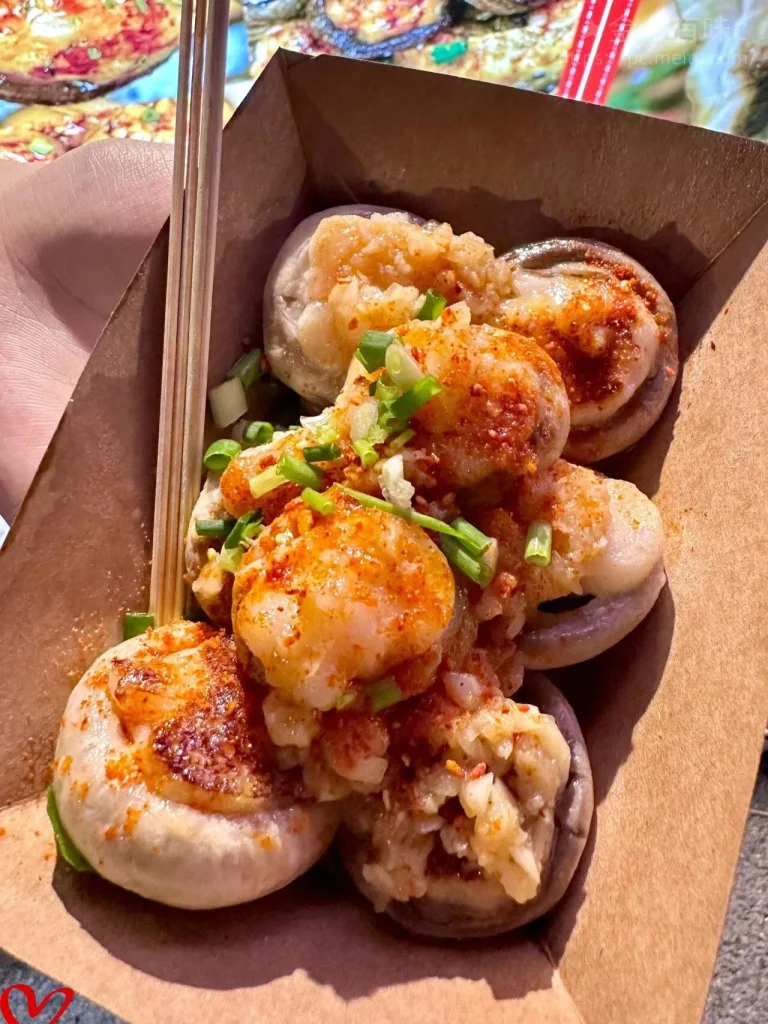
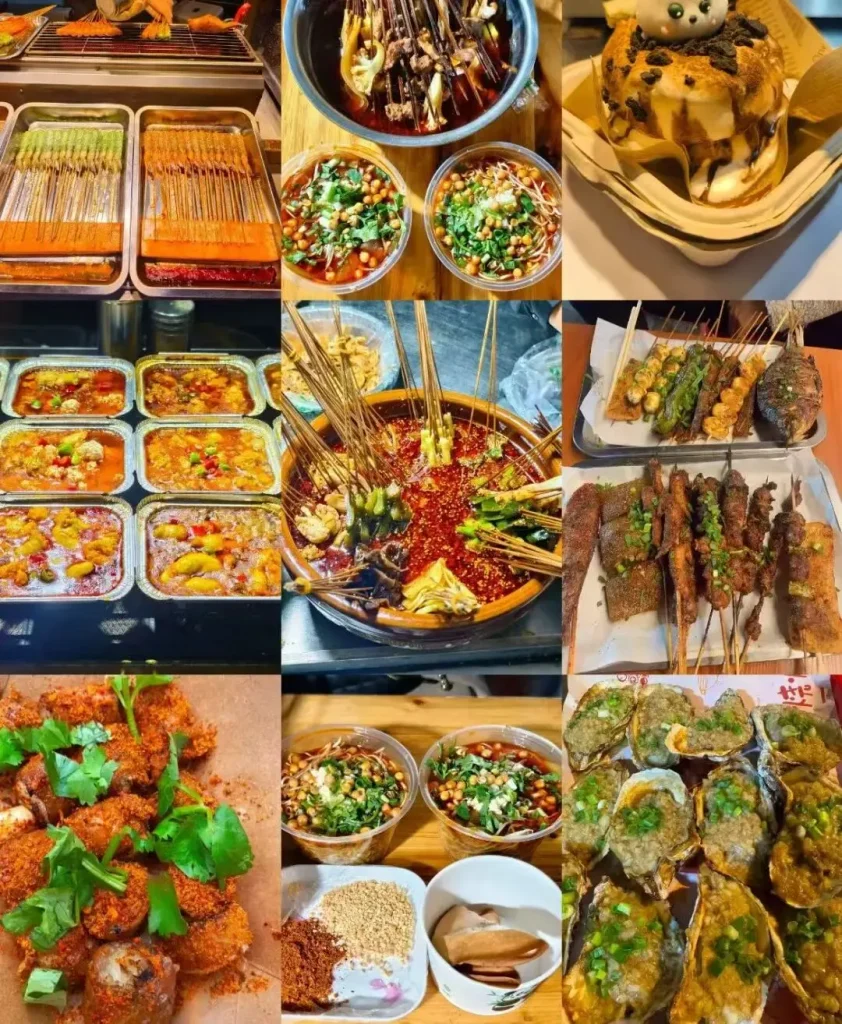
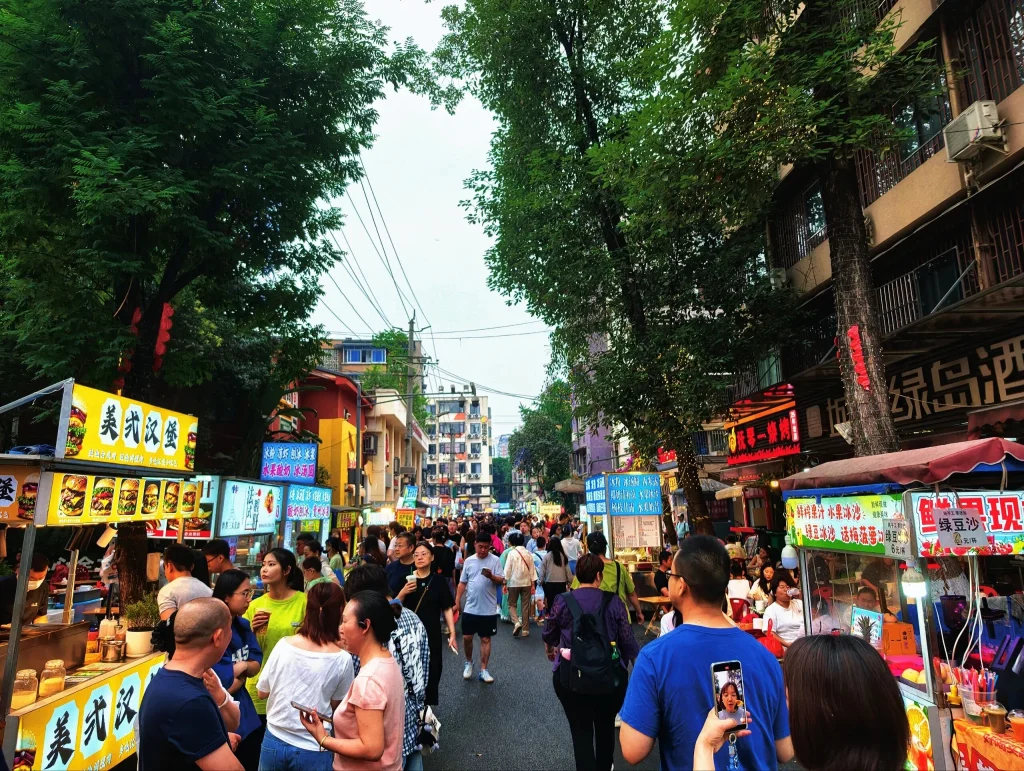
Arrive around 17:30 if you want easier photos and a calmer first walk. Choose roughly 18:30–20:00 if you care more about the full dinner atmosphere, when grills are busy and local tables fill up.
OTA listings and visitor information generally place the active window at approximately 17:00–23:00, though under current street-management conditions many stalls may begin winding down earlier. If Fuqin is an important stop, do not leave it until the final half-hour.
Allow around 1.5–2.5 hours for a multi-stop food crawl. Weekday evenings are generally easier if you want more walking space and shorter queues.
The metro is the simplest option.
Take Chengdu Metro Line 5 to Fuqin Station (抚琴站), Exit B1. Exit B1 puts you at the edge of the food area; the core lanes are a short walk away.
Do not waste time looking for one grand entrance. Fuqin spreads through several connected neighborhood lanes; once you reach the food cluster, keep exploring beyond the first row of stalls.
For the wider rail network, ticketing and foreign-traveler payment options, see the Chengdu Metro Guide for Foreign Travelers.
Allow roughly:
| Starting Point | Approximate Public-Transport Time |
|---|---|
| Tianfu Square / Chunxi Road | 20–30 min |
| Kuanzhai Alley | About 20 min |
| Wuhou Shrine / Jinli | 30–40 min |
| Chengdu East Railway Station | 30–40 min |
| Chengdu Shuangliu Airport (CTU) | Around 40–50 min |
| Chengdu Tianfu Airport (TFU) | Around 70–80 min |
These are planning estimates rather than guaranteed journey times. Transfers, walking and waiting can change the total.
If you are coming directly from the airport, check the full Chengdu Airport-to-City Transport Guide before deciding whether Fuqin makes sense on your arrival night.
A taxi or DiDi can be convenient from central Chengdu, particularly if you are traveling with several people or leaving later in the evening.
Ask to be dropped on a nearby main road rather than expecting the driver to enter the narrow food lanes.
For international travelers unfamiliar with Chinese ride-hailing, TripChina’s DiDi Guide for Foreigners in China explains how to set it up without relying on a Chinese phone number.
Driving yourself is rarely worthwhile. Streets around the market are narrow, parking is limited, and evening pedestrian traffic makes the metro or ride-hailing much easier.
Do not approach Fuqin like a normal restaurant meal.
The better strategy is to order small amounts from several places: perhaps barbecue first, something fried or soupy next, and ice jelly at the end.
A typical food-crawl flow: start with barbecue, try a small portion of malatang or fried snacks, then finish with brown-sugar ice jelly for dessert.
Look at what nearby tables are eating. At a neighborhood market like this, a stall full of local customers is often more useful than an English-language recommendation list.
One practical warning: extremely low advertised skewer prices can refer to a particular size, ingredient or pricing method. Check how the stall calculates the final bill before filling a tray.
Barbecue is one of Fuqin’s strongest categories.
Common choices include pork belly, ribs, chicken wings, chicken skin, offal, vegetables and other skewers.
One particularly Chengdu-style option is grilled large intestine stuffed with scallion (烤肥肠夹大葱). It sounds intimidating if you have never eaten intestine, but the scallion cuts through the richness and gives the skewer a fresher finish.
There is one naming trap worth knowing: Fuqin First Grill (抚琴第一烤) and Fuqin First Barbecue (抚琴第一烧烤) are not names you should treat interchangeably when searching on a map.
Fuqin First Grill (抚琴第一烤), associated with Fuqin Street South First Lane (抚琴街南一巷), is a long-running neighborhood barbecue name known for items such as pork belly and ribs. Fuqin First Barbecue (抚琴第一烧烤) refers to a separate business in the wider Fuqin food area.
For travelers, the key takeaway: check Chinese characters and map locations rather than assuming they are the same shop.
There is no need to turn the distinction into a hunt for the one “authentic” shop. Both names have histories in the area, and Fuqin has plenty of other barbecue options.
Lao Liu BBQ (老刘烧烤) is another independent local barbecue option commonly mentioned alongside Fuqin’s better-known grills. It is not part of the “Fuqin First” naming confusion. If the famous stalls have long queues, it is one of several alternatives worth considering.
For a more substantial Sichuan meal on another evening, use TripChina’s Chengdu Hot Pot Guide rather than trying to turn a night-market crawl into a full hotpot dinner.
Yes, but say it clearly before the seasoning goes on.
不辣 — bú là — not spicy
微辣 — wēi là — mildly spicy
不要辣 — bú yào là — no chili/spice
“Not spicy” does not necessarily mean completely free of chili residue if the same grill and utensils are used for spicy food.
Malatang (麻辣烫) works especially well if you want control over what goes into your meal.
You choose ingredients—vegetables, tofu, mushrooms, meat or other items—and the stall cooks them for you.
Confirm how the stall charges before filling your bowl. Depending on the business, pricing may be by weight, by skewer or by ingredient category.
If you have dietary restrictions, pointing to ingredients individually is often easier than trying to explain a complicated requirement in English.
Note: Shared cooking equipment may lead to cross-contact with allergens for travelers with severe food allergies.
Danhonggao (蛋烘糕) is one of Chengdu’s classic small snacks: a soft, warm egg-based pancake folded around sweet or savory fillings.
Fillings vary from stall to stall and can include cream, sweet pastes, vegetables or pork floss.
It is a good break between heavily seasoned dishes.
Brown sugar ice jelly (红糖冰粉) is one of the easiest Chengdu desserts for first-time visitors.
It is cool, sweet and particularly welcome after barbecue or chili-heavy food. If you are building a multi-stop food crawl, save it for the second half rather than filling up on dessert immediately.
| Food | Typical Price Range | What to Expect |
|---|---|---|
| Grilled intestine / intestine with scallion | About ¥15–20 | Rich, smoky, strongly local |
| Tianbula / fried snacks | Around ¥10+ | Sweet-savory sauce, chewy or crisp textures |
| Grilled squid | Around ¥15+ | Firm seafood texture with Sichuan seasoning |
| Hand-made ice jelly | About ¥8–10 | Cool, sweet finish after spicy food |
| Beef-offal soup | About ¥12–18 | Warm, savory and generally milder |
| Fried skewers | Varies by stall | Choose several ingredients and share |
| Egg-wrapped potato | Around ¥10–20 | Filling potato snack with Guizhou influence |
Prices change by stall and portion size. Check the posted menu before ordering.
For most travelers, ¥50–80 per person is enough for several small foods and a drink or dessert. A couple sharing dishes can usually try more varieties without dramatically increasing the budget.
Some stalls may not display every price clearly. For skewers, mixed dishes or food sold by weight, confirm the pricing method before ordering.
多少钱? — duō shǎo qián? — How much?
That five-second check can prevent confusion when the final price is calculated.
Mobile payment is the most practical option.
Most vendors use WeChat Pay and/or Alipay QR codes. A physical international credit card is much less useful at a small street-food stall than a supported foreign card linked to one of these mobile-payment systems.
Under Tenpay’s current international-card rules, single transactions of ¥200 or less are exempt from the international-card processing fee. For a single transaction above ¥200, the current fee is 3% of the full transaction amount.
This small-payment rule is separate from temporary promotions. Eligible first-time international-card users may also see an additional first-time binding fee-waiver promotion in WeChat. This is a time-limited offer, subject to real-time in-app terms.
Because individual night-market purchases are usually well below ¥200, the standard small-transaction waiver is particularly useful at Fuqin.
Set mobile payment up before standing in front of a busy food stall. TripChina has step-by-step guides for Setting Up WeChat Pay Before Arriving in China and Using Alipay Without a Chinese Bank Account.
I would still carry a modest amount of RMB cash as backup. QR codes can fail, phones run out of battery, and individual operators may prefer cash. Tipping is not customary at Chinese night-market stalls; simply pay the amount shown or quoted.
For a full comparison of cards, cash, Alipay and WeChat Pay, see the China Payment Guide for Foreign Travelers.
Having mobile payment ready lets most foreign travelers pay at Chengdu night markets without opening a Chinese bank account.
Beyond payment, many foreign travelers also ask about vegan food at Fuqin Night Market; check the FAQ below for practical dietary tips.
Do not let the lack of English menus put you off.
At Fuqin, pointing works surprisingly well. Take a photo of what another customer is eating, point to food displayed at the stall, or use your phone’s camera translation.
It also helps to save the Chinese names of two or three dishes before arriving.
Do not depend on Google Maps as your primary real-time navigation tool in mainland China. Amap (Gaode Maps / 高德地图) is generally more useful for local businesses, walking routes and metro navigation.
App availability can vary by country and app store, so install and test your China navigation app before departure rather than waiting until you reach Chengdu.
TripChina’s China Navigation App Guide explains the practical options before you arrive.
These places solve different travel needs.
| Fuqin | Jinli | Kuanzhai Alley | |
|---|---|---|---|
| Main reason to visit | Local food | Historic-style sightseeing + snacks | Architecture, cafés, shopping |
| Atmosphere | Neighborhood, casual | Highly tourist-oriented | Polished and visitor-friendly |
| Food prices | Generally lower | Generally higher | Generally higher |
| English convenience | Limited | Better | Better |
| Best time | Dinner / evening | Late afternoon / evening | Day to early evening |
| Crowd level | Moderate to heavy at dinner peak | Heavy in tourist hours | Heavy in daytime / holidays |
| Best traveler type | Food-focused, independent travelers | First-time sightseers seeking a mix of sightseeing and casual snacks | Casual sightseeing, café-hopping and souvenir shopping |
| Main drawback | Less polished | Commercialized | Commercialized and crowded |
If you have only one short evening in Chengdu and want an easy sightseeing experience, Jinli may be simpler.
If you have already seen Chengdu’s headline attractions and want an authentic Chengdu night market experience centered on food rather than sightseeing, Fuqin becomes much more interesting.
A practical combination is to visit Kuanzhai Alley during the day—or Wuhou Shrine and Jinli earlier—then move to Fuqin for dinner rather than expecting one place to provide both experiences.
If you are considering Kuanzhai instead, read TripChina’s Kuanzhai Alley Guide before spending heavily on snacks or souvenirs there.
Do not arrive too early unless you deliberately want quieter streets. Fuqin becomes much more interesting once the evening food trade is fully underway.
Avoid overpriced souvenir or specialty goods from temporary sellers around the busier approaches. Fuqin’s real strength is food, not souvenir shopping.
Wear comfortable shoes. Barbecue smoke, cooking oil, wet pavement and tightly packed tables are part of the environment, so expensive white clothing and high heels are poor choices.
Remember that Fuqin is a residential street network, not a pedestrian-only attraction. Pedestrians have priority in the busiest food lanes. Do not ride bicycles or e-bikes through the crowd, and avoid pushing against the main pedestrian flow during peak dinner hours. Do not leave shared bikes or e-bikes inside the food lanes; use designated parking areas on nearby roads where available.
Public murals and streetscapes can be photographed normally. Ask before taking close-up photographs of vendors or residents. Fuqin is a working neighborhood, not an outdoor museum.
Light rain does not necessarily ruin a visit. Many fixed restaurants and stalls have awnings or covered seating.
Heavy rain affects temporary street stalls much more than permanent businesses. Mobile vendors may close or shorten their operating hours, while brick-and-mortar neighborhood restaurants are more likely to continue operating normally.
If a downpour is forecast, focus on fixed restaurants or move the visit to another evening if the street-market atmosphere is important to you.
Partially.
The main neighborhood streets are relatively flat, but crowding, temporary tables, stools and narrow passages can make movement difficult during the dinner peak.
If accessibility is important, try a weekday shortly after stalls are operating rather than the busiest evening period.
Do not expect the accessibility infrastructure of a modern shopping mall or purpose-built tourist attraction.
Generally, yes. Fuqin is a busy residential food district rather than an isolated nightlife zone, but normal big-city precautions still apply.
Keep valuables secure in crowded lanes and use the metro or a reputable ride-hailing service when leaving late.
For broader planning, see TripChina’s Solo Female Travel Safety Guide for China.
Yes, but strict vegan eating requires more checking than simply choosing vegetable skewers.
Possible options include corn, mushrooms, tofu, potato, lotus root and some ice-jelly desserts, but sauces, broths, cooking oils and shared grills may contain or come into contact with animal products.
Useful phrases:
纯素 — chún sù — vegan
不要肉 — bú yào ròu — no meat
不要动物油 — bú yào dòng wù yóu — no animal fat
Travelers with serious allergies or strict religious dietary requirements should not assume that separate grills, oil or utensils are used.
Chicken, squid, tofu, mushrooms, lotus root, potato, corn and other vegetable skewers are commonly available.
不要猪肉 — bú yào zhū ròu — no pork
不要牛肉 — bú yào niú ròu — no beef
Shared cooking equipment is common, so this is different from guaranteed pork-free or beef-free preparation.
Google Maps should not be your primary navigation tool in mainland China. Amap (Gaode Maps / 高德地图) is generally more useful for current local businesses, walking routes and metro navigation.
Install your preferred China navigation app before your trip because availability can differ between overseas app stores.
There is no single weekly closing day for the entire Fuqin food district. Individual restaurants and small vendors may take occasional days off.
If one particular stall is the main reason for your visit, check its current listing on the day rather than assuming every business operates daily.
Basic public restrooms exist in the surrounding neighborhood, but there is no obvious centralized tourist facility inside the food lanes. Facilities are simpler and less obvious than in a shopping mall; use one when you see it.
Usually, yes. Weekend evenings tend to bring heavier dinner crowds and longer waits at popular stalls.
For easier walking and faster service, choose a weekday evening. You can still experience the main food scene without the strongest weekend crowd pressure.
Yes, if you want food rather than another attraction.
Fuqin has changed. The February 2026 upgrade reorganized heavy-smoke street operations, reduced pressure on residential lanes and added a more visible cultural layer. But it still offers something Chengdu’s famous tourist streets struggle to reproduce: ordinary neighborhood eating culture.
It works best for travelers who enjoy discovering local food and do not mind limited English, small stools, smoke and a less polished setting. If you want quiet dining and tourist-oriented service, it is probably not the right evening.
Simple plan: arrive after 17:30, enter from Fuqin Station B1, share several small dishes and have mobile payment ready. Weekdays are easier for avoiding crowds; aim to finish eating by around 22:30–23:00 rather than relying on the final half-hour of the listed operating window.
China International Communications Group / CRI — Fuqin Night Market 2.0 Upgrade
Tenpay — International Card Payment Service Rules
Tencent — 2026 Inbound Payment Service Upgrade
This guide was reviewed in September 2026 using current local listings, reporting on Fuqin Night Market’s February 2026 redevelopment, local street-management information and official Tenpay/Tencent international-payment rules. Stall prices and individual restaurant hours can change independently, so they are presented as practical planning ranges rather than guaranteed tariffs. Individual vendors may also adjust their own operating schedules. The names 抚琴第一烤 and 抚琴第一烧烤 were researched as separate businesses with distinct listings and possible historical connections rather than being conflated as a single brand.
Ready to visit China without spending weeks researching? TripChina.me Premium Travel Guides combine optimized itineraries, booking workflows, local recommendations, and backup plans to help independent travelers experience China with confidence.