Our Location:
No. 99, Jiazi Road, Chengdu

 authorChris Lee
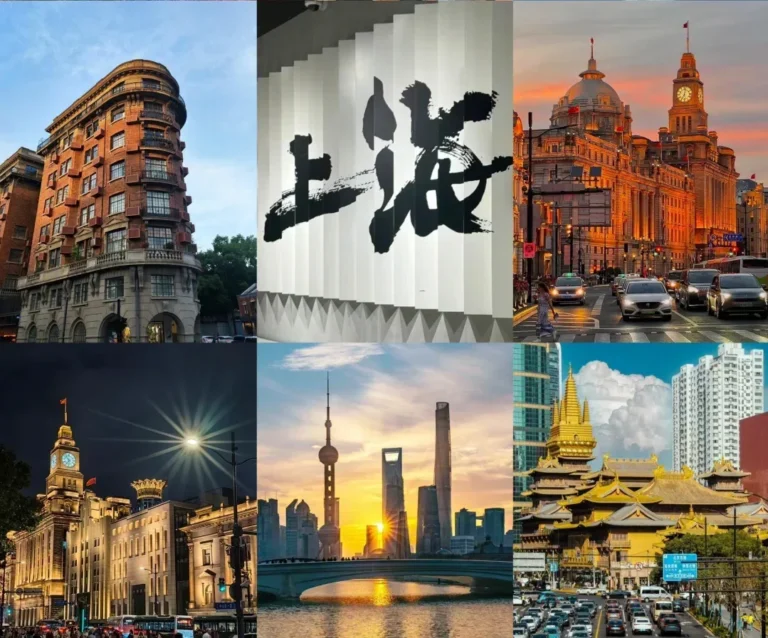
Most English Bund guides stop at the waterfront. That misses some of the most interesting parts: free century-old interiors, hidden banking halls, rooftop viewpoints, the 2 RMB public ferry and the few minutes when sunset, city lights and a deep-blue sky line up perfectly. This guide shows independent travelers how to experience the Bund beyond the promenade—and which expensive tourist shortcuts are easy to skip.
For a first visit, combine a Building Interior Walk with the 2 RMB Huangpu River ferry, then return to the promenade around Blue Hour.
If you only have one hour, walk from Chen Yi Square toward Waibaidu Bridge. If you have half a day, the interiors are what turn the Bund from a skyline photo stop into a much more interesting Shanghai experience.
Bund Experience Comparison
| Experience | Time | Cost | Best For | Main Trade-off | TripChina Pick |
|---|---|---|---|---|---|
| Promenade Walk | 1–2 hr | Free | First visit, short stop | Misses most interiors | Good backup |
| Building Interior Walk | 2–4 hr | Mostly free | Architecture, history | Some access depends on schedule | Best overall |
| Public Ferry | 20–40 min | ¥2 each way | River views, budget travel | Can change during major events | Best value |
| Huangpu Night Cruise | ~1 hr | Usually ¥100+ | Romantic night view | Much more expensive | Optional splurge |
| Public Bus 65 | 1–2 hr | Low cost | Seated city view | Not a dedicated tour | Better-value alternative |
| Sightseeing Tunnel | ~10 min | Much higher than ferry | Novelty only | No open river view | Skip |
The best-value combination is still straightforward: historic interiors + waterfront + public ferry.
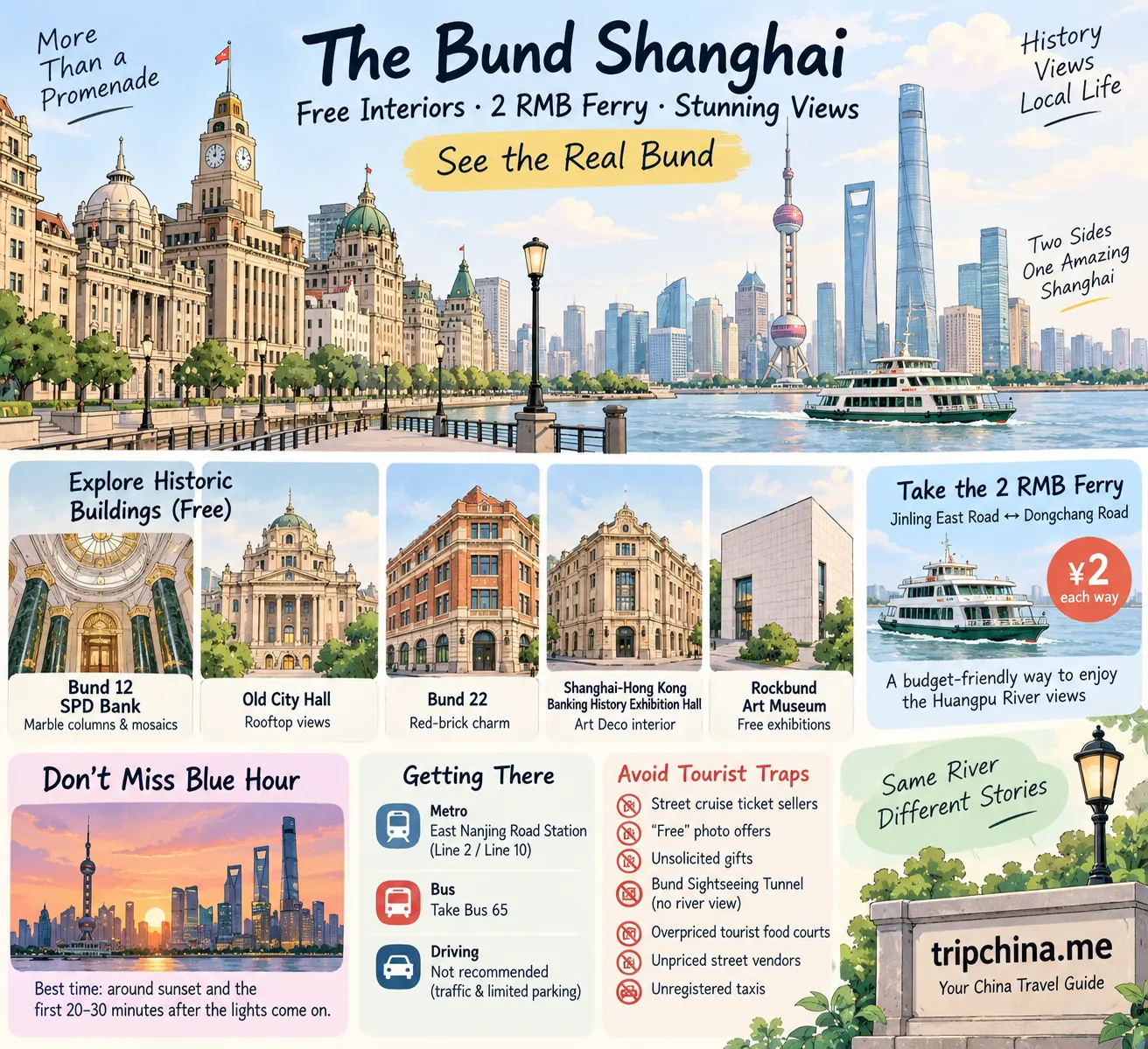
The Bund’s waterfront buildings are not just facades. Several contain century-old banking halls, mosaics, marble interiors, exhibition spaces and restored public areas that most first-time visitors never enter.
A practical route starts around East Nanjing Road Station and moves north toward the Bund Origin area.
Bund 12 is the former HSBC Building and today’s SPD Bank headquarters.
The octagonal hall is the highlight. Its ceiling contains historic mosaic murals depicting major world cities, while four exceptionally rare seamless Italian marble columns stand inside the building. Contemporary reporting notes that six such complete columns are said to survive worldwide, with four at Bund 12 and two at the Louvre.
Official public tours currently operate on weekdays:
Reservations are made through the “浦发银行” or “遇见浦发” official WeChat accounts and related SPD Bank channels. Places are limited, so do not treat this as a walk-in guided tour.
A useful local detail: the public-tour entrance has been listed at 36 Fuzhou Road, rather than the grand river-facing doorway.
Banking note: SPD Bank also operates normal banking services inside the building. Overseas visitors may ask about account-opening services, but eligibility depends on the bank’s current identity-verification, visa and account-opening requirements. Short-term tourists should not visit Bund 12 expecting that a Chinese debit card is guaranteed; treat banking services as separate from the sightseeing experience.
It is only a short walk inland from Bund 12.
The appeal is the upper ring terrace, which gives you a very different Shanghai composition: historic rooftops and church architecture in the foreground with the Lujiazui towers rising behind them.
The terrace has previously remained open into the evening, but operating hours can change with events and building management. Check the access notice when you arrive rather than building your entire itinerary around a late closing time.
For a broader self-guided walking day beyond the Bund, our Shanghai city walk routes can help you connect this area with nearby neighborhoods.
Bund 22 at 22 Zhongshan East 2nd Road is unusual because of its red-brick exterior and internal balconies.
It once housed Butterfield & Swire and later the Feng Hua pen factory. Today, the building contains commercial and event spaces, and the ground-floor public areas are the easiest parts for casual visitors to explore.
As of September 2026, commonly published visitor information lists hours around 10:30–21:00. Because Bund 22 is an active commercial and event building rather than a conventional museum, public access and operating hours can change. Check the entrance notice if the interior is a priority.
Yes—and it is one of the better small interiors near the Bund if you enjoy historic banks and Art Deco details.
Inside the former Bank of East Asia building at 299 Sichuan Middle Road, look for the long marble banking counter, historic vault, black-and-white stonework and spiral staircase.
As of September 2026, the latest Shanghai municipal tourism route information lists:
Older online pages still circulate more limited opening schedules, including Tuesday/Thursday/Saturday-only access. Because this is a small exhibition space rather than a major museum, check the current opening notice before making a special trip.
A practical last-minute check is to search “沪港银行历史展览馆” in WeChat or a Chinese map app and compare the current-day status with the latest official notice. If the exhibition is essential to your itinerary, treat the municipal tourism listing or a venue notice as more authoritative than an old review.
Yes.
Rockbund Art Museum at 20 Huqiu Road introduced free exhibition admission in May 2025, and the policy remains in place.
Current official hours are:
Wednesday through Friday normally allow direct free entry. On weekends and public holidays, visitors can reserve through the museum’s WeChat mini-program for priority access or queue on site.
That makes RAM a useful flexible stop if your Bund 12 tour is fully booked.
Bund Origin No. 1 at 33 Zhongshan East 1st Road occupies the former British Consulate complex.
Outdoor and garden access can vary with exhibitions and events. The historic interior is also frequently used for temporary exhibitions rather than operating as a permanently open museum.
Treat it as a bonus stop. Check the entrance signage and current exhibition schedule on the day.
Finish around Zha Pu Road Bridge.
It gives you a classic layered Shanghai composition: Waibaidu Bridge in the foreground, historic architecture around Suzhou Creek and the Lujiazui skyline across the river.
It is also a useful place to escape the densest crowds around Chen Yi Square.
Yes. For pure value, it is difficult to beat.
The Dongjin Line (东金线) connects Jinling East Road Ferry Terminal on the Bund side with Dongchang Road in Pudong.
The crossing takes only a few minutes, but you still get an open river-level view of the Huangpu.
How to do it:
Walk south from the main Bund promenade to Jinling East Road Ferry Terminal. Pay the fare using supported local payment methods or a transport card.
If you still need to set up mobile payments, see our guides to using Alipay in China and setting up WeChat Pay overseas.
When the ferry arrives in Pudong, you can walk north toward Lujiazui. If you plan to stay on that side of the river, our guide to where to stay in Shanghai explains the trade-offs between Pudong and Puxi.
For planning purposes, do not assume the Dongjin Line is a late-night ferry.
The established regular timetable lists the final departure at approximately 18:30 from Jinling East Road and 18:15 from Dongchang Road. Shanghai Ferry can also shorten or suspend the route during major public holidays and crowd-control periods.
For example, from May 1–5, 2026, the Dongjin Line stopped operating from 12:00 each day. Passengers were directed to the nearby Dongfu Line (东复线) between Dongchang Road and Fuxing East Road instead.
From May 1 to October 31, 2026, the Dongfu Line—not the Dongjin Line—has a seasonal extension from 21:00 to 22:00.
That distinction matters if you want to cross after sunset:
Dongjin Line = the classic 2 RMB Bund ferry experience, but plan it earlier.
Dongfu Line = the more useful backup for a later crossing during its seasonal extended schedule.
For same-day changes, check the Shanghai Ferry official WeChat account (“上海轮渡”) or a current public-transport app before walking to the pier. Holiday crowd control, major events and severe weather can override the normal timetable.
For photography, aim for the transition from sunset into the first 20–30 minutes after the lights come on.
That is the Bund’s Blue Hour sweet spot: the sky still holds color while the historic facades and Pudong towers begin to glow.
The regular municipal landscape-lighting schedule has generally followed:
Special events can override the normal schedule. Festivals, major celebrations, weather conditions and temporary lighting programs may change the opening or closing time.
So do not assume that the lights always start at exactly the same time year-round.
Go around 06:00–07:30.
You will see runners, photographers and local residents rather than tour groups. The air is usually cooler and the promenade is dramatically calmer.
The trade-off is simple: this is an outdoor-only visit. The historic interiors and museums do not open that early.
East Nanjing Road Station on Lines 2 and 10 is the default choice.
Exit 7 works well for the main promenade and historic-building route. Exit 6 is useful if you are heading toward the Bund Origin area.
Yuyuan Garden Station on Lines 10 and 14 is better for approaching the southern Bund and Shiliupu area.
For tickets, QR codes and navigating the network, use our Shanghai public transport guide for foreigners.
If you rely heavily on your phone for walking directions, our China navigation app guide is useful because international mapping apps can be less reliable for detailed local navigation in China.
Bus 65 is a useful low-cost option because it runs through the Bund area and gives you a street-level view.
It is not a sightseeing tour, but for travelers who simply want to watch the waterfront from a seat, it can be much better value than tourist buses.
Usually no.
Parking is limited, traffic is heavy and major events regularly trigger temporary road controls around the waterfront. Public transport is much easier.
Do not assume the most visible food court beside a tourist street is the best place to eat.
For cheaper local meals, walk one or two blocks inland toward Fuzhou Road and Hankou Road. Look for small restaurants with local office workers and residents inside.
Good Shanghai basics include:
For a broader food plan, use our Shanghai local food guide.
If you specifically want historic institutions rather than tourist food courts, our guide to Shanghai’s century-old restaurants is a better starting point.
Higher-end Bund restaurants and rooftop bars are mostly about the view. Decide whether you are paying for the food or for the skyline before booking.
Bund Photo Spot Comparison
| Photo Spot | Best For |
|---|---|
| Zha Pu Road Bridge | Waibaidu Bridge + Lujiazui composition |
| Chen Yi Square | Classic wide Bund waterfront shot |
| Old City Hall Terrace | Historic rooftops + modern skyline |
| Sumei Building area | Historic red-brick streetscape; access can vary |
| Bund rooftop bars | Elevated evening skyline views |
| Jinling–Dongchang Ferry | Moving river-level perspective |
For the famous promenade shot, arrive before the evening crowd reaches its peak rather than fighting for the front railing after full darkness.
Use official cruise ticket channels or the Shiliupu Wharf ticketing system.
Do not hand money to someone simply because they promise a “special cheap cruise.”
Costume characters or informal photo operators may expect payment after the photo.
Ask the price first or politely decline.
Flowers, balloons or souvenirs handed to you on the street can turn into an awkward payment demand.
The easiest response is simply not to take the item.
The Bund Sightseeing Tunnel is an indoor visual-effects ride beneath the Huangpu.
You do not get an open view of the river.
If your goal is the skyline, spend ¥2 on the public ferry or take Metro Line 2 instead.
The Bund itself is one of Shanghai’s most expensive locations.
Walk inland before deciding where to eat. You will usually find more choice and better value.
If a seller does not display a clear price, confirm the total before ordering.
Fixed shops are easier if you want predictable pricing.
Use a registered taxi or app-based ride instead of negotiating with drivers around tourist areas.
Our DiDi guide for foreign travelers explains how to book rides without relying on spoken Chinese. This article is part of the Shanghai Travel Guide Hub.
Allow about 3–4 hours if you want to enter several historic buildings and still spend time on the waterfront.
If one or two interiors are closed, you can shorten the route. If you add lunch, Rockbund Art Museum or a long photography stop, allow half a day.
Yes. Waibaidu Bridge is a public bridge and does not require a ticket.
It is particularly useful for photography because you can frame the historic bridge with the Pudong skyline and Suzhou Creek area.
Yes, but your options depend on the building.
Some interiors are walk-ins, while Bund 12’s guided visit requires advance registration through SPD Bank channels. The Shanghai-Hong Kong Banking History Exhibition Hall currently allows on-site information registration, and Rockbund Art Museum allows weekday walk-in access.
Casual travel photography is usually much easier than professional production.
Tripods, lighting setups, commercial shoots or large equipment may require approval, particularly inside banks and protected historic buildings. Ask staff before setting up anything beyond normal handheld photography.
Yes.
These are working banks, commercial buildings, museums and event spaces—not one unified attraction. Temporary exhibitions, holidays, private events and security arrangements can change access, so recheck the specific building if it is the main reason for your visit.
Light rain does not automatically stop normal ferry service, but severe weather, safety restrictions and crowd-control measures can suspend routes.
Public holidays are another exception: the Dongjin Line has been closed early during several major holiday periods. Check the “上海轮渡” official WeChat account or same-day transport information before heading to the pier.
If you have enough time, do more than photograph the promenade.
Choose two or three historic interiors, add the public ferry if it is operating normally, and time your waterfront walk around Blue Hour.
That gives you the Bund’s architecture, history and skyline without turning the visit into an expensive checklist.
For broader planning beyond the waterfront, continue with the Shanghai complete travel hub.
Shanghai Municipal Administration of Culture and Tourism — Bund Historic Buildings Route
Shanghai Municipal Transportation Commission — Shanghai Ferry Operations
Shanghai Ferry — 2026 Dongjin/Dongfu Line Service Adjustment
Rockbund Art Museum — Official Visitor Information
Updated September 2026 using Shanghai municipal tourism information, official venue guidance and Shanghai Ferry service notices. Bund 12 access, the Shanghai-Hong Kong Banking History Exhibition Hall, landscape lighting and ferry operations were rechecked against current official information. Where older secondary sources conflict with current municipal listings, the latest official notice is prioritized. Ferry schedules and individual building access can change during public holidays, major events or severe weather.
TripChina.me creates practical China travel guides shaped by real local experience, helping independent travelers navigate transport, payments, food, neighborhoods, and the cultural details that make traveling in China easier and more meaningful. Find the guide for your destination at tripchina.me.