Our Location:
No. 99, Jiazi Road, Chengdu

 authorChris Lee
Many first-time visitors say they have “visited Yu Garden” when they have actually seen only the surrounding bazaar, Nine-Bend Bridge and lantern-filled shopping streets. The real Yu Garden is a separate, ticketed Ming-era classical garden hidden behind the commercial district.
This guide explains the difference, current tickets and hours, the separate night experience, what is worth seeing, when to go, what to eat and how to experience both sides without wasting half a day.
Yes—especially if you go inside the actual classical garden.
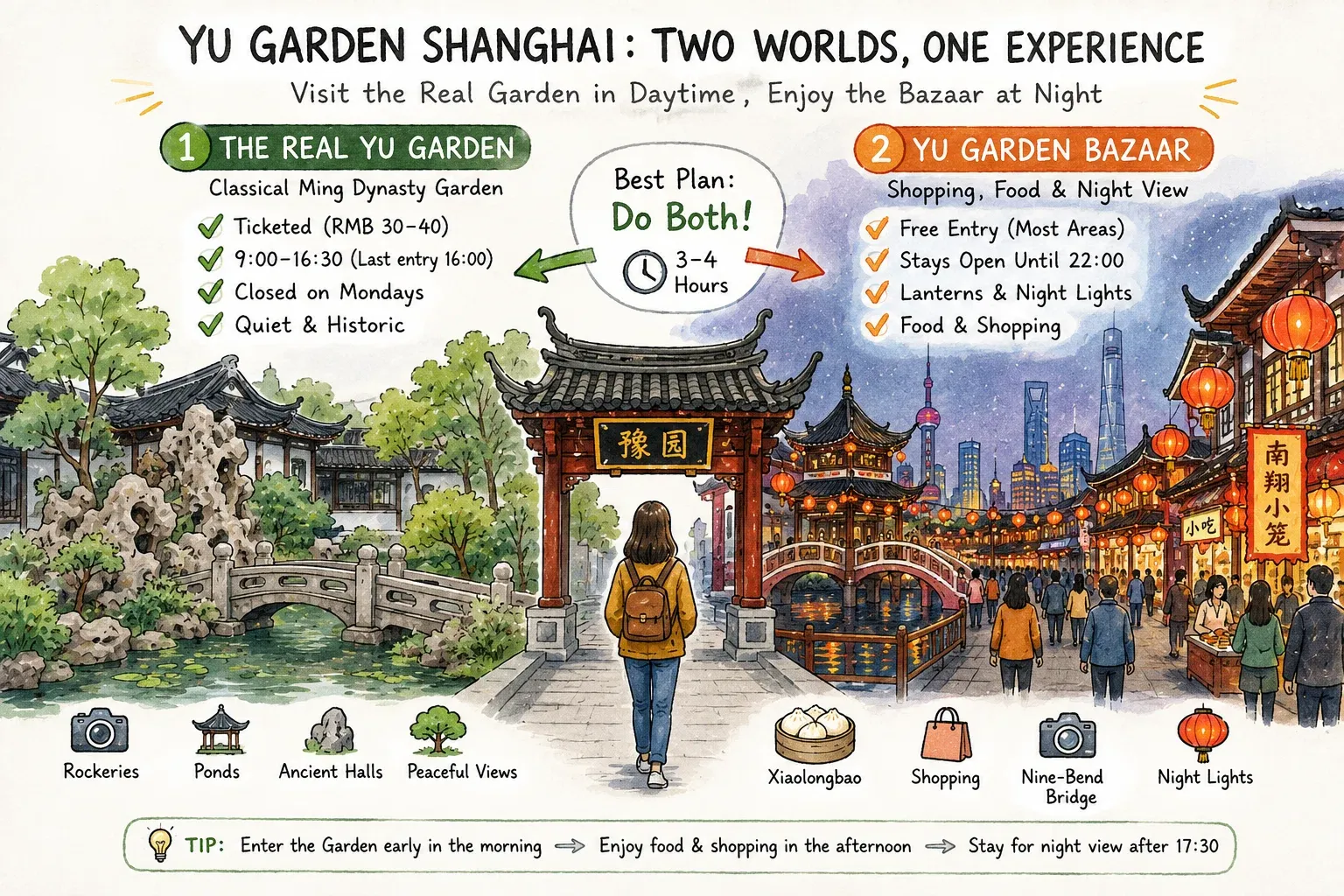
This is the single most important thing to understand before visiting.
Yu Garden (豫园) is the historic classical garden itself.
Construction began in 1559 under Pan Yunduan. Inside, you find rockeries, ponds, halls, covered corridors, dragon walls, old trees and carefully framed views—the elements that make a Jiangnan garden fundamentally different from an ordinary city park.
The Yu Garden Mall / bazaar area surrounds the garden and contains:
If you photograph Nine-Bend Bridge, eat dumplings and walk through the shopping streets but never pass through the ticketed entrance, you have explored the commercial district around Yu Garden—not the classical garden itself.
That distinction explains why some visitors leave saying Yu Garden is “just shops and crowds.”
| Experience | Cost | Best For | Time Needed | Main Trade-Off |
|---|---|---|---|---|
| Classical Garden | RMB 30–40 | History, gardens, architecture | 1–2 hrs | Limited daytime hours |
| Bazaar / Mall Area | Usually free* | Food, shopping, atmosphere | 1–2 hrs | Highly commercial |
| Garden + Bazaar | RMB 30–40 + spending | First-time visitors | 3–4 hrs | Needs more time |
| Paid Night Tour | Separate ticket | Immersive night experience | About 50 min | Much more expensive |
| Yuyuan Lantern Festival | Seasonal | Chinese New Year atmosphere | 2–3+ hrs | Heavy crowds and special rules |
*Controlled event zones can use separate ticketing arrangements.
TripChina Pick: For a first visit, use this sequence:
real garden → food and bazaar → Nine-Bend Bridge around dusk
You get both sides of the district without unnecessary backtracking.
| Item | Current Daytime Information |
|---|---|
| Opening hours | 9:00 AM–4:30 PM |
| Last admission | 4:00 PM |
| Closed | Mondays, except national holidays |
| Peak season | Apr 1–Jun 30; Sep 1–Nov 30 |
| Peak adult ticket | RMB 40 |
| Off-peak season | Jul 1–Aug 31; Dec 1–Mar 31 |
| Off-peak adult ticket | RMB 30 |
| Visitors aged 60+ | Half-price with valid ID |
| Ages over 6 through 18 | Half-price |
| Eligible full-time students | Half-price |
| Age 6 or under / height 1.3 m or under | Free with an accompanying adult |
Qualifying children must be accompanied by an adult. Bring the original document needed to prove age, student status or other concession eligibility.
There are two official options:
On-site: North Gate or South Gate ticket windows
Online: official “上海豫园” WeChat mini-program
Advance purchase is most useful during Chinese public holidays, major festivals and other dates when temporary capacity controls are announced.
If Yu Garden is only one part of a larger sightseeing plan, TripChina's Shanghai Attraction Booking Guide explains which Shanghai attractions need more advance planning.
Third-party listings can include:
For ordinary daytime admission, compare the listing against the official RMB 40 peak / RMB 30 off-peak price before paying.
Do not turn Yu Garden into a checklist of every pavilion.
A classical Chinese garden works through movement, concealment and framed views.
A wall blocks your view. A corridor turns. A doorway suddenly frames a rockery. A pond makes a small space feel larger than it really is.
Several places are especially worth slowing down for.
The Grand Rockery shows how traditional garden designers recreated the feeling of a mountain landscape inside a compact urban garden.
Instead of using it only as a photo backdrop, notice:
It is designed to be experienced from multiple viewpoints.
The Exquisite Jade Rock, Yulinglong (玉玲珑), is one of Yu Garden's best-known objects.
Traditional Chinese scholar's rocks were admired for qualities such as irregularity, perforation, changing silhouettes and their ability to suggest a miniature mountain world.
Walk around it rather than judging it from a single angle.
Dianchun Hall adds a political layer to the garden's history.
Yu Garden's historical records connect it with the Small Sword Society uprising of 1853–1855, when the hall served as the society's northern headquarters.
That makes Yu Garden more than an attractive reconstruction of “old Shanghai.”
Yes.
The Inner Garden dates to 1709 and was later incorporated into the restored Yu Garden.
Look for:
At the Ancient Stage, look upward. Its elaborate domed caisson ceiling is easy to miss if you focus only on the architecture at eye level.
For most first-time visitors, about 90 minutes inside the garden is a good target.
| Visitor Type | Time Inside Garden |
|---|---|
| Quick first look | About 1 hr |
| Most first-timers | About 90 min |
| Architecture / garden lovers | 1.5–2 hrs |
| Serious photography / history | Up to 2+ hrs |
A practical sequence is:
North Gate → Sansui Hall area → Grand Rockery → Dianchun Hall → central water-and-corridor areas → Exquisite Jade Rock → Inner Garden → Ancient Stage → South Gate
Follow current signs if conservation or maintenance changes the visitor flow.
| Time | What to Do | Why |
|---|---|---|
| 0:00–1:30 | Classical Yu Garden | See the heritage site before the commercial area |
| 1:30–2:00 | One snack or tea stop | Sample the area without turning the visit into a food crawl |
| 2:00–2:30 | Bazaar streets | Shops, architecture and atmosphere |
| 2:30–3:00 | Nine-Bend Bridge | Finish with the area's most recognizable view |
For an afternoon visit, time the final section near dusk if photography matters.
If you have four hours, slow down inside the garden or add a proper meal.
Yu Garden now has a separate immersive night experience:
Yuyuan Garden: A Night Walk in Mountain and Forest — 豫享山林
The project uses lighting, projection mapping, digital multimedia and around two dozen designed scenes to reinterpret the classical garden after dark.
The guided experience lasts roughly 50 minutes.
The published seasonal schedule is:
| Season | Regular Nights | Hours | Last Entry |
|---|---|---|---|
| May–October | Tue, Wed, Fri, Sat, Sun | 6:30 PM–9:50 PM | 9:00 PM |
| Jan–Apr & Nov–Dec | Fri, Sat, Sun | 6:00 PM–9:20 PM | 8:30 PM |
Holiday arrangements can override the regular schedule.
The experience is organized in timed groups, with staff leading visitors through the night route. Chinese-language guiding is included in the standard experience.
Book through the official “上海豫园” WeChat mini-program and arrive within your reserved time slot.
Published adult pricing for the night product is:
These are night-experience prices, not normal daytime admission.
The night tour is therefore several times more expensive than entering the garden during the day.
The official night-tour booking channel is the “上海豫园” WeChat mini-program.
Foreign visitors should carry their original passport when using a passport-based booking or claiming an age/student concession. If the mini-program does not accept your document smoothly, contact Yu Garden or ask the staffed ticket office before buying through an unofficial reseller.
For the night tour specifically, the publicly available official information does not publish a separate foreign-passport workflow, so do not assume the ID process is identical to a Chinese ID booking.
This is not free exploration of the entire garden after dark.
Visitors enter in scheduled groups and follow a designed approximately 50-minute experience through a sequence of illuminated garden spaces, multimedia scenes and architectural settings.
That controlled route is part of the product: you are buying an immersive cultural experience rather than ordinary extended opening hours.
Worth considering if you:
Probably skip it if you:
For most first-time visitors, the RMB 30–40 daytime garden ticket offers better value.
The night tour makes more sense as an additional experience, not a replacement for seeing the garden naturally in daylight.
They are not the same event.
| Night Tour: 豫享山林 | Yuyuan Lantern Festival | |
|---|---|---|
| Location | Inside classical Yu Garden | Large Yu Garden commercial district and surrounding zones |
| Experience | Guided multimedia garden route | Large-scale festival lantern displays |
| Duration | About 50 min | Usually 2–3+ hrs |
| Schedule | Seasonal regular nights | Around Chinese New Year |
| Ticket | Separate night-tour ticket | Festival-specific rules |
| Best For | Immersive garden experience | Festival atmosphere and lanterns |
| Crowds | Controlled by sessions | Can be extremely busy |
During the 2026 Yuyuan Lantern Festival, the regular 《豫享山林》 night tour was suspended during the core festival period and resumed afterward.
Do not buy one product expecting access to the other.
For atmosphere and photography, often yes.
The traditional-style commercial buildings become much more dramatic once the decorative lights come on.
Around Nine-Bend Bridge, you can combine:
Mid-Lake Pavilion + traditional roofs + water reflections + modern skyline
But remember that “Yu Garden at night” can mean:
Check which experience you are actually planning before buying anything.
The annual lantern festival is a special event rather than normal Yu Garden nighttime opening.
In 2026, six themed lantern zones operated around the wider Yuyuan area.
The central Yuyuan folk-art lantern zone used ticket controls during designated periods, while the other five zones—BFC, Gucheng Park, Middle Fangbang Road, Fuyou Road and the Bund lantern zone—could be visited free.
The 2026 adult ticket for the controlled core area was RMB 80.
Crowd-control measures can temporarily alter entrances, walking routes and pedestrian access.
If you are visiting specifically for a future Lantern Festival, check that year's rules rather than using the previous year's ticket strategy.
For the classical garden itself, the strongest choice is:
a weekday around opening time
For combining the garden with the bazaar and night photography:
mid-afternoon → garden → food → dusk at Nine-Bend Bridge
| Visit Type | Best Time | Why |
|---|---|---|
| Quietest classical-garden experience | Weekday around 9:00 AM | Fewer groups and easier photography |
| First-time combined visit | About 2:00 PM onward | Garden + food + dusk atmosphere |
| Weekend | Opening time | Beat the heaviest midday crowds |
| Night atmosphere only | After dusk | Illuminated commercial district |
| Light rain | Daytime | Atmospheric garden scenery |
| Major holiday | As early as practical | Heavy pedestrian traffic later |
Expect substantially heavier crowds around:
Temporary controls can affect walking routes, road access and nearby transport.
If your dates are flexible, TripChina's China Public Holidays guide can help you identify the busiest travel periods.
Yu Garden is one of Shanghai's most famous food-tourism areas.
Its advantage is concentration, not necessarily value.
A good strategy is:
one or two Shanghai classics here → another meal in a less tourist-heavy neighborhood
Three sensible choices are:
Xiaolongbao (小笼包)
The obvious Shanghai classic and easy to combine with sightseeing.
Shengjian (生煎)
Pan-fried buns offer a different texture and are worth trying if you have not eaten them elsewhere in Shanghai.
Traditional Shanghai-style pastries or dim sum
A better option if you want something small rather than another full restaurant meal.
Yes—if you understand what you are choosing.
Nanxiang Mantou Dian beside Nine-Bend Bridge is:
iconic + convenient + tourist-heavy
It is not a hidden local dumpling shop.
If the queue becomes long, do not sacrifice an hour of a short Shanghai visit solely for the name.
TripChina's Shanghai Food Guide has better options if food quality matters more than eating at the famous Yu Garden location.
Green Wave Corridor (绿波廊) makes more sense if you want:
rather than a quick street snack.
Check the current menu instead of relying on old online price estimates.
Be cautious about:
The biggest mistake is trying to eat everything here.
Choose one or two things, then save another meal for another Shanghai neighborhood.
Use this quick photo plan:
| Scene | Best Spot / Technique | Best Time |
|---|---|---|
| Old vs New Shanghai | Nine-Bend Bridge area: roofs + Mid-Lake Pavilion + skyline | Dusk / blue hour |
| Classical garden | Moon gates, corridors and framed doorways | Morning |
| Rockery composition | Shoot through openings instead of straight-on | Daytime |
| Water reflections | Pond edges and framed garden views | Soft daylight |
| Bazaar architecture | Ninghui Road and layered rooflines | Blue hour / night |
| Nine-Bend Bridge with fewer people | Weekday morning | Near opening time |
Start around Nine-Bend Bridge.
Try to place:
traditional roofline + Mid-Lake Pavilion + water + modern skyline
in the same frame.
Dusk and blue hour give you the best chance of balancing illuminated buildings with a still-visible sky.
Look for:
Chinese gardens were deliberately designed to frame scenes.
Use the architecture as your composition.
Drones, unauthorized commercial photography and equipment that obstructs visitor circulation are restricted.
Take:
Shanghai Metro Line 10 or Line 14 → Yuyuan Garden Station (豫园站)
Then walk toward the entrance you need.
The regular daytime garden has two principal entrances:
North Gate: 168 Fuyou Road
South Gate: 279 Yuyuan Old Street
The North Gate handles groups and individual visitors; the South Gate is for individual visitors.
Driving is rarely useful because Yu Garden does not have a dedicated scenic-area parking lot.
For the rest of your city travel, TripChina's Shanghai Metro and Transport Guide covers metro, buses and practical navigation.
Partly—but it is not a fully step-free modern attraction.
The historic garden contains:
Wheelchairs and strollers can access parts of the site, but some historic spaces may require assistance or detours.
If mobility is a major concern, ask staff at the entrance which current route avoids the most steps before starting the visit.
For families with strollers, the surrounding bazaar is easier to navigate than the interior garden, although heavy crowds around Nine-Bend Bridge can make pushing a stroller difficult.
| Rule | What to Know |
|---|---|
| Large luggage | No luggage-storage service inside the garden |
| Pets | Generally prohibited; qualifying guide dogs are excepted |
| Drones | Prohibited |
| Commercial photography | Site rules / authorization apply |
| Wheelchairs and strollers | Possible, but historic surfaces create barriers |
| Rain | Stone surfaces can become slippery |
| Maintenance | Restoration can temporarily alter routes |
The luggage rule matters if your plan is:
hotel checkout → Yu Garden → train or airport
Store large bags before arriving.
| Mistake | Why It Matters | Better Choice |
|---|---|---|
| Thinking the bazaar is the whole attraction | You miss the heritage site | Enter the classical garden |
| Arriving after 4:00 PM for daytime entry | Day admission has ended | Arrive earlier |
| Assuming night products share one ticket | Night tour and festival are separate | Check the exact product |
| Relying only on walk-up tickets on major holidays | Capacity controls can apply | Check the official mini-program |
| Blocking Nine-Bend Bridge for photos | Creates bottlenecks | Follow crowd-control instructions |
| Eating every meal around Yu Garden | Tourist concentration reduces value | Sample here, explore elsewhere |
| Bringing large luggage | No storage inside the garden | Store it before arriving |
| Planning a drone/commercial shoot casually | Restrictions apply | Confirm permission first |
Yes. Passport-based ticketing is supported for foreign visitors.
Bring your original passport, particularly when using a passport reservation or when staff need to verify eligibility for a concession.
Arrive close to the 9:00 AM opening time on a normal Tuesday–Friday outside public holidays and major events.
That is usually the best window for narrow corridors, rockeries and framed garden photography before larger groups build up.
It can be, but it is not essential for a first visit.
Choose it for an immersive multimedia interpretation of the garden after dark. Choose the much cheaper daytime ticket if classical architecture, history and natural garden scenery are your priorities.
The festival uses formal pedestrian crowd controls during busy periods.
For a solo traveler, the main issue is density rather than isolation: expect tightly packed pedestrian areas, temporary one-way routes and controlled entrances.
Keep your phone and valuables secure, follow staff directions and avoid stopping in major pedestrian bottlenecks.
Light rain can make the garden especially atmospheric because stonework, roofs and vegetation become more saturated.
Historic stone paths, bridges and steps can become slippery, so wear suitable shoes and slow down.
Yes.
A particularly efficient sequence is:
Yu Garden → food / bazaar → Nine-Bend Bridge around dusk → Bund
TripChina's Bund Shanghai Guide can help you plan the waterfront section without wasting time on the most crowded route.
Yes—but the value comes from understanding what you are visiting.
The classical garden is the cultural reason to come: a Ming-era Jiangnan garden of rockeries, halls, corridors, ponds, historic buildings and deliberately constructed views.
The surrounding bazaar adds food, lanterns, traditional-style shopfronts and one of central Shanghai's most recognizable evening scenes.
For a first visit:
See the real garden first. Eat and wander afterward. Stay until dusk if the evening atmosphere matters to you.
Three to four hours is enough for most visitors.
Yu Garden Official Visitor Information
Shanghai Municipal Government — Yu Garden Night Tour Ticket and Schedule Information
Shanghai Municipal Administration of Culture and Tourism — Yuyuan Garden Night Experience
Shanghai Huangpu / Yu Garden Management Office — 2026 Lantern Festival and Night Tour Notice
Last verified: September 2026. Daytime admission, seasonal pricing, opening hours, concession rules, ticket channels and entrances were checked against Yu Garden's official visitor information. Night-tour schedules and pricing were cross-checked against Shanghai government and cultural-tourism sources. The 2026 Lantern Festival temporarily suspended the regular night tour. Restaurant menus, night-tour sessions, festival arrangements, maintenance closures and crowd controls can change; check the official “上海豫园” WeChat mini-program shortly before visiting.
TripChina.me creates practical China travel guides shaped by real local experience, helping independent travelers navigate transport, payments, food, neighborhoods, and the cultural details that make traveling in China easier and more meaningful. Find the guide for your destination at tripchina.me.