Our Location:
No. 99, Jiazi Road, Chengdu

 authorChris Lee
Shanghai has two major airports, and they serve different flight networks and parts of the city. Hongqiao (SHA) is much closer to central Shanghai and the high-speed rail hub, while Pudong (PVG) handles most of the city's long-haul international traffic.
The right choice depends less on which airport is “better” and more on your flight, hotel location, arrival time and onward travel plans.
If your airline gives you a genuine choice, Hongqiao is usually more convenient for central Shanghai because it is much closer to downtown and directly connected to Shanghai Hongqiao Railway Station.
For most travelers arriving from North America, Europe, Australia or other long-haul international destinations, however, Pudong will usually be the relevant airport.
| Hongqiao (SHA) | Pudong (PVG) | |
|---|---|---|
| Approx. location | West of central Shanghai | East of central Shanghai |
| Best known for | Domestic + regional international flights | Major international and long-haul gateway |
| Approx. distance to People's Square | ~15 km | ~45 km |
| Main rail options | Metro Lines 2 & 10 | Metro Line 2 + Maglev |
| High-speed rail connection | Excellent — Hongqiao Railway Station | No equivalent adjacent HSR hub |
| Airport-to-airport connection | Airport Link Line | Airport Link Line |
| Best for | City convenience + rail connections | Long-haul international flights |
| Main drawback | Fewer long-haul international options | Much farther from downtown |
| TripChina verdict | Choose SHA when your route and fare make sense | Expect PVG for many international trips |
Important: Do not choose an inconvenient flight purely to land at Hongqiao. Flight schedule, fare and nonstop availability matter more than saving some ground-transport time.
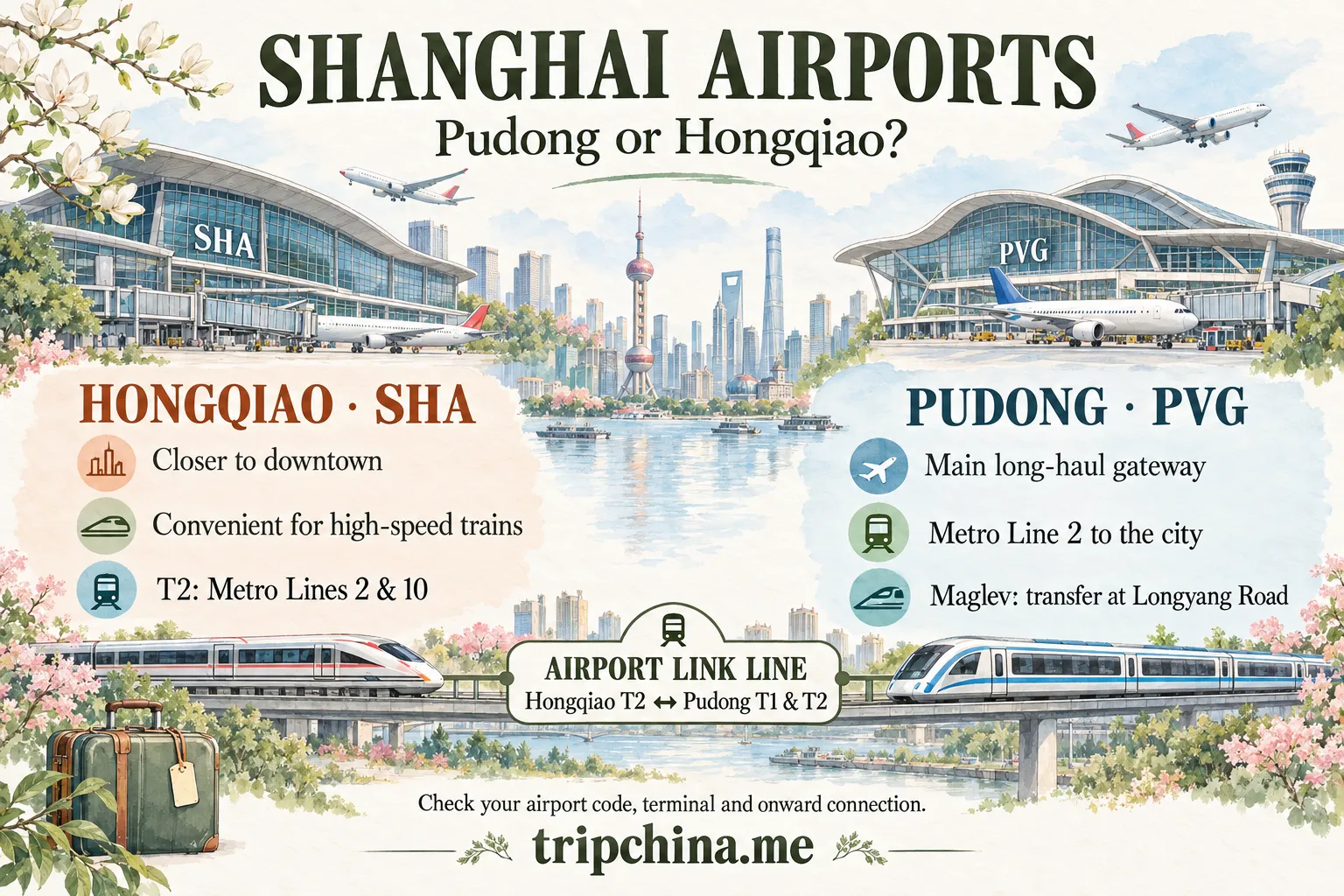
Shanghai Pudong International Airport (PVG) is Shanghai's primary long-haul international gateway and handles a large mix of international and domestic services.
Shanghai Hongqiao International Airport (SHA) is heavily focused on domestic flights while also serving selected regional international routes, including destinations elsewhere in East Asia.
Always confirm the three-letter airport code on your ticket: PVG and SHA are not interchangeable.
If you are staying around People's Square, Nanjing Road, Jing'an, Xintiandi or the western side of central Shanghai, Hongqiao generally requires much less ground travel.
Pudong is considerably farther east, so your choice of airport transport matters more.
Hongqiao has a major advantage.
Hongqiao Airport Terminal 2 forms part of the wider Hongqiao transport hub, together with Shanghai Hongqiao Railway Station.
If you are flying into Shanghai and then taking a high-speed train to Hangzhou, Suzhou, Nanjing or another city, SHA can be extremely convenient.
For using China's railway system, see TripChina's China Train Travel Guide for Foreign Visitors.
For many independent travelers, yes.
Hongqiao Terminal 2 is served by Metro Lines 2 and 10, while Terminal 1 is served by Line 10.
Line 10 is particularly useful for several visitor areas, while Line 2 provides access across Shanghai's major east-west corridor.
If your hotel is near a metro station and you do not have excessive luggage, rail is usually the simplest budget option.
Consider a taxi when:
Shanghai's current official guidance estimates approximately ¥100–150 and around 30 minutes from Hongqiao to the city center, although traffic can substantially change the journey.
Use the official taxi queue or a legitimate ride-hailing service rather than accepting unsolicited rides inside the terminal.
For choosing a hotel area before you land, see TripChina's Where to Stay in Shanghai.
Check your terminal before arriving.
Hongqiao T1 and T2 are separate terminals, and Metro Line 10 connects them. T2 is also integrated into the larger Hongqiao rail and transport hub.
Do not simply tell your taxi driver “Hongqiao Airport”—show the correct terminal and flight information.
There is no single best option for everyone.
| From PVG | Approx. Travel Pattern | Best For | Main Drawback |
|---|---|---|---|
| Maglev + Metro | 8 min to Longyang Road + metro transfer | Speed + unique experience | Requires transfer |
| Metro Line 2 | Direct rail toward central Shanghai | Budget travelers | Long journey with luggage |
| Taxi / Didi | Door-to-door | Families, groups, heavy luggage | More expensive + traffic |
| Late-night airport transport | Depends on current schedule | Arrivals after regular rail hours | Fewer options |
The Shanghai Maglev runs between Pudong Airport and Longyang Road.
Current official Shanghai visitor information lists the train's operating speed at up to 300 km/h, with the approximately 30-km airport–Longyang Road journey taking about eight minutes.
A standard single ticket is currently ¥50, while a round trip is ¥80.
No.
The Maglev terminates at Longyang Road, not central tourist areas such as People's Square or the Bund.
From Longyang Road, you must transfer to the metro or another form of transport.
The Maglev therefore makes most sense if:
With several heavy suitcases, a direct taxi may be more comfortable.
Yes.
Shanghai's current transport guidance lists a Maglev and Metro Pass.
The single-Maglev version costs ¥55 and combines one economy-class Maglev trip with unlimited eligible metro rides for 24 hours after first metro entry.
A round-trip Maglev version costs ¥85.
This can be useful if you plan to take several metro journeys soon after arriving.
For many budget travelers, yes.
Metro Line 2 connects Pudong Airport with central Shanghai without requiring a separate airport express ticket.
The trade-off is time.
It is a long metro journey, and traveling with large luggage can become uncomfortable during busy periods.
If you arrive late, check the current Shanghai Metro timetable for your exact direction and destination. Line 2 operating patterns and terminal stations can vary.
Official Shanghai Metro information: https://www.shmetro.com/
A car becomes increasingly attractive if you are:
Taxi and Didi costs vary with destination, traffic, tolls and time of day, so use the current meter or live app quote rather than relying on a fixed airport-to-city estimate.
For ride-hailing setup, see TripChina's DiDi Guide for Foreigners in China.
No.
Do not assume one fixed “last metro” time applies to every PVG journey.
Shanghai's rail operating patterns and final destinations vary, and timetables can change.
Check the official Shanghai Metro timetable for your exact arrival date.
If regular rail service no longer works for your destination, use the current airport night transport service, an official taxi or Didi.
Pudong Airport operates late-night ground-transport services, but routes, stops, departure intervals and fares can change.
If your flight lands late, check the current airport transport information after arrival rather than relying on a historic fixed route or price.
This is particularly important if immigration or baggage collection pushes you well beyond your scheduled landing time.
For most travelers, yes.
Shanghai's Airport Link Line (市域机场线) directly connects Hongqiao Airport Terminal 2 with Pudong Airport Terminals 1 & 2.
Current official information gives:
| Airport Link Line | Current Information |
|---|---|
| PVG ↔ SHA journey | About 40 minutes |
| Full-route fare | ¥26 |
| Train frequency | About every 15 minutes |
| First from Hongqiao T2 | 05:45 |
| Last from Pudong T1 & T2 | 22:15 |
| Main advantage | Direct rail between both airports |
For most direct PVG–SHA transfers, the Airport Link Line is now the most straightforward rail option.
It remains possible to travel through the metro system, but for an airport-to-airport transfer the Airport Link Line is generally the more logical rail option.
Metro Line 2 can still matter as a backup if your timing or destination does not work with the Airport Link Line.
Usually only when rail does not suit your situation.
Road travel is much more vulnerable to Shanghai traffic, and the fare is considerably higher than ¥26.
A taxi may still make sense for a group with substantial luggage or for a transfer outside Airport Link Line operating hours.
No. I would not plan it.
The Airport Link Line's roughly 40-minute journey is only the rail portion of your transfer.
A cross-airport connection can also involve:
immigration → baggage claim → customs → walking to the railway → waiting for a train → airport transfer → check-in → baggage drop → security → immigration for the next international flight → boarding
For separately ticketed flights, build a substantial buffer.
For some eligible China Eastern and Shanghai Airlines itineraries, cross-airport transfer assistance is available.
Shanghai's August 2026 official update says China Eastern has dedicated transfer counters at both airports and that eligible passengers may transfer between Pudong and Hongqiao without collecting their checked baggage.
Do not assume your ticket qualifies.
Check with China Eastern before travel because eligibility depends on the itinerary and ticketing arrangement.
Yes, provided the card meets the system requirements.
Since June 28, 2025, Shanghai Metro's network-wide Tap to Ride pilot has supported eligible contactless:
UnionPay, Visa, Mastercard, American Express and JCB cards, plus qualifying e-CNY hard wallets.
Your card still needs the appropriate contactless functionality, and issuer restrictions can cause an otherwise supported card to fail.
Keep a backup payment method.
Shanghai Metro service centers also accept major international bank cards for ticket purchases.
This gives foreign visitors a useful fallback if direct contactless entry does not work.
For the broader payment setup you should complete before traveling to China, see TripChina's China Payment Guide for Foreign Visitors:
| Common Mistake | Better Approach |
|---|---|
| Confusing PVG and SHA | Check the three-letter airport code on your ticket |
| Assuming SHA is always the “better” airport | Compare flight schedule, fare and ground transport together |
| Accepting unsolicited rides inside arrivals | Use official taxi queues or legitimate ride-hailing |
| Following outdated airport-transfer advice | Check current Airport Link Line and airport transport information |
| Treating scheduled landing time as airport-exit time | Allow time for immigration, baggage collection and customs |
| Your Situation | Best Starting Choice |
|---|---|
| Flying long-haul from the US or Europe | Expect PVG in most cases |
| Domestic flight with both airports available | SHA is usually more convenient |
| Taking a high-speed train after landing | SHA has the major advantage |
| PVG + solo + light luggage | Maglev + Metro is worth considering |
| PVG + lowest budget | Metro Line 2 |
| PVG + family/heavy luggage | Taxi or Didi |
| PVG ↔ SHA transfer | Airport Link Line |
| Late-night arrival | Check current rail service, then taxi/Didi or current night transport |
| Hotel near Pudong/Longyang Road | PVG may be more convenient than the usual downtown comparison suggests |
This article is part of the Shanghai Travel Guide Hub.
Terminal access and overnight facilities can vary by area, renovation status and security arrangements.
If you have a long overnight layover, check your airline and the airport's current rest facilities rather than assuming a particular lounge, capsule room or shower listed in an older guide is still operating.
Both airports provide passenger-service facilities, but locations and operating hours can change.
Check the airport information desk or official airport directory after arrival if you need short-term luggage storage.
Both major airports and Shanghai's principal rail systems provide accessibility facilities.
Airport Link Line stations include barrier-free gates, elevators and other accessible infrastructure.
Travelers who require boarding or mobility assistance should still arrange airline assistance in advance where possible.
Yes.
In April 2026, Shanghai introduced pilot foreign-currency exchange services at Hongqiao Airport Terminal 2 Station and Pudong Airport Terminal 1 & 2 Station on the Airport Link Line.
This can be useful if you leave the terminal before exchanging cash.
Last researched: September 4, 2026.
Airport and ground-transport information was checked against Shanghai Airport Authority, Shanghai Metro and Shanghai municipal visitor-service sources.
Fares, operating hours and travel times are presented as current guidance rather than guarantees because services may change and road journeys depend on traffic. TripChina recommendations reflect convenience for independent international travelers and are editorial judgments, not official airport rankings.
TripChina.me creates practical China travel guides shaped by real local experience, helping independent travelers navigate transport, payments, food, neighborhoods, and the cultural details that make traveling in China easier and more meaningful. Find the guide for your destination at tripchina.me.