Our Location:
No. 99, Jiazi Road, Chengdu

 authorChris Lee
Many first-time visitors waste time and money picking the wrong transport option after landing in Shanghai.
Shanghai is actually easy to get around once you know which system to use. The metro handles most sightseeing trips, DiDi is useful with luggage or late at night, and taxis remain a practical backup. The confusing parts are payment, airport transfers, luggage rules and choosing the right option at the right time.
Updated for 2026:
If this is your first trip to China, set up Alipay for foreign visitors and WeChat Pay before arrival. They are useful far beyond transport.
| Transport | Typical Cost | Best For | Main Drawback |
|---|---|---|---|
| Metro | From ¥3 | Most sightseeing | Crowded at rush hour |
| City bus | Usually ¥1–2 | Short local trips | Routes are harder for first-time visitors |
| Official taxi | ¥14–16 first 3 km | Luggage, late night | Traffic and language barrier |
| DiDi | Dynamic pricing | Door-to-door travel | Pickup points can be confusing at hubs |
| Maglev | ¥50 one way | PVG ↔ Longyang Road | Does not go directly downtown; transfer to the metro at Longyang Road |
For most first-time visitors, metro + DiDi is the easiest combination.
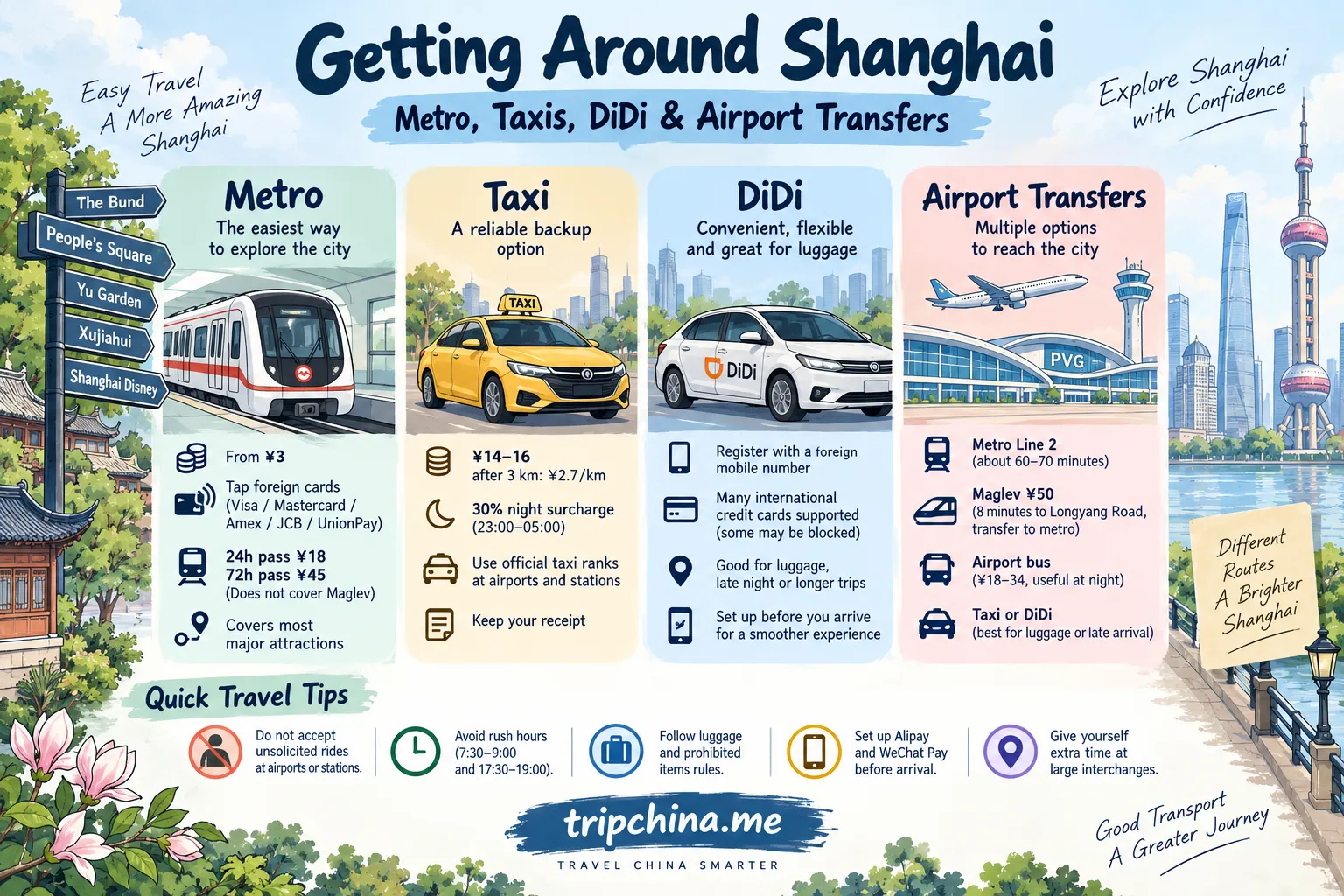
Shanghai has one of the largest metro systems in the world. For visitors, however, you do not need to understand the entire map. A handful of lines cover most major attractions and transport hubs.
Fares are distance-based and start at ¥3 for trips up to 6 km, with additional charges as distance increases.
Line 1 — Red
Useful for Shanghai Railway Station, People’s Square, Xujiahui and Shanghai South Railway Station.
Line 2 — Green
The most important line for many visitors. It connects Pudong Airport with central Shanghai and continues toward Hongqiao, passing Lujiazui, East Nanjing Road and People’s Square.
If you are still deciding which airport or transfer method makes sense, see the Shanghai Airport Guide for PVG and SHA.
Line 10 — Light Purple
Useful for Yu Garden, Xintiandi and East Nanjing Road. If Yu Garden is on your itinerary, our Yu Garden visitor guide explains the difference between the historic garden and the surrounding bazaar.
Line 11 — Brown
The main metro line for Shanghai Disney Resort. First-time visitors should also read the Shanghai Disneyland mistakes guide before deciding what time to arrive.
Line 17 — Orange
Connects Hongqiao Railway Station with Zhujiajiao and Xicen. It is particularly useful for travelers making a western Shanghai day trip.
Foreign visitors have several practical choices.
1. Tap a foreign contactless bank card
Shanghai Metro expanded its Tap to Ride system across the urban rail network in June 2025.
Eligible contactless cards include:
Your card must support contactless payment and may need small-value password-free transactions enabled.
This is now one of the simplest options for short-term visitors: tap the same card when entering and leaving.
2. Use Alipay or WeChat
Open Transport / 出行 and activate the Shanghai metro QR service. Scan the code when entering and exiting.
This remains useful if you already rely on mobile payment throughout China.
For a wider overview of cards, cash and mobile payment, see our foreign visitor payment guide for China.
3. Buy a single-journey ticket
Ticket machines sell distance-based tickets. Shanghai now uses both traditional reusable IC tickets and paper QR-code tickets in different contexts.
International bank cards can also be used at metro station service-center payment terminals.
4. Buy a one-day or three-day metro pass
Current pricing is:
The validity period begins with your first metro entry.
These passes allow unlimited metro rides during their validity period but do not cover the Shanghai Maglev. The ¥18 one-day and ¥45 three-day prices are still listed in Shanghai’s official metro guidance.
For travelers making only one or two short trips per day, ordinary distance-based fares may still cost less.
Yes, normal suitcases are fine, but Shanghai has formal size and weight limits.
Items are not permitted if they exceed:
Bicycles, inflated balloons and animals are also prohibited, except permitted guide and police dogs.
With a large suitcase, look for the wide-access gate (宽通道闸机) rather than trying to squeeze through a standard turnstile.
This matters especially at Pudong Airport, Hongqiao Airport and the major railway stations, where travelers often arrive with full-size luggage.
Security screening is normal at Shanghai Metro stations.
Apart from oversized luggage, prohibited or restricted items include bicycles, inflated balloons, dangerous flammable or explosive materials, toxic or corrosive substances, and poorly packed sharp or fragile objects.
Do not assume metro rules are identical to those in your home country.
Avoid the worst rush hours. Trains can become extremely crowded around roughly 7:30–9:00 in the morning and 17:30–19:00 in the evening.
Prepare your QR code before reaching the gate. Do not stop directly in front of the scanner while searching through your phone.
Allow time for large transfers. A transfer marked as one station on the map can still involve several minutes of underground walking. At large interchange stations, allow 5–10 minutes; busy transfers may take longer.
Move away from the center of the platform. The first and last carriages are sometimes less crowded than the middle sections closest to escalators.
If you miss your stop, stay inside the paid area. Get off at the next station and travel back. There is no need to exit and buy another trip.
Do not rely on a generic “last train” time. Last departures vary by station and direction. Check the actual station-specific timetable and aim to enter well before the final service.
Use door-to-door transport when:
For most tourists, DiDi offers the best balance between price, destination accuracy and convenience.
Shanghai taxi fares vary by vehicle type.
| Fare Component | Current Rate |
|---|---|
| Standard taxi | ¥14 for first 3 km |
| Touran / designated electric taxi | ¥16 for first 3 km |
| After first 3 km | ¥2.7/km |
| Beyond 15 km | 50% surcharge on the distance portion beyond 15 km |
| Night trips, 23:00–05:00 | 30% surcharge on base and distance fares |
| Slow traffic / waiting | Additional metered waiting charge |
Do not assume every taxi starts at ¥16. Standard vehicles can still have a ¥14 base fare.
Holiday surcharges may also apply during major national holiday periods.
| Option | Best For | Payment | Main Trade-Off |
|---|---|---|---|
| Official taxi | Immediate street pickup, airport queues | Cash and supported electronic payment | Destination communication |
| DiDi | Most foreign travelers | App; many international cards supported | Need correct pickup point |
| Amap / Gaode | Comparing multiple ride providers | Depends on provider | Interface can feel more complex |
Ride-hailing prices fluctuate with demand, distance, vehicle category, traffic and weather, so fixed “starting prices” are less useful than the live quote shown before booking.
For detailed setup instructions, read how to use DiDi in China without a Chinese number. It is also worth installing the other essential China travel apps before your flight.
Not necessarily.
The DiDi Greater China app supports registration with foreign mobile numbers, and many overseas visitors can bind international credit cards. Shanghai’s official visitor guidance specifically lists foreign mobile numbers and international credit cards as supported for DiDi Greater China.
However, successful card binding is not guaranteed. Some overseas banks may block or flag transactions in China, so it is worth checking your card’s overseas-payment settings before departure.
I would still set up DiDi before arriving in China, while you have reliable access to your normal phone number and banking verification.
If DiDi setup gives you trouble, Alipay also provides ride-hailing access through its transport/taxi functions.
This is one of the simplest Shanghai rules to remember:
Do not follow people walking through the arrivals hall asking, “Taxi?”
At Pudong Airport, Hongqiao Airport and major railway stations, legitimate taxis use marked official taxi ranks.
Follow the airport or station signs yourself.
Also watch for these warning signs:
For an ordinary street taxi, showing the destination written in Chinese is useful. With DiDi, confirm the license plate number before entering.
Keep the taxi receipt after longer trips. It records useful journey and vehicle information if you leave something behind or need to question a fare.
For broader tourist-scam advice, see the Shanghai tourist traps and mistakes guide.
Your first transport decision in Shanghai often happens before you have even reached the city.
You have four practical options.
Metro Line 2
Best for budget travelers. A trip toward People’s Square usually takes roughly 60–70 minutes depending on service and waiting time.
Maglev
The Maglev connects Pudong Airport with Longyang Road in about 8 minutes.
The standard one-way fare is ¥50. From Longyang Road, transfer to the metro for your final destination.
The Maglev saves time on the airport section, but remember that Longyang Road is not the historic city center.
Airport bus
Airport buses serve several parts of Shanghai.
For detailed terminal and transfer planning, see our Shanghai Airport Guide.
Taxi or DiDi
Best when several people are traveling together, you carry heavy luggage, or your hotel is not close to Line 2.
Use only the official taxi queue or designated app pickup area.
Pudong Airport’s Airport Night Bus (守航夜宵线) is one useful alternative.
It operates from approximately 23:00 until 05:30, with Terminal 2 departures beginning a few minutes after Terminal 1.
It travels toward Hongqiao Transportation Hub and serves useful stops including:
Fares are roughly ¥18–34, depending on distance, and the maximum scheduled gap is generally no more than about 30 minutes, subject to traffic and passenger demand.
If your hotel is far from these stops, a taxi or DiDi may still be worth the extra cost after a long flight.
From Terminal 2, Metro Lines 2 and 10 are the main public-transport choices.
Hongqiao is much closer to central Shanghai than Pudong, which makes taxi or DiDi trips relatively practical as well.
Follow airport signs rather than accepting unsolicited transport offers inside arrivals.
Hongqiao Railway Station is directly connected to:
The station is enormous, so budget extra walking time after leaving your train.
If using a taxi or DiDi, pay attention to the specific north/south pickup area shown in your app or station signs. “Hongqiao Railway Station” is too large to treat as a single pickup point.
Shanghai Railway Station is served by:
Lines 3 and 4 share tracks through part of central Shanghai, so check the line number and destination displayed on the approaching train instead of boarding only because you are standing on the correct platform.
They can be, but the metro is easier for most first-time visitors.
Standard downtown bus fares are generally inexpensive, usually around ¥1–2, and buses can be useful for places between metro stations.
Payment is increasingly visitor-friendly. Shanghai buses accept the Shanghai Public Transportation QR Code through platforms including Alipay and WeChat, while supported foreign bank-card payment options are also available.
The bigger challenge is navigation: route numbers, stop sequences and transfers are less intuitive for visitors unfamiliar with Chinese place names.
Use buses when your map app clearly shows a simple direct route. For complex journeys, the metro is usually less stressful.
It works, but repeatedly stopping at a vending machine wastes time.
Use a foreign contactless card, Alipay, WeChat or another compatible transport payment method if possible.
Sometimes waiting 20–30 minutes, walking to another line or using DiDi is more comfortable than forcing yourself onto a packed central train.
Look at the train display and final destination before boarding.
Last-train times are directional and station-specific. Check your actual station, not just the line’s first departure point.
This is completely unnecessary. Shanghai airports have clear official transport systems. Keep walking until you reach the signed taxi rank or app pickup area.
This article is part of the Shanghai Travel Guide Hub.
Children 1.3 meters tall or shorter may ride free when accompanied by an adult, according to Shanghai’s current metro passenger rules. Preschool children should not travel alone.
Many major Shanghai stations provide elevators and accessible routes, but the exact barrier-free path can vary by station and exit.
At older or complex interchange stations, ask staff for the accessible route rather than following the shortest stairway route shown on a map.
Do not tap one bank card repeatedly for several passengers.
Each rider should use a separate valid payment method or ticket because the system needs to match each entry with a corresponding exit.
Check the pickup zone in the app before calling the driver.
Large Shanghai transport hubs have multiple floors, parking areas and designated ride-hailing zones; the correct terminal, level and pickup number matter more than the general station name. If the pickup area is still confusing, share your real-time location through the DiDi app to help the driver find you.
Once the final train has passed, switching to an official taxi or DiDi is usually the most practical option.
At Pudong Airport, the Airport Night Bus may also be available depending on your arrival time and hotel location.
Shanghai transport looks complicated on a map, but the practical strategy is simple: use the metro for most of the day, then switch to DiDi or an official taxi when luggage, weather or late hours make public transport inconvenient.
The biggest improvements for international visitors are payment-related: foreign contactless cards make metro travel easier, DiDi is more accessible to overseas users, and Shanghai’s public-transport payment system increasingly supports international visitors.
The main mistakes are equally easy to avoid — unofficial airport rides, outdated taxi-price assumptions, oversized metro luggage, and leaving too little time for the last train.
Shanghai Municipal Government — Shanghai Taxi Fare Guide
Shanghai Municipal Government — How to Take the Metro in Shanghai
Shanghai Municipal Government — Taking a Bus in Shanghai
Shanghai Airport Authority — Pudong Airport Ground Transportation
This guide was reviewed in September 2026 against Shanghai government transport guidance, Shanghai Metro passenger rules and Shanghai Airport transport information. Particular attention was given to foreign-card metro payment, day-pass pricing, taxi fares, luggage restrictions, bus payment methods, DiDi access and late-night airport transport. Fares, app functionality and schedules can change, so travelers should reconfirm time-sensitive details shortly before travel.
TripChina.me creates practical China travel guides shaped by real local experience, helping independent travelers navigate transport, payments, food, neighborhoods, and the cultural details that make traveling in China easier and more meaningful. Find the guide for your destination at tripchina.me.






[…] Shanghai transportation guide explains how to plan the journey from your […]