Our Location:
No. 99, Jiazi Road, Chengdu

 authorChris Lee
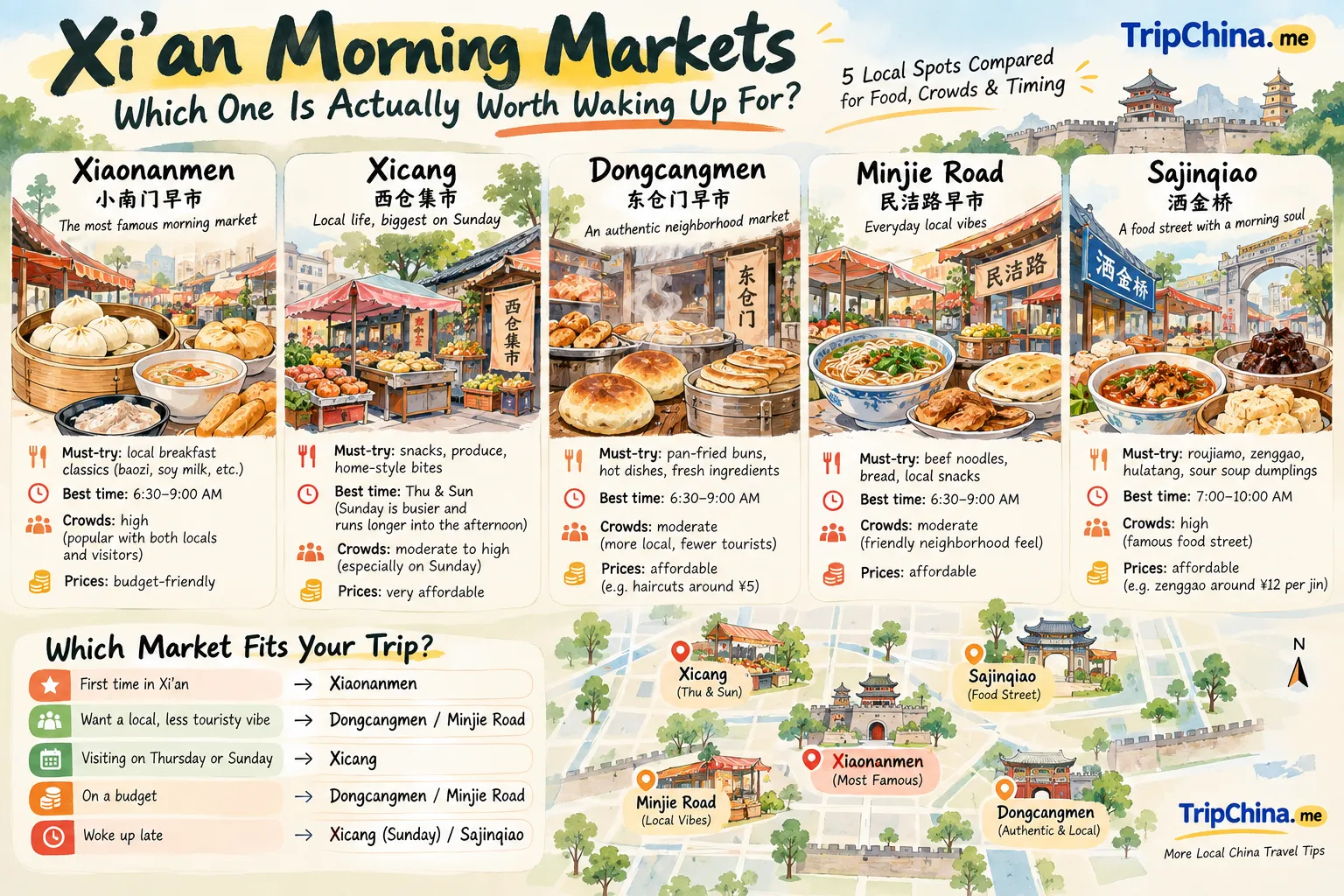
Most visitors spend their Xi'an mornings heading for the Terracotta Warriors. But before the tour buses start moving, another Xi'an is already awake: steam rising beside the city wall, ¥5 breakfasts, vegetable carts and neighborhood shoppers. We compared five very different morning markets—from famous Xiaonanmen to chaotic Xicang—to help you choose one that actually fits your trip.
| If you want... | Go to | Why |
|---|---|---|
| The easiest first visit | Xiaonanmen (小南门早市) | Famous, atmospheric, huge food choice |
| Fewer tourists | Minjie Road (民洁路早市) | Residential, calmer, more everyday |
| The most unusual experience | Xicang (西仓集市) | Food, antiques, birds, flowers and second-hand goods |
| The cheapest breakfast | Dongcangmen (东仓门早市) | Tiny local stalls and very low prices |
| A later breakfast | Sajinqiao (洒金桥) | Morning food plus an all-day food district |
If you can visit only one, Xiaonanmen is the easiest introduction. If your priority is seeing how Xi'an residents actually shop and eat in the morning, Minjie Road is the better fit.
The sweet spot for most markets is roughly 7:00–8:00 a.m. You are early enough for the breakfast stalls but late enough that most vendors are fully set up.
Prices and operating hours below are observations and published local information checked as of September 2026. Individual stalls, prices and weather-dependent opening times can change.
Yes—but go early.
Xiaonanmen Morning Market (小南门早市), beside Wumu Gate (勿幕门), has become Xi'an's best-known morning market. The stalls run for hundreds of meters along the base of the ancient city wall toward Hanguangmen.
That backdrop is a big part of its appeal. You get steaming breakfast pans, plastic stools and vegetable stands beneath old gray brick—a much more memorable morning scene than another hotel buffet.
The downside is exactly what you would expect from a market that became famous online: crowds.
By around 7:30 a.m., the main walkway can become uncomfortable, especially on weekends and holidays. The best-known food stalls may develop long queues, and some tourist-facing stalls charge more than neighborhood vendors elsewhere in Xi'an.
For a broader look at what else to eat in the city, see TripChina's Xi'an Food Guide.
| Food | Typical Price | Best For |
|---|---|---|
| Zenggao (甑糕) | ¥5 small | Something sweet |
| Oil tea with fried dough | About ¥4–6 at ordinary stalls | Cold mornings |
| Elbow meat sandwich (肘子夹馍) | About ¥12 | A heavy breakfast |
| Jasmine soy milk | About ¥6 | A lighter drink |
| Vegetable pie (菜盒) | About ¥6 | Cheap savory snack |
Treat these as reference prices, not fixed menus. The same food can cost noticeably more at a heavily photographed stall than a few meters away.
That difference is part of Xiaonanmen now. It is still a real morning market, but it is also a destination.
Address: Shuncheng South Road West Section, Beilin District (碑林区顺城南路西段)
Metro: Take Line 2 to Yongningmen Station (永宁门), Exit A2, then walk about 15 minutes or use a shared bike.
Hours as of September 2026: approximately 6:00–9:00 a.m. in the warmer season; winter activity generally starts closer to 7:00 a.m. Stalls may pack up early in poor weather.
Do not drive here unless you have a specific reason. Parking around the city wall is far more trouble than the breakfast is worth.
If you want to turn the morning into a half-day route, Xiaonanmen pairs naturally with the Xi'an City Wall after breakfast.
For many travelers, yes.
Minjie Road Morning Market (民洁路早市) feels closer to a neighborhood market than a tourist attraction. It stretches along a residential street in western Xi'an, with retirees shopping for vegetables, families buying breakfast and far fewer people arriving specifically to take photos.
It is easier to slow down here. You can watch vendors cook, compare produce and stand to one side without blocking a stream of selfie sticks.
Prices also tend to feel more residential. Exact comparisons between individual stalls are anecdotal, so do not expect every item to cost half the Xiaonanmen price. The important difference is the customer base: Minjie Road primarily serves people who live nearby.
| Food | Typical Price | Why Try It |
|---|---|---|
| Hulatang (胡辣汤) | About ¥7 | Peppery, filling local breakfast |
| Vegetable pie (菜盒) | About ¥5 | Crisp and inexpensive |
| Donkey meat sandwich | About ¥12 | Less common breakfast choice |
| Fresh youtiao (油条) | About ¥2 | Classic fried dough |
| Fresh soy milk | About ¥3 | Easy pairing with youtiao |
Address: Minjie Road, Lianhu District (莲湖区民洁路)
Metro: Line 5 to Hancheng South Road Station (汉城南路), Exit C, then walk roughly 10 minutes north.
Hours as of September 2026: approximately 6:00–9:30 a.m. The most reliable visiting window is 7:00–9:00 a.m.; in colder months, some vendors may arrive later.
Do not accidentally schedule Xicang for a Monday.
Unlike the other markets in this guide, Xicang (西仓集市) is traditionally associated with Thursday and Sunday market days—with Sunday generally being the busier and longer-running of the two. Locals report that Sunday can stay active well into the afternoon, while Thursday tends to wind down earlier.
It is less a breakfast market than an old-fashioned urban bazaar.
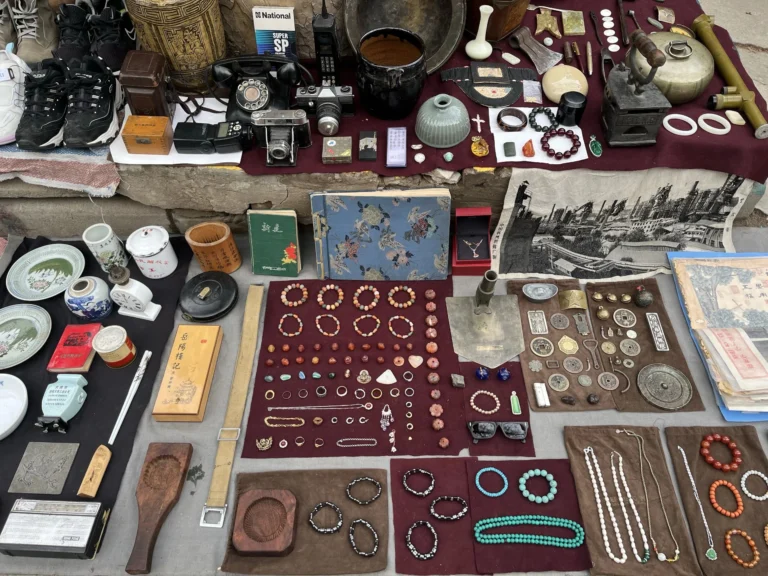
You may find breakfast food, flowers, second-hand tools, antiques, pet fish and bird-related stalls within the same maze of lanes. In April 2026, Xi'an authorities were conducting wildlife-trade inspections in Xicang's bird-trading area, confirming that this remains an active and regulated part of the market rather than a reconstructed tourist attraction.
That is also why Xicang should not be approached like a polished food street. The lanes are narrow, signs are limited, and the point is partly to wander.
Most activity clusters around Xicang North Lane (西仓北巷). One of the easiest approaches is from Sajinqiao Street: look for the alley beside Ma'er Sour Soup Dumplings (马二酸汤水饺) and follow the flow of shoppers into the market.
For a deeper visit rather than a quick breakfast stop, use TripChina's dedicated Xicang Market Xi'an guide.
| Food | Typical Price | Best For |
|---|---|---|
| Egg and vegetable sandwich | About ¥8 | Filling breakfast |
| Honey cold rice cake | About ¥5 | Sweet snack |
| Beef pie (馅饼) | About ¥6 | Eating while walking |
| Lamb soup | Around ¥15+ | A proper meal |
Food is not the main reason to choose Xicang. Choose it because the market itself is the experience.
Address: Around No. 5 Xicang North Lane, Lianhu District (莲湖区西仓北巷5号一带)
Metro: Take Line 1 to Sajinqiao Station (洒金桥), Exit B. From Sajinqiao Street, look for the alley beside Ma'er Sour Soup Dumplings (马二酸汤水饺) and follow the morning foot traffic into Xicang.
Market days: Thursdays and Sundays. Sunday is generally the busier day and tends to stay active longer.
Hours as of September 2026: there is no single reliable closing time for the entire market. Around 7:00 a.m.–3:00 p.m. is a useful planning window, but different sections wind down at different times. Food is best tackled in the morning; on Sundays, antiques, birds, flowers and general market activity may continue well into the afternoon.
Major public holidays can affect individual vendors and market activity, so check locally before building an itinerary around Xicang.
Sajinqiao (洒金桥) is not really a morning market at all. It is an established food district that behaves like one in the morning.
That distinction matters because you do not have the same hard deadline. If you wake up too late for Xiaonanmen or Dongcangmen, Sajinqiao still gives you a strong Xi'an breakfast—and the neighborhood remains active long after breakfast ends.
If you want to understand the wider food district rather than simply hunt down two famous stalls, compare it with TripChina's Xi'an Muslim Quarter food guide.
Two names appear repeatedly in local breakfast recommendations.
Pangzi Zenggao (胖子甑糕) sells sticky rice cake layered with dates and beans. Recent 2026 reports put a small portion at roughly ¥5 and a larger one around ¥10, though zenggao may also be sold by weight rather than by a fixed portion at some stalls. The stall starts early and popular portions can sell out.
Li Weiyi Hulatang (李唯一肉丸胡辣汤) is another classic breakfast stop. Expect roughly ¥8–9 depending on portion and current pricing.
If you intend to eat at several places, order a small portion of zenggao. It is surprisingly filling, and there is no prize for being full before stall number two.
Address: Sajinqiao Street, Lianhu District (莲湖区洒金桥街)
Metro: Line 1 to Sajinqiao Station (洒金桥), Exit B.
For the strongest breakfast atmosphere, aim for roughly 6:30–9:00 a.m. Individual restaurants and street-food businesses continue later.
Try Dongcangmen (东仓门).
It lacks Xiaonanmen's social-media fame, and that is part of the attraction. The setup is simple: small food stalls, neighborhood shoppers and inexpensive breakfasts without much performance around them.
The strongest sign that Dongcangmen is still a neighborhood market may not be the food at all. Local reporting has documented services as ordinary as ¥5 street haircuts here—a small detail that says more about the market's role in daily Xi'an life than any viral breakfast stall.
One signature bargain is shuijianbao (水煎包)—pan-fried buns, not “boiled dumplings.” Some stalls have been reported selling three small pieces for around ¥1, although ultra-low prices like this should always be treated as a stall-specific snapshot rather than a permanent promise.
| Food | Typical Price | Best For |
|---|---|---|
| Small shuijianbao (水煎包) | Sometimes around ¥1 for 3 | Ultra-budget snack |
| Beef pancake | About ¥5 | Crisp, savory breakfast |
| Hulatang | About ¥5 | Warm, filling start |
| Zenggao | About ¥7 | Sweet finish |
Address: Dongcang Lane, Beilin District (碑林区东仓巷)
Metro: Line 4 to Hepingmen Station (和平门), Exit A, then walk roughly five minutes.
Hours as of September 2026: roughly 6:30–9:00 a.m. Morning-market vendors can change, so treat the market—not one viral stall—as the destination.
| Traveler | Best Choice | Main Trade-Off |
|---|---|---|
| First-time visitor | Xiaonanmen | Biggest crowds |
| Food-focused traveler | Sajinqiao | Less of a true market |
| Wants local daily life | Minjie Road | Away from major sights |
| Loves flea markets and street culture | Xicang | Only key market days; chaotic layout |
| Budget traveler | Dongcangmen | Fewer famous “must-eat” stalls |
| Photographer | Xiaonanmen before the rush | Requires an early start |
| Hates tourist crowds | Minjie Road | Less dramatic backdrop |
Choose Xiaonanmen if you want the easiest combination of food, atmosphere and sightseeing.
Go before the main rush, eat two or three small things rather than queueing for every viral stall, then continue toward the city wall.
Choose Minjie Road.
You lose the ancient-wall backdrop but gain breathing room and a more residential feel.
Consider Xicang.
If both days work for your itinerary, Sunday generally offers the busier and longer-running experience. Come for the bazaar rather than breakfast alone—it gives you a side of Xi'an that looks very different from the polished historic center.
Dongcangmen is the strongest fit.
Do not take individual ¥1 or ¥5 prices as guarantees, though. Morning-market prices are stall prices, not regulated admission fees.
Go to Sajinqiao.
It gives you far more flexibility than a temporary morning market, and you can continue eating through the neighborhood after breakfast hours.
Set up Alipay or WeChat Pay before you arrive, but carry RMB cash as backup.
As of September 2026, foreign visitors do not need a Chinese bank account simply to use mobile payment. Official Chinese guidance states that eligible overseas Visa, Mastercard, UnionPay, American Express, JCB, Diners Club and Discover cards can be linked to supported Chinese payment apps.
That does not mean every street-market transaction will work.
A tiny vendor's QR setup, your issuing bank, payment-product restrictions or card verification can still cause a transaction to fail. Official guidance specifically warns that overseas-card binding and authorization can fail and recommends contacting the payment provider or issuing bank when necessary.
The practical setup is simple:
Use Alipay or WeChat Pay as your first option. Keep the other app ready as a fallback. Carry about ¥100–200 in RMB cash, preferably including ¥1, ¥5, ¥10 and ¥20 notes.
Cash remains a legitimate payment method in China, and official guidance for overseas visitors explicitly includes RMB cash alongside mobile payments and bank cards.
Before your trip, TripChina's China payment guide for foreign visitors explains the full payment setup, while the Alipay guide for foreigners without a Chinese bank account covers the app itself.
Bring as little as possible.
A phone, tissues, a small amount of RMB cash and a small bag are enough. Large backpacks become annoying very quickly in Xiaonanmen and Xicang's narrow sections.
Wear comfortable shoes. Seating is limited at many temporary food stalls, so expect to eat standing or while moving between stalls.
Your phone also matters for navigation and payment. If this is your first trip to China, install and test your essential apps before flying; TripChina's 7 essential China travel apps is a useful pre-arrival checklist.
For navigation, do not depend on Google Maps for precise local-market positioning. TripChina's China navigation app guide explains the better local options.
Do not drive just to visit a morning market. Metro plus walking is easier for all five markets in this guide. For stations, fares and payment methods, use the Xi'an Metro Guide for Foreigners.
Do not arrive at 9:00 a.m. expecting the same market you saw online at 7:00. Temporary breakfast stalls disappear quickly once the morning trading window closes.
Do not build your entire visit around one viral vendor. Many stalls operate in temporary market environments, and individual vendors can move, take a day off or sell out.
And do not automatically join the longest line. Sometimes the line tells you where the best food is. Sometimes it tells you which stall went viral last week.
Xi'an's city management system includes a convenience map covering dozens of vegetable morning markets and other temporary trading areas, with addresses, opening information and navigation functions. It is useful when checking whether a neighborhood market is operating.
Morning markets run on a different cost structure from restaurants in tourist districts.
Many operate in designated or managed temporary trading areas rather than conventional restaurant premises. Xi'an authorities regulate temporary street-vending zones and morning markets, including their operating areas and hours.
There is little branding, simple equipment and a customer base built heavily around nearby residents and repeat purchases. Vendors still have food, transport, labor and sometimes stall-related costs, so “no overhead” is too simplistic.
The other side of the low-cost model is the schedule: early starts, limited trading windows and vendors who may not appear every day.
That impermanence is part of the experience. Do not visit a Xi'an morning market expecting a curated attraction. Visit because, for a few hours each morning, you are stepping into the machinery of an ordinary neighborhood.
Usually not by handing the physical card directly to a small street vendor. A more practical option is to link an eligible overseas card to Alipay or WeChat Pay and scan the vendor's QR code.
Because overseas-card authorization can still fail, carry some RMB cash as backup.
No, but expect very limited English at small stalls. Pointing at the food, showing a photo, or using your phone's translation function is usually enough for a simple order.
Two useful phrases are “这个” (zhège, “this one”) and “多少钱?” (duōshao qián, “how much?”).
Conditions vary significantly. Xicang has narrow, crowded lanes, while Xiaonanmen can become difficult to move through once the morning rush builds.
If mobility matters, avoid peak periods and assess the street conditions on arrival rather than assuming a temporary market has a continuous accessible route.
Food safety cannot be judged simply from whether a stall is busy. Choose food that is cooked thoroughly and served hot, pay attention to visible handling and cleanliness, and be more cautious with food that has been sitting uncovered or unrefrigerated.
If you have a sensitive stomach or food allergies, start with small portions and ask about ingredients when possible.
Do not assume normal schedules, especially around Spring Festival. Individual vendors may take days off even when a market area remains open, and temporary-market arrangements can change.
Before traveling during a major holiday, check TripChina's China Public Holidays guide and confirm locally when a specific market is central to your plans.
No. The Muslim Quarter is a much larger historic food and commercial district, and its busiest visitor experience is different from a temporary neighborhood morning market.
Sajinqiao overlaps with Xi'an's Muslim food culture, but visiting Sajinqiao for breakfast and visiting the main Muslim Quarter are not the same experience.
You do not need to visit all five.
Choose Xiaonanmen if this is your first trip and you want the classic city-wall breakfast scene. Choose Minjie Road if the reason you are reading this article is that you specifically want something less touristy. Pick Xicang if your dates line up and the market itself interests you more than breakfast—Sunday is generally the stronger choice if both market days fit your itinerary.
Go to Dongcangmen when price and neighborhood atmosphere matter most. Keep Sajinqiao for the morning when you sleep through your alarm.
The important part is not collecting five markets. It is getting up early enough to see one of them while it is still doing what it exists to do: feeding the city before the sightseeing day begins.
Curious what locals actually eat in Xi’an mornings? This video shows the lively street markets, traditional breakfast foods, and everyday scenes most tourists never experience.
Xi'an Urban Management Convenience Map
Xi'an Qinling Ecological Environment Protection Administration
Travel China — Mobile Payment Guide for Overseas Visitors
Chinese Government — Payment Service Guide for Overseas Visitors
Information was reviewed and updated in September 2026 using Xi'an government and city-management material, current Chinese payment guidance for overseas visitors, recent local reporting, and TripChina field observations. Morning-market stall prices and operating times are inherently variable, so they are presented as approximate rather than guaranteed. Claims without reliable support—such as a fixed success rate for foreign-card QR payments, a precise percentage of English-speaking vendors, or blanket food-safety comparisons—were intentionally excluded.
TripChina.me creates practical China travel guides shaped by real local experience, helping independent travelers navigate transport, payments, food, neighborhoods, and the cultural details that make traveling in China easier and more meaningful. Find the guide for your destination at tripchina.me.