Our Location:
No. 99, Jiazi Road, Chengdu

 authorChris Lee
Xi’an City Wall circles the historic center in a 13.74-kilometer rectangle, but you do not need to complete the whole loop. Cycle if you want to see its scale, walk if history and photography matter more, or take the sightseeing cart if you want broader coverage with less effort. Here is how to choose the right route, gate and transport option, plus the current ticket and foreign-passport entry rules.
There is no single “correct” way to visit the wall.
| Option | Typical Time | Best For | Main Trade-Off |
|---|---|---|---|
| Full bike loop | 1.5–2.5 hrs | Seeing the wall’s scale | Rough brick surface |
| Short walk | 1–1.5 hrs | History and photography | Covers one section |
| Long walk | 2–3 hrs | Slow exploration | Physically tiring |
| Full walk | 4–5 hrs | Serious walkers | Repetitive in places |
| Sightseeing cart | Varies by route | Seniors, families, low-effort sightseeing | Less freedom to stop |
| South Gate only | 30–60 min | Tight itineraries | Limited perspective |
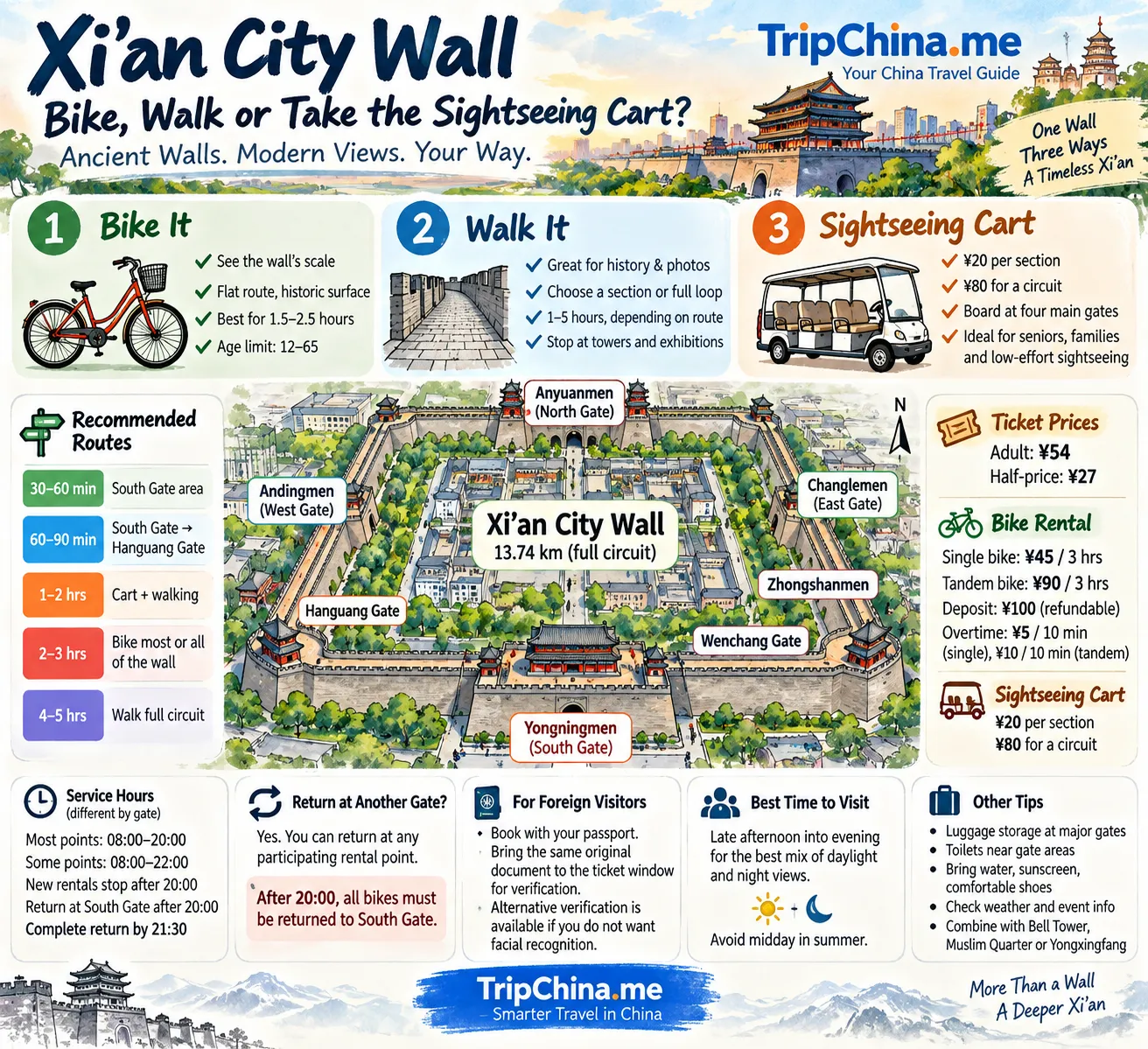
Cycling is the best choice if you have two to three hours and want to understand how large the old city actually is.
The route is flat, but the historic brick surface is not smooth. Expect vibration from brick joints, and the rental bikes can feel heavier and less comfortable than a modern city bike.
Slow down near gates, busy pedestrian areas and temporary event zones.
Current rental rules apply to riders aged 12–65.
Walk if you care more about architecture, photographs and historical detail.
You can stop around towers, archaeological remains and exhibitions without watching a rental clock.
For most travelers, a selected section is better than walking the complete circuit. The full loop is long enough that architectural repetition and physical fatigue can outweigh the benefit.
The sightseeing electric cart is the practical third option, especially for:
As of September 2026, published visitor information lists the fare at ¥20 per section or ¥80 for a circuit, with boarding available around the four main gates: Yongningmen (South), Andingmen (West), Anyuanmen (North) and Changlemen (East).
Do not automatically assume the service works like a Western hop-on hop-off bus. Confirm the ticket conditions and the last cart when boarding, especially during holidays or special events.
You only need a simple mental map:
| Anyuanmen — North Gate | ||
|---|---|---|
| Andingmen — West Gate | Historic city center | Changlemen — East Gate |
| Hanguang Gate | Yongningmen — South Gate | Wenchang Gate |
Useful orientation:
South Gate → west → Hanguang Gate
Best short walking route.
South Gate → east → Wenchang Gate
Popular southern section, but cycling restrictions can affect part of this area.
East Gate / Zhongshanmen
Useful if you want to finish near Yongxingfang.
West or southwest side
More convenient for continuing toward the Bell Tower and Muslim Quarter.
If you are arriving by subway, TripChina’s Xi’an Metro Guide for Foreigners explains payment and station navigation.
The scenic area expanded from 11 to 17 public access points after May Day 2025, according to Xi’an Qujiang New District.
Most travelers only need five:
| Gate | Best For | Why Choose It? |
|---|---|---|
| Yongningmen | First visit | Most impressive arrival and night atmosphere |
| Hanguangmen | History | Tang-period archaeological context |
| Changlemen | Eastern old city | Major historic gate |
| Andingmen | Quieter experience | Convenient western access |
| Zhongshanmen | Food afterward | Near Yongxingfang |
Usually.
Yongningmen combines the moat, monumental gate complex, broad rampart and one of the strongest evening settings on the wall.
It is also the busiest area, so continue away from the gate if you want a quieter experience.
Choose Hanguangmen if historical context matters more than the iconic entrance.
Archaeological remains here connect the present wall with the earlier Tang imperial city.
If step-free access is important, Hanguang Gate is also one of the first entrances worth checking. Confirm elevator operation before traveling because accessibility is not uniform around the wall.
Prices published as of September 2026 are:
| Rental | Price | Included Time | Overtime |
|---|---|---|---|
| Single bike | ¥45 | 3 hrs | ¥5 / 10 min |
| Tandem bike | ¥90 | 3 hrs | ¥10 / 10 min |
| Deposit | ¥100 / bike | — | Refundable after normal return |
Service arrangements can change during festivals, bad weather and special events. Current published information confirms the ¥100 deposit and overtime charges.
Nine bicycle service points are currently listed around the wall, including:
Zhongshanmen, the northwest corner and Jianguomen were added to the service network in 2025.
Yes. Current service information confirms that bicycles can be returned at another participating rental point, so you do not normally need to ride back to your starting desk.
After 20:00, however, bicycles must be returned to the South Gate service area. Visitors are advised to complete the return by about 21:30.
This makes one-way and partial rides practical earlier in the day.
Bike-service hours are different from the wall’s general opening hours.
| Service Point | Published Service Hours |
|---|---|
| South Gate-area points | 08:00–22:00 |
| Wenchang Gate | 08:00–22:00 |
| Hanguang Gate | 08:00–20:00 |
| East / West / North Gates | About 08:00/08:15–20:00 |
| Zhongshanmen / Northwest Corner / Jianguomen | 08:00–22:00 in current service information |
Key evening rule: After 20:00, regular new-rental service ends and bikes still out on the wall should be returned at South Gate. Aim to return by 21:30 rather than waiting until the service area closes.
Special events can alter individual service points, so check the desk if you rent late.
Stop riding if the bike develops a mechanical problem rather than continuing with a damaged wheel, chain or brake.
Contact the nearest bicycle-service point or ask scenic-area staff for assistance.
The scenic area visitor consultation number is:
029-87272792
| Time | Recommended Plan | Best For |
|---|---|---|
| 30–60 min | South Gate area | Very tight schedule |
| 60–90 min | South Gate → Hanguang Gate | History + photos |
| 1–2 hrs | Cart + selected walking | Seniors / families |
| 2–3 hrs | Bike most or all of wall | Full-scale experience |
| 4–5 hrs | Walk full circuit | Dedicated walkers |
South Gate → Hanguang Gate
Enter at Yongningmen, explore the gate complex, then walk west.
You move from the wall’s most monumental entrance toward a quieter section with stronger archaeological context.
Cycle most or all of the wall.
Beyond the busy southern section, the relationship between old and modern Xi’an becomes much easier to understand: traditional streets remain inside the fortification while major roads and newer development spread beyond it.
That city-scale perspective is what a short stop at one gate cannot give you.
Finish near Zhongshanmen if you want to continue to Yongxingfang.
For the Bell Tower, Sajinqiao or Muslim Quarter, the southern or western side is more convenient.
TripChina’s Xi’an Muslim Quarter food guide explains why the busiest tourist street is not necessarily where you should spend your whole food evening.
Do not think of a city gate as a single doorway.
Xi’an City Wall combines the moat, gate passages, towers, ramparts, barbicans and other defensive structures into a layered system.
The wengcheng (瓮城), or barbican, created an enclosed defensive area rather than allowing attackers to move directly through the gate into the city.
Hanguang Gate helps explain that the Ming wall visible today sits within a much longer history of fortified Xi’an.
Its archaeological remains connect this area with the Tang imperial city, making it one of the most worthwhile stops for history-focused visitors.
Thirteen former defensive watchtowers have been converted into public cultural exhibition spaces covering City Wall history, Chinese civilization, Shaanxi folk culture and intangible cultural heritage.
They also make useful breaks during a longer walk or ride.
For a deeper history day, TripChina’s guide to Xi’an museums worth visiting can help you choose what deserves additional time.
For overseas visitors booking online, the process in effect since July 1, 2026 is:
Foreign visitors can also purchase and register at the ticket window.
Shaanxi Daily’s July 2026 notice confirms that overseas visitors with online reservations need to present the travel document used for the booking at an offline ticket window before entry.
If you are booking several major attractions, TripChina’s Xi’an attraction booking guide explains where advance reservations matter most.
Go to the ticket hall at your entrance gate and ask staff for another verification method.
The July 2026 entry notice specifically provides this option.
Prices below are published as of September 2026. Temporary events or service adjustments can affect add-on services.
| Item | Price |
|---|---|
| Standard admission | ¥54 |
| Half-price admission | ¥27 |
| Single bike | ¥45 / 3 hrs |
| Tandem bike | ¥90 / 3 hrs |
| Bike deposit | ¥100 |
| Sightseeing cart | ¥20 / section |
| Sightseeing-cart circuit | ¥80 |
The sightseeing-cart fares are also reported in current local visitor information, with the four main gates listed as boarding points.
Under Xi’an’s current government pricing rules:
Foreign-issued student or eligibility documents may require manual verification, so bring original documents rather than only phone images.
Full-price, half-price, senior and other qualifying individual concession tickets can be used for multiple same-day entries after verification.
Group and designated special/open-day ticket categories may be single-entry.
Do not depend on only one payment method.
Keep a combination of:
Do not assume Apple Pay or Google Pay contactless acceptance wherever a card terminal is present.
TripChina’s guide to how foreigners pay in China explains the practical differences between cards, mobile payments and cash.
For most travelers, late afternoon into evening offers the best mix of temperature, daylight photography and night atmosphere.
There is no fixed year-round minute when the decorative lights turn on, so plan around sunset rather than one exact lighting time.
| Season | Walking | Cycling | Sightseeing Cart |
|---|---|---|---|
| Spring | Excellent | Excellent | Comfortable |
| Summer | Best morning/evening | Avoid midday heat | Good low-effort option |
| Autumn | Excellent | Best cycling season | Comfortable |
| Winter | Cold on exposed sections | Wind can make riding uncomfortable | Easier physically, but can still feel cold |
The rampart is exposed and shade is limited.
Avoid a long walk or ride around the hottest part of the afternoon. Summer visits work better early or toward sunset.
Carry water and sun protection.
The elevated wall is exposed to wind.
Cycling can feel considerably colder than walking because of the extra wind chill, and sitting still in a sightseeing cart can also feel cold.
Winter sunset comes earlier, so start earlier if you want both daylight and evening views.
Rain, snow or strong wind can interrupt bicycle operations and may also affect sightseeing-cart service.
If cycling or the cart is central to your plan, confirm current operation shortly before visiting.
Expect heavier crowds around Spring Festival (usually late January or February), the Labor Day holiday around May 1, and the National Day holiday around October 1–7. Exact holiday arrangements vary by year.
Yongningmen is particularly affected because the South Gate area regularly hosts performances, lantern displays and other seasonal programming.
Large events can also change pedestrian routes, rental points and service capacity.
TripChina’s China public holiday crowd calendar can help if your Xi’an dates are flexible.
Yes, but avoid treating the full circuit as the default family route.
For a stroller, choose a gate with easier access and keep the route short. Hanguang Gate is worth checking first when step-free access matters.
Even after reaching the top, the historic brick surface remains rougher than modern pavement.
For families who do not want a long walk, combining a short South Gate visit with the sightseeing cart is often more practical than attempting the whole wall.
Visitor service centers have provided luggage-storage facilities at major gate areas, including South, East, West, North and Zhongshan Gate.
However, storage locations and operating hours can change.
If you are arriving directly from a train station or hotel checkout with large luggage, do not assume every entrance has storage.
Call 029-87272792 or ask your hotel to confirm the nearest operating luggage-storage point before heading to the wall.
Toilets and rest facilities are concentrated around major gates and visitor-service areas rather than evenly spaced at fixed short intervals around the entire circuit.
If you are doing a long walk or full bike loop, use facilities when you pass a major gate instead of assuming another one is immediately ahead.
Bring:
If cycling, avoid a large backpack. The uneven brick surface already produces considerable vibration.
Walking the entire wall simply because you can.
A shorter route often has better sightseeing value.
Expecting a smooth bike path.
The historic paving makes cycling rougher than the flat profile suggests.
Renting a bike late without checking the return rule.
After 20:00, return it at South Gate and aim to finish by 21:30.
Assuming the sightseeing cart is automatically hop-on hop-off.
Confirm ticket conditions before boarding.
Visiting at midday in summer.
There is limited shade on the rampart.
Ignoring temporary event arrangements.
South Gate performances and major festivals can affect access and transport services.
| Finish Area | Good Next Stop |
|---|---|
| South Gate | Bell Tower / central old city |
| Zhongshanmen | Yongxingfang |
| Southwest side | Muslim Quarter / Sajinqiao |
| Hanguang Gate | History-focused old-city route |
| South Gate after sunset | Dinner in the old city |
For a more local start the following morning, TripChina’s Xi’an morning markets guide covers markets that feel very different from the city’s major tourist streets.
Current rules generally do not permit outside bicycles; cycling is managed through designated scenic-area rental bikes. Special events can introduce additional restrictions.
Yes. Published visitor information prices the sightseeing cart by section as well as for a complete circuit, so a single-section ride is possible.
This can work well if you want to walk one part of the wall and use the cart for another. Confirm your intended stop when buying the ticket.
No.
For most first-time travelers, either a 60–90 minute South Gate–Hanguang Gate walk or a two-hour-plus bike experience provides enough variety without turning the visit into an endurance exercise.
Choose the cart if long walking is difficult, you are traveling with older family members or young children, or weather conditions make cycling uncomfortable.
Yes—but completing the circuit is not the goal.
Walk for architecture and history. Cycle for scale and changing city views. Use the sightseeing cart when comfort matters more than stopping wherever you want.
Choose the experience that fits your time and energy, and the wall becomes far more interesting than simply trying to cover the entire circuit.
Xi’an City Wall Entry and Foreign-Passport Verification — Shaanxi Daily
Xi’an City Wall Access Points — Xi’an Qujiang New District Administrative Committee
Xi’an Scenic-Area Ticket and Concession Policy — Xi’an Development and Reform Commission
Xi’an City Wall Bicycle Rental Rates and Service Information
Updated September 2026. Entry rules, admission prices, concession standards and access points were checked against Shaanxi and Xi’an government sources. Bicycle prices, overtime fees, nine service points and evening return rules were cross-checked against recent local service information. Sightseeing-cart fares are supported by current local visitor information, while service frequency and special-event operations can vary; travelers should confirm same-day arrangements when these affect their route.
TripChina.me creates practical China travel guides shaped by real local experience, helping independent travelers navigate transport, payments, food, neighborhoods, and the cultural details that make traveling in China easier and more meaningful. Find the guide for your destination at tripchina.me.