Our Location:
No. 99, Jiazi Road, Chengdu

 authorChris Lee
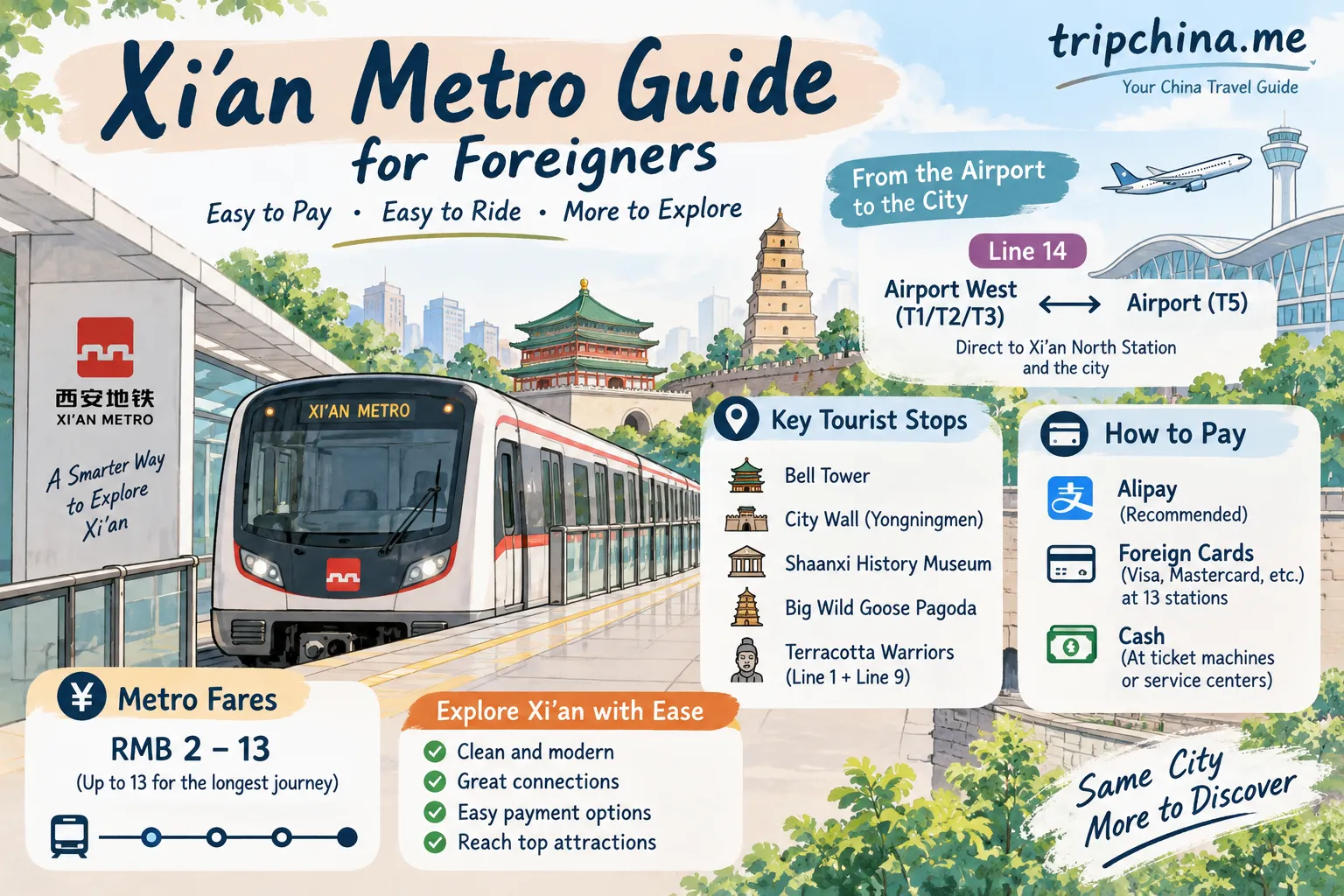
Xi'an Metro is one of the easiest ways to explore the city, with fares starting at RMB 2, English signage, and useful connections to the Bell Tower, City Wall, Big Wild Goose Pagoda and airport.
For most foreign visitors, the bigger challenges are choosing the right exit, activating a metro payment code and knowing when the last airport train leaves. A foreign bank card that works in Alipay does not automatically work at every metro gate.
This 2026 Xi'an metro and subway guide covers the current map, tickets, operating hours, Line 14 airport connections, foreign-card payments, station exits and the mistakes that can leave first-time visitors at the wrong terminal or ticket gate.
Yes. Xi'an Metro is inexpensive, generally well signed and convenient for most first-time visitors.
| Question | Quick Answer |
|---|---|
| How much is Xi'an Metro? | RMB 2 for the first 6 km; fares increase with distance. |
| Best line for sightseeing? | Line 2 for Xi'an North Station, the Bell Tower, Yongningmen and Xiaozhai. |
| Which metro goes to the airport? | Line 14, serving Airport West (T1/T2/T3) and Airport (T5). |
| Can foreigners use Alipay? | Yes, if the Xi'an transit QR service activates successfully; ordinary Alipay payment alone is not enough. |
| Can I use a foreign credit card? | At designated staffed station service centers, not as a guaranteed direct gate tap. |
| Is there an English Xi'an Metro map? | Yes. Check a current network map and the station's exit directory. |
| How late does the airport metro run? | Airport West toward Heshao: 22:20; Airport (T5) toward Heshao: 22:24 under the published regular timetable. |
| Which app should I use to check the last train? | Check the official Xi'an Metro app or current operator timetable, then confirm the station and direction. Amap helps with route planning. |
| What if my QR code fails? | Go to station staff, or use a single-journey ticket or supported payment alternative. |
Three things to check before entering: your destination station, the correct train direction and the exit you will need.
Airport warning: A train's final departure from the airport is not the same as the last service from a downtown station toward the airport. Always look up your own boarding station and direction.
For sightseeing, the metro should usually be your default. Taxis and DiDi are more useful when luggage, late-night arrivals or awkward last-mile connections are involved.
| Situation | Best Option | Why |
|---|---|---|
| Downtown sightseeing | Metro | Predictable and avoids road traffic |
| Airport arrival while metro runs | Line 14 + connecting metro | Convenient public transport |
| Large luggage | Taxi / DiDi | Less walking and fewer transfers |
| Late-night airport arrival | Taxi / DiDi | Metro service may have ended |
| Terracotta Warriors | Metro + local bus or taxi | Reaches the Lintong area |
| First visit to Xi'an | Metro + transit QR or ticket backup | Simple for central attractions |
For a broader comparison, see TripChina's Xi'an guide to metro, buses, DiDi and railway stations.
If you plan to use ride-hailing after the metro closes, set it up beforehand. Our DiDi guide for foreign visitors without a Chinese phone number explains the setup.
Yes. English station signage and bilingual announcements are widely available.
The bigger challenge is often finding the correct exit.
A station such as Zhonglou can have several exits leading to different sides of a busy intersection. Choosing the wrong one can turn a short walk into a confusing detour.
Before leaving the train, check the station name, Chinese characters and recommended exit. Save your destination's Chinese name on your phone.
Do not depend on announcements alone. Watch the train's station display and the platform signs, especially when transferring or when audio announcements are difficult to hear.
For first-time travelers, the name Xi'an subway means the same urban rapid-transit system as Xi'an Metro.
A current Xi'an metro map is especially useful because the network has expanded substantially.
For planning, use:
Do not rely on an old downloaded metro map without checking whether new lines or stations have opened.
If you save an English Xi'an metro map before departure, also save the Chinese names of your hotel, railway station and key attractions.
For detailed navigation beyond the metro, TripChina explains which maps and navigation apps work for foreign visitors in China.
Xi'an Metro uses distance-based fares.
| Distance | Standard Fare |
|---|---|
| 0–6 km | RMB 2 |
| 6–10 km | RMB 3 |
| 10–14 km | RMB 4 |
| 14–20 km | RMB 5 |
| 20–26 km | RMB 6 |
| Beyond 26 km | Additional RMB 1 per 8 km |
Short sightseeing journeys within central Xi'an commonly cost RMB 2–4. Longer journeys toward the airport or outer districts cost more.
For example, Zhonglou and Yongningmen are close enough that the fare is at the bottom end of the system's fare scale, while a journey involving Line 14 crosses several fare bands.
Following the expansion of the network, the published maximum fare has been around RMB 13. Most tourists pay considerably less on ordinary sightseeing journeys.
These fares follow the distance-based policy published by the Xi'an Metro operator.
For a short visit, you can pay for individual rides rather than purchasing a special pass.
Xi'an Metro also offers one-day and three-day period passes.
| Ticket Type | Price | Validity |
|---|---|---|
| Single-journey ticket | Distance-based | One journey |
| 1-Day Pass | RMB 15 | 24 hours |
| 3-Day Pass | RMB 40 | 72 hours |
The period passes allow unlimited metro rides during their applicable validity periods.
The RMB 15 one-day pass and RMB 40 three-day pass are published by Xi'an Metro's operator for physical period tickets. Some commercial travel listings may show different amounts; compare the actual product and any service charge instead of treating a third-party listing as the official station fare.
Electronic period passes are available through the official Xi'an Metro app, and physical passes are available through staffed station customer service centers.
For electronic tickets, validity starts when you activate the pass. For physical period tickets, the operator states validity begins upon first entry. Follow the instructions for the exact product purchased.
Is a day pass worth it?
If you make only three or four short central-city rides costing RMB 2–3 each, individual tickets are usually cheaper.
A RMB 15 day pass begins to save money only when your expected individual fares add up to more than RMB 15. That could mean five or six rides, or fewer longer journeys.
Do not assume that five rides is a universal break-even point: it depends on the fare of each journey.
The same principle applies to the three-day pass.
For most independent visitors, there is no need to buy a pass automatically.
You do not need a mainland Chinese bank account simply to ride the metro.
The most practical payment options are:
The important point is that paying with Alipay at a ticket machine, using Alipay's metro transit QR code and paying with a foreign bank card are different operations.
A foreign card that works for ordinary Alipay purchases does not guarantee that every transit QR-code feature will activate.
Yes. Alipay can be convenient for foreign visitors when the appropriate Xi'an Metro transit service is successfully activated.
Foreign travelers can register Alipay with an overseas mobile number and link eligible international cards.
Before your first ride:
Use the same transit credential for entry and exit.
If the code does not activate, use a single-journey ticket instead of repeatedly attempting to scan an inactive code.
Some foreign travelers report that ordinary Alipay payments work even when the local Xi'an transit code remains unavailable. Overseas telephone numbers, identity checks and transit-service eligibility can affect activation.
There is no reliable universal success rate for overseas Alipay accounts.
Test your Xi'an metro transit code before your first time-sensitive journey.
For account setup and foreign-card limitations, see TripChina's Alipay guide for foreign travelers.
Yes.
Ticket machines and customer service centers support RMB cash payments.
Carry smaller notes if you intend to use cash regularly.
At a machine, select the destination station, confirm the fare and follow the payment instructions.
If you have difficulty, ask station staff for assistance.
Yes, at designated station customer service centers.
Do not assume that you can tap a foreign Visa or Mastercard directly at a standard metro fare gate.
Xi'an Metro published an international-card ticket-sale program at customer service centers in the following 13 stations:
Published information identifies support for Visa, Mastercard, JCB, Diners Club, Discover, American Express and UnionPay at these staffed facilities.
This is a staff-assisted payment process, not a self-service gate tap.
Go to the customer service center, ask for a ticket and let staff operate the POS terminal.
Allow extra time, especially at major transport interchanges. If staff need to clarify your card or ticket type, the process may take longer than a normal QR-code entry.
Card acceptance can depend on the specific card, issuer, terminal status and current operator arrangements. Keep an alternative payment method.
The 13-station list is based on the published service rollout; verify availability locally if foreign-card acceptance is essential to your journey.
Do not depend on an overseas Apple Pay or Google Pay wallet as your Xi'an Metro ticket.
A foreign bank card stored in a phone wallet is not the same as a locally activated metro transit QR code or a supported transport credential.
Use a supported transport code, single-journey ticket, period pass or staff-assisted payment option.
First check whether you are at an entrance or exit gate and whether you are using the correct QR scanner.
Use the same ticket or QR credential on both entry and exit.
If the gate displays an error, do not repeatedly switch between payment apps, codes or tickets.
Go to the station customer service center and show staff the ticket or the error message.
If your phone battery is low, keep enough charge for the exit scan.
Xi'an Xianyang International Airport (XIY) connects to the metro network through Line 14.
There are two airport metro stations:
| Station | Airport Terminal |
|---|---|
| Airport West (机场西) | T1 / T2 / T3 |
| Airport (机场) | T5 |
The Terminal 5 metro station opened in February 2025 and is integrated with the airport's Ground Transportation Center.
Do not confuse Airport West with Airport (T5). The terminals are not interchangeable destinations.
If you arrive at the wrong terminal or need to transfer, you have two practical options.
Metro: Line 14 links Airport (T5) and Airport West (T1/T2/T3). The journey between these airport metro stations takes only a few minutes during service hours.
Airport information has described an arrangement allowing qualifying terminal-transfer passengers to request free travel between the two stations by showing relevant flight details to station staff. Confirm the procedure locally rather than assuming an ordinary journey is automatically free.
Free airport shuttle: The airport operates terminal shuttle services. Published pickup locations have changed with terminal operations, so follow current airport shuttle signs rather than an older exit-number screenshot.
For most central Xi'an destinations, the usual metro route is:
Airport → Line 14 → Xi'an North Station → Line 2 → Zhonglou / Yongningmen / Xiaozhai
Allow roughly 35–40 minutes for the Line 14 section between the airport area and Xi'an North Station, then add transfer and onward journey time.
If you're deciding between metro, taxi, DiDi or airport bus, see our separate Xi'an airport-to-city transport comparison.
Xi'an Metro does not have one network-wide last-train time.
Service hours vary by line, station and direction.
Many lines begin operating around 6 AM, but the last departure depends on your exact journey.
For sightseeing, check the final train for your direction before starting a late-evening activity.
Airport trips deserve particular attention because reaching the airport metro station involves walking through the terminal or Ground Transportation Center.
For Line 14 trains traveling toward Heshao (贺韶) and the city-side network, the published regular departures are:
| Airport Station | First Train Toward Heshao | Last Train Toward Heshao |
|---|---|---|
| Airport West (T1/T2/T3) | 06:00 | 22:20 |
| Airport (T5) | 06:04 | 22:24 |
These are scheduled departures from the stations, not recommended times to leave the terminal.
If your flight lands after 21:00, immigration, baggage collection and walking to the station may leave little margin.
Do not treat 22:20 or 22:24 as the time you can start walking from arrivals.
Also remember that catching Line 14 does not automatically guarantee a convenient connection to every onward metro line.
Under the regular published timetable, Line 14 also runs in the opposite direction, toward Airport West (机场西).
Examples of published last-train departures in that direction include:
| Station | Last Train Toward Airport West |
|---|---|
| Xi'an North Railway Station | 22:52 |
| Airport (T5) | 23:22 |
| Airport West | Terminal station; the last arriving service is later |
Do not interpret the T5 23:22 departure as the last train leaving downtown for the airport. It is the departure time at T5 toward Airport West, one station farther along.
The exact last airport-bound train from your starting station must be checked separately.
Temporary holiday timetables can extend or modify these services.
For late arrivals, a licensed taxi or DiDi is a practical backup.
If you are leaving Xi'an and relying on the metro to reach the airport, work backward from your flight check-in deadline, not from the last train.
A typical central-city route is:
Zhonglou → Line 2 → Xi'an North Station → Line 14 → Airport West or Airport (T5)
For planning, allow approximately:
| Journey Component | Practical Allowance |
|---|---|
| Zhonglou to Xi'an North on Line 2 | Around 25–30 min |
| Transfer at Xi'an North | 15–20 min |
| Line 14 to airport station | Around 35–40 min |
| Station to check-in area | Additional walking and terminal time |
Total planning allowance: Approximately 80–100 minutes from central Xi'an to the airport check-in area, depending on the terminal, train wait and walking route. Add a buffer for queues or disruption.
For domestic departures, a practical aim is to be at the airport around two hours before departure, or earlier if required by the airline.
International departures generally justify more time, often around three hours, subject to your airline's instructions.
For example, with a 23:00 domestic flight, reaching the airport by about 21:00 means leaving Zhonglou around 19:20–19:40 is a more conservative plan than waiting until 20:30.
For flights departing late at night, the last train may still technically be operating, but that does not make it a safe airport transfer.
DiDi or taxi backup: From central Xi'an, road travel may take around 40–60 minutes under ordinary conditions, but traffic, pickup location and late-night demand can change the journey substantially.
Use a ride-hailing fare estimate rather than relying on one fixed price.
You do not need to memorize the entire network.
Most first-time visitors can navigate the city's key attractions using a handful of lines.
Line 2 is the most useful north–south line for many visitors.
Important stations include:
If you remember only one metro line before arriving in Xi'an, make it Line 2.
Dayanta Station is served by Lines 3 and 4.
Both are useful for the Big Wild Goose Pagoda and the surrounding Tang-themed sightseeing district.
Line 4 also provides useful connections to Tang Paradise, the Daming Palace area and Xi'an Railway Station.
Line 9 runs east into Lintong District.
From central Xi'an, connect from Line 1 to Line 9 at Fangzhicheng.
Qinling West Station (秦陵西站) is a useful metro stop for onward travel to the Terracotta Warriors.
The metro does not reach the museum entrance directly. You still need a connecting bus, taxi or ride-hailing car.
Line 14 connects Airport West, Airport (T5) and Xi'an North Station with the wider metro network.
It is the primary metro connection for travelers arriving at or departing from Xi'an Xianyang International Airport.
The correct station is only half the journey. You also need the correct exit.
Use this table to plan, then compare it with the station's current exit directory.
| Attraction | Metro Line | Useful Station | Exit / Connection | Approx. Final Walk |
|---|---|---|---|---|
| Bell Tower | 2 / 6 | Zhonglou | Follow Bell Tower signs | A few minutes |
| Muslim Quarter | 2 / 6 | Zhonglou | Exit C is commonly convenient | About 5–10 min |
| City Wall South Gate | 2 | Yongningmen | Follow South Gate signs | A few minutes |
| Big Wild Goose Pagoda | 3 / 4 | Dayanta | Follow attraction signs | A few minutes |
| Shaanxi History Museum | 2 / 3 | Xiaozhai | Exit E, then walk | About 10–15 min |
| Daming Palace area | 4 | Hanyuandian | Depends on destination | Varies |
| Terracotta Warriors | 9 | Qinling West | Bus / taxi connection | Road transfer required |
| Xi'an Airport | 14 | Airport West / Airport (T5) | Terminal connection | Direct |
Station exits may close temporarily or change because of maintenance, construction or crowd management.
For the South Gate and City Wall, TripChina's Xi'an City Wall guide explains entrances and visiting options.
Shaanxi History Museum timing warning: From March 15 to November 14, 2026, the museum's main building is temporarily open on Mondays under an official extended-hours program. Do not follow older guides claiming it is always closed on Monday. Check the current reservation availability and opening notice before going.
For museum admission details, use our Shaanxi History Museum ticket-booking guide.
A useful local habit is to save the Chinese destination name and exit letter before your train arrives.
From central Xi'an, a common route is:
Line 1 → Fangzhicheng → Line 9 → Qinling West
From Qinling West Station, transfer to a local bus or use a taxi or ride-hailing service for the final section.
Bus 617 has served the connection between the Qinling West metro area and the Terracotta Warriors area, but local surface routes and schedules can change. Verify the current service before depending on it.
The metro gets you into Lintong. It does not deliver you directly to the museum entrance.
Allow approximately 1.5 hours each way from central Xi'an as a general planning estimate, depending on transfers and surface transport.
For detailed museum route planning, see TripChina's Terracotta Warriors visitor guide and transport tips.
Check the posted return-bus information when you arrive at the museum.
Do not assume the same buses operate late into the evening.
A taxi or DiDi from the Terracotta Warriors area back to Qinling West Station may take around 10–15 minutes in normal traffic, depending on pickup location.
During holidays and late afternoons, allow extra time for vehicle availability.
If you plan to use a local bus such as 617, verify its current return schedule before beginning your museum visit.
The metro works particularly well when you group attractions geographically instead of crossing the city repeatedly.
Start around Zhonglou Station.
Explore the Bell Tower area and walk toward the Muslim Quarter.
The famous main street is only one part of the neighborhood. Smaller surrounding lanes can also be rewarding places to explore local food.
Return to Line 2 when you are ready to continue.
Ride one stop south to Yongningmen.
Follow the station signs for the South Gate of Xi'an City Wall.
You can walk part of the wall or rent a bicycle if the current conditions and arrangements allow.
Continue south on Line 2 to Xiaozhai.
From Exit E, allow around 10–15 minutes on foot.
The museum requires separate admission planning, and advance booking is generally required.
The main museum's special 2026 schedule runs through November 14 and includes Mondays, but reservation requirements remain in place.
From Xiaozhai, take Line 3 to Dayanta.
The Big Wild Goose Pagoda area connects naturally with Grand Tang Mall (Datang Everbright City), which becomes particularly atmospheric after dark.
For travelers choosing between these neighboring evening attractions, see TripChina's Big Wild Goose Pagoda, Tang Paradise and Grand Tang Mall comparison.
This sightseeing sequence works because it moves progressively south through the city instead of repeatedly doubling back.
A station may be correct while the exit is wrong.
Around major intersections, that can mean crossing wide roads or walking around barriers.
Check the exit before leaving the paid area.
There is no single useful “Xi'an Metro closes at 11 PM” rule.
Last trains vary by line, station and direction.
Airport travel is where guessing is particularly risky.
They are different stations.
| Station | Chinese | Main Role |
|---|---|---|
| Xi'an North Station | 西安北站 | Major high-speed rail hub; Line 14 airport interchange |
| Xi'an Railway Station | 西安站 | Central railway station near the old city |
Always check the exact Chinese station name printed on your railway ticket.
If you are using China's rail network for the first time, TripChina's guide to boarding trains in China as a foreigner explains passport checks and station-entry procedures.
Line 9 gets you into the Lintong area, not to the museum entrance.
You still need a road connection.
Central lines and major interchanges can become crowded during weekday commuting periods.
As a practical guide, expect heavier crowds around 07:30–09:00 and 17:30–19:00, particularly on busy central corridors and at Xi'an North Station.
Holiday crowds may be heavier.
If possible, plan large-luggage transfers outside busy periods and consult TripChina's China public holiday travel calendar before fixing a demanding itinerary.
Yes.
Passengers must cooperate with metro security screening.
Bags normally pass through an X-ray scanner while passengers pass through the checkpoint.
Dangerous items, including flammable, explosive, toxic, radioactive and corrosive materials, are prohibited.
Allow extra time at major stations during holidays.
Do not eat inside metro carriages.
Xi'an's urban rail regulations prohibit eating inside train carriages.
Follow station signs and staff instructions for drinks and other situations within the paid area.
Yes. Ordinary tourist luggage is usually fine, but there are published limits.
A passenger's luggage should not exceed:
Oversized or excessively heavy luggage may not be allowed into the paid area.
For most travelers, the bigger practical challenge is moving luggage through crowded transfers.
Under Xi'an Metro's published fare rules, one adult may bring one child measuring 1.3 m or below without purchasing a separate ticket.
Children above the applicable free-travel threshold need a valid ticket unless another concession applies.
Station staff can clarify borderline cases.
Go to the station customer service center for assistance.
Staff can help resolve ticketing or QR-code problems.
If your phone is your metro ticket, keep enough battery for the exit scan.
Major stations provide elevators and accessible routes, but not every exit offers identical step-free access.
If you use a wheelchair, stroller or heavy luggage, check which exit has an elevator before leaving the station.
Do not choose an exit solely because it appears closest on a map.
Apple Maps can be useful for English-language route planning on iPhones in China.
Amap (Gaode Maps / 高德地图) can provide detailed local walking routes, metro connections and station-exit information.
However, station signage remains important for the final exit.
Compare the app's directions with the current physical station directory, especially if construction or crowd-control arrangements are in place.
For the mobile data needed to use maps and ticketing apps, see our China eSIM vs SIM card comparison.
Xi'an looks compact around the City Wall, but many major attractions are outside the historic core.
Road traffic can become slow around tourist areas, on weekends and during public holidays.
The metro gives independent travelers predictable routing and low fares.
For a journey such as:
Bell Tower → City Wall → Xiaozhai → Big Wild Goose Pagoda
the metro is often the simplest backbone.
You do not need to memorize the whole network. Learn the few lines you will use, save the Chinese names of your destinations, check your exits and keep a backup payment method.
Yes. English-language network and journey-planning resources are available. Check the current network diagram and use station exit signs for the final walking route.
A standard personal transit QR credential is normally for one passenger and should not simply be scanned twice for two travelers.
However, the official Xi'an Metro app has introduced a family-ticket feature (亲情票) allowing a main account to manage additional passenger codes under the applicable rules.
If you are not using that supported feature, each passenger should have their own valid ticket or credential.
Sometimes. Operating hours may be extended for specific holidays or events, but those changes are not guaranteed. Check official announcements for your travel date.
Yes, subject to the published size, weight and prohibited-item rules described above.
Go to the station customer service center. Staff can help check the ticket, entry record or available payment alternatives.
Yes. Single-journey tickets, RMB cash, supported transit QR codes and international-card purchases at designated staffed customer service centers provide alternatives.
Do not assume it does. The published foreign-card service uses staffed customer service centers at selected stations, rather than guaranteeing contactless payment at ordinary entry gates.
Yes. Take Line 2 toward Xi'an North Station, transfer to Line 14 and leave at Airport (T5).
Check the last airport-bound train from your actual boarding station and allow sufficient time for airline check-in.
It depends on how many trips you make and their individual fares.
A RMB 15 day pass is unlikely to save money if you take only a few RMB 2–3 trips. It becomes more useful when the fares you would otherwise pay exceed RMB 15.
Use the official Xi'an Metro operator's current timetable or app to check station-specific first and last trains. Amap is useful for journey planning, but confirm critical late departures against official information.
For most first-time visitors, yes—especially for daytime sightseeing.
The metro connects the main visitor districts at low cost and avoids much of the uncertainty of road traffic.
The most useful preparation is simple: save a current metro map, know your destination station, activate your preferred payment method and check the last train when traveling late.
For airport journeys, remember that Line 14 serves both Airport West and Terminal 5. For the Terracotta Warriors, plan a road connection after the metro.
With those details sorted, Xi'an Metro is a practical way to spend less time navigating and more time enjoying the city.
Xi'an Metro fares and RMB 15/RMB 40 period passes were checked against rail-operator information; commercial listings may show different product prices. Line 14 airport departure times were checked against published station timetables and official airport information. International-card purchases remain described as staff-assisted, not guaranteed direct gate taps. The Shaanxi History Museum's temporary 2026 Monday-opening program was checked against the museum's official notice. Last trains, exits, shuttle services and foreign-card availability can change, so confirm time-sensitive details before traveling.
Planning your China trip? TripChina.me provides practical travel guides covering transport, food, neighborhoods, and local experiences. When you are ready for a smoother journey, our Premium Travel Guides offer ready-to-follow plans designed for independent travelers.