Our Location:
No. 99, Jiazi Road, Chengdu

 authorChris Lee
Most first-time Chengdu travelers stick to central food streets and tourist-heavy markets. Xipu Night Market /犀浦夜市 is different: this long-running street-food hub in Pidu District is built around students and local residents rather than sightseeing crowds.
Around 30 RMB can cover a satisfying meal of a few snacks, while 50–80 RMB lets you taste much more. The trade-off is distance: Xipu makes the most sense if you have enough time to explore Chengdu beyond the center.
Yes — especially if you care more about local food, low prices and everyday Chengdu atmosphere than convenience.
| Question | Quick Answer |
|---|---|
| Best for | Foodies, budget travelers and repeat/longer-stay Chengdu visitors |
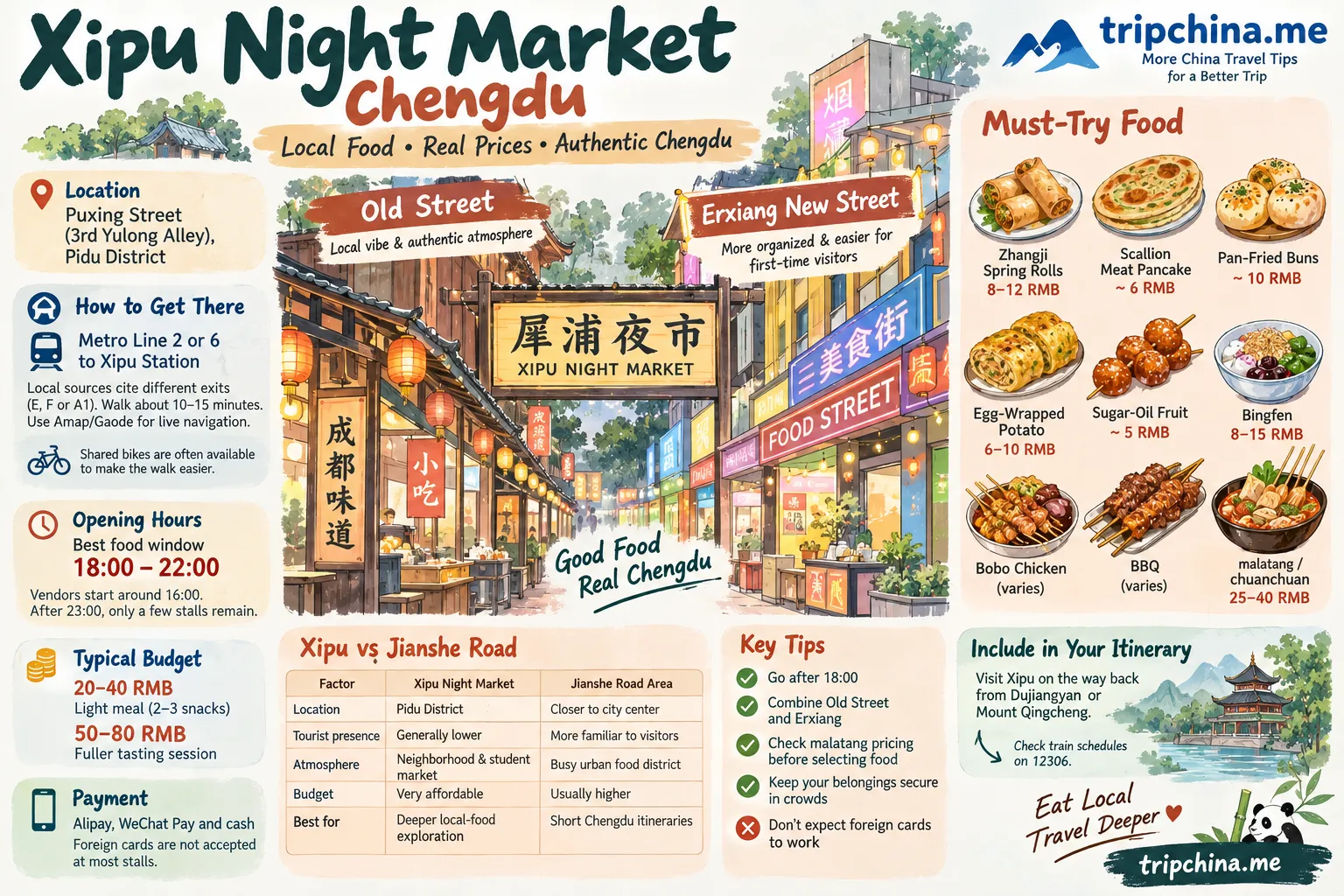
| Location | Puxing Street (3rd Yulong Alley), Pidu District |
| Best food window | Roughly 18:00–22:00 |
| Typical budget | 20–40 RMB for a light meal of roughly 2–3 snacks; 50–80 RMB for a fuller tasting |
| Getting there | Metro Line 2 or 6 to Xipu Station; local sources cite different exits, so use live navigation for the final walk |
| Visit duration | About 1.5–3 hours |
| Entry fee | Free |
| Best section for food | New Street / Erxiang for easier browsing and a more managed environment |
| Best section for atmosphere | Old Street |
| Payment | Alipay, WeChat Pay and cash; do not rely on foreign cards |
| Main practical concern | Dense crowds — keep phones and wallets secured |
| Best time to go | Weekday evening, ideally around 18:00–19:00 |
If you have only one or two days in Chengdu, Xipu may not be the best use of your time. The journey from central Chengdu can easily consume a meaningful part of your evening.
Save this table before you go — Xipu is much easier once you know what to eat, which section to explore first and when to head back to the metro.
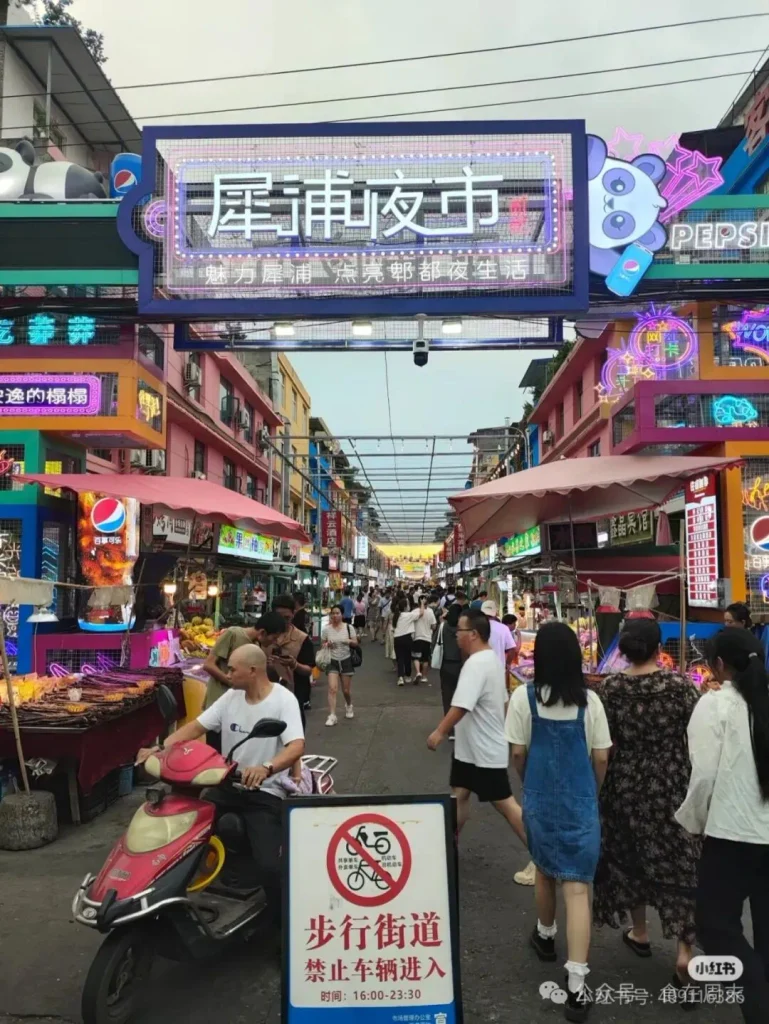
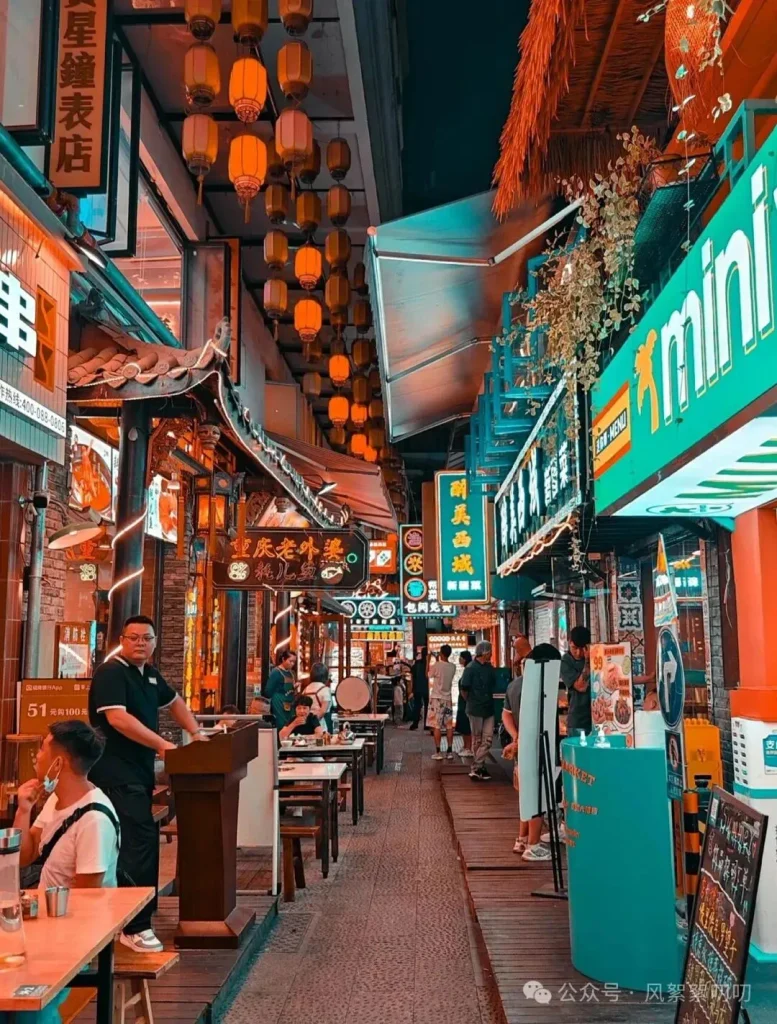
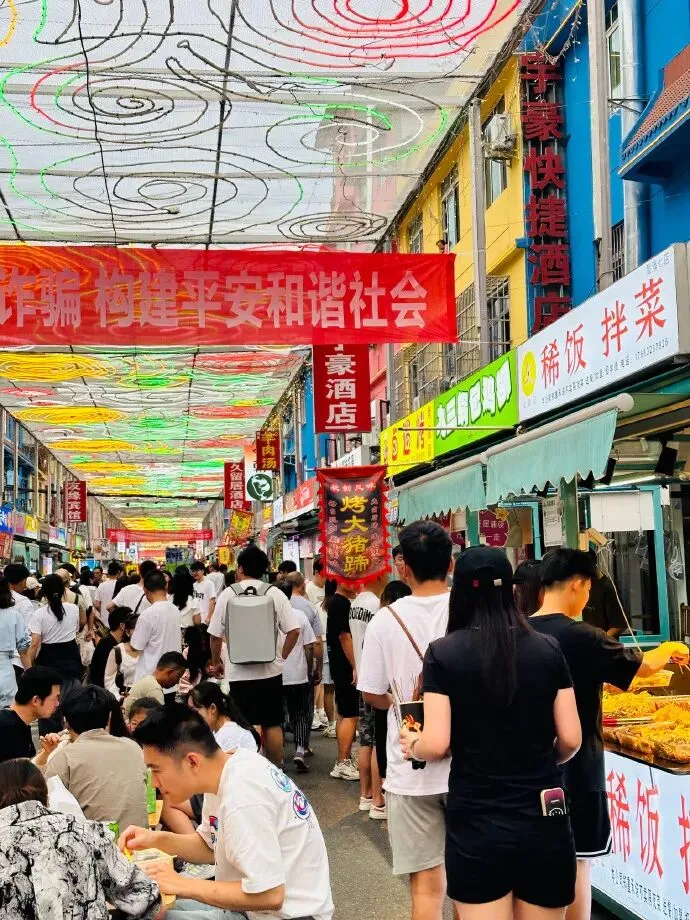
Xipu Night Market is at Puxing Street (3rd Yulong Alley) in Xipu Subdistrict, Pidu District, northwest of central Chengdu — the location listed by Chengdu's official tourism information.
The night market has existed for more than 20 years and developed around a large student and residential population. Local media have long described Xipu as one of the area's classic places for inexpensive food, with its university-town setting playing a major role in the market's identity.
It is an open street environment rather than a gated attraction. There is no admission fee and no formal entrance procedure.
That matters because Xipu does not feel like a tourist attraction pretending to be a market. People are here primarily to eat.
Do not plan your visit around a single published opening-hours listing.
As of September 2026, published hours for Xipu vary between map listings, older travel sources and individual businesses. Stall schedules also vary.
For travelers, the more useful schedule is:
| Time | What to Expect |
|---|---|
| Before 16:00 | Too early for a proper night-market visit |
| 16:00–18:00 | Vendors begin opening; relatively quiet |
| 18:00–22:00 | Most dependable food window |
| 19:30–22:00 | Busiest atmosphere and densest crowds |
| After 22:00 | Food choices begin thinning out |
| After 23:00 | Do not rely on finding a substantial selection of food stalls |
A few BBQ, drink or late-night vendors may continue later, especially on busy nights, but midnight opening is too inconsistent to build a travel plan around.
For a first visit, I would aim for around 18:30–19:00. You get the market close to full operation without immediately walking into the heaviest crowd.
Weekdays are generally easier than Friday and weekend evenings.
Take Chengdu Metro Line 2 or Line 6 to Xipu Station.
Local sources currently cite different recommended exits — including E, F and A1 — and walking estimates vary from roughly 10 to 15 minutes or more depending on the exact part of the market you are heading toward.
For that reason, I would not choose an exit based on an old travel article alone. Enter “犀浦夜市” or “浦兴街玉龙三巷” into Amap/Gaode and follow the live pedestrian route as you approach Xipu Station. Shared bikes are also commonly available around urban metro areas, but availability should be checked on arrival rather than assumed.
For metro tickets, payment and navigation basics, see the Chengdu Metro Guide for Foreign Visitors.
If you have not yet set up reliable navigation in China, read the Best Navigation Apps for Foreign Tourists in China.
Local buses also serve the Xipu market area and can reduce the amount of walking required from the metro.
Routes and stops change more frequently than metro services, so check the live route in Amap/Gaode on the day of travel rather than relying on a fixed bus number from an older guide. For most first-time foreign visitors, the metro plus live walking or bus navigation is simpler than memorizing a local bus route in advance.
From central Chengdu, a taxi or ride-hailing trip commonly takes around 30–40 minutes when traffic is reasonable, although rush-hour conditions can make it much slower.
Late at night, ride-hailing is usually easier than searching for a street taxi around Xipu.
If you have never used Chinese ride-hailing before, set it up in advance with the DiDi Guide for Foreign Visitors to China.
Do not wait until you reach the platform to think about your return.
Late-evening departures toward central Chengdu are generally around the 23:00 period, but the exact last train depends on the line, direction and current timetable. Check the official Chengdu Metro timetable on the day you visit, particularly if you plan to stay after 22:00.
If you expect to leave after about 22:30, save your hotel or return destination in DiDi before entering the market. If you miss the final metro, DiDi or another legitimate ride-hailing platform is the most practical fallback.
Yes — and this is one of the smartest ways to fit Xipu into a Chengdu itinerary.
Xipu Railway Station connects directly with Chengdu's metro network and sits on the Chengdu–Dujiangyan intercity rail corridor. Many services on this corridor stop at Xipu, but stopping patterns vary by train.
If your specific return train stops at Xipu, get off there in the late afternoon or early evening, continue to the night market for dinner, and then take the metro back toward central Chengdu.
Always check whether your specific train stops at Xipu on the official 12306 platform before relying on this plan.
For a full day-trip strategy, see the Dujiangyan Full Day Trip Guide or Mount Qingcheng Itinerary Guide.
Allow 1.5–3 hours.
A focused food visit can be done in roughly 90 minutes. If you want to compare Old Street and Erxiang, browse non-food stalls, photograph the streets and sample several dishes, two to three hours feels more relaxed.
Remember that the journey matters too. From central Chengdu, Xipu is not a quick detour.
That is why I recommend it most strongly for travelers spending at least three days in Chengdu.
The attraction is not one famous dish. It is the ability to try many inexpensive Sichuan snacks in one evening.
Prices below reflect observed or commonly listed ranges and can change by stall, portion and ingredient.
Zhangji Spring Rolls — roughly 8–12 RMB per portion.
This is a long-standing Xipu vendor frequently associated with the area's old food scene. The thin wrappers, vegetables and sweet-spicy seasoning make it an easy first stop.
Wusheng Scallion Meat Pancake — around 6 RMB.
Fresh, crisp outside and layered inside. It is filling enough that I would share one if you plan to sample several stalls.
Pan-Fried Buns — around 10 RMB for a small portion.
Look for freshly cooked batches with a crisp bottom rather than buns that have been sitting under a heat lamp.
Egg-Wrapped Potato — roughly 6–10 RMB.
Mashed or chopped potato wrapped with egg and seasoned to order. Ask for less chili if this is your first serious Sichuan street-food evening.
Sugar-Oil Fruit — around 5 RMB per skewer.
This is one of my favorite old-Chengdu snacks here: glutinous rice balls fried until golden and coated in caramelized sugar.
The combination of crisp outside and chewy inside is simple, cheap and much more memorable than many of the trend-driven desserts at tourist streets.
Self-Serve Bingfen — roughly 8–15 RMB.
Bingfen is a cold jelly dessert and one of the easiest ways to cool down after spicy food. Some stalls offer large topping selections.
Bobo Chicken — prices vary by skewer.
Choose vegetables and meats from the display and pay according to the stall's pricing system. Confirm how skewers are counted before filling your bowl.
BBQ — usually priced per skewer or plate.
Pork belly, chicken gizzard, tofu, eggplant and vegetables are common choices. Busy stalls with rapid turnover are usually the most practical option.
malatang / chuanchuan — roughly 25–40 RMB for a modest meal.
This is where you should pay the most attention to pricing. Ask how skewers or ingredients are charged before filling your basket.
You will still find options.
Egg cakes (蛋烘糕), bingfen (冰粉), sugar-oil fruit (糖油果子), soy milk, fruit drinks and some guokui or pancake-style snacks can be relatively mild.
Two phrases are worth saving:
不要辣 — bù yào là — not spicy
微辣 — wēi là — mildly spicy
Remember that Chengdu's idea of “mild” may still feel hot if you rarely eat chili.
Xipu is still inexpensive by major-city travel standards, but “30 RMB feeds everyone” is too simplistic.
A better budget is:
| Budget | What It Realistically Covers |
|---|---|
| 20–40 RMB | Light meal of roughly 2–3 inexpensive snacks |
| 50–80 RMB | Proper tasting session across several stalls |
| 100–150 RMB for two | Comfortable shared tasting with multiple dishes and drinks |
Your spending rises quickly if you order seafood, BBQ plates, alcohol or repeatedly buy drinks and desserts. Individual vendors set their own prices, so treat these ranges as planning estimates rather than fixed market-wide prices.
The advantage of Xipu is not that every item is extraordinarily cheap. It is that you can still build a varied meal without the tourist-area markup found in more central locations.
Alipay and WeChat Pay are the most practical payment methods.
Foreign Visa or Mastercard cards, Apple Pay and Google Pay should not be treated as dependable ways to pay individual street vendors. Carrying 50–100 RMB in cash gives you a useful backup if a stall's QR payment does not work for you.
Before visiting, set up either How to Set Up Alipay for Travel in China or WeChat Pay Setup for Foreign Travelers.
For a broader explanation of cards, cash and mobile payments, see the Complete China Mobile Payment Guide for Foreigners.
Xipu effectively offers two different night-market experiences.
| Feature | Old Street | Erxiang / New Street |
|---|---|---|
| Atmosphere | Dense and old-school | More organized and designed |
| Food style | Long-standing neighborhood vendors | Large managed mix of vendors |
| Cleanliness | Varies significantly | Generally easier to navigate and more managed |
| Photography | Better for everyday street atmosphere | Better for lights and designed streetscape |
| First-time foreigners | More adventurous | Easier starting point |
| Best use | Wander and explore | Eat first |
The older section is the reason Xipu has character.
It is denser, less polished and more unpredictable than a newly built food street. You will find food mixed with small shops and everyday neighborhood commerce.
Do not expect a curated “ancient street” experience. This is closer to a functioning neighborhood market.
Some of my favorite moments at Xipu come from this section precisely because it has not been polished into a sightseeing product.
The newer Xipu Night Market Erxiang development opened beside the older market in 2023.
According to local media reports published around its opening, the development brought together about 144 food businesses and more than 180 food choices. These figures describe the project at that time rather than a guaranteed current stall count.
Erxiang is more organized and visually designed than Old Street, with managed stalls and a more consistent streetscape.
Based on my visits, it also feels easier to navigate when you are unfamiliar with Chinese street markets.
For visitors with sensitive stomachs, I would start here and choose busy, high-turnover stalls where food preparation is visible. That is practical risk management rather than a guarantee that one section is inherently safer than another.
My preferred order is simple: eat in Erxiang first, then wander the older streets for atmosphere.
| Mistake | Better Approach |
|---|---|
| Arriving too early | Go after roughly 18:00 |
| Going only to Old Street | Combine Old Street with Erxiang |
| Assuming foreign cards will work | Prepare Alipay/WeChat Pay and backup cash |
| Filling a malatang basket before confirming pricing rules | Verify skewer/weight pricing before selecting food |
| Carrying your phone loosely in dense crowds | Use a zipped front pocket or secure bag |
| Spending your whole evening on carnival games | Treat them as entertainment, not a way to win valuable prizes |
| Expecting tourist-level English | Save Chinese dish names and use translation tools |
Xipu has no official tourism warning identifying the night market itself as a special danger zone. However, local residents have previously raised theft concerns involving the broader Xipu area, and local authorities responded with increased patrol and public-security measures.
For travelers, the practical conclusion is simple: crowded stall zones deserve extra attention. Never keep a phone or wallet in a back pocket. During peak hours, keep backpacks zipped and front-facing, especially near entrances and popular food stalls.
If you are carrying valuables you do not need for the evening, leave them at your hotel. Most purchases can be made by mobile payment, so 50–100 RMB in backup cash is usually enough.
If you plan to stay late, check your metro or ride-hailing route before the crowds thin out rather than working it out on the street afterward.
If your belongings are stolen, contact the local police or ask nearby market staff or security personnel to help you reach the police.
Never assume every skewer has the same price.
Some shops separate meat, vegetables and premium ingredients; others charge by weight or use different colored sticks.
Ask the price system before choosing food. Watch what goes into your basket or pot and check the total before paying.
This is a useful habit at street-food markets anywhere in China, not just Xipu.
Only if you consider the money an entertainment expense.
Ring tosses, spinning wheels and similar games can be fun for a few minutes, but do not assume the displayed prize is easy to win.
I would spend the same 20 RMB on another round of food.
I would avoid making an impulse pet purchase at a night market.
A traveler cannot easily verify an animal's health, vaccination history, breeding background or seller's after-sales responsibility in this setting.
Enjoy the food and leave major purchases for businesses where those details can be properly checked.
Hygiene varies by stall.
Based on personal observation, the managed Erxiang section generally feels more orderly than the older, denser streets. Conditions can still change from one vendor to the next.
If you have a sensitive stomach, I use three simple filters: choose stalls with high turnover, choose food cooked in front of you, and avoid ingredients that have been sitting exposed for long periods.
You do not need to be afraid of street food. You do need to choose intelligently.
Xipu makes the most sense for:
It is less suitable for travelers with only one or two days in Chengdu, families with very young children who dislike dense crowds, visitors with strict dietary restrictions that are difficult to communicate, or anyone who values convenience more than local atmosphere.
If Xipu sounds too far from your itinerary, compare it with other options in the Best Chengdu Local Night Markets Comparison Guide.
The biggest difference is not the food. It is who the market is for.
Students and neighborhood residents form much of Xipu's everyday customer base. People are buying dinner, meeting friends and picking up snacks rather than moving through a sightseeing checklist.
That creates a different pricing pressure and a different atmosphere.
The older streets still feel rough around the edges. Erxiang shows the other side of modern Chengdu night-market culture: the same appetite for street food, but reorganized into a managed commercial space.
One memory sticks with me: watching sugar-oil fruit turn golden in bubbling oil before being coated in caramelized sugar.
It cost almost nothing. Nobody was performing it for tourists. It was simply another evening snack.
That ordinary quality is Xipu's real appeal.
These two experiences solve different problems.
| Factor | Xipu Night Market | Jianshe Road Area |
|---|---|---|
| Location | Pidu District | Much closer to central Chengdu |
| Convenience | Lower | Higher |
| Tourist presence | Generally lower | More familiar to visitors |
| Atmosphere | Neighborhood/student market | Busy urban food district |
| Budget | Very affordable | Usually somewhat higher |
| Best for | Deeper local-food exploration | Short Chengdu itineraries |
| Time commitment | Significant | Easier to fit into sightseeing |
If you have only one or two days, convenience matters. A central food area gives you more sightseeing time.
If you have three or more days and specifically want a less polished neighborhood food experience, Xipu becomes much more interesting.
I would not cross the city solely because somebody told me Xipu is “better.” I would go because I specifically wanted the kind of local evening Xipu offers.
This article is part of the Chengdu Travel Guide Hub.
A small backpack is manageable, but keep it zipped and move it to your front in dense crowds. Large suitcases are awkward on narrow, busy food streets.
Do not assume dedicated luggage storage is available inside the night market. If you arrive from Dujiangyan or Qingcheng Mountain with a suitcase, check current luggage-storage options around Xipu Railway Station before heading to the market.
Light rain does not necessarily end the evening, but Xipu is primarily an outdoor street-food environment. Some vendors may reduce or pause service when conditions worsen, and the older market lanes offer limited weather protection.
In heavy rain, Xipu is not a good night-market choice. Check the forecast before making the trip from central Chengdu.
Xipu is not built primarily around foreign tourists, so the main issues are more practical than classic tourist scams.
Pay attention to how malatang and chuanchuan ingredients are priced before ordering, and treat carnival games as paid entertainment rather than an easy way to win prizes. Confirm prices whenever they are not clearly displayed.
Do not assume toilets will be conveniently available throughout the older market lanes. Restroom access is generally easier around newer commercial areas such as Erxiang and the surrounding Xipu commercial district.
If restroom access matters to you, use facilities near the metro or in nearby commercial buildings before wandering deep into Old Street.
Yes. Xipu is an open street market rather than a ticketed attraction, so bringing bottled water or another non-alcoholic drink is generally not a problem.
Carrying water is particularly useful if you plan to sample several spicy Sichuan dishes.
Xipu is not the Chengdu night market I would recommend to everyone.
If you have only one or two days, stay closer to central Chengdu and spend your limited time on the city's major sights and easier food areas.
But if you have three or more days, enjoy street food and want to see a neighborhood where the evening crowd is still shaped heavily by students and residents, Xipu deserves consideration.
Go around 18:30, start with Erxiang, wander the older streets afterward, keep your valuables secure, check your return transport before staying late, and do not try to eat everything at the first stall.
Xipu works best when you treat it as dinner in a real neighborhood rather than another attraction to complete.
Pidu District People's Government — Xipu Night Market
The Paper — Xipu / Chengdu Night Market Coverage
Updated September 2026. Xipu Night Market location, transport routes and Erxiang development details were cross-referenced against Pidu District Government releases, GoChengdu tourism information and local mainstream Chinese media. Food pricing, hygiene and safety advice combine published local information with TripChina on-site field observations. Published opening hours and recommended metro exits vary between sources, so travelers should use live navigation. Metro and intercity train timetables should be verified through Chengdu Metro and 12306 on the travel day.
TripChina.me creates practical China travel guides shaped by real local experience, helping independent travelers navigate transport, payments, food, neighborhoods, and the cultural details that make traveling in China easier and more meaningful. Find the guide for your destination at tripchina.me.