Our Location:
No. 99, Jiazi Road, Chengdu

 authorChris Lee
Most disappointed visitors make one mistake: they choose the wrong side of the mountain.
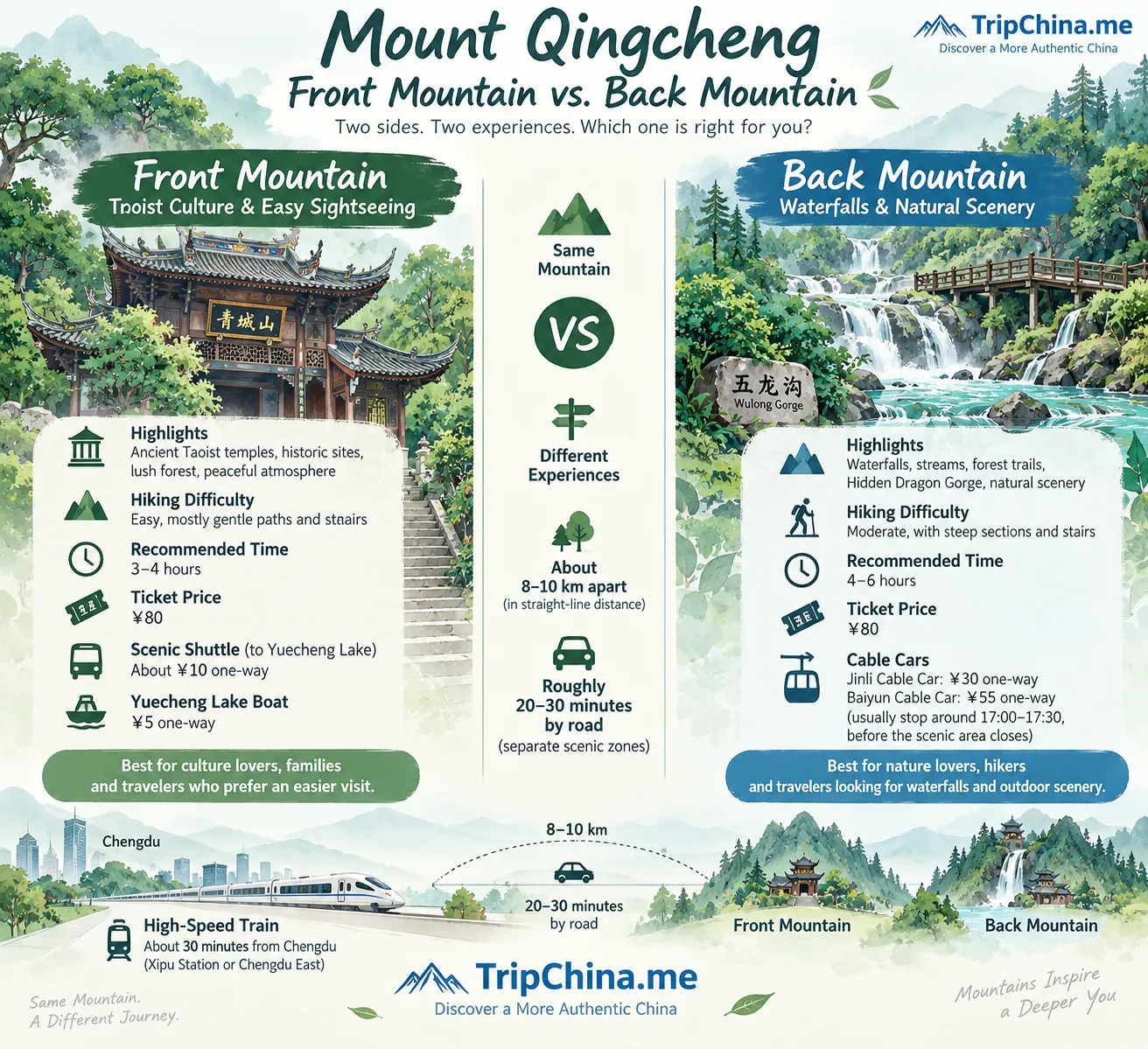
Front Mountain is the classic experience—Taoist temples, forest paths, ancient trees and cable-car access. Back Mountain is a much wilder day of waterfalls, gorges, slippery stone trails and serious hiking. This guide helps you choose the right one, then shows you exactly how to visit it.
If this is your first visit, choose Front Mountain unless hiking is the main reason you are coming.
| Front Mountain | Back Mountain | |
|---|---|---|
| Best for | First visits, Taoist culture, families, photography | Hiking, waterfalls, nature |
| Adult ticket | ¥80 | Around ¥20 |
| Typical time | 3–5 hours | 5–8 hours |
| Difficulty | Easy to moderate | Moderate to strenuous |
| Cable cars | Yes | Jinli + Baiyun |
| Main experience | Temples, forest, Taoist heritage | Gorges, waterfalls, plank paths |
| Good for bad knees? | Possible with cable car | Generally no |
| Rainy day? | More manageable | Avoid if trails are wet |
| English signage | Better | Limited |
| Transfer note | Separate scenic zone | Roughly 20–30 min by road; separate scenic zones |
| Best choice if unsure | Yes | No |
As of September 2026, the government-controlled admission price for Front Mountain remains ¥80. Transport services, cable-car operations and opening arrangements can change seasonally, so confirm them through the scenic area’s official channels shortly before visiting.
My simple rule is this: if the words “Taoist mountain” brought you here, go to Front Mountain. If the words “waterfall hike” brought you here, go to Back Mountain.
If you are comparing it with another major Sichuan mountain, the Mount Emei hiking & logistics guide explains why Emei is a much bigger logistical and hiking commitment.
Front Mountain and Back Mountain are not simply two entrances to the same walking route. Treat them as separate experiences with different entrances, transport arrangements and physical demands.
The two scenic areas are about 8–10 km apart in straight-line distance, but the practical road transfer is longer (roughly 20–30 minutes by vehicle).
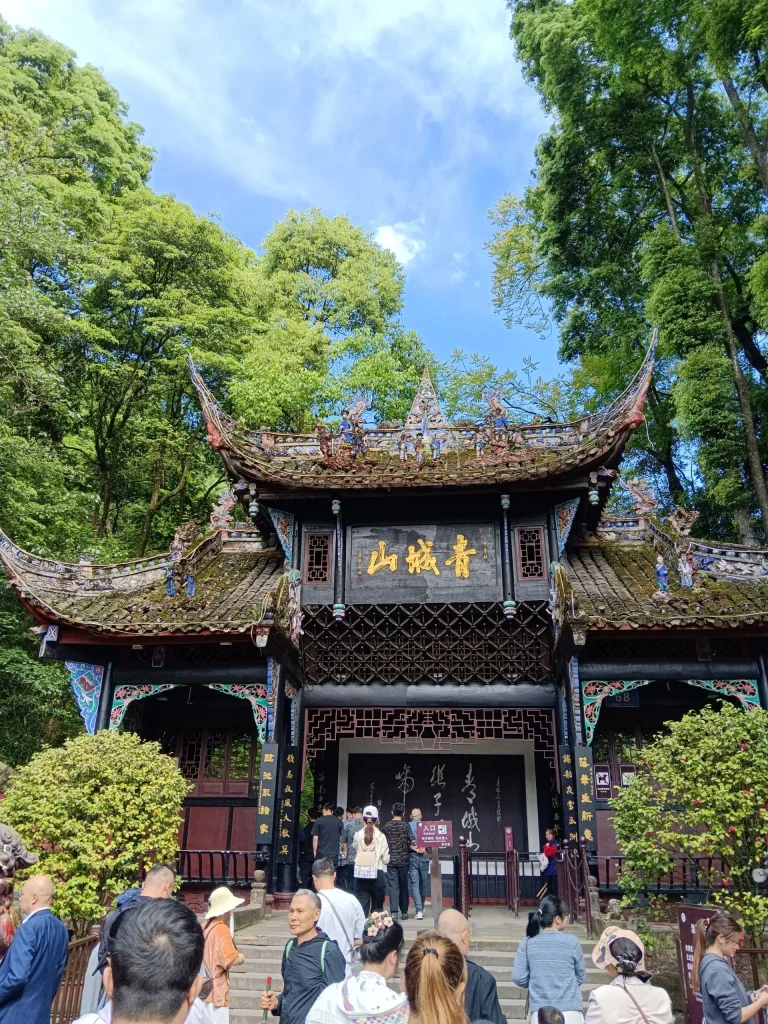
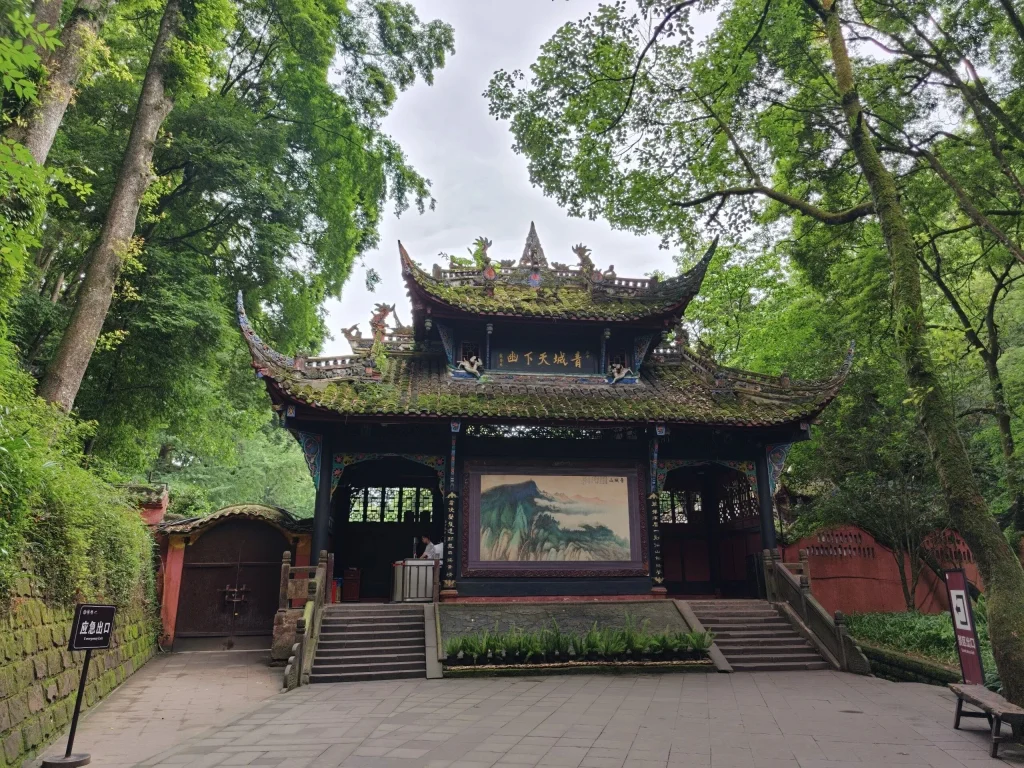
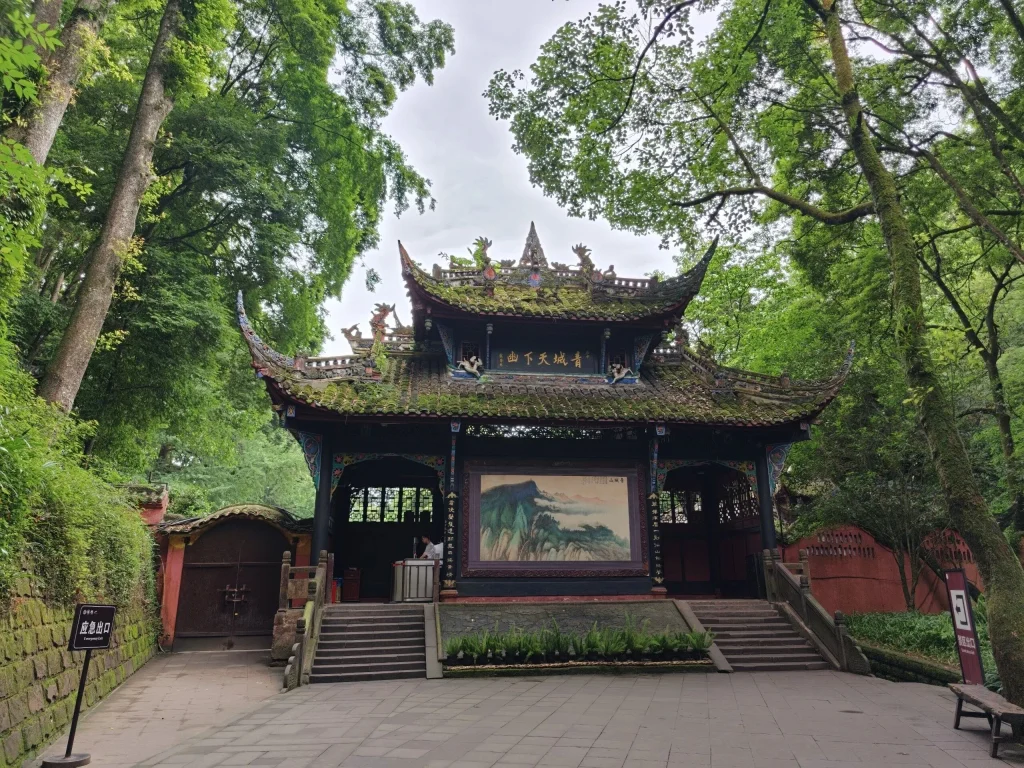
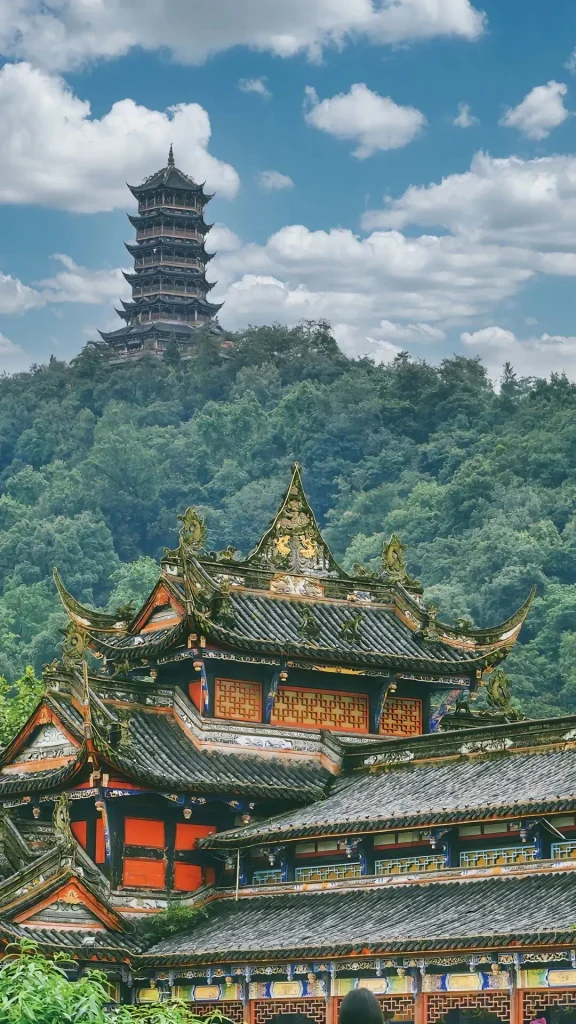
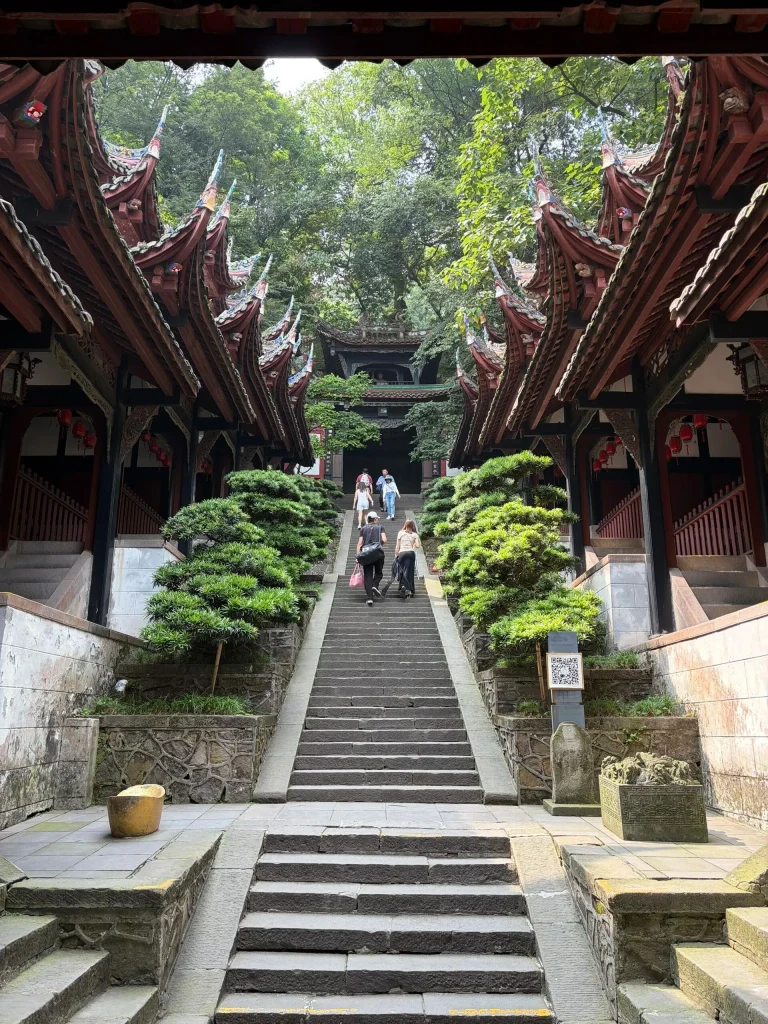
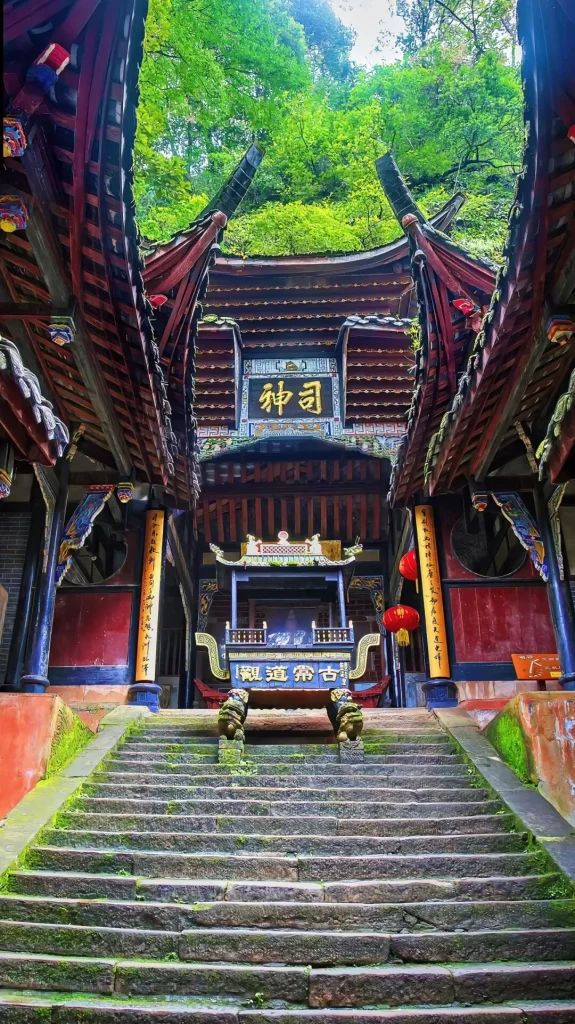
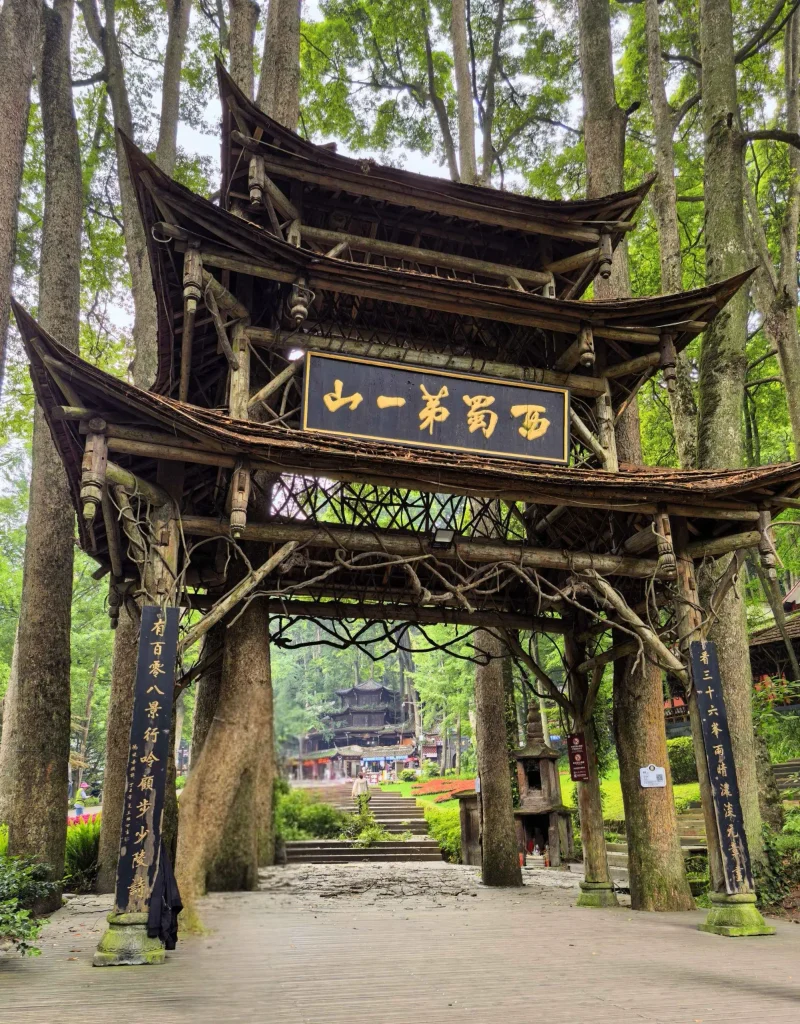
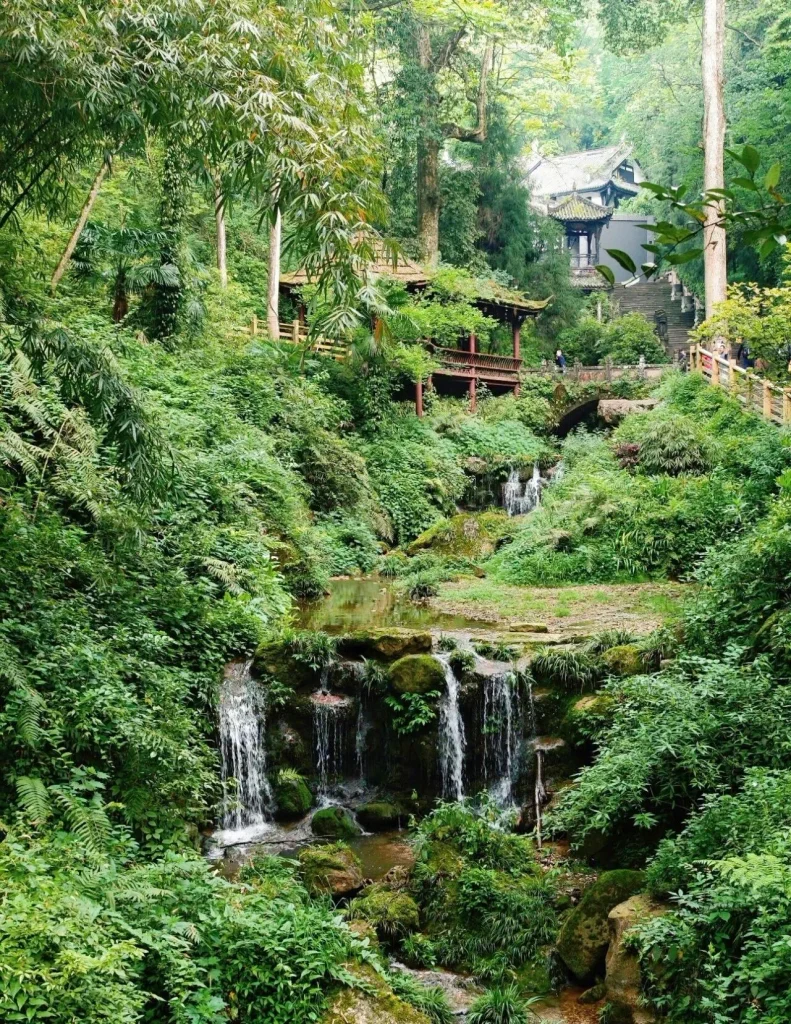
Front Mountain is the cultural core. You come for Taoist temples, stone paths beneath dense forest, old courtyards, incense, mist and the feeling behind the traditional description of Qingcheng as one of China’s most tranquil mountains.
Back Mountain is about water and terrain. Trails follow streams through deep vegetation, pass waterfalls and cliffside sections, and climb far more aggressively. It feels less polished and considerably more physical.
That distinction matters more than any “must-see” list.
As of September 2026, use these figures for planning. Cable-car and boat operations can still change because of weather, maintenance or temporary scenic-area adjustments.
| Item | Planning Price | What to Know |
|---|---|---|
| Front Mountain admission | ¥80 | Government-regulated admission |
| Front Mountain scenic shuttle | About ¥10 one-way | Main gate toward Yuecheng Lake area |
| Yuecheng Lake ferry | ¥5 one-way | Optional |
| Front Mountain cable car | ¥35 one-way / ¥60 round-trip | Useful for the easy route |
| Back Mountain admission | About ¥20 | Confirm before travel |
| Jinli Cable Car | About ¥30 one-way / ¥55 round-trip | Back Mountain |
| Baiyun Cable Car | About ¥45 one-way / ¥60 round-trip | Verify current fare at the gate |
| Cuiying Lake boat | A few RMB | Small local crossing |
| Xipu → Qingchengshan train | Usually around ¥10 second class | Check your exact train in 12306 |
The Front Mountain ¥80 admission price is set under Sichuan’s government pricing framework. The Front Mountain cable car is commonly listed at ¥35 one-way / ¥60 round-trip.
For Baiyun Cable Car, ¥45 one-way and ¥60 round-trip are useful current planning figures, but the round-trip fare is less consistently published than the one-way price. Verify the displayed fare before purchasing.
Sichuan’s government-priced scenic-area rules provide concessions for children, students and seniors. The official provincial rules apply according to age/status and valid identification rather than providing a separate published “foreign tourist” price category.
| Visitor | Published Concession | What Foreign Visitors Should Bring |
|---|---|---|
| Children aged 6 or under, or 1.2 m or shorter | Free admission | Passport / valid ID |
| Ages over 6 through 18 | Half-price | Passport / valid ID |
| Full-time undergraduate students and below | Half-price | Passport + valid student documentation |
| Age 65+ | Free under provincial government-priced attraction rules | Passport showing date of birth |
| Under 65 but qualifying as a senior under Sichuan rules | Free outside national statutory holidays; half-price or free during statutory holidays | Ask the staffed ticket window to verify eligibility |
For Front Mountain, a half-price admission ticket is ¥40 where the standard ¥80 ticket and the relevant concession apply. For a ¥20 Back Mountain ticket, the corresponding half-price amount is ¥10 where that concession is accepted.
Foreign-passport tip: Bring your original passport and any supporting student documentation. If the online system does not recognize your document or concession automatically, use the staffed ticket window rather than assuming you are ineligible.
For passport-specific booking problems at Chengdu-area attractions, see the Chengdu attraction ticket booking guide for foreign passport holders.
Important: scenic-area tickets are for a single entry. Once you leave through the exit, do not assume the same ticket can be used to enter again.
Use the following as the 2026 planning windows, but check the official Qingchengshan–Dujiangyan notice before your visit. Weather, maintenance and seasonal operating adjustments can change individual facilities.
| Scenic Area | Season | Opening Hours | Last Ticket / Entry Planning Point |
|---|---|---|---|
| Front Mountain | Peak season | 08:00–17:30 | Around 16:30–17:00; verify current notice |
| Front Mountain | Winter / off-season | Around 08:30–17:00 | Around 16:30 |
| Back Mountain | Peak season | Around 08:00–18:00 | Around 16:30–17:00 |
| Back Mountain | Off-season | Around 08:00–17:30 | Around 16:30 |
Do not treat the gate-closing time as your arrival target. Cable cars, ferries and individual facilities may stop operating earlier, and bad weather can cause temporary suspension.
For Front Mountain, arriving around opening also gives you a much better experience. Back Mountain requires enough daylight to finish your route safely.
Public transportation is straightforward and usually makes more sense than taking a taxi all the way from central Chengdu.
Take Chengdu Metro Line 2 or Line 6 to Xipu Station.
From central Chengdu, allow roughly 40–50 minutes depending on your starting point and transfer.
The Chengdu Metro guide for visitors explains ticketing, payment and navigation if this is your first time using the system.
From Xipu, take an intercity C-train to Qingchengshan Station.
The ride is typically around 23–30 minutes, with second-class fares commonly around ¥10.
Book your outbound and return tickets at the same time. Weekend and Chinese public-holiday services can sell out, and discovering that your preferred return train is full after a six-hour hike is not a pleasant way to end the day.
Use the official 12306 system. Foreign travelers can book using passport details.
Our 12306 train ticket booking tutorial explains the booking process, while the China train travel guide for overseas tourists covers passport checks and station procedures.
Alternative from Chengdu East: Some services allow travelers to start farther inside Chengdu rather than going first to Xipu. Where a suitable Chengdu East–Qingchengshan service is available, expect roughly 50–60 minutes and approximately ¥19–27 for second class, depending on the train. Check 12306 for your actual travel date before deciding which departure station is easier.
If your hotel is near Chunxi Road, Taikoo Li or Chengdu East Station itself, departing from Chengdu East may save you the cross-city metro transfer to Xipu. Compare total door-to-door time, not just train duration.
From Qingchengshan Station, use official public or scenic-area transport toward the entrance you actually want.
For Front Mountain, local buses, scenic transport and taxis operate toward the main visitor area.
For Back Mountain, continue toward Tai’an Ancient Town (泰安古镇), the practical base for the Back Mountain trail system.
Do not simply tell a driver “Qingchengshan” and assume you will end up where you intended. Show the Chinese destination:
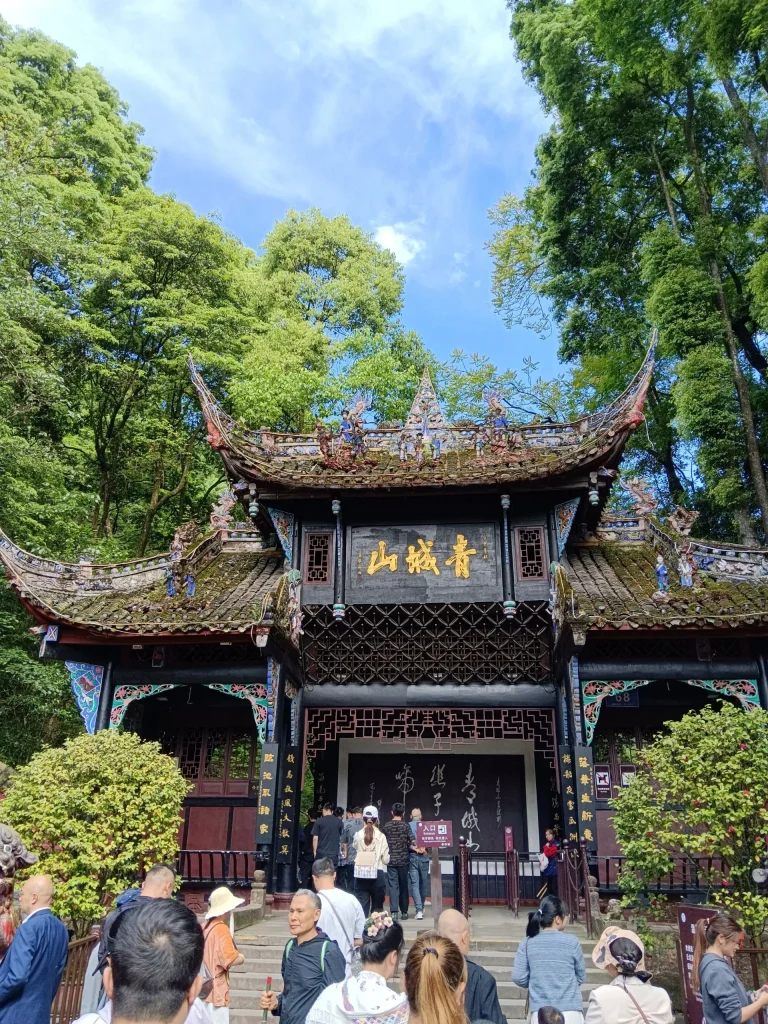
Front Mountain: 青城山前山
Back Mountain: 青城后山
Tai’an Ancient Town: 泰安古镇
From Chengdu, follow the expressway toward Dujiangyan/Qingchengshan and then local signs for your chosen scenic area. Driving normally takes around 1–1.5 hours, but holiday congestion can add substantial time.
Paid parking around the scenic area is typically inexpensive; ¥10–20 per day is a reasonable planning range. During major holidays, traffic controls and overflow parking arrangements may change, so follow current local traffic guidance rather than relying on an old parking location.
Remember that Front and Back Mountain have separate access routes. Put the exact entrance—not simply “Qingchengshan”—into your navigation app.
Technically, yes. Practically, do not take a suitcase onto either mountain.
If this is a day trip from Chengdu, leave your large luggage at your Chengdu hotel and travel with a small backpack. If you are staying overnight around Tai’an Ancient Town, ask your guesthouse in advance whether it can hold luggage before check-in or after check-out.
Do not rely on an unofficial station-side luggage shop without checking its opening hours and collection procedure first.
Choosing a convenient Chengdu base also makes early departures much easier; compare the best accommodation areas in Chengdu.
Front Mountain works because you can adjust the physical effort without sacrificing the main cultural experience.
Main Gate → scenic shuttle → Yuecheng Lake → ferry → cable car → Shangqing Palace → Laojun Pavilion → cable car down
Allow roughly 3–4 hours.
The scenic shuttle toward the Yuecheng Lake area costs about ¥10 one-way. The Yuecheng Lake ferry is about ¥5 one-way, while the cable car is around ¥35 one-way or ¥60 round-trip.
This route removes much of the repetitive climbing while still getting you high onto the mountain. It is the obvious choice if you have young children, limited time or do not want several hours of stairs.
One local mistake worth avoiding: do not automatically walk every paved approach just because it appears on the map. Some connecting sections add time without adding much scenery.
Main Gate → Jianfu Palace → Natural Picture → Tianshi Cave → Shangqing Palace → Laojun Pavilion → descend on foot or by cable car
Allow roughly 4–5 hours.
This is the route I would choose if you want to understand why the mountain matters rather than simply reach its highest point.
Between the temples, the trail narrows into shaded stone paths beneath thick forest. On a quiet morning, this section feels far more distinctive than the summit viewpoint itself.
Main Gate → Natural Picture → Tianshi Cave → Chaoyang Cave → Shangqing Palace → Laojun Pavilion → descend
Allow roughly 5–6 hours depending on pace.
Skip most mechanical transport and walk. The elevation is not extreme, but repeated stone steps add up.
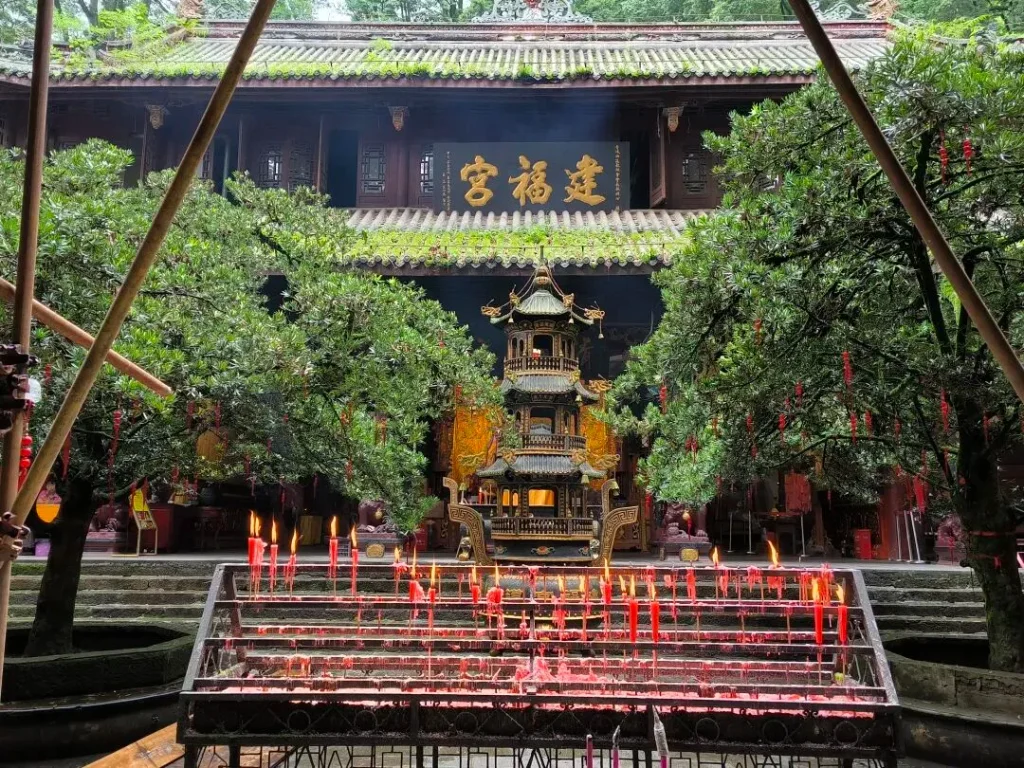
Jianfu Palace (建福宫) sits near the base and makes a natural first cultural stop.
Natural Picture (天然图画) is more about the setting than a major monument: forest, pavilion and the transition into the mountain.
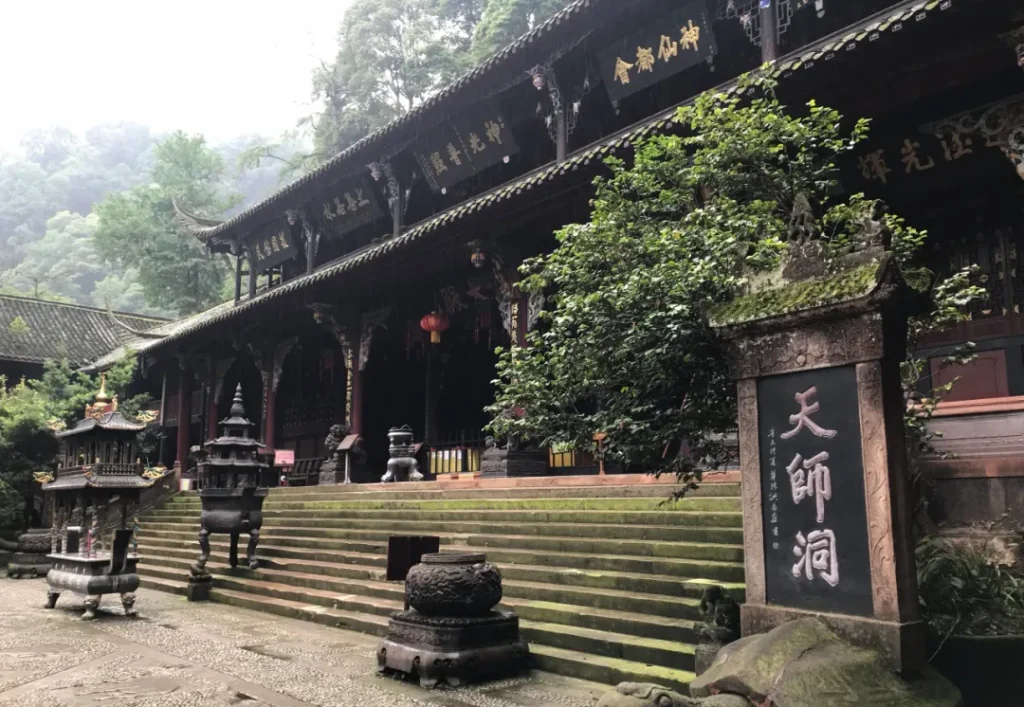
Tianshi Cave (天师洞) is one of the essential stops. The old courtyard, Taoist atmosphere and ancient ginkgo are far more memorable when you arrive before the tour groups.
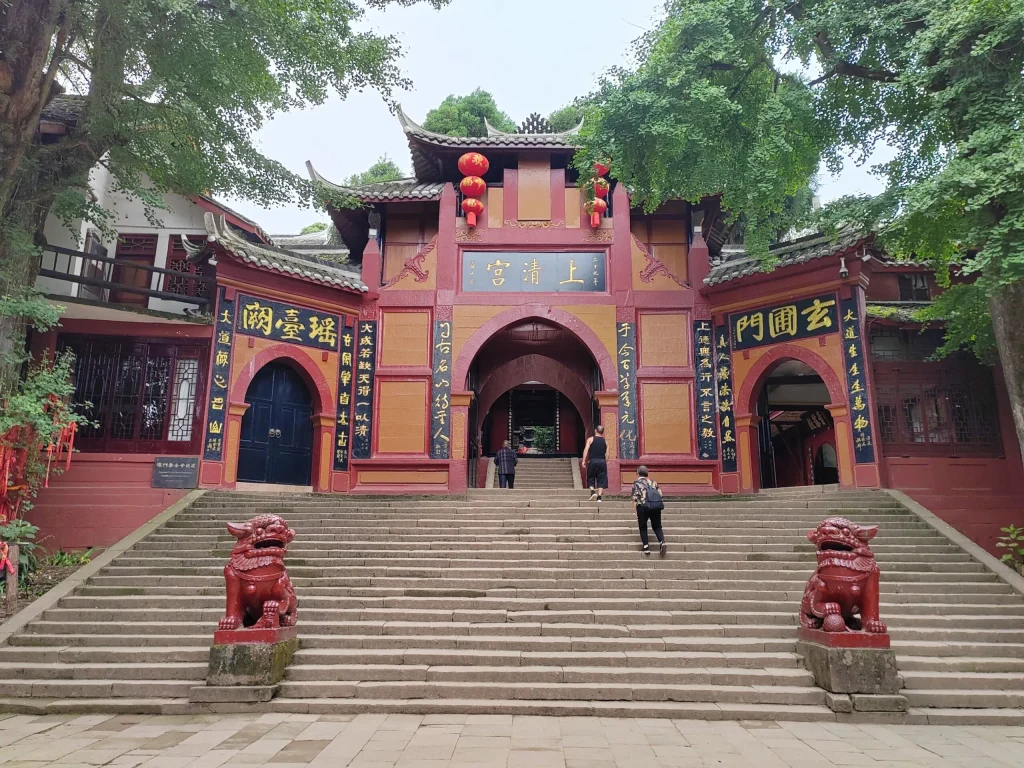
Shangqing Palace (上清宫) sits near the upper mountain and is another place where slowing down matters more than checking a box.
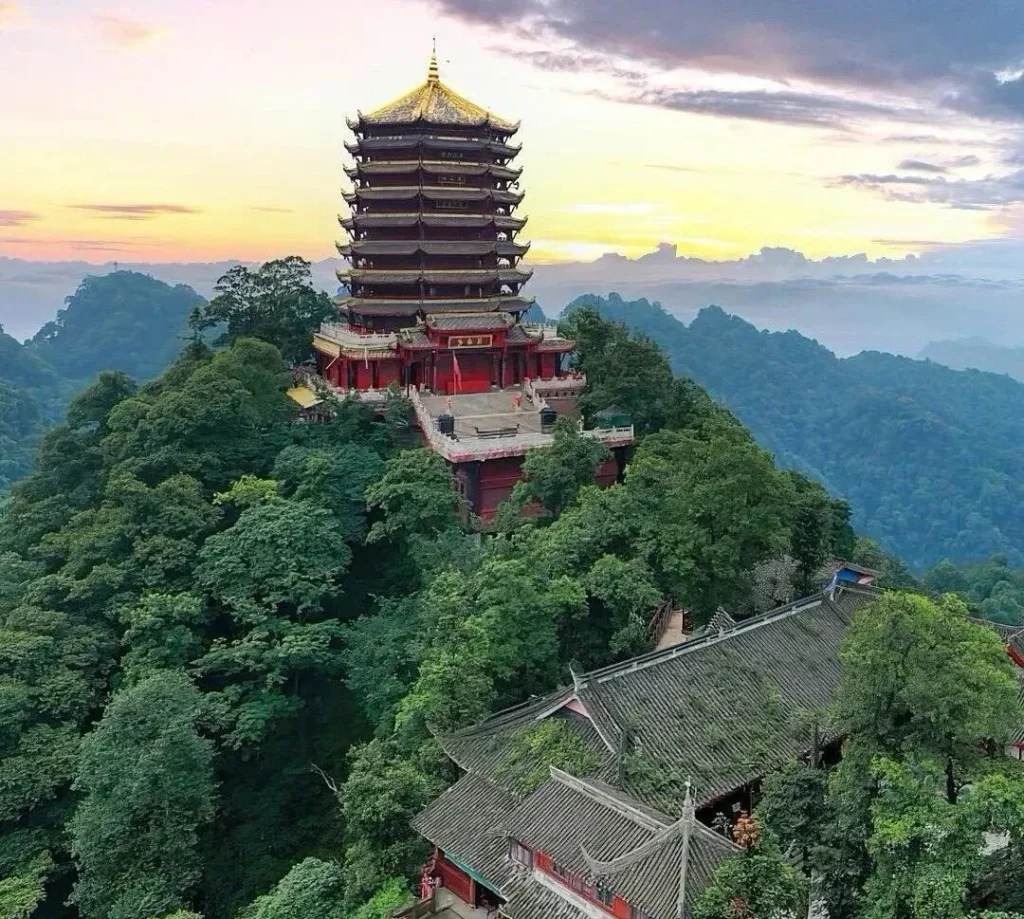
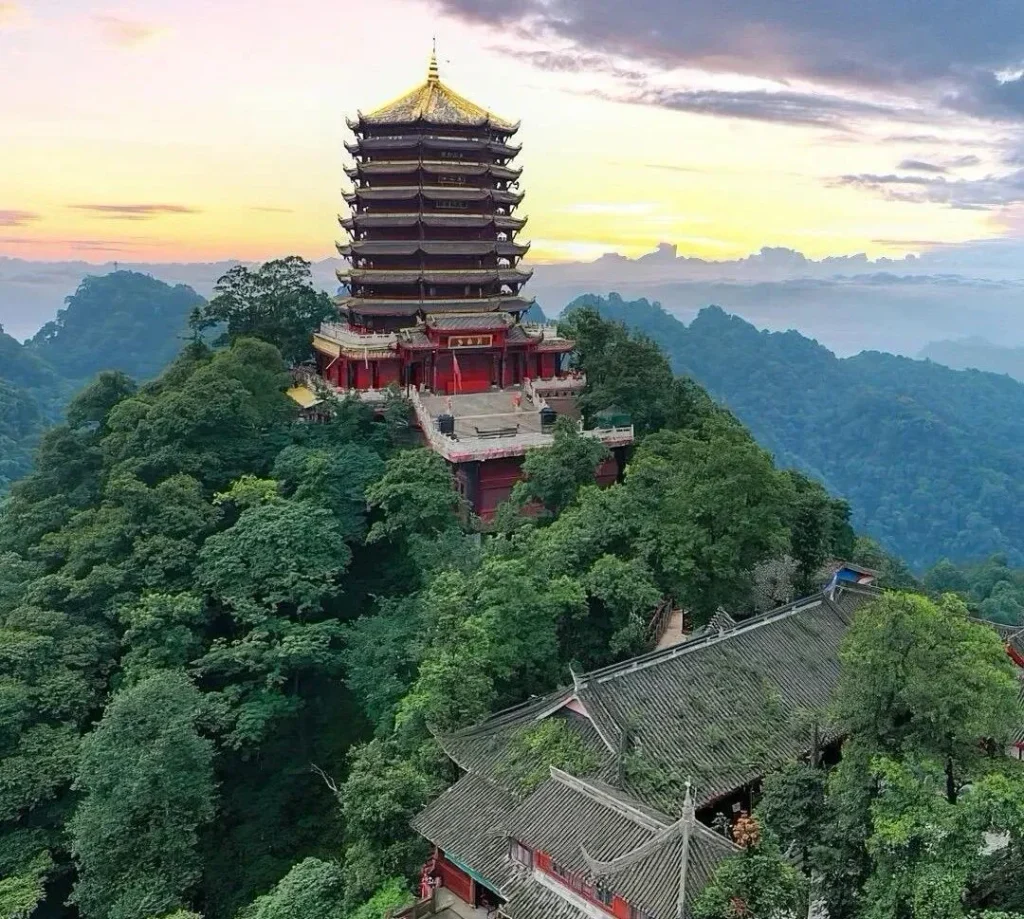
Laojun Pavilion (老君阁) marks the summit area. On a clear day, the wider Chengdu plain opens below you. On a misty day, you may see almost nothing.
That is not necessarily a failure. Mist is part of the experience.
Back Mountain is where route planning matters more. Do not underestimate it because the entrance ticket is cheap.
Tai’an Ancient Town → Wulong Ditch → Hidden Dragon Gorge Plank Walk → Youyi Village → Cuiying Lake → Feiquan Ditch → Tai’an
Allow approximately 5–6 hours.
This is the sweet spot for most hikers. You get waterfalls, narrow gorges, forest, plank-path sections and Cuiying Lake without forcing the full upper-mountain extension.
From Tai’an Ancient Town, allow additional time to reach the actual Wulong Ditch trail section rather than assuming the serious hiking begins the instant you leave town.
Follow the Small Loop but extend upward toward Baiyun Ancient Village and Baiyun Temple before descending.
Allow roughly 6–8 hours.
Do this only if you start early and genuinely enjoy long mountain days. Back Mountain is not difficult because of altitude; it is difficult because of accumulated stairs, wet stone, uneven surfaces and duration.
A practical assisted route is:
Tai’an Ancient Town → Jinli Cable Car up → Wulong Ditch / Youyi Village area → Baiyun Cable Car toward the upper section → descend via Cuiying Lake and Feiquan Ditch → Tai’an
The two cable cars do not magically turn Back Mountain into an accessible sightseeing attraction. You still need to walk stairs and uneven trails between sections.
If your knees are the reason you are considering both cable cars, Front Mountain is probably the better mountain.
Important: Back Mountain cable cars may stop operating before the scenic area itself closes, with the final operating time varying by season, weather and maintenance. If you are relying on a cable car for your descent, check the last operating time at the station before you start climbing. Do not plan your descent around the scenic-area gate-closing time.
Yes—and this is one of the best compromises if you want Back Mountain scenery without committing to a full loop.
Enter from Tai’an and follow Wulong Ditch toward the Hidden Dragon Gorge area. Enjoy the gorge, streams, waterfalls and plank-path scenery.
If you feel tired after the Hidden Dragon Gorge section, turn around before committing to the route beyond Youyi Village. Retracing your route is the simplest partial-hike strategy.
Depending on your pace and turnaround point, a partial out-and-back hike can take roughly 3–4 hours.
This is a better strategy than racing around the full circuit just to say you completed it.
The wild monkeys have become accustomed to people and may associate visible food, plastic bags and backpacks with something edible.
Do not carry food or plastic shopping bags in your hands. Keep snacks completely inside a zipped backpack, and do not open it beside monkeys.
Do not tease, feed, corner or attempt to touch them.
If a monkey approaches you, stay calm. If it is targeting exposed food or a plastic bag, let go of the item rather than fighting over it, then slowly create distance. Do not run, shout or try to grab the item back.
Monkey activity is not perfectly predictable, so I would not rely on claims that they appear at one exact waterfall or junction every day.
The important rule is simpler: once you are in the gorge sections, keep food out of sight.
I would switch to Front Mountain if meaningful rain is falling.
Back Mountain’s stone surfaces become slippery. Wet wooden and narrow trail sections require considerably more care, while heavier rain can affect individual routes or cause temporary closures.
If heavy rain, thunderstorms or an official closure warning is in effect, do not enter Back Mountain.
A brief drizzle does not automatically mean the entire mountain is closed, but weather is not the place to prove how committed you are to your itinerary.
Check same-day scenic-area notices and conditions before entering.
Anti-slip hiking shoes matter far more here than fashionable footwear. As one local joke puts it: “Do not wear high heels to cultivate immortality.”
Front Mountain is reasonably manageable without Chinese because it is the more developed international tourist route and major destinations are easier to identify.
Back Mountain is different. English signage and English-language assistance can be limited, particularly once you move away from the main visitor areas.
Save the Chinese names of your route points. Take a photo of the trail map before starting and keep an offline map or translation tool available.
Do not assume you will have perfect mobile signal throughout the mountain. Before leaving Chengdu, our guide to navigation apps for travelling in China explains why relying only on Google Maps is a poor strategy in China.
Wear shoes with real grip. Bring water, a light rain layer and enough food for your planned route.
I also carry some RMB cash on mountain trips. Mobile payment works extremely well across China, but weak signal, a dead phone or a small mountain stall can turn a backup ¥100–200 into something surprisingly useful.
For setting up Alipay, WeChat Pay, cards and cash before your trip, use the mobile payment guide for foreign visitors to China.
On Back Mountain, trekking poles can be useful, especially on long descents.
Use the restroom before heading deep into Back Mountain. Remote trail sections may have only very basic squat or pit-style facilities, sometimes without flushing. Do not rely on finding a modern restroom once you are well beyond Tai’an Ancient Town.
Carry tissues and hand sanitizer.
Bottled water sold deeper inside the scenic area is naturally more expensive than in town. Around ¥5–10 per bottle is a useful planning range, although prices vary by stall and location.
On Front Mountain, simple vegetarian meals may be available around major Taoist temple areas. Expect straightforward food rather than a destination restaurant experience, and carry your own water and snacks.
For Back Mountain, Tai’an Ancient Town is the better place for a proper meal before or after hiking.
Local dishes commonly found around the Qingchengshan–Dujiangyan area include smoked pork, smoked ribs, tofu pudding with rice, ciba glutinous-rice cakes and cold-water fish dishes.
After six hours of stairs, almost anything in Tai’an tastes better than it has any right to.
• Choosing the wrong mountain. Do not choose Back Mountain because someone simply told you it was “more beautiful.” If you want Taoist temples and an easier day, choose Front Mountain.
• Arriving too late. Front Mountain is at its best early, before larger groups fill the main temple corridors and paths.
• Confusing Front and Back Mountain. They are separate scenic zones. Save your exact destination in Chinese before leaving the railway station.
• Trying to visit both in one day. You cannot manufacture extra daylight—or fresh knees.
• Buying suspiciously cheap tickets. Avoid unofficial “fast-track” tickets from people approaching travelers around transport areas. Use official scenic-area channels or authorized ticket windows.
• Hiking Back Mountain in bad rain. Wet stone, stairs and plank sections can become dangerously slippery.
• Assuming cash is useless. China is highly mobile-payment oriented, but cash remains a useful backup when mountain signal or your phone fails.
Yes, but only if you keep the mountain visit simple.
Panda Valley in Dujiangyan is geographically more convenient for this combination than returning to the main Chengdu Research Base. Visit the pandas early, when they are generally more active, then continue toward Front Mountain.
A realistic structure is:
Early Chengdu departure → Panda Valley in the morning → Front Mountain around late morning → easy cable-car-assisted route → return toward Chengdu in the afternoon or evening.
Do not add Back Mountain.
If pandas are a major part of your Sichuan trip, compare Chengdu panda viewing sites before choosing which facility fits your itinerary.
Day 1: Travel from Chengdu to the mountain, visit Front Mountain using the Classic Route, then transfer toward Tai’an Ancient Town and stay overnight.
Day 2: Start Back Mountain early, complete the Small Loop, return to Qingchengshan Station and take the train back to Chengdu.
This is the plan for travelers who genuinely want both the cultural and natural sides of the area.
For most first-time international visitors, this is the more varied two-day combination.
Day 1: Visit the Dujiangyan Irrigation System and, if time permits, Panda Valley. Stay in Dujiangyan.
Day 2: Visit Front Mountain using the Easy or Classic Route, then return to Chengdu.
The Dujiangyan Irrigation System travel guide covers transport and the most efficient walking sequence.
Spring and autumn offer the easiest combination of comfortable temperatures and walking conditions.
Summer makes Back Mountain’s vegetation and waterfalls especially attractive, but Chengdu’s wet season also means humidity, rain and slippery trails. The mountain can be an excellent escape from the city’s summer heat, provided you take weather seriously.
Winter is quieter and atmospheric, but operating hours are shorter and damp mountain conditions can feel much colder than the temperature suggests.
Whatever the season, Chinese public holidays matter more than the month. Labor Day, National Day and other major holiday periods can dramatically change crowd levels and transportation availability.
This article is part of the Chengdu Travel Guide Hub.
Yes, a passport is valid identification for foreign visitors, although the online booking process can vary by channel. If an online interface does not process your passport or concession correctly, take your original passport to a staffed ticket window.
Do not rely on a fixed “last train” time from a travel guide because the timetable varies by date. Check your actual travel day in 12306 and, preferably, buy your return ticket together with your outbound ticket. Weekend and public-holiday trains can sell out.
If your preferred service is sold out—or you miss your booked train—check 12306 immediately for later Qingchengshan services and practical departures from the Dujiangyan area. A taxi back to Chengdu or an overnight stay is the fallback if rail options have finished.
The established tourist areas are commonly visited independently, but Back Mountain deserves normal hiking precautions: start early, stay on marked trails, avoid bad weather and tell someone your planned route.
Poor mobile signal is another reason to download maps before setting out.
Front Mountain is the practical choice. Use the shuttle, ferry and cable car to reduce walking, and bring a child carrier if necessary rather than relying on a stroller.
Back Mountain’s long stairways, wet surfaces and rugged trail sections make it a poor choice for most families with very young children.
Usually, the bigger issue is queuing rather than advance reservation. Operating arrangements can change during peak periods, so check the scenic area’s current notice before travel and arrive early on weekends or public holidays.
For most travelers, no. Laojun Pavilion’s officially published elevation is about 1,260 meters, so this is not comparable with the high-altitude destinations of western Sichuan.
The challenge here is stairs, humidity, slippery surfaces and hiking duration—not extreme elevation.
Do not plan around Wi-Fi. Front Mountain’s developed visitor areas may have mobile connectivity, but reception can weaken as you move deeper into the mountain.
Back Mountain’s gorge sections can have unreliable mobile signal. Download your map, save the Chinese names of important route points and screenshot your return transport details before starting.
Choose Front Mountain for Taoist culture, old temples, forest atmosphere and a flexible route that can be made much easier with mechanical transport.
Choose Back Mountain for waterfalls, gorges and a genuine half- or full-day hike.
The mistake is not choosing one over the other. The mistake is expecting them to be the same place.
If you have only one day and this is your first visit, Front Mountain gives you the classic experience. If you already know that temples are secondary and what you really want is several hours beside waterfalls and forest streams, head for Back Mountain instead.
Sichuan Provincial Development and Reform Commission
Sichuan Provincial People’s Government
Chengdu Municipal People’s Government
Official WeChat: Qingchengshan Dujiangyan (青城山都江堰)
Updated September 2026. Admission prices and concessions were cross-checked against Sichuan government sources; rail planning against China Railway 12306. Scenic transport prices, routes and operating windows were compared with current tourism information. Straight-line/general geographic distance between Front and Back Mountain is commonly cited at roughly 8–10 km, while practical road transfer varies by access point and traffic; sources checked in September 2026 did not agree on one official distance figure. Variable fares and operating times are therefore flagged for on-site verification.
TripChina.me creates practical China travel guides shaped by real local experience, helping independent travelers navigate transport, payments, food, neighborhoods, and the cultural details that make traveling in China easier and more meaningful. Find the guide for your destination at tripchina.me.