Our Location:
No. 99, Jiazi Road, Chengdu

 authorChris Lee
Shanghai has over 8,000 coffee shops, more than any other city in China. Most visitors end up at chain cafes or Instagram-friendly spots with mediocre beans. TripChina.me researched the city's specialty coffee scene to find the roasters that actually matter: the ones shaping flavor, sourcing rare beans, and defining what Shanghai coffee tastes like right now.
Shanghai’s coffee culture didn’t appear overnight. The city has a long café tradition, but the specialty coffee boom started around 2015, when a new generation of Chinese roasters returned from Australia, Japan, and the U.S.
Unlike Beijing or Guangzhou, Shanghai stands out for its density. In the former French Concession area, hundreds of specialty coffee shops compete within a small radius, pushing quality higher and creating one of Asia’s most dynamic coffee scenes.
Today, top roasters source directly from farms in Panama, Ethiopia, Colombia, and Kenya, often securing rare micro-lots that never reach mass markets.
TripChina Tip: The best coffee in Shanghai is rarely in tourist areas. Many top roasters are hidden in office buildings, industrial parks, or weekend-only studios—finding them is part of the experience.
Each coffee shop is marked with an Amap navigation bar; clicking it will provide precise navigation.
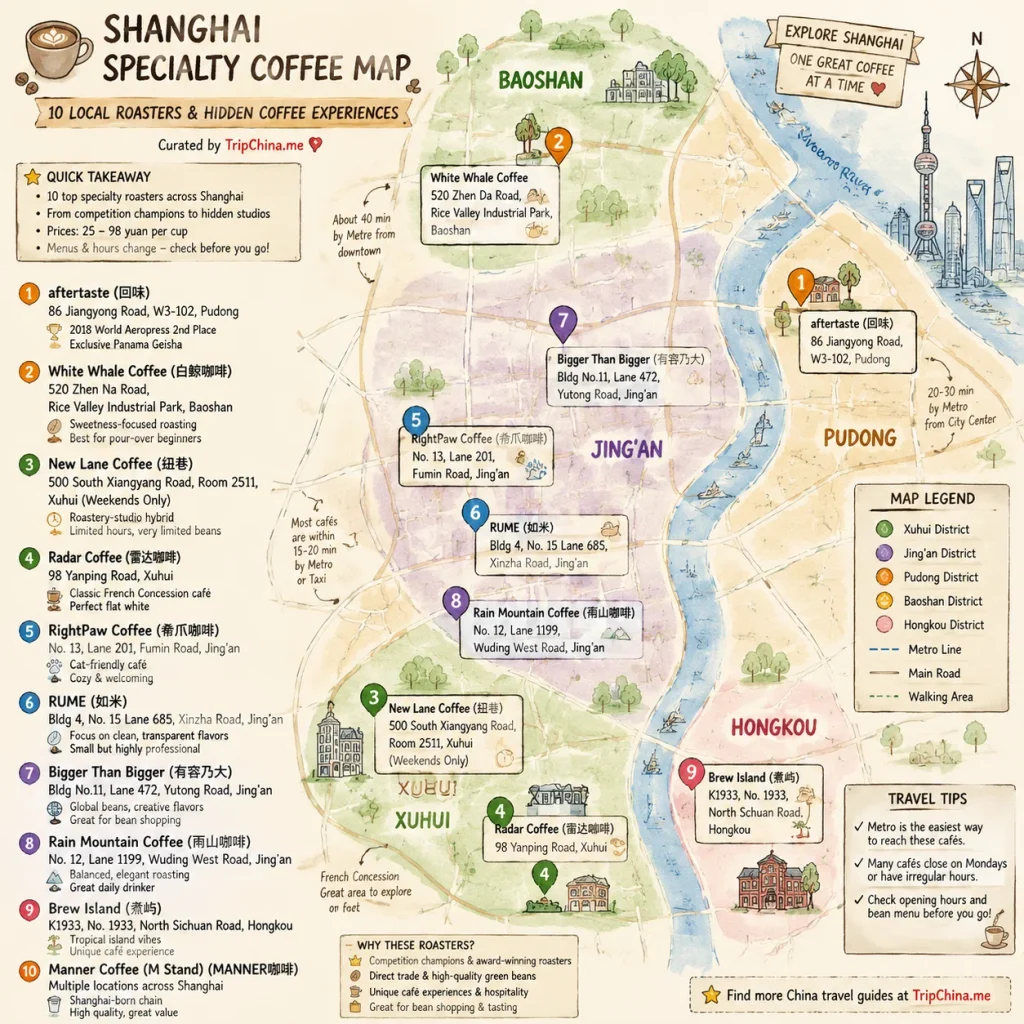
Location: Pudong, 86 Jiangyong Road, W3-102
📍 Open in Amap — aftertaste (回味)aftertaste is not a typical cafe. It's a coffee concept lab run by a barista who placed second in the 2018 World Aeropress Championship and won the Shanghai Brewers Cup in 2019 and 2021. He also founded CCC, a cup brand used by cafes across China, his limited-edition cups sell out at every coffee expo.
The real advantage: the owner is one of China's largest specialty green bean buyers. He works directly with farms in Panama, often securing exclusive lots that never reach other Chinese roasters.
What to order: The Geisha from Finca Altieri, a farm that placed second in Panama's Best of Panama competition three times. The beans come from a sub-lot called ALE, grown in a volcanic forest reserve canyon in Boquete. The honey processing concentrates the flavor, expect floral notes, citrus, and a surprising longan fruit sweetness with a light cream mouthfeel.
TripChina verdict: The most technically impressive roaster on this list. Worth visiting for the Geisha alone, but the real value is in the exclusive lots you won't find elsewhere.
Location: Baoshan, 520 Zhen Da Road, Rice Valley Industrial Park
📍 Open in Amap — White Whale Coffee (白鲸咖啡)White Whale (Mobydick) has been roasting since 2015, making it one of Shanghai's older specialty roasters. For most of its history, it had no physical cafe, just a bean roasting operation. In late 2024, it opened a tasting room in Baoshan where you can try before you buy.
The roasting philosophy is simple: maximize sweetness. White Whale selects beans specifically for their sugar content, making them forgiving for home brewers. If you're new to pour-over, this is the roaster that makes you look good.
What to order: The Maracaturra from Nicaragua, a rare hybrid of Caturra and Maragogype (elephant bean). It's uncommon because the large, soft beans are difficult to roast evenly. White Whale nails it: red berry and strawberry notes upfront, green apple acidity in the middle, and a juicy, bright finish.
TripChina verdict: Best for beginners and anyone who values sweetness over complexity. The tasting room is worth the trip to Baoshan.
Location: Xuhui, 500 South Xiangyang Road, Room 2511 (weekends only)
📍 Open in Amap — New Lane Coffee (纽巷)New Lane (纽巷) is not a cafe. It's a roasting studio that supplies beans to other shops and opens to the public only on Saturdays and Sundays. The bean list changes weekly, like a secret appointment with regulars.
The roasting style is distinctive: a subtle milky sweetness runs through every bean, regardless of origin. One customer described it as "a river of gentleness." It's the kind of coffee that makes you slow down.
What to order: The Geisha blend from three Colombian sub-regions, Narino, Cauca, and Huila. The blend creates exceptional balance and brewing forgiveness, with chamomile, jasmine, and lemongrass aromatics. The 36-hour controlled fermentation adds bright sweetness and clean elegance.
TripChina verdict: The most romantic roaster in Shanghai. Plan your weekend around it.
Location: Huangpu, 27 Sinan Road
📍 Open in Amap — Radar Coffee (雷达咖啡)Radar Coffee opened in 2021 as an 11-square-meter shop on Sinan Road. Within six months, it ranked first in the annual coffee. The owner started roasting his own beans in 2023, giving him full control from green bean to cup.
The remarkable thing: Radar maintains everyday affordable prices despite using competition-grade beans. Most shops would charge double for this quality.
What to order: The Pink Bourbon from Canoe Farm in Colombia. Canoe is known for its 40,000-square-meter plantation with 16,000 chili bourbon and pink bourbon trees, considered "cheat code" varieties for their intense flavor. The washed processing delivers clean sweetness: apple and hawthorn juice brightness, mouthwatering acidity.
TripChina verdict: The best value-for-money roaster in Shanghai. If you only visit one shop, make it this one.
Location: Online only, no physical store
📍 Open in Amap — RightPaw Coffee (希爪咖啡)RightPaw (希爪咖啡) has no cafe. It sells beans exclusively online in small-batch flash sales, known only to serious coffee enthusiasts. The roaster won the 2019-2020 Giesen Coffee Roasting Championship and the 2020 Guangzhou Regional China Roasting Championship.
The style is aggressively fruity, "juice bomb" is the accurate description. Every bean is pushed to express its brightest, most drinkable character.
What to order: The Papayo from Prospect Farm in Colombia, which placed second in Cup of Excellence. Papayo is a rare Colombian variety named for its elongated, papaya-like fruit shape. It was the bean used by the 2025 World Barista Champion. The semi-washed processing highlights peach and tropical fruit sweetness. One taster reported: "I couldn't stop smiling."
TripChina verdict: For experienced drinkers who want to taste what champions use. Buy online before the flash sale ends.
Location: Online only, no physical store
📍 Open in Amap — RUME (如米)RUME (如米) is the new brand from Single Coffee Studio, a well-known Shanghai roaster that supplies beans to top cafes across China. The 2024 coffee's "most memorable" Ethiopian was roasted by Single.
RUME specializes in rare, hard-to-find microlots. The current standout is from Coffea Diversa Garden in Costa Rica, a farm whose beans sell for 80 yuan per cup at Shanghai cafes.
What to order: The Mokka micro-lot from Coffea Diversa, processed with red wine-style natural fermentation. Mokka is the smallest Arabica variety, about the size of a peppercorn, a mutation of Bourbon adapted to Yemen's environment. The red wine processing (no actual wine involved, just extended fermentation) adds sweetness and complexity. Expect bright citrus peel intensity, complex cocoa notes, and the roaster's signature elegant finish.
TripChina verdict: For collectors and curious drinkers. These beans are genuinely rare, the batch arrived in China only two months ago.
Location: Jing'an, 1622 West Beijing Road
📍 Open in Amap — Bigger Than Bigger (有容乃大)Bigger Than Bigger (有容乃大) won the first ever coffee in 2019 and has never dropped off since. It's widely considered Shanghai's best value espresso and the fastest-changing pour-over menu in the city.
The real strength is the bean library. Bigger Than Bigger sources from more origins, processes, and varieties than any other Shanghai roaster, releasing nearly 1,000 new beans per year. They supply cafes across China.
Their blends are particularly creative, combining beans from different origins to create flavors impossible with single-origin beans.
What to order: The "Sweet Berries" Kenyan blend from Kiambu region, combining SL28, SL34, and Ruiru 11 varieties from two different processing stations. Karatu station contributes dark berry sweetness with brown sugar depth and fermented tea notes. Karinga station adds pink grapefruit brightness. Together: black plum intensity, long finish, and a flavor that one customer described as "a firework of berries."
TripChina verdict: The most comprehensive roaster in Shanghai. Go for the variety, stay for the blends.
Location: Xuhui, Feizhou International Building, 1st floor lobby
📍 Open in Amap — Rain Mountain (雨山咖啡)Rain Mountain (雨山咖啡) is the savior of Xuhui office workers. The shop sits in a corporate building lobby, but the beans are anything but corporate.
Rain Mountain roasts its own beans with a distinctive philosophy: explore unusual origins like Jamaica and Tanzania, and take familiar origins in unexpected directions, deep-roasted Ethiopian, light-roasted Mandheling. The skill is making unconventional choices taste excellent.
What to order: The Salvadoran SL28, a Kenyan variety grown in El Salvador's Santa Ana volcanic zone. The volcanic soil transforms the flavor completely: instead of the expected dark plum and tomato notes, you get apple sweetness with vanilla undertones. It's a fascinating example of terroir overriding variety.
TripChina verdict: Best for drinkers who want to explore unusual origins. The office lobby location is oddly charming.
Location: Hongkou, 739 Liyang Road
📍 Open in Amap — Brew Island (煮屿)Brew Island (煮屿) is run by a barista who won the Shanghai regional World Barista Championship in 2014, reached the China finals top 5 in 2015, and has coached multiple regional champions. He brings that precision to every cup.
The concept is coffee as fine dining. Every drink, espresso and pour-over alike, uses single-origin beans to highlight terroir. The staff will explain bean characteristics, tasting notes, extraction theory, and sourcing logic if you ask.
Prices reflect the approach: espresso starts at 70 yuan, pour-over at 98 yuan.
What to order: The Rwandan from Gatare washing station, one of Rwanda's oldest and most decorated stations, consistently ranking in COE national competitions. The traditional natural processing delivers honeyed preserved plum, long brown sugar sweetness, and rounded spice finish.
TripChina verdict: For serious drinkers who want to understand coffee deeply. The price is high, but the education is included.
A limited-edition tasting set brings together all 10 roasters in a single package: 99 yuan for 10 pour-over bags, each from a different roaster, with no flavors.
The set solves a real problem: most single-origin beans require dialing in grind size and brew temperature, which wastes beans. The set's factory pre-grinds each bag to the optimal particle size for its specific bean, then nitrogen-flushes for freshness. Many small roasters don't nitrogen-flush their pour-over bags.
Who it's for: First-time visitors to Shanghai's coffee scene, travelers who want to taste multiple roasters without visiting 10 locations, and anyone who wants a curated introduction to what Shanghai specialty coffee can do.
Who it's not for: Experienced home brewers who prefer whole beans and their own grind settings.
Shanghai's coffee culture has its own etiquette and expectations. Here's what matters:
Order pour-over, not latte: Most specialty roasters focus on filter coffee. A latte masks the bean's character. Order a pour-over (手冲) to taste what the roaster is trying to express.
Ask about the bean list: Shanghai roasters change their menus every 2-4 weeks. The staff at shops like Bigger Than Bigger and Brew Island will happily walk you through the current offerings.
Don't expect free wi-fi: Many specialty shops are small, 11 square meters in Radar's case. They're designed for drinking, not working.
Bring cash or Alipay: Most independent roasters don't accept international credit cards. Set up Alipay before you go.
Visit on weekdays: Weekend-only shops like New Lane exist, but most roasters are quieter Monday through Friday. Weekend afternoons at popular spots can mean 20-minute waits.
Shanghai has a growing coffee event scene. Here's what to look for:
Shanghai Coffee Festival: Held annually in spring at the Shanghai Exhibition Center. Multiple roasters, cupping sessions, and workshops. Tickets are ¥50-100.
Cafe-specific cupping sessions: Some roasters like Big Heart and Aftertaste host regular cupping sessions. Follow their social media accounts for announcements.
Pop-up tastings: Weekend-only studios like Soft Focus occasionally host tasting events. Check their schedules.
Bean markets: Some roasters like Rume and RightPaw announce new arrivals through flash sales. Join their notification lists.
| Roaster | Location | Best For | Trade-off |
|---|---|---|---|
| aftertaste | Pudong, 86 Jiangyong Road | Exclusive Geisha lots | Out of the way for most tourists |
| White Whale | Baoshan, Rice Valley Park | Beginner-friendly beans | Far from city center |
| New Lane | Xuhui, 500 S Xiangyang Road | Romantic weekend experience | Only open Sat-Sun |
| Radar | Huangpu, 27 Sinan Road | Best value | Tiny space, no seating |
| RightPaw | Online only | Champion-level beans | No physical visit possible |
| RUME | Online only | Rare microlots | No physical visit possible |
| Bigger Than Bigger | Jing'an, 1622 W Beijing Road | Largest variety | Can be overwhelming |
| Rain Mountain | Xuhui, office lobby | Unusual origins | Corporate setting |
| Brew Island | Hongkou, 739 Liyang Road | Fine dining experience | High prices |
A few things to know before you go:
Payment: Most specialty coffee shops in Shanghai accept Alipay and WeChat Pay. Some accept cash. Few accept international credit cards. Download Alipay before you go.
Language: Baristas at the shops on this list speak basic English. For detailed conversations about bean origins and processing, use a translation app or bring a Chinese-speaking friend.
Tipping: Not expected. Service is included in the price.
Photography: Most shops allow photos. Ask before taking pictures of the barista or equipment.
This article is part of the Shanghai Travel Guide Hub.
Explore all Shanghai travel guides here → Shanghai Hub
Most specialty roasters in central Shanghai have English menus or staff who speak basic English. Radar, Bigger Than Bigger, and Brew Island are particularly foreigner-friendly. Online-only roasters like RightPaw and RUME require Chinese for ordering.
Start at Bigger Than Bigger in Jing'an for variety, walk to Radar on Sinan Road for value, then take the metro to Brew Island in Hongkou for the fine dining experience. That covers three distinct styles in one afternoon.
Yes, especially White Whale and Radar. White Whale's beans are designed to be forgiving for home brewing. Radar's prices make experimentation affordable. Brew Island is better for experienced drinkers.
Yes. Every roaster on this list sells whole beans or pre-ground pour-over bags. The tasting set is the easiest way to take home 10 different roasters in one package.
Brew Island's rare hand-pour options can reach 98 yuan per cup. aftertaste's exclusive Geisha lots are similarly priced. For beans, RightPaw's Papayo and RUME's Mokka microlot are among the most expensive at retail.
Yes, if you want to survey Shanghai's roaster landscape without visiting 10 locations. No, if you prefer whole beans and your own brewing parameters.
Tourists assume Shanghai's best coffee is in the obvious places, French Concession Instagram spots, hotel lobbies, or international chains. The reality is the opposite. The city's most interesting roasters are hidden in office building lobbies (Rain Mountain), industrial parks (White Whale), and online-only operations (RightPaw, RUME).
The French Concession has beautiful cafes, but many serve mediocre beans at premium prices. The roasters on this list are where Shanghai's coffee talent actually lives.
This guide combines local research, specialty coffee community information, official business channels, and practical considerations for international visitors.
We focused on independent Shanghai roasters that represent different parts of the city's coffee scene, including competition-level roasting, specialty bean sourcing, tasting experiences, and visitor accessibility.
Because coffee menus, opening hours, and available beans change frequently, we recommend checking each roaster's latest information before visiting.
This article is part of the Shanghai Travel Guide Hub.
Explore all Shanghai travel guides here → Shanghai Hub
TripChina.me creates practical China travel guides shaped by real local experience, helping independent travelers navigate transport, payments, food, neighborhoods, and the cultural details that make traveling in China easier and more meaningful. Find the guide for your destination at tripchina.me.