Our Location:
No. 99, Jiazi Road, Chengdu

 authorChris Lee
Wondering what to eat in Harbin beyond ice cream and red sausage? Harbin local food brings together hearty Dongbei dishes, Russian-influenced cooking and northern Chinese street food. Choose well and a few meals can introduce you to the city’s history without spending your visit in restaurant queues.
This Harbin food guide explains where to eat in Harbin, what to order and how much to budget. Compare restaurants near Central Street, explore Lao Daowai and morning markets, and decide which Russian restaurants and food experiences deserve your limited time.
Restaurant information: Recommendations are research-based rather than a current comparative tasting. Check your chosen branch before a special trip. Prices below are planning estimates.
For food-focused visitors interested in old restaurants and neighborhood culture, Lao Daowai is a strong starting point. Central Street is more convenient for a short first visit.
If you try one iconic Harbin dish, start with guobaorou—锅包肉, crispy pork with a sweet-sour glaze. Heilongjiang cultural-tourism sources associate its development with Lao Chu Jia founder Zheng Xingwen and Harbin’s former Daotai government kitchen.
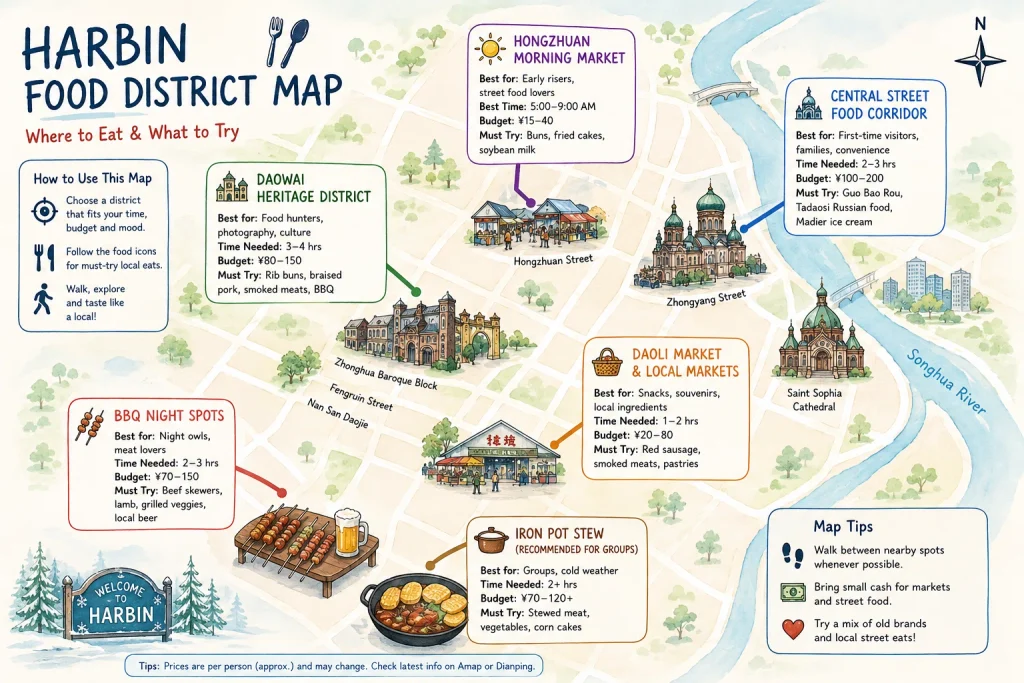
When deciding where to eat in Harbin, choose the food experience first, then the restaurant. A market breakfast, a shared Dongbei dinner and a Russian-style meal serve different purposes.
| Food experience | Best for | Time needed | Estimated budget per person | Main trade-off |
|---|---|---|---|---|
| Lao Daowai food walk | Food history and neighborhood exploration | 3–4 hours | ¥80–150 | More navigation; limited English |
| Central Street food walk | First visits and convenience | 2–3 hours | ¥100–200 | More tourist-oriented |
| Hongzhuan Morning Market | Breakfast and small snacks | 1–2 hours | ¥15–40 | Early start |
| Iron pot stew | Groups and winter dinners | 1½–2+ hours | ¥70–120+ | Large portions and slower dining |
| Harbin barbecue | Evening food and flexible ordering | 2–3 hours | ¥70–150 | Quality varies by branch |
| Everyday budget food | Solo travelers | 30–60 minutes | ¥15–50 | Basic surroundings |
These are food allowances, excluding transport. Shared dishes assume a sensible number of diners; a solo traveler ordering a group-sized pot may spend considerably more.
If you have one evening, use Central Street. If you have a food-focused half-day, explore Lao Daowai.
Before reserving a long dinner, use our Harbin winter travel guide to fit meals around outdoor sightseeing and indoor breaks.
The Amap links below retain the original guide’s map markers. Check the current business listing and exact branch before navigating. A saved marker is not confirmation that a restaurant remains open at that location.
Amap links may open differently depending on your device, browser and whether the app is installed. If a link does not open, copy the Chinese restaurant name into your preferred map app. Overseas readers can also use Google Maps for initial research, but should cross-check the branch address before traveling.
Our guide to choosing a map app for China explains how to search Chinese restaurant names and reduce branch-selection mistakes.
For a short must-eat list, prioritize a mix of dishes rather than several heavy meat meals.
| Dish or food | What it is | Why try it | Best context |
|---|---|---|---|
| Guobaorou 锅包肉 | Crisp pork with a sweet-sour glaze | A signature Harbin dish | Dongbei restaurant |
| Iron pot stew 铁锅炖 | Meat and vegetables cooked communally | A substantial shared Northeast meal | Group dinner |
| Smoked and sauced meats 熏酱 | Prepared pork, chicken and other meats | Part of old Harbin food culture | Lao Daowai |
| Barbecue 烧烤 | Grilled skewers | Flexible evening eating | Busy barbecue restaurant |
| Dongbei dumplings and buns | Wheat-based comfort food | Useful for breakfast or a simpler meal | Markets and neighborhood shops |
| Madier ice cream 马迭尔冰棍 | A milk-based frozen treat | A familiar Central Street experience | A short snack stop |
| Harbin red sausage 哈尔滨红肠 | Smoked sausage | A recognizable local food and souvenir | Established food shops |
| Dalieba 大列巴 | Russian-influenced bread | Another part of Harbin’s food heritage | Bakery or takeaway purchase |
Dongbei food in Harbin often comes in portions suited to sharing. For two people, start with one main dish, one vegetable dish and a staple, then add more if needed.
A practical first order might be:
Ask about serving sizes before ordering another meat dish. A vegetable-looking dish is not automatically vegetarian: check the stock, sauces and cooking fat if that matters to you.
Use this Lao Daowai food guide as a neighborhood walk: combine buns, braised pork or smoked meats with older streets and Chinese-Baroque architecture. Choose a few stops rather than ordering a full meal at each one.
Around Zhonghua Baroque Historic Block, Nan Er Daojie, Nan San Daojie and nearby lanes, you can explore several food stops without treating each meal as a separate cross-city journey.
Heilongjiang cultural-tourism reporting quotes the local expression “吃在老道外”—“eat in old Daowai” and identifies Nan Er Daojie as an important food street. The area also attracts substantial visitor traffic, so “traditional” does not mean quiet or undiscovered.
Zhangbao Pu is one of the classic old Daowai food names. Historical accounts trace its beginnings to a bun shop established by Zhang Ren, who came from Tianjin.
Try: rib-meat buns—排骨包.
Best for: a filling, shareable start.
Expect a savory, substantial bun rather than a light tasting bite. Split your order if braised pork or another restaurant is next.
Open original Amap marker — Zhangbao Pu
This is a classic Harbin-style braised pork option.
Try: braised pork with rice and pickled vegetables.
It is richer and heavier than a bun stop, so share if you are planning several restaurants. Rice and pickled vegetables provide a useful contrast to the rich meat.
Open original Amap marker — Zhang Fei Braised Pork
Choose a small serving of barbecue or smoked meats rather than another full meal.
Possible choices include:
Buy only what you can eat comfortably. If taking cooked food back to your hotel, ask about storage and consume it promptly.
Choose it if you enjoy food history, photography and independently finding smaller places.
Save Chinese dish names as screenshots. English menus and English-speaking staff should not be assumed.
Shorten the walk if mobility is limited or the weather is severe. If food is a priority, compare where to stay in Harbin before choosing between restaurant access and proximity to other attractions.
Central Street is a convenient first food area, especially when you want to combine sightseeing with Russian-influenced dining and classic Harbin snacks.
It works well for an arrival evening. You do not need to eat every meal there.
Madier ice cream—马迭尔冰棍 is one of Harbin’s best-known treats. You may also encounter the spelling Madieer and the English name Modern, including references to the Modern Hotel.
Worth trying: yes, as a short snack stop while exploring Central Street.
Worth a long wait: usually not on a short first visit. Return later if the queue would take time away from your main sightseeing plans.
Check the flavor and displayed price before ordering. Eating ice cream outdoors in winter is optional; it need not become a cold-tolerance challenge.
Open original Amap marker — Modern Hotel Cold Drinks Hall
Tadaosi is a history-focused restaurant choice. Its origins date to 1901, when Armenian founder Tadaos established a Western restaurant in Harbin. Its tradition includes Caucasian-style dishes, rather than only a generic Russian menu.
Look for: Caucasian-style grilled meat, soups and Russian-Harbin dishes on the current menu.
Best for: travelers who value the setting and history alongside the meal.
If grilled meat is your priority, compare those dishes before defaulting to a multi-course Western set menu.
Open original Amap marker — Tadaosi Western Restaurant
If you are searching for the best guobaorou in Harbin, Lao Chu Jia—老厨家 is a logical history-based starting point. Compare the crispness, vinegar sharpness and sweetness you enjoy rather than assuming one restaurant suits every palate.
Order guobaorou, then add a vegetable dish or another Dongbei classic instead of filling the table with meat.
The appeal of guobaorou is the contrast between its crisp coating and sharp, sweet-sour glaze. Eat it soon after serving: a long photo session does the texture no favors.
“Best” depends on your preference for crispness, sweetness and vinegar sharpness. The restaurant’s historical association is a reason to consider it, not proof that every branch always outperforms every alternative.
Open original Amap marker — Lao Chu Jia
Lao Chang is a casual option when you want something less formal than a heritage restaurant.
Best for: families, solo travelers and a straightforward lunch.
Ask about the size of pancake portions and fillings before ordering several dishes.
Open original Amap marker — Lao Chang Spring Pancake
Use the restaurant’s exact branch location to build your meal around your walk. Brand names alone do not establish walking distance.
| Choice | Main reason to consider it | Before committing |
|---|---|---|
| Tadaosi | History and Caucasian/Russian-influenced food | Check the current menu and queue |
| Lao Chu Jia | Guobaorou and Dongbei dishes | Confirm the branch and serving sizes |
| Lao Chang Spring Pancake | Casual shared meal | Check fillings and portion sizes |
| Madier cold-drink outlet | A short snack stop | Check the queue and displayed price |
For a popular restaurant, try arriving near the start of its lunch or dinner service rather than at the busiest conventional mealtime.
At the door, establish three things:
A queue number is not a seating-time guarantee. Ask whether you can receive a phone notification and what happens if you miss your turn.
For a short visit, decide your waiting limit before joining. A nearby alternative is often more useful than committing to a famous name while hungry and cold.
| Factor | Central Street | Lao Daowai |
|---|---|---|
| First-visit convenience | Easier to combine with major sightseeing | Requires more deliberate navigation |
| Historic atmosphere | European-influenced streetscape | Chinese-Baroque streets and courtyards |
| Food focus | Tourist snacks and Russian-influenced dining | Buns, braised pork, smoked meats and neighborhood meals |
| English-language assistance | More likely at visitor-oriented venues | Less dependable |
| Best use | Arrival evening or short stay | Food-focused half-day |
Use Central Street for convenience and Daowai when you have time to explore.
Neither area guarantees a good meal at every restaurant. Match the menu and price to what you want from that meal.
Yes, especially if breakfast and street-food browsing interest you.
Hongzhuan Street Morning Market—红专街早市 is a popular visitor stop as well as a working food market. Expect tourists and queues at recognizable stalls.
Use roughly 5:30–7:00 AM as an early-visit target, not a guaranteed operating window for every vendor. Check current hours locally, especially in severe weather. Do not leave the visit until late morning.
Open original Amap marker — Hongzhuan Street Morning Market
Choose a few small items:
July 2026 provincial reporting described buns, lamb soup, youtiao, pancakes, sausage, egg burgers and sticky-bean buns among the market’s foods.
Check prices before ordering and ask whether a quoted portion contains one item or several.
Buy hot food in small batches and eat it promptly. A large takeaway selection may cool before you finish photographing it.
Keep gloves accessible and plan an indoor break. January 2026 local reporting documented warming stations offering services such as heat, charging and hot water; check current signs for availability.
Before an early market visit, check our Harbin winter clothing and footwear guide so breakfast does not become an uncomfortable outdoor wait.
Daoli Market—道里菜市场 is useful for browsing prepared foods, pastries and takeaway purchases.
Look for:
Check whether food is sold per piece, per portion or by weight.
A practical morning sequence is:
Hongzhuan Morning Market → Saint Sophia Cathedral area → Daoli Market
Treat Daoli Market as browsing or a light snack stop if you have already eaten a substantial breakfast.
Yes—particularly with other people.
Iron pot stew is a communal Dongbei meal: meat, vegetables and sauce cook together, sometimes with corn cakes or dough around the pot’s edge.
It suits:
It is less convenient for solo diners or anyone trying several restaurants in one evening.
Vegetarians should not assume a separate meat-free pot is available. Confirm the stock, cooking fat and preparation arrangements before choosing this meal.
Zaozuo Xiaoguo Hu Bing—灶座小锅烀饼 is one candidate to investigate. Other established iron-pot restaurants may also fit your trip.
Choose according to:
Open original Amap marker — Zaozuo Xiaoguo Hu Bing
Plan around 1½–2+ hours, plus any queue.
Some pots require cooking after you sit down. Ask about preparation time if you have an evening reservation elsewhere.
Make this your main dinner rather than another stop after several substantial meals.
Harbin barbecue works well as an evening meal with flexible ordering.
Start with a small selection, then add more. You do not need the most famous chain.
Consider:
Ask about seasoning and whether prices are per skewer or per serving.
Look for a combination of:
A busy room is useful information, but it is not a substitute for basic food-handling standards.
These are candidates to compare, not a permanent ranking:
| English name | Chinese search name | Original map link |
|---|---|---|
| Lao Wei BBQ | 老味烧烤 | Amap |
| Pian Lian Zi BBQ | 偏脸子烧烤 | Amap |
| Dashuangxi Beef Skewers | 大双喜牛肉串店 | Amap |
| Jingangshan BBQ | 金刚山烧烤 | Amap |
If dinner requires a taxi, our DiDi guide for foreign visitors explains how to confirm the restaurant branch and arrange the correct pickup point.
Shida Night Market—师大夜市 offers a busy street-food setting with grilled skewers, fried snacks and other small dishes.
Choose it if browsing multiple stalls is part of the experience you want.
Skip the detour if you have only one evening, are already tired from sightseeing or mainly want a comfortable sit-down dinner near Central Street.
Winter operation has expanded in recent years. February 2026 local reporting described winter stalls, warming facilities and substantial holiday crowds.
Check current opening hours, arrive before the final trading period and expect queues at popular stalls. Keep entrances and walking lanes clear while waiting.
Harbin’s Russian-influenced food has developed locally for more than a century.
Expect a mixture of Russian and other European traditions, local ingredients and Chinese preferences. This adaptation is part of the city’s food culture.
The best Russian restaurant in Harbin for your trip depends on whether you value food history, grilled dishes, atmosphere or a simpler meal. Use the comparison below to narrow your choice.
| Restaurant | Chinese search name | Reason to investigate | What to check |
|---|---|---|---|
| Tadaosi | 塔道斯西餐厅 | History and Caucasian-influenced cooking | Grilled dishes, soups and current prices |
| Portman | 波特曼西餐厅 | A more theatrical dining atmosphere | Current entertainment arrangements and charges |
| Lucia | 露西亚西餐厅 | Decorative setting and a slower meal | Current menu, seating and reservation requirements |
| Kuziming | 库兹明俄式餐厅 | A potentially simpler Russian-style meal | Current branch, portions and value |
| Lao Eqiao Private Kitchen | 老俄侨私房菜 | A family-style Sino-Russian dining option | Opening arrangements and advance booking |
For menu comparison, look for soups such as borscht, grilled meats, stews, cutlets and bread where offered. These are dishes to check for, not a promise that every restaurant serves the same selection.
As a planning allowance, set aside roughly ¥100–200 per person for a straightforward sit-down Russian-style meal, and ¥200–300+ for a more elaborate dinner with several courses or drinks. These are not restaurant-specific quotations.
Original map links:
Tadaosi is a reasonable history-focused choice. For any restaurant, weigh its current menu, price and travel time against what you want from the meal.
Historical significance alone does not establish which kitchen serves the best food today.
Yes. Smaller everyday meals can also be easier for solo travelers than large shared dishes.
| Meal | Illustrative allowance | Ordering tip |
|---|---|---|
| Simple market breakfast | ¥10–30 | Buy a few small items |
| Broader market tasting | ¥15–40 | Check portion prices |
| Malatang | ¥20–50 | Check the weighing system and minimum charge |
| Simple neighborhood meal | ¥15–50 | Look at the menu before sitting down |
Malatang lets you select ingredients, but vegetables do not make the finished meal vegetarian if they are cooked in meat stock.
Cafeteria-style meals around offices and residential neighborhoods can also offer straightforward options.
Many small stalls and family-run restaurants cannot accept an international card directly.
Alipay and WeChat Pay can support eligible overseas bank cards; a Chinese bank account is not universally required. Card compatibility, verification and individual transactions can still vary.
Set up and test a payment method before your food walk:
Use the following Harbin food prices as daily planning allowances per adult, excluding transport. They are budget examples rather than live restaurant quotations.
| Style | Daily budget | What it can cover |
|---|---|---|
| Budget | ¥60–100 | Market breakfast, simple meal and malatang or snacks |
| Comfortable | ¥150–250 | Local meals, a food walk and one better dinner |
| Food-focused | ¥250–400+ | A more expensive restaurant meal, tastings and drinks |
These are planning ranges, not fixed Harbin food prices.
Tourist locations, special dishes, alcohol and minimum orders can raise the total. Group meals may cost less per person when portions are shared sensibly. Winter holidays can increase queues and affect menus or offers; check the displayed prices.
Rough USD illustration: using an assumed rate of ¥7 = US$1, the three daily budgets are approximately US$9–14, US$21–36 and US$36–57+. This is a calculation example, not a live exchange-rate quote. Use your bank’s current rate when budgeting.
This self-guided Harbin food tour combines markets, neighborhood meals and one main dinner. Select stops that fit your appetite and sightseeing route; you do not need to complete every food stop.
| Time | Suggested plan |
|---|---|
| Early morning | Hongzhuan Morning Market breakfast |
| Later morning | Saint Sophia Cathedral area and optional Daoli Market browsing |
| Lunch | One meal in Lao Daowai |
| Afternoon | Architecture walk and a break |
| Dinner | Choose either Russian-style food or barbecue |
You do not need a full meal at every stop. If lunch is substantial, keep dinner lighter.
Day 1: Central Street sightseeing, one snack and either guobaorou or a Russian-style dinner.
Day 2: Market breakfast, Lao Daowai exploration and a shared iron pot dinner—or a simpler meal if traveling solo.
If visiting Ice and Snow World, avoid scheduling a lengthy dinner immediately before a timed activity. Our Harbin Ice Festival planning guide helps you arrange the attraction around meals and warm-up breaks.
Prepare translation, payment and mapping tools before your food walk. Our essential China travel apps guide explains what to set up before you need it.
Choose the season around the dining experience you want.
Winter suits long indoor meals, iron pot stew and warming breakfasts between sightseeing stops. Outdoor markets require shorter visits and warm-up breaks.
Summer makes food walks and outdoor evening browsing more comfortable. It also gives you more flexibility to explore several neighborhoods without cold-weather interruptions.
Harbin’s signature dishes are not a winter-only attraction. If food is your main interest, you do not need to visit during the busiest ice-and-snow tourism period.
A food walk needs indoor breaks as well as food stops.
For wider seasonal precautions, see our Harbin winter survival guide.
When deciding where to buy Harbin red sausage, compare established branded outlets, supermarkets and food markets. Check the manufacturer and storage instructions rather than choosing by souvenir packaging alone.
Check:
Vacuum packaging does not automatically make sausage shelf-stable or permissible to carry into another country.
For international travel, check your destination’s food-import rules before buying meat products.
Large Russian-style loaves can be awkward to carry. Smaller packaged portions may be easier.
Check freshness, ingredients and storage requirements.
Smoked meats: follow refrigeration instructions and destination import rules.
Kvass: usually easier to enjoy locally. Check liquid and baggage rules before taking it on a flight.
Traditional pastries: compare established shops and markets, checking freshness and allergens.
| Mistake | Better approach |
|---|---|
| Eating every meal on Central Street | Add a Lao Daowai meal or market visit |
| Assuming a historic restaurant must have the best current food | Compare its menu, reviews and price |
| Arriving at a morning market late | Check current hours and visit early |
| Ordering a group-sized iron pot alone | Choose a smaller meal or share |
| Scheduling heavy meals back-to-back | Alternate rich dishes with lighter meals |
| Choosing a restaurant only because it is busy | Also assess food handling and cleanliness |
| Treating a saved map marker as a verified branch | Search the current Chinese listing |
| Dismissing adapted Russian dishes automatically | Judge the local style on its own terms |
| Ordering several large meat dishes immediately | Start smaller and add food if needed |
| Buying meat souvenirs without checking restrictions | Verify storage and import rules |
For vegetarian food in Harbin, start by searching for dedicated vegetarian restaurants using 素食餐厅 or 素斋. Check recent listings and opening hours before planning a meal around one.
At ordinary restaurants, potatoes, mushrooms, cabbage, tofu, cold dishes and vegetable dumplings may offer options, but ask about meat stock, lard, oyster sauce and other animal ingredients.
Useful wording:
我不吃肉,也不吃肉汤。
I do not eat meat or meat broth.
Vegan travelers should also specify no eggs or dairy. A vegetable-based dish name alone is not enough to establish suitability.
Generally, classic Harbin and Dongbei cooking is less chili-focused than Sichuan or Chongqing food.
Expect salty, smoky, sour, sweet-sour and savory flavors. Barbecue seasoning and individual dishes can still be spicy.
Ask for:
不要辣椒。
No chili, please.
For halal food in Harbin, search 清真—Qingzhen and confirm the restaurant’s current status before ordering. Use the Chinese search term alongside the neighborhood where you plan to eat.
Lao Daowai is a useful area to investigate: provincial heritage information documents its Hui community and traditional halal cooking, including Liu He Shun—六合顺. Treat that as a research lead, not verification of a particular branch’s current certification.
Confirm the meat source, cooking practices and any certification relevant to your requirements. A beef or lamb dish at an ordinary restaurant is not automatically halal.
If planning a late dinner, contact your chosen restaurant about its last food order, especially in winter. Do not assume it follows nearby barbecue restaurants’ hours.
Some visitor-oriented restaurants provide them, but smaller shops and market stalls may not.
Save Chinese dish names, use camera translation and confirm the quantity and price before ordering.
For an allergy, show a clear written explanation and ask whether the kitchen can accommodate it. Do not rely only on an automated menu translation.
For a specific dinner time, larger group or special dining experience, contact the restaurant in advance.
For casual meals, a backup nearby can be more useful than committing to a long queue. Ask whether a reservation guarantees seating or simply places you on a waiting list.
Choose one main food experience for each day, then fit smaller snacks around your sightseeing.
A market breakfast, a Lao Daowai lunch and one carefully chosen dinner will usually be more enjoyable than chasing every famous restaurant. Leave room for a spontaneous stop—and enough time to eat while the food is hot.
Use the linked Harbin planning guides above to build the rest of your visit around those meals.
This update checked official historical and payment information, plus published 2026 market reporting. Restaurant suggestions remain research-based, not a current comparative tasting or verification of every branch. Prices are planning estimates; USD figures use an illustrative exchange rate. Original Amap markers are retained. Confirm your chosen restaurant’s location, hours and any dietary arrangements before a special trip.
TripChina.me creates practical China travel guides shaped by real local experience, helping independent travelers navigate transport, payments, food, neighborhoods, and the cultural details that make traveling in China easier and more meaningful. Find the guide for your destination at tripchina.me.