Our Location:
No. 99, Jiazi Road, Chengdu

 authorChris Lee
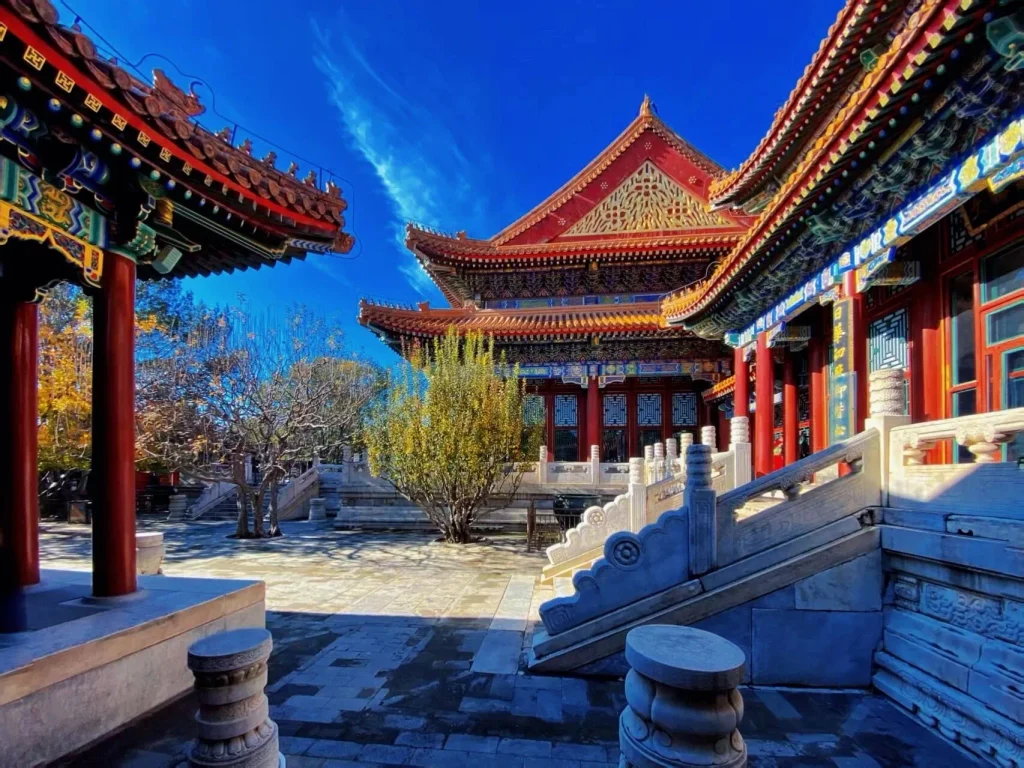
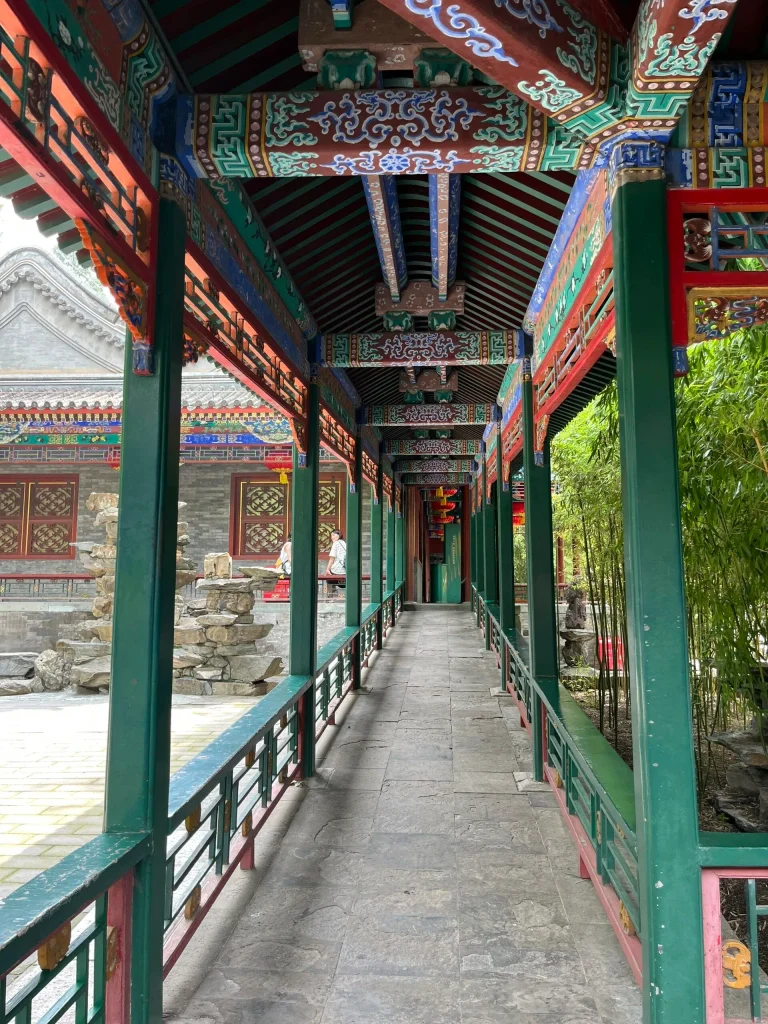
Prince Kung’s Mansion (恭王府, Gong Wang Fu / Gongwangfu Beijing) is smaller than the Forbidden City, but that is exactly why it works for many travelers. You can see Qing Dynasty architecture, gardens, the famous Fu Stele and one of Beijing’s remarkable historic theaters without committing most of a day.
This guide explains whether it deserves a place in your itinerary, how foreigners book tickets, what to see, and the route that makes the most of your visit.
Yes — especially if you have at least two days in Beijing.
Prince Kung’s Mansion works best as a 1.5–2.5-hour historical stop combined with the Shichahai Lake area and surrounding hutongs. Admission is 40 RMB. Advance online booking is required.
Foreign visitors booking with passports must bring the same valid passport. On the visit date, passport holders should complete the required admission procedure at the Comprehensive Service Office.
If you have only one sightseeing day in Beijing, prioritize the Forbidden City. If you have two or more days, Prince Kung’s Mansion offers a different and more compact look at elite Qing-era life.
On mobile devices, swipe horizontally to view the full table.
| Quick Fact | What to Know |
|---|---|
| Attraction | Prince Kung’s Mansion (Gong Wang Fu) |
| Ticket | 40 RMB |
| Recommended time | 1.5–2.5 hours |
| Opening hours* | 08:30–17:00 |
| Last entry | 16:10 |
| Closed | Mondays, except statutory public holidays |
| Advance booking | Required |
| Ticket release | Up to 10 days ahead from 20:00 Beijing time |
| Foreign passport | Accepted for online booking |
| Passport visitors | Complete admission procedure at Comprehensive Service Office |
| Nearest metro | Line 6, Beihai North / Beihaibei Station |
| Best combination | Shichahai + hutongs |
| Best time | Weekday morning around opening |
Official sources currently list 08:30–17:00 with last entry at 16:10. If you encounter an older museum page showing seasonal winter hours, check the official website or WeChat account before a November–March visit.
As of September 2026, Prince Kung’s Mansion uses advance online real-name ticketing.
The official ticket notice states that reservations open as early as 20:00 Beijing time ten days before the visit date.
Each valid identity document is limited to one ticket per admission day.
A personal booking account can submit up to two orders per day, with a maximum of five tickets per order. This is an account-level booking limit, not a passport ticket allowance. Every traveler still needs a separate ticket tied to their own real-name identity document or passport.
Passports are explicitly listed as an accepted identification type.
If you are booking several Beijing attractions, the Beijing attraction ticket booking guide explains the different reservation systems. For the city’s hardest reservation, see the separate Forbidden City ticket guide for foreign visitors.
(Source: Prince Kung’s Mansion official ticketing notice, pgm.org.cn)
The safest starting point is the official Prince Kung’s Mansion website or its official WeChat channel. Search WeChat for 恭王府博物馆.
The museum also directs visitors to its official ticket website and the “巡·恭博” section of its official WeChat account.
The ticket system accepts passports (护照). Enter your passport number and personal information exactly as they appear on the document you will carry in Beijing.
Booking for several people? Enter each traveler’s identity information separately. Tickets are tied to the registered visitor and identity document.
If you notice incorrect passport information, return to the original booking channel. Correct the reservation where possible, or cancel and rebook before visiting. Do not rely on entrance staff being able to change identity details.
Save the official museum website or WeChat account on your phone. It is the easiest way to check ticket availability or last-minute schedule changes.
Passport holders should follow the museum’s designated admission procedure at the Comprehensive Service Office.
Go there on your scheduled visit date and bring the original passport used for the reservation. The museum’s rules also list procedures for several other non-mainland-ID document types.
The official rules specify that this process takes place on the admission day. There is no need to visit the museum a day earlier.
Do not rely on a passport photo or booking screenshot alone. Bring the original document.
Allow an extra 5–10 minutes rather than arriving at the exact start of your planned visit.
Standard admission is 40 RMB.
Half-price admission applies to eligible groups. Importantly for international travelers, the museum’s official policy states that eligible overseas, Hong Kong, Macao and Taiwan young visitors can receive student concessions with valid identification or student documentation.
Children aged six or younger, or 1.2 meters or shorter, qualify for free admission under the current rules.
If WeChat Pay or other Chinese mobile-payment systems are unfamiliar, set them up before sightseeing using our foreign visitor payment guide for China.
As of September 2026, the museum’s current official website lists:
| Time | Current Official Schedule |
|---|---|
| Opens | 08:30 |
| Ticket sales stop | 16:00 |
| Entry stops | 16:10 |
| Closes | 17:00 |
| Monday | Closed except statutory public holidays |
For practical planning, use 08:30–17:00 with last entry at 16:10 as the current schedule.
Check pgm.org.cn or the official WeChat account shortly before your visit, particularly for winter visits and Chinese public holidays.
Statutory holidays can override the normal Monday closure. This means the mansion is closed on regular Mondays, with exceptions for statutory public holidays.
(Source: Prince Kung’s Mansion official website and visitor information, pgm.org.cn)
For most independent travelers, take Beijing Subway Line 6 to Beihai North Station (北海北站 / Beihaibei). Use Exit B, then walk through the hutong area toward the museum’s No. 1 Gate.
The museum’s official directions give two approaches from the station: roughly 200 meters via Sanzuoqiao Hutong or about 300 meters via Longtoujing Street.
Our Beijing subway guide for foreign travelers explains payment, station navigation and common first-time mistakes.
For ride-hailing, use the Chinese attraction name 恭王府博物馆 and confirm the entrance rather than relying entirely on an English map pin.
Hutong streets and access restrictions can make the final drop-off less intuitive than it looks on a map.
If you have not used Chinese ride-hailing before, see how to use DiDi in China without a Chinese number.
Google Maps can be unreliable for detailed navigation in mainland China, particularly around small lanes. A Chinese navigation app is usually more useful. Our China navigation app guide for foreign travelers explains the practical options.
Driving yourself is not recommended. Parking around the historic Shichahai and hutong district is limited, and the museum itself recommends public transportation.
(Source: Prince Kung’s Mansion official visitor directions, pgm.org.cn)
The site is usually understood through its mansion buildings in front and garden behind.
If your time is limited, do not try to inspect every room equally. Concentrate on the architectural and cultural features that distinguish Gongwangfu Beijing from the city’s imperial sites.
The Western Gate is the main entrance to the garden and one of the mansion’s most recognizable architectural details.
Built from white stone in a Western-style arched form, it stands apart from the surrounding Qing architecture. The museum describes it as the only Western-style building within the complex.
If photography matters to you, reach this part of the garden before the main late-morning crowds.
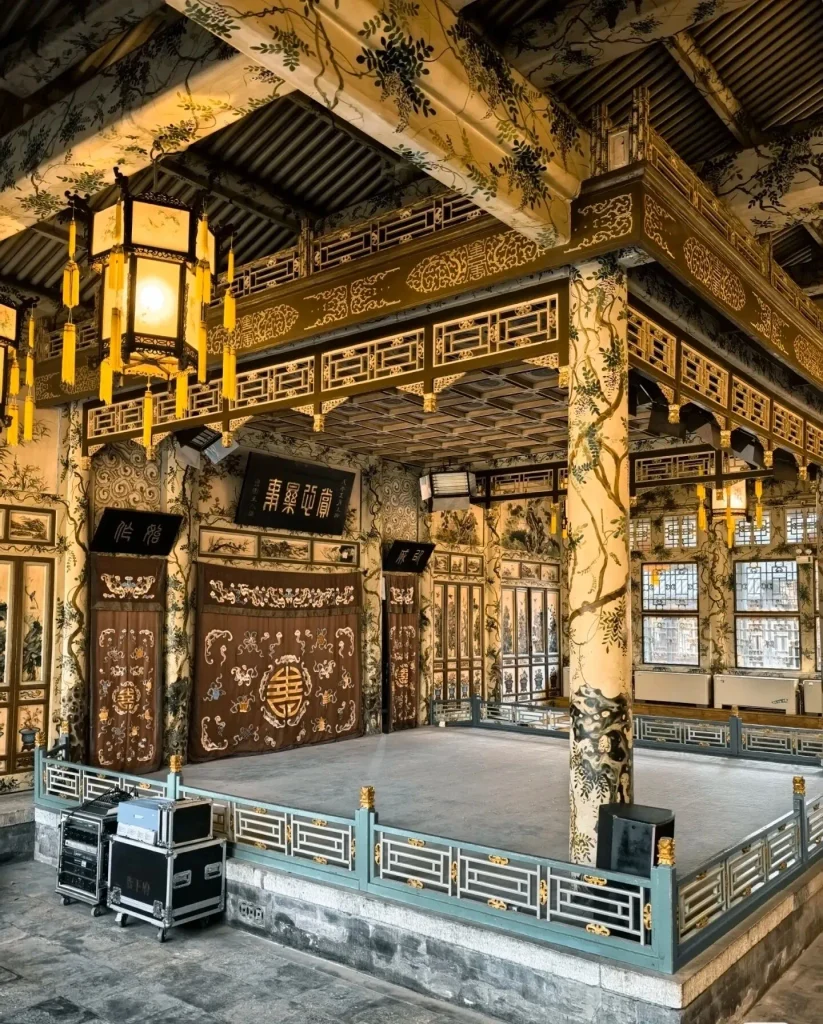
The Grand Theater is one of the mansion’s strongest reasons to visit.
This enclosed Qing-era theater uses an unusual three-section connected wooden structure. Painted wisteria covers its interior surfaces, creating the impression of sitting beneath a flowering trellis.
Official museum material describes it as one of the very few surviving enclosed Qing theaters of its kind.
Its acoustics are especially interesting. The theater’s acoustic design is traditionally explained through large vessels buried beneath the stage. Popular accounts often specify nine jars, while museum research discusses the building’s acoustic principles.
The safest way to understand this detail is as part of the traditional explanation of the theater’s sound design, rather than as a precise modern archaeological finding.
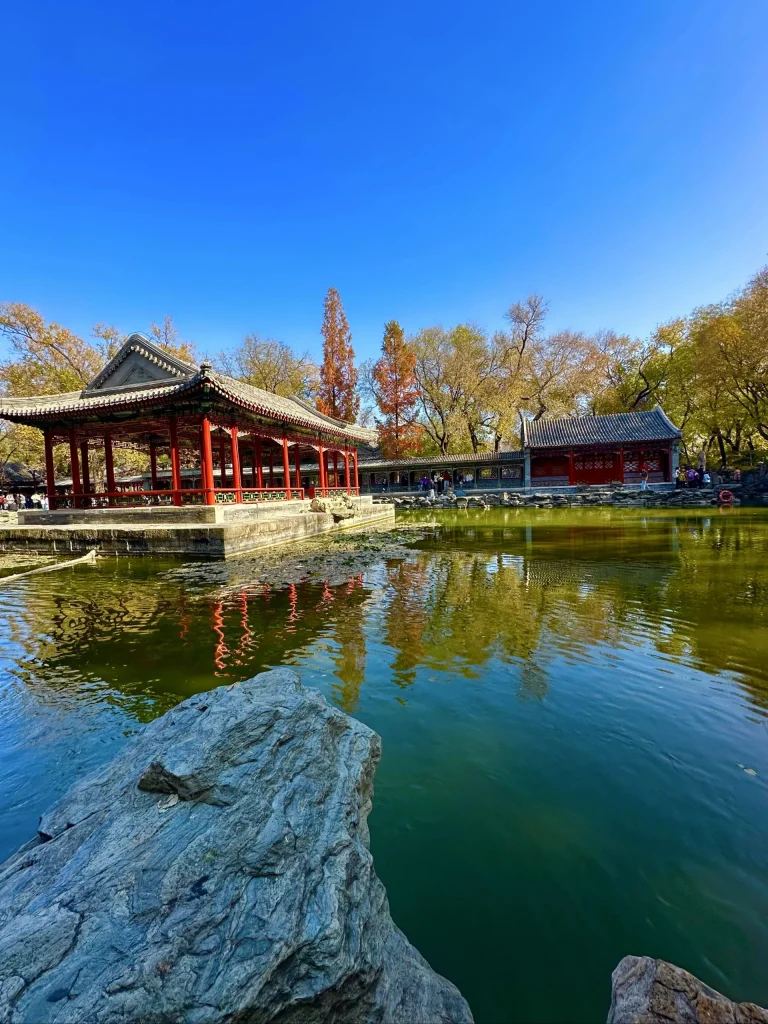
The pool is shaped like a bat for a reason.
In Chinese, 蝠 (fú, bat) sounds like 福 (fú, good fortune or blessing). This makes bats one of the most recognizable symbols of good fortune in traditional Chinese decorative art.
You will find this symbolism repeatedly throughout the garden.
Five bats together traditionally evoke the “Five Blessings” — longevity, wealth, health, virtue and a peaceful death. Red bat motifs can also carry the wordplay of hóng fú, meaning abundant or widespread good fortune.
Once you understand that visual language, many decorative details around the mansion become much easier to read.
Hidden inside Miyun Cave beneath the garden rockery is the site’s most famous object: a stone stele bearing a large 福 character attributed to Emperor Kangxi.
The stele measures about 129 cm high and 54 cm wide. Its unusual calligraphy is traditionally interpreted as combining visual elements associated with “many children, talent, fields, longevity and fortune.”
Touching the Fu (摸福) is a widely practiced folk tradition associated with the stele. Museum cultural materials explicitly describe mō fú as part of traditional “Fu culture,” and historical museum reports record visitors taking part in the custom.
Access arrangements around a protected cultural relic can change, however. Barriers, protective installations and staff instructions may affect how visitors approach the stele.
Follow the on-site arrangement rather than assuming in advance that you can directly touch the stone.
Stories claiming that He Shen secretly stole the stele from the Forbidden City are better treated as folklore, not established historical fact.
The stele’s Kangxi calligraphy and its place in the mansion’s broader “Fu culture” are more useful for understanding what you are seeing.
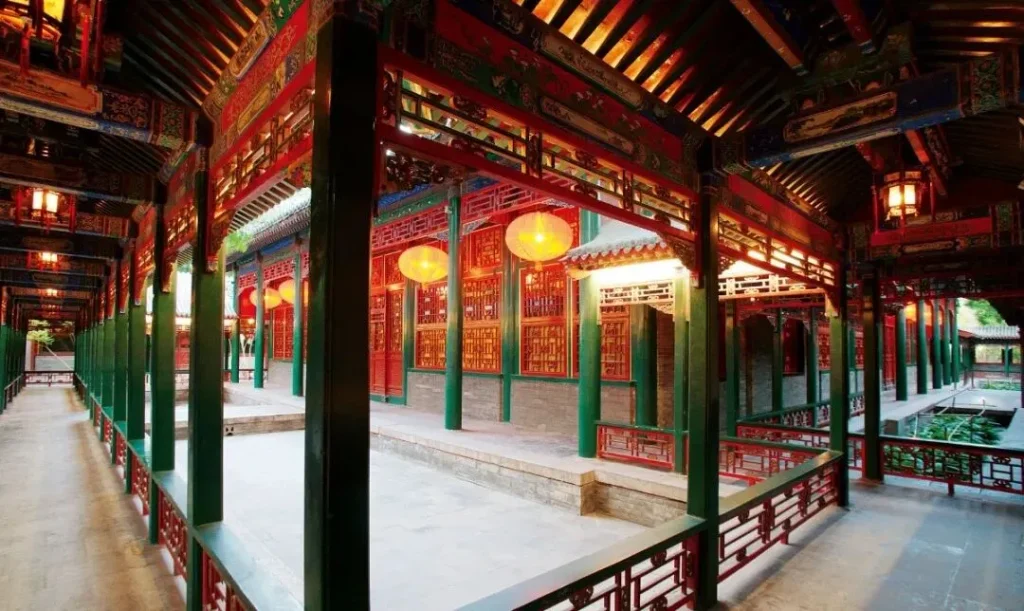
The long Houzhao Building separates the residential mansion from the garden and is visually one of the complex’s most imposing structures.
Official museum material describes the building as roughly 165 meters long, with 108 rooms, traditionally referred to as “99 and a half rooms.”
Look especially at the building from the garden side.
The famously varied shijinchuang (什锦窗), or decorative windows, are concentrated on the rear facade facing the garden. Museum material describes windows in many forms, including peach, fan, gourd, diamond, bat and fish shapes.
This is a useful practical detail: you do not need to circle the entire building looking for them. The garden-facing side is where the window designs are easiest to appreciate.
Stories connecting specific window shapes with different categories of treasure are part of the popular lore surrounding He Shen and his wealth. Even museum historical writing acknowledges this as a story traditionally told about the building rather than a proven inventory system.
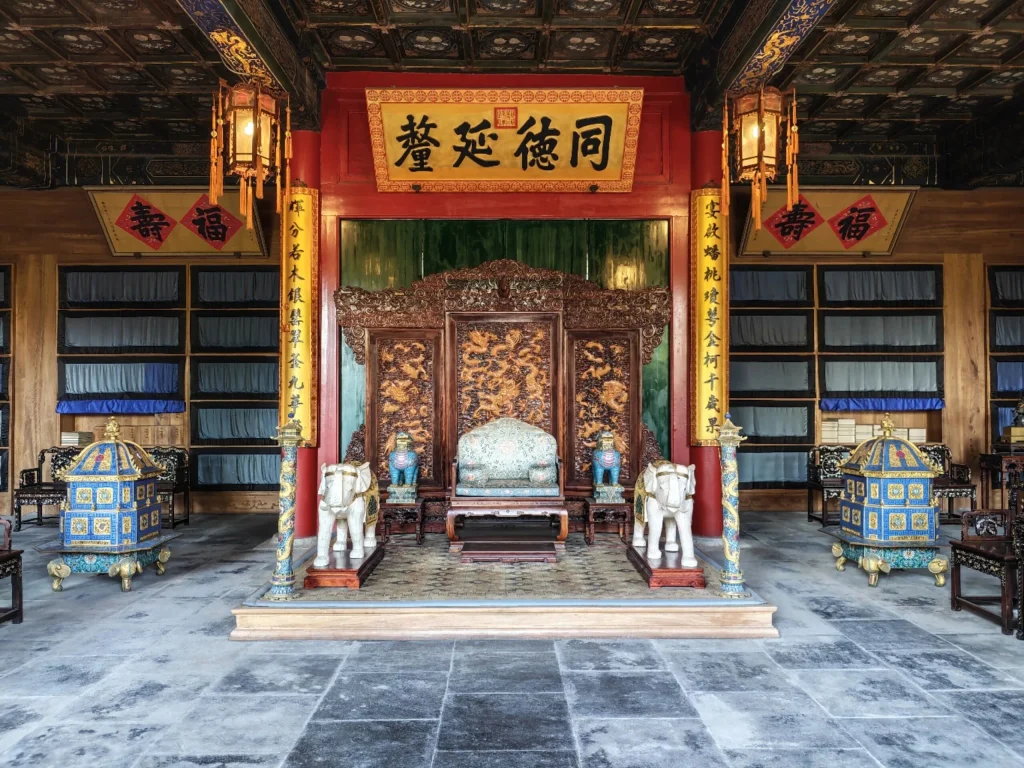
Yinan Hall anchors the formal ceremonial side of the mansion.
Its architectural hierarchy gives you an immediate visual contrast with the Forbidden City. This is princely architecture — impressive, but governed by a different rank and scale from the imperial palace.
Spend a few minutes here for context before moving toward the more visually memorable garden.
Xijin Studio is one place where the story of He Shen’s extraordinary wealth is backed by stronger historical evidence.
The building contains elaborate nanmu woodwork and an interior arrangement modeled on architectural elements of the Ningshou Palace complex inside the Forbidden City.
Official museum research links the building to an accusation made against He Shen after his downfall: that his nanmu residence and interior design exceeded the architectural standards appropriate to his rank.
This distinction matters. He Shen’s connection with Xijin Studio is not merely a tourist legend; the museum cites Qing records when discussing the excessive architectural standards used here.
The terrace sits on higher ground in the garden and gives the visit a quieter finish after the enclosed halls and narrow cave around the Fu Stele.
You may hear local stories about crossing stone obstacles without looking back as a symbol of overcoming difficulties. Treat these as modern visitor folklore rather than museum rules.
The real appeal here is the garden composition and change in elevation.
There is no reason to use the same route if you have one hour and if you have half a day.
| Your Situation | Recommended Route | Time |
|---|---|---|
| First visit | Mansion halls → Houzhao Building → Western Gate → Fu Stele → Bat Pool → Grand Theater → Xijin Studio | 2–2.5 hrs |
| Short visit | Western Gate → Fu Stele → Grand Theater → Houzhao Building | 1–1.5 hrs |
| Garden priority | Western Gate → Bat Pool → Fu Stele → Grand Theater → upper garden | About 1 hr |
| Crowd avoidance | Enter at opening and visit major garden highlights before midday | 1.5–2.5 hrs |
My preferred full route is:
Main entrance → Yinan Hall → Houzhao Building → Western Gate → Miyun Cave and Fu Stele → Bat-shaped Pool → Grand Theater → Inviting the Moon Terrace → Xijin Studio → Exit.
Allow about two hours without rushing. Give yourself closer to 2.5 hours if you stop for architectural details, photography and the audio guide.
Prioritize:
Western Gate → Fu Stele → Grand Theater → Houzhao Building.
This sacrifices some historical context but preserves most of the features that make Prince Kung’s Mansion different from Beijing’s larger imperial attractions.
Weekday mornings are the safest choice if you want quieter courtyards and shorter bottlenecks.
| Visit Window | Typical Experience |
|---|---|
| Weekday 08:30–10:00 | Best chance of lighter crowds |
| Weekday late morning | Increasing tour groups |
| Around 10:00–14:00 | Usually busiest part of the day |
| Weekday after 14:00 | Often more manageable, but watch 16:10 cutoff |
| Weekend | Busy |
| Chinese public holiday | Very busy; reserve early |
Spring brings greenery and flowering plants. Late September and October can be especially attractive as Beijing moves into autumn.
The practical rule is simpler: if you care about the Fu Stele or uncluttered garden photographs, arrive near opening rather than trying to squeeze the visit into the middle of the day.
Yes.
The official audio-guide service lists English, French, Spanish, Japanese and several Chinese-language options. The content covers roughly 50 points of interest.
The current listed rental price is 30 RMB for two hours.
The official page does not publish a standard overtime fee. If you expect to keep the device longer, ask about the current return policy when collecting it.
For an international visitor who wants historical context without joining a Chinese-language group, this is one of the most useful upgrades to the basic 40 RMB visit.
Yes — useful if you are visiting between hotel check-in times.
The official visitor guide states that the Visitor Service Center just inside No. 1 Gate provides luggage storage. It also lists visitor information, phone charging, hot water, wheelchair use and stroller use.
The museum does not publish detailed suitcase-size limits on its general visitor guide. If you are carrying very large luggage, confirm available space at the service desk.
(Source: Prince Kung’s Mansion official visitor guide, pgm.org.cn)
Partly.
Wheelchairs and strollers are available through visitor services.
The site contains traditional stone steps, rockeries and uneven garden surfaces. Some main paths are manageable, while historic garden sections and changes in elevation can be more difficult.
Ask the Visitor Service Center for the easiest current route when you arrive rather than automatically following the full garden circuit.
The most expensive mistake is arriving without the correct reservation or identification.
Do not assume you can simply buy a ticket at the entrance. The museum’s official rules require advance online real-name booking. Even when same-day returned tickets reappear in the online inventory, they still need to be booked through the reservation system.
Book before arriving. Enter your passport information accurately and carry the original passport used for the booking.
Passport holders should also allow time for the Comprehensive Service Office. The admission procedure is handled on the scheduled visit date.
Do not plan to arrive at 16:10. That is the entry cutoff, not a recommended arrival time.
Follow photography and equipment restrictions posted at individual buildings and exhibitions. Do not assume one rule applies everywhere in the complex.
Ignore anyone outside the attraction claiming that you need a special unofficial “priority” ticket. For broader examples of what to watch for around major Beijing attractions, read our Beijing tourist scams and mistakes guide.
These two places should not be treated as substitutes.
The Forbidden City explains imperial power at monumental scale. Prince Kung’s Mansion brings you closer to the private world of Qing princes, powerful officials, residential architecture and garden culture.
| Factor | Prince Kung’s Mansion | Forbidden City |
|---|---|---|
| Typical visit | 1.5–2.5 hrs | 3–5 hrs |
| Standard admission | 40 RMB | Depends on season/ticket type |
| Scale | Compact | Enormous |
| Main story | Elite/princely Qing life | Imperial Ming–Qing court |
| Strongest features | Garden, Fu Stele, Grand Theater, mansion architecture | Palace axis, throne halls, imperial architecture |
| Physical commitment | Moderate | Higher |
| Best itinerary role | Second major historic site | Core first-time Beijing sight |
| Combine with | Shichahai + hutongs | Jingshan + central Beijing |
If this is your first trip to Beijing and you have only one sightseeing day, the Forbidden City gives you the more fundamental introduction to imperial Beijing. Use our Forbidden City visitor guide to plan its entrances and route.
With two or more days, Prince Kung’s Mansion makes much more sense because it tells a different story rather than repeating the Forbidden City experience.
Trying to do both on the same day is possible for fast-paced travelers, but I would not design the trip that way unless your schedule forces you to.
The Forbidden City can easily consume half a day before you account for lunch and transportation.
This is one of the strongest reasons to visit the mansion: you walk out into one of Beijing’s best historic neighborhoods rather than into an isolated attraction zone.
Budget an additional 1–2 hours for Shichahai and Yandai Byway if you want a leisurely lakeside walk, snacks and some hutong wandering.
If you only want a quick look around the lakes, a short walk and photo stop around Silver Ingot Bridge can fit into roughly 20–30 minutes.
Continue toward Shichahai for the lakeside lanes and hutongs. Instead of wandering randomly through similar-looking alleys, use one of our self-guided Beijing hutong walking routes.
Nearby Yandai Byway is an easy extension if you want a classic hutong street with shops, snacks and access toward the Drum Tower area.
If you want a slower break after the museum, the area also works well for coffee. Our Beijing hutong coffee guide focuses on cafés inside the historic center.
For a proper meal, continue toward Shichahai, Gulou or another nearby dining area rather than choosing the first restaurant beside a heavily trafficked tourist lane. The Beijing food streets guide compares the more useful options.
This article is part of the Beijing Travel Guide Hub.
Yes, passports are accepted for real‑name online booking. You must bring your original passport to complete the admission procedure at the Comprehensive Service Office on your visit date.
Yes. The garden, theater and residential architecture work visually even without historical background.
Knowing that the property passed through the worlds of He Shen, Prince Qing and eventually Prince Gong simply adds another layer to what you are seeing.
Photography rules can depend on the space, exhibition and conservation requirements in effect during your visit.
Follow the signs and staff instructions inside the theater, particularly for flash and photography equipment.
Normally, no separate sightseeing admission is required simply to include the Grand Theater on your museum visit.
Special performances or events can have their own ticket arrangements. Do not confuse ordinary museum access with separately ticketed cultural programming.
Bring bottled drinking water for personal use. Follow posted rules inside historic buildings and exhibition spaces, and avoid eating meals or snacks inside exhibition interiors.
Yes.
Allow 1.5–2.5 hours for Prince Kung’s Mansion and another 1–2 hours for Shichahai, Silver Ingot Bridge and Yandai Byway.
That makes the combination a comfortable half-day itinerary without forcing you to rush through the mansion.
Prince Kung’s Mansion works best when you stop thinking of it as a “smaller Forbidden City.”
It is a different Beijing experience: less about emperors and monumental ceremonial space, and more about elite Qing life, private gardens, architectural status, symbolism and the complicated history surrounding He Shen and Prince Gong.
Give it about two hours, book before you go, carry the passport used for your reservation, and combine the visit with Shichahai and the hutongs.
That combination turns a 40 RMB museum visit into a strong half-day in old Beijing.
Prince Kung’s Mansion Museum — Official Website
Current opening hours, ticket price, announcements and visitor information
Prince Kung’s Mansion Museum — Official Ticket Policy
Advance booking, 10-day release window, real-name ticketing, passport booking and admission rules
Prince Kung’s Mansion Museum — Official Visitor Guide
Opening hours, transport, luggage storage, wheelchairs, strollers and visitor services
Prince Kung’s Mansion Museum — Architecture & Cultural Research
Museum research on the mansion’s architecture, Grand Theater, Fu culture and historic features
Information was rechecked in September 2026 against the museum’s official ticket policy, visitor information, architectural research and current website. The official ticket notice states a 10-day booking window beginning at 20:00 Beijing time. Current opening information lists 08:30–17:00 with last entry at 16:10. Because older museum pages can retain different seasonal information, verify official channels before winter or holiday visits. Where popular accounts add details beyond accessible official summaries, such as the precise number of acoustic vessels beneath the Grand Theater stage, this guide identifies them as popular accounts rather than official findings.
TripChina.me creates practical China travel guides shaped by real local experience, helping independent travelers navigate transport, payments, food, neighborhoods, and the cultural details that make traveling in China easier and more meaningful. Find the guide for your destination at tripchina.me.