Our Location:
No. 99, Jiazi Road, Chengdu

 authorChris Lee
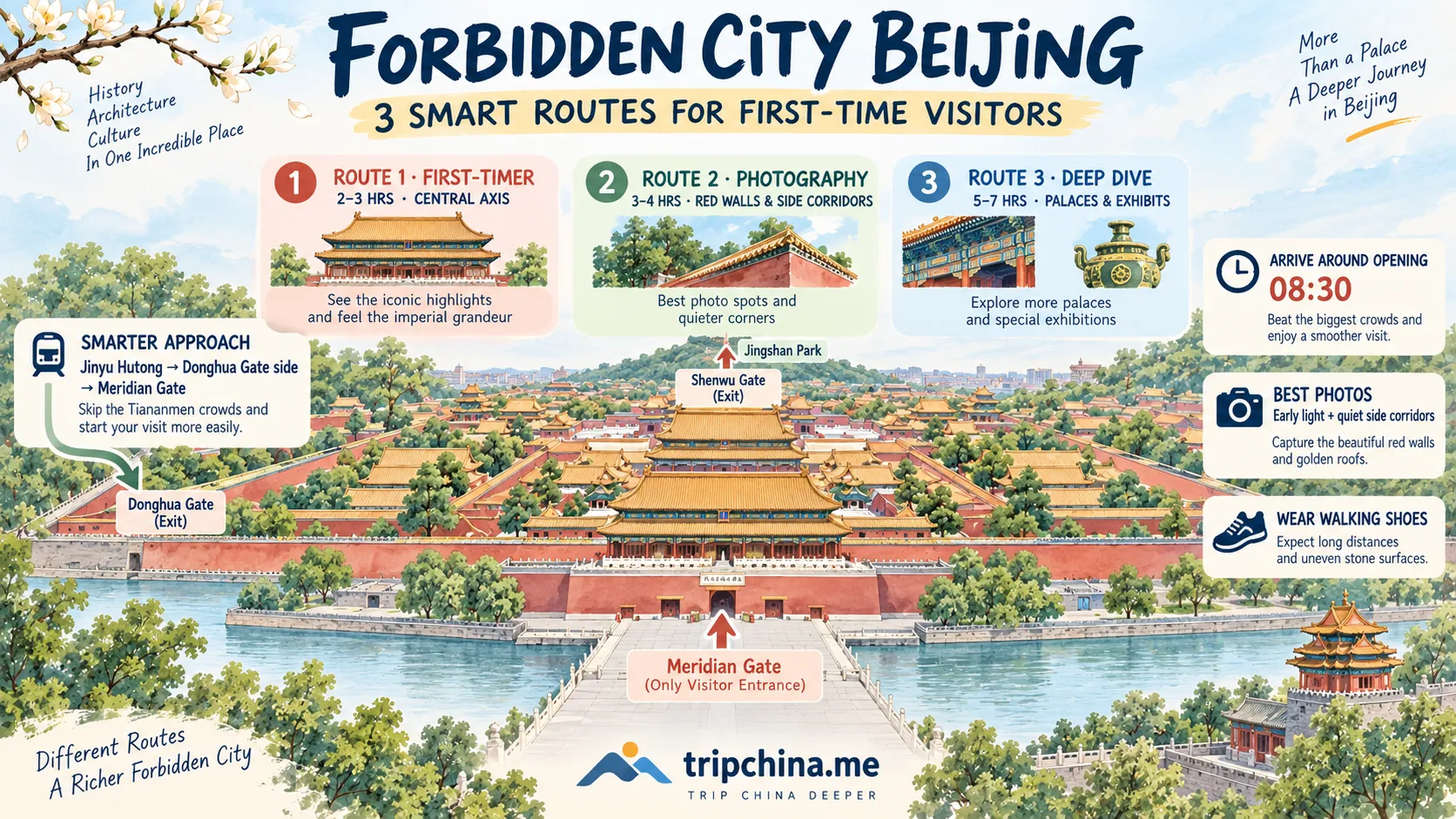
For first-time visitors, the best Forbidden City route starts with a decision many guides overlook: you do not automatically need to approach through Tiananmen Square. Reaching Meridian Gate from the Donghua Gate side can make the start of your visit much simpler.
This Forbidden City Beijing guide focuses on what happens on the ground: three practical routes, crowd timing, photography, luggage, seasonal hours and the details foreign visitors actually need.
| What matters | Quick answer |
|---|---|
| Only visitor entrance | Meridian Gate (午门), South Gate |
| Smarter approach | Jinyu Hutong → Donghua Gate area → East Tongzihe Road → Meridian Gate |
| Opening time | 08:30 |
| Best arrival | Around 08:15–08:30 |
| Best first visit | 3–4 hours |
| Quick highlights route | 2–3 hours |
| Deep visit | 5–7 hours |
| Weekly closure | Monday, except Chinese statutory public holidays |
| Daily visitor limit | 40,000 |
| Best exit for first-timers | Shenwu Gate → Jingshan Park |
| Large luggage | Official storage and transfer service is available |
| Photography | Golden hour and quiet side corridors offer the best Forbidden City photo compositions |
| Prohibited items | Drones are prohibited; equipment restrictions apply inside exhibition halls |
For a first visit, my default strategy is simple: approach from the Donghua Gate side, enter as close to 08:30 as possible, spend less time fighting the central-axis crowd, and finish at Shenwu Gate so you can continue to Jingshan Park.
The biggest mistake many first-time visitors make is assuming that the logical way into the Forbidden City is through Tiananmen Square.
It can work. It is simply not always the most efficient approach.
Tiananmen East and Tiananmen West stations on Metro Line 1 place you around the Tiananmen area. If your plan also includes Tiananmen Square, that route makes sense.
But if the Forbidden City is your only goal, you do not need to make Tiananmen Square part of the approach.
The Palace Museum's current visitor rules specifically state that visitors going only to the museum can reach the Meridian Gate via East or West Tongzihe Road.
My preferred approach is:
Metro Line 8 → Jinyu Hutong Station (金鱼胡同站) → Exit C → Donghua Gate area → East Tongzihe Road → Meridian Gate.
The final section follows the moat toward the entrance.
If Beijing's subway system is unfamiliar, read our Beijing Subway Guide for First-Time Foreign Visitors before your sightseeing day.
I have approached the palace both through the Tiananmen side and from the east. On crowded days, the difference is not the scenery—it is how much of your first hour you spend moving versus queuing.
Do not interpret this as “Donghua Gate is another entrance.” It is not.
You are only using the Donghua Gate side as an approach to the Meridian Gate, which remains the only public visitor entrance.
The Forbidden City is not a place where “see everything” is a useful goal.
Choose according to your available time and what you actually want to see.
| Route | Time | Best for | Main trade-off |
|---|---|---|---|
| Route 1: First-Timer Express | 2–3 hrs | First visit, limited time | Skips much of the side-palace detail |
| Route 2: Photography Route | 3–4 hrs | Architecture and photography | Some areas may temporarily close |
| Route 3: Deep Dive | 5–7 hrs | History and architecture | Physically demanding |
Best for: First visit, limited time, iconic architecture.
Route:
Meridian Gate → Hall of Supreme Harmony → Hall of Central Harmony → Hall of Preserving Harmony → Palace of Heavenly Purity → Hall of Union → Palace of Earthly Tranquility → Imperial Garden → Shenwu Gate.
This is the classic central axis.
It is also the busiest part of the palace, but for a first visit it gives you the clearest understanding of the Forbidden City's ceremonial structure.
The Hall of Supreme Harmony is the visual climax: the monumental ceremonial hall, dragon throne and huge courtyard explain the imperial scale better than almost anywhere else in the complex.
Trade-off: You skip most of the eastern and western palace compounds.
If you only have two hours, keep moving north.
If you have nearly three hours and want extra sights, add a brief detour to the eastern palace area. Just remember that this adds extra walking time to what is designed as a quick highlights route.
Best for: Photography, red-wall compositions and quieter side corridors.
⚠️ Temporary Closure Note: Palace of Prolonging Happiness (Yanxi Palace, 延禧宫) is closed September 1–October 31, 2026, and is scheduled to reopen November 1. Do not build a September or October itinerary around entering it.
Route:
Meridian Gate → west-side red walls → Hall of Supreme Harmony square → East Six Palaces corridors → eastern palace area → Treasure Gallery area → Imperial Garden → Shenwu Gate.
Do not stay in the middle of the central axis all day. Some of the best compositions appear when you move toward the sides.
My favorite photo opportunities include:
Before 09:00 usually gives you the cleanest combination of softer light and lower visitor density. Late afternoon can produce beautiful warm light on the red walls as well.
Yanxi Palace's unfinished Western-influenced structure, Lingzhao Xuan (灵沼轩), is still worth knowing about once the compound reopens.
Temporary conservation work is common in a living heritage site. Check the Palace Museum's current notices before relying on any individual hall.
Best for: History enthusiasts, architecture lovers and travelers who want more than the central axis.
Route:
Meridian Gate → Hall of Martial Valor → Three Main Halls → Hall of Mental Cultivation → West Six Palaces → eastern palace area → Gallery of Clocks area (a separate exhibit zone within the complex) → Shenwu Gate.
The Hall of Martial Valor is particularly interesting when its galleries and exhibitions are open. Check current exhibition notices before assuming every gallery will be accessible during your visit.
The Hall of Mental Cultivation is one of the biggest reasons this route has become more interesting.
After almost a decade of conservation work, it officially reopened on December 26, 2025. The restored displays include the emperor's working and living spaces and the tiny Three Rare Treasures Studio (三希堂), reconstructed according to historical records.
The West Six Palaces add another layer of court life beyond the ceremonial axis.
This route is physically demanding. On one of my longer visits, my total reached roughly 28,000 steps.
Bring water, light snacks and a power bank.
For me, yes.
Both reveal a completely different side of the Palace Museum from the giant ceremonial halls.
The Treasure Gallery occupies the Palace of Tranquil Longevity area and contains imperial objects made from jade, gold, silver and other precious materials.
Highlights include the Jade Mountain of Yu the Great, the Golden Cup of Eternal Unity and the famous Nine-Dragon Wall.
The Jade Mountain alone is easy to underestimate from photographs: it stands more than two meters high and was carved from an enormous piece of jade during the Qianlong period.
The Nine-Dragon Wall is equally worth slowing down for. Look closely at the glazed-tile dragons rather than treating it as another quick photo stop.
The Gallery of Clocks occupies the Hall for Ancestral Worship area and displays elaborate Chinese and imported mechanical clocks once collected by the Qing court.
Some are not simply clocks. They combine timekeeping with music, moving figures and mechanical performances.
The Copper-Gilt Writing Man Clock is one of the collection's most memorable pieces.
Demonstration arrangements can change. Live mechanical clock performances usually run several times daily when operational, but do not plan around an old online timetable.
Check the current museum notice or ask staff about that day's demonstrations when you arrive.
The scale of the Forbidden City encourages people to look straight ahead.
Sometimes the better details are above you.
Caisson ceilings (藻井) are elaborate recessed ceiling structures found in important palace spaces and pavilions.
Look upward when you reach places such as the Pavilion of Ten Thousand Springs in the Imperial Garden and the Hall of Union.
The Hall of Mental Cultivation is another place where the restored interiors reward visitors who stop looking only at the main route.
There are four corner towers around the palace walls.
Beijing's official descriptions note the traditional saying that each has “nine beams, eighteen columns and seventy-two ridges”—a popular way of describing their extraordinary structural complexity rather than a modern architectural measurement.
For photography, some of the best views are actually outside the museum walls, looking across the moat.
Late afternoon is especially good if you have enough energy left after the visit.
Expect a lot of hard stone, uneven surfaces and stairs.
For a substantial visit, 15,000–25,000 steps is entirely realistic.
I once wore fashion sneakers here and regretted the decision before lunch. Proper walking shoes matter more than they seem.
For photos, light or darker saturated colors generally separate well from the palace's red walls. Bright red can disappear into the background.
Yes.
The Palace Museum offers audio-guide services, and its mini-program also provides digital map and guide functions.
Service languages, rental points and prices can change, so confirm the current options at the Meridian Gate visitor area when you arrive.
If you prefer a human guide, use official museum services rather than accepting unsolicited guide offers outside the entrance.
Yes, but I would not plan the visit around the food.
The museum has restaurants, cafés and snack facilities, including the Ice Cellar Restaurant and other visitor-service dining points.
Lunch periods can become busy. Carry water and a small portable snack so you are not forced to interrupt your route just because you are hungry.
After exiting, you will have far more choice. Read our Best Beijing Food Streets for Travelers for better options around the city instead of defaulting to the most tourist-heavy areas.
Yes. The Palace Museum provides official luggage storage and free transfer service.
Large bags and suitcases measuring 20 inches or more fall under the museum's storage rules.
The storage point is near the visitor service center on the western side of Duanmen Square.
Deposited bags can later be collected outside Shenwu Gate or Donghua Gate. Storage hours vary between peak and off-peak seasons.
Valuables, electronics, food and certain other items cannot be deposited. If possible, leaving large luggage at your hotel is still the simplest plan.
A basic digital setup makes the rest of your Forbidden City day easier.
Before sightseeing, our China Payment Guide for Foreign Visitors explains Alipay, WeChat Pay, cards and cash.
For walking around Donghua Gate, Jingshan and nearby hutongs, see the Best Navigation Apps for Foreign Tourists in China.
The biggest seasonal differences are closing time, daylight and outdoor comfort.
| Season | Open | Last Entry | Close | Gallery Last Entry |
|---|---|---|---|---|
| Apr 1–Oct 31 | 08:30 | 16:00 | 17:00 | 16:10 |
| Nov 1–Mar 31 | 08:30 | 15:30 | 16:30 | 15:40 |
April through October gives you longer visiting hours and more daylight.
The Palace Museum currently caps daily attendance at 40,000 visitors, so older claims of 60,000–80,000 daily visitors should not be used for current planning.
April–May and September–October usually offer a better balance of temperature and outdoor comfort than midsummer.
Arriving around opening remains my preferred strategy.
The museum closes earlier during the off-peak season, so long routes require more careful timing.
November and March can be excellent choices if you want cooler weather without the deepest winter cold.
Snow is never something you should build a Beijing itinerary around, but if it happens, the combination of white roofs, red walls and the surrounding moat is exceptional.
Before choosing dates, check our China Public Holidays and Major Crowd Periods Guide. A theoretically “good month” can still be extremely busy during a national holiday.
Your exit determines what comes next.
For most first-time visitors, yes.
Shenwu Gate places you directly opposite Jingshan Park.
If you still have energy, cross the road and climb to Wanchun Pavilion. The climb itself is short, and the reward is the classic elevated view over the Forbidden City's golden roofs and central axis.
If photography matters, save Jingshan for late afternoon when possible.
Beihai Park and the Shichahai area are also relatively easy to continue toward from this side.
Use Donghua Gate if you want to return toward Wangfujing or the eastern side of central Beijing rather than climbing Jingshan.
For shopping afterward, our Beijing Shopping Guide compares the city's major shopping areas instead of assuming Wangfujing is always the best choice.
If you want to leave monumental Beijing behind and walk through older residential neighborhoods instead, try one of our Self-Guided Beijing Hutong Walking Routes.
| Mistake | Better plan |
|---|---|
| Automatically approaching via Tiananmen | Approach Meridian Gate from East Tongzihe Road if Tiananmen is not part of your plan |
| Arriving well after opening | Aim for roughly 08:15–08:30 |
| Treating Donghua Gate as an entrance | Use it only as an approach; enter through Meridian Gate |
| Trying to see everything | Pick one of the three routes |
| Spending the entire visit on the central axis | Move into the eastern or western palace areas |
| Bringing large luggage to security | Use official luggage storage first |
| Bringing drones, tripods or long selfie sticks | Leave restricted equipment at your hotel and follow current exhibition-hall rules |
| Wearing fashion shoes | Expect long distances and uneven stone |
| Assuming every palace is always open | Check temporary closure notices |
| Scheduling Yanxi Palace in Sep–Oct 2026 | It is temporarily closed until Nov 1 |
| Leaving from the wrong gate | Shenwu for Jingshan; Donghua for the eastern city |
Basic photography rules and restricted gear are summarized in the mistake table above.
Inside exhibition halls, photography restrictions can vary, and some temporary exhibitions may prohibit photography completely. Always follow the signs at the entrance to each exhibition and current instructions from Palace Museum staff.
Do not automatically schedule another enormous attraction immediately afterward.
A three-to-five-hour palace visit plus Jingshan is already a substantial sightseeing day.
If you want a contrast, walk through nearby hutongs rather than another monumental site.
If the Great Wall is your next major Beijing day, our Mutianyu Great Wall Route Guide explains cable-car, walking and descent choices before you go.
This article is part of the Beijing Travel Guide Hub.
Want to know what the Forbidden City really feels like before visiting?
This video shows the atmosphere, scenery, and real visitor experience to help you better understand what to expect.
Small amounts of bottled water and portable snacks are practical for a long visit. Use designated visitor areas for eating rather than exhibition rooms, and avoid bringing glass containers or a large picnic setup.
Follow current security instructions if staff advise otherwise.
Photography is possible across much of the outdoor complex. Inside galleries and temporary exhibitions, rules vary by space, so check the entrance signage before shooting.
Do not assume that permission outdoors automatically applies inside an exhibition.
Yes. Restrooms are available at multiple points around the museum and can be located through the official visitor map or mini-program.
If you are following the five-to-seven-hour route, use them when convenient rather than waiting until you reach Shenwu Gate.
Do not plan on carrying a large suitcase through your sightseeing route. Use the museum's designated luggage service, or—more conveniently—leave larger bags at your accommodation before heading out.
This keeps the long palace walk considerably easier.
Partly. The Palace Museum provides barrier-free routes and visitor services, but historic stone thresholds, steps and uneven surfaces remain in parts of the complex.
Strollers and pushchairs can be used, but some palace areas are difficult to navigate. Wheelchair users and families with strollers should follow the official accessible route and ask staff about any temporary route changes.
You do not need a complicated itinerary.
Three decisions matter most: choose the right approach to Meridian Gate, arrive early, and pick a route that matches your available time.
For most first-time visitors, I would enter around 08:30, avoid spending the entire morning on the central axis, explore at least one side-palace area, exit through Shenwu Gate, and finish at Jingshan.
The Forbidden City becomes much easier once you stop trying to “complete” it and start treating it as a place you can explore selectively.
The Palace Museum — Visitor Guidelines
The Palace Museum — Visitor Guide & Opening Hours
The Palace Museum — Official Announcements
Visit Beijing — Official Tourism Portal
Updated September 2026. Opening hours, daily capacity, luggage services, prohibited items, temporary closures and the Hall of Mental Cultivation reopening were cross-checked against current Palace Museum information. Route timing, walking estimates and crowd-avoidance advice combine official access rules with first-hand field observations. Temporary exhibition access, conservation closures and visitor services can change, so current Palace Museum notices take priority on the day of your visit.
TripChina.me creates practical China travel guides shaped by real local experience, helping independent travelers navigate transport, payments, food, neighborhoods, and the cultural details that make traveling in China easier and more meaningful. Find the guide for your destination at tripchina.me.