Our Location:
No. 99, Jiazi Road, Chengdu

 authorChris Lee
Most first-time visitors make the same mistake at Mutianyu: they follow the crowd west without deciding what kind of Great Wall experience they actually want.
The smarter approach is to choose your route before you arrive. This Mutianyu Great Wall guide compares three practical routes, explains the cable car–toboggan ticket trap, covers the current Haohan Slope closure, and shows how to arrive before the biggest crowds.
| Question | Quick Answer |
|---|---|
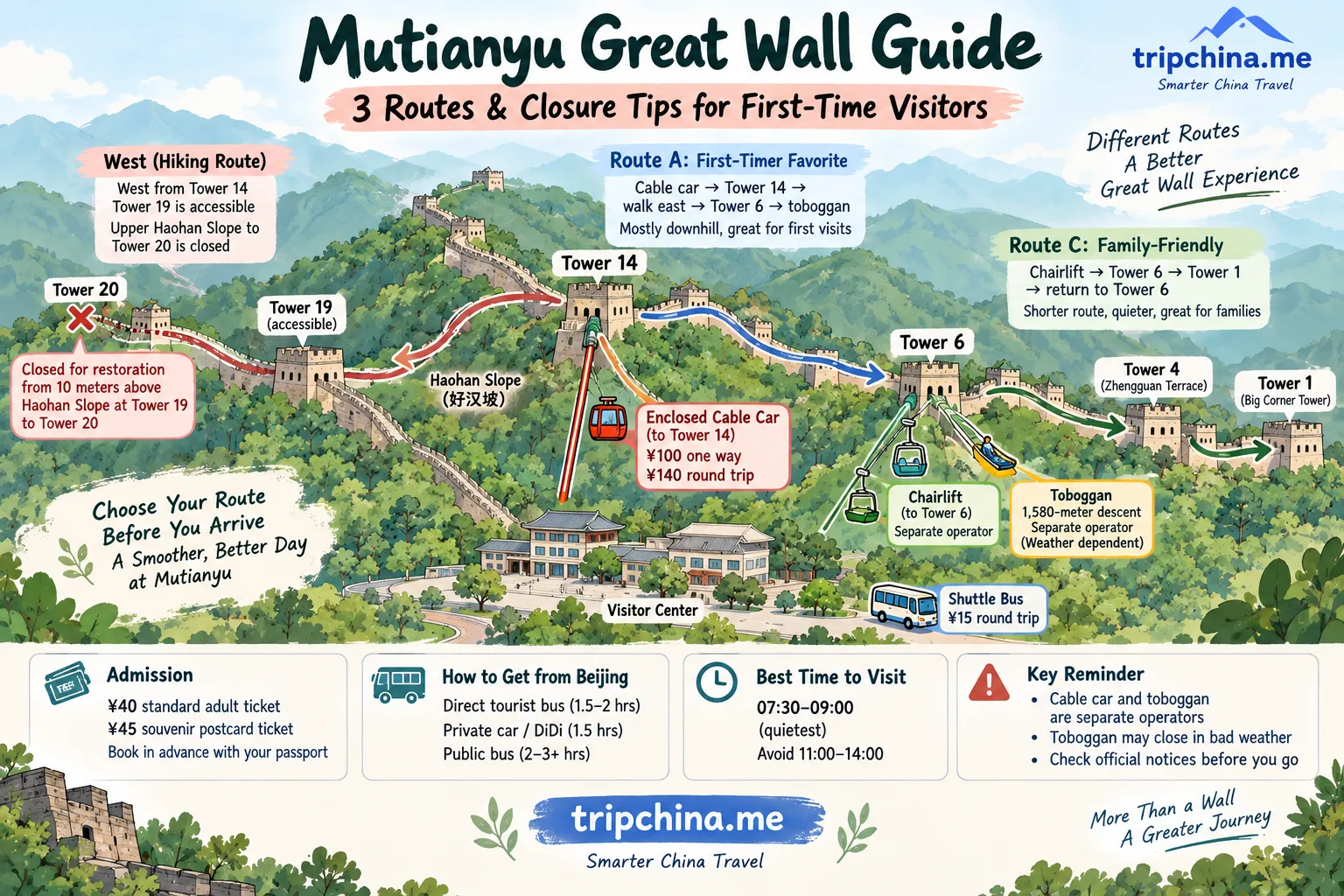
| Best route for most first-timers | Cable car → Tower 14 → walk east → Tower 6 → toboggan |
| Best easy route | Chairlift → Tower 6 → Tower 1 → return to Tower 6 |
| Best route for hikers | West from Tower 14; Tower 19 is accessible, but upper Haohan Slope toward Tower 20 is closed for restoration |
| Best arrival time | Around opening; 07:30–09:00 is ideal in peak season |
| Adult admission | ¥40 standard adult ticket; ¥45 collectible souvenir postcard ticket also available |
| Shuttle bus | ¥15 round trip |
| Cable car / toboggan | Separate operators; tickets are not interchangeable |
| Toboggan | 1,580-meter descent from the Tower 6 side |
| Current major closure | From 10 meters above Haohan Slope at Tower 19 (19号敌楼好汉坡10米以上区域) to Tower 20 |
| Passport booking | Real-name reservation; book in advance with your passport and bring the original |
| Best transport from Beijing | Direct tourist bus for most independent travelers |
| Bad-weather risk | Toboggan and aerial transport may suspend; severe weather can close the scenic area |
Save this quick-reference table for your Mutianyu trip planning.
Badaling Great Wall (八达岭长城) is the name almost everyone knows before arriving in Beijing.
Mutianyu offers a different experience.
Its wall runs across heavily forested mountain ridges, and the combination of restored watchtowers, quieter side sections, an enclosed cable car, open chairlift and toboggan gives you more ways to build your visit.
The biggest difference is not simply distance from Beijing. It is route flexibility.
At Mutianyu, you can choose a short family route, a mostly downhill first-timer route, or a more strenuous western hike.
For first-time visitors, the practical choice usually comes down to this: Badaling is easier to reach from central Beijing, while Mutianyu gives you more flexibility in how you go up, walk the wall and come down.
For a broader overview of Mutianyu's current visitor information, check the official Mutianyu Great Wall website.
For most independent foreign visitors, a direct tourist bus is the easiest balance of price and convenience.
Public transport is cheaper but requires a transfer in Huairou. A private car is simpler for families or small groups but costs substantially more.
| Transport | Typical Time | Typical Cost | Best For |
|---|---|---|---|
| Direct tourist bus | 1.5–2 hrs each way | Around ¥80 round trip on major tourist lines | Most independent visitors |
| Private car / DiDi | Around 1.5 hrs | Varies by pickup, traffic and waiting time | Families and groups |
| 916 Express + local H bus | 2–3+ hrs | Lowest-cost option | Budget travelers with flexible schedules |
Usually, yes.
The Beijing Tourism Distribution Center operates tourist services from central Beijing, including Qianmen. Private operators such as BusDa and MuBus also run direct services.
Pickup points, fares and departure times can change, so confirm your specific service before travel.
One advantage is simplicity: you avoid changing buses in Huairou and usually receive basic route guidance during the journey.
Some bus packages include the scenic-area shuttle or other services; others cover transportation only. Check exactly what your fare includes before paying.
If your departure point requires the metro, our TripChina Guide to the Beijing Subway for Foreign Visitors explains payment, maps and common first-trip mistakes.
For three or four people, it can be.
A private car gives you control over departure time and removes the pressure of catching a fixed return bus.
It is particularly useful for families with young children, travelers with limited mobility, or anyone trying to arrive near opening.
If you plan to book your own ride, set up DiDi for Foreign Travelers in China before your Great Wall day.
Yes, but it takes more effort.
A common route is:
Beijing Subway → Dongzhimen → Bus 916 Express → Huairou Beidajie → local bus such as H23 or H24 toward Mutianyu.
Local H-bus frequencies are much thinner than central Beijing services. Do not build a tight return schedule around one departure without checking the current timetable.
This option works best for budget travelers who are comfortable navigating transfers in Chinese.
Mutianyu currently uses real-name ticketing.
As of September 2026, the official system allows reservations up to 30 days in advance and accepts passports.
Enter your name and document details exactly as they appear on your passport. Bring the original passport used for the reservation.
The current official ticketing system lists a standard adult ticket at ¥40 and a collectible souvenir postcard adult ticket at ¥45. Check the live official ticketing page before payment because available ticket products and prices can change.
Foreign visitors under 18 do not automatically qualify for free entry. Current official ticketing information shows discounted eligibility for qualifying foreign minors, subject to document verification.
If you are using WeChat for bookings or payments in China, set it up before your trip with our WeChat Pay Guide for Foreign Visitors.
This is the decision that matters most.
The restored scenic area is not one single linear experience. Where you go up determines what kind of walk you get—and how you come down.
| Route | Main Section | Time on Wall | Best For | Main Trade-Off |
|---|---|---|---|---|
| Route A: Smart First-Timer | Tower 14 → Tower 6 | 2–3 hrs | Most first visits | Requires different uphill/downhill systems |
| Route B: Western Hike | Tower 14 → toward Tower 19 | 3–4 hrs | Strong hikers | Upper Haohan Slope to Tower 20 currently closed |
| Route C: Quiet East | Tower 6 → Tower 1 → Tower 6 | 2–3 hrs | Families, architecture, quieter walking | Less of the classic western ridge panorama |
Best for: First-time visitors, families and travelers who want scenery without an exhausting climb.
This remains my favorite all-around Mutianyu route.
The Tower 14-to-6 walk is mostly downhill. You still get stairs and uneven stone, but you avoid making Haohan Slope the center of your day.
The route also lets you combine the two sides of Mutianyu instead of riding the same transport system up and down.
Allow roughly 2–3 hours on the wall, plus time for queues and transport.
TripChina tip: If the toboggan queue is very long, take the chairlift down instead. Do not spend an hour in line just because a viral video convinced you the slide is mandatory.
[Image: Mutianyu Tower 14 view east toward Tower 6 | Alt text: Mutianyu Great Wall view east from Tower 14 along the classic cable-car-up and toboggan-down route for first-time visitors]
Not by the traditional wall route.
As of September 2026, the section from 10 meters above Haohan Slope at Tower 19 (19号敌楼好汉坡10米以上区域) to Tower 20 is temporarily closed for restoration.
Tower 19 itself remains accessible. The lower section of Haohan Slope before the closure point also remains open.
Visitors continuing toward Towers 21–23 may detour via the ecological trail outside the wall where officially permitted.
The restoration began on April 7, 2026. The scenic area has not published a fixed reopening date; reopening will be announced according to construction progress.
You can therefore still hike west from Tower 14 toward Tower 19, but do not plan on reaching Tower 20 along the normal wall route.
Check the official restoration announcement and current scenic-area notice before your visit.
Haohan Slope is one of Mutianyu's most physically demanding sections.
The famous upper climb toward Tower 20 contains hundreds of steep, uneven steps. Before the current closure, this was the section where many visitors slowed to a crawl.
I have climbed it twice. The first time, I stopped three times. The second time, I made it without stopping and felt genuinely proud.
For now, treat the restoration barrier as the end of the normal western wall route. Do not cross barriers or attempt to bypass the closed section yourself.
Best for: Families, visitors who prefer a shorter route, and travelers interested in the eastern architecture.
Take the chairlift to Tower 6, walk east toward Tower 1, then return to Tower 6.
Tower 4, Zhengguan Terrace (正关台), is the architectural highlight. Its unusual connected-tower structure makes it one of Mutianyu's most distinctive defensive buildings.
Continue toward Tower 1, the Big Corner Tower (大角楼).
Three lines of wall meet around this eastern end: the main wall extends toward Gubeikou and Badaling, while a branch wall runs south.
This eastern section often feels calmer than the western ridge.
Return to Tower 6 and descend by toboggan or chairlift.
[Image: Zhengguan Terrace at Mutianyu | Alt text: Zhengguan Terrace near Tower 4 on the quieter eastern route of Mutianyu Great Wall]
You do not need to turn every watchtower into another checklist item.
A few locations genuinely change the experience.
Tower 14 is where the enclosed cable car brings you onto the wall.
It is one of the busiest nodes at Mutianyu, so do not judge the entire experience by the first five minutes here.
The famous “Good Man” photo area attracts queues. If one photo point is packed, keep walking rather than spending your best early-morning time waiting for the same shot.
This is also your decision point: west toward the steeper ridge or east toward the mostly downhill walk to Tower 6.
The ridge becomes more visually dramatic as you look west from around Tower 15.
The wall climbs and falls across the mountains, creating the layered watchtower composition many travelers imagine before visiting China.
This is where I have taken some of my favorite Mutianyu photos.
If the light is clear, slow down here rather than rushing toward a checklist destination.
Zhengguan Terrace near Tower 4 is one of Mutianyu's most unusual defensive structures.
Its connected layout feels very different from the single watchtowers along much of the ridge.
For architecture rather than panoramic scenery, this is one of the strongest reasons to explore the eastern side.
Tower 1, or Big Corner Tower, sits near the eastern end of the main visitor route.
The defensive walls extend in three directions around this area, which explains its “corner” name.
It is quieter, more architectural and less about reaching a famous summit.
For many visitors, yes—if the queue is reasonable.
The Mutianyu slide is about 1,580 meters long and descends from the Tower 6 side through the forest.
You control your speed with a hand brake. The actual ride can feel surprisingly short after a long wait.
That is why my rule is simple:
Short queue: take the toboggan.
Long queue: take the chairlift down.
On busy days, the wait can become longer than the experience itself.
Weather matters too. The toboggan may suspend operation in rain or other unsafe conditions.
If toboggan service closes, the chairlift from the Tower 6 side is the most practical backup when it remains operational.
For families, treat online age and height limits as planning guidance rather than a substitute for the operator's current safety notice. Several established travel sources state that children under 10 should ride with an adult, but current restrictions should still be confirmed at the entrance before purchasing.
If you are traveling with an older family member, check the operator's current age restriction before planning the toboggan as the only way down.
Because Mutianyu's enclosed cable car and its chairlift/toboggan system belong to separate operators.
Their tickets are not interchangeable.
| Feature | Enclosed Cable Car | Chairlift / Toboggan |
|---|---|---|
| Wall access | Tower 14 | Tower 6 |
| Ride type | Enclosed cabin | Open chairlift / slide |
| Best use | Western or middle routes | Eastern route / toboggan descent |
| Same operator? | No | Separate from enclosed cable car |
| Tickets interchangeable? | No | No |
This matters most on Route A.
If you want to take the enclosed cable car to Tower 14, walk east to Tower 6, then use the toboggan, do not automatically buy a round-trip enclosed cable-car ticket.
The official ticketing system currently lists the enclosed cable car at ¥100 one way or ¥140 round trip.
The chairlift/toboggan is operated separately. Do not assume one online purchase covers both systems; confirm the current operator fare and sales channel before buying.
This small detail saves a surprising number of visitors from buying the wrong product.
For most visitors, yes.
The scenic-area shuttle connects the main service area with the uphill entrance zone, avoiding an approximately 3 km road walk.
The official round-trip shuttle ticket is currently ¥15.
Unless hiking the access road is deliberately part of your plan, save your legs for the Great Wall.
Some direct tourist-bus products include the scenic shuttle while others do not. Check the package description rather than assuming it is included.
Arriving near opening remains the single most useful crowd strategy.
During the current peak season, the scenic area opens at 07:30. Weekday mornings give you the best chance of experiencing quieter sections before large tour groups build.
| Time | What to Expect | My Take |
|---|---|---|
| 07:30–09:00 | Quietest practical morning window | Best |
| 09:00–11:00 | Visitor numbers building | Still good |
| 11:00–14:00 | Usually the busiest core period | Avoid if possible |
| After 14:00 | Crowds may ease | Good if return transport allows |
These are planning ranges, not guaranteed crowd counts.
Weekends, summer vacation and Chinese public holidays can change the pattern dramatically.
Before choosing your Great Wall date, check our TripChina Guide to China Public Holidays so you do not accidentally apply a normal weekday strategy to a national holiday.
Spring brings greener hillsides and generally comfortable walking weather.
Summer is lush but can be hot, humid and exposed. Carry more water than you think you need.
Autumn is visually spectacular, especially when the surrounding mountains turn red and gold. Try to visit on a weekday and arrive near opening during peak foliage periods.
Winter brings colder temperatures and shorter days but often fewer visitors. Snow can transform the landscape, though icy steps require extra care.
Yes, but only as a seasonal summer program. There is no regular year-round night service in spring, autumn or winter unless a special event is announced.
In 2026, the night route covered Towers 10–15. Night admission began at 17:30, with last entry at 20:30 and closing at 21:00.
The program was interrupted several times by weather and flood-control measures. It resumed with the scenic area on August 13, while another night session was cancelled on August 25 because of weather.
The lesson is simple: if you want the night tour, check the official notice page for your exact date rather than relying on the seasonal schedule alone.
Mountain weather can change the day's transport plan quickly.
The toboggan may suspend operation in rain or unsafe conditions. Cable-car and chairlift services can also stop when conditions make aerial transport unsafe.
In severe weather, the entire scenic area can close.
Mutianyu issued temporary closures during flood-control and severe-weather events in summer 2026.
Check the official notice page on the morning of your visit if heavy rain, thunderstorms or strong winds are forecast.
If the toboggan closes but the scenic area and chairlift remain open, use the chairlift as your Tower 6 descent. If the scenic area itself closes, follow the refund instructions issued for your specific date.
Only partially.
The visitor center provides accessibility services, and the enclosed cable-car side is generally the more practical option for travelers with limited mobility.
But reaching the upper area does not make the Great Wall itself wheelchair accessible.
Historic steps, steep gradients and uneven stone remain fundamental parts of the site. Assistance may be necessary even on relatively accessible sections.
The toboggan should not be treated as an accessible transport option.
If wheelchair accessibility is your main criterion, compare Mutianyu with Badaling before deciding which Great Wall section to visit.
Do not overpack, but do not underestimate the exposure. A small daypack works best; there is little reason to carry a large backpack onto the wall.
For everyday spending, our Alipay Guide for Foreign Visitors explains how to set up mobile payment before you arrive.
Avoid taking large luggage onto the wall. If you are arriving with a suitcase, confirm current storage arrangements at the visitor center before heading uphill.
You may spot cats around the visitor facilities and parts of the scenic area.
Enjoy them from a respectful distance and avoid disturbing or feeding them unfamiliar food.
| Mistake | Better Plan |
|---|---|
| Following everyone west toward Haohan Slope without choosing a route | Decide between Routes A, B and C first |
| Planning to climb from Tower 19 directly to Tower 20 | Upper Haohan Slope is currently closed |
| Buying a round-trip cable-car ticket before deciding on the toboggan | Choose your ascent and descent first |
| Assuming cable car and toboggan tickets are interchangeable | They belong to separate operators |
| Arriving late morning | Aim for opening or shortly afterward |
| Assuming the toboggan always operates | Have the Tower 6 chairlift as a backup |
| Spending energy walking the access road | Use the shuttle unless you deliberately want the extra walk |
| Wearing fashion shoes | Use shoes with good grip |
| Relying on one local bus departure | Check H-bus timing before leaving Beijing |
| Ignoring weather alerts | Check official notices before departure |
This article is part of the Beijing Travel Guide Hub.
Technically yes, but it makes for a rushed first visit.
Mutianyu is outside central Beijing, while the Forbidden City deserves several hours on its own. If you attempt both, start very early and treat Mutianyu as a shorter 2–3 hour wall visit rather than a full hiking day.
Do not assume recreational drone flying is permitted simply because Mutianyu is outside central Beijing.
Drone operations in China are subject to aviation, airspace and local scenic-area restrictions. If aerial photography matters to you, check current authorization requirements before bringing or operating a drone.
The enclosed cable car can currently be booked through Mutianyu's official ticketing system together with admission and shuttle options.
The chairlift/toboggan belongs to a separate operator. Do not assume an online cable-car booking includes the chairlift or toboggan; check the separate operator's current sales channel when planning Route A.
Yes.
You can skip the scenic shuttle and walk the roughly 3 km access road. You can also add substantially more hiking by avoiding mechanical transport on the mountain.
For most first-time visitors, saving your energy for the Great Wall itself is the better use of time.
The official booking system requires real contact information, including a phone number, and supports passport-based reservations for foreign visitors.
If your international number is rejected or you cannot complete the booking, contact the official ticketing service at 010-61626928 rather than entering a false Chinese number.
Children can use the toboggan subject to the operator's current safety rules.
Established travel sources commonly report that children under 10 must ride with an adult. Because age and height rules are safety-critical and can be updated, confirm the current posted limits at the toboggan entrance before purchasing.
Multiple current travel operators and specialist Great Wall guides report an upper age restriction for the toboggan, commonly stated as age 60.
Because the toboggan is operated separately from the main scenic area, confirm the current operator rule on arrival before building your route around it.
If the toboggan is not available to someone in your group, choose a route that allows an alternative descent rather than separating the group unexpectedly.
During full scenic-area or night-tour closures in summer 2026, Mutianyu instructed affected visitors to request refunds through their original ticket-purchasing channel.
A partial facility suspension is different. If only the toboggan or another transport system closes while the scenic area remains open, refund rules may depend on the specific operator and ticket product.
Check the notice issued for your date before requesting a refund.
The biggest mistake at Mutianyu is not choosing the “wrong” watchtower. It is arriving without deciding where you want to walk, how you want to go up, and how you want to come down.
That matters even more while the upper Haohan Slope between Towers 19 and 20 is under restoration.
Check the official Mutianyu notice page on the morning of your trip for the latest closure, weather and transport updates. Then arrive early and spend your time walking the wall—not fixing a route mistake at the ticket gate.
Save this Mutianyu route guide for your Beijing trip before you go.
Mutianyu Great Wall Official Website — Official opening hours, real-name reservations, visitor information and current notices
Mutianyu Great Wall Tower 19–20 Restoration Announcement — Official April 2026 closure notice for the upper Haohan Slope between Towers 19 and 20
Mutianyu Great Wall Official Ticketing System — Current ticket products, 30-day reservation window, shuttle and enclosed cable-car fares
Mutianyu Great Wall Official Notices — Weather closures, reopenings and night-tour operational changes
Updated September 2026. Admission products, passport reservations, the 30-day booking window, opening hours, shuttle and enclosed cable-car fares were checked against Mutianyu's official website and ticketing system. The Tower 19–20 closure was verified against the scenic area's April 2026 restoration notice. Night-tour changes and weather closures were cross-checked against official summer 2026 announcements. Chairlift and toboggan rules are operator-specific, so current safety restrictions should be confirmed on the day of travel.
TripChina.me creates practical China travel guides shaped by real local experience, helping independent travelers navigate transport, payments, food, neighborhoods, and the cultural details that make traveling in China easier and more meaningful. Find the guide for your destination at tripchina.me.