Our Location:
No. 99, Jiazi Road, Chengdu

 authorChris Lee
Most Beijing hutong guides treat every old lane as interchangeable. They are not. Some routes are better for history, some for food and photography, while others are simply better if you want to escape the biggest crowds.
These four routes create a practical self-guided Beijing hutong walking tour, with exact metro starts, realistic walking times, food stops and the details that matter once you are actually on the street.
| Route | Best For | Start | Time | Approx. Distance | Main Character |
|---|---|---|---|---|---|
| Route 1: Classical Heritage Loop | First-time visitors | Yonghegong Station, Exit F | 5–7 hrs | 6–7 km | Heritage + lakes |
| Route 2: Hidden Literary Walk | History + photography | Fuchengmen Station, Exit B | 3–4 hrs | ~3 km | Quiet historic Beijing |
| Route 3: Food & Temple Route | Food + local neighborhoods | Caishikou Station, Exit G | 2–3 hrs | ~2–3 km | Muslim food + old Beijing |
| Route 4: Quiet Commercial Lane | Shops + snack hopping | Dongsi Station, Exit D | 3–4 hrs | ~3 km | Residential + independent shops |
Best first route: Route 1.
Best for fewer tourists: Route 2.
Best for food: Route 3.
Best for a slower local afternoon: Route 4.
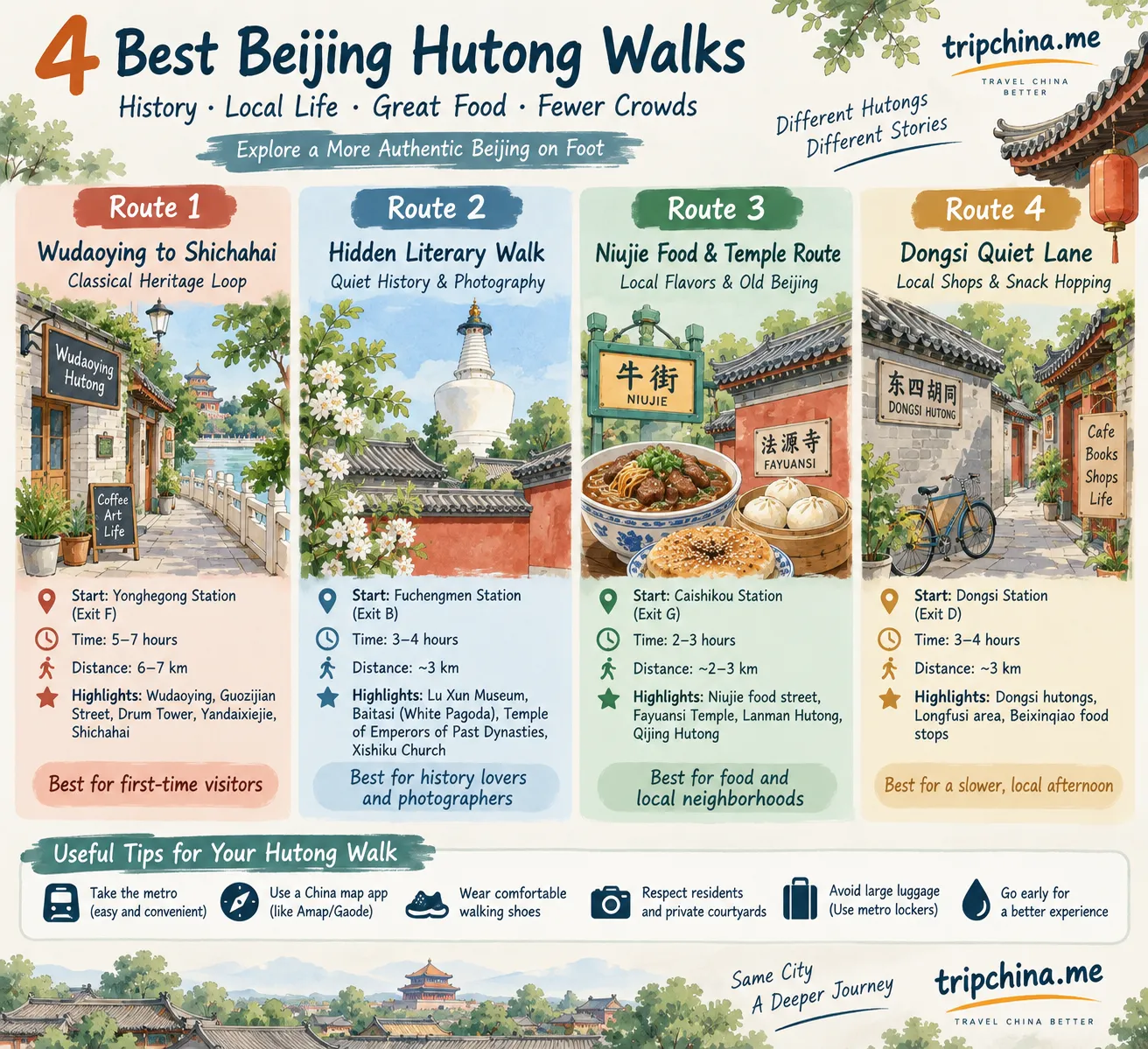
All four work as self-guided walks and are easy to reach by metro. If this is your first time using Beijing's subway, read the Beijing subway guide for first-time foreigners before setting out.
For most first-time visitors, this is the one route I would choose. It combines three things that make Beijing hutongs interesting: a historic lane with real commercial life, a preserved imperial-era street, and a lakeside finish at Shichahai.
Wudaoying Hutong is a 632-meter east-west lane filled with independent coffee shops, small galleries, boutiques and restaurants.
It is more local in scale than Nanluoguxiang, but it is not frozen in time. New shops open regularly, and the street continues to evolve.
A Saturday 8:15am visit still reveals a quieter local rhythm as the coffee shops begin opening. The street remains manageable around 10am, while noon brings a much heavier tourist flow.
Honest take: Wudaoying is not a hidden hutong anymore. It is popular and increasingly commercial. But the balance between neighborhood life and visitor-oriented businesses still works better here than on Beijing's busiest tourist streets.
If coffee is part of the reason you are coming, several worthwhile stops are covered in our guide to independent Beijing hutong coffee shops.
Start at Yonghegong Station (雍和宫站), Exit F.
Walk south on Yonghegong Street (雍和宫大街) for about 3 minutes, then turn right into Wudaoying Hutong (五道营胡同).
Walk the full length of Wudaoying. Without stops, it takes roughly 15 minutes.
Continue west through Jianchang Hutong (箭厂胡同), a quieter lane connecting the area with Guozijian Street (国子监街). This section takes around 8 minutes.
Guozijian Street is one of the better-preserved historic streets in central Beijing. Four ornate pailou (牌楼) archways mark the street, while the Confucius Temple (孔庙) and Imperial College (国子监) sit along the route.
From Guozijian, continue toward Andingmen Inner Street (安定门内大街) and then into Beiluogu Xiang (北锣鼓巷), a quieter northern counterpart to Nanluoguxiang.
Continue toward Gulou East Street (鼓楼东大街), then the Drum Tower (鼓楼) and Bell Tower (钟楼).
The final section follows Yandaixiejie (烟袋斜街), a roughly 232-meter diagonal lane, into Shichahai (什刹海).
| Segment | Approx. Distance | Time | Best Window |
|---|---|---|---|
| Wudaoying Hutong | 632 m | 30–45 min | 8:00–10:00 |
| Jianchang Hutong | ~200 m | 10–15 min | Anytime |
| Guozijian Street | ~669 m | 45–60 min | 9:00–11:00 |
| Beiluogu Xiang | ~500 m | 20–30 min | Late morning |
| Drum & Bell Tower area | ~300 m | 15–20 min | Late morning |
| Yandaixiejie | 232 m | 20–30 min | Early afternoon |
| Shichahai | ~1.5 km loop | 60–90 min | Late afternoon |
Total: roughly 5–7 hours and 6–7 km, depending on stops.
If you have only half a day, start at Wudaoying early, continue to Guozijian, then shorten the route toward Yandaixiejie and Shichahai.
If crowds bother you, start around 7:30–8:00am. The Yandaixiejie–Shichahai section becomes considerably busier later in the day; ending around the Drum Tower is a reasonable alternative.
Route 2 is one of the better quiet hutongs in Beijing without crowds options. It stays in Xicheng District (西城区) and links several historical sites without relying on one heavily commercialized pedestrian street.
It is a better choice for travelers interested in architecture, literary history and photography than for someone trying to see Beijing's most famous sights in one day.
Start at Fuchengmen Station (阜成门站), Exit B.
Walk north for about 5 minutes to the Beijing Lu Xun Museum (北京鲁迅博物馆).
Lu Xun lived here from 1924 to 1926. The museum and former residence focus on his life, writing and the intellectual world of early 20th-century Beijing.
Hours: 09:00–17:00, with last entry at 16:30. Closed Mondays except statutory holidays. Admission is free. Foreign visitors can use a valid passport for admission; check the museum's current visitor notice before going in case of temporary adjustments.
From the Lu Xun Museum, walk east along Fuchengmen Inner Street (阜成门内大街) for roughly 8 minutes to Miaoying Temple (妙应寺), better known as Baitasi or the White Pagoda Temple.
The Yuan-dynasty White Pagoda dates to 1271 and was designed by the Nepalese architect Araniko.
As of September 2026, regular visiting hours are 09:00–17:00, with ticket sales and admission ending at 16:30. The temple is normally closed on Mondays. The standard admission price is ¥20.
During the temporary July 5–August 30, 2026 summer schedule, Baitasi switched its weekly closure from Monday to Tuesday and offered extended evening hours on Fridays and Saturdays. The normal Monday closure resumed after the summer arrangement ended.
For photography, do not rush straight inside.
Walk toward the lanes east of the temple, where the white pagoda rises above red walls and gray hutong roofs. Late-afternoon light can be especially good on clear days.
Continue east toward the Temple of Emperors of Past Dynasties (历代帝王庙), then Zhengyang Bookstore (正阳书局) near the Wansong Old Man Pagoda (万松老人塔).
The bookstore is worth a short stop if you are interested in old Beijing maps, local history and urban culture.
From there, continue toward Xishiku Church (西什库教堂), one of Beijing's most distinctive historic Catholic churches.
| Traveler | Fit |
|---|---|
| History lovers | Excellent |
| Photographers | Excellent |
| Solo travelers | Excellent |
| Families with young children | Good, but slower-paced |
| First-time visitors with only one day | Route 1 is usually more varied |
Total distance: around 3 km.
Time: approximately 3–4 hours.
If you want to extend the walk, continue toward Beihai Park or Jingshan Park. If you are combining the neighborhood with Beijing's imperial core, our Forbidden City travel guide explains how to avoid wasting the busiest part of the day.
Route 3 combines Niujie (牛街), Fayuansi Temple (法源寺) and the surrounding historic lanes.
Unlike Route 1, food is not something you squeeze in between sights here. It is one of the main reasons to come.
For a wider comparison of local eating areas, see our guide to the best Beijing food streets for travelers.
Start at Caishikou Station (菜市口站), Exit G and walk west toward Niujie.
Niujie is one of Beijing's best-known areas for traditional Muslim food.
Approximate 2026 street prices:
| Food Stop | What to Try | Approx. Price |
|---|---|---|
| Baiji Niangao (白记年糕) | Sticky rice cakes and sweets | ~¥21/jin, varies by item |
| Hongji Baozi (洪记包子) | Halal beef/lamb buns | ~¥2.5 each |
| Manji Shaobing (满记烧饼) | Sesame flatbread | ~¥1–3 each |
| Yueshengzhai (月盛斋) | Braised beef/lamb | Varies by weight/item |
Remember that 1 jin (斤) = 500 grams. When buying food by weight, confirm whether the displayed price is per jin, per portion or per piece before ordering.
Weekends can bring 20–30 minute queues at popular Niujie counters. Weekday mornings are much easier.
Honest take: come for reliable traditional flavors and the neighborhood atmosphere rather than expecting every bite to be a life-changing discovery.
Small food shops increasingly accept mobile payment, but payment setups vary. Foreign visitors unfamiliar with QR payments should read the foreign payment guide for China travel before the trip.
From Niujie, walk toward Fayuansi Temple (法源寺).
Founded in the Tang Dynasty, Fayuansi is one of Beijing's oldest Buddhist temples. In spring, its courtyard lilacs are one of the area's seasonal highlights.
Published visitor information currently lists approximately 08:30–16:00, with last entry reported as early as 15:30. Admission is free. No regular Monday closure is commonly listed, but temple access can change for religious activities or temporary arrangements, so check the current notice before making Fayuansi the fixed point of your day.
Continue into Lanman Hutong (烂缦胡同) and the surrounding Fayuansi historic district.
This area has undergone gradual conservation-led urban renewal. Historic residential lanes now sit alongside small cafés, cultural spaces and restored streetscape elements without completely losing their residential function.
Continue through Qijing Hutong (七井胡同) and Xizhuan Hutong (西砖胡同).
These are not museum streets. People still live here.
You may see signs such as:
私人住宅,请勿打扰
Private residence — please do not disturb.
Treat them literally. Do not step through courtyard doors or photograph the inside of private homes without permission.
| Stop | Time Needed | Admission |
|---|---|---|
| Niujie | 60–90 min | Free |
| Fayuansi Temple | 30–45 min | Free |
| Lanman Hutong | 20–30 min | Free |
| Xizhuan / Qijing Hutongs | 20–30 min | Free |
| Total | 2–3 hrs | Mostly free |
After a long food-and-hutong walk, many travelers start looking for Beijing duck without knowing which famous names are actually worth the detour. Our separate guide compares the best Beijing roast duck shops for travelers.
Dongsi Hutong works differently from Wudaoying or Nanluoguxiang.
Rather than one obvious visitor street, the Dongsi (东四) area is a network of residential hutongs between Dongsi North Street (东四北大街) and the Beixinqiao area, with cafés, bakeries, bookstores and neighborhood businesses scattered between older courtyard lanes.
Start at Dongsi Station (东四站), Exit D.
Walk north along Dongsi North Street, then turn into Dongsi Santiao (东四三条).
The lane is broader than many smaller hutongs and lined with courtyard houses.
Continue through the Dongsi hutong network toward Dongsi Qitiao (东四七条) and neighboring residential lanes.
The attraction here is not one must-see monument. It is the rhythm of moving between commercial streets and quieter residential blocks.
Some independent shops and cafés change frequently, so I would not build the route around one specific boutique. Use the neighborhood itself as the route and treat individual shops as optional stops.
Continue toward Longfusi (隆福寺).
The wider Longfusi area has been redeveloped into a cultural and commercial district with cafés, shops and cultural venues.
Do not plan this walk around guaranteed rooftop access. Rooftop spaces, exhibitions and access arrangements can change with events and venue operations. Check the current Longfusi venue information on the day if a rooftop viewpoint matters to you.
Continue north toward Beixinqiao (北新桥), where local food becomes a stronger part of the walk.
Traditional Beijing dishes in this area include luzhu (卤煮) and chaogan (炒肝).
At established luzhu shops, expect roughly ¥25–40 for a bowl depending on the portion and branch. At Yaoji Chaogan (姚记炒肝), smaller portions of chaogan are commonly around ¥12–15, though current menu prices should be checked at the counter.
These dishes use pork offal and have strong textures and flavors. If that does not sound appealing, there is no reason to force the experience simply because it is “local.”
The foods around Dongsi and Beixinqiao generally work better as multi-stop tasting than one large meal.
Choose Route 4 if you want a quieter afternoon built around residential lanes, independent businesses and occasional food stops.
It is also the easiest of these four routes to shorten. If one lane feels too quiet or a shop has closed, move back toward Dongsi North Street or continue toward Beixinqiao.
Total distance: approximately 3 km.
Time: 3–4 hours, longer if you stop repeatedly for food or coffee.
Best for: repeat visitors, slow travelers, snack hopping and anyone who does not need a famous attraction every 20 minutes.
Timing changes the experience more than most visitors expect.
For a Beijing hutong walk early morning is usually the strongest choice: the lanes are quieter, residential life is more visible, and popular sections have not yet filled with day visitors.
| Start Time | What to Expect |
|---|---|
| 07:30–08:30 | Quiet residential atmosphere; best for walking and photos |
| 09:00–10:30 | Shops opening; good balance of activity and manageable crowds |
| 11:00–14:00 | Busiest period around major tourist corridors |
| 15:00–16:00 | Good second choice; useful for afternoon photography |
| After dark | Commercial areas remain active, but residential lanes become quieter and harder to navigate |
My preferred window is 07:30–08:30 if the route does not depend on attractions that open later.
If your route includes temples, museums or shops, use the early hour for walking and reach the attraction after opening.
Chinese public holidays can completely change normal crowd patterns. Before planning an October, May or Spring Festival visit, check the China public holiday calendar and crowd guide.
Old Beijing is easy to explore on foot, but the lanes were not designed as modern pedestrian attractions.
Expect uneven brick, patched pavement, curbs, bicycles, e-bikes, delivery scooters and occasional narrow sections. Walk along the side of narrow lanes and check behind you before stepping sideways to take a photo.
Large rolling suitcases are a bad idea. Bring a small daypack instead.
Do not rely on Google Maps alone for lane-level navigation in China. Download a locally reliable mapping option before starting; our guide to the best navigation apps for foreign tourists in China explains the practical differences.
Most importantly, remember that a hutong can be historically significant and still be someone's front yard.
Do not block doorways, enter open courtyard gates, photograph residents at close range without permission, or treat door stones and historic structures as photo props.
Too many hutong itineraries concentrate almost entirely on Nanluoguxiang and Shichahai while overlooking residential networks around Xicheng and Dongsi.
Those famous areas are not inherently bad, but they show only one highly commercialized version of Beijing's old neighborhoods.
Nanluoguxiang, Wudaoying, Baitasi and Dongsi serve very different purposes.
A traveler looking for historic architecture should not choose a route the same way as someone primarily looking for street food.
Route 1 is roughly 6–7 km before you count detours inside attractions.
For most visitors, combining two full hutong routes in one day turns an enjoyable walk into a mileage exercise.
Wudaoying is not hidden. Baitasi is not hidden.
They are simply less overwhelming than Beijing's most heavily visited tourist corridors. That is already useful.
Hutongs are living residential communities, not outdoor photography sets.
The best-looking courtyard is not automatically a public attraction. If a doorway is marked 私人住宅 (private residence) or 请勿打扰 (please do not disturb), stay outside.
This article is part of the Beijing Travel Guide Hub.
Yes, if you want a lively commercial pedestrian street and do not mind crowds. It is much less convincing if your priority is quiet residential hutong life. For a more traditional walking experience, use one of the four routes above and treat Nanluoguxiang as an optional commercial stop.
Wear comfortable walking shoes with decent grip. Old brick, stone paving and patched road surfaces can be uneven, especially after rain. In summer, bring sun protection and water; in winter, layers work better because you will repeatedly alternate between walking and stopping.
Only partly. Route 4 around Dongsi is the easiest of these four options, but continuous barrier-free access should not be assumed. Traditional residential hutongs can still have curbs, uneven paving and narrow sections.
Yes, public toilets exist throughout Beijing's older neighborhoods, but they are not always obvious to foreign visitors. Look for 公共厕所 (gōnggòng cèsuǒ) on local map apps and use facilities at metro stations or major public attractions when convenient. Do not wait until you urgently need one before searching.
You can photograph public lanes, architecture and streetscapes, but private courtyards remain private homes. Do not enter an open doorway or point a camera into someone's living space without permission. Signs saying 私人住宅,请勿打扰 mean exactly what they say.
For drones, the rules are much stricter: as of September 2026, all of Beijing is controlled airspace and outdoor drone flights require authorization. Do not bring a drone expecting to launch it casually above a hutong.
Major commercial areas remain active into the evening, but smaller residential lanes become quieter and can be poorly lit. For a first visit, finish unfamiliar residential sections before dark and use the busier streets or metro for your return.
There is no dedicated luggage-storage system serving these four walking routes. If you are arriving directly from an airport or train station, leaving large bags at your hotel or another confirmed storage facility before the walk is the safest plan.
Some larger metro stations may have lockers or other storage facilities, but availability is not universal and should be checked in advance. Do not rely on a café to hold your luggage; a small bag may occasionally be accepted for customers, but this is informal rather than a service.
Use a China-friendly map such as Amap/Gaode (高德地图) and save your starting point plus major intersections before walking.
If you lose the route, head toward a major road such as Dongsi North Street, Andingmen Inner Street or Fuchengmen Inner Street, then reorient from there. Hutong lane signs are often primarily in Chinese, so keeping the Chinese place names in this guide on your phone helps.
Yes, but the choice is limited because Niujie is strongly associated with halal beef and lamb dishes. Baiji Niangao and some plain shaobing can be meat-free, but recipes vary and shared preparation areas mean strict vegetarians should ask before ordering.
For travelers who need a wider choice of vegetarian snacks, Route 2 or Route 4 is generally easier.
You can, but it is not recommended for most visitors. Route 1 alone covers roughly 6–7 km before attraction detours, and combining two full routes usually means rushing through the neighborhoods rather than experiencing them.
Choose one main route per day. If you still have energy, add only a short nearby extension.
No. Public hutong lanes are free to walk, so there is no ticket for a self-guided hutong walk.
Individual museums, temples and heritage sites along a route may have their own admission rules or fees.
They can be. Narrow residential lanes are shared spaces, and e-bikes or delivery scooters may approach quietly and pass close to pedestrians.
Walk near the side of the lane, look behind you before stepping into the roadway for photos, and avoid blocking the path while checking your phone.
For a first visit, choose Route 1 for the strongest mix of historic streets, architecture and recognizable Beijing scenery.
Choose Route 2 if you care more about history and photography than famous attractions. Choose Route 3 for Niujie food and the Fayuansi historic district. Choose Route 4 when you want a slower neighborhood walk with fewer must-see stops.
The point is not to walk as many hutongs as possible. Pick the route that matches what you actually want to see, start earlier than the tour groups, and leave enough time to notice the ordinary street life between the landmarks.
This article is part of the Beijing travel hub series for independent travelers.
Beijing Municipal Administration of Cultural Heritage — Baitasi Visitor Information
Beijing Tourism — Fayuansi Historic District
Beijing Municipal Government — Beijing Unmanned Aircraft Regulations
Beijing Tourism — Lanman Hutong Urban Renewal
Updated September 2026. TripChina's route structure, walking times and crowd observations come from field-tested itineraries. Current museum and temple hours, Baitasi's 2026 seasonal schedule, neighborhood information and relevant Beijing regulations were cross-checked against official municipal, cultural-heritage and tourism sources. Food prices are approximate 2026 reference prices because menus and weight-based pricing change. Seasonal opening hours, temporary venue access and individual shop operations should be checked again on the day of travel.
TripChina.me creates practical China travel guides shaped by real local experience, helping independent travelers navigate transport, payments, food, neighborhoods, and the cultural details that make traveling in China easier and more meaningful. Find the guide for your destination at tripchina.me.