Our Location:
No. 99, Jiazi Road, Chengdu

 authorChris Lee
They are the ones hidden in alleys so narrow you'll walk past them twice. The ones where the barista remembers your name after one visit. The ones where the coffee is so good you forget to take a photo.
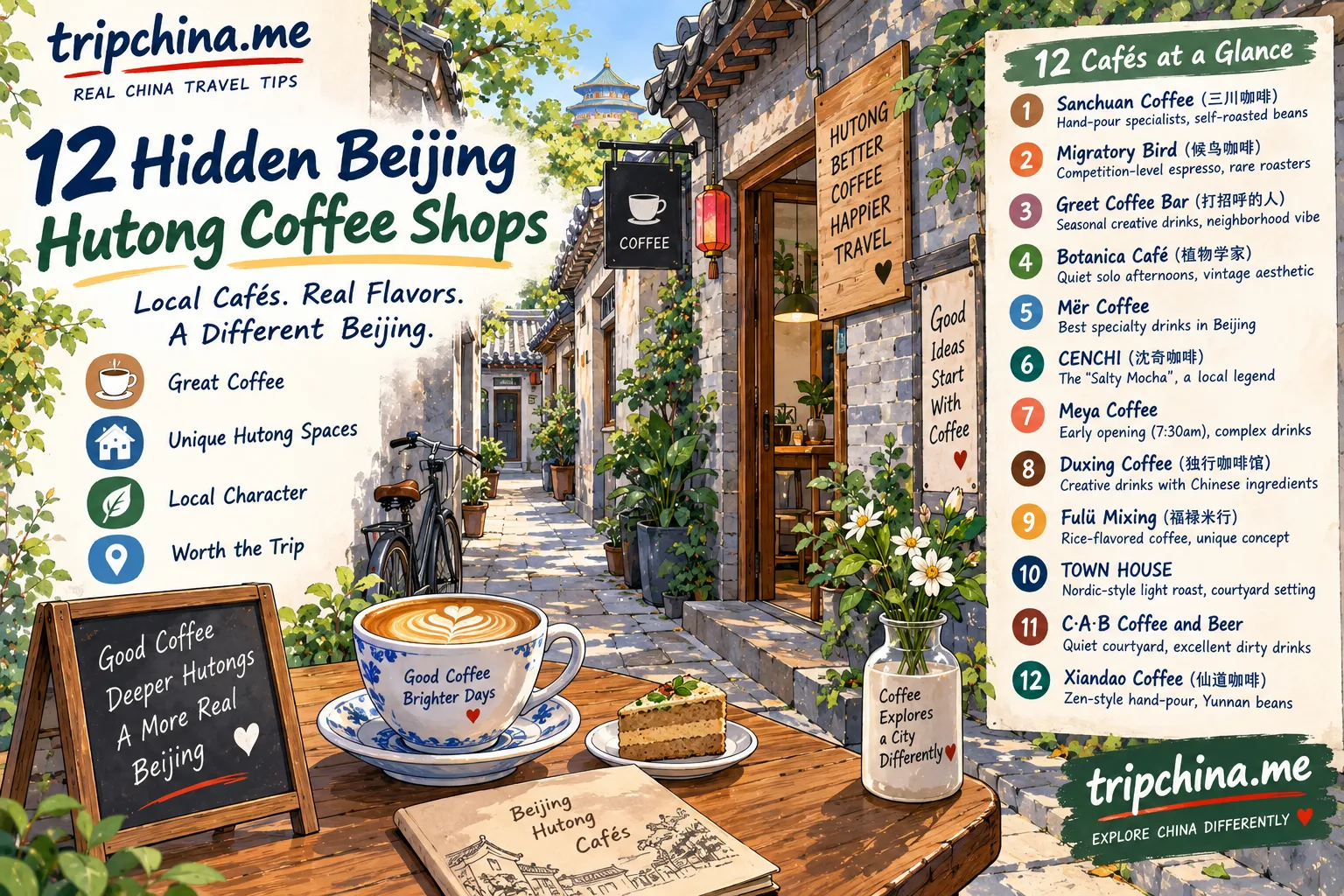
Here is what I learned, and the 12 cafés that changed how I think about coffee in Beijing.
These 12 shops were selected because each does something genuinely different. Some are hidden in residential alleyways. One is run by a former chef who makes his own fermentation blends. Another serves an 88-yuan (about $12) deep-roast Geisha from a world-famous Panamanian estate. All of them are worth the trip.
| Café | Best For | Honest Trade-off |
|---|---|---|
| Sanchuan Coffee (三川咖啡) | Hand-pour specialists, self-roasted beans | Gets crowded on weekends |
| Migratory Bird (候鸟咖啡) | Competition-level espresso, rare international roasters | Small courtyard, limited seating |
| Greet Coffee Bar (打招呼的人) | Seasonal creative drinks, neighborhood vibe | Very small, 15 seats max |
| Botanica Café (植物学家) | Quiet solo afternoons, vintage aesthetic | Only two espresso options |
| Mēr Coffee | Best specialty drinks in Beijing | Not near major tourist areas |
| CENCHI (汵奇咖啡) | The "Salty Mocha", a local legend | East 4th location is the best one |
| Meya Coffee | Early opening (7:30am), complex ferment drinks | South of center, out of the way |
| Duxing Coffee (独行咖啡馆) | Creative drinks with Chinese ingredients | Hand-pour selection is limited |
| Fulü Mixing (福禄米行) | Rice-flavored coffee, unique concept | More about the experience than the coffee |
| TOWN HOUSE | Nordic-style light roast, courtyard setting | Desserts are better than the coffee |
| C·A·B Coffee and Beer | Quiet courtyard, excellent dirty drinks | Newer shop, still finding its rhythm |
| Xiandao Coffee (仙道咖啡) | Zen-style hand-pour, Yunnan specialty beans, Chinese courtyard atmosphere | Hard to find, no desserts offered |
TripChina Verdict: If you only visit one, make it Sanchuan or Migratory Bird. These two represent what Beijing hutong coffee can be at its best.
Sanchuan is the best hand-pour coffee experience in Beijing right now, and it is not close.
Walk down the narrow alley off Lanman Hutong (烂漫胡同) in the south of the city, and you might miss the entrance. The courtyard is small, the signage is minimal. Inside, the barista is almost always pouring coffee. On both my visits, he did not stop from the moment I arrived until the moment I left.
The menu is overwhelming in the best way. Geisha (瑰夏) beans take up two-thirds of the options, from Panama's Elida Estate (a BOP top-three farm) to various Ethiopian lots. Because they roast their own beans, the prices are shockingly reasonable. I had a dark-roast Geisha from Elida for 88 RMB. Anywhere else in Beijing, that drink would cost well over 100 RMB.
What sets Sanchuan apart is the attention to detail. Light-roast beans come with a lid to concentrate the aroma. The cups are thick-walled to enhance the mouthfeel of delicate beans. Each pour-over comes with a small glass of sparkling water to cleanse your palate. The barista switches filter cones based on the bean's characteristics.
Honest answer: The dark-roast Geisha I tried is temporarily off the menu. The owner is sourcing more expensive beans. Check before you go if this is your priority. Menu availability changes frequently. Check before visiting if a specific bean matters to you.
Who this is for: Hand-pour enthusiasts. People who want to taste the difference between a washed and natural Ethiopian. Anyone who thinks 88 RMB for a Geisha is a steal.
Who this is not for: People who want a quick latte to go. The experience here demands time.
Migratory Bird has been a fixture in the Beijing coffee scene for years, and it remains one of the most serious coffee shops in Beijing.
The café is tucked deep inside a hutong near the Drum and Bell Towers. During the day, it serves coffee. At night, it transforms into a small cocktail bar, a "morning coffee, evening alcohol" setup that has become common in Beijing but rarely done this well.
The baristas here compete. I ordered an espresso, the hardest drink to get right, and watched the barista pull it using the same parameters she used in a competition. The result was balanced, with clear stone fruit notes. She showed me the extraction parameters without me asking.
The hand-pour program is where Migratory Bird really shines. They source beans from top international roasters: Monogram (Canada), DAK (Netherlands), SEY (USA). I tried a washed Geisha from Monogram that had explosive sweetness, Monogram has competed at the World Barista Championship level.
The barista's technique was fascinating. She ground the beans at two different coarseness levels, then combined them. The coarse particles brought out floral notes; the fine particles added sweetness and body. The result was a cup with both bright fruit and heavy sweetness.
Who this is for: Coffee nerds who want to taste world-class roasters. People who enjoy watching skilled baristas work.
Who this is not for: Anyone looking for a quiet place to work. The courtyard is small and conversation flows.
Botanica Café near Longfusi/钱粮胡同 (隆福寺) is the café I go to when I want to be alone with a good book and a better coffee.
The space is vintage British in style, dark wood, leather chairs, soft lighting. It operates as a café during the day and a cocktail bar at night. The 00-born owner is still in university, splitting time between classes and running the shop. He sources beans from Yika Duo (意咖多), a Beijing self-roasting brand.
I ordered a combo, espresso and milk-based drink from the same bean. The black coffee tasted like clean dark fruit juice. The milk drink was high in sweetness with a light body. The owner used specially treated water for the pour-over, which softened the acidity and made the sweetness more pronounced.
Who this is for: Solo visitors. People who want a quiet afternoon without loud music or conversation.
Who this is not for: Groups looking for a lively atmosphere. This is a contemplative space.
CENCHI Coffee's Dongsi branch is the most complete coffee experience in a Beijing hutong, and their salty mocha is the reason to go. The shop has three locations, The Dongsi branch is the original. It features a 360-degree circular bar where you can watch every drink being made.
The salty mocha was created when the shop first opened and has since become a staple at coffee festivals across China. The innovation is simple but effective: mix sea salt into the cocoa powder, and replace regular milk with concentrated ice-brewed milk for a thicker, creamier texture. The result is a drink that tastes like cheese, salty, sweet, and layered. It is not a gimmick. It is genuinely good.
The shop launched its in-house roasting program in early 2026, upgrading its pour-over consistency and offering better value for single-origin lovers. I tried a TOH championship honey-processed coffee from Africa, citrus notes throughout, with a tea-like finish that made it drink like a fruit tea.
Espresso options are divided into three categories: "Deep," "Sweet," and "Fruity." The "Sweet" option uses a pyramid natural-processed Ethiopian from the ALO village, a famous origin that would normally be reserved for pour-over. Using it for SOE Americano or combo drinks is excellent value.
Location: Dongsi branch, 114 Dongsi South Street (东四南大街114号). About 5 minutes walk from Dongsi Station (东四站), Exit B. The Dongsi branch is about 5 minutes from Dongsi Station (东四站), Exit B. If you are navigating Beijing by subway for the first time, the Beijing subway guide for foreigners covers payment, maps and common mistakes.
Who this is for: Travelers craving innovative signature drinks and structured, approachable single-origin options.
Who this is not for: Visitors seeking ultra-quiet workspaces or simple basic lattes.
Mēr Coffee is the only shop in Beijing where I would order a specialty drink over a straight espresso. The market is flooded with mediocre specialty cafes that use fancy ingredients to mask bad coffee. Mēr is different. Their drinks are genuinely well-designed, and the seasonal rotation keeps the menu fresh.
The standout is the "bōpōmōfō" (bōpōmōfō), a name that sounds like playful onomatopoeia. It uses a Colombian cold brew base, already clean and refreshing, then adds low-temperature slow-cooked bergamot and pineapple for bright acidity and sweetness. Finally, pandan leaf is layered in for a subtle, sticky rice-like fragrance. The result is layered but harmonious. Every component is identifiable, and none overwhelms the others.
Another permanent menu item is "You Nuo Mi" (有糯米, "has sticky rice"). It looks like a hot latte but uses a dark roast espresso blend with milk that has been processed with brown sugar, butter, and house-made sticky rice cream. The rice aroma is gentle, not artificial. The drink is sweet but not cloying. One large sip is deeply satisfying.
The seasonal rotation is frequent. At their new Xisi branch, I tried "Silver Slope" (银色山坡), a classic espresso blend with almond milk and toasted rice, topped with hojicha-flavored cream. The first sip was roasted tea aroma mixed with cocoa nibs on top. The second sip was a nutty latte. Two distinct experiences in one drink.
Location: Two branches. The original is near Dongsi. The newer Xisi branch is near Xisi Station (西四站). Both are small and easy to miss.
Who this is for: Specialty drink lovers who prioritize balanced, layered, non-artificial flavors.
Who this is not for: Traditional coffee purists who prefer straight black coffee only.
Greet Coffee Bar is the most creative coffee shop in Beijing's hutongs, and their seasonal fruit-coffee blends are the reason. The shop is tiny, barely 15 seats when full, and sits at the intersection of a residential alley and Dongsi North Street. It is so small that regular customers leave their personal cups there because they come so often.
The shop is run by two people: Dong Ge (东哥), the barista who previously worked at a coffee bean factory in Tongzhou, and Xing Xing (星星), an illustrator who designed the logo, menu cards, and wall art. The shop's character comes from this partnership, the coffee is serious, but the atmosphere is playful.
The menu changes with the seasons. Apples, pears, strawberries, guava, navel fruit, hawthorn, bergamot, whatever is in season gets turned into a coffee drink. I tried a navel fruit blend that used fresh juice combined with a light roast Ethiopian. The fruit was not a syrup or a concentrate. It was real, fresh, and carefully balanced against the coffee.
What makes it special: The drinks are not gimmicks. Dong Ge experiments with ratios and extraction methods until the fruit and coffee complement each other. When I asked about one drink, he told me exactly which brand of pomelo juice from Hema Supermarket (盒马) he used and how to replicate it at home. That level of openness is rare.
Honest take: The shop gets crowded on weekends. Go on a weekday afternoon if you want a seat. The menu is small, maybe 8 drinks total, but every one is intentional.
Location: Dongsi North Street, near the intersection with a residential alley. About 3 minutes walk from Dongsi Station (东四站), Exit B.
Who this is for: Seasonal drink fans and travelers who love community-style neighborhood cafes.
Who this is not for: Large groups or anyone needing guaranteed seating on weekends.
Direct answer: Duxing's signature drinks are named after films and TV dramas, and they are genuinely creative — not just syrup shots in coffee.
The first thing you notice when you walk into Duxing is the energy. The furniture is a collection of vintage trunks and mismatched chairs. The open bar lets you watch every drink being made. The owner has curated every object in the room, from the cups to the light fixtures.
What to order: "Go to a Place with Wind" (去有风的地方) — named after the TV drama set in Dali, Yunnan. The base is an Ethiopian espresso, but it is mixed with cold-brewed Longjing tea and homemade sour papaya syrup. Before serving, the barista shaves a small amount of wild pepper root over the top, mimicking the technique used in Yunnan rice noodle shops. It sounds chaotic. It tastes like a breeze through a mountain town — sour, herbal, slightly spicy, and completely refreshing.
Another standout: "Carol" (卡罗尔) — named after the Cate Blanchett film. A deep-roast espresso base with a salted cream top,柚子酱 (yuzu jam), and orange peel. It is bright and creamy at the same time.
Honest take: The pour-over menu is simpler — mostly classic Ethiopian naturals and washed Kenyans. It is reliable, not adventurous. Come here for the signatures.
Who this is for: Creative drink explorers and travelers looking for Chinese-flavor coffee innovation.
Who this is not for: Strict pour-over purists seeking rare international bean varieties.
Direct answer: Meya Coffee opens at 7:30 AM and serves signature drinks with house-fermented syrups made by the owner, a former Chinese chef.
Meya is in the south of the city, near the Temple of Heaven. The space has a Japanese zen feel — clean lines, natural wood, a bar that separates the espresso station from the pour-over station. The owner, A-Xuan, used to work in a Chinese restaurant kitchen. He brings that precision to coffee.
What to order: The "Nanyang Fermentation" (南洋发酵曲) — 52 RMB. A blend of tropical fruit ferments — pineapple, mango, maybe something else — mixed with cold brew and nitrogen-charged for a creamy texture. It tastes like a fruit soda but without the sugar crash.
Pour-over: Meya does not have a fixed menu. Instead, there is a flavor quadrant map on the wall, and the owner brings out frozen beans from international roasters. The selection changes weekly.
Honest take: Meya is small — maybe 10 seats. If you come after 10 AM on a weekend, you will likely wait.
Note: Weekend waiting times often exceed 20 minutes after 10 AM; visit on weekday mornings for the full ferment drink experience.
Who this is for: Early risers, fermented flavor enthusiasts, and slow coffee lovers. Who this is not for: Travelers in a hurry or visiting on busy weekends.
Xiandao Coffee is not for everyone, but if you miss the old-school Italian espresso style, this is the only place in Beijing that does it right. The shop is more of a hobbyist's workshop than a commercial cafe. The owner is a serious coffee enthusiast who operates on his own schedule. Opening hours are highly flexible and owner-dependent. There is no fixed weekly schedule. Always verify opening status via Dianping before traveling.
The menu is unusual for Beijing. Almost all the beans are roasted extremely dark. The preparation methods are classic Italian: Espresso Con Panna (康宝莱, espresso topped with fresh whipped cream), Viennese coffee (维也纳, layered hot coffee, cold cream, and chocolate syrup), and cappuccino, all drinks that have mostly disappeared from modern Chinese coffee shops.
The machine is a vintage lever espresso machine that requires the barista to control pressure manually. It is unstable and demands experience. The owner handles it with ease.
I ordered a cappuccino. The barista achieved a "golden ring", the ring of crema that forms on the surface when the espresso and thick milk foam separate properly. It is difficult to execute. The drink arrived with the liquid bulging above the rim like a liquid soufflé. The first sip was fine milk foam, followed by the nutty, cocoa-like bitterness of the dark roast. Bitter and sweet arrived at the same time.
Honest take: This is not a place for casual coffee drinkers. The atmosphere is quiet, almost monastic. The owner does not engage in small talk. If you want a quick latte to go, go somewhere else.
Location: Inside a residential community near Dongsi. Specific address is hard to find, search for "Xiandao Coffee" on Dianping (大众点评) and follow the map. For navigating addresses like this across Beijing, the Beijing travel apps and digital services guide covers the tools that actually work for foreign visitors.
Who this is for: Traditional Italian espresso purists and quiet solo coffee drinkers. Who this is not for: Casual visitors, groups, or travelers needing fixed opening hours.
Most visitors assume the best coffee is at the rooftop spots with views of the Drum Tower or White Pagoda. Those places are fine for photos, but the coffee is usually an afterthought.
The reality: Beijing's real coffee culture is happening in residential alleyways, inside unmarked courtyards, and at community shops where regulars leave their cups. These places do not advertise. They do not have Instagram-worthy interiors. But the coffee is better, the prices are lower, and you will actually learn something about how coffee works.
A few practical truths:
This article is part of the Beijing Travel Guide Hub.
Are Beijing hutong coffee shops laptop-friendly?
Depends on the shop. Botanica Café and TOWN HOUSE have more spacious layouts suited to working. Sanchuan and Migratory Bird are small and prioritize the coffee experience—laptops feel out of place. Greet is tiny (15 seats) and better for conversation.
Do I need to speak Chinese to order at these shops?
Basic pointing works. Many baristas know enough English for coffee orders. Having the Chinese name of the shop saved on your phone helps with navigation. Dianping listings often have photos you can show.
Can I visit multiple hutong coffee shops in one afternoon?
Yes, if they‘re clustered. The Dongsi area has CENCHI, Greet, and Mēr within walking distance. Sanchuan is farther south. Plan two to three shops max per afternoon to actually enjoy them.
Is there a coffee shop in Beijing that serves competition-level espresso?
Migratory Bird’s baristas apply official competition extraction parameters for espresso and hand-pour. They source world-class international roasters and adjust grind coarseness in dual-stage brewing for competition-level balance and sweetness.
Which Beijing hutong coffee shop has the best specialty drinks?
Mēr Coffee has the most creative and well-executed specialty drinks in the city. The "bōpōmōfō" and seasonal offerings are worth the trip.
What is the best time to visit Beijing hutong coffee shops?
Weekday afternoons between 2pm and 4pm. Weekend crowds at popular shops can mean long waits and limited seating.
How do I find hidden coffee shops in Beijing hutongs?
Use Dianping (大众点评) to search for specific shops. Many hidden places do not have visible signage from the main street. Follow the map and look for narrow alley entrances. If you want to combine coffee with a proper hutong walk, the Beijing hutong routes guide covers four routes that actually show the real city.
If I had to pick one, it would be Greet Coffee Bar.
Not because the coffee is the best, though it is very good. Not because the space is beautiful, though it has a quiet charm. But because of how it feels to sit there on a Sunday afternoon, watching Dong Ge make drinks and Xing Xing draw at the counter, while regulars come and go like it is their second living room.
That is what a great hutong café does. It creates a space where real life happens. The coffee is just the excuse. If you are choosing where to base yourself for this kind of slow, neighborhood-level exploring, the Where to Stay in Beijing guide compares five areas for first-time visitors.
TripChina.me creates practical China travel guides shaped by real local experience, helping independent travelers navigate transport, payments, food, neighborhoods, and the cultural details that make traveling in China easier and more meaningful. Find the guide for your destination at tripchina.me.