Our Location:
No. 99, Jiazi Road, Chengdu

 authorChris Lee
Mount Hua (Huashan) is located in Huayin, Shaanxi Province, about 120 km east of Xi'an. It is a popular mountain day trip from Xi'an, but not a place I would improvise. Your ticket type, passport, cable-car direction and arrival time can completely change the day.
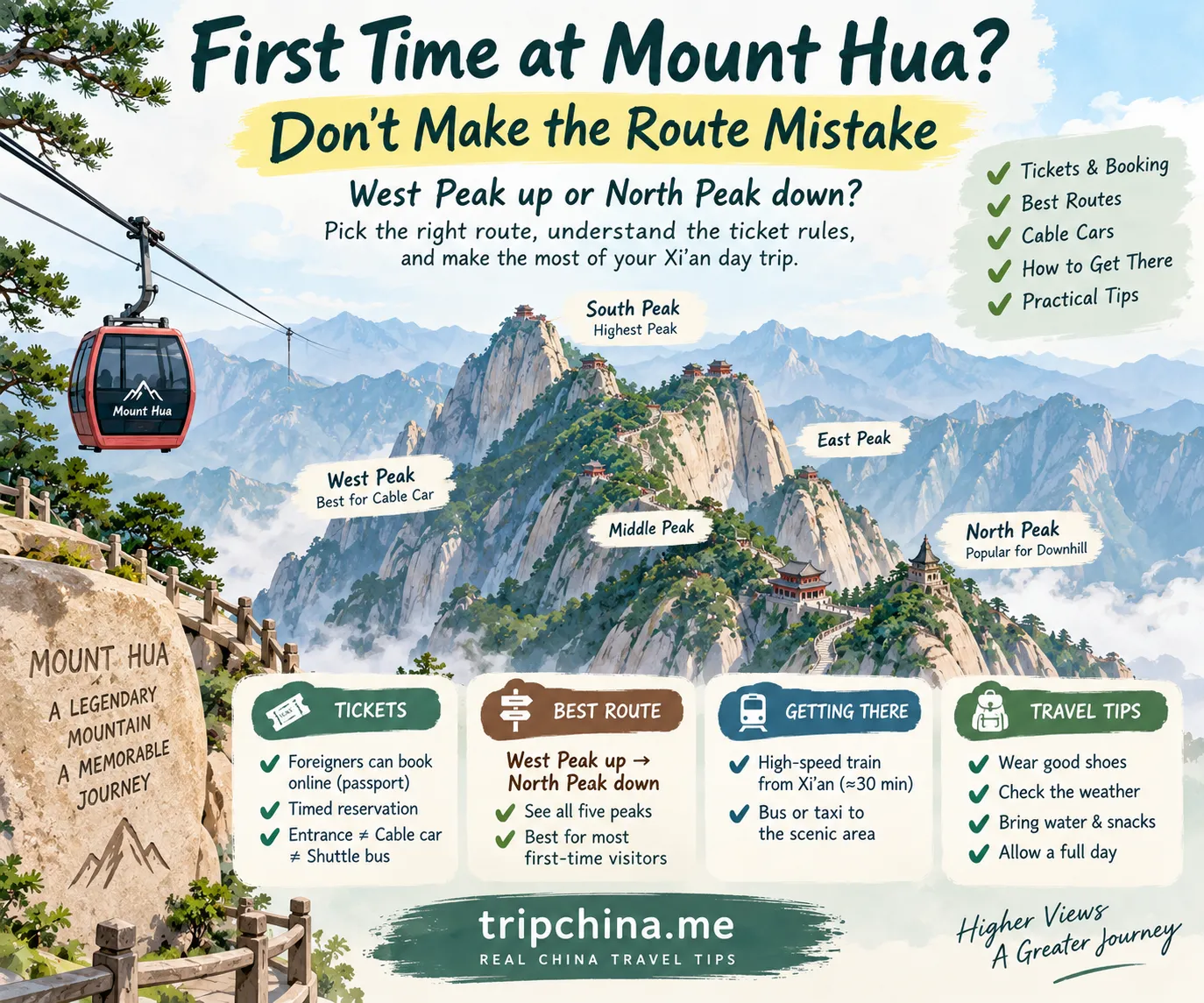
For most first-time visitors, I would go West Peak up and North Peak down: you get the five-peak experience without turning the trip into an all-day uphill grind.
But there is one important catch: the entrance ticket, mountain shuttle and cable cars are separate products. Choosing the wrong combination can cost you time, money and a lot of unnecessary climbing.
Here is how I would plan Mount Hua—and what foreign visitors need to know before leaving Xi'an.
| Question | Short Answer |
|---|---|
| Can foreigners visit Mount Hua? | Yes. Bring your original passport. |
| Can foreigners book online? | Some international platforms may offer passport-compatible booking. The official channel has restrictions for ordinary foreign-passport holders, so check the current booking and special-ticket procedures. |
| Best route for a first visit? | West Peak up → North Peak down for many travelers with average fitness. |
| Easiest shorter route? | West Peak up → West Peak down. |
| How long do you need? | Allow a full day from Xi'an; approximately 5–6 hours on the mountain for the classic route, plus queues and transfers. |
| Fastest way from Xi'an? | High-speed rail from Xi'an North to Huashan North, often around 30 minutes. |
| Standard adult entrance fee? | ¥160 in the March–November peak season; ¥100 in the December–February off-season. |
| Are cable cars included? | No. Entrance, shuttle buses and cable cars are separate charges. |
| Are the Plank Walk and Yaozi Fanshen open? | Both were suspended from September 15, 2026. No official reopening date has been confirmed in the notices reviewed. |
| Can you still visit Mount Hua? | Yes. The main peaks and standard cable-car sightseeing routes remain open, subject to normal weather and safety restrictions. |
Important October 2026 update: Mount Hua's temporary ¥80 adult admission promotion ended on October 10, 2026. From October 11, the standard peak-season adult entrance price returned to ¥160.
The scenic area announced the temporary closure of the Plank Walk in the Sky (长空栈道) and Yaozi Fanshen (鹞子翻身) from September 15 for maintenance and safety upgrades.
No confirmed reopening date was included in the original announcement. Some later official travel-guide content still mentions these attractions, but that does not establish that they have reopened.
The rest of the main mountain sightseeing experience remains the reason to visit.
If you have an extra day in Xi'an and enjoy mountain scenery, yes.
Mount Hua is one of China's Five Great Mountains and has centuries of Taoist and imperial significance. According to UNESCO, the Hua Shan Scenic Area is on China's Tentative List, which is different from being a fully inscribed World Heritage Site.
But history is only half the reason to go.
The mountain feels dramatically different from Xi'an. One day you are standing on the City Wall or looking at the Terracotta Warriors; the next you are moving between granite peaks, stone stairways and ridgelines high above the surrounding plain.
And despite Mount Hua's reputation online, you do not have to spend the day clinging to a plank bolted onto a cliff.
Cable cars make the main peak areas accessible to ordinary travelers with reasonable fitness. The famous extreme sections are optional and are subject to separate safety and operating rules.
If Mount Hua is only one part of your stay, use our Xi'an travel guide to decide whether it fits better into a three-, four- or five-day itinerary.
This is the most important section for foreign visitors.
Foreign passport holders should not assume that Mount Hua is an attraction where they can always buy an ordinary ticket at the entrance without advance arrangements.
The scenic area uses real-name, time-slot-based reservations, and booking arrangements can vary between the main entrance, cable cars and special ticket categories.
Mount Hua's published ticket-policy guidance distinguishes between foreign visitors using a Chinese Foreign Permanent Resident ID Card and those using an ordinary foreign passport.
Eligible permanent-residence ID holders may use supported online booking procedures.
For foreign visitors using passports, the official guidance directs relevant ticket handling to the scenic area's special-ticket service counter (特殊票种办理处).
This means you should not assume that the official Chinese booking interface will accept an ordinary passport for every ticket product.
For an overseas visitor, I would use this order:
International booking platforms may offer passport-compatible products, but document handling and redemption rules depend on the specific ticket.
Do not assume that online booking will always work with a foreign passport, and do not assume that the special-ticket counter guarantees same-day ordinary admission.
The October 2026 National Day rules, for example, required advance real-name reservations and suspended ordinary walk-up ticket sales.
If you cannot confirm a valid booking or reservation method, contact the scenic area before traveling from Xi'an.
Official visitor consultation numbers published in Mount Hua notices include:
Do not arrive with only a screenshot and no passport.
Even when a platform accepts an overseas document, some concessions or special products may require additional manual verification.
If Mount Hua is one of several ticketed attractions on your trip, our Xi'an attraction booking guide explains which other reservations to arrange before arrival.
I recommend advance booking rather than treating same-day admission as guaranteed.
Reservations are especially important during public holidays, busy weekends and dates when cable-car tickets or mountain entry slots are limited.
During the October 2026 National Day holiday, Mount Hua explicitly required real-name time-slot reservations and did not provide ordinary walk-up admission sales at the site.
For other dates, follow the current official booking instructions rather than assuming the holiday policy applies unchanged all year.
The temporary promotion ran from July 15 through October 10, 2026.
During that period, the standard adult entrance price was reduced from ¥160 to ¥80.
That offer has now ended.
From October 11, 2026, the normal peak-season adult admission of ¥160 applies unless a new official promotion is announced.
The earlier discount did not automatically cover mountain shuttle buses or cable cars.
The headline admission price is only one part of your Mount Hua budget.
The tables below show standard adult planning prices, excluding any currently available package discounts or personal concessions.
| Item | Standard Peak-Season Price | Notes |
|---|---|---|
| Main entrance | ¥160 | March–November |
| Off-season entrance | ¥100 | December–February |
| West Peak cable car | ¥140 one way | Reaches the higher western peak area |
| North Peak cable car | ¥80 one way | Standard peak-season single fare |
| North Peak cable car round trip | ¥150 | Separate round-trip product |
| Shuttle to West Peak cable car | ¥40 one way | Separate from admission |
| Shuttle to North Peak cable car | ¥20 one way | Separate from admission |
All prices above are standard adult reference rates. Eligible children, students, seniors and other visitor categories may qualify for reduced or free admission or discounted transport products, subject to the specific provider's rules and valid identification.
For the North Peak cable car, the published peak-season standard fare is ¥80 one way or ¥150 round trip.
The ¥150 return ticket is a separate discounted round-trip product. It does not mean that every individual one-way ticket costs ¥75.
Some sellers may show discounted offers or different concession rates.
The seasonal entrance fare and ticket-product prices are published reference rates. Check the current winter cable-car and shuttle tariffs if you travel outside the main season.
| Route | Entrance | Cable Cars | Shuttles | Total Reference Budget |
|---|---|---|---|---|
| West Up → North Down | ¥160 | ¥140 + ¥80 | ¥40 + ¥20 | ¥440 |
| West Up → West Down | ¥160 | ¥140 × 2 | ¥40 × 2 | ¥520 |
| North Up → West Down | ¥160 | ¥80 + ¥140 | ¥20 + ¥40 | ¥440 |
| North Up → North Down | ¥160 | ¥150 round trip | ¥20 × 2 | ¥350 |
These totals assume standard peak-season adult pricing and the appropriate shuttle for each cable-car direction.
The North Up–North Down total uses the separately priced ¥150 North Peak round-trip cable-car ticket. Purchasing two individual ¥80 tickets instead would increase that route's reference total to ¥360.
They exclude train tickets from Xi'an, food, guided services and optional activities.
The important distinction is:
Entrance ticket ≠ mountain shuttle ≠ cable car.
That catches first-time visitors more often than the headline entrance price.
A traveler who buys the cheapest admission ticket without checking transportation could still face substantial additional costs at the mountain.
If you are trying to reduce spending, compare complete route packages—not just the main entrance fare.
This decision matters more than almost anything else you do before the trip.
Mount Hua is not one simple “up and down” mountain route. West Peak and North Peak cable cars let you build very different days depending on fitness, available time and whether you want to walk across the major peaks.
| Route | Approx. Mountain Time | Physical Demand | Main Trade-Off | Best For |
|---|---|---|---|---|
| A: West Up → North Down | 5–6 hrs | Moderate | Long downhill sections | Most first-time visitors |
| B: West Up → West Down | 3–4 hrs | Lower | Backtracking; misses North Peak | Families, limited time, lower fitness |
| C: North Up → West Down | 6–7 hrs | Moderate–High | More sustained uphill walking | Fit hikers wanting a challenge |
| D: Hike Up → Cable Car Down | 8–10+ hrs | High | Long, demanding climb | Experienced hikers and sunrise seekers |
Route times are planning estimates, not guarantees.
Queues, weather, photography stops, physical ability and temporary closures can change the day substantially.
First-time visitor with average fitness: Route A — West Up → North Down.
Limited time or uncomfortable with long descents: Route B — West Up → West Down.
Fit hiker wanting a challenge: Route C — North Up → West Down.
Experienced sunrise hiker: Route D — traditional hiking entrance, subject to current access and weather conditions.
For a first visit, Route A is the one I would choose.
The sequence is:
Visitor Center → West Peak shuttle → West Peak cable car → West Peak → South Peak → East Peak → Middle Peak → North Peak → North Peak cable car → shuttle → Visitor Center
The big advantage is simple: you start high.
Instead of spending a large part of the day climbing toward the main peak area, you use the West Peak cable car to gain elevation, then work across the peaks toward North Peak.
You still walk a lot.
Do not confuse “cable car” with “easy sightseeing.” There are repeated stone staircases and enough descending to make your knees very aware that Mount Hua exists.
But for an average first-time visitor who wants the mountain experience without turning the entire day into an endurance event, this is the most balanced route.
Under standard peak-season pricing, the entrance, West Peak shuttle and cable car, North Peak cable car and return shuttle cost approximately ¥440 per adult, before food and transport from Xi'an.
Choose Route B if you are traveling with parents, younger children, have limited time or simply do not care about ticking off every peak.
You take the West Peak cable car up, explore the upper mountain area, then return to the same cable car.
The downside is backtracking.
You also miss North Peak and some of the classic ridge experience between the upper peaks and North Peak.
But there is no prize for choosing the hardest route.
If a shorter route means you actually enjoy Mount Hua instead of watching the clock and worrying about the last cable car, it is the better route for you.
At standard peak-season prices, the complete West Up–West Down transportation and admission budget is approximately ¥520.
Route C reverses the physical logic:
North Peak → Canglong Ridge → Middle Peak → East Peak → South Peak → West Peak
This means considerably more climbing before reaching the higher peaks.
It can be rewarding if you specifically want more hiking, but I would not choose it simply because it sounds more “authentic.”
If this is your first visit and your priority is scenery rather than physical challenge, West Up–North Down is easier to justify.
Only if you genuinely want the hike itself.
The traditional hiking route begins around Yuquan Temple and continues through the Mount Hua Gate hiking entrance toward North Peak and the upper peaks.
This is a serious overnight hike involving hours of stone steps and steep terrain.
It requires substantially more fitness and preparation than a cable-car day trip.
The hiking entrance has been published as operating around the clock, but entry remains subject to reservations, weather, safety controls and temporary restrictions.
Night-hiking entry slots may become unavailable during busy dates, and temporary trail restrictions can affect the route even when daytime cable-car sightseeing continues.
Do not assume that an advertised 24-hour hiking entrance guarantees entry at any time without a valid reservation.
If you choose this route, bring a headlamp or flashlight, proper shoes, water, food and warm layers.
Do not depend on your phone flashlight for an entire night climb.
The Plank Walk in the Sky (长空栈道) and Yaozi Fanshen (鹞子翻身) are separate, optional high-exposure attractions.
They are not required for the normal West Peak–South Peak–East Peak–North Peak sightseeing itinerary.
Mount Hua Scenic Area announced that both would temporarily close from September 15, 2026, for maintenance and safety improvements.
The official notice did not announce a fixed reopening date.
As of this October 2026 review, no confirmed official reopening date has been identified.
Some official travel-guide content published after the closure notice still promotes these attractions as experiences to try.
That creates an information inconsistency between the scenic area's promotional content and its formal operating notices.
A travel-guide description should not be treated as confirmation that a previously suspended activity has reopened.
If either attraction is the main reason you want to visit Mount Hua, check the latest official notice or call the scenic area directly before buying tickets.
Official visitor consultation numbers include:
0913-8376888 / 0913-8375999
Even when these features reopen, they may require separate safety equipment, queues, eligibility checks or additional fees.
Do not buy a normal Mount Hua entrance ticket assuming the Plank Walk is included or available that day.
The main peaks and standard sightseeing routes remain open, subject to weather and routine safety restrictions.
This is one detail I would check again the day before your visit.
The regular published operating framework is:
| Service | Published Operating Framework |
|---|---|
| Cable-car visitor entry | 7:00 AM–4:00 PM |
| Cable-car operation | 7:00 AM–7:00 PM |
| Traditional hiking entrance | Around the clock, subject to restrictions |
The 4:00 PM cable-car visitor-entry cutoff does not mean you can start a multi-peak route at 3:55 PM and comfortably finish it.
It also does not mean that every cable car will be available until 7:00 PM regardless of weather.
During major public holidays, the scenic area may extend hours or make other temporary adjustments.
For example, October 2026 National Day arrangements included earlier ascent operations and later descent services than the standard schedule.
Wind, storms, safety conditions and visitor management can cause additional changes.
Plan backward from your final descent cable car, not forward from the attraction's closing time.
This is why I would not arrive at Huashan North around lunchtime and assume everything will somehow work out.
Mount Hua rewards early starts.
For most independent travelers, high-speed rail is the obvious first choice.
If you are still deciding where to base yourself, our where to stay in Xi'an guide compares areas that make early train departures and city sightseeing easiest.
Yes.
Take a train from Xi'an North Railway Station (西安北站) to Huashan North Railway Station (华山北站).
Direct high-speed services commonly take around 28–35 minutes, although the exact fare and journey time depend on the train.
Check your specific service on China Railway 12306 before travel rather than building your itinerary around one fixed fare or journey time.
For purchasing a ticket with a passport and avoiding passenger-name problems, read our China train ticket booking guide for foreigners.
The high-speed railway station is not the mountaintop cable-car boarding point.
Local bus services, including routes traditionally numbered 1 and 2, connect the Huashan North area with scenic-area facilities.
Check the current destination and service arrangements before boarding.
The Visitor Center (游客中心) is the place you want if you are using the West or North Peak cable-car system.
A taxi or DiDi is useful when you are short on time or carrying more gear.
For the wider railway-station and transport setup in your base city, see our Xi'an transport guide.
Regular trains from Xi'an to Huashan Station can be cheaper, with journeys around 1.5 hours on some services.
But be careful with the station names:
Huashan North (华山北站) = high-speed railway station
Huashan Station (华山站) = conventional railway station
For a one-day trip from Xi'an, I would normally use high-speed rail.
I would not recommend it for a normal independent day trip.
Both attractions deserve substantial time, and they are not adjacent stops on one convenient sightseeing loop.
Mount Hua involves railway travel, local transfers, entrance procedures, cable cars and several hours of mountain walking.
The Terracotta Warriors require a separate journey from Xi'an and their own museum visit.
If you have only a limited number of days, use our Terracotta Warriors route and visitor guide to decide how to allocate your time.
Do not make cash your only plan—but do not make your phone your only plan either.
China is highly mobile-payment oriented.
Alipay and WeChat Pay can be linked to supported overseas cards, and these are useful for transport, food and everyday purchases.
At the same time, Mount Hua is exactly the kind of place where I like having a backup.
Phone batteries die. Mobile connections weaken. A payment attempt can fail at the least convenient moment.
Bring some RMB cash and at least one physical card in addition to your mobile wallet.
If you need an alternative to your primary payment app, see our WeChat Pay guide for foreign visitors.
The important thing is to prepare payment methods before you leave Xi'an.
You do not need expedition equipment for the standard cable-car routes, but this is still a mountain.
Bring your original passport, shoes with reliable grip, water, snacks, sun protection and a light layer.
Weather on the peaks can feel significantly cooler than at the base, and conditions can change quickly.
Cheap work gloves can also be surprisingly useful.
Some steeper sections have chain handrails, and gloves make them more comfortable to grip.
I would also download translation and navigation tools before leaving Xi'an.
English support is improving, but it is still limited enough that having place names saved on your phone makes the day much easier.
For the wider digital setup—payments, maps and transport—our essential China travel apps guide is a useful pre-trip checklist.
Our China navigation app guide explains why you should not build a China trip around Google Maps alone.
If you have not arranged mobile connectivity, the China eSIM vs SIM card guide compares internet options before arrival.
Make sure your train tickets, passport booking confirmation and important place names are available offline.
Save screenshots of route maps and cable-car booking details before reaching the mountain.
If your mobile connection fails, do not assume you can complete every booking or payment step using public Wi-Fi.
TripChina's guide to fixing internet access after arriving in China explains how to troubleshoot connectivity problems.
1. Arriving without checking reservation rules.
Mount Hua uses real-name, time-slot reservations. Do not assume that an ordinary walk-up ticket will always be available.
2. Forgetting your passport.
Your booking and identity verification depend on it.
3. Buying the wrong route combination.
Decide whether you are going West Up–North Down, West Up–West Down or another route before buying cable-car products.
4. Underestimating the walking after taking a cable car.
Route A may save substantial climbing, but it still involves several hours on your feet.
5. Wearing slippery shoes.
Mount Hua has extensive stone stairs, and wet weather makes them considerably less forgiving.
6. Ignoring the weather forecast.
Wind, rain and other safety conditions can affect cable cars and exposed sections.
7. Arriving too late for your chosen cable-car route.
The last entry cutoff and final descent timetable are not the same as the time you should begin sightseeing.
8. Assuming the Plank Walk is open.
Check the specific operating status rather than relying on older videos.
9. Traveling during a major Chinese public holiday without planning for crowds.
Mountain shuttles, cable cars and rail tickets can become much more difficult when demand surges.
For other problems that catch first-time visitors off guard, see our Xi'an travel mistakes and scams guide.
Check our China public holidays and crowd guide before fixing your date, especially around National Day and Labor Day.
For many travelers, April–June and September–October offer a useful balance between temperatures and mountain scenery.
But “best season” does not automatically mean “best day.”
A clear weekday in September can be excellent. A holiday weekend with perfect weather can mean much longer queues.
Summer requires sun protection, water and an early start.
Winter can bring cold, ice and more difficult trail conditions. Some areas may be closed or restricted for safety.
I would choose weather, weekday and crowd level over chasing one supposedly perfect month.
Bring some of your own.
Food and drinks are available around major mountain nodes, but prices are naturally higher than at the base because getting supplies up a steep mountain is not cheap.
Bottled water may cost approximately ¥10–15 and simple meals ¥50–80; treat these only as rough budgeting estimates, not fixed prices.
A sandwich, fruit, energy bar or other easy snack from Xi'an can save both money and time.
More importantly, carry enough water for the section between major facilities rather than assuming a shop will appear whenever you want one.
The standard tourist routes are designed for ordinary visitors, but Mount Hua is still steep, exposed and physically demanding.
You do not need to do the most dramatic sections to experience the mountain.
If you dislike heights, have significant knee problems or are uncomfortable on steep stairs, choose a shorter West Peak route and skip optional exposed sections.
Do not let social media convince you that the Plank Walk is the whole point of Mount Hua.
It is one optional experience on a much larger mountain.
The main peaks, granite scenery and mountain trails can make Mount Hua rewarding even when extreme sections are unavailable.
Yes. Basic mountain accommodation is available for sunrise hikers. Rooms are generally simple and can sell out quickly on peak dates, so confirm accommodation availability and current trail-access rules before booking.
Yes. Toilets are available around major peaks, cable-car areas and key visitor facilities. Standards vary, so carrying tissues and hand sanitizer is sensible.
No. They can help if your knees dislike long descents, particularly on West Up–North Down. Bring your own if you know you need them rather than depending on rental availability.
Possibly. Standard cable-car routes do not require the Plank Walk or other optional extreme sections, but parts of the mountain still involve exposed views, steep stairs and ridges. West Up–West Down is the easier route to consider if you want the scenery with less walking and exposure.
Luggage-storage arrangements may be available around the Visitor Center and transport hubs, but services and limits can change. For an Xi'an day trip, I would leave large luggage at your Xi'an hotel or railway-station storage and carry only what you need on the mountain.
Cable-car service can be suspended for safety reasons. Depending on conditions, you may need to wait for operations to resume or follow instructions from scenic-area staff about alternative descent arrangements. Check current weather and operating notices before starting your route rather than assuming the cable car will run all day.
Allow about 5–6 hours on the mountain for the classic West Up–North Down route, plus time for railway travel, local buses, entry checks and queues.
A full day from Xi'an is much more realistic than treating Mount Hua as a short excursion.
Some international booking platforms may offer passport-compatible products, but the official Chinese booking interface may not support ordinary foreign passports for every ticket type.
Mount Hua's published guidance directs relevant passport-holder procedures to the scenic area's special-ticket service counter.
Confirm the current reservation requirements before visiting, and bring your original passport.
Yes. Main admission, mountain shuttle buses and cable-car tickets are separate products.
Some official or authorized booking channels offer bundled packages, but you should compare the components rather than assuming every package covers both ascent and descent.
Choose your preferred route before purchasing.
No. Entrance admission, mountain shuttle services and cable cars are charged separately unless your selected package specifically includes them.
The scenic area announced a temporary closure from September 15, 2026, for maintenance and safety improvements.
No confirmed reopening date was given in the original notice, and later official promotional articles may not reflect the current operating status.
Check the scenic area's latest formal announcement or call its visitor service before planning a trip around the Plank Walk.
For a first trip from Xi'an, I would take an early high-speed train, reach the Visitor Center in the morning and go:
West Peak up → walk across the main peaks → North Peak down.
It costs more than simply hiking, but that is not the part of the trip I would try to save money on.
The West Peak cable car buys you something more valuable on a one-day visit: time and legs.
If you are traveling with parents or know your knees will hate several hours of descending stairs, go West Up–West Down instead.
If you genuinely love hiking, then consider North Up–West Down or the traditional hiking route.
Mount Hua is spectacular, but the smartest way to experience it is not to choose the route that sounds toughest.
It is to choose the one that leaves you enough energy to look up from the stairs.
Ticket, cable-car, shuttle and food prices are planning references reviewed in October 2026.
The temporary ¥80 adult admission promotion ended October 10, 2026.
The standard peak-season North Peak cable car reference fare is ¥80 one way or ¥150 round trip. Concession prices and winter rates may differ.
Mount Hua may adjust prices, booking arrangements, access and operating hours because of season, weather, safety conditions and visitor volume.
Confirm all ticket products, foreign-passport booking procedures, active closures and final cable-car departures shortly before traveling.
This guide was checked against Mount Hua's visitor information, 2026 operating announcements, ticketing conditions and published cable-car prices.
The July 15–October 10 adult admission promotion has expired and is not presented as a current price. North Peak cable-car single and round-trip products are priced separately.
Official guidance distinguishes foreign permanent-residence ID holders from ordinary passport holders, whose ticket handling may require the scenic area's special-ticket service counter.
The September 2026 formal closure notice suspended the Plank Walk and Yaozi Fanshen pending safety work and a subsequent reopening announcement. Some later official travel-guide pages still promote these attractions, creating an inconsistency between general promotional content and operating notices. Visitors should consult the latest formal scenic-area announcement or call 0913-8376888 / 0913-8375999 before traveling for these activities.
Route durations are estimates, not guarantees. Foreign-passport booking, mountain access, extreme attractions, weather restrictions and operating hours should be reconfirmed before departure.
Avoiding mistakes is only the first step. TripChina.me Premium Travel Guides help independent travelers explore China with ready-to-follow routes, booking strategies, practical solutions, and local insights — so you can travel with confidence.