Our Location:
No. 99, Jiazi Road, Chengdu

 authorChris Lee
Xi’an rewards travelers who plan just a little before arriving. The Terracotta Warriors sit outside the city center, the Shaanxi History Museum requires advance reservations, and trying to squeeze everything into two days can turn one of China’s great historic cities into a rushed checklist. For most first-time visitors, three days is the sweet spot. This guide shows you when to go, what to budget, how to move around and which mistakes are easiest to avoid.
| Question | Best Choice | What to Know |
|---|---|---|
| How many days? | 3 days | 2 days is possible but rushed; 4–5 days allows Huashan or deeper exploration |
| Best time? | Spring or autumn | April–May and September–October usually offer the easiest sightseeing weather |
| Where to stay? | Bell Tower or South Gate | Central, convenient for the metro and easy for evening sightseeing |
| Biggest planning issue? | Advance reservations | The Shaanxi History Museum and major attractions can be difficult during peak periods |
| Best first major sight? | Terracotta Warriors | Give it at least half a day rather than squeezing it between city-center sights |
| Comfortable daily budget | About ¥700–1,200 | Mid-range hotel, local restaurants, attractions and normal urban transport |
According to the Xi’an Municipal Government, Xi’an has more than 3,100 years of urban history and served as a capital for 13 dynasties over 1,129 years. But what makes the city interesting is not the number itself. Modern metro trains run beneath a city where imperial capitals once stood, while a Ming-era wall still encloses the historic center.

Yes—especially if Chinese history is one of the reasons you are coming.
Beijing gives you imperial China on a monumental scale; Shanghai shows you a very different, modern and international chapter. Xi’an reaches much further back. Chang’an, as the city was historically known, was a major imperial capital and the eastern starting point of the ancient Silk Road.
The contrast is what stays with you. You can spend the morning looking into the pits of the Terracotta Army, cycle above the traffic on the City Wall in the afternoon, then eat lamb, noodles and flatbread in the Muslim Quarter after dark.
According to UNESCO, the Mausoleum of the First Qin Emperor is a vast archaeological complex associated with the thousands of life-size terracotta figures for which the site is famous. The Big Wild Goose Pagoda and Small Wild Goose Pagoda are also component sites of the UNESCO-listed Silk Roads: Chang’an–Tianshan Corridor.
One thing I would not do is treat the Terracotta Warriors as a quick photo stop. Without historical context, row after row of clay figures can become surprisingly difficult to interpret. A good guide or audio explanation can greatly improve the experience.
For the route, crowd strategy and the mistakes that matter once you arrive, use TripChina’s Terracotta Warriors mistake-avoidance guide.
For most travelers, spring and autumn are the easiest seasons. Summer can be intensely hot, while winter is colder and drier but often easier for travelers who value lower crowds over perfect weather.
| Season | Typical Experience | Crowds | Best For |
|---|---|---|---|
| Spring | Mild to warm, increasingly pleasant outdoors | Moderate | First-time sightseeing |
| Summer | Hot; temperatures can exceed 35°C during heat waves | High | Travelers who can shift outdoor sights to mornings/evenings |
| Autumn | Mild to warm, generally comfortable outdoors | Moderate | First-time sightseeing |
| Winter | Cold and dry; nights can fall below freezing | Lower | Budget-conscious travelers and lighter crowds |
April–May and September–October would be my first choices. They make outdoor sights such as the City Wall considerably easier to enjoy.
July and August require a different rhythm. Do the City Wall and other exposed outdoor sights early, move museums and indoor attractions toward midday, and save the Big Wild Goose Pagoda–Tang Dynasty Ever-Bright City area for the evening.
Chinese public holidays are another variable. A comfortable-weather day during a major national holiday can still mean packed museums, busy trains and harder-to-book hotels. Check TripChina’s China best travel timing guide before locking in your dates.
Three days is the best balance for most first-time visitors.
| Trip Length | Best For | What You Can Realistically Cover | Pace |
|---|---|---|---|
| 2 days | Quick stopover | Terracotta Warriors, City Wall, central old city | Fast |
| 3 days | Most first-time visitors | Major sights plus museum, food and an evening district | Comfortable |
| 4 days | History-focused travelers | Above plus Huaqing Palace or more museums | Relaxed |
| 5 days | Xi’an + day trip | Above plus Huashan or another full-day excursion | Relaxed |
Day 1 — Lintong: Make the Terracotta Warriors your main event. According to the official museum, the Terracotta Warriors Museum and Lishan Garden sections each take roughly 1.5 hours, with a free shuttle connecting the two. Add Huaqing Palace only if you still have the time and energy.
Day 2 — Ancient City Center: Start with the City Wall, then continue toward the Bell Tower, Drum Tower and Muslim Quarter. Xi’an’s wall runs approximately 13.74 km around the old city, so cycling is very different from simply walking around one gate area. For route choices, use the Xi’an City Wall complete guide.
Day 3 — Yanta District: Visit the Shaanxi History Museum, then the Big Wild Goose Pagoda area and finish around Tang Dynasty Ever-Bright City (Da Tang Bu Ye Cheng). As of September 2026, the museum’s main venue uses real-name reservations through its official system. According to the Shaanxi History Museum, standard tickets are released five days ahead at 17:00.
If you want a performance on one evening, compare the options before buying. TripChina’s Xi’an evening show comparison guide separates Chang Hen Ge, Jiu Jiu Da Qin and Everlasting Love by experience, location and practical trade-offs.
As of September 2026, these are planning ranges rather than fixed prices.
| Travel Style | Daily Planning Budget | Typical Choices |
|---|---|---|
| Budget | ¥250–450 | Budget hotel/hostel, noodles and street food, metro |
| Comfort | ¥700–1,200 | Mid-range hotel, restaurants, major sights, metro + occasional DiDi |
| Luxury | ¥1,800+ | Upscale hotel, private guides, premium dining and transport |
For four days, that puts a comfortable planning budget at roughly ¥2,800–4,800 per person, depending heavily on hotel choice and whether you book private tours. This estimate excludes international flights and long-distance high-speed rail to reach Xi’an.
As of September 2026, the Terracotta Warriors charge ¥120 for a standard adult ticket. Check the official museum again before your visit for current ticket categories and concession rules.
Xi’an City Wall’s standard full-price admission is ¥54 under the current government-set tariff. A 2025 official response from the Qujiang New District administration confirms the ¥54 full-price and ¥27 half-price tariff.
The Shaanxi History Museum’s basic admission is free but requires a reservation at the main museum. Some special exhibitions are separately ticketed, so “the museum is free” does not mean every exhibition inside costs nothing. As of September 2026, the museum’s official website continues to describe the main museum as “free but ticketed” and directs visitors to its official WeChat reservation system.
Check current attraction prices again shortly before visiting, especially if your trip falls around a public holiday or temporary exhibition period.
For a first trip, I would usually choose Bell Tower, Yongningmen/South Gate, or the area between them.
Bell Tower is convenient for the historic center, metro connections and evening food. South Gate works particularly well if you want easy City Wall access plus cafés, bars and a slightly less compressed atmosphere.
The practical advantage is time. Staying centrally lets you return to your hotel between sightseeing blocks instead of turning every evening into another cross-city commute.
For neighborhood trade-offs, hotel prices and areas that look convenient on a map but are less useful in practice, see TripChina’s Xi’an accommodation guide.
Xi’an Xianyang International Airport (XIY) is connected to the urban rail network by Metro Line 14, providing a rail connection toward Xi’an North Railway Station and onward connections into the city. Current operating times can change with seasonal and holiday adjustments, so check the day’s timetable rather than relying on an old screenshot.
A taxi or DiDi becomes more attractive if you arrive with several people, heavy luggage or late at night.
TripChina’s Xi’an airport transport guide compares the metro, taxi and DiDi options in more detail.
Xi’an North Railway Station is the city’s principal high-speed rail hub and connects Xi’an with major destinations including Beijing, Shanghai and Chengdu. Actual journey times vary by train, so check the specific service rather than planning around one generic travel time.
If Xi’an is part of a multi-city China itinerary, high-speed rail is often more convenient than flying once airport transfers and security time are included.
Xi’an’s metro reaches most areas a first-time visitor is likely to use. The network has expanded substantially; by the end of 2025 it had reached 12 lines and 246 stations.
Particularly useful stations include:
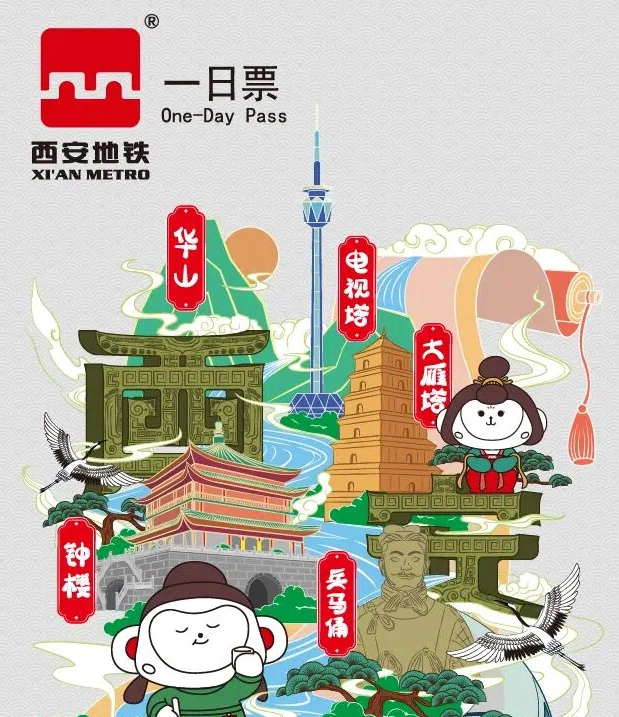
The system has expanded well beyond the limited line list found in older Xi’an guides, so use a current network map. TripChina’s Xi’an metro guide covers payment, routes and common mistakes.
Metro Line 9 reaches Huaqingchi Station in Lintong, after which you need a road connection toward the Terracotta Warriors. Because last-mile bus arrangements can change, check your route on the day rather than building the trip around an old bus number.
A licensed taxi or DiDi for foreign visitors is an easy final connection.
Avoid drivers or touts approaching you with unsolicited “cheap” attraction rides. Use official public transport, licensed taxis or app-booked cars.
Xi’an is not a city where food should be squeezed between attractions.
Start with roujiamo, biangbiang noodles, yangrou paomo, liangpi and the city’s many beef-and-lamb dishes. The Muslim Quarter is worth seeing, but the busiest tourist street is not automatically where you will eat best.
That distinction matters. The Muslim Quarter is a large historic Hui neighborhood, not simply one snack street.
For specific dishes and where to look beyond the most tourist-heavy stretch, use the Xi’an food guide and TripChina’s Muslim Quarter food guide.
Do not arrive at the Terracotta Warriors without understanding the scale of the site. The ticket covers both the Terracotta Warriors Museum and Lishan Garden; according to the official museum, each section takes roughly 1.5 hours and a free shuttle connects them.
Do not leave the Shaanxi History Museum until the last minute. As of September 2026, standard reservations are released five days ahead at 17:00, and the museum uses a real-name reservation system.
Do not schedule the City Wall at the hottest part of a summer afternoon. It is highly exposed, and there is little reason to make a 13.74 km wall harder than it needs to be.
Do not confuse Tang Dynasty Ever-Bright City with a conventional “Tang Dynasty night market.” It is a large pedestrian cultural and entertainment district rather than simply a food market.
Do not stay far outside the historic center just to save a small amount on a hotel. Xi’an is easy to navigate, but repeated cross-city trips eat into a short three-day itinerary.
Do not assume tickets for every major attraction can be purchased on arrival. Reservation rules are one of the areas where China travel differs most from spontaneous travel in many Western destinations. TripChina’s Xi’an attraction booking guide explains which sights need advance planning.
Xi’an itself is relatively straightforward once your China travel basics are working. The friction usually comes from payment, navigation and internet access rather than the attractions themselves.
International visitors can use China’s major mobile-payment systems with supported overseas cards, but keeping some RMB cash as backup is sensible. Set this up before your first restaurant or metro journey using TripChina’s payment guide for foreign visitors in China.
Internet access is the other one to solve before landing. If you depend on overseas apps and services, choose your connectivity setup in advance rather than troubleshooting it at the airport. See the China eSIM & internet guide.
This article is part of the Xi'an Travel Guide Hub.
Xi’an is generally straightforward for solo travelers, including around busy central areas such as Bell Tower and South Gate. Use normal city precautions in crowded places, avoid unlicensed transport and keep your hotel name and address saved in Chinese.
It depends on your nationality and itinerary. As of August 2026, China’s 240-hour visa-free transit policy applies to citizens of 57 countries who meet the requirements, including transiting onward to a third country or region through an eligible route. According to the National Immigration Administration, the policy currently covers 65 eligible ports across 24 provincial-level regions. Always check the latest rules for your passport and itinerary before booking.
Do not rely on untreated tap water for drinking. Use bottled or properly boiled water; hotels commonly provide bottled water or a kettle.
Some restaurants in major tourist areas do, but small noodle shops and neighborhood restaurants often do not. A translation app, photos of dishes and the name of what you want saved in advance are more useful than assuming an English menu will be available.
Not necessarily. Chili and chili oil appear in many dishes, but Shaanxi cooking is not simply another version of Sichuan cuisine. If you do not want chili, save the phrase “bu yao la” (“not spicy”) in your translation app.
Yes. Xi’an has a long-established Hui Muslim community, and halal restaurants are particularly easy to find around the Muslim Quarter. Look for restaurants displaying “Qingzhen,” the Chinese term commonly used for halal food.
Yes, bicycle rental is normally available on the City Wall, but rental points, operating hours and weather restrictions can change. Check the current rental rules when you enter rather than assuming bikes will remain available until the wall closes.
Same-day availability can vary, so advance reservation is the safer choice, particularly on weekends, public holidays and other busy dates. The official museum uses real-name reservations and allows foreign visitors to book through its official website and WeChat channels.
They can be especially useful for first-time visitors because much of the value of the site lies in archaeological and historical context rather than simply seeing the clay figures. If you prefer to explore independently, an audio guide or well-researched background material can serve the same purpose.
No. Tipping is generally not customary in ordinary restaurants, taxis or everyday services in Xi’an. Higher-end hotels or specialized private-tour services may operate differently, so check whether a service charge is already included.
Yes, but ordering requires more care than simply asking for a dish without visible meat. Noodles, tofu and vegetable dishes may still contain meat stock or small amounts of meat, so clearly explain your dietary requirements or use a translation app when ordering.
Yes for most first-time visitors. Three days balances the core landmarks with evening sightseeing; extend to four or five days if you plan to visit Huashan or add more historical sites.
The point of Xi’an is not simply to collect famous attractions. It is one of those places where the distances between different periods of Chinese history suddenly feel very small: Qin soldiers outside the city, Tang history around the pagodas, a Ming wall around the center, and a modern metropolis running through all of it.
Give it three days if you can.
All ticket, hotel, food and transport figures in this guide reflect information researched through September 2026 and are intended as planning references. Actual prices, operating hours, reservation rules and transport schedules can change, particularly during Chinese public holidays and peak travel periods. Confirm current attraction rules and fares before visiting.
Xi’an Municipal Government — History of Xi’an — Historical background, including Xi’an’s 3,100+ years of urban history, 13 dynasties and 1,129-year capital record. Accessed September 2026.
Emperor Qinshihuang’s Mausoleum Site Museum — Visitor Guide — Official opening hours, reservations, museum layout, recommended visit duration and shuttle information. Accessed September 2026.
Shaanxi History Museum — Visitor Guide — Official reservation rules, five-day booking window and release time. Accessed September 2026.
National Immigration Administration — Visa-Free Transit Policies — Current 240-hour visa-free transit eligibility, 57-country list and conditions. Accessed September 2026.
This guide was reviewed in September 2026 using TripChina’s destination research and current official sources from Xi’an municipal authorities, major attractions and China’s National Immigration Administration. Historical figures, reservation rules and major ticket prices were checked against primary sources where available. Prices, journey times and daily budgets are planning ranges rather than guaranteed quotes. Transport schedules and attraction rules can change, especially around public holidays. Restaurant names and transport options are examples, not endorsements.
TripChina.me creates practical China travel guides shaped by real local experience, helping independent travelers navigate transport, payments, food, neighborhoods, and the cultural details that make traveling in China easier and more meaningful. Find the guide for your destination at tripchina.me.