Our Location:
No. 99, Jiazi Road, Chengdu

 authorChris Lee
Getting from Chongqing Jiangbei International Airport (CKG) to the city center is easiest when you match your transport to your hotel location, luggage and arrival time. Metro Line 10 is usually the best budget choice, with an approximate ¥5–10 fare and a 45–60-minute journey to central Chongqing, including transfers. DiDi and official taxis typically cost around ¥50–90 for many central destinations, while the K01 airport bus runs toward Jiefangbei for ¥15.
This guide explains how to reach Jiefangbei and Hongyadong from Terminal 3, where to change metro lines, what to do after the last train and how to avoid the wrong hotel entrance in Chongqing's multi-level streets.
For most independent travelers, take Metro Line 10 from Terminal 3. It is affordable and avoids traffic congestion.
If you're heading to Jiefangbei, a useful metro route is:
Jiangbei Airport T3 → Line 10 → Hongtudi → Line 6 → Xiaoshizi
Choose DiDi or an official taxi when you have heavy luggage, are arriving late or need to reach a hotel entrance that is difficult to access on foot.
The K01 airport express bus is another low-cost option for passengers traveling toward Jiefangbei, including some late-night arrivals.
| Transport | Approximate Cost | Typical Time | Best For | Main Trade-Off |
|---|---|---|---|---|
| Metro Line 10 | ¥5–10 | 45–60 min | Solo travelers, budgets, avoiding traffic | Transfers and final walk |
| DiDi | ¥50–90 | 30–60 min | Luggage, door-to-door convenience | Variable fare and airport pickup rules |
| Official taxi | ¥50–90 | 30–60 min | Families, groups, passengers without an app | Metered fare varies with traffic |
| K01 airport bus | ¥15 per person | About 65 min | Budget travel toward Jiefangbei | Road traffic and final walk |
These are planning ranges, not guaranteed fares or journey times. Check current metro schedules, live ride prices and your precise hotel location.
TripChina verdict: Choose the metro for predictable travel, DiDi for easier hotel access, an official taxi if you prefer not to use an app, or K01 when its route and operating period match your arrival.
For a broader introduction to the city, see TripChina's Chongqing travel guide for first-time visitors.
Scheduled passenger flights at Chongqing Jiangbei International Airport have operated through Terminal 3 since December 23, 2025.
This includes domestic, international and regional passenger services under the airport's announced terminal consolidation.
You may still see Terminal 2 mentioned in older travel guides, metro maps or airport transport information.
That is because a transport stop can remain in operation even when the terminal is no longer the normal passenger-flight arrival point.
Metro Line 10 serves both Jiangbei Airport T3 Station and Jiangbei Airport T2 Station, while Line 3 serves T2.
For your arrival, follow the terminal details on your airline itinerary and current airport signs. Normally, begin your city-transfer plan from T3.
Metro Line 10 connects Terminal 3 with Chongqing's urban rail network.
It is generally the most economical and predictable way to reach the central city during normal operating hours.
After collecting your luggage:
A route that looks shortest on the metro map may not be the easiest with heavy luggage. Chongqing's hills, stairs and multi-level roads make the final walk unusually important.
One practical route is:
江北机场T3航站楼 → 10号线 → 红土地 → 6号线 → 小什字
In English:
Jiangbei Airport T3 → Line 10 → Hongtudi → Line 6 → Xiaoshizi
At Hongtudi, change to Line 6 toward Chayuan and continue to Xiaoshizi.
From there, walk to the part of Jiefangbei or the surrounding Yuzhong District where your hotel is located.
Allow around 45–60 minutes for a typical airport-to-central-city metro journey, depending on waiting time, transfers and the final walk.
Xiaoshizi is a useful destination for many central hotels, but it is not the best exit for every address. For some Jiefangbei hotels, another station or a door-to-door ride may be more convenient.
Chongqing Jiangbei International Airport is north of the central urban area, but the practical road distance depends on your destination.
Jiefangbei, Hongyadong and Guanyinqiao are different areas, and a straight-line distance does not describe the actual driving route.
As a useful planning estimate:
Also allow time for immigration where applicable, luggage collection and walking from the aircraft to the transport pickup point. These airport procedures are additional to the quoted city journey times.
Chongqing Jiangbei Airport currently publishes the following times for Line 10 departing T3 toward Lanhua Road, the direction used for central Chongqing.
| Day | First Train | Last Train |
|---|---|---|
| Weekdays | 06:38 | 23:23 |
| Weekends | 06:33 | 23:23 |
These times describe the published departure window at T3, not a guarantee that every later interchange remains available.
If you land near the last train, allow time to collect your bags and reach the platform. Check the current timetable and the last available connecting service before relying on the metro.
It is particularly suitable for solo travelers, couples with manageable luggage and visitors staying close to a convenient metro exit.
A taxi or DiDi may be easier if you have several suitcases, small children, limited mobility or a hotel entrance on a steep side street.
DiDi is a practical alternative for foreign visitors who want to travel directly to their hotel.
The main advantage is that you enter your destination before the ride, avoiding the need to explain a complicated hotel address to the driver.
A typical planning range for many central destinations is ¥50–90, but the actual fare depends on the vehicle type, traffic, demand, pickup point and exact address.
Expect the live quote to vary.
Prices can increase with:
Always check the amount shown in the app after landing.
Before your trip, follow TripChina's guide to using DiDi in China without a Chinese phone number so you can prepare your account and payment method.
Use the pickup point shown in your current DiDi booking, not an old screenshot.
Airport ride-hailing areas can change as traffic-management arrangements change.
After requesting the ride:
At Chongqing Airport, a driver may be close on the map but physically separated from you by a road, elevated platform or another traffic level.
Save your hotel's full Chinese address before you leave home. It can help with both DiDi and ordinary taxi travel.
If you are still choosing where to stay, read TripChina's guide to the best areas to stay in Chongqing, especially before booking a hotel that appears close to a metro station.
An official metered taxi is a practical choice when you want a car without setting up a ride-hailing account.
Use the airport's designated taxi queue and avoid unsolicited offers from people approaching passengers inside the terminal.
The published standard for the central urban area includes:
| Period | Starting Fare | Included Distance | Additional Distance |
|---|---|---|---|
| 06:00–23:00 | ¥10 | First 3 km | ¥2/km |
| 23:00–06:00 | ¥11 | First 3 km | ¥2.3/km |
Low-speed driving charges and other applicable tariff adjustments may affect the final price.
For many Jiefangbei-area journeys, ¥50–90 is a planning range rather than a guaranteed quote.
Many taxis accept QR-based mobile payments, but payment compatibility can differ.
Prepare a supported international-card mobile wallet before arrival and keep a reasonable amount of RMB cash as backup.
TripChina explains the setup process in its Alipay guide for international visitors and compares cash, cards and wallets in the China tourist payment guide.
If your payment app fails or the driver's collection code is incompatible with your funding method, use another legitimate accepted payment option.
Follow the official taxi signs and join the designated queue.
Do not accept an unverified ride simply because someone approaches you after baggage claim offering a special hotel fare.
The safest practical options are the official taxi queue, a confirmed DiDi booking, the metro or the airport's published K01 service.
K01 is the airport express bus serving Jiefangbei. It is useful when you prefer a direct, inexpensive ride toward the central shopping and hotel district.
According to the airport's published ground-transport information:
| Item | Published Information |
|---|---|
| Route | T3 → Jiazhou Garden → Damiao → Shangqingsi → Great Hall of the People → Jiefangbei |
| Ticket fare | ¥15 per passenger |
| Typical journey | About 65 minutes |
| Airport departure period | From 08:30 until 30 minutes after arriving flight operations end |
| Departure interval | Airport states the wait after the first passenger boards is no more than 30 minutes |
| Jiefangbei-to-airport departures | No fixed departure time published; telephone inquiry recommended |
The airport lists 023-67910674 for K01 inquiries.
The route and timetable may change, so verify the airport's current information if you are arriving late or depending on the bus for a flight departure.
Consider K01 if you are heading toward Jiefangbei, would rather avoid a metro transfer or have arrived after the last practical metro connection.
It is less attractive when traffic is heavy or your hotel is far from the bus's downtown endpoint.
A direct airport bus is not automatically door-to-door transport. Check the final walk from the Jiefangbei stop to your accommodation.
Your hotel address matters more than the general label “Chongqing city center.”
| Destination or Situation | First Choice | Alternative | Why |
|---|---|---|---|
| Jiefangbei | Metro Line 10 with transfer | DiDi or K01 | Good transit access and central bus destination |
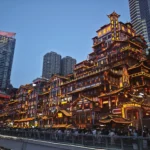
| Hongyadong | Metro toward Xiaoshizi | DiDi | Metro avoids congestion, car helps with luggage |
| Yuzhong hotel on a steep road | DiDi | Official taxi | Easier access to the hotel entrance |
| Two to four people with luggage | DiDi | Taxi | Car cost is shared |
| Solo traveler on a budget | Metro | K01 | Lower cost |
| Late arrival | DiDi or taxi | K01 if operating | Metro may have stopped |
| Heavy traffic | Metro | — | Rail travel avoids road congestion |
A common public-transport approach is Line 10 to Hongtudi, then Line 6 to Xiaoshizi.
However, Hongyadong is built into Chongqing's steep, multi-level terrain.
A hotel that looks close to Xiaoshizi may have an entrance on a different road level, and a short-looking walk can involve stairs or steep slopes.
If you have heavy luggage, check whether a car can reach your hotel's main entrance directly.
For sightseeing after check-in, use TripChina's Hongyadong guide to entrances and night views.
Choosing a transfer based only on straight-line map distance.
A hotel 400 meters from a station might be easy to reach—or the route might involve a steep staircase and another street level.
Save your hotel's Chinese name, the precise entrance location and any instructions the property provides.
This also helps prevent some of the common issues covered in TripChina's Chongqing travel mistakes guide.
First check whether you can still catch Metro Line 10 from T3 and make any required connections.
The airport's published final T3 departure toward Lanhua Road is 23:23.
If the rail connection is no longer practical, compare these alternatives:
DiDi: Useful for door-to-door travel when your phone, account and payment method are working.
Official taxi: A straightforward choice without a ride-hailing app. Use the airport's designated taxi queue.
K01 airport bus: Consider it if you are heading toward Jiefangbei and the service is still operating. The airport publishes departures continuing until 30 minutes after arriving flight operations finish, subject to its current schedule.
If you arrive around midnight or later, the simplest choice may be a direct car rather than trying to save a small amount with multiple transfers and a long walk.
Check your actual landing time, baggage collection time and hotel location before deciding.
Metro Line 10 has one major advantage: road congestion does not delay the train.
DiDi, taxis and K01 can all take longer when traffic is heavy.
The effect varies by route, weather, holidays and time of day, so avoid relying on a fixed rush-hour travel time.
If your navigation app shows serious traffic congestion and your luggage is manageable, the metro becomes especially attractive.
You should ideally have mobile data, a working payment method and your hotel address ready before exiting the terminal.
Save the following information:
This makes it easier to take a taxi, find the correct DiDi destination or ask airport staff for help.
For navigation, use TripChina's guide to the best map apps for China travel.
If you haven't chosen your mobile-data plan, compare China eSIM and SIM card options.
For a complete phone checklist, see the seven essential apps for traveling in China.
If you land without working internet, follow our China arrival connectivity troubleshooting guide before relying on airport Wi-Fi for a ride request.
| Common Mistake | Better Approach |
|---|---|
| Following an older guide that assumes your flight arrives at T2 | Check current airline information; scheduled passenger flights normally use T3 |
| Treating taxi and DiDi estimates as fixed prices | Check the meter or live app quote |
| Assuming cars are always faster | Compare road traffic with the metro |
| Choosing a metro route without checking the final walk | Verify your hotel's actual entrance |
| Accepting unsolicited airport transfers | Use official taxi, DiDi, metro or K01 services |
| Following an outdated DiDi pickup screenshot | Use the live pickup point |
| Relying on the last T3 train without allowing baggage-collection time | Check the final connection and prepare a fallback |
| Assuming old K01 departure details are still current | Check the airport's official bus page |
Yes, but the journey may be more difficult with several suitcases. Stations can involve lengthy transfers, even when lifts and escalators are available. A door-to-door vehicle may be more convenient for families carrying substantial luggage.
Do not assume so. A standard car generally has four passenger seats. Choose an appropriately sized vehicle or arrange more than one car, considering the luggage space as well.
Yes, but check the actual hotel entrance before choosing the metro. The surrounding streets have substantial elevation differences, and a seemingly short walk may include stairs.
Airport Wi-Fi access and login procedures may change, and international phone numbers do not always work smoothly with every verification system. Prepare your own working mobile data whenever possible.
Tipping is not normally expected for ordinary taxi or ride-hailing trips. Pay the applicable metered or app-displayed fare and any legitimate charges shown.
Remain near the designated pickup zone displayed in your booking. Check the vehicle plate and use in-app messaging or calling if available. Do not walk into active traffic lanes trying to find the driver.
Metro Line 10 serves Terminal 3, but reaching the central Jiefangbei area normally involves a transfer or a final walk. One practical route changes at Hongtudi to Line 6 and continues to Xiaoshizi.
Yes, for the published standard fare: K01 costs ¥15 per person, while a taxi is metered and usually costs substantially more for a full airport-to-city journey. However, K01 is not a hotel-door service.
For most first-time visitors, Metro Line 10 is the best budget option, while DiDi and official taxis are easier with luggage or late arrivals.
If your hotel is near Jiefangbei, compare the metro route through Hongtudi and Xiaoshizi with the ¥15 K01 bus. If you're staying near Hongyadong or on a steep Yuzhong side street, check your precise hotel entrance before deciding.
The main Chongqing mistake is not picking the wrong transport company. It's choosing a route that looks easy on a flat map but ends at the wrong road level.
This guide uses Chongqing Airport's published rail and K01 service information, municipal terminal announcements and the supplied article's taxi and ride-hailing estimates. Prices and travel times are planning figures, not guaranteed quotes. Metro schedules, road conditions, airport pickup locations and hotel access can change. Check current transport information and your hotel's actual entrance before traveling.
TripChina.me creates practical China travel guides shaped by real local experience, helping independent travelers navigate transport, payments, food, neighborhoods, and the cultural details that make traveling in China easier and more meaningful. Find the guide for your destination at tripchina.me.