Our Location:
No. 99, Jiazi Road, Chengdu

 authorChris Lee
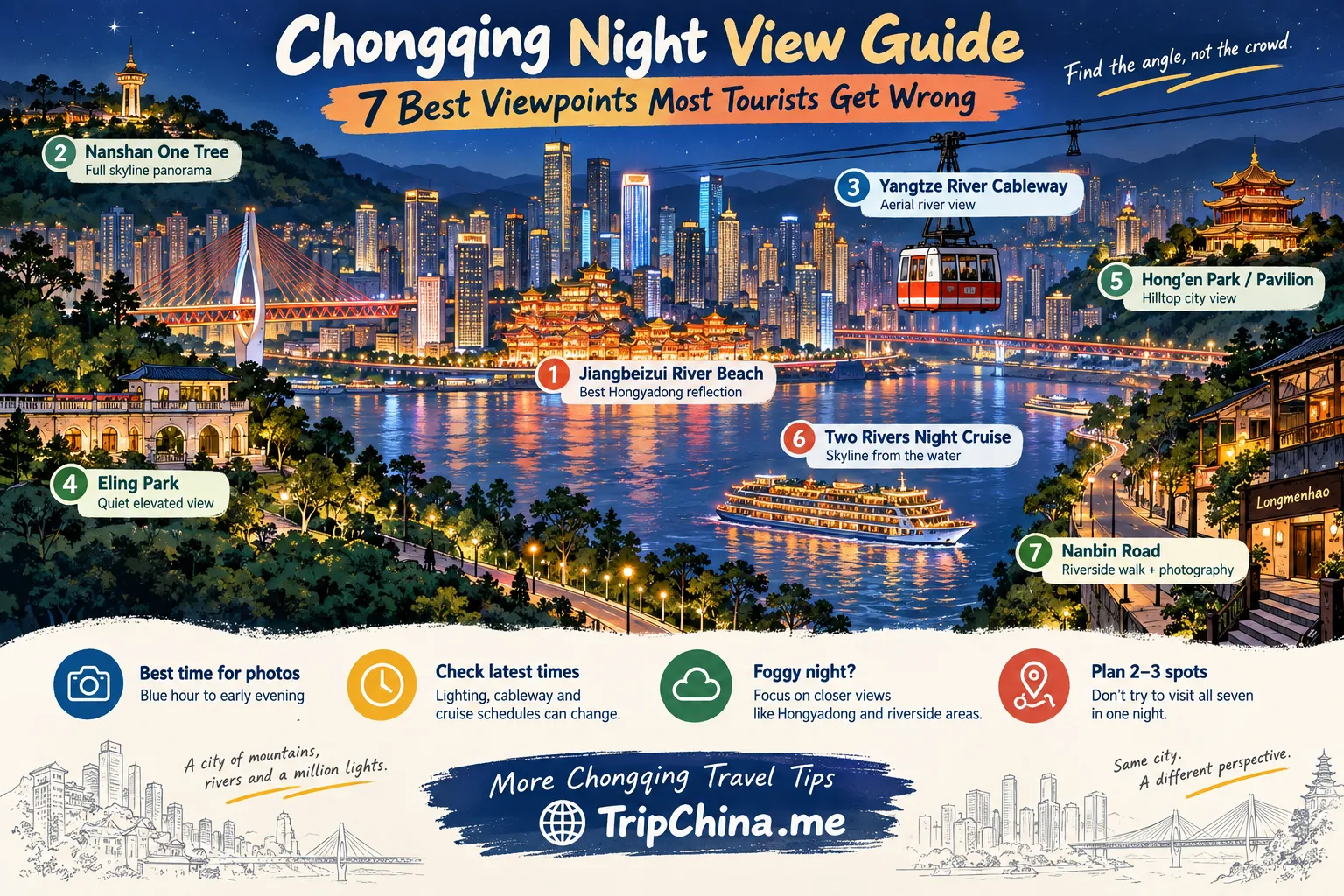
Looking for the best Chongqing night view? Most guides send everyone to the same places. But after exploring the city’s famous viewpoints and quieter alternatives, I found a simple pattern: the best view is often somewhere other than the attraction itself.
This guide covers free viewpoints, night-photography locations, crowd-free itineraries and practical tips for foreign travelers.
Table of Contents: Quick Answer · Best Time for Photography · Foggy Nights · 7 Best Night View Spots · How to Choose · 3-Hour Route · Smart Tips · FAQ · Sources
| Spot | Best For | Price | Crowd |
|---|---|---|---|
| Jiangbeizui River Beach (江北嘴江滩公园) | Hongyadong reflection | Free | Low |
| Nanshan One Tree (南山一棵树) | Full skyline panorama | ¥30 | Moderate |
| Yangtze River Cableway (长江索道) | Aerial river view | ¥30 one-way | High |
| Eling Park (鹅岭公园) | Quiet elevated view | Free | Low |
| Hong’en Park / Pavilion (鸿恩寺森林公园 / 鸿恩阁) | Hilltop city view | Free | Low |
| Two Rivers Night Cruise (重庆两江夜游) | Skyline from the water | ¥120–180 | Moderate |
| Nanbin Road (南滨路) | Riverside walk + photography | Free | Low–Moderate |
For photography: start with Jiangbeizui.
For the classic panorama: choose Nanshan One Tree.
For a free, quieter evening: try Eling Park or Nanbin Road.
For the easiest sightseeing experience: take a river cruise.
As of September 2026, I would not plan around one fixed Hongyadong lighting time. The most recent government notice I could verify changed the lighting schedule to 18:30–23:00, but lighting times can be adjusted again, so check the latest notice on the day you visit. (Chongqing Municipal Government)
The first mistake is obvious: everyone goes to the same spots. Hongyadong interior, Qiansimen Bridge and the Yangtze River Cableway during peak hours can become some of the busiest places in central Chongqing.
The second mistake is subtler.
Most visitors treat Chongqing night views as a checklist—see Hongyadong, ride the cableway, done. But the city’s real magic is in the layering. The best views are often from across a river, from a hillside, or from a boat moving between the illuminated banks.
I learned this the hard way. My first night, I spent about 40 minutes waiting for an elevator inside Hongyadong. I never got to the top.
The next night, I stood across the river at Jiangbeizui and watched the same building from roughly 500 meters away. The view was dramatically better.
📍 Open in Amap — Jiangbeizui River Beach (江北嘴江滩公园)Find the angle, not the crowd.
If Hongyadong is one of your priorities, TripChina’s Hongyadong guide to entrances, night views and common mistakes goes into the site itself in more detail.
For photography, aim for the blue-hour-to-night transition rather than arriving only after the sky is completely black.
The remaining blue in the sky helps separate Chongqing’s buildings from the background and usually produces a more balanced photograph than a completely black sky.
Most viewpoints are best visited from blue hour into the early evening. Avoid starting too late—after roughly 22:30, some attractions, towers and businesses are already closing or winding down.
September through November can be a particularly comfortable period for evening walks, with cooler temperatures and often better visibility.
That does not mean autumn guarantees a clear skyline. Chongqing’s weather changes quickly, and fog, low cloud and rain can affect distant views in any season.
If you are visiting during a major Chinese holiday, crowd levels can change just as dramatically as the weather. Check TripChina’s China public holiday and crowd calendar before fixing Hongyadong or the cableway to one particular evening.
If visibility is poor, skip a distant hilltop panorama and switch to closer subjects.
Hongyadong’s architecture, riverside streets, illuminated bridges and Longmenhao can still photograph well even when the far skyline disappears.
For expensive or time-consuming viewpoints such as Nanshan One Tree, check visibility before leaving downtown. There is little point climbing higher if the skyline is already hidden in cloud.
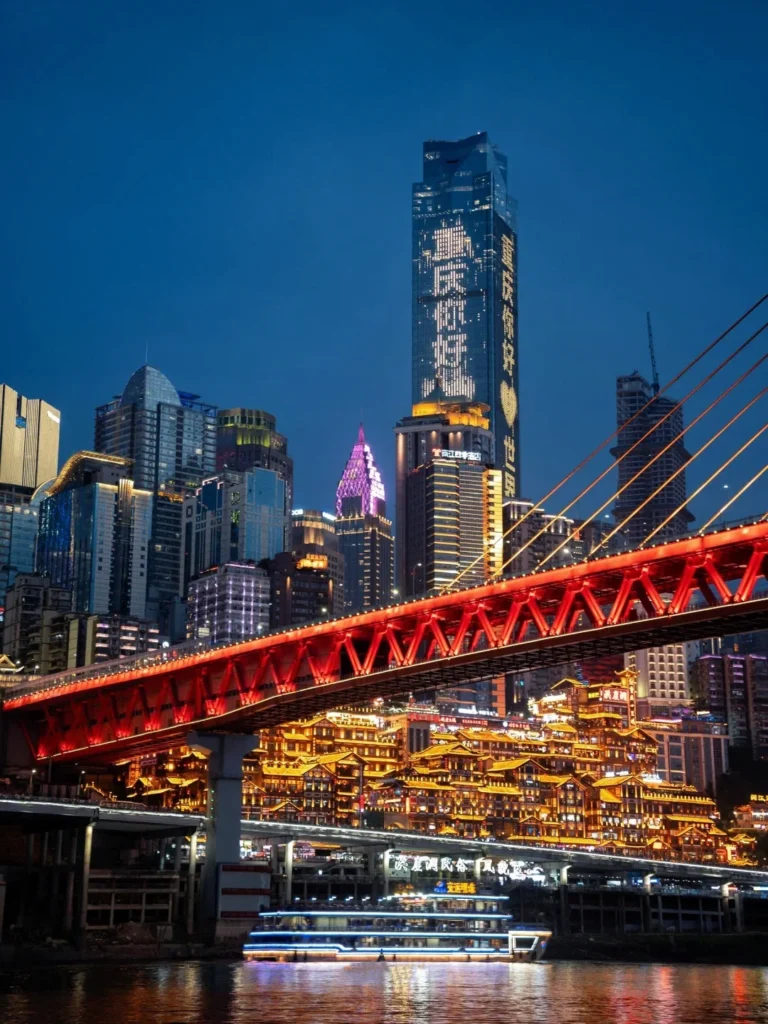
For my favorite Hongyadong photo, head toward the riverfront below Chongqing Grand Theatre (重庆大剧院) on the Jiangbeizui side.
From Grand Theatre metro station, walk toward the river and follow the designated riverside access.
On a clear, calm evening, you can frame Hongyadong, Qiansimen Bridge and the Jialing River together. When the water is still, the illuminated buildings reflect across the river.
Best time: blue hour through early evening, once Hongyadong is illuminated.
Photography: A normal wide-angle phone lens works well here. Try a low composition with more water in the frame when reflections are strong.
Trade-off: Some routes toward the lower riverbank can be steep and poorly lit.
Stay on designated paths. Some riverbank sections may close after dark or when river conditions require it. Never climb barriers or walk close to the water solely for a better photo.
📍 Open in Amap — Chongqing Grand Theatre (重庆大剧院)If you want the classic Chongqing skyline panorama, Nanshan One Tree (南山一棵树) remains one of the strongest choices.
The viewpoint faces the Yuzhong Peninsula from the southern hills. Instead of looking at one landmark, you see Chongqing as a whole—the peninsula, rivers, bridges and dense layers of illuminated buildings.
Price: typically around ¥30; verify the current ticket price before visiting.
Best time: arrive before sunset and stay through blue hour.
Photography: This is the place for a wide skyline shot rather than close-up architecture. A small tripod can be useful where permitted.
Visibility is the deciding factor. If conditions are poor, save Nanshan for another evening rather than spending time and money on a view hidden by cloud.
Transport is also less straightforward than for downtown viewpoints. A taxi or DiDi can save considerable time, especially on the return journey.
If you have not used Chinese ride-hailing before, TripChina’s DiDi guide for foreign travelers without a Chinese number explains the setup.
📍 Open in Amap — Nanshan Yikeshu (南山一棵树)Yes—but I prefer it around dusk rather than at the busiest point of the evening.
The Yangtze River Cableway (长江索道) was once primarily urban transport. Today it is one of Chongqing’s best-known tourist experiences, giving you a moving aerial view over the Yangtze.
Operating hours change seasonally and may also be adjusted temporarily. Chongqing government notices, for example, have announced both seasonal schedules and one-day maintenance closures, so check the official notice before your trip rather than relying only on a saved screenshot. (Chongqing Municipal Government)
The government-set maximum fares remain:
If your itinerary continues on the opposite bank, a one-way ticket is usually more practical than automatically buying a return.
For tickets, use the official 长江索道 WeChat account, on-site machines, the ticket counter or an authorized travel platform.
If WeChat payment is unfamiliar, TripChina’s WeChat Pay setup guide for foreign visitors is worth completing before your evening out.
Photography: Shoot through the cabin window toward the skyline rather than trying to photograph the cable car itself. Window reflections become stronger after dark, which is another reason dusk often works better.
📍 Open in Amap — Chongqing Yangtze River Cableway Shangxinjie Station (重庆长江索道上新街站)📍 Open in Amap — Chongqing Changjiang Cableway Xinhua Road Station (重庆长江索道新华路站)Yes. Eling Park (鹅岭公园) is one of my favorite alternatives when you want an elevated city view without committing to Nanshan.
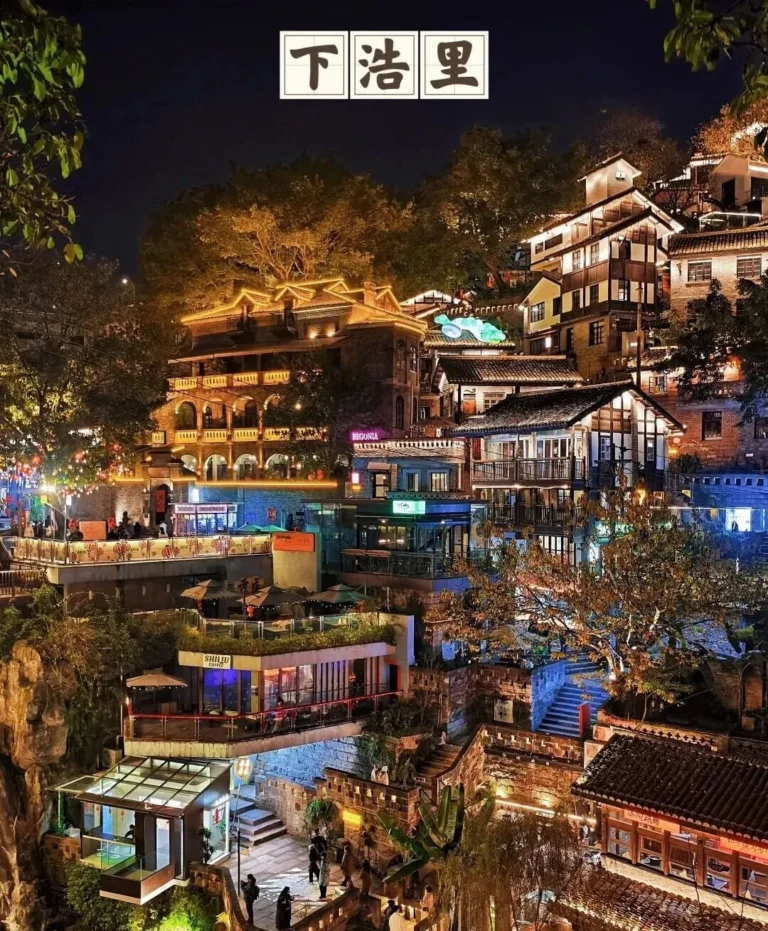
The park sits high in Yuzhong District, and Kansheng Tower (瞰胜楼) provides an elevated perspective over the surrounding city and rivers.
The old sub-¥1 tower fee is no longer useful for planning. The tower is currently free.
The tower’s opening hours may differ from the park itself, so arriving very late can mean you still enter the park but miss access to the highest viewpoint.
Best time: blue hour to early evening.
Photography: Because the city surrounds you rather than sitting entirely in front of you, this works well for layered compositions—bridges, towers and hills stacked into the same frame.
Eling is also a good option when you want a quieter evening without committing to one of Chongqing’s headline attractions.
📍 Open in Amap — Eleming Park Kanshenglou (鹅岭公园瞰胜楼)Hong’en Park and Hong’en Pavilion (鸿恩阁) offer a different perspective from the better-known Yuzhong viewpoints.
Instead of looking directly across the rivers at the classic peninsula skyline, you get a broader elevated view over Chongqing’s dense urban landscape.
The pavilion itself—with traditional-style roofs and illumination—also becomes part of the photograph.
Price: Free.
Best time: after dusk, when the pavilion and surrounding city are illuminated.
Check the current lighting time on the day you visit rather than relying on a fixed schedule.
Photography: Try using the illuminated pavilion as foreground rather than shooting only the distant skyline.
The park is large and involves uphill walking. Wear shoes that handle Chongqing’s stairs and slopes comfortably, and check your return transport before staying late.
📍 Open in Amap — Hongenge (鸿恩阁)If you want to see Chongqing from the water without planning several separate viewpoints, the Two Rivers Night Cruise (重庆两江夜游) is the easiest option.
From the river, the appeal is not one individual building. You see illuminated riverbanks, bridges and Chongqing’s vertical skyline continuously as the boat moves.
📍 Open in Amap — Hongyadong Passenger Dock (洪崖洞客运码头)Schedules, vessels, prices and departure docks vary. Check the exact departure dock printed on your ticket rather than assuming every cruise leaves from Hongyadong.
As of April 2026, Chongqing’s transport authorities still identified both Hongyadong and Chaotianmen as Two Rivers Cruise boarding docks and specifically advised passengers to verify the dock printed on their ticket. (Chongqing Municipal Government)
Typical price: around ¥120–180 depending on product and vessel.
If you cannot use a Chinese WeChat ticketing account, buy on-site or through a reputable authorized travel platform.
Photography: The moving boat makes long exposures difficult. Use a faster shutter speed and photograph the skyline as the boat approaches. Night mode is best used sparingly for moving subjects.
There is also a much cheaper river option worth knowing about. The Two Rivers Ferry B route launched in June 2026 at ¥15, departing from Danzishi at 18:30 once per day. (Chongqing Municipal Government)
This is a dusk/daylight sightseeing ferry rather than a regular after-dark night-cruise service. Do not plan on using it later in the evening as a substitute for the Two Rivers Night Cruise.
Yes—especially if you prefer walking to standing on one observation deck.
Nanbin Road (南滨路) follows the south side of the Yangtze and gives you a changing perspective on the Yuzhong skyline as you move along the river.
Rather than trying to cover the entire waterfront, choose a section and walk slowly.
Two useful areas include:
📍 Open in Amap — Nanbin Road (南滨路)Zhonglou Square (钟楼广场) — useful for layered riverfront architecture.
Huguishi Garden (呼归石花阶公园) — useful for broader river and skyline compositions.
Longmenhao Old Street (龙门浩老街) is nearby but should not be treated as simply another stop on one continuous Nanbin Road walking path. It works better as a separate atmospheric stop before or after your riverfront walk.
If you enjoy exploring Chongqing on foot, TripChina’s comparison of eight Chongqing citywalk routes can help you choose a longer daytime or evening route.
Photography: Nanbin Road is best for wide skyline images, bridges and river reflections rather than close-ups of individual landmarks.
| If You Want... | Go To... | Why |
|---|---|---|
| Classic skyline | Nanshan One Tree | Broad Yuzhong panorama |
| Best Hongyadong photo | Jiangbeizui River Beach | Across-river angle + reflections |
| Aerial experience | Yangtze River Cableway | Moving view above the Yangtze |
| Quiet elevated view | Eling Park | Free and centrally located |
| Architecture + skyline | Hong’en Pavilion | Pavilion works as foreground |
| See many landmarks quickly | Two Rivers Night Cruise | Moving river-level panorama |
| Night photography walk | Nanbin Road | Multiple compositions in one evening |
Do not attempt to visit all seven viewpoints in a single night. Two or three complementary spots will give you a much more relaxed Chongqing night-view experience.
My original mistake was treating famous viewpoints as destinations to collect.
A better evening combines one high view, one across-river view and one atmospheric street-level stop.
Start with an elevated city view as daylight fades.
Skip Qiansimen Bridge as a dedicated stop during the evening peak.
The bridge gives a famous Hongyadong angle, but it can become extremely crowded—the opposite of what this route is designed to achieve.
If you specifically want the bridge-level view, go earlier, before around 19:00, or save it for a separate evening rather than compromising the rest of this crowd-free route.
Photograph Hongyadong and the Jialing River from across the water.
Stay on the designated promenade rather than descending into closed or unsafe riverbank areas.
Finish around Longmenhao Old Street or the nearby south-bank area for a slower end to the evening.
Note: many cafes and bars in this area begin closing around 21:30–22:00, so if food or drinks are part of the plan, head there directly.
If you want to finish the night with local food somewhere else, TripChina’s Chongqing night markets guide can help you choose a stop that fits your route.
Going inside Hongyadong just for the view. The famous photograph is of Hongyadong, not from deep inside it. The exterior riverfront angles are usually more rewarding.
Choosing a high viewpoint without checking visibility. For Nanshan and other distant panoramas, check conditions before committing to the journey.
Buying cableway or cruise tickets from street sellers. Use official ticket counters, official WeChat channels or recognized authorized platforms. Chongqing transport authorities continue to warn travelers to use formal ticket channels for river cruises. (Chongqing Municipal Government)
Assuming your map will work exactly as it does at home. Chinese mapping apps behave differently—set one up before going out, and save the Chinese names of your destinations. TripChina’s China navigation-app guide for overseas visitors explains the main options.
Underestimating Chongqing’s terrain. A distance that looks short on a map may involve stairs, steep streets, overpasses or several vertical levels.
For more city-specific problems beyond night views, see TripChina’s 15 Chongqing mistakes first-time visitors should avoid.
Chongqing becomes much easier once your phone is ready before sunset.
Make sure you have working mobile data and at least one usable payment method.
TripChina’s China eSIM vs SIM guide for foreign travelers explains connectivity options, while the China payment guide for Alipay, WeChat Pay, cards and cash covers paying once you are out.
Save the Chinese names of your destinations as well. Showing “鹅岭公园” or “重庆大剧院” to a driver is often more reliable than relying on an English translation.
For more Chengdu travel tips, visit our Chongqing Travel Guide Hub.
Yes. The major viewpoints in this guide can be visited independently using metro, walking and ride-hailing.
A tour becomes more useful if you want private transport linking several hilltop locations in one evening.
Absolutely. Modern phones handle Chongqing’s illuminated skyline surprisingly well.
Keep the phone stable where safe and slightly reduce exposure if bright signs are blown out. For moving boats or cable cars, use shorter exposures to reduce motion blur.
Small tripods are generally easier to use in open public areas, but individual attractions or crowded viewpoints may restrict them for safety or crowd management.
Never block stairs, walkways or busy viewing platforms.
Switch from distant skylines to closer subjects.
Hongyadong’s architecture, Longmenhao, illuminated streets, bridge structures and close riverfront scenes can still work well even when the distant skyline disappears.
My favorite Chongqing night view still came from the simplest place: across the river, looking back at the attraction everyone else was standing inside. That riverbank—Jiangbeizui—was the one I found by accident, not the one I planned.
If you take one thing from this guide: find the angle, not the crowd. The best Chongqing night view is rarely where everyone else is standing.
Updated September 9, 2026. This guide combines the author’s on-the-ground experience with current Chongqing government and transport information. Cableway operations, cruise boarding guidance, Hongyadong lighting and the new Two Rivers Ferry B route were rechecked against official notices. The original guide’s seven-viewpoint structure and first-hand Jiangbeizui experience were retained. Variable details such as lighting, fog, business closing times, cruise departures and maintenance closures should still be checked shortly before visiting.
TripChina.me creates practical China travel guides shaped by real local experience, helping independent travelers navigate transport, payments, food, neighborhoods, and the cultural details that make traveling in China easier and more meaningful. Find the guide for your destination at tripchina.me.