Our Location:
No. 99, Jiazi Road, Chengdu

 authorChris Lee
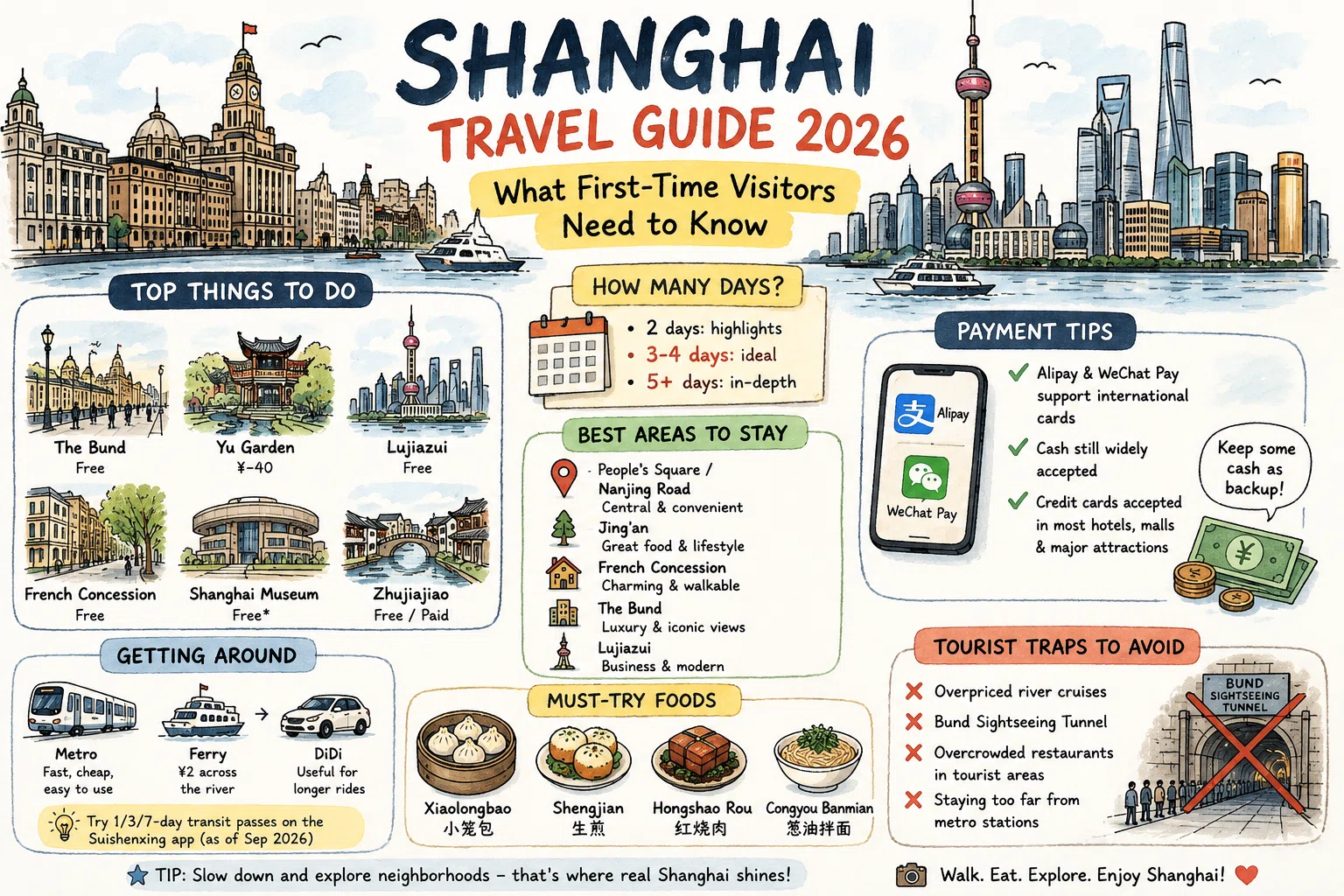
Shanghai is easy to underestimate. The skyline gets the photos, but the city becomes much more rewarding when you combine the Bund with historic neighborhoods, local food and slower street-level exploration. This guide shows first-time visitors what is actually worth their time, how many days to stay, where to base themselves, how to get around and pay, and how to build a realistic Shanghai itinerary using information checked as of September 2026.
• Stay 3–4 days for a balanced first trip; two days works if you only want the major highlights.
• Prioritize the Bund, one historic neighborhood, Yu Garden and one modern Pudong experience instead of trying to complete every famous attraction.
• People's Square / central Nanjing Road or Jing'an are usually the most practical first-trip bases.
• Use metro + walking + occasional DiDi. Suishenxing also offers 1-, 3- and 7-day unlimited public-transport passes covering eligible metro, bus and ferry services.
• Set up Alipay or Weixin Pay, but keep RMB cash or another payment option as backup.
• If your itinerary qualifies, China's 240-hour visa-free transit policy covers citizens of 57 countries, including the United States—but it is a transit policy, not unconditional visa-free entry for any Shanghai holiday.
Yes.
Shanghai is one of the easier Chinese megacities for international travelers to navigate independently, but convenience is not the main reason to visit.
The city works particularly well if you want several versions of China in the same trip:
• early-20th-century commercial architecture along the Bund
• classical Jiangnan garden design
• shikumen and historic residential neighborhoods
• contemporary art and retail districts
• some of China's most recognizable modern skyscrapers
• an extensive waterfront and metro network
The mistake is treating Shanghai entirely as a checklist.
The city becomes more interesting when you alternate major sights with neighborhoods where the experience is simply:
walking → eating → stopping for coffee → noticing the architecture → turning down a side street
| City | What It Adds to a First China Trip |
|---|---|
| Beijing | Imperial history, national monuments, Great Wall |
| Xi'an | Ancient capitals, archaeology, Tang-era history |
| Chengdu | Sichuan food, pandas, slower regional culture |
| Shanghai | Historic-modern contrast, cosmopolitan China, Jiangnan culture |
Shanghai does not replace Beijing or Xi'an for imperial history.
Its strength is seeing how Chinese, international and modern urban influences overlap within the same streetscape.
Unlike Chengdu, Shanghai's primary draw is not regional food or wildlife-related sightseeing. The city itself—its architecture, neighborhoods, waterfront and layers of urban history—is a large part of the attraction.
For most first-time visitors:
3–4 full days is the sweet spot.
Two days can cover the biggest landmarks, but you will probably sacrifice the neighborhood walks and slower experiences that make Shanghai distinctive.
| Time in Shanghai | Best For | Realistic Experience |
|---|---|---|
| 1 day | Long layover / very short visit | Bund + one central district |
| 2 days | Fast China itinerary | Major landmarks + one historic neighborhood |
| 3–4 days | Most first-time visitors | Landmarks + neighborhoods + food + museum |
| 5+ days | Slow travel | Art districts, water town, deeper neighborhood exploration |
The easiest way to plan Shanghai is geographically rather than by collecting individual attractions.
| Day | Morning | Afternoon | Evening |
|---|---|---|---|
| Day 1 — Classic Shanghai | Yu Garden / Old City | People's Square or Nanjing Road | Bund + waterfront |
| Day 2 — Historic Shanghai | Wukang Road area | Anfu Road / Sinan Road / nearby lanes | Jing'an |
| Day 3 — Modern + Cultural Shanghai | Shanghai Museum East | Lujiazui / Pudong | Ferry or North Bund |
Visit Yu Garden earlier in the day before the surrounding commercial area becomes busier.
Continue through central Shanghai rather than crossing the city unnecessarily.
Finish at the Bund around late afternoon.
That gives you:
daylight architecture
and
the Pudong skyline after dark.
Spend the morning around Wukang Road and the Hengshan Road–Fuxing Road historical area.
Do not treat every famous villa, café or photo point as compulsory.
Pick a route and actually walk it.
Continue into Sinan Road or another nearby neighborhood if you still have time instead of jumping across Shanghai for another landmark.
Use the morning for Shanghai Museum East or another cultural stop.
Then move to Pudong for Lujiazui, the riverfront or another modern Shanghai experience.
If you want a river view without turning it into a formal sightseeing activity, use a regular Huangpu ferry.
A fourth day gives you room for West Bund, Hongkou, Zhujiajiao or simply another slower neighborhood day.
You do not need 20 “must-see” attractions.
For most first trips, these give you the strongest mix of Shanghai's different identities.
| Place | Best For | Time Needed | Entry |
|---|---|---|---|
| The Bund | Classic skyline | 1–2 hrs | Free |
| Yu Garden | Jiangnan garden | 1–2 hrs | Paid |
| Historic former French Concession area | Walking, architecture | 2–3 hrs | Free |
| Lujiazui | Modern Shanghai | 1–2 hrs | Walking free; decks paid |
| Shanghai Museum East | Chinese art / history | 2–3 hrs | General entry free |
| Zhujiajiao | Water-town atmosphere | Half/full day | Town access / attractions vary |
Yes.
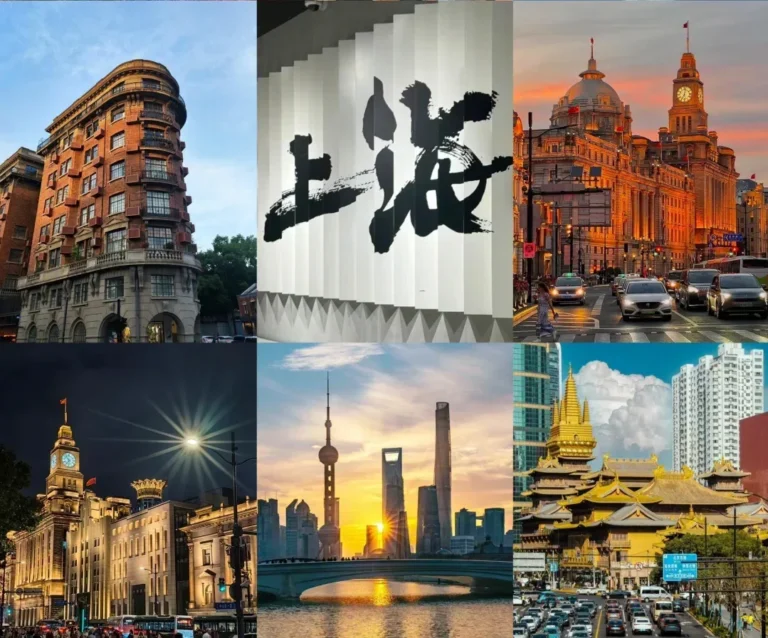
If you see only one classic Shanghai view, make it the Bund.
From the Puxi waterfront, you get Shanghai's defining visual contrast:
historic Bund architecture → Huangpu River → Pudong skyline
The promenade itself is free.
TripChina Local Tip: Arrive before sunset and stay after dark if your schedule allows. You get two different versions of the skyline without making two separate trips.
If crowds matter more than standing at the classic postcard viewpoint, North Bund can be a good alternative.
Ideally both.
They show opposite sides of the same skyline.
| The Bund | Lujiazui | North Bund | |
|---|---|---|---|
| Best for | First-time visitors | Skyscrapers | Walking / photography |
| Main view | Pudong skyline | Historic Bund | Wider river panorama |
| Atmosphere | Historic + iconic | Modern + commercial | More spacious |
| Cost to walk | Free | Free | Free |
| TripChina pick | Best first choice | Add afterward | Good alternative |
If time is limited:
prioritize the Bund.
Yes—if what you want is a cheap river crossing rather than a sightseeing cruise.
As of September 2026, the pedestrian fare on regular Huangpu ferry routes remains around:
RMB 2
A public ferry and a tourist cruise solve two different needs.
Use the ferry for:
• transportation
• a quick river view
• a low-cost local experience
Choose a sightseeing cruise when the river journey itself is the attraction.
Yes, particularly if you have never visited a classical Jiangnan garden.
Inside you get:
• pavilions
• rockeries
• ponds
• corridors
• traditional garden composition
The Yuyuan commercial district outside is a different experience:
busy + photogenic + commercial
Do not judge the garden entirely by the shopping streets surrounding it.
Visit earlier if you want a calmer experience, and check current ticket arrangements shortly before going.
A good first choice is the Wukang Road / Hengshan Road–Fuxing Road historic area.
Start around Wukang Building.
A simple route is:
Wukang Building → Wukang Road → Anfu Road → nearby residential streets
Allow approximately 2–3 hours.
Don't spend the entire walk looking at a list of viral photo spots.
The area becomes more interesting once you start noticing the streets between the landmarks.
Try Sinan Road and the surrounding historic residential area.
The neighborhood offers garden villas and quieter streets that show another side of Shanghai's historic urban fabric.
It works particularly well for repeat visitors or anyone who finds Wukang Road too crowded.
You can also use it as part of a longer historic walk rather than treating it as another attraction to “complete.”
Your hotel location matters more than having a famous view.
Shanghai is enormous.
Saving 20–30 minutes on several daily trips often matters more than seeing Pudong from your hotel room.
| Area | Best For | Advantages | Trade-Off |
|---|---|---|---|
| People's Square / Nanjing Road | First trip | Central, strong transport | Busy |
| Jing'an | Food + comfortable stay | Restaurants, cafés, metro | Farther from some Bund sights |
| Former French Concession | Atmosphere | Historic, walkable | Exact location matters |
| Bund | Luxury + views | Iconic setting | Expensive |
| Lujiazui | Business / skyscrapers | Modern hotels | Less convenient for historic areas |
For pure convenience, start with:
People's Square / central Nanjing Road
If you care more about:
restaurants + cafés + neighborhood atmosphere
choose Jing'an.
Keep metro connectivity high on your checklist before booking.
Waterfront views often carry a substantial price premium.
Use:
metro + walking + occasional DiDi
Shanghai's metro should handle most sightseeing days.
DiDi becomes useful when:
• it is late
• you have luggage
• you are traveling with older parents or young children
• two places connect awkwardly by metro
• heavy rain or heat makes walking unpleasant
You do not need to memorize the network.
Line 2 is especially useful because it connects or serves areas around:
• Pudong Airport
• Lujiazui
• central Shanghai
• Jing'an
• Hongqiao
But route each journey individually rather than organizing your entire trip around line numbers.
One detail matters more than tourists expect:
station exits.
Large Shanghai stations can have many exits, and choosing the wrong one can add a substantial walk.
For detailed transport instructions, see TripChina's Shanghai Metro Guide.
They can be—especially if you expect to use public transport heavily.
Suishenxing / SH MaaS offers intermodal day passes with the following prices:
| Pass | Price | Validity |
|---|---|---|
| 1-day | ¥19.80 | 24 hours |
| 3-day | ¥47.80 | 72 hours |
| 7-day | ¥85.80 | 168 hours |
During the validity period, the passes provide unlimited eligible rides on:
metro + city buses + pedestrian ferry services
They do not cover every form of transport in Shanghai.
Notably, the intermodal day passes do not include services such as the Maglev, Airport Link Line, sightseeing routes and certain other excluded services.
Do not automatically assume the pass is cheaper.
If you make only two or three inexpensive metro journeys per day, pay-as-you-go may still cost less.
Buy the pass primarily for:
convenience + frequent transport use.
Mostly if:
• you want the experience
• you are already using Pudong Airport
• Longyang Road works with your onward route
The Maglev connects:
Pudong International Airport → Longyang Road
It does not take you directly to the Bund or People's Square.
As of 2026, official Shanghai visitor information lists approximately:
Maximum operating speed: up to 300 km/h
Travel time: about 8 minutes
Single fare: RMB 50
Round trip: RMB 80
This is an important correction to older articles that still describe current service using the historic 430 km/h maximum.
If your only goal is getting to the hotel efficiently, compare:
Maglev + transfer vs Metro Line 2 vs direct car
before choosing.
Do not build your trip around the claim:
“China is cashless and nobody accepts cash.”
That is misleading.
Shanghai's official guidance for international visitors covers:
• foreign bank cards
• RMB cash
• Alipay
• Weixin Pay
• e-CNY
For most travelers, the simplest everyday setup is:
mobile payment first + international card + some RMB cash backup
Yes.
Doing it before your flight removes one of the most common first-day frustrations.
Link an eligible international card and complete any required verification before traveling.
Use TripChina's Alipay Guide for Foreign Visitors for step-by-step instructions.
Don't panic if one mobile-payment transaction fails.
A single failed transaction does not mean your entire payment setup is broken.
Try another payment method or ask the merchant.
Shanghai has continued adding services designed to reduce friction for foreign travelers.
International visitor service centers at Pudong and Hongqiao airports can assist with:
• payment
• transport
• communications
• travel-related information
Shanghai has also promoted Hu Xiaoyou, an AI-enabled service offering multilingual trip-planning and visitor support.
These are useful backups.
You do not need to structure your itinerary around them.
The 37th Shanghai Tourism Festival runs from July 8 to October 6, 2026, with summer and classic-event phases.
The summer program included more than 170 activities across themes including:
• museums
• cultural heritage
• urban life
• arts
• countryside experiences
• city exploration
If you are visiting in September or around the National Day period, check the current festival program shortly before traveling.
Temporary discounts, event tickets and individual activity schedules change too quickly to build an evergreen itinerary around them.
This is one of the fastest-changing parts of Shanghai travel planning.
Do not assume that a reservation rule from an old blog still applies.
For normal individual entry:
No general advance reservation is currently required.
As of September 2026:
Opening hours: Wednesday–Monday, 10:00 AM–6:00 PM
Last admission: 5:00 PM
Closed: Tuesday, except national holidays
Individual visitors should bring an original valid identity document and enter through the B1 East Gate, near Dingxiang Road, after security screening.
However, specific interactive spaces still require advance reservation, including:
• The Curio-City / Ancient Civilizations Exploration area
• Digital Gallery
Ticketed special exhibitions may also use separate ticketing arrangements.
Visitor-flow controls can be introduced during busy periods even when general reservations are not required.
This is where many older 2026 articles are already outdated.
The People's Square building temporarily closed earlier in 2026 but has since reopened.
From July 9, 2026 to November 14, 2027, it is primarily being used for the ticketed exhibition:
On Top of the World Tree: Ancient Civilizations of the Americas
During this period, the People's Square building is not displaying its normal permanent collections in the usual way.
If your goal is Shanghai Museum's broader Chinese art collections, prioritize:
Shanghai Museum East.
Shanghai food is often less spicy than visitors expect after reading about Sichuan cuisine.
Traditional Shanghainese cooking frequently leans toward:
savory + rich + slightly sweet
For a first trip:
| Dish | Chinese | What to Expect |
|---|---|---|
| Xiaolongbao | 小笼包 | Thin-skinned soup dumplings |
| Shengjian | 生煎 | Pan-fried buns with crispy bottoms |
| Hongshao rou | 红烧肉 | Rich red-braised pork |
| Congyou banmian | 葱油拌面 | Scallion-oil noodles |
| Paigu niangao | 排骨年糕 | Pork ribs with rice cakes |
Hairy crab is another famous regional specialty, but it is seasonal rather than a year-round obligation.
Don't automatically reject a restaurant because it is near a tourist attraction.
And don't assume:
“locals inside = automatically authentic.”
Look instead at:
• menu
• prices
• recent reviews
• specialty dishes
• what the restaurant actually focuses on
Around Yuyuan and Nanjing Road, walking slightly away from the most obvious tourist frontage often gives you more options.
Shanghai food works particularly well as part of a neighborhood walk rather than as another attraction to “complete.”
The most expensive Shanghai mistakes are usually measured in:
time
rather than money.
Shanghai looks compact on a tourist map because famous names cluster around the Huangpu.
It isn't.
Keep most sightseeing days to roughly:
two geographic clusters + meals
instead of zigzagging across the city for isolated attractions.
You do not need:
a river cruise + observation deck + paid skyline attraction
to understand Shanghai's skyline.
Start with the free Bund promenade.
For an ultra-low-cost river-crossing view, use the public Huangpu ferry described earlier.
Add an observation deck only if the high-altitude view itself matters to you.
Yuyuan's commercial streets and Nanjing Road can be:
• crowded
• commercial
• tourist-heavy
• sometimes expensive
That does not make every shop or restaurant fraudulent.
Ask instead:
“Is this experience worth this price to me?”
Browse, compare and save high-value purchases for places where you can judge quality confidently.
A Bund-view room can be memorable.
But if it makes every restaurant, historic neighborhood and sightseeing day harder, the trade-off may not be worthwhile.
For most first trips:
metro access wins.
The Bund Sightseeing Tunnel is an attraction, not the most practical river crossing.
If your goal is simply to get between Puxi and Pudong, use:
metro or public ferry
instead.
Choose the tunnel only if the underground light-effects ride itself interests you.
For more common expectation mismatches and tourist traps, see TripChina's Shanghai Tourist Traps Guide.
For walking-heavy trips, the easiest seasons are generally:
March–May
and
September–November
| Season | What to Expect | Best For |
|---|---|---|
| Spring: Mar–May | Mild, changeable, some rain | Walking, gardens |
| Summer: Jun–Aug | Hot, humid, thunderstorms | Night activities + indoor/outdoor mix |
| Autumn: Sep–Nov | Generally comfortable | City walks, architecture |
| Winter: Dec–Feb | Cold, damp, limited snow | Lower-season city trip |
For long urban walks, autumn is often Shanghai's strongest season.
Temperatures are generally easier than midsummer, while tree-lined historic districts become increasingly attractive later in the season.
Autumn is particularly good for:
• former French Concession walks
• Suzhou Creek
• Bund and North Bund
• residential architecture
• café-heavy neighborhood days
But early autumn can still overlap with typhoon activity.
Check the forecast before committing to a long outdoor route.
Shanghai summers are hot and humid.
The city's plum-rain season typically falls around mid-June into early July, while typhoons can affect the region later in summer and early autumn.
For long walks:
early morning or late afternoon > midday
A small amount of preparation removes most of the friction associated with independent travel in China.
Before departure:
For connectivity, see TripChina's China eSIM vs SIM Guide.
It depends on the itinerary.
As of August 20, 2026, China's 240-hour visa-free transit policy covers citizens of 57 countries.
The United States is among those 57 eligible nationalities.
The latest additions were:
Vietnam
and
Kyrgyzstan
bringing the total from 55 to 57.
But this distinction is critical:
240-hour visa-free transit is not ordinary visa-free entry for any Shanghai vacation.
The traveler must satisfy the transit conditions, including holding confirmed onward travel to a qualifying third country or region.
For example:
United States → Shanghai → Japan
may meet the basic third-destination direction requirement, subject to all other conditions.
But:
United States → Shanghai → United States
does not qualify merely because the Shanghai stay is under 240 hours.
Always verify your nationality, route, passport and current eligibility with China's National Immigration Administration or an official Chinese diplomatic source before travel.
Can I drink tap water in Shanghai?
For drinking, use bottled, properly filtered or boiled water rather than drinking directly from the tap. Hotels commonly provide bottled water or a kettle, but check your accommodation's setup.
Do I need to tip in Shanghai?
Generally no. Tipping is not normally expected in ordinary restaurants, taxis or everyday services. High-end hotels, private guides or specialized services can be different, but US-style percentage tipping is not the local norm.
Can I use a foreign driving license to rent a car in Shanghai?
A foreign driving license alone is generally not sufficient to drive legally in mainland China. For normal sightseeing, Shanghai's metro, taxis and ride-hailing services also make renting a car unnecessary for most travelers.
Can I visit Shanghai with young children or older parents?
Yes, but reduce the number of daily stops. Metro stations can be large and transfers may involve considerable walking. Using DiDi for selected journeys can reduce fatigue significantly.
Is Shanghai suitable for a long layover?
Potentially. Calculate immigration, airport transfers and return time conservatively. Pudong Airport is far enough from central Shanghai that a short connection is not a good reason to rush into the city. Longer eligible layovers make a Bund-centered visit much more realistic.
Can I use Uber in Shanghai?
Uber is not the normal ride-hailing platform used in mainland China. DiDi is the main practical option for international visitors in Shanghai.
DiDi supports an English interface and can also be accessed through WeChat or Alipay. Depending on the setup you use, international visitors can register with overseas contact details and use supported payment methods.
Save your destination in Chinese when possible and always check the car's license plate before getting in.
For most first-time visitors:
yes.
Shanghai is strongest when you stop trying to make every hour “productive.”
See the Bund.
Walk a historic neighborhood.
Eat xiaolongbao or shengjian.
Cross the Huangpu.
Spend enough time in one district that you stop checking your phone every five minutes for the next attraction.
A better first Shanghai trip is:
one iconic skyline + one traditional site + one historic neighborhood + one food experience + enough unscheduled time to notice the city between them.
That is the Shanghai most visitors remember.
International Services Shanghai — Guide for Foreign Tourists
Shanghai Museum — Official Website
National Immigration Administration
Last verified: September 5, 2026. All time-sensitive details were cross-checked against official information from the Shanghai municipal government, Shanghai Museum and China's National Immigration Administration. Key checks included the 57-country 240-hour visa-free transit policy, Shanghai Museum East walk-in procedures and opening hours, the current People's Square Museum arrangement, foreign-payment guidance, Suishenxing transport products and Maglev operations. Attraction prices, exhibitions, booking rules, transport services and entry policies can change, so critical details should be reconfirmed shortly before travel. Itinerary recommendations reflect TripChina's editorial judgment rather than official rankings.
TripChina.me creates practical China travel guides shaped by real local experience, helping independent travelers navigate transport, payments, food, neighborhoods, and the cultural details that make traveling in China easier and more meaningful. Find the guide for your destination at tripchina.me.