Our Location:
No. 99, Jiazi Road, Chengdu

 authorChris Lee
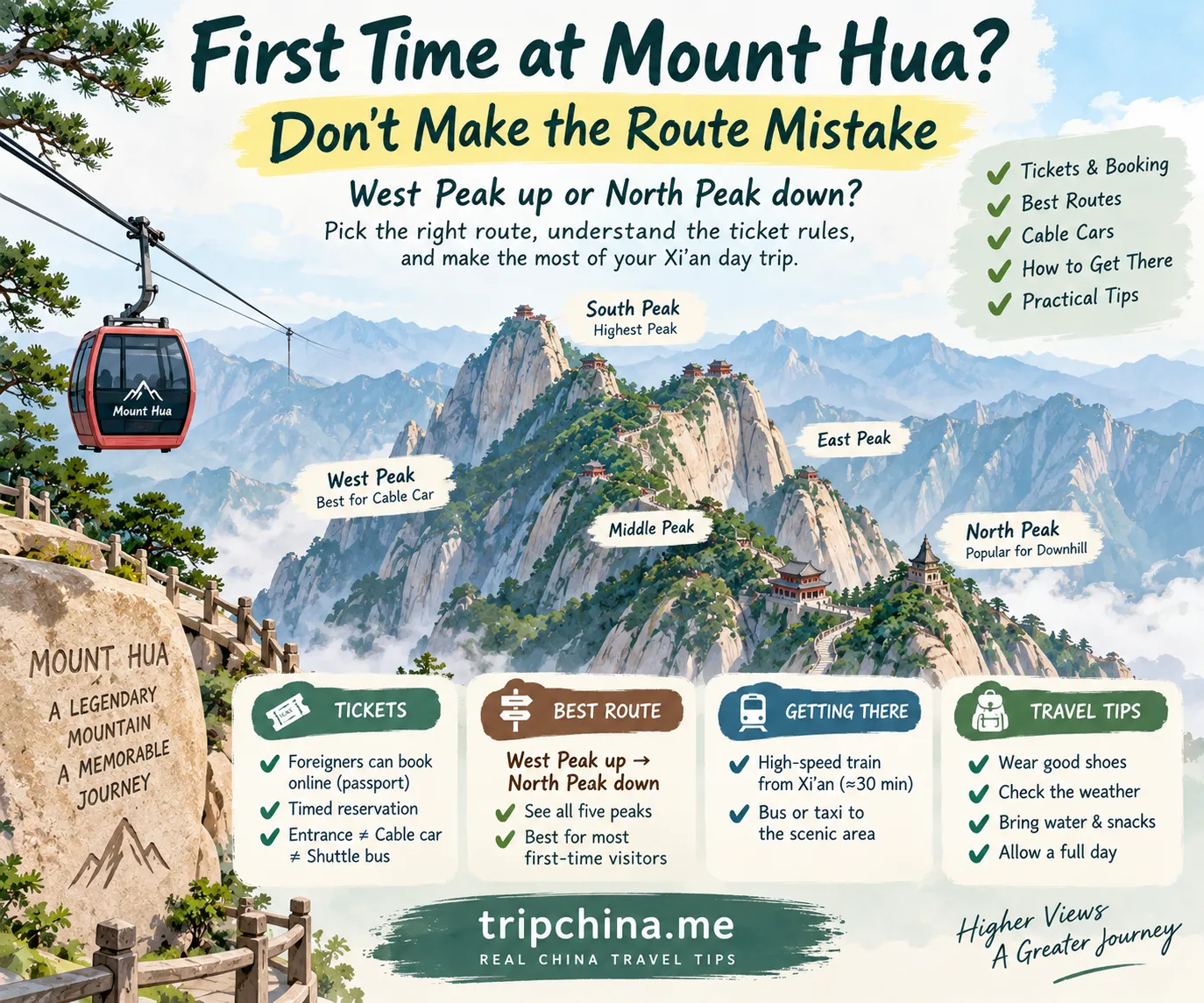
Mount Hua (Huashan) is close enough to Xi’an for a day trip, but it is not a place I would improvise. Your ticket type, passport, cable-car direction and arrival time can completely change the day. For most first-time visitors, I would go West Peak up and North Peak down: you get the five-peak experience without turning the trip into an all-day uphill grind. Here is how I would plan it—and what foreign visitors need to know before leaving Xi’an.
| Question | Short Answer |
|---|---|
| Can foreigners visit Mount Hua? | Yes. Bring your original passport. |
| Can foreigners book online? | Yes, but channels differ. The official WeChat mini-program primarily uses Chinese ID-card verification; overseas visitors should use passport-compatible official or international booking channels. Even with an online booking, passport holders may still need on-site verification for certain ticket types. |
| Best route for a first visit? | West Peak up → North Peak down for most travelers with average fitness. |
| How long do you need? | Allow a full day from Xi’an; roughly 5–6 hours on the mountain is a realistic planning range for the classic route. |
| Fastest way from Xi’an? | High-speed rail from Xi’an North to Huashan North, typically around 30 minutes depending on the train. |
| Current adult entrance fee? | ¥80 through October 10, 2026 under the current half-price promotion; the regular peak-season adult price is ¥160. |
| Biggest mistake? | Treating the entrance ticket, shuttle bus and cable cars as one ticket. They are separate parts of the trip. |
Important current update: According to a September 2026 Mount Hua official notice, the Plank Walk in the Sky and Yaozi Fanshen are temporarily closed for maintenance and safety upgrades. The closure began September 15, and no reopening date had been announced as of this update. Other main areas of Mount Hua remain open.
If you have an extra day in Xi’an and enjoy mountain scenery, yes.
Mount Hua is one of China’s Five Great Mountains and has centuries of Taoist and imperial significance. According to UNESCO, the Hua Shan Scenic Area is currently on China’s Tentative List, which is different from being a fully inscribed World Heritage Site.
But history is only half the reason to go.
The mountain feels dramatically different from Xi’an. One day you are standing on the City Wall or looking at the Terracotta Warriors; the next you are moving between granite peaks, stone stairways and ridgelines high above the surrounding plain.
And despite Mount Hua’s reputation online, you do not have to spend the day clinging to a plank bolted onto a cliff.
Cable cars make the main peaks accessible to ordinary travelers with reasonable fitness. The famous extreme sections are optional—and, as of September 19, 2026, the Plank Walk and Yaozi Fanshen are temporarily closed anyway.
If Mount Hua is only one part of your stay, use our Xi’an travel guide to decide whether it fits better into a three-, four- or five-day Xi’an itinerary.
This is the most important section for foreign visitors.
Foreign passport holders should not assume that Mount Hua is “on-site purchase only.” According to the official Mount Hua website, the scenic area uses real-name, timed reservations and provides booking guidance for overseas visitors. Passport holders may still need on-site verification or special-ticket handling for certain products.
For an overseas visitor, I would use this order:
International booking platforms such as Trip.com are also commonly used by overseas visitors. Some ticket combinations may allow passport-based reservation and verification, while specific concessions or cable-car products may still require additional on-site handling.
According to the official Mount Hua website, foreign visitors holding a permanent residence ID can purchase eligible tickets online, while passport holders may need to use the special-ticket handling area for relevant ticket types.
The practical rule is simple: do not arrive with only a screenshot and no passport.
If Mount Hua is one of several ticketed attractions on your trip, our Xi’an attraction booking guide explains what else should be reserved before you arrive.
According to Shaanxi Daily, Mount Hua is running a temporary half-price promotion from July 15 through October 10, 2026.
The main-peak adult entrance ticket is ¥80 instead of the regular ¥160 peak-season price. The promotion applies to the main entrance ticket, not automatically to cable cars or mountain shuttle buses.
During this period, the scenic area uses real-name, timed reservations. Do not assume that arriving without a reservation and buying an ordinary ticket at the gate will be a reliable backup plan.
That distinction matters.
As of September 2026, these are the main planning prices for a standard adult visitor.
| Item | Peak-Season Planning Price | Notes |
|---|---|---|
| Main entrance | ¥160 | ¥80 from Jul 15–Oct 10, 2026 |
| West Peak cable car | ¥140 one way | Higher, faster access to the upper peak area |
| North Peak cable car | ¥80 one way | Lower-cost cable-car option |
| Shuttle to West Peak cable car | ¥40 one way | Separate from entrance ticket |
| Shuttle to North Peak cable car | ¥20 one way | Separate from entrance ticket |
According to the official Mount Hua website, the regular adult entrance ticket is ¥160 from March through November and ¥100 from December through February. Foreign visitors also have specific child, student and senior concession rules, so check eligibility rather than assuming Chinese-ID-only discounts apply to everyone.
The important thing is not memorizing every number. It is understanding the cost structure:
Entrance ticket ≠ shuttle bus ≠ cable car.
That catches first-time visitors more often than the headline entrance price.
This decision matters more than almost anything else you do before the trip.
Mount Hua is not one simple “up and down” mountain route. West Peak and North Peak cable cars let you build very different days depending on fitness, time and whether you want to walk all five main peaks.
| Route | Approx. Mountain Time | Physical Demand | Main Trade-Off | Best For |
|---|---|---|---|---|
| A: West Up → North Down | 5–6 hrs | Moderate | Long downhill sections | Most first-time visitors |
| B: West Up → West Down | 3–4 hrs | Lower | Backtracking; misses North Peak | Parents, limited time, lower fitness |
| C: North Up → West Down | 6–7 hrs | Moderate–High | Much more uphill walking | Fit hikers wanting more challenge |
| D: Hike Up → Cable Car Down | 8–10+ hrs | High | Long, demanding climb | Experienced hikers / sunrise seekers |
Route times are planning estimates, not guarantees. Queues, weather, photography stops and temporary closures can change the day substantially.
For a first visit, Route A is the one I would choose.
The sequence is:
Visitor Center → West Peak shuttle → West Peak cable car → West Peak → South Peak → East Peak → Middle Peak → North Peak → North Peak cable car → shuttle → Visitor Center
The big advantage is simple: you start high.
Instead of spending a large part of the day climbing toward the main peak area, you use the West Peak cable car to gain elevation, then work across the peaks toward North Peak.
You still walk a lot. Do not confuse “cable car” with “easy sightseeing.” There are repeated stone staircases and enough descending to make your knees very aware that Mount Hua exists.
But for an average first-time visitor who wants the mountain experience without turning the entire day into an endurance event, this is the most balanced route.
Under regular peak-season pricing, the entrance + West Peak shuttle + West Peak cable car + North Peak cable car + North Peak shuttle works out to roughly ¥440 before food and optional activities. During the current ¥80 entrance promotion, the equivalent total falls by about ¥80.
Choose Route B if you are traveling with parents, younger children, have limited time or simply do not care about ticking off every peak.
You take the West Peak cable car up, explore the upper mountain area, then return to the same cable car.
The downside is backtracking. You also miss North Peak and some of the classic ridge experience between the upper peaks and North Peak.
But there is no prize for choosing the hardest route.
If a shorter route means you actually enjoy Mount Hua instead of watching the clock and worrying about the last cable car, it is the better route for you.
Route C reverses the physical logic:
North Peak → Canglong Ridge → Middle Peak → East Peak → South Peak → West Peak
This means considerably more climbing before reaching the higher peaks.
It can be rewarding if you specifically want more hiking, but I would not choose it simply because it sounds more “authentic.” If this is your first visit and your priority is scenery rather than physical challenge, West Up–North Down is easier to justify.
Only if you genuinely want the hike itself.
The traditional hiking route begins around Yuquan Temple and continues through the Mount Hua Gate hiking entrance toward North Peak and the upper peaks.
This is a serious overnight hike involving hours of stone steps and steep terrain. It requires substantially more fitness and preparation than a cable-car day trip.
The hiking entrance operates around the clock under the current published schedule, although entry remains subject to reservations, weather, safety controls and temporary restrictions. The official Mount Hua visitor information currently lists the hiking entrance as operating from 00:00 to 23:59.
If you choose this route, bring a headlamp or flashlight, proper shoes, water, food and warm layers. Do not depend on your phone flashlight for an entire night climb.
This traditional night-hike route starts at Yuquan Temple and uses the 24-hour hiking entrance.
This is one detail I would check again the day before your visit.
The official Mount Hua visitor information currently publishes the following operating framework:
| Service | Current Published Time |
|---|---|
| Cable-car visitor entry | 07:00–16:00 |
| Cable-car operation | 07:00–19:00 |
| Hiking entrance | 00:00–23:59 |
The 16:00 cutoff for cable-car visitor entry means you cannot begin a normal cable-car ascent after 4 PM; cable-car operations currently continue until 19:00.
Weather, wind, safety conditions and crowd management can cause changes.
This is why I would not arrive at Huashan North around lunchtime and assume everything will somehow work out.
Mount Hua rewards early starts.
For most independent travelers, high-speed rail is the obvious first choice.If you are still deciding where to base yourself, our where to stay in Xi’an guide compares the areas that make early train departures and city sightseeing easiest.
Yes.
Take a train from Xi’an North Railway Station to Huashan North Railway Station.
Direct high-speed services commonly take around 28–35 minutes, although the exact fare and journey time depend on the train. Check your specific service on the official China Railway 12306 platform before travel rather than building your itinerary around one fixed fare or journey time.
For buying Chinese train tickets with a passport and avoiding name-format problems, use our China Train Tickets for Foreigners.
According to the official Mount Hua website, local Bus 1 and Bus 2 connect the high-speed rail station area with the Mount Hua scenic area and operate as free city buses serving the attraction.
The Visitor Center is the place you want if you are using the West or North Peak cable-car system.
A taxi or DiDi is useful when you are short on time or carrying more gear. If you have never used the app in China, set it up before the trip using our DiDi guide for foreign visitors.
For the wider rail-station and transport setup in your base city, see our Xi’an transport guide.
Regular trains from Xi’an to Huashan Station can be cheaper, with journeys around 1.5 hours on some services.
But be careful with the station names:
Huashan North = high-speed rail
Huashan Station = conventional rail
For a one-day trip from Xi’an, I would normally pay the modest difference and use high-speed rail.
Do not make cash your only plan—but do not make your phone your only plan either.
China is highly mobile-payment oriented. Alipay and WeChat Pay can be linked to supported overseas cards, and these are useful for transport, food and everyday purchases.
At the same time, Mount Hua is exactly the kind of place where I like having a backup. Phone batteries die. Mobile connections weaken. A payment attempt can fail at the least convenient moment.
Bring some RMB cash and at least one physical card in addition to your mobile wallet.
If you have not set up payments before arriving in China, do it before your mountain day with our China payment guide for foreign visitors.
You do not need expedition equipment for the standard cable-car routes, but this is still a mountain.
Bring your original passport, shoes with reliable grip, water, snacks, sun protection and a light layer. Weather on the peaks can feel significantly cooler than at the base, and conditions can change quickly.
Cheap work gloves can also be surprisingly useful. Some steeper sections have chain handrails, and gloves make them more comfortable to grip. You can also read our dedicated China hiking gear guide.
I would also download translation and navigation tools before leaving Xi’an. English support is improving, but it is still limited enough that having place names saved on your phone makes the day much easier. For the wider digital setup—payments, maps, transport and essential apps—our essential China travel apps guide is a useful pre-trip checklist.
Our China navigation app guide explains why you should not build a China trip around Google Maps alone, while the China eSIM and internet guide covers connectivity options before arrival.
The first mistake is arriving without checking active reservation rules. Mount Hua uses timed real-name reservations. During this promotional period, standard walk-up tickets are not available as a simple backup plan.
The second is forgetting your passport. Your booking and identity verification depend on it.
The third is buying the wrong route combination. Decide whether you are going West Up–North Down, West Up–West Down or another route before buying cable-car products.
The fourth is underestimating the walking after taking a cable car. Route A may save a huge amount of climbing, but it still involves several hours on your feet.
The fifth is wearing slippery shoes. Mount Hua has endless stone stairs, and wet weather makes them considerably less forgiving.
The sixth is ignoring the weather forecast. Wind, rain and other safety conditions can affect cable cars and exposed sections. The mountain is not a good place to insist that an itinerary must happen exactly as planned.
And the seventh is going during a major Chinese public holiday without understanding what that means. Mountain transport, cable cars and rail tickets can all become much more difficult when demand surges. For other problems that catch first-time visitors off guard, see our Xi’an travel mistakes and scams guide.
Check our best time to visit China guide before fixing your date, especially around National Day, Labor Day and other peak periods.
For many travelers, April–June and September–October offer a useful balance between temperatures and mountain scenery.
But “best season” does not automatically mean “best day.”
A clear weekday in September can be excellent. A holiday weekend with perfect weather can mean much longer queues.
Summer requires sun protection, water and an early start. Winter can bring cold, ice and more difficult trail conditions.
I would choose weather + weekday + crowd level over chasing one supposedly perfect month.
Bring some of your own.
Food and drinks are available around major mountain nodes, but prices are naturally higher than at the base because getting supplies up a steep mountain is not cheap.
Bottled water typically costs ¥10–15 and simple meals ¥50–80; treat these only as rough budgeting estimates, not fixed prices.
A sandwich, fruit, energy bar or other easy snack from Xi’an can save both money and time.
More importantly, carry enough water for the section between major facilities rather than assuming a shop will appear whenever you want one.
The standard tourist routes are designed for ordinary visitors, but Mount Hua is still steep, exposed and physically demanding.
You do not need to do the most dramatic sections to experience the mountain.
If you dislike heights, have significant knee problems or are uncomfortable on steep stairs, choose a shorter West Peak route and skip optional exposed sections.
Do not let social media convince you that the Plank Walk is the whole point of Mount Hua. It is one optional experience on a much larger mountain.
As of September 19, 2026, both the Plank Walk in the Sky and Yaozi Fanshen are temporarily closed for maintenance, with reopening dependent on inspection and a future scenic-area announcement.
Yes. Basic mountain lodges are available for sunrise hikers. Rooms are generally simple and can sell out quickly on peak dates, so confirm accommodation availability and current trail-access rules before booking.
Yes. Toilets are available around major peaks, cable-car areas and key visitor facilities. Standards vary, so carrying tissues and hand sanitizer is sensible.
No. They can help if your knees dislike long descents, particularly on West Up–North Down. Bring your own if you know you need them rather than depending on rental availability.
Possibly. Standard cable-car routes do not require the Plank Walk or other optional extreme sections, but parts of the mountain still involve exposed views, steep stairs and ridges. West Up–West Down is the easier route to consider if you want the scenery with less walking and exposure.
Luggage-storage arrangements may be available around the Visitor Center and transport hubs, but services and limits can change. For a Xi’an day trip, I would leave large luggage at your Xi’an hotel or railway-station storage and carry only what you need on the mountain.
Cable-car service can be suspended for safety reasons. Depending on conditions, you may need to wait for operations to resume or follow instructions from scenic-area staff about alternative descent arrangements. Check current weather and operating notices before starting your route rather than assuming the cable car will run all day.
For a first trip from Xi’an, I would take an early high-speed train, reach the Visitor Center in the morning and go West Peak up → walk across the main peaks → North Peak down.
It costs more than simply hiking, but that is not the part of the trip I would try to save money on. The West Peak cable car buys you something more valuable on a one-day visit: time and legs.
If you are traveling with parents or know your knees will hate several hours of descending stairs, go West Up–West Down instead.
If you genuinely love hiking, then consider North Up–West Down or the traditional hiking route.
Mount Hua is spectacular, but the smartest way to experience it is not to choose the route that sounds toughest. It is to choose the one that leaves you enough energy to look up from the stairs.
All ticket, cable-car, transport and food prices in this guide reflect information researched through September 19, 2026 and are planning references only. Mount Hua adjusts operating hours and access in response to season, weather, safety conditions and visitor volume. The current ¥80 adult entrance promotion is scheduled through October 10, 2026. Confirm current reservations, prices, cable-car hours and temporary closures before traveling.
Updated September 19, 2026. This guide was checked against Mount Hua’s official visitor information, current scenic-area operating notices, Shaanxi official media, China Railway 12306 and UNESCO records. Special attention was given to foreign-passport ticketing, current promotional pricing and temporary closures. Route times are estimates; actual times depend on fitness, weather and queues. Prices, access rules and operating hours can change, so recheck official information before departure.
Avoiding mistakes is only the first step. TripChina.me Premium Travel Guides help independent travelers explore China with ready-to-follow routes, booking strategies, practical solutions, and local insights — so you can travel with confidence.