Our Location:
No. 99, Jiazi Road, Chengdu

 authorChris Lee
Wuhou Shrine and Jinli sit side by side, but they deliver two very different versions of Chengdu: Three Kingdoms history inside Wuhou Shrine, then food, folk culture and lantern-lit streets in Jinli. This guide shows foreign independent travelers how to combine them into one efficient half-day visit without rushing the museum, missing the red walls or arriving at Jinli before its evening atmosphere begins.
For most first-time visitors, visit Wuhou Shrine in the afternoon and continue directly into Jinli for food and the evening lights.
A practical route is:
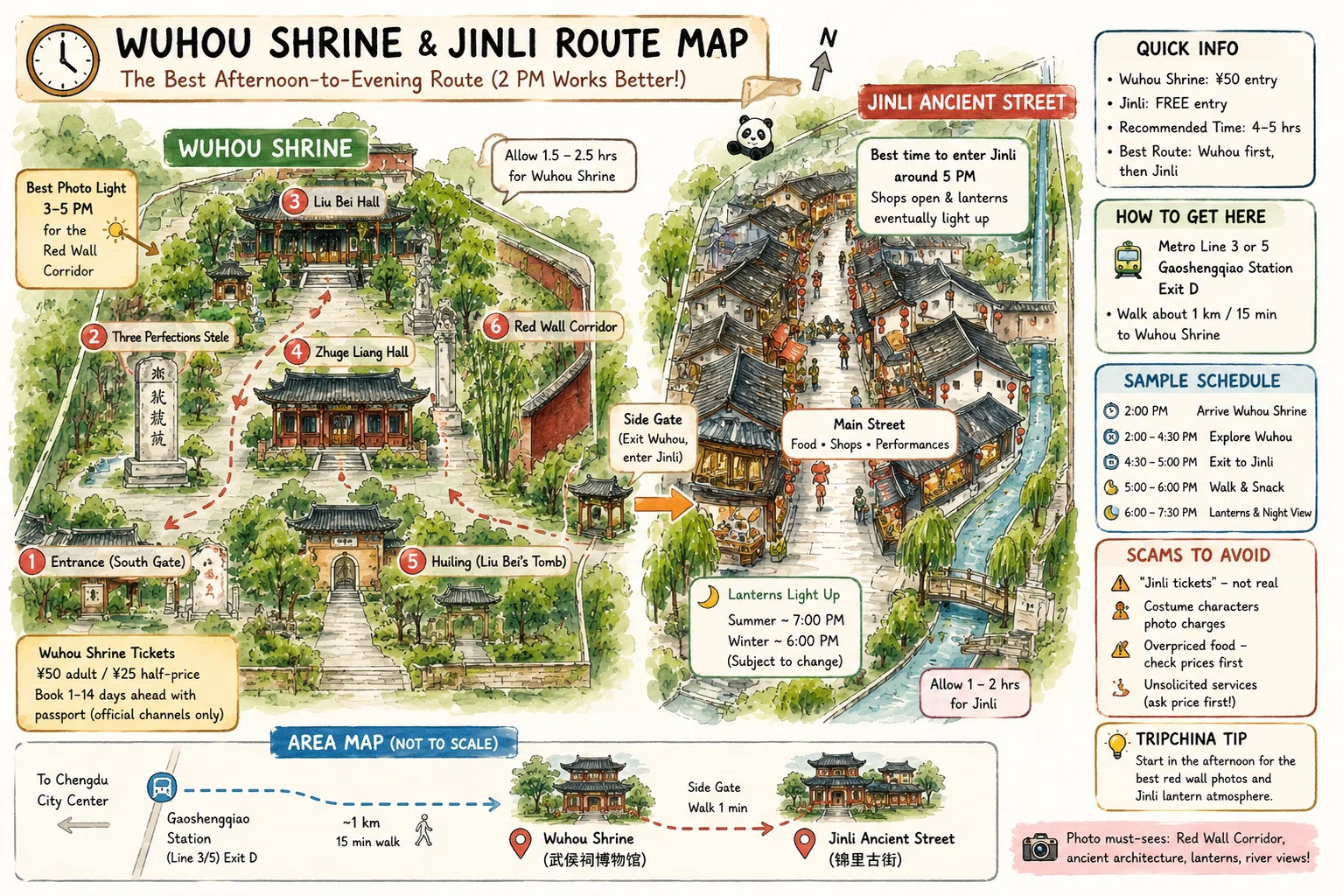
2:00 PM → Wuhou Shrine → Three Perfections Stele → Liu Bei Hall → Zhuge Liang Hall → Huiling → Red Wall Corridor → around 4:30–5:00 PM → Jinli → food → lanterns
As of September 2026:
• Standard Wuhou Shrine admission: ¥50
• Eligible half-price ticket: ¥25
• Passport booking: officially supported
• Standard reservations: up to 14 days in advance
• Jinli admission: free during normal operations
• Jinli lighting: approximately 7:00 PM in summer / 6:00 PM in winter, subject to conditions
The afternoon-first strategy is not a rule. If Three Kingdoms history and quieter museum halls matter more than evening atmosphere, go closer to opening instead.
For most travelers:
Wuhou Shrine first, Jinli second.
The reason is not simply that they are next to each other.
Their rhythms are completely different.
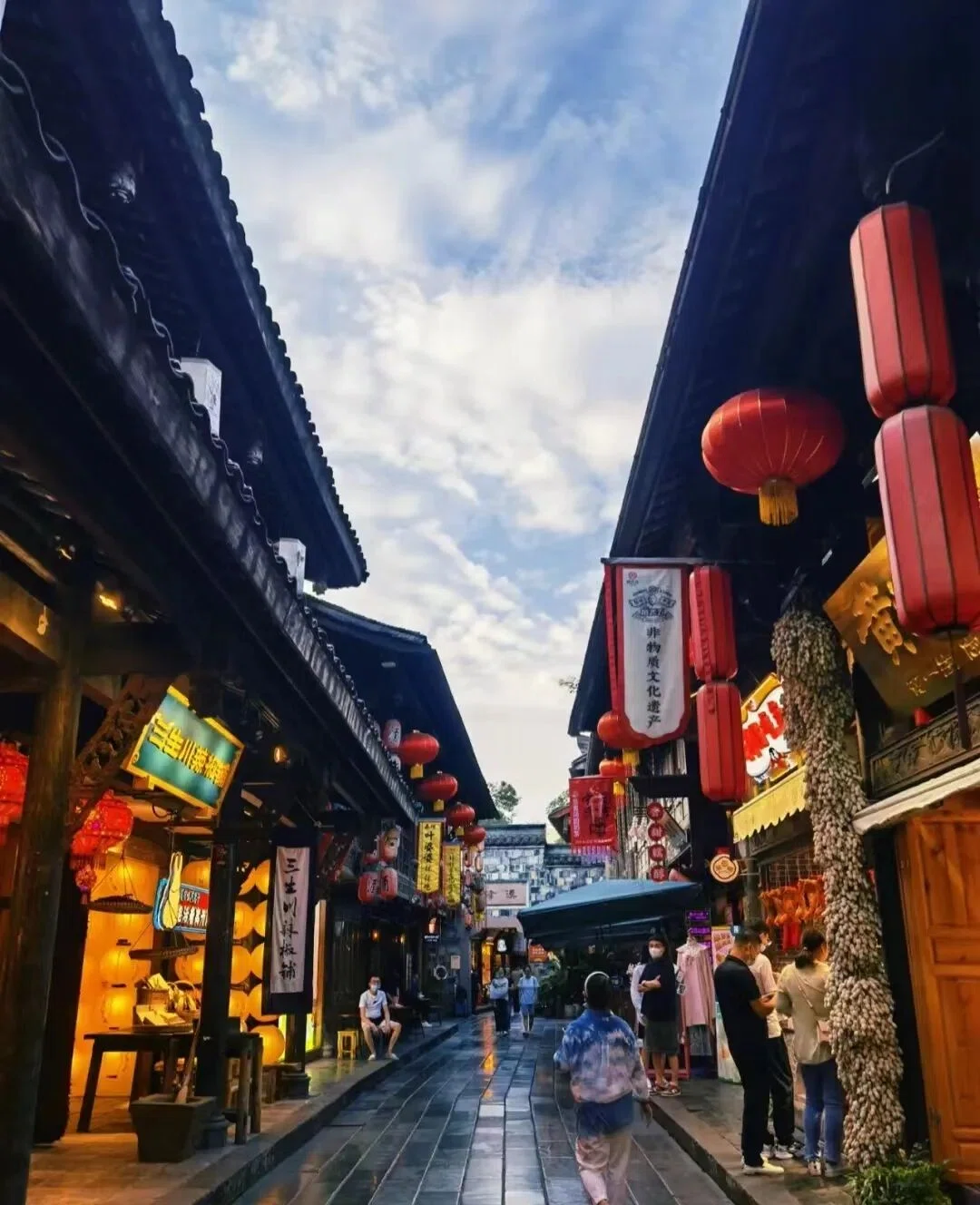
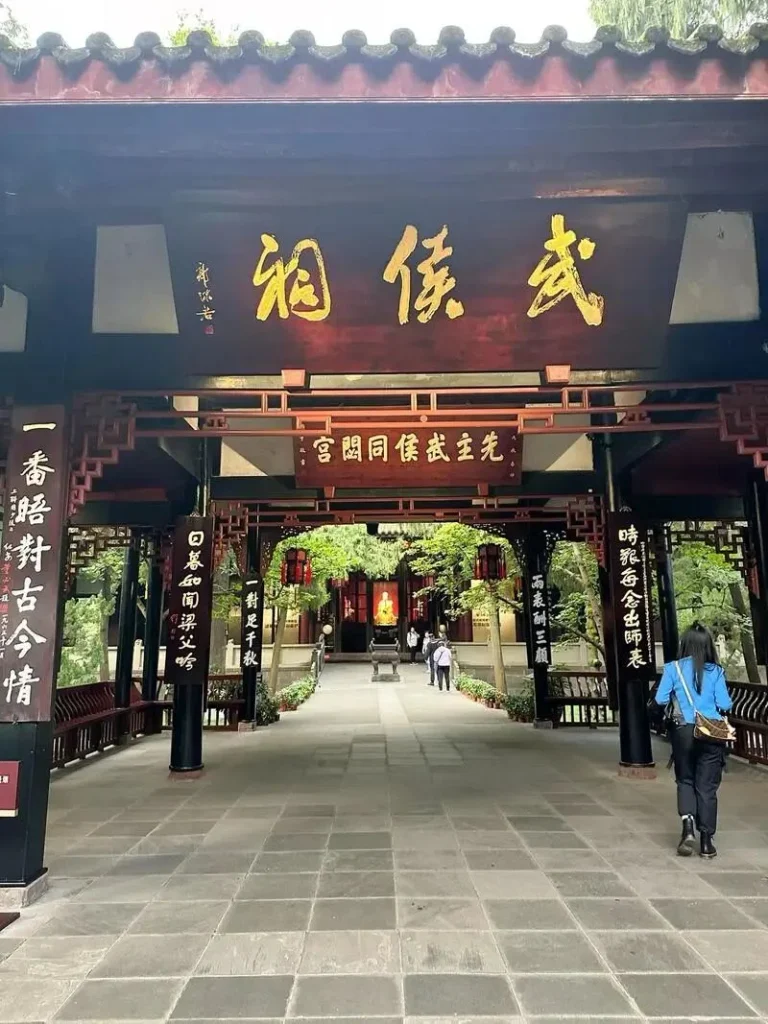
Wuhou Shrine is a museum and historic memorial complex with admission rules and defined opening hours. Jinli is a cultural-commercial street that becomes more atmospheric toward evening, particularly once its lanterns are illuminated.
That creates a natural progression:
history → red-wall photography → food → lanterns → evening Chengdu
Wuhou Shrine is best explored while you still have daylight.
Its courtyards, mature trees, historic halls, tomb complex and famous red walls are visual experiences as well as historical ones.
Jinli then works as a change of pace rather than as a second historical attraction.
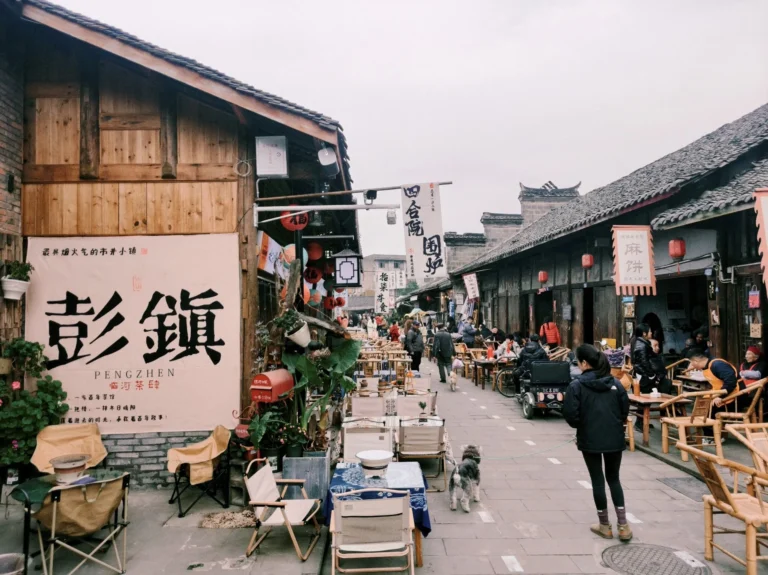
Today's Jinli should not be confused with a completely preserved centuries-old neighborhood. The current cultural-tourism street began development around 2000 and opened in stages from 2004, with architecture inspired largely by late-Qing and early-Republic Sichuan styles.
Think of it as:
a modern cultural-commercial street built around traditional Chengdu aesthetics, Sichuan folk culture and Three Kingdoms imagery.
Once you understand that distinction, the pairing makes much more sense.
Choose a morning visit if:
• Three Kingdoms history is your main reason for coming
• you want quieter museum halls
• you dislike dense evening crowds
• you are visiting during a major Chinese public holiday
• you want more time for inscriptions, interpretation and exhibitions
In that case, arrive near opening and treat Jinli as optional rather than forcing the afternoon-to-evening formula.
| Factor | Wuhou Shrine | Jinli |
|---|---|---|
| Main experience | Three Kingdoms history | Food, shops, folk culture, evening atmosphere |
| Standard admission | ¥50 adult | Free during normal operations |
| Reservation | Official real-name booking | Normally none |
| Passport booking | Supported | Normally unnecessary |
| Suggested time | 1.5–2.5 hrs | 1–2 hrs |
| Best timing | Afternoon for combined route; morning for quieter visit | Late afternoon into evening |
| Photography | Red Wall Corridor, bamboo, historic architecture | Lanterns, streets, food, water features |
| Historical value | High | Cultural-commercial rather than preserved ancient street |
| Best for | History, architecture, photography | Food, atmosphere, casual wandering |
TripChina Verdict: If you only have time for one, choose Wuhou Shrine for historical substance. If you have 4–5 hours, combining afternoon Wuhou with evening Jinli gives you a more complete Chengdu experience.
As of September 2026, the standard published pricing is:
| Ticket Type | Price |
|---|---|
| Adult | ¥50 |
| Eligible half-price ticket | ¥25 |
| Annual pass | ¥100/year |
| Jinli | Free during normal operations |
Special events can use different prices.
For example, the 2026 Wuhou Shrine Chengdu Temple Fair used temporary ¥40 full-price and ¥20 half-price event admission.
Do not assume a festival ticket shown in an old travel post represents the museum's normal ticket price.
Yes.
This is one of the most important practical points for overseas visitors.
Wuhou Shrine's official ticket rules explicitly accept passports for foreign visitors making real-name reservations.
Tickets can be booked through:
• the official Wuhou Shrine website
• the official WeChat account: 成都武侯祠博物馆
The standard ticket system currently releases reservations 14 days in advance.The official system currently releases reservations 14 days in advance. Note that some third-party sources may list different windows—always check the official museum website or WeChat account for the current booking period.
Enter your personal information exactly as required and bring the original passport used for booking.
Temporary booking-interface or payment problems can occur with any mini-program, so if the online process fails, do not assume that means foreigners cannot enter.
Use the museum's official channels.
Wuhou Shrine explicitly warns that it has not authorized third-party organizations or individuals to act as its online ticket agents.
That makes the safest rule simple:
Official website or official WeChat account first.
If you cannot complete online payment, the museum's official English ticket information says foreign visitors may take their passport to the onsite service window and ask about purchasing there.
For other Chengdu attractions, TripChina's Chengdu Attraction Tickets Guide for Foreigners explains how passport-based reservation systems differ across major sights.
This is one area where foreign travelers should be cautious with generic internet summaries.
Official standard rules include half-price or free admission for several eligible categories, including certain minors and students.But the exact document requirements matter.
Official half-price eligibility includes: minors aged 6–18, and full-time undergraduate students or below aged 19–23 with valid student ID. Free admission applies to children under 6, adults 70+, and certain other categories. Exact document requirements matter—bring the original passport or ID used for booking.
For foreign visitors, age, student status, residence status and the document accepted by the booking system can affect how a concession is processed.
Do not assume that every senior discount applying to Chinese citizens automatically applies to an ordinary foreign passport holder.
This matters because many travel sites reduce the rule to something like:
“60+ = free.”
That can be misleading.
Special-event policies have explicitly distinguished between Chinese citizens, permanent residents and other foreign visitors.
If a senior discount matters to your budget, check the current official ticket page or ask the service window with the traveler's passport before purchasing.
That is more reliable than planning your day around a discount that may not apply to your document type.
Opening hours are one of the easiest details for an old travel article to get wrong.
The museum‘s official information lists standard hours as 9:00 AM–6:00 PM (last admission 5:00 PM). During summer, extended hours may apply—currently 8:30 AM–6:30 PM (last admission 5:30 PM). Check the official museum page shortly before visiting.
Avoid locking your itinerary around opening-hour details you read months before departure.
Check the official museum page shortly before visiting, especially during:
• summer
• Spring Festival
• Labor Day
• National Day
• major museum events
• important Chengdu festivals
For the route in this guide, arriving at roughly 2:00 PM normally leaves a comfortable buffer under the standard schedule.
Jinli is much less restrictive than the museum, but simply calling it “open 24 hours” is not useful for trip planning.
The official Jinli website currently recommends a general visitor period of approximately:
8:00 AM–10:30 PM
Most merchants operate roughly:
9:00 AM–10:00 PM
Jinli itself is free to enter during normal operations.
The official Jinli site currently gives approximately:
Summer: 7:00 PM
Winter: 6:00 PM
Weather and operational conditions may cause adjustments.
So don't build your itinerary around claims such as:
“Every lantern switches on at exactly 6:30 PM.”
Treat these as seasonal reference times, not a guaranteed minute-by-minute schedule.
Yes.
Major events can temporarily change the normal system.
During the 2026 Wuhou Shrine Chengdu Temple Fair, Jinli became part of the festival-management area during certain periods and operated under special circulation and access arrangements.
So the accurate rule is:
Jinli is normally free and requires no separate entrance ticket, but major festival operations can temporarily change access arrangements.
For most travelers, allow 4–5 hours.
You do not need to turn Wuhou Shrine into a race between every plaque and statue.
Use the sequence below as a framework.
Start with the historic central axis.
Wuhou Shrine is much more than “a temple for Zhuge Liang.”
The complex developed around Liu Bei's Huiling tomb, Han Zhaolie Temple and the memorial tradition associated with Zhuge Liang.
Its unusual ruler-minister relationship is central to understanding why this site became so important in Chinese Three Kingdoms memory.
Don't rush directly toward the famous red walls.
The Three Perfections Stele (三绝碑) is one of Wuhou Shrine's most important historical objects.
Dating to the Tang dynasty, it became famous for the combined quality of its text, calligraphy and engraving.
Even if you cannot read classical Chinese, stop here.
It immediately reminds you that Wuhou Shrine is not merely a photogenic temple complex—it has been a place of historical commemoration for centuries.
The layout itself helps explain the site's history.
Visitors encounter spaces associated with Liu Bei before moving deeper toward Zhuge Liang.
Without this context, the complex can easily feel like:
old building → courtyard → statue → another old building.
With context, the architecture becomes part of the story.
For many Chinese visitors, this is the emotional center of Wuhou Shrine.
Zhuge Liang is remembered not only as a strategist but also as a cultural symbol of intelligence, loyalty, political responsibility and devotion to duty.
Look for the famous Attack-the-Heart Couplet (攻心联) rather than treating the hall only as another photography stop.
If the Three Kingdoms story is unfamiliar to you, even a small amount of interpretation can make this section dramatically more meaningful.
Huiling is associated with Liu Bei, founder of Shu Han.
The quieter tomb area changes the rhythm of the visit after the busier halls and courtyards.
It also brings you naturally toward one of Wuhou Shrine's most photographed areas.
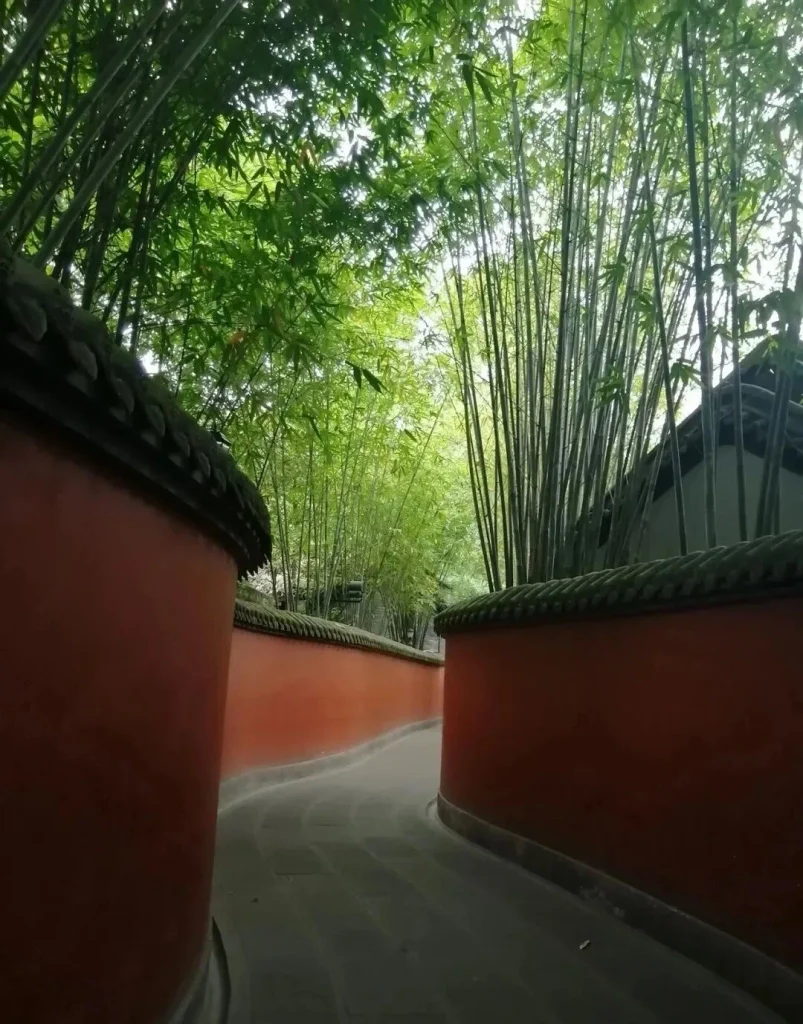
The curved red walls, bamboo and shifting shadows have become one of Chengdu's signature travel images.
Late-afternoon light can create attractive side-light and bamboo shadows.
But do not turn “4 PM” or “3–5 PM” into a photographic law.
Light depends on:
• season
• cloud cover
• rain
• tree growth
• direction of sunlight
• crowd levels
Morning light can also work very well, particularly if your priority is softer portraits and fewer people rather than the afternoon-to-evening route.
On an overcast Chengdu day, don't give up on the red wall. Diffused light can reduce harsh contrast, while wet conditions can make the reds and greens appear richer.
TripChina Photo Tip: White, cream, beige and other relatively light clothing tend to separate clearly from the deep red wall.
This is when the personality of the afternoon changes.
You move from:
tombs + halls + inscriptions + historical memory
to:
food + shops + Sichuan folk culture + lanterns + crowds
That contrast is the real reason the pairing works.
And because Jinli is immediately beside Wuhou Shrine, you don't lose another 30–45 minutes crossing Chengdu between attractions.
Don't buy the first snack you see simply because you're hungry.
Walk through the street first.
Look at:
• smaller lanes
• Sichuan-style architectural details
• folk-craft shops
• waterside sections
• snack areas
• evening photography spots
Then decide what looks worth trying.
Jinli works better as a place to wander than as a checklist of “must-eat” stalls.
The exact timing depends on the season.
This daylight-to-evening transition is the main payoff of starting Wuhou Shrine in the afternoon.
You get to see Jinli twice:
before the lights
and
after the lights.
If you arrive only after dark, you get the lantern atmosphere but miss the transition.
Use an express route.
Spend about 1.5 hours inside Wuhou Shrine.
Prioritize:
Three Perfections Stele → Liu Bei Hall → Zhuge Liang Hall → Huiling → Red Wall
Then give Jinli around 60–90 minutes.
Walk the main route, explore one or two side streets and try one snack.
The trade-off is straightforward:
you can visit both, but you may miss Jinli's stronger evening atmosphere depending on the season.
If you hope to catch the lantern display, shift the express itinerary slightly later—but first check Wuhou Shrine's final admission time so you do not sacrifice the main historical site for the lights.
Skip Jinli and visit Wuhou Shrine closer to opening.
Allow approximately 2–3 hours.
This is the clearest situation where I would actively choose morning over the headline afternoon route.
Spend more time on:
• historical inscriptions
• Liu Bei Hall
• Zhuge Liang Hall
• civil and military official galleries
• Three Brothers Temple
• Huiling
• museum interpretation
The experience will feel completely different from an evening-oriented Chengdu itinerary.
And that's fine.
The best time depends on what you want from Wuhou Shrine—not on a universal “best hour.”
Many first-time travelers misunderstand Jinli's background, so this deserves clear clarification.
The present Jinli cultural-tourism street began development around 2000.
Its first phase opened to the public in 2004, followed later by additional waterside development.
Its architectural language is inspired by traditional Sichuan design, particularly late-Qing and early-Republic aesthetics.
That's also too simplistic.
Jinli is not valuable because every storefront is several hundred years old.
Its role is to present:
• Sichuan folk culture
• traditional-style architecture
• handicrafts
• snacks
• performances
• Three Kingdoms references
• contemporary Chengdu tourism culture
If you arrive expecting an untouched historic residential neighborhood, you may be disappointed.
If you treat it as a cultural-commercial street attached to one of Chengdu's most important historical sites, it makes much more sense.
It is touristy.
That does not automatically make it a tourist trap.
For first-time visitors, the better question is:
Does Jinli add something to a Wuhou Shrine visit?
I think it does.
The historical substance comes from Wuhou Shrine.
Jinli supplies the sensory contrast afterward.
The mistake is expecting Jinli itself to deliver the historical authenticity of Wuhou Shrine.
You can.
But I would treat Jinli as a sampling stop, not necessarily your definitive Chengdu food experience.
Try one or two snacks that interest you.
For a serious Sichuan meal, Chengdu gives you far more options outside its largest tourist districts.
Prices, portion sizes and quality vary by vendor, so look at menus before ordering rather than assuming the longest queue or most visible stall must be the best.
The easiest current public-transport option has improved.
The official Jinli visitor information currently directs visitors to:
Metro Line 3 → Wuhou Shrine Station (武侯祠站) → Exit A2
The official guidance describes Exit A2 as providing direct access to the attraction area.
This is more convenient than older guides that send visitors to Gaoshengqiao and then require a longer walk.
So if you see an older recommendation such as:
Gaoshengqiao → walk around 1 km
it can still get you into the area, but it is no longer the most useful default recommendation for most visitors.
Use Wuhou Shrine Station A2 first.
Check your navigation app for the most current routing, as station names and exits can change.
For broader transport planning, see TripChina's Chengdu Metro Guide.
A ride-hailing car may be easier if:
• you're traveling with children
• it's raining heavily
• you're staying somewhere poorly connected by metro
• several people are sharing the fare
• mobility is an issue
Use the Chinese destination: 成都武侯祠博物馆
Address: 成都市武侯区武侯祠大街231号
During major holidays, metro travel may still be faster because visitor congestion and traffic controls can affect roads around the attraction.
This is when the “2 PM route” should be abandoned if necessary.
During:
Spring Festival
Labor Day
National Day
or major Wuhou Shrine events,
ticketing, entrances, crowd circulation and Jinli access can change.
During the 2026 Chengdu Temple Fair, authorities used reservations, staggered admission and visitor-capacity controls.
If Wuhou Shrine is a must-see:
go close to opening.
You sacrifice some of the late-afternoon photography sequence, but avoiding the heaviest crowd pressure matters more.
This is an important exception to the main recommendation in this guide.
Alipay or WeChat Pay is the most convenient setup for food, drinks, shops and everyday purchases around Jinli.
Wuhou Shrine's official online ticketing also supports WeChat Pay and Alipay.
Carry some RMB cash as backup rather than assuming every small merchant in Jinli will accept a foreign physical Visa or Mastercard directly.
A practical combination is:
international card linked to Alipay + WeChat Pay backup + some RMB cash
For setup instructions, see TripChina's China Payment Guide for Foreign Travelers.
For other self-guided routes combining neighborhoods, food and local culture, see TripChina's Chengdu City Walk Guide.
If you're deciding where to base yourself, the Where to Stay in Chengdu Guide compares the most practical neighborhoods for first-time visitors.
This is one Chengdu attraction where interpretation can genuinely improve the visit.
Without context, you may see:
temple → statue → courtyard → another statue → red wall.
With context, the same sequence becomes a story about Liu Bei, Zhuge Liang, Shu Han and how later generations understood the relationship between ruler and minister.
Yes.
The museum's current official visitor information lists paid interpretation services in:
Chinese, English, Japanese and Korean.
Standard interpretation lasts about an hour, and current official information advises checking or arranging the service through the interpretation desk.
The museum also offers a free short digital introduction through its official WeChat account, including approximately 10 minutes of audio plus map and image-text guidance, with Chinese and English listed.
I would use that if you don't want a full guided tour.
Even spending five minutes learning who Liu Bei and Zhuge Liang were before entering will make the site much easier to understand.
Under normal operations, Jinli itself is free.
Wuhou Shrine, meanwhile, explicitly warns visitors to use its official website or official WeChat account rather than unauthorized online sellers.
So be cautious with products marketed vaguely as:
“Jinli entrance ticket”
“Wuhou + Jinli joint ticket”
“fast-track admission”
A product may actually be a guided tour, event ticket, activity or performance rather than ordinary Jinli admission.
Always check exactly what you are paying for.
The afternoon route is designed around the overall experience:
Wuhou history + red wall + Jinli evening atmosphere
It is not necessarily the quietest time.
If avoiding crowds matters more than evening lights, go earlier.
The red wall is photogenic.
It is not the reason Wuhou Shrine is historically important.
At minimum, understand the basic sequence:
Liu Bei → Zhuge Liang → Shu Han → Huiling → ruler-minister memorial tradition
Then make the red wall the visual ending to the visit.
Today's Jinli is a modern cultural-tourism development inspired by traditional Sichuan design and culture.
Knowing that beforehand prevents the common:
“This feels too touristy.”
reaction caused by the wrong expectation.
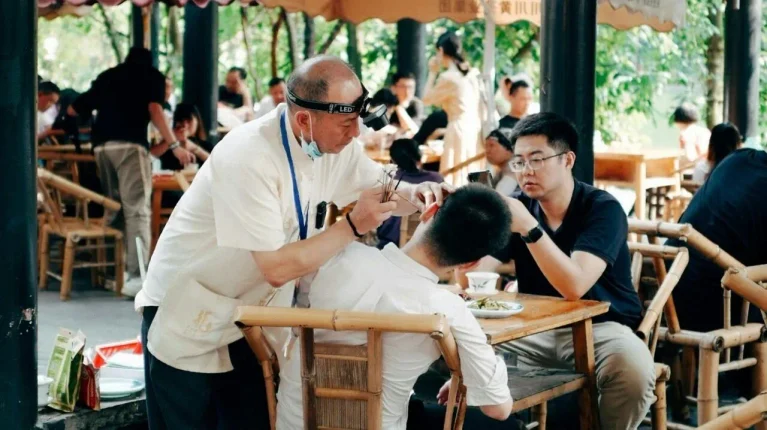
Jinli and its surrounding tourism area may include photography, souvenirs, tea, ear-cleaning and other paid services.
Do not assume a casual street interaction is automatically free.
Ask: How much in total?
Chinese: 一共多少钱?
Confirm the total price before sitting down, accepting props or beginning a service.
That is more accurate and useful than assuming every performer or independent provider is trying to scam tourists.
Parking exists in the wider area.
That doesn't make driving the best choice.
Holiday congestion, pedestrian management and temporary traffic controls can make public transport much easier.
Because they should not feel the same.
Wuhou Shrine represents Chengdu's historical side.
Its story reaches back through the memory of Shu Han, Liu Bei and Zhuge Liang and remains one of China's most important Three Kingdoms cultural sites.
Jinli represents something different.
It packages Sichuan visual traditions, food culture, crafts, folk arts and Three Kingdoms imagery into an accessible contemporary visitor district.
One is where you slow down and understand.
The other is where you wander, eat and watch the street change after dark.
The contrast is the point.
That is why I would not visit Jinli first and then spend the afternoon worrying about whether Wuhou Shrine is about to close.
For most first-time visitors, the story works better in the opposite direction:
history first, Chengdu street life second.
| Traveler | Best Route | Why |
|---|---|---|
| First-time visitor | 2 PM Wuhou → evening Jinli | Best overall balance |
| Photographer | Afternoon Wuhou → Jinli after lighting | Red wall + lanterns |
| Three Kingdoms fan | Wuhou near opening, 2–3 hrs | More historical depth |
| Tight schedule | 1.5 hrs Wuhou + 1 hr Jinli | Covers both efficiently |
| Major-holiday visitor | Wuhou near opening | Crowd avoidance matters more |
| Food-focused traveler | Shorter Wuhou + longer Jinli | More evening wandering |
| Already visited Wuhou | Evening Jinli only | No need to repeat museum |
For other self-guided neighborhood routes, see TripChina's Chengdu City Walk Guide.
If you're deciding where to stay, TripChina's Where to Stay in Chengdu Guide compares the most practical bases for first-time visitors.
Is Wuhou Shrine worth visiting if I know nothing about the Three Kingdoms?
Yes. Even without prior Three Kingdoms knowledge, the gardens, architecture, inscriptions and red-wall corridor are worth seeing. But spend a few minutes learning who Liu Bei and Zhuge Liang were—or use the museum's interpretation options—because the site's unusual ruler-minister layout becomes much more meaningful once you understand their relationship.
Is Wuhou Shrine suitable for a rainy day?
Light rain can work surprisingly well. The complex still involves outdoor courtyards and paths, but wet bamboo and saturated red walls can photograph beautifully. For heavy rain or severe weather, check current museum and local weather notices before traveling specifically for outdoor photography.
Can I bring large luggage to Wuhou Shrine and Jinli?
Avoid it if possible. Both attractions involve considerable walking, while Jinli can become crowded after dark. Leave large suitcases at your hotel or station storage and visit with a small day bag; if onsite luggage storage is essential, confirm the current arrangement with the visitor center when you arrive.
Is Wuhou Shrine suitable for travelers who don't speak Chinese?
Yes. The museum provides an English-language website, accepts foreign passports for official ticket reservations and lists English interpretation services. Save 成都武侯祠博物馆 on your phone and keep mobile data active; if an online passport or payment step fails, take the original passport to the onsite service window rather than abandoning the visit.
Can I combine Wuhou Shrine and Jinli with another Chengdu attraction on the same day?
Yes, but keep the morning relatively light if you plan to use the recommended afternoon-to-evening route. One additional attraction or neighborhood works better than another full half-day itinerary. Kuanzhai Alley is popular, but visiting two highly commercial historic-style streets on the same day can feel repetitive.
Chengdu Wuhou Shrine Museum — Official Website
Chengdu Wuhou Shrine Museum — Official Ticket Information
Jinli Cultural Tourism Street — Official Website
Last researched: September 5, 2026. This guide was checked against current Wuhou Shrine Museum and Jinli official information. Key verification points included the ¥50 standard admission, passport-based real-name booking, 14-day ticket window, official-channel warning, standard opening hours, Jinli's free-entry policy, seasonal lighting guidance, Metro Line 3 Wuhou Shrine Station A2 access and current interpretation services. Dynamic details—especially extended opening hours, holiday access, lighting times, discounts and same-day availability—should be reconfirmed shortly before visiting. All timing-based itineraries in this article are recommendations, not mandatory schedules.
TripChina.me creates practical China travel guides shaped by real local experience, helping independent travelers navigate transport, payments, food, neighborhoods, and the cultural details that make traveling in China easier and more meaningful. Find the guide for your destination at tripchina.me.