Our Location:
No. 99, Jiazi Road, Chengdu

 authorChris Lee
Most visitors come to Chengdu for pandas, tea houses and old streets. Dongjiao Memory shows another side of the city: red-brick factories, steel pipes, a vintage locomotive, street art, cafés and live music. This practical guide covers the best metro route, photo spots, 2- and 4-hour walking routes, food strategy and the mistakes that can waste your time.
Yes — especially if you have at least three days in Chengdu and want something completely different from the city's traditional attractions.
If you have only one or two days in the city, I would prioritize the Chengdu Panda Base visitor guide, Kuanzhai Alley visitor guide and the city's traditional core sights first.
For public transport beyond this visit, the Chengdu metro guide for foreign travelers explains tickets, payment and navigation in more detail.
| Factor | Dongjiao Memory | Kuanzhai Alley | Jinli |
|---|---|---|---|
| Entry | Free outdoor park | Free | Free |
| Main atmosphere | Industrial + creative | Traditional-style lanes | Traditional-style night street |
| Typical visit | 2–4 hours | 1–2 hours | 1–2 hours |
| Photography | Industrial, street art, night scenes | Courtyards and lanes | Lanterns and night scenes |
| Food | Cafés and restaurants; more nearby | Many options | Many snack stalls |
| Best for | Modern Chengdu, photography, music | First-time sightseeing | Evening atmosphere |
| Best time | Late afternoon–evening | Earlier in the day | Evening |
| Main drawback | Less essential on a short first trip | Heavy tourist traffic | Highly tourist-oriented |
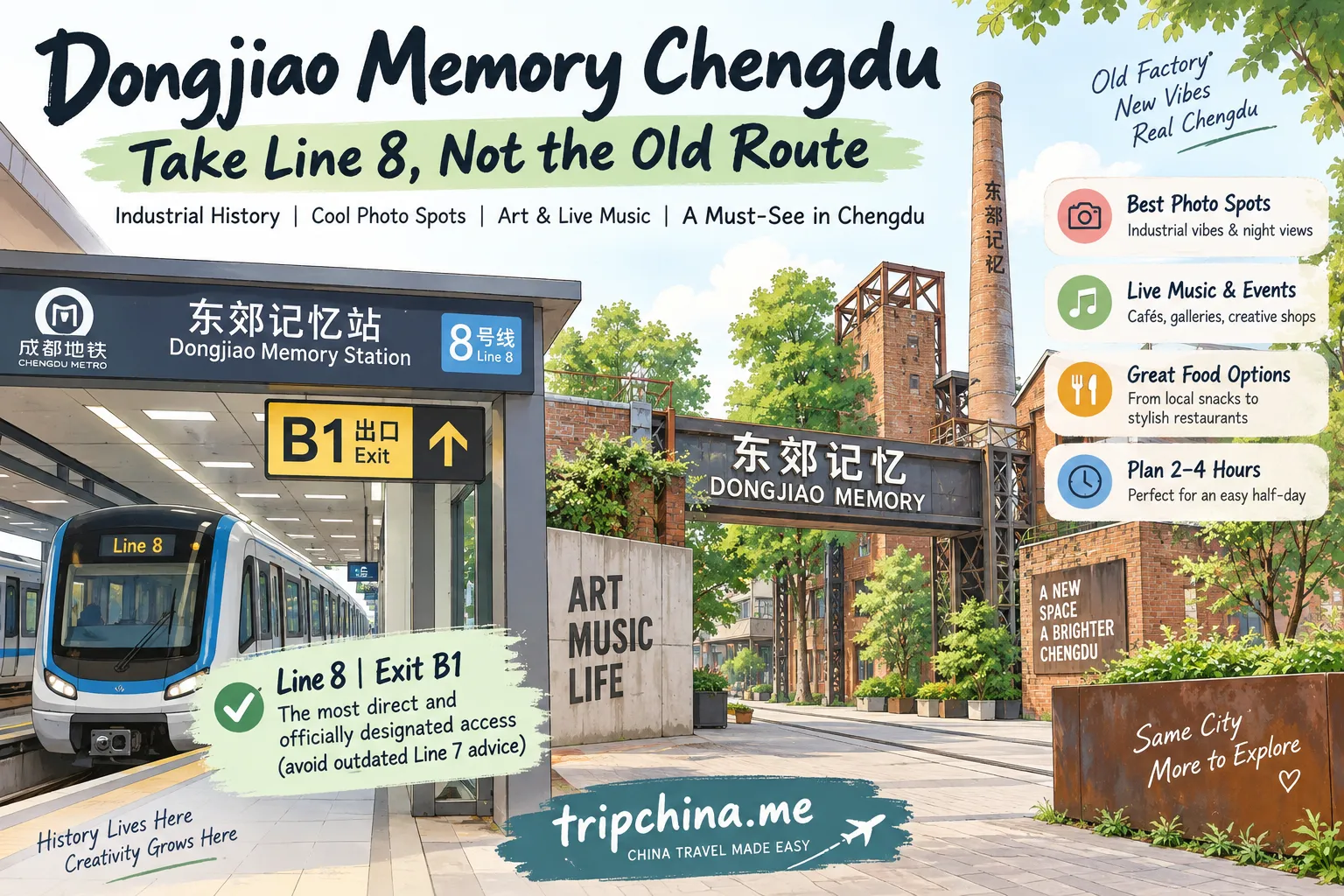
If traditional Chengdu is your priority, start with Kuanzhai Alley or Wuhou Shrine & Jinli. If you have already seen pandas, tea houses and historic streets, Dongjiao Memory provides a much stronger contrast.
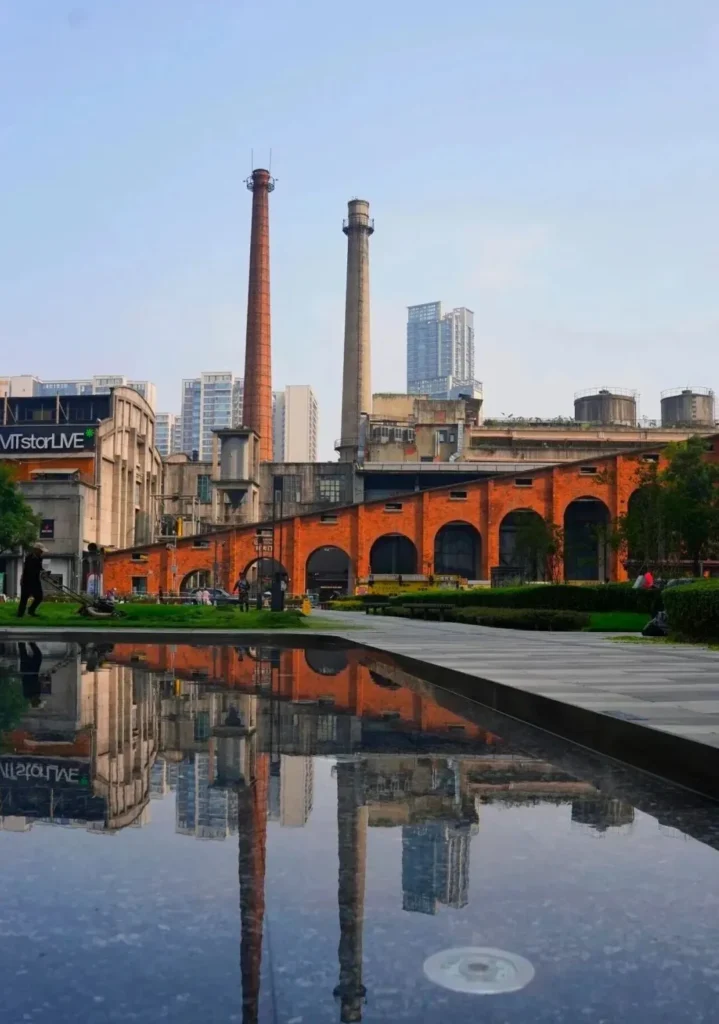
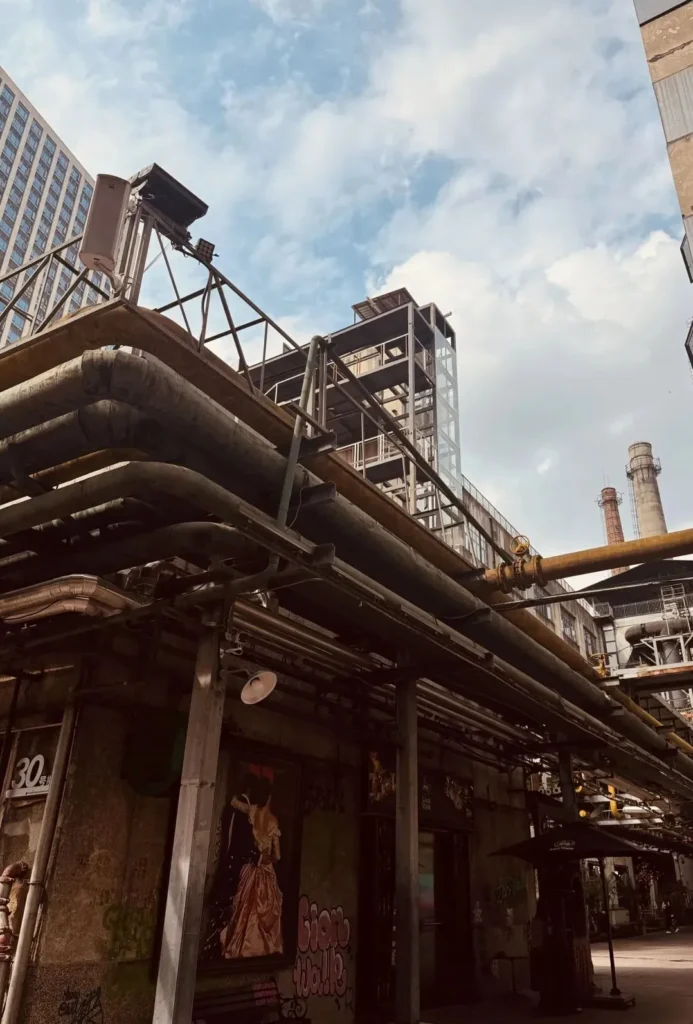
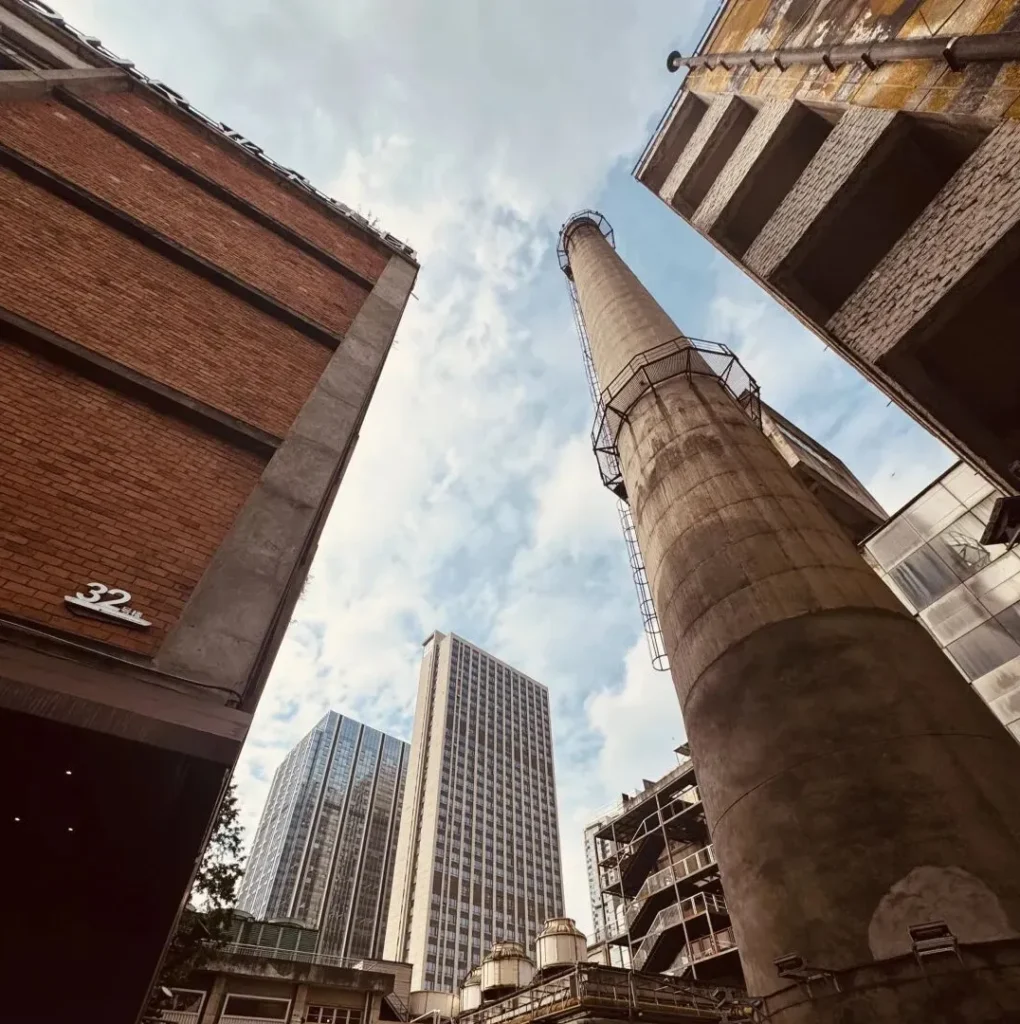
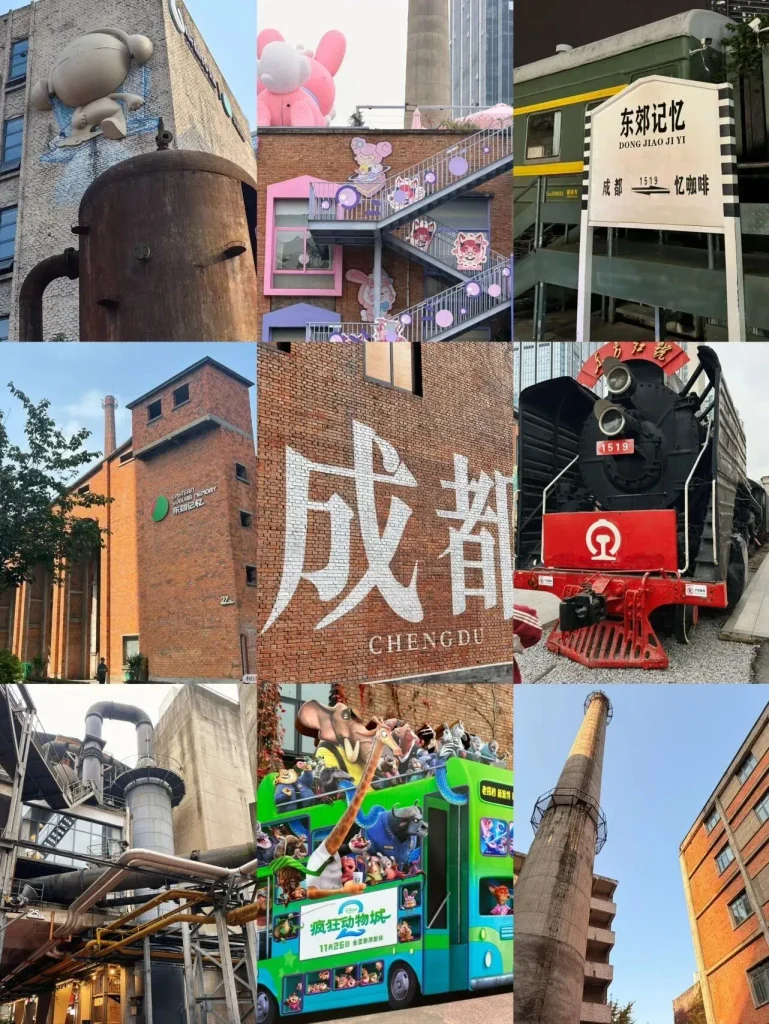
Take Chengdu Metro Line 8 to Dongjiao Memory Station (东郊记忆站) and use Exit B1.
From B1, allow roughly 3–5 minutes for the shortest approach to the park area, depending on the exact entrance or venue you are targeting. For a specific café, livehouse or restaurant inside the complex, search the venue itself in Amap rather than navigating only to “Dongjiao Memory.”
For tickets, payment and metro navigation elsewhere in the city, see the Chengdu metro guide for foreign travelers.
Usually, no.
Older guides may still send visitors to Line 7 Ligongdaxue Station. For the shortest and simplest metro approach, use Line 8 → Dongjiao Memory Station → Exit B1.
If local map results or entrances look confusing, the China navigation app guide explains why Amap is generally more useful for precise metro exits and attraction entrances in mainland China.
From central areas such as Chunxi Road or Taikoo Li, ride-hailing can be convenient if you are traveling with luggage or sharing the fare.
Enter the specific gate or venue rather than simply “Dongjiao Memory,” because the complex covers a sizeable area.
For setup and payment instructions, see the DiDi guide for foreign visitors.
For most travelers, I prefer late afternoon into evening on a weekday.
Come in the morning if photography matters more than atmosphere.
The popular walls and locomotive area are generally quieter, making it easier to compose photos without waiting for other visitors.
This is my favorite window.
Soft late-day light works particularly well with the red brick, steel pipes and industrial textures. As daylight fades, illuminated factory buildings create a completely different atmosphere.
Exact sunset and lighting conditions change with the season and weather, so do not plan around a fixed “lights-on” minute.
Weekdays generally mean fewer people.
Weekends can be more energetic, especially when performances, markets or events are running, but the most recognizable photo locations can become crowded.
Performance spaces inside Dongjiao Memory operate separately from the free public park. Shows are independently ticketed and are not included in the park's free entry. Schedules, lineups and ticket prices change by event, so check the individual venue's current official ticketing channel before visiting.
Also check China's public holiday calendar and crowd periods before assuming a weekday will be quiet.
| Visit Style | Time | What You Can Cover |
|---|---|---|
| Quick highlights | 2 hours | Locomotive, Chengdu Wall, industrial architecture |
| Recommended visit | 3 hours | Main photo spots + heritage areas + shops |
| Relaxed visit | 4 hours | Full route + coffee + browsing |
| Half day | 4+ hours | Park + meal nearby or ticketed experience |
For most first-time visitors, 3 hours is enough. Four hours makes sense if you enjoy photography, industrial architecture, cafés or browsing creative spaces.
The vintage locomotive and rail setting are among Dongjiao Memory's most recognizable industrial scenes.
Go earlier if you want cleaner compositions. Later in the day, the area has more atmosphere but usually more people.
The giant “Chengdu” wall is one of the park's most popular photo stops.
Weekday mornings are easiest if you want to avoid waiting. Late-day light gives the brickwork more texture.
If the main shooting position is packed, check the nearby second-floor platform. It can provide a similar elevated angle with a shorter wait, although crowd levels vary.
This is where the industrial character becomes much stronger.
Exposed steel, overhead pipes, red-brick buildings and old factory structures give the area a visual identity that feels very different from central Chengdu's historic-style attractions.
For photos, simple clothing tends to work better against the busy industrial background — black, white, khaki or workwear are easy choices.
Come here for color rather than industrial history.
The large street-art walls make this an easy detour between the more recognizable heritage locations.
The corridor uses historic factory imagery and industrial elements to connect today's creative park with the site's manufacturing past.
This is a better stop if you want context rather than another standard social-media photo.
For a deeper explanation of the site's industrial past, see the Dongjiao Memory Factory 773 history guide.
For a quick visit:
South-side entrance → locomotive area → Chengdu Wall → industrial pipe/bridge area → continue through the central park → exit toward your next destination
Allow extra time at the Chengdu Wall if it is busy.
This route is best if Dongjiao Memory is only one stop in a larger Chengdu day.
For a fuller visit:
South-side entrance → locomotive area → Chengdu Wall → industrial architecture → graffiti area → Memory Corridor → central shops and creative spaces → coffee break → exit
The advantage of four hours is not simply seeing more “attractions.” It gives you time to notice the old factory structures instead of turning the park into a checklist of photo spots.
If you want to connect the area with a longer urban walk, compare the routes in the Chengdu citywalk guide.
You have two very different strategies.
Yes if convenience matters.
There are cafés, restaurants, snack counters and commercial spaces throughout the wider area. Prices and opening hours vary by business, so I would not plan around one specific stall unless you have checked it on the day.
For coffee, there are enough choices that I would simply pick one along your route rather than crossing the park for a supposedly “best” café.
Yes if food is an important part of your evening.
The broader Jianshe Road neighborhood has far more casual local eating options. I would not describe every part of Jianshe Road as a fixed “10-minute walk from the North Gate.” The food area is spread across the neighborhood, and walking time depends on the exact restaurant or stall you choose.
Search the specific business in Amap before walking.
For a more systematic introduction to local eating, use the Chengdu night markets guide rather than choosing a stall only because it is closest to the attraction.
Shuyan Fu (蜀宴赋) is not a normal park meal. It is an immersive Chinese banquet-and-performance experience near Dongjiao Memory.
As of September 2026, current listings generally place standard/main seating in the ¥398–598 range, with higher-priced premium options available.
Published sessions commonly include 12:30, 18:30 and 21:00, with the full experience lasting roughly 90–100 minutes depending on the package.
Prices, packages and performance times are subject to seasonal adjustment, so confirm the current session and final price before booking. Shuyan Fu is independently ticketed and is not included in Dongjiao Memory's free park entry.
Do not follow an old guide simply because it still ranks highly in search.
Use Line 8 → Dongjiao Memory Station → Exit B1 for the most direct metro approach.
Parking and surrounding traffic can become inconvenient during weekends, holidays and major events.
Metro Line 8 removes that uncertainty.
The red walls are fun, but they are not the whole point.
Look at the surviving industrial structures and factory details. Knowing what the complex once produced changes the experience.
Performance spaces inside the district operate separately from the free public park.
Use the venue's official ticketing channel or a recognized ticket platform for the specific event. Ticket prices and schedules vary by performance.
If a line has formed behind you, take a few shots and move on.
You can always return later when the crowd thins.
The outdoor district may remain accessible later than individual businesses, but shops, exhibitions, cafés and performance venues keep their own operating hours.
Do not interpret “free/open outdoor park” as meaning every indoor venue stays open late.
Temporary exhibitions, cafés, markets, stamp activities and commercial tenants change.
Use this guide for the park's durable route and planning logic, then verify temporary activities on the day.
Walking: A full visit can involve several kilometers, so wear comfortable shoes.
Weather: Chengdu is frequently cloudy or rainy. Carry a compact umbrella when rain is forecast, especially if you plan to stay into the evening.
Mobile payment: Many cafés, restaurants and shops rely heavily on QR payment. Set up Alipay for foreign visitors or review the broader China payment guide for foreign travelers before sightseeing.
Internet: A working data connection makes local maps, ride-hailing, restaurant searches and QR ordering much easier. Compare China eSIM and SIM options before departure.
Luggage: As of September 2026, Dongjiao Memory Metro Station is included in Chengdu Metro's luggage-storage service network. Smart storage lockers are located in the station hall and operate in line with metro service hours, making the station a practical place to check before carrying luggage into the park.
Locker availability is not guaranteed when storage is full, so travelers with large suitcases should keep a backup option.
Yes, but there is one important correction to older itinerary advice.
Chengdu Panda Base is roughly 8 km from Dongjiao Memory as the crow flies, rather than the outdated 3 km figure seen in some older travel guides. Driving time is typically around 15–20 minutes under favorable traffic conditions, but Chengdu traffic can make the trip longer.
The combination still works well because pandas are best handled early:
Panda Base early morning → lunch → Dongjiao Memory in the afternoon → stay into early evening
Before going, check the Chengdu Panda Base visitor guide and the foreign visitor Panda Base ticket guide.
This is the part that makes Dongjiao Memory more interesting than a generic creative park.
The site grew from the Red Light Electronic Tube Factory (国营红光电子管厂), military code Factory 773. Construction began in 1958 as part of China's Soviet-assisted industrialization program. Sichuan historical records identify it as one of the major projects associated with the First Five-Year Plan. The factory was formally completed and accepted by the state on December 25, 1963.
The timeline matters because describing it simply as “a 1958 factory that produced China's first black-and-white and color picture tubes” compresses several different milestones into one sentence.
During the factory's early development, workers produced China's first 35-centimeter black-and-white picture-tube glass shell. By the 1960s, the plant had become a major picture-tube production base. In 1966, a Red Light Factory team produced China's first color picture tube; further development produced a single-gun, three-beam color picture-tube prototype in 1970.
That history is still physically visible.
Instead of demolishing everything and constructing a faux-industrial attraction, the redevelopment preserved substantial red-brick factory architecture and industrial elements. Dongjiao Memory opened as a cultural project in 2011 and subsequently developed into the music, performance, art and commercial district you see today.
That is why I would not rush through it just for the “Chengdu” wall.
The best moments are often between the famous photo spots: old steel structures above a café, factory brick behind a new storefront, or a locomotive sitting inside a district now filled with music and young visitors.
This article is part of the Chengdu Travel Guide Hub.
For the main public park, you generally do not need a sightseeing ticket or advance reservation. Ticketed performances, temporary exhibitions or special events may have their own booking and identification requirements.
Check the individual event's rules if you are attending a show rather than simply visiting the park.
Yes, if industrial heritage, live music, cafés or creative districts interest you.
If none of those appeal to you and you mainly want classic Chengdu culture, your time may be better spent drinking tea in People's Park, exploring traditional neighborhoods or visiting another historic attraction.
For normal use of the public outdoor areas, carrying your own bottled drink or takeaway snack is generally not an issue.
Individual performance venues, exhibitions and indoor businesses can set their own food-and-drink rules, so check before entering a ticketed space.
Most of the main outdoor walking areas are relatively flat and manageable with a stroller.
Some preserved industrial structures, stairs and individual indoor spaces may be less convenient, so families should treat the main outdoor route as the easiest option.
Yes, foreign visitors can attend public performances, but livehouses operate as individual venues with event-specific schedules, prices and ticketing rules.
Most shows are aimed at the domestic market, so booking interfaces and event information may primarily be in Chinese.
Dongjiao Memory is generally comfortable for solo visitors in the evening, particularly around its main illuminated public areas and active commercial zones.
Normal urban precautions still apply, especially later at night when businesses close and foot traffic decreases. Stay around the main public routes and use the metro or a licensed ride-hailing service when leaving.
Do not assume recreational drone flying is permitted simply because Dongjiao Memory is an outdoor park.
Drone operations in urban Chengdu are subject to China's aviation rules, local airspace restrictions and potentially site-specific controls. Check current official restrictions and obtain any required authorization before flying; otherwise, plan to photograph the park from ground level.
Yes. As of September 2026, Dongjiao Memory Station is included in Chengdu Metro's luggage-storage service network, with smart lockers located in the station hall.
Locker availability and permitted storage duration can vary, so do not treat a locker as guaranteed during busy periods. If you are carrying an unusually large suitcase, keep a hotel or commercial luggage-storage service as a backup.
The main outdoor areas of Dongjiao Memory are relatively flat and are more manageable for wheelchair users or travelers with limited mobility than some of Chengdu's historic attractions.
Dongjiao Memory Metro Station provides barrier-free facilities, but preserved industrial structures, stairs and individual indoor venues can present obstacles. Exit B1 provides the most direct approach to the park, and travelers who require step-free access to a particular performance venue should confirm that venue's accessibility before booking.
Dongjiao Memory is not the Chengdu I would choose for someone's only afternoon in the city.
But once you have seen the pandas, tea houses and traditional streets, it becomes much more interesting.
Take Metro Line 8 to Dongjiao Memory Station, Exit B1, arrive in the late afternoon, spend two to four hours walking through the surviving factory landscape, and stay long enough to see the industrial architecture change after dark.
The famous photo wall is fun. The real reason to come is the collision between Factory 773's industrial past and Chengdu's current creative culture.
This article is part of the Chengdu Travel Guide Hub.
Written by Chris Lee, Chengdu-based travel writer.
Official / Local Public Information
Sichuan Local Chronicles — Red Light Factory / Factory 773 History
Chengdu Metro — Official Platform
Current Venue & Travel Information
ShowStart — Dongjiao Memory Livehouse Venue & Events
Sichuan Online / Chuanguan News — Chengdu Metro Luggage Storage
Updated September 2026. Metro routing, Exit B1 and station facilities were cross-checked against current Chengdu Metro and local public information. Factory 773's 1958–1970 timeline was checked against Sichuan historical records.
Livehouse schedules and ticketing were checked against current venue listings. Shuyan Fu prices, individual event tickets, pop-up markets, exhibitions and business hours are dynamic and should be reconfirmed before visiting. Third-party pages that could not be reliably accessed or parsed were excluded rather than used as evidence.
TripChina.me creates practical China travel guides shaped by real local experience, helping independent travelers navigate transport, payments, food, neighborhoods, and the cultural details that make traveling in China easier and more meaningful. Find the guide for your destination at tripchina.me.