Our Location:
No. 99, Jiazi Road, Chengdu

 authorChris Lee
Most visitors head straight to Jiuyanqiao (九眼桥) for Chengdu nightlife. But the best night usually happens elsewhere: cocktails in Yulin, newer neighborhood bars around Yixin Bridge, live music, then perhaps Jiuyanqiao for the river lights. This guide compares the main nightlife areas, recommends specific bars, explains current prices and opening patterns, and shows foreign visitors how to avoid minimum-spend surprises and tourist traps.
For more local neighborhoods beyond the nightlife scene, our Chengdu City Walk guide covers several self-guided routes across the city.
Weekend reservations are sensible for popular cocktail bars. Smaller neighborhood bars usually still accept walk-ins.
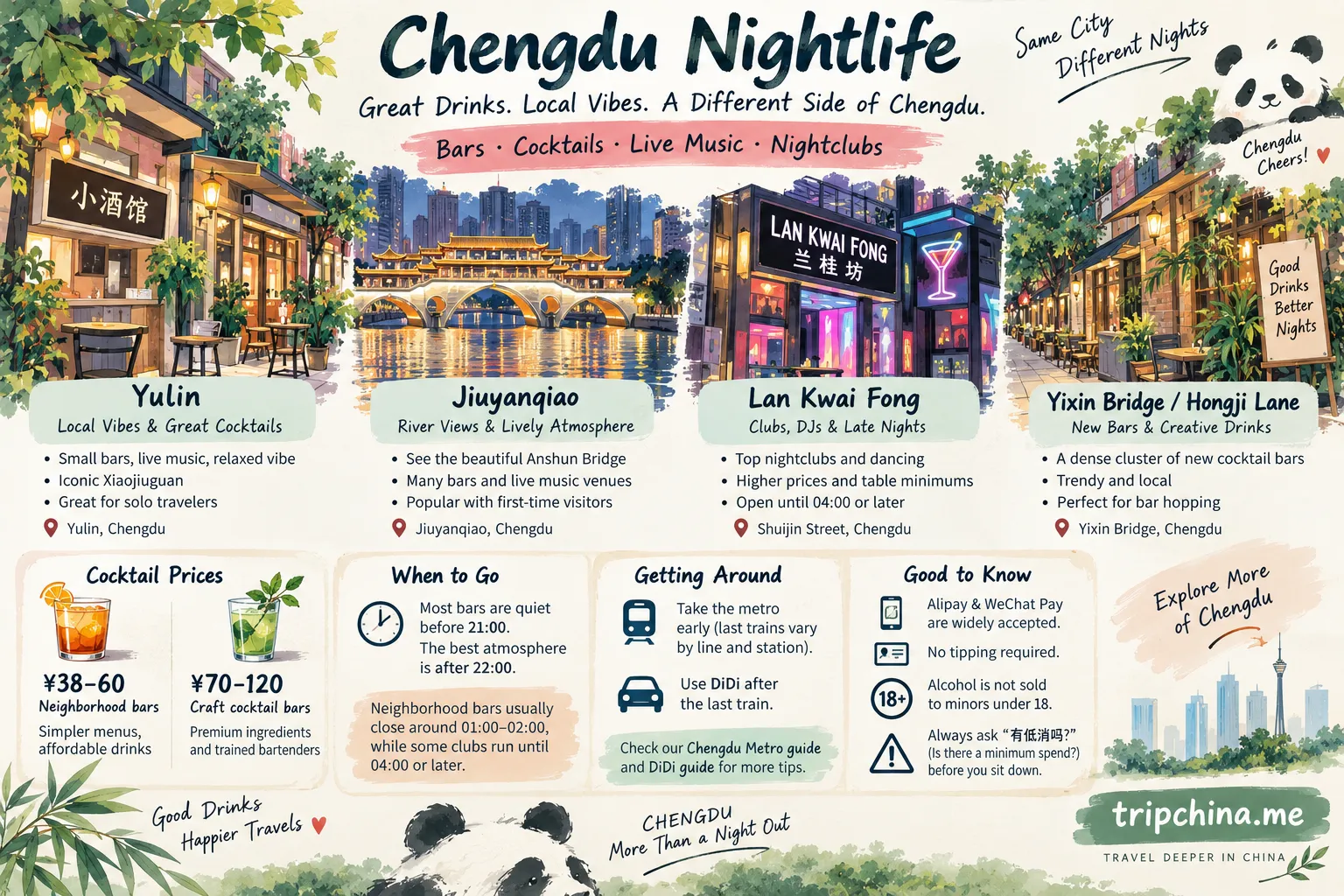
| Area | Best For | Typical Budget | Best Time | Honest Trade-Off |
|---|---|---|---|---|
| Yulin 玉林 | Cocktails, local atmosphere, solo travelers | ¥40–120 per drink | 21:00–01:00 | Relaxed rather than high-energy |
| Jiuyanqiao 九眼桥 | River views, first-time visitors, live-bar atmosphere | ¥50–100+ | 20:00–23:30 | Tourist-oriented and uneven quality |
| Lan Kwai Fong 兰桂坊 | DJs, dancing, clubs | Higher; tables may have minimums | 22:00–04:00 | Expensive and less distinctly Chengdu |
| Yixin Bridge / Hongji Lane 一心桥 / 宏济巷 | New cocktail bars, bar hopping | ¥60–120+ | 21:00–01:00 | Venues change quickly |
| 339 / Mengzhuiwan 339 / 猛追湾 | Alternative nightlife, late-night venues | Varies widely | 21:00 onward | More spread out |
The Best Time column means when each area usually feels most lively, not its official opening or closing time. Individual venues vary widely: Xiaojiuguan’s Yulin West Road location is currently listed around 15:00–02:00, some Jiuyanqiao bars open around 17:00 and close near 02:00, SAGI at Lan Kwai Fong is listed around 20:00–04:00, and some Mengzhuiwan/339-area bars operate as late as 05:00. Always check the venue on your actual date.
Prices and operating hours change frequently. The ranges above reflect September 2026 conditions and should be treated as planning references rather than fixed tariffs.
Jiuyanqiao is the image many visitors have of Chengdu nightlife: river reflections, glowing bridges, live-music bars and crowds moving along the Jin River.
The visual centerpiece is not actually Jiuyanqiao itself. It is the nearby Anshun Covered Bridge (安顺廊桥), whose traditional-style architecture becomes the dominant night-photo subject.
The modern road bridge called Jiuyanqiao is relatively ordinary. The historic nine-arch bridge that gave the area its name was demolished in 1992.
As of September 2026, the covered bridge is normally illuminated after dark, with recent visitor information commonly placing the strongest viewing period roughly between 19:00 and 22:30. Lighting schedules can change seasonally, so do not plan around an exact switch-off time.
For photos, the most reliable window is shortly after full darkness, when the bridge lights are on but restaurants and bars have not yet reached their busiest late-night period.
The setting is better than the average drink.
Many riverside venues cater heavily to visitors, and prices are often higher than at small neighborhood bars. Beer commonly falls around ¥30–60, while cocktails often cost around ¥50–90 or more.
Minimum spending is where visitors need to pay attention.
Do not assume every Jiuyanqiao bar charges a fixed ¥100 minimum. Policies depend on the venue, day and table. Small bars may have none, while larger nightlife venues can attach substantial minimums to river-view tables, booths or weekend reservations.
Before sitting down, ask:
有低消吗?
Yǒu dīxiāo ma?
Is there a minimum spend?
If there is one, ask staff to show you the amount before ordering.
Jiuyanqiao should not be treated as one giant tourist trap. The better way to understand it is that quality varies sharply from door to door.
If you do want to drink in the area, Siheyuan Bar (四合院酒吧) has traditionally offered a more Chengdu-style courtyard atmosphere than many riverfront venues, while Jingjie Folk Bar (井介民谣酒馆) is better suited to folk music and a slower evening.
Treat places like these as exceptions rather than proof that every bar along the river is worth entering.
TripChina verdict: Walk the riverfront, photograph Anshun Bridge, listen to the atmosphere — then decide whether you actually want to drink there.
Yes, if clubbing is what you want.
Chengdu Lan Kwai Fong around Shuijin Street is a polished nightlife development dominated by music, bottle service, DJs and late-night crowds. It feels closer to an international entertainment district than an old Chengdu neighborhood.
Best for: Clubbers who want DJs, dancing and a high-energy night and do not mind higher spending.
Not ideal for: Budget travelers or anyone whose priority is discovering a distinctly local Chengdu drinking culture.
Jellyfish remains one of the best-known names associated with the area, while SAGI continues to operate in the Lan Kwai Fong complex. Current listings for SAGI show hours around 20:00–04:00, illustrating how much later clubs run compared with neighborhood cocktail bars.
Do not confuse Lan Kwai Fong with PLAY HOUSE. PLAY HOUSE is currently listed at No. 65 Kehua North Road, not inside Lan Kwai Fong. Its current published hours run approximately 20:00–04:30, and DJ Mag has repeatedly ranked the Chengdu venue among its global Top 100 Clubs.
There is no useful citywide number.
Large clubs may impose table minimums, especially on Friday and Saturday nights, and premium booths can require spending in the thousands of yuan. Standing admission, regular tables and bottle-service areas can all follow different rules.
That is why a generic claim such as “all clubs have a ¥50–100 cover charge” is misleading.
Before confirming a table, ask for:
Never rely on a promoter’s verbal quote if the amount shown at the venue is different.
Yulin (玉林) is still one of the easiest neighborhoods in Chengdu for an unforced night out.
Tree-lined streets, low-rise buildings, old restaurants, cafés and small bars make it feel like an actual neighborhood rather than a nightlife development. You can eat, drink, walk and change plans without turning the evening into a logistics exercise.
It is especially good for couples, solo travelers and people who want cocktails or music without a huge nightclub.
For solo travelers, Yulin’s small cocktail bars are generally easier to navigate than large clubs. Sitting at the bar rather than taking a table also makes it easier to speak with bartenders or other customers without committing to a group-oriented bottle-service setup.
If nightlife location matters when choosing a hotel, our where to stay in Chengdu guide explains which neighborhoods work best for different travel styles.
Yes — but understand what you are going for.
The Xiaojiuguan (小酒馆) on Yulin West Road became nationally famous through Zhao Lei’s song “Chengdu.” It remains a cultural landmark and attracts a steady stream of visitors taking photos.
The original Yulin West Road location is primarily worth visiting for the cultural connection. Drinks are basic compared with Chengdu’s modern cocktail bars, and the area around the entrance can become crowded with visitors.
Current map and travel listings generally show the Yulin West Road location operating into the early morning, around 15:00–02:00 on most days. Treat that as a current listing rather than a guaranteed permanent schedule.
The important 2026 update is the Fangqin branch.
The former Xiaojiuguan Fangqin livehouse closed in its old form in 2024 and later reopened as Xiaojiuguan Fangqin Space (小酒馆芳沁空间), a more open cultural venue focused on exhibitions, conversations and experimental cultural programming. It should no longer be recommended as a standard nightly livehouse.
Current reporting identifies the MixC branch as the main Xiaojiuguan venue for livehouse performances.
If live music matters more than the song reference, check the official 成都小酒馆 account for the latest event venue before going.
Chengdu’s serious cocktail scene is now much broader than the three tourist nightlife districts.
The best bars increasingly sit inside residential neighborhoods or on ordinary side streets, which is part of the appeal.
Beatniks remains one of the stronger names in Chengdu’s modern cocktail scene and appeared on the 2026 Ganlan China Bar Awards list for Sichuan.
The room is warm and understated rather than theatrical. The menu has traditionally leaned creative without abandoning technique.
Memorable drinks have included a green-pea-shoot cocktail and fruit-driven combinations using ingredients such as mango, shiso and sushi vinegar.
The food is also unusually serious for a cocktail bar; grilled shrimp and pan-fried dumplings have both been worthwhile pairings.
Trade-off: The experience is drink-focused rather than performative. Go because you care about the cocktail rather than because you want a nightclub atmosphere.
Vertigo brought a Beijing cocktail-bar concept into Chengdu with a larger room and polished service.
The guava cocktail has been one of its most distinctive drinks: vanilla ice cream, fresh guava and a juicy, dessert-like body. The “Lucky Money” drink takes a sweeter, bitter-edged direction.
Menus and prices change, so the old “every cocktail is ¥80” reference should no longer be treated as a permanent tariff. Expect roughly Chengdu premium-cocktail pricing and check the current menu before ordering.
Trade-off: If you have already visited Vertigo in Beijing, some of the concept may feel familiar.
Black Dog (黑狗兄) stands out because of its tea-centered approach.
Its menu has been organized around different tea styles, with several cocktails developed from each. An oolong martini gives you a clean tea-driven structure, while milk-washed combinations move closer to an adult bubble-tea profile.
The hospitality is part of the appeal. The atmosphere is warmer and more playful than at many technique-first cocktail bars.
A mobile bar cart has also been used for tableside service.
Practical tip: Guest shifts can temporarily replace the normal menu, so check the bar’s latest Dianping or social-media update if there is one particular drink you want.
The Yixin Bridge (一心桥) and Hongji Lane (宏济巷) area has developed into one of Chengdu’s denser newer bar clusters.
It is useful because several different styles — cocktails, whisky, beer and food-led bars — sit within a compact urban neighborhood rather than a purpose-built club district.
For a first visit, around 21:00–22:00 is a good starting window: enough venues are active to bar-hop, but it is still easier to get a seat than closer to midnight.
Natural is deliberately understated.
The venue has been described as having almost no obvious exterior signage, creating more of a neighborhood living-room feel than a commercial bar entrance.
Its menu has played with classic templates such as the Bee’s Knees, Martini and New York Sour, offering variations around each.
A coffee martini using higher-grade fresh coffee and Bee’s Knees variations built around different Sichuan honeys are good examples of the style.
Trade-off: Drinks lean premium and the concept is intentionally niche.
Glitch works well as a neighborhood nightcap bar.
The room is small, the atmosphere is relaxed and food matters more here than at many cocktail-focused spaces. Beef pho has been one of the more memorable late-night options.
If you do not want a polished “destination bar,” this community-bar feel can be exactly the point.
Go to Song if whisky matters more than cocktails.
The bar focuses on independent-bottling whisky and has a much more specialist feel than mainstream nightlife venues.
Smoking has been permitted inside at times, so travelers sensitive to cigarette smoke should confirm current conditions before visiting.
Angry Pillar No. 4 (愤怒的柱子四店) is more useful when your group wants beer and food rather than formal cocktails.
Its focus is lager and fresh-made bar food, including dishes such as oil-splashed udon and beef ciabatta.
It is a good reminder that Chengdu nightlife does not have to mean cocktails or clubs.
Not every worthwhile Chengdu bar opened recently.
Some older names remain useful precisely because they represent different layers of the city’s nightlife culture.
StillFun (萃坊) is one of Chengdu’s long-running specialist whisky bars and remains associated with the development of the city’s bartender community.
The selection has historically extended well beyond standard Scotch and Japanese labels, with bottles from less obvious whisky-producing countries.
Its signature Qingcheng Question (青城问道) uses kiwifruit wine connected with the Qingcheng Mountain area, giving the menu a specifically Sichuan reference rather than simply copying international classics.
Address listings place the Yulin branch around Yulin West Road.
Erma (贰麻酒馆) is built around a very different type of night.
The name refers to being lightly drunk in local dialect, and the brand mixes Chinese-style drinking culture, group games, low-alcohol rice-wine or fruit drinks and Sichuan food.
Maocai and beef hot-pot noodles make it easier to spend an entire evening there rather than drinking on an empty stomach.
It is popular and can become noisy, crowded and commercial.
Go for the social atmosphere, not because you are searching for precision cocktails.
Food is inseparable from Chengdu nightlife. Our Chengdu hot pot guide explains how to order if you want to build dinner into the night.
Music House (音乐房子) is one of Chengdu’s established live-music names and has long been associated with musicians and singers who later became nationally known.
The Yulin venue remains oriented toward live performance rather than serious cocktail culture, with rock, blues, funk and singer-led sets depending on the night.
Check the day’s performance schedule before traveling specifically for a band.
Minimum spending is not limited to Jiuyanqiao.
Large clubs and premium tables elsewhere may also impose minimums, particularly on weekends.
Ask “有低消吗?” before you sit down, then confirm whether the quoted amount applies to one person or the entire table.
A common nightlife scam pattern involves a stranger steering visitors toward a specific unmarked or unfamiliar bar, followed by an inflated or poorly itemized bill.
The approach may happen on the street or after an online conversation.
The safest response is simple: decline the invitation and go to a venue you chose yourself.
If the bar has no clear menu, refuses to show prices or pressures you to order quickly, leave before ordering.
For wider Chengdu scam patterns, see our complete Chengdu travel pitfalls guide.
Chengdu nightlife runs late.
Many cocktail bars remain subdued before 21:00, while the atmosphere builds noticeably after 22:00. Clubs start later still.
Eat first, start slowly and save the highest-energy venue for later.
A common local rhythm is to finish with noodles, barbecue or 老妈蹄花 after midnight.
Our guide to Chengdu night markets locals actually visit has more late-night food options.
20:00–21:30: Start in Yulin. Visit the Xiaojiuguan Yulin West Road location for the cultural reference, or choose Music House if a live performance is scheduled.
21:30–23:30: Move into one or two Yulin cocktail bars rather than rushing across the city.
23:30 onward: Go to Jiuyanqiao for the Anshun Bridge view if you still want the classic nighttime photo.
This route puts the better drinking first and treats Jiuyanqiao as scenery rather than making it the entire night.
21:00–00:00: Bar-hop around Yixin Bridge and Hongji Lane.
After midnight: Choose between Lan Kwai Fong for a compact club district or PLAY HOUSE on Kehua North Road for a large-scale nightclub experience.
After the club: Finish with late-night Sichuan food rather than another forced round of drinks.
Alipay and WeChat Pay are the default at most Chengdu bars.
International bank cards are accepted at some higher-end venues, but acceptance varies. Do not build your entire night around being able to tap a foreign Visa or American Express card.
China’s current official payment guidance confirms that foreign visitors can use mobile payment, bank cards and cash.
For setup before arrival, read our China payment guide for foreign visitors.
Carry a small amount of RMB cash as backup.
At international-style clubs and well-known cocktail bars, an English menu or basic English assistance is fairly common.
At small local bars it is less predictable.
Save your hotel address in Chinese and install translation and navigation tools before going out. Our essential apps for China guide covers the practical setup.
No.
Tipping is not expected at ordinary Chinese bars. You do not need to add 15–20% to the bill as you would in the United States.
If you receive exceptional service, a bartender may appreciate the gesture, but there is no social obligation.
Do not rely on the old advice that enforcement is “relaxed.”
Chinese law prohibits selling alcohol to minors under 18, and bars and other venues considered unsuitable for minors are required to refuse minors entry.
If staff cannot clearly determine your age, they can ask for identification.
Foreign visitors who look young should therefore carry a valid passport or another form of identification accepted by the venue.
Do not assume every Chengdu metro line stops at exactly 23:00; last-train times vary by station, direction and line.
Check your route before entering the first bar. Our Chengdu Metro guide covers operating times and foreign-visitor payment options.
After the last train, DiDi is usually the easiest option. Set it up before going out using our DiDi guide for foreign travelers.
Take a screenshot of the bar’s Chinese name and address. It makes pickup much easier in dense nightlife districts.
Chengdu nightlife is generally straightforward for visitors, but “safe city” should never mean ignoring normal nightlife precautions.
For a first solo night, Yulin is generally easier than a large club district: arrive around 21:00, choose a small cocktail or live-music bar with visible menu pricing, and sit at the bar rather than booking a table.
Choose the venue yourself, keep your drink in sight, avoid following strangers to a second location and confirm prices before ordering.
Solo women may also find our solo female travel in China safety guide useful for transportation and late-night precautions.
For more Chengdu travel tips, visit our Chengdu Travel Guide Hub.
Yes. Chengdu has a visible LGBTQ+ and queer-friendly nightlife scene, including dedicated and mixed venues.
However, individual venue names and locations change relatively quickly, so old English-language lists can become unreliable. Check a current local listing shortly before your trip rather than planning around a several-year-old recommendation.
Generally, yes. Major Chengdu clubs regularly receive foreign customers and there is no separate tourist admission process.
Bring your passport or valid identification because venues can check age or identity. Special events may also operate their own guest-list or ticket rules.
Most neighborhood bars and cocktail bars are casual.
Large clubs are more likely to reject extremely casual beachwear, slippers or clothing considered unsuitable for the venue. You do not normally need a jacket, heels or formal Western clubwear.
Small bars often accept walk-ins, so no reservation may be necessary.
For popular weekend venues, ask your hotel to call, message the bar through WeChat, or use a booking platform that accepts your account. Always request written confirmation of any table minimum before agreeing to a club reservation.
For a first Chengdu night out, start with Yulin or Yixin Bridge / Hongji Lane, not Jiuyanqiao.
Go to Jiuyanqiao for Anshun Bridge, river lights and the spectacle.
Choose Lan Kwai Fong or PLAY HOUSE when your goal is dancing rather than discovering local neighborhood culture.
The best Chengdu nightlife is not one famous bar street. It is the contrast between an old neighborhood bar, a technically ambitious cocktail, late-night Sichuan food and a city that often feels more alive at midnight than it did at dinner.
This article is part of the Chengdu Travel Guide Hub. More local research and field notes are available on the Chris Lee author profile.
China Payment Guide for Foreign Visitors
Ministry of Education — Law on the Protection of Minors
People’s Daily / Sichuan Daily — Xiaojiuguan Fangqin Space Update
This guide was fully updated in September 2026 using TripChina’s local research, current Chinese map and booking listings, recent Sichuan media reporting, nightlife industry sources, and official Chinese guidance on payments and minors. Opening hours, prices, table minimums and event schedules vary by venue and date; “Best Time” refers to the strongest atmosphere, not official business hours. Travelers should recheck Dianping, WeChat or the venue’s current map listing before making a dedicated trip.
TripChina.me creates practical China travel guides shaped by real local experience, helping independent travelers navigate transport, payments, food, neighborhoods, and the cultural details that make traveling in China easier and more meaningful. Find the guide for your destination at tripchina.me.