Our Location:
No. 99, Jiazi Road, Chengdu

 authorChris Lee
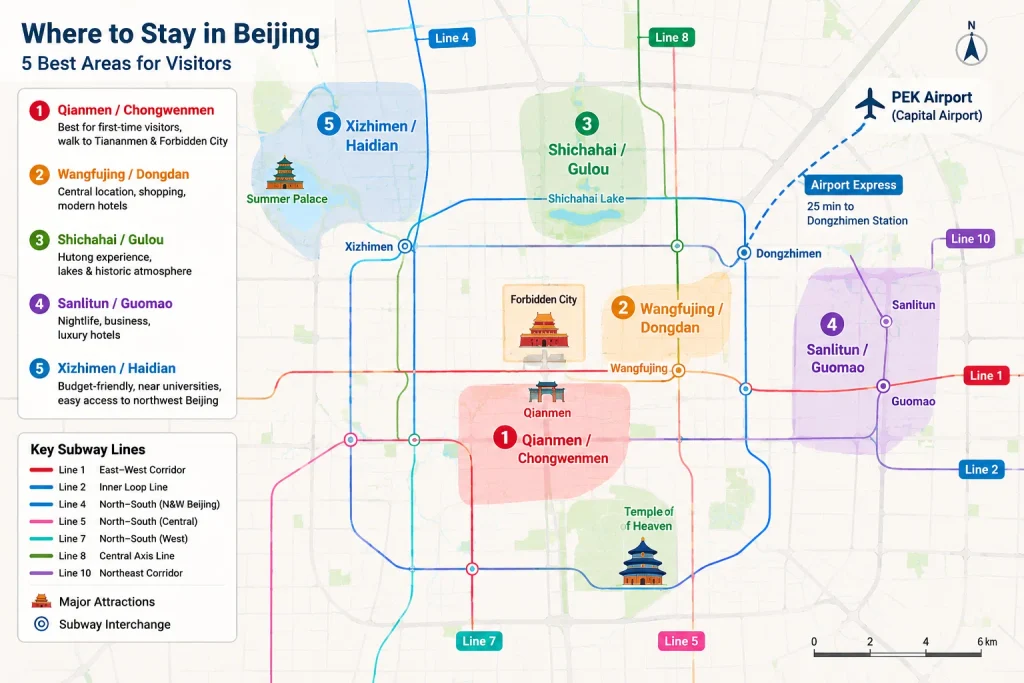
Beijing is sprawling. Most first-time visitors don’t need to evaluate the entire city. The key question: which neighborhood places your hotel close to the sights, subway lines and evening activities you will actually use on your itinerary.
This guide compares five practical bases—from Qianmen and Wangfujing to the hutongs, Sanlitun and Haidian—so you can choose by itinerary rather than hotel price alone.
For most first-time visitors, Qianmen/Chongwenmen or Wangfujing/Dongdan are the safest all-round choices. They keep you close to central Beijing while providing strong subway access.
Choose Shichahai/Gulou for hutong atmosphere, Sanlitun/Guomao for nightlife, business and modern hotels, and Xizhimen/Haidian if value or northwestern Beijing attractions matter more.
TripChina Verdict: In Beijing, prioritize location near a useful subway station and your actual itinerary over district name, hotel star rating or straight-line map distance.
These five bases cover most first-time international travelers better than trying to compare dozens of Beijing neighborhoods.
| Area | Best For | Central Sightseeing | Subway Access | Evening Options | Main Trade-Off | TripChina Verdict |
|---|---|---|---|---|---|---|
| Qianmen / Chongwenmen | First trip, short stays | Excellent | Excellent | Very good | Busy tourist core | ★★★★★ |
| Wangfujing / Dongdan | Convenience, modern hotels | Excellent | Excellent | Excellent | Less hutong atmosphere | ★★★★★ |
| Shichahai / Gulou | Hutongs, couples, culture | Very good | Very good | Excellent | Hotel access varies | ★★★★☆ |
| Sanlitun / Guomao | Nightlife, business, luxury | Moderate | Excellent | Excellent | Farther from old-city sights | ★★★★☆ |
| Xizhimen / Haidian | Value, Summer Palace, longer stays | Moderate | Excellent | Good | More commuting | ★★★☆☆ |
These ratings are TripChina editorial judgments for a typical international visitor, not official rankings.
For a short, sightseeing-heavy first visit, this is one of the strongest bases.
Qianmen sits on Beijing's historic Central Axis, while Chongwenmen lies slightly farther east and offers excellent subway connectivity.
Qianmen works particularly well if your itinerary revolves around:
Line 8 runs through Qianmen and connects several major Central Axis areas, including Wangfujing, Nanluoguxiang, Shichahai and Drum Tower. Beijing's official visitor information specifically highlights Line 8 as a useful way to explore the Central Axis.
If this is your first visit, see our Beijing travel guide hub before deciding how many nights you need.
Not as a general rule.
Qianmen is convenient for Tiananmen and the historic core, but walking time depends heavily on your hotel's exact location, security arrangements, pedestrian routes and which entrance you are trying to reach.
The Forbidden City itself is entered from the south through Meridian Gate, so “near the Forbidden City” should never be judged purely by straight-line map distance.
For current ticket rules, entry routes and foreign-passport booking, see our Forbidden City ticket and passport guide.
Choose Chongwenmen if you want central access without necessarily sleeping inside the busiest tourist streets.
Its Lines 2 and 5 connections make it particularly practical for travelers moving around central and eastern Beijing.
For many visitors, that is a better compromise between:
location + metro + hotel choice
than insisting on a room immediately beside Qianmen Street.
For travelers who want a modern hotel in the historic center, this is arguably the easiest Beijing base.
You remain close to:
Unlike a hutong stay, luggage access is usually straightforward.
Unlike Sanlitun, you have not moved far away from Beijing's major historic sights.
Choose Wangfujing/Dongdan if you prioritize:
Choose Qianmen if the historic Central Axis and old-city atmosphere matter more.
Wangfujing feels more commercial.
You are choosing central convenience rather than a residential old-Beijing atmosphere.
That is not necessarily a disadvantage—especially after a long sightseeing day.
If atmosphere matters more than maximum efficiency, this is the strongest choice.
The broader Shichahai–Gulou–Nanluoguxiang area puts you among hutongs, courtyard buildings, lakes and some of Beijing's most walkable historic neighborhoods.
The appeal is not simply that the building looks old.
You can step outside in the morning and immediately walk through neighborhood lanes rather than emerging from a commercial hotel tower.
But the experience varies enormously by property.
A courtyard hotel may involve:
Do not assume every hutong hotel has these problems—but check before booking.Some courtyard hutong hotels have no elevator and require carrying suitcases up stone steps.
Think twice if you:
You can still stay near Shichahai without choosing a property deep inside a narrow alley.
For exploring the area on foot, see our Beijing hutong walking routes and courtyard stays.
No. Nanluoguxiang is simply one of the best-known hutong areas. Accommodation also exists around Gulou, Shichahai and other parts of Dongcheng and Xicheng.
Do not choose a hotel solely because its booking page uses the word:
“hutong.”
Look at the actual street and surrounding neighborhood.
These two areas belong in the same broad decision category—but they are not the same neighborhood.
Sanlitun works well if your priorities include:
It is a much stronger evening base than Qianmen or Haidian.
Guomao is the better fit for:
It is functional rather than historic.
They are workable, but not optimal if your trip is overwhelmingly focused on the historic center.
Beijing's subway makes the journey manageable, but you will commute into old Beijing rather than wake up inside it.
That trade-off is worthwhile if nightlife, work or hotel quality matters more to you.
It can work for cost‑conscious travellers, but do not treat Xizhimen and Haidian as Beijing’s guaranteed cheapest neighbourhoods. Hotel rates shift significantly depending on individual properties, travel dates and market demand.
The compelling case for staying here comes from its balanced value, robust transport links, and convenient access to sights across western Beijing.
Xizhimen is a major transport interchange with Lines 2, 4 and 13.
That makes it useful if your itinerary includes both central Beijing and the northwest.
Haidian becomes attractive if you plan significant time around:
Line 4 is particularly useful for this part of the city.
If Summer Palace is high on your list, our Summer Palace route and stay guide can help you decide whether staying farther west is actually worthwhile.
Daily commuting.
If almost every day starts at Tiananmen, Qianmen or the Forbidden City, saving money farther out can be a false economy on a three-day trip.
For a longer stay, the calculation changes.
Usually not on a first 2–4 day Beijing trip. Staying near the Summer Palace makes more sense as a special-purpose choice than as a default base for first-time visitors.
It can make sense if:
For a first visit focused on Tiananmen, Forbidden City, Temple of Heaven and hutongs, central accommodation is usually more efficient.
This is a more useful comparison than trying to rank every Beijing neighborhood.
| Question | Qianmen / Chongwenmen | Wangfujing / Dongdan |
|---|---|---|
| Historic atmosphere | Better | Good |
| Modern hotel choice | Good | Better |
| Central sightseeing | Excellent | Excellent |
| Subway access | Excellent | Excellent |
| Shopping | Good | Better |
| Hutong feel | Better | Limited |
| Easy luggage/taxi access | Varies | Generally easier |
| First-time visitor | Excellent | Excellent |
Choose:
Qianmen → history and atmosphere
or:
Wangfujing → convenience and modern hotels
Neither is universally “better.”
That distinction is more useful than claiming one area is the only correct answer.
For most independent travelers, this matters more than the district name.
Beijing is too large to judge accommodation only by whether it is “central.”
It is a useful target—not a law.
A hotel 700 meters from a station along a simple pedestrian street may be easier than one 400 meters away across a huge intersection or inside a maze of hutongs.
Before booking, check:
Beijing's subway remains one of the most practical ways to move around the city, and tourist-heavy stations receive additional crowd-management measures during peak travel periods.
For first-time use, see our Beijing subway guide for first-time visitors.
You do not need to stay on one specific “tourist line.”
But several lines are especially useful.
| Line | Useful Areas for Visitors | Why It Matters |
|---|---|---|
| Line 1 | Tiananmen, Wangfujing, Guomao | Major east–west central corridor |
| Line 2 | Chongwenmen, Dongzhimen, Xizhimen | Loops around central Beijing |
| Line 4 | Xizhimen, Haidian, Summer Palace | Excellent for northwest Beijing |
| Line 5 | Chongwenmen, Temple of Heaven area | Useful north–south route |
| Line 6 | Nanluoguxiang, central/east Beijing | Useful for hutong districts |
| Line 8 | Qianmen, Wangfujing, Nanluoguxiang, Shichahai, Gulou | Excellent Central Axis access |
Line 8 deserves particular attention for tourists because it connects multiple Central Axis and old-city areas.
But a hotel sitting directly above a less famous interchange can still outperform a “perfect tourist neighborhood” that requires a 15-minute walk to the station.
Not as a general legal requirement. Under China's current accommodation-registration rules, hotels register foreign guests' accommodation information during check-in.
For a normal hotel booking, bring the original passport or other accepted travel document required for check-in. Foreigners staying somewhere other than a hotel have separate accommodation-registration obligations.
Then the rules are different.
Foreigners staying outside hotels must complete accommodation registration according to current requirements. Beijing provides online registration services as well as other official channels.
This is an important distinction:
Hotel → hotel handles registration.
Private/non-hotel accommodation → you or the host need to ensure registration is completed.
Many do, especially larger hotels—but do not make it an absolute assumption.
Official guidance for foreign visitors specifically recommends asking the hotel in advance whether it accepts Visa, Mastercard or other international bank cards. Hotels may also accept RMB cash, Alipay and WeChat Pay.
Beijing has continued expanding international-card acceptance and foreign-visitor payment services in 2026.
For payment setup before arrival, see our China payment setup guide for foreign visitors.
Book earlier when your trip overlaps with:
For normal dates, a refundable booking is often more useful than trying to predict the exact cheapest booking window.
Sometimes—but not automatically.
Moving hotels costs time too.
For a five-night first visit, I would normally keep one well-located central hotel unless the second accommodation is itself part of the experience—for example, spending the final two nights in a courtyard hotel.
| Mistake | Better Approach |
|---|---|
| Choosing by district name alone | Check the exact hotel, nearest subway station and your actual itinerary |
| Assuming “near the Forbidden City” means easy entry | Check the real pedestrian route and current visitor entrance |
| Booking a hutong hotel without checking vehicle access | Confirm whether taxi/DiDi can reach the entrance and how far you must carry luggage |
| Saving money far outside central Beijing on a short trip | Compare the room saving with the extra daily commute |
| Assuming a luxury hotel automatically has the best location | Match the hotel to the sights and activities you will actually use |
| Your Trip | Best Base | Why |
|---|---|---|
| First 3-day visit | Qianmen / Chongwenmen | Efficient historic sightseeing |
| First trip + modern comfort | Wangfujing / Dongdan | Central + conventional hotels |
| Hutong experience | Shichahai / Gulou | Strongest neighborhood atmosphere |
| Nightlife trip | Sanlitun | Restaurants, bars, contemporary Beijing |
| Business / luxury | Guomao | CBD and premium hotels |
| Longer budget-conscious stay | Xizhimen / Haidian | Transport + potential value |
| Summer Palace-heavy itinerary | Haidian | Better northwest access |
| Slow resort-style trip | Summer Palace / Xishan | Special-purpose choice |
If you are still undecided:
Qianmen/Chongwenmen for history; Wangfujing/Dongdan for convenience.
Those are the two lowest-risk choices for a typical first-time visitor.
This article is part of the Beijing Travel Guide Hub.
Do not choose your entire stay based on one airport journey. Dongzhimen has direct Capital Airport Express access, but your hotel affects every sightseeing day, while the airport transfer usually happens only twice. For most tourists, central sightseeing convenience should matter more.
For PEK versus PKX transport options, see our Beijing airport transfer guide for PEK and PKX.
If Universal is only one day of a broader Beijing trip, you usually do not need to relocate to Tongzhou. A hotel with convenient access to Line 7 can make the day trip manageable while keeping you better positioned for central Beijing on other days.
If Universal is the primary purpose of the trip for several days, staying closer to the resort becomes more reasonable.
Yes, provided the hotel is near a useful subway interchange. Beijing is geographically large, but the metro makes one-base itineraries practical. Changing hotels is worthwhile mainly when your itinerary shifts substantially or the second hotel is part of the experience.
It depends more on your travel style than neighborhood. Hotel breakfast is useful for early attraction bookings and families, while travelers interested in local breakfast food may prefer eating outside. Check how early breakfast begins if you have early-entry plans.
Treat the view as a luxury upgrade, not a transport advantage. Verify recent guest photos and the exact room category before paying a premium; “Forbidden City view” can describe very different sightlines depending on the property and room.
Forbidden City Tickets for Foreigners
Beijing Subway Guide for First-Time Visitors
Beijing Municipal Government — Guide to Accommodation Registration for Foreigners
National Immigration Administration — 2026 Accommodation Registration Policy for Foreigners
Beijing Municipal Government — Beijing Central Axis by Bus and Subway
Beijing Municipal Government / Ministry of Commerce — Accommodation Guidance for Foreign Travelers
This guide was reviewed in August 2026 using current Beijing municipal and National Immigration Administration guidance on accommodation registration, transport and services for international visitors.
Neighborhood recommendations are TripChina editorial judgments based on sightseeing access, subway connectivity and practical travel friction. Hotel prices, facilities and payment options vary by property and date, so verify current details before booking.
TripChina.me creates practical China travel guides shaped by real local experience, helping independent travelers navigate transport, payments, food, neighborhoods, and the cultural details that make traveling in China easier and more meaningful. Find the guide for your destination at tripchina.me.