Our Location:
No. 99, Jiazi Road, Chengdu

 authorChris Lee
The Summer Palace is not too big—you may simply be using the wrong entrance. Enter through the busiest gate, follow the wrong direction, or buy every add-on ticket, and a beautiful imperial garden can become an exhausting day. This Summer Palace Beijing guide shows you which gate to use, three routes for different travelers, what tickets actually make sense, when the inner attractions close, and how foreign visitors can avoid the most common mistakes.
| Question | Best Answer |
|---|---|
| Best entrance for most first-time visitors | North Gate (北宫门) if stairs are not a problem |
| Best time to arrive | Opening time: 06:00 peak season / 06:30 off-peak |
| Best short route | North Gate → Four Great Regions → Foxiang Pavilion → Long Corridor → Seventeen-Arch Bridge → New Gate |
| Time needed | About 3–4 hours for the essentials; 5+ hours for a deeper visit |
| Base ticket | ¥30 peak / ¥20 off-peak |
| Combo ticket | ¥60 peak / ¥50 off-peak |
| Peak season | April 1–October 31 |
| Off-peak season | November 1–March 31 |
| Monday rule | Main park stays open; major paid inner attractions close except on statutory holidays |
| Foreign visitors | Bring the valid passport or other ID used for ticketing |
| Best accessible entrance | East Gate or New Gate rather than the North Gate hill route |
For most casual visitors, do not automatically buy the combo ticket. Start with the base ticket unless you already know you want several separately ticketed attractions.
Foreign visitors can buy tickets online or use the comprehensive service window at the entrance if online verification is inconvenient. Bring the valid passport or other identity document used for ticketing.
For the broader Beijing booking system, see the Beijing Attraction Ticket Booking Guide.
The single most important decision you make at the Summer Palace is not which pavilion to photograph. It is where you enter.
Your entrance determines whether your first hour is spent around tour groups or moving through a quieter section of the garden.
| Gate | Best For | Transport | Main Trade-Off |
|---|---|---|---|
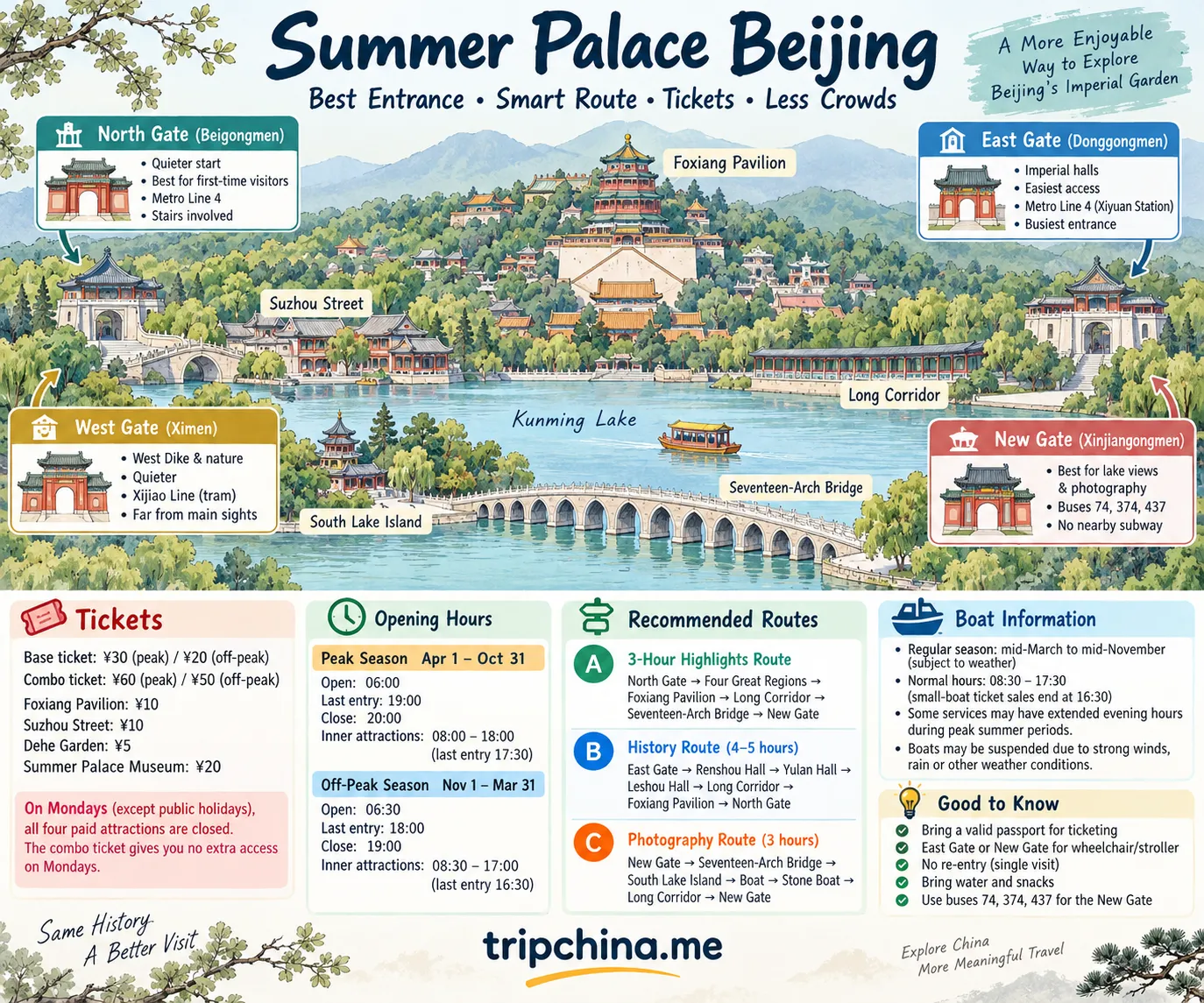
| North Gate 北宫门 | First-time visitors who want a quieter start | Line 4, Beigongmen Station | Steep stairs; not suitable for wheelchair routes |
| East Gate 东宫门 | Imperial halls, history, accessibility | Line 4, Xiyuan Station + walk | Busiest traditional entrance |
| New Gate 新建宫门 | Seventeen-Arch Bridge, lake, photography | Bus, taxi or DiDi | No nearby subway station |
| West Gate 西门 | West Dike, spring scenery, repeat visitors | Xijiao Line | Far from the core imperial sights |
The North Gate (北宫门) remains my preferred entrance for most able-bodied first-time visitors.
Take Metro Line 4 to Beigongmen Station. If Beijing's metro system is still unfamiliar, the Beijing Subway Guide for Foreigners explains payment, maps and common first-trip mistakes.
From the North Gate entrance area, walk to the bridge overlooking Suzhou Street (苏州街). You can see the reconstructed waterside street from above without a ticket. Entering the street itself requires the combo ticket or a separate ¥10 Suzhou Street ticket.
Continue uphill toward the Four Great Regions (四大部洲), a Tibetan-style Buddhist architectural complex that feels completely different from the lakeside palace buildings.
The North Gate strategy does have one major disadvantage: stairs. If mobility is limited, do not choose this route simply because it is quieter.
The East Gate (东宫门) is the traditional main entrance and makes more sense if you want to concentrate on the imperial living and political quarters.
Take Line 4 to Xiyuan Station and allow roughly 10–15 minutes for the walk, depending on your pace and exact route.
From here, you reach areas such as Renshou Hall, Yulan Hall and Leshou Hall without first climbing over the back hill.
The downside is crowd concentration. Tour groups commonly use this side of the garden, particularly during the middle of the day.
If accessibility matters more than crowd avoidance, however, the East Gate is a better starting point than the North Gate and is generally more practical for a Summer Palace wheelchair accessible route.
The New Gate (新建宫门) is a strong choice if your priority is Kunming Lake and the Seventeen-Arch Bridge.
It puts you near the southeastern lake area, making it particularly useful for a late-afternoon photography route.
But there is no nearby subway station. Public buses 74, 374 and 437 serve the Xinjiangongmen area directly; a taxi or DiDi is another simple option.
For travelers who do not want to decipher buses, a short ride-hailing trip is usually simpler. See the DiDi Guide for Foreigners in China before relying on it for the first time.
The West Gate (西门) is the quietest choice in this guide and works particularly well for visitors interested in the West Dike.
It is accessible via the Xijiao Line, the modern tram running from the Bagou area and stopping at Summer Palace West Gate.
This entrance places you near one of the most peaceful parts of Kunming Lake, especially attractive when peach blossoms appear along the West Dike in spring.
The trade-off is distance. The major imperial buildings and Long Corridor are far away, so use the West Gate when you have at least five hours or when the West Dike itself is one of your priorities.
There is no reason for every visitor to walk the Summer Palace in the same direction.
Choose your route based on time, interests and physical ability.
| Route | Best For | Time | Walking | Start / Finish |
|---|---|---|---|---|
| Route A | First-time visitors | ~3 hours | ~4 km | North Gate → New Gate |
| Route B | History-focused visitors | 4–5 hours | ~5 km | East Gate → North Gate |
| Route C | Photography | ~3 hours | ~3 km | New Gate → New Gate |
North Gate → Four Great Regions → Foxiang Pavilion → Long Corridor → Seventeen-Arch Bridge → New Gate
This is the route I recommend for most first-time visitors who are comfortable with stairs. It covers the essential scenery without unnecessary backtracking.
Start at the North Gate and walk to the bridge overlooking Suzhou Street. You do not need a Suzhou Street ticket merely to see it from above.
Then climb through the Four Great Regions. The Tibetan-style stupas, red walls and hillside architecture are particularly atmospheric early in the day.
Continue toward Foxiang Pavilion (佛香阁). The final approach involves stairs, but the elevated position gives you one of the garden's broadest views over Kunming Lake and the surrounding landscape.
The pavilion requires a separate ¥10 ticket if it is not included in your combo ticket.
Walk down toward the Long Corridor (长廊). At 728 meters, it is one of the defining architectural features of the Summer Palace, with thousands of painted scenes across its beams and panels.
Do not rush through it just because it is long. The paintings include stories, landscapes and characters drawn from Chinese literature and mythology.
Finish at the Seventeen-Arch Bridge (十七孔桥) and South Lake Island. Looking back across the water gives you the classic composition of the bridge, lake and Longevity Hill.
In late afternoon, the stone railings cast long shadows. Around the winter-solstice period, sunlight can align dramatically through the bridge arches; in other seasons, the late-afternoon light is still worth planning around.
Exit through the New Gate.
Walking: approximately 4 km
Time: about 3 hours at a comfortable pace
East Gate → Renshou Hall → Yulan Hall → Leshou Hall → Long Corridor → Foxiang Pavilion → Four Great Regions → North Gate
Choose this route if the political and imperial history matters as much as the landscape.
Start at Renshou Hall (仁寿殿), where Empress Dowager Cixi conducted state affairs during her periods at the Summer Palace.
Continue to Yulan Hall (玉澜堂), associated with Emperor Guangxu. After the failed Hundred Days' Reform in 1898, Guangxu was confined here under Cixi's authority.
Then visit Leshou Hall (乐寿堂), Cixi's residential area. The courtyard contains the famous giant Taihu rock popularly known as the “Family-Breaking Stone” (败家石), surrounded by stories about the enormous cost of transporting it.
From here, continue through the Long Corridor and climb toward Foxiang Pavilion before descending through the Four Great Regions to the North Gate.
Walking: approximately 5 km
Time: about 4–5 hours
This is the better route if you want context rather than simply collecting famous photo spots.
New Gate → Seventeen-Arch Bridge → South Lake Island → Boat → Stone Boat area → Long Corridor → Seventeen-Arch Bridge
Start in the afternoon rather than at opening.
Enter through the New Gate and head first toward the Seventeen-Arch Bridge. Cross to South Lake Island for the classic view toward Longevity Hill and Foxiang Pavilion.
If boats are operating, take an official park boat across Kunming Lake toward the Stone Boat area. The water-level perspective makes the hillside architecture easier to understand: temples, pavilions and roofs appear stacked vertically above the lake.
Then walk back along the Long Corridor as the light becomes softer.
Return toward the bridge area later in the afternoon if conditions are good.
Walking: approximately 3 km
Time: about 3 hours, depending on boat queues
For travelers searching specifically for Summer Palace boat operating hours, the important distinction is between the normal timetable and temporary extensions. As of September 2026, the regular boating season began on March 14 and is expected to continue into roughly mid-November, subject to seasonal conditions. Official 2026 information lists normal operations around 08:30–17:30, with small-boat ticket sales ending at 16:30.
During high-demand summer periods, selected ferry services may receive temporary evening extensions. These are exceptions rather than the normal timetable, so check the current dock notice before building an evening itinerary around a boat connection.
Early spring and late autumn can bring shorter or adjusted schedules, while strong wind, heavy rain and other adverse conditions can suspend boating entirely.
For broader seasonal planning—including public holidays and peak travel periods—see the China Public Holidays and Best Time to Travel Guide.
For many first-time visitors, no.
As of September 2026, official prices are:
| Ticket | Peak Season Apr 1–Oct 31 | Off-Peak Nov 1–Mar 31 |
|---|---|---|
| Base admission | ¥30 | ¥20 |
| Combo ticket | ¥60 | ¥50 |
| Foxiang Pavilion | ¥10 | ¥10 |
| Suzhou Street | ¥10 | ¥10 |
| Dehe Garden | ¥5 | ¥5 |
| Summer Palace Museum / Wenchang Gallery | ¥20 | ¥20 |
The combo ticket includes the main admission plus Foxiang Pavilion, Suzhou Street, Dehe Garden and the Summer Palace Museum / Wenchang Gallery.
That sounds like the obvious deal until you look at the clock.
A casual 3–4 hour visitor usually does not have enough time—or interest—to explore every paid inner attraction properly. If your priorities are the lake, Long Corridor, Seventeen-Arch Bridge and the main landscape, the base ticket is enough.
For most first-timers, I would buy the base ticket and add Foxiang Pavilion for ¥10 if you decide the climb and view are worth it.
Unless you specifically plan to visit Suzhou Street, Dehe Garden and the museum as well, the combo ticket may still offer little practical value even on a longer visit.
Critical Monday warning: Foxiang Pavilion, Suzhou Street, Dehe Garden and the Summer Palace Museum—the four paid attractions included with the combo ticket—are closed on Mondays except statutory public holidays. On an ordinary Monday, do not buy the combo ticket; plan your visit around the main garden, lake, Long Corridor, bridges and other open areas instead.
Do not assume every Beijing landmark follows exactly the same Monday rule. For example, the Forbidden City Guide explains its own opening and crowd strategy separately.
As of September 2026, Beijing municipal parks offer both online and on-site ticket purchasing.
The official online system is Visiting Beijing Parks / Changyou Gongyuan (畅游公园). For a Summer Palace foreign passport ticket, passports are accepted as visitor identification, but first-time online real-name verification currently requires a Chinese mainland mobile number.
That makes the on-site comprehensive service window particularly useful for international travelers who arrive with only an overseas number or data-only eSIM.
At the service window, bring your valid passport or other accepted identity document. No mainland phone number or advance real-name appointment is required for this on-site process.
Payment options include RMB cash, BEIJING PASS and foreign bank cards such as Visa and Mastercard.
There is currently no need to treat third-party resellers as the only solution simply because you are a foreign visitor. Beijing's municipal park authority states that Changyou Gongyuan is its official ticketing platform and that tickets are also available at park service windows.
For a wider explanation of attraction reservations and passport booking in the city, use the Beijing Attraction Ticket Booking Guide.
If you need to prepare mobile payments for the rest of your trip, see How Foreigners Pay in China and How to Use WeChat Pay in China.
The official schedule uses peak season and off-peak season, not vague “summer” and “winter” labels.
This distinction matters.
If you arrive at 15:00, you still have plenty of time to enjoy Kunming Lake and the open garden, but you cannot assume every paid courtyard will remain accessible until the main park closes.
Visit the time-sensitive inner attractions first. Save the lake, bridges and open grounds for later.
The West Dike is where the Summer Palace begins to feel less like a checklist.
The willow-lined causeway sits away from the main imperial cluster and gives you long views back across Kunming Lake toward Longevity Hill.
It is particularly attractive during the spring blossom period, but the trade-off is distance: adding the West Dike can mean roughly another 2 km of walking depending on your route.
If you only have three hours, skip it.
If you have five or six, it can become one of the most relaxing parts of the day.
Many visitors rush directly toward Foxiang Pavilion and the Long Corridor.
The back hill (后山) between the North Gate and the main summit feels different. The Four Great Regions introduce Tibetan Buddhist architectural elements, while the area around Suzhou Street adds water, bridges and a more enclosed atmosphere.
It is one reason the North Gate route works so well: you see a completely different side of the garden before reaching the famous lakefront.
Yes.
Food inside the Summer Palace is generally less compelling than the scenery, and tourist-site prices can be higher than outside the park. Bring water and a few snacks, especially on a long walking route.
For a proper meal, the area around Beigongmen and other nearby commercial streets has fast-food and local dining options.
If food is an important part of your Beijing day, save the serious eating for elsewhere; the Beijing Food Streets Guide is much more useful than trying to turn the Summer Palace into a dining destination.
Bring a fully charged phone and preferably a portable battery.
You may rely on your phone for navigation, mobile payment, translation, photography and ride-hailing. Do not plan a five-hour park visit assuming convenient charging will always be available exactly when you need it.
And do not rely exclusively on Google Maps for detailed navigation in China. The Best Navigation App for Foreign Tourists in China explains the more reliable options.
| Mistake | What to Do Instead |
|---|---|
| Entering East Gate automatically | Consider North Gate if you can handle stairs |
| Using North Gate with mobility limitations | Choose East Gate or New Gate |
| Buying the combo ticket without a plan | Base ticket + selected add-ons is often enough |
| Buying the combo ticket on an ordinary Monday | Buy base admission; its four paid add-ons are closed |
| Treating 20:00 as the closing time for everything | Finish inner attractions before their earlier closing time |
| Assuming New Gate has a nearby subway | Use buses 74/374/437, taxi or DiDi |
| Entering Suzhou Street without a ticket | View it from above or buy the separate ticket |
| Depending on a data-only eSIM for online verification | Use the on-site service window if online verification fails |
| Building a boat route without checking conditions | Confirm that boats are operating that day |
| Wearing poor walking shoes | Expect 3–5 km or more plus stairs |
Entrance choice matters as much as timing here. It is the same principle that makes route planning so important at places such as the Badaling Great Wall: a famous attraction can feel completely different depending on where you start and which direction you move.
This article is part of the Beijing Travel Guide Hub.
Do not fly a drone inside the Summer Palace unless you have the required authorization under current Beijing flight-control rules. The park sits within Beijing's regulated low-altitude airspace, and heritage-site restrictions can add further limits.
For tripods, do not assume unrestricted use simply because the equipment is small. Casual handheld photography is straightforward, but professional filming or equipment that affects visitor circulation should be cleared with park staff in advance.
All Summer Palace tickets are strictly single-entry. No re-entry is allowed on the same ticket after exiting any park gate, with no exceptions for lunch or short breaks.
The practical approach is to treat admission as one continuous visit: bring the food, water and essentials you need, and ask gate staff before exiting if an unexpected situation requires you to leave temporarily.
There is no official luggage storage service at any Summer Palace entrance. Travelers with large suitcases must store bags at hotels or subway lockers before entry; only small daypacks are suitable for in-park touring.
Leave large suitcases at your hotel or another verified storage facility before visiting whenever possible. A small daypack is far more practical for the stairs and 3–5 km walking routes.
Foreign visitors aged 60 or above receive free base admission. Beijing's municipal park authority states that eligible overseas seniors can present a passport, Foreign Permanent Resident ID Card or another valid identity document directly at the ticket-verification lane; advance purchase is not required.
Do not assume the same automatic treatment for overseas student cards. Student concessions depend on current eligibility and accepted documentation, so ask at the service window if you intend to claim a student ticket.
East Gate is generally the more practical starting point for a wheelchair or stroller. It avoids making the steep North Gate hill route the foundation of your visit and provides easier access to flatter palace and lakeside areas.
For a Summer Palace wheelchair accessible route, keep the itinerary primarily around flatter sections and confirm current barrier-free access if you need to enter specific historic buildings or hilltop attractions.
Yes. Bring your valid passport or other accepted ID to a comprehensive service window at the park entrance for staff-assisted on-site ticketing.
No mainland Chinese phone number is required for this on-site process, making it the simplest fallback for visitors using an overseas number or data-only eSIM.
For most able-bodied first-time visitors, the Summer Palace best route is straightforward: enter through the North Gate, move over the back hill, add Foxiang Pavilion if you want the elevated view, follow the Long Corridor toward Kunming Lake, and finish around the Seventeen-Arch Bridge before leaving through the New Gate.
Choose the East Gate if imperial history or easier terrain matters more than crowd avoidance, the New Gate for a shorter photography-focused visit, and the West Gate when you have time for the quieter side of Kunming Lake.
For foreign visitors, the essential entrance guide is simple: match your gate, route, ticket and closing times to your mobility, available time and priorities rather than trying to cover the entire Summer Palace in one visit.
Updated September 2026. Ticket prices, seasonal opening hours, Monday closures, foreign-passport ticketing, senior admission rules and 2026 boat operations were checked against official 2026 information from the Beijing Municipal Administration Center of Parks and Beijing Municipal Government. Route recommendations reflect practical visitor planning rather than official routing. Temporary operating changes—including boat schedules, access controls and on-site services—remain subject to same-day park notices and weather conditions.
TripChina.me creates practical China travel guides shaped by real local experience – helping independent travelers navigate transport, payments, food, neighborhoods, and the cultural details that make traveling in China easier and more meaningful. Find the guide for your destination at tripchina.me.