Our Location:
No. 99, Jiazi Road, Chengdu

 authorChris Lee
Beijing roast duck is easy to find and surprisingly easy to get wrong. Famous names do not always mean the best meal, while some less glamorous local restaurants offer better value.
This guide compares six useful choices for international visitors — Sijimin Fu, Quanjude, Ziguangyuan, Bianyifang, Dadong and Liqun — by flavor, price, queue, location and dining style.
For most first-time visitors, Sijimin Fu is the safest all-round choice: reliable hanging-oven duck, convenient central locations and the classic Beijing roast-duck experience. The main drawback is the queue, although remote WeChat queuing can greatly reduce the time you actually spend standing outside.
If price matters most, choose Ziguangyuan. For the traditional closed-oven style, choose Bianyifang. Choose Quanjude Hepingmen for history and brand heritage rather than assuming Beijing’s most famous duck name automatically means the best meal.
• Best overall for first-timers: Sijimin Fu — but plan for the queue; use WeChat remote queuing or arrive off-peak
• Best value: Ziguangyuan
• Best traditional closed-oven duck: Bianyifang
• Best for history: Quanjude Hepingmen
• Best upscale experience: Dadong
• Best hutong atmosphere: Liqun
All prices below are approximate per-person prices in RMB (CNY) as of September 2026. Bills vary by duck size, side dishes, drinks and set menus. Service charges, where applicable, are not included unless stated otherwise.
| Restaurant | Chinese Name | Typical Spend (RMB per-person) | Oven Style | Best For | Queue Risk | Main Trade-Off |
|---|---|---|---|---|---|---|
| Sijimin Fu | 四季民福 | ¥150–200 | Hanging | First-time visitors | High | Long queues; remote WeChat queuing reduces on-site waiting |
| Quanjude Hepingmen | 全聚德和平门店 | ¥180–300 | Hanging | History and ceremony | Medium–High | Famous name, mixed value |
| Ziguangyuan | 紫光园 | ¥70–90 | Hanging | Budget/local meal | Low–Medium | Not every branch serves duck |
| Bianyifang Xianyukou | 便宜坊鲜鱼口店 | ¥120–140 | Closed | Traditional technique | Medium | Richer, less smoky style |
| Dadong | 大董 | ¥300+ | Hanging | Upscale dining | Medium | Expensive |
| Liqun | 利群烤鸭店 | ¥160–280 | Hanging | Hutong atmosphere | Variable; limited seating | Basic setting and service |
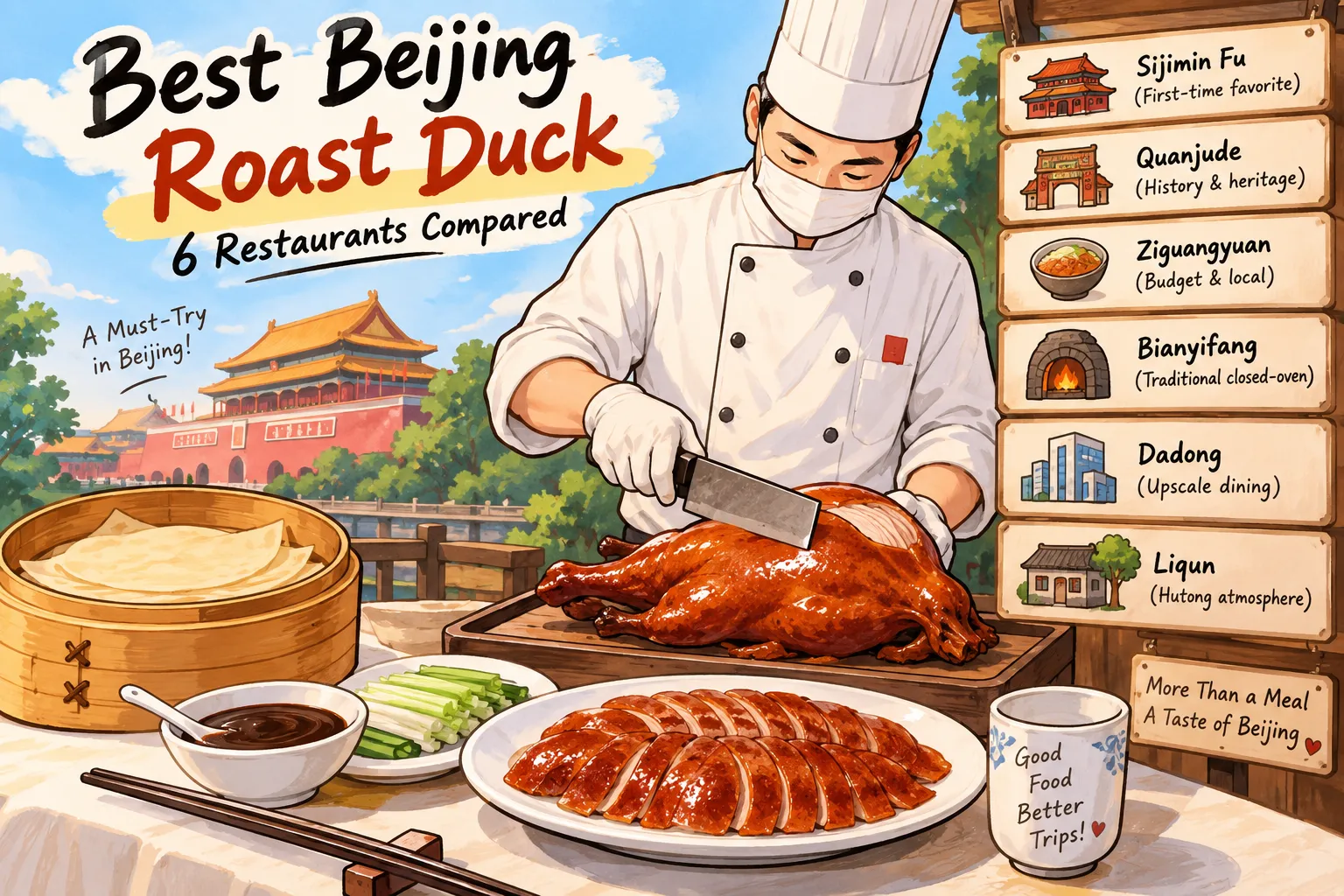
Prices are planning estimates rather than guaranteed menu prices. Restaurant prices, operating hours, promotions and branch menus can change.
For mobile readers, this comparison works best as a horizontally scrollable table in your CMS.
Sijimin Fu (四季民福) has become one of the easiest recommendations for a visitor who only has one roast-duck meal in Beijing.
The basic formula works: crisp hanging-oven duck, traditional pancakes and condiments, table-side carving, good Beijing side dishes and central locations that fit naturally into a sightseeing day.
Expect roughly ¥150–200 per person depending on what you order.
Popular accompaniments include tossed pea shoots and duck-liver dishes, while the roast duck itself is generally served in the classic style with pancakes, scallions, cucumber and sauce.
The branch at 11 Nanchizi Street near the Forbidden City is the famous tourist choice because some seats overlook the Donghuamen side of the palace complex.
That view comes with a price: demand.
At quieter times, the wait can be manageable. During weekends, holidays and peak meal periods, reported waits can stretch to two or even three hours. Treat that as a peak-case scenario rather than a guaranteed daily wait.
If you plan to combine lunch with sightseeing, see TripChina’s Forbidden City visitor guide before locking your meal into a tightly timed itinerary.
Use the restaurant’s WeChat queue function when available to take a number before arriving.
At peak times, the queue may still be long, but remote queuing changes the practical impact: instead of spending two hours standing outside, you can monitor your place in line and use much of that time nearby.
If you cannot access the WeChat queue system, arrive before the main lunch or dinner rush and collect an on-site number.
Do not rely on international email as your main reservation strategy for Beijing roast-duck restaurants. Digital queueing in China is commonly handled through Chinese-language WeChat Mini Programs, restaurant apps or on-site number systems, while some restaurants may also accept telephone reservations depending on the branch.
For an overseas visitor, the practical backup is simple: arrive early, show the Chinese restaurant name to staff and ask for an on-site queue number.
Quanjude (全聚德) deserves more nuance than either “must visit” or “tourist trap.”
Founded in 1864, it is one of the historic names associated with Beijing’s hanging-oven roast-duck tradition. In this method, the duck is roasted over an open fruitwood fire, creating crisp skin and a characteristic roasted aroma.
The mistake is assuming every Quanjude location delivers exactly the same experience.
Different branches can vary in crowd levels, service, atmosphere and execution. For a first-time visitor who specifically wants the Quanjude name, the Hepingmen location is the most logical choice.
Chinese name: 全聚德和平门店
Address: 前门西大街14号楼, Xicheng District
The Hepingmen restaurant is one of Quanjude’s major flagship locations and is closely associated with the brand’s historic presentation of Beijing roast duck.
A practical planning range is ¥180–300 per person, depending on the duck, additional dishes, drinks and set-menu choices.
Previous promotions have included afternoon discounts, but restaurant promotions change frequently. Do not plan your itinerary around a specific discount unless you confirm it shortly before visiting.
TripChina take: Go to Hepingmen if the historic brand and ceremonial experience matter to you. If food quality and value alone are the priority, you have stronger alternatives.
Ziguangyuan (紫光园) is almost the opposite of a grand tourist roast-duck restaurant.
It is a long-running halal Beijing restaurant group used by local families for ordinary meals, snacks and gatherings. The setting is functional rather than ceremonial, which is part of its appeal.
Expect roughly ¥70–90 per person for a typical meal, although the final price depends on branch and order.
The duck pairs well with Ziguangyuan’s other halal Beijing dishes and its well-known milk-skin yogurt.
No.
This is the detail that matters more than memorizing one “best branch.”
Do not search for Ziguangyuan, select whichever outlet appears closest on your map and assume it serves roast duck. Branch menus differ.
Check the current menu on Dianping, Amap or another Chinese restaurant listing before traveling across Beijing.
If Chinese apps feel intimidating, TripChina’s essential apps for foreign travelers in China explains the tools most useful for restaurant searches, navigation and payments.
Bianyifang (便宜坊) is the restaurant to choose when the cooking technique itself is part of what you want to experience.
The brand traces its history back more than 600 years and is strongly associated with menlu, or closed-oven roasting.
Instead of exposing the duck directly to an open fruitwood flame, the closed oven relies more heavily on retained heat inside the oven.
For a traveler, the difference is simple:
Hanging-oven duck generally emphasizes crisper skin and a stronger roasted, fruitwood aroma.
Closed-oven duck generally feels juicier, richer and less obviously smoky.
Neither technique is inherently better. They are two different traditional approaches to the same dish.
For visitors, I recommend the Xianyukou branch:
Chinese name: 便宜坊鲜鱼口店
Address: 鲜鱼口街70号, Dongcheng District
It is near Qianmen and Dashilan, making it particularly easy to combine with sightseeing in old central Beijing.
Expect roughly ¥120–140 per person for planning purposes.
Rather than assuming every Bianyifang outlet will feel identical, use Xianyukou as the practical tourist choice: it combines the historic closed-oven style with a convenient central location and an established visitor profile.
Operating hours can change, so confirm current hours shortly before visiting.
Dadong (大董) is aimed at a different diner.
It is a polished, contemporary restaurant known for its “crispy, not greasy” approach to roast duck and a more refined presentation than traditional high-volume roast-duck halls.
Expect to spend roughly ¥300 or more per person, with the final bill potentially much higher depending on the menu.
Choose Dadong if:
• this is a special-occasion meal
• restaurant ambience matters
• you prefer a lighter, more refined presentation
• you are comfortable paying significantly more than at Ziguangyuan or Bianyifang
Do not choose it because “more expensive” automatically means “more authentic.” It represents a modern interpretation of Beijing roast duck rather than the only correct version.
Convenient tourist location: Beijing APM on Wangfujing Street. Check the current restaurant directory or map listing before visiting because branch and floor information can change.
Liqun (利群烤鸭店) appeals to travelers who want the setting as much as the food.
Save this information before you leave your hotel:
Chinese name: 利群烤鸭店
Address: 北京市东城区北翔凤胡同11号
Liqun sits inside an older hutong environment, and the dining space is relatively limited. That makes waiting times less predictable than at a large restaurant.
Do not build a tightly timed attraction reservation immediately around the meal. Leave some buffer and confirm the location on your map app before heading into the hutong.
Liqun is known for its rustic old-Beijing feel and fruitwood-roasted duck.
Choose it if the hutong atmosphere is part of what you want.
Skip it if you expect polished service, a large dining room or the convenience of a restaurant inside a major shopping district.
Do not treat the “15-minute rule” as proof that a duck was reheated.
A busy specialist restaurant may already have ducks roasting before you order, so fast service alone tells you very little.
Instead, look at several clues together:
• skin that arrives soft rather than crisp
• meat that feels dry or only lukewarm
• pre-sliced duck appearing without carving or explanation
• a suspiciously cheap tourist set built around a small pre-cut serving
• staff being unable to explain whether the duck was freshly roasted
Half-duck portions can also come from previously prepared stock at some restaurants, so ordering half a duck does not automatically guarantee freshness.
At a specialist restaurant, the easiest approach is to ask whether the duck is freshly roasted and whether it will be carved at the table.
Dine-in — especially if crispy skin is the reason you are ordering Beijing roast duck.
Once freshly carved duck sits inside a takeaway container, trapped steam softens the skin. Reheating it later rarely recreates the texture that makes Beijing roast duck distinctive.
Takeaway is still reasonable if convenience matters more than texture, but I would not make it your one “must-try” roast-duck meal in Beijing.
If you only have one chance to try the dish properly, eat it fresh at the restaurant.
Bai Jia Da Yuan (白家大院) belongs in a different category from Beijing’s specialist roast-duck restaurants.
Its real attraction is the setting.
Beijing tourism sources describe the property as a Qing-era garden associated with the former garden of Prince Li’s family, with traditional courtyards, pavilions, rockeries and landscaped grounds. Its dining concept also leans heavily into imperial and old-Beijing atmosphere.
That makes the experience closer to a cultural evening than a simple duck dinner.
If roast-duck quality and value are your priorities, I would spend your meal at Sijimin Fu, Bianyifang or another duck specialist.
If you want Qing-style garden surroundings, period atmosphere and a more theatrical Beijing dining experience, Bai Jia Da Yuan can still make sense — just do not choose it primarily as a best-value roast-duck destination.
| Mistake | Better Approach |
|---|---|
| Going to Sijimin Fu at peak dinner time without a plan | Take a digital queue number when available or arrive off-peak |
| Choosing Quanjude only because it is the most famous name | Pick Hepingmen if you specifically want the historic brand |
| Assuming every Ziguangyuan serves roast duck | Check the exact branch menu first |
| Expecting hanging-oven and closed-oven duck to taste the same | Choose based on crisp/smoky vs juicy/richer preference |
| Judging freshness only by how quickly the duck arrives | Look at texture, temperature, carving and preparation together |
| Ordering your one major roast-duck meal as takeaway | Eat it fresh in the restaurant |
| Depending only on an English restaurant name | Save the Chinese name and address |
| Treating old discounts or opening hours as permanent | Verify time-sensitive details before visiting |
If you need help with restaurant apps, maps or payments, TripChina’s Beijing digital tools guide for foreign visitors covers the Beijing-specific systems international visitors are most likely to encounter.
For nationwide payment setup, see the China payment guide for foreign visitors.
If your Beijing itinerary includes more than one food-focused meal, these three local experiences are worth exploring alongside — rather than replacing — your main roast-duck meal.
They are not random additions. Together they show three other sides of Beijing food culture: the communal warmth of copper-pot hotpot, the earthy intensity of traditional offal dishes, and the everyday simplicity of a local breakfast. Each adds something different rather than repeating the roast-duck experience.
Copper-pot mutton hotpot: One of the best complements to roast duck if you want another classic Beijing communal meal. Niujie is especially well known for this style.
Lu zhu: A much more local combination of braised offal, tofu and bread. It is less immediately accessible than roast duck but far more representative of everyday old-Beijing flavors.
Traditional breakfast: Tofu pudding, fried dough and tangyou bing show a completely different side of Beijing food culture.
For restaurant neighborhoods and a broader food itinerary, see TripChina’s Beijing food streets guide.
Yes, but a whole duck is usually excessive for one traveler once pancakes and side dishes are included.
Many traditional roast-duck restaurants are designed around shared dining and do not offer genuinely small individual duck portions. Look for a legitimate half-duck option or share with another diner if you want room for side dishes.
Major tourist-facing restaurants often provide photographs, English translations or staff accustomed to international visitors, but this is not guaranteed at every branch.
Keeping the restaurant name and a few dishes in Chinese on your phone makes ordering much easier.
Not universally.
Ziguangyuan is a well-known halal Beijing restaurant group and is the easiest option in this guide for travelers specifically looking for halal roast duck. Confirm the individual branch if strict dietary compliance is important.
For two hungry adults sharing side dishes, a whole duck can make sense. For one traveler or lighter eaters, half may be enough.
The more important question is whether the portion is freshly prepared, so ask the restaurant rather than assuming every half-duck order is carved from a newly roasted duck.
Neither technique is objectively superior.
Hanging-oven duck emphasizes smoky aroma and very crisp skin. Closed-oven duck generally produces juicier, richer meat with less obvious smoke. Choose according to the texture and flavor you prefer.
Save the Chinese name and full Chinese address on your phone. This is especially useful for restaurants inside older hutong areas.
If this is your first Beijing trip and you only have one duck meal, choose Sijimin Fu — but manage the queue instead of spending your sightseeing time standing outside.
Choose Ziguangyuan if value and local atmosphere matter more than ceremony.
Choose Bianyifang Xianyukou if you want to experience the traditional closed-oven method.
Choose Quanjude Hepingmen if the historic brand and ceremonial Beijing experience matter to you.
Choose Dadong for an upscale modern interpretation.
Choose Liqun if eating inside an old hutong environment is part of the appeal.
The biggest mistake is searching “best Peking duck near me” at 7 PM and walking into whichever tourist restaurant appears first.
Decide what kind of experience you want, save the Chinese restaurant name, and deal with queueing or reservations before you get hungry.
For the rest of your trip, see TripChina’s where to stay in Beijing guide and Beijing digital tools guide for foreign visitors.
Beijing Tourism — Quanjude Hepingmen and Beijing Roast Duck
Beijing Tourism — Bianyifang Xianyukou
Beijing Tourism — Bai Jia Da Yuan
Beijing Tourism — Bai Jia Da Yuan Qing-Style Garden and Cuisine
Updated September 6, 2026. Restaurant history, roasting techniques, addresses and selected pricing information were checked against Beijing tourism sources, while queue patterns and practical dining advice were compared with current visitor information. Prices are planning ranges rather than fixed menu quotes. Opening hours, promotions, branch menus, reservation systems and digital queue functions can change and should be reconfirmed before visiting.
All restaurant recommendations in this guide are based on editorial assessment, not sponsorship or commercial partnerships. No restaurant paid for inclusion or favorable treatment.
Beijing roast duck is famous, but finding a good one is a minefield. Quanjude has a reputation problem. Bai Dayuan is expensive and reportedly bad. Sijimin Fu has a 2-hour queue. And some shops serve pre-sliced, microwaved duck in 15 minutes. Here is how to choose the right one for your trip without wasting time or money.
If you're planning a trip to Beijing, this guide is part of the Beijing travel guide hub, where you can explore all related travel resources in one place.
Direct answer: Sijimin Fu is the safest choice for most first-time visitors. It balances consistent quality, reasonable price (148-200 RMB per person), and good locations near the Forbidden City and Qianmen. The duck skin is thin and crispy, and the signature sides like tossed pea shoots and salted duck liver are reliable. The main downside is the queue, expect 1.5 to 2 hours at peak times.
Direct answer: Ziguangyuan at 70-79 RMB per person is the best value roast duck in Beijing. It is a halal chain popular with local families. The duck is served with a garlic dip instead of the usual sweet bean sauce, and the milk-skin yogurt is famously thick enough to stand up on a spoon. Not all branches serve roast duck, so check before you go.
Direct answer: Only the Hepingmen flagship store is worth considering. Quanjude franchise stores have poor quality control, and locals generally avoid them. The flagship offers a 20% discount from 3-5 PM and a Roast Duck Museum on the 7th floor. If you want the ceremony and history of the 1864 originator, go to Hepingmen. Otherwise, skip it.
Direct answer: Hanging-oven duck (Quanjude, Sijimin Fu, Dadong) is roasted over an open flame, producing crispier skin with a smoky aroma. Closed-oven duck (Bianyifang) is roasted without an open flame, resulting in more tender meat and a fattier texture. Bianyifang’s method is over 600 years old and produces a greener, less smoky duck.
| Restaurant | Price (RMB) | Oven Type | Best For | Queue Risk | Signature Detail | Location Tip |
|---|---|---|---|---|---|---|
| Sijimin Fu | 148-200 | Hanging | First-timer, all-rounder | High (1-2 hrs) | Tossed pea shoots, salted duck liver | Forbidden City branch has 7 window tables with Donghuamen view |
| Quanjude (Hepingmen) | 180-300 | Hanging | History, ceremony | High | Prosperous Peony duck, Roast Duck Museum | 3-5 PM 20% discount; only Hepingmen flagship |
| Ziguangyuan | 70-79 | Hanging | Budget, local | Low | Garlic dip, milk-skin yogurt | Not all branches serve duck; Niujie branch is reliable |
| Bianyifang | 126-130 | Closed | Traditional, tender meat | Medium | 600-year history, green roast duck | Xianyukou branch near Dazhalan |
| Dadong | 260-500 | Hanging | High-end, low-fat | Medium | “Crispy not greasy” (su bu ni), 22-day duckling | APM Wangfujing; hollow sesame buns instead of pancakes |
| Liqun | 161-280 | Hanging | Hutong experience | Low (but full) | Fruitwood aroma, former Quanjude chef | Must order whole duck; water costs money |
For a first visit, eat at Sijimin Fu near the Forbidden City. For a budget meal, go to Ziguangyuan. For a traditional closed-oven experience, choose Bianyifang. Skip Quanjude unless you want the museum and discount. Skip Bai Dayuan entirely. And never order takeout roast duck.
If you’re planning a full Beijing trip, understanding where to stay in Beijing can completely change your experience.
Sijimin Fu is the most recommended restaurant for first-time visitors. It was founded in 2008 and has grown into a reliable chain with consistent quality. The duck is hanging-oven style, with thin, crispy skin that melts when dipped in sugar.
Key details:
Trade-off: The duck is slightly fattier than Dadong. Takeaway duck is terrible, microwaving ruins the skin. Eat in-store only.
Quanjude was founded in 1864 and invented the hanging-oven method. It is the most famous roast duck brand in China. But its reputation has suffered due to poor franchise quality control.
Only go to the Hepingmen flagship at 14 Qianmen West Street. This branch has:
Price: 180-300 RMB per person. The duck skin is softer and fattier than Sijimin Fu.
Trade-off: Expensive, tourist-heavy, and long queues. Locals say: “We don’t go to Quanjude for roast duck.” [TripChina.me Insight] If you want the history and ceremony, go for the museum and the discount window. If you want better duck, go elsewhere.
Ziguangyuan is a halal chain that Beijing locals actually eat at. It is not fancy, but it is honest and cheap.
Price: 70-79 RMB per person
Signature: The duck is served with a garlic dip (suan ni) instead of sweet bean sauce. The milk-skin yogurt (nai pi zi suan nai) is famously thick, it can stand up on a spoon.
Location: The Niujie branch is reliable. Not all branches serve roast duck, so call ahead.
Trade-off: The setting is rustic and the duck is less refined. But for the price, it is unbeatable. [TripChina.me Insight] If you want a quick, cheap, and local meal, this is your spot.
Bianyifang is the oldest roast duck restaurant in Beijing, with a history of over 600 years (founded in 1416). It uses the closed-oven method (men lu), meaning the duck is roasted without an open flame.
Price: 126-130 RMB per person
Signature: “Green roast duck”, no open flame, more tender meat, fattier texture.
Location: 65-77 Xianyukou Street, in the Dazhalan area near Qianmen.
Hours: 10:30-14:00, 16:30-21:00
Trade-off: Some find the duck too fatty. Quality varies between branches. But for a traditional, affordable, and less touristy meal, it is a strong choice.
Dadong is the high-end choice for business meals and special occasions. Its trademark is “crispy not greasy” (su bu ni), achieved by using a 22-day duckling with very low fat content.
Price: 260-500 RMB per person
Signature: The duck is served with hollow sesame buns instead of lotus leaf pancakes. The skin is crispy, translucent, and low in fat.
Location: 5F, Beijing APM, 138 Wangfujing Street. Also at Joy Shopping Center and Jinbaohui.
Trade-off: Expensive. The low-fat style means less of the rich, fatty flavor that some duck lovers want. [TripChina.me Insight] Best for those who want a refined, healthy take on the classic.
Liqun is a small hutong shop run by a former Quanjude chef. It is famous for its strong fruitwood aroma and rustic setting.
Price: 161-280 RMB per person
Location: 11 Beixiangfeng Hutong, Dongcheng District
Rules: You must order a whole duck. Water costs money. All guests must be seated before service begins.
Trade-off: The service is famously rude. The setting is simple. But the fruitwood aroma is real, and the duck has a loyal following. [TripChina.me Insight] Go for the hutong photo and the smoky duck. Do not go if you expect good service or a comfortable seat.
Some restaurants serve pre-sliced, reheated duck. You can spot them easily: if the duck arrives at your table in under 15 minutes, it was pre-prepared. The leg will be dry and tough, and the skin will not be crispy.
How to avoid it:
This is why many tourists say Beijing roast duck is bad. They ate reheated duck.
A Beijing food trip is not just about duck. Here are three other essential meals.
Sijimin Fu is the best choice for first-time visitors. It offers consistent quality, reasonable prices (148-200 RMB), and good locations near the Forbidden City and Qianmen. The queue is long, but the duck is reliable and the signature sides are excellent.
Only the Hepingmen flagship store is worth considering. It offers a 20% discount from 3-5 PM and a Roast Duck Museum on the 7th floor. Franchise stores have poor quality control and are not recommended. If you want the history and ceremony, go to Hepingmen.
Hanging-oven duck is roasted over an open flame, producing crispier skin with a smoky aroma. Closed-oven duck is roasted without an open flame, resulting in more tender meat and a fattier texture. Bianyifang is the most famous closed-oven restaurant.
Sijimin Fu’s Nanchizi branch has seven window tables facing Donghuamen and the corner tower. Arrive by 10 AM to secure one. The queue is long, but the view is unique.
Ziguangyuan at 70-79 RMB per person is the most affordable option. It is a halal chain popular with local families. The duck is served with a garlic dip, and the milk-skin yogurt is a must-try.
Take a number via the WeChat mini-program before you go. Arrive at 10 AM for the Forbidden City branch. Avoid peak lunch and dinner hours. The queue is typically 1.5 to 2 hours at busy times.
Liqun is good for the hutong experience and the strong fruitwood aroma. It is overrated if you expect good service or a comfortable setting. You must order a whole duck, and water costs money. Go for the atmosphere, not the service.
It is Dadong’s trademark style, achieved by using a 22-day duckling with very low fat content. The skin is crispy and translucent, and the duck is served with hollow sesame buns instead of pancakes. It is a high-end, low-fat take on the classic.
At Sijimin Fu, order the tossed pea shoots and salted duck liver. At Ziguangyuan, order the milk-skin yogurt. At Xiaodiaolitang, order the jasmine roast duck and the pear soup. These sides are as famous as the duck itself.
If the duck is served in under 15 minutes, it is pre-sliced and reheated. The leg will be dry and tough. Avoid restaurants near major tourist attractions that serve duck quickly. A proper roast takes 45-55 minutes.
If you only have limited time in Beijing, planning a route that combines major attractions like the Great Wall will give you a more complete cultural experience.
This article is part of the Beijing Travel Guide Hub.
Explore all Beijing travel guides here → Beijing Hub
TripChina.me creates practical China travel guides shaped by real local experience, helping independent travelers navigate transport, payments, food, neighborhoods, and the cultural details that make traveling in China easier and more meaningful. Find the guide for your destination at tripchina.me.