Our Location:
No. 99, Jiazi Road, Chengdu

 authorChris Lee
Most first-time visitors to Badaling make the same mistake: they arrive late, follow everyone north, and spend more time navigating crowds than enjoying the Wall.
Badaling actually gives you very different experiences depending on the route you choose. This guide compares the north and south sections, explains three practical walking routes, and shows when a cable car can genuinely improve your visit.
For a broader look at the alternatives around Beijing, see our Beijing Great Wall sections comparison guide.
As of September 2026, the established restored visitor area extends through North Watchtower 12 and South Watchtower 7. North 8 is the most famous northern destination, not the end of the north section.
| Route | Best For | Typical Time | Difficulty | Crowds | Main Goal |
|---|---|---|---|---|---|
| North to North 8 | First-time visitors, fit adults | 2–3 hrs | Moderate–hard | Highest | Hero’s Slope / classic views |
| South to South 4 | Families, seniors, casual walkers | 1.5–2 hrs | Easier | Lower | Quiet views and South 4 |
| South + North | Fit travelers | 4–5 hrs | Hard | Mixed | Experience both sides |
| Cable car + North 8 | Limited time or reduced mobility | 1.5–2 hrs | Easier | High near North 8 | North 7 → North 8 |
Crowd levels depend on the day of the week, season and Chinese holiday calendar, not just which route you choose. A weekday north-route climb can be calmer than a holiday south-route visit.
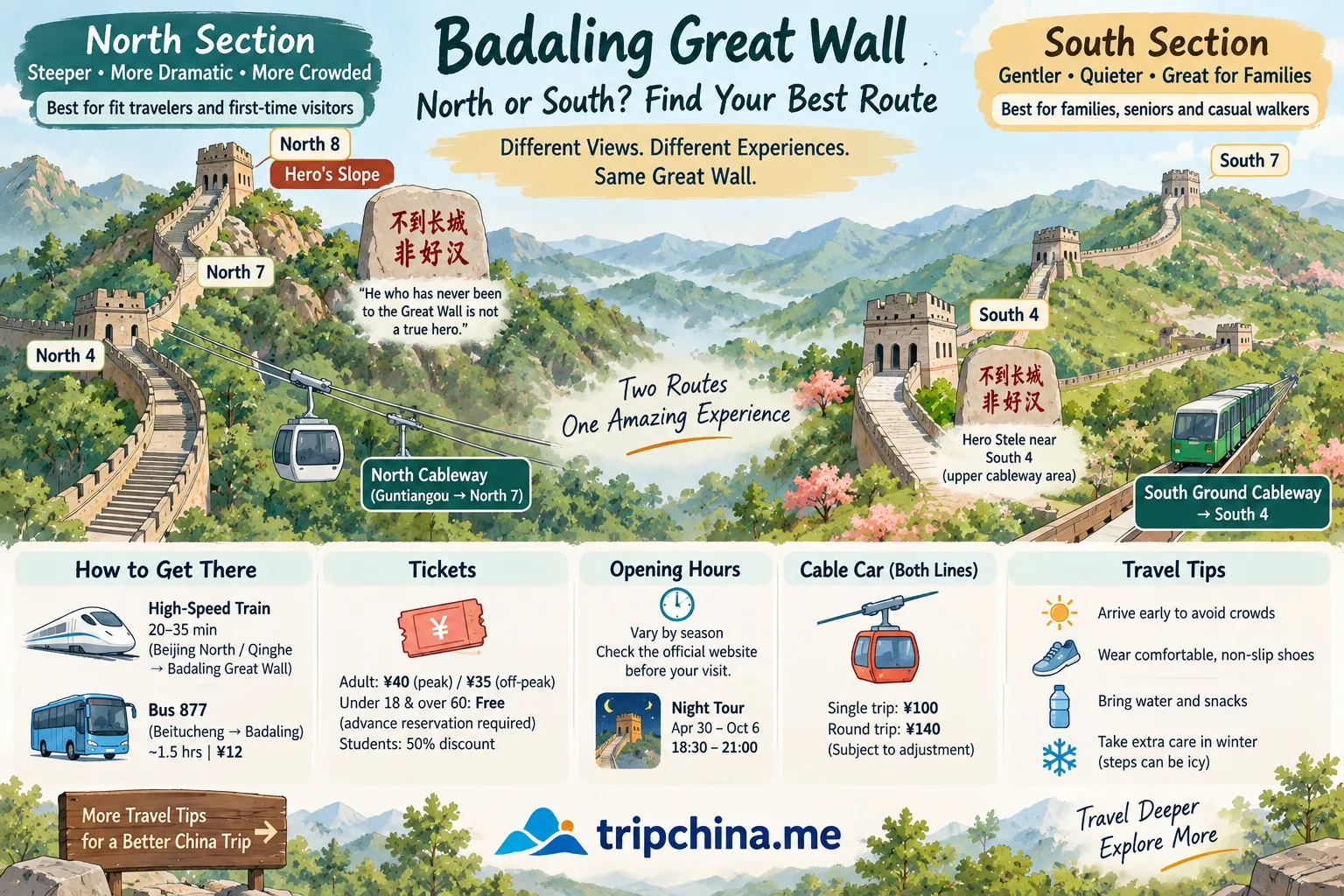
The north section is the Badaling most people recognize from photographs: steep ridgelines, tightly packed watchtowers and the famous climb toward North 8.
It is also where visitor pressure is most obvious. North 4 and North 8 are established congestion points, particularly on weekends and Chinese public holidays.
The south section feels different. The slopes are generally gentler, the walking experience is calmer, and South 4 offers excellent views back toward the northern wall. In spring, the stretch from South 4 to South 7 is also one of Badaling’s particularly attractive sections.
That does not make the south section “better.” It simply serves a different traveler.
If you are traveling during a major Chinese holiday, check the dates in our China public holidays guide before deciding when to visit.
This is more confusing than many online guides suggest.
The phrase “不到长城非好汉” — usually translated as “He who has never been to the Great Wall is not a true hero” — is strongly associated with the North 8 / Hero’s Slope area.
Badaling also has a Hero Stele bearing the phrase on the south route near South Watchtower 4, immediately around the upper station of the South Line ground cableway. That makes the south-side photo point particularly easy to reach for families and travelers using the ground cableway.
In other words, there is no need to build your entire route around finding one supposedly unique stone tablet.
The important distinction is:
North 8 is the famous Hero’s Slope destination and the classic physical achievement most visitors associate with becoming a “hero.”
South 4 has its own “不到长城非好汉” Hero Stele photo point and is much easier to reach, especially by the ground cableway.
This also means claims that the “original Hero Stele was permanently moved from the north section to South 1” should not be used as a route-planning fact.
Best for: Fit adults and first-time visitors who want the classic Badaling experience
Allow: About 2–3 hours for North 8 and return; longer if continuing farther
Start around the main entrance area and turn north. Continue through the northern watchtowers toward North Watchtower 8, the highest and most famous point on the standard north route.
The final sections become noticeably steeper. Railings are useful, especially when descending, and wet or icy stone can make the route much more demanding than the distance suggests.
North 8 is where many organized groups stop or turn around. If the route beyond North 8 is open on your visit and you still have energy, you can continue toward North 11 and North 12. Crowd levels often drop once you move beyond the main North 8 concentration.
Trade-off: This is the most iconic route, but also the section most vulnerable to crowding.
I have seen fit friends underestimate this climb. The distance is not extraordinary; the combination of steep stone, uneven steps, sun and crowds is what wears people down.
If you have knee problems or limited time, take the aerial cableway to North 7, then walk the final section toward North 8.
Best for: Families, older travelers, photographers and anyone who prefers a quieter walk
Allow: About 1.5–2 hours
From the central entrance area, turn south and work your way toward South Watchtower 4.
The route is generally gentler than the north section, and South 4 gives you an excellent perspective across the surrounding ridgelines and back toward the busier northern wall.
A “不到长城非好汉” Hero Stele photo point is located near South Watchtower 4 at the upper ground-cableway exit, making it one of the easiest Hero Stele locations to reach without a demanding climb.
The south section continues beyond South 4 toward South 7 in the regular restored visitor area. Access arrangements can change during weather events, maintenance or crowd-control periods, so follow the barriers and signs you see on the day.
Trade-off: The south feels less dramatic than the climb to North 8, but that is exactly why it works well for travelers who want to experience the Great Wall without turning the visit into a physical challenge.
I brought my parents here in their 60s. They managed the south route comfortably, and the slower pace gave us much more time to stop and actually look at the Wall rather than simply concentrating on the next staircase.
Best for: Fit travelers with half a day at Badaling
Allow: About 4–5 hours
Start with the south section first. Walk toward South 4, enjoy the quieter early-morning section, then return toward the central area.
From there, switch to the north route and continue toward North 8.
This order gives you two completely different versions of Badaling: a calmer southern walk first and the dramatic northern ridgeline afterward.
Trade-off: It requires more energy than the map suggests. If you arrive well after opening, you may reach the northern section just as the main tour-group crowds are building.
For most independent foreign travelers, yes.
High-speed trains run from Beijing North Railway Station and Qinghe Railway Station to Badaling Great Wall Railway Station. Depending on the service, the ride is roughly 20–35 minutes.
Badaling Great Wall Station itself is deep underground. After exiting, follow the signs toward the scenic area; the walk to the main visitor zone is relatively short.
China Railway’s current ticket sales window is 15 days including the travel date. Popular morning trains can sell out quickly on weekends and holidays.
Foreign visitors can book train tickets using a passport. For the complete process, read our foreigners’ guide to train travel in China and our 12306 vs Trip.com train-ticket guide.
Yes, but there is an important update.
Bus 877 no longer starts at Deshengmen. The route now operates between Beitucheng Bus Terminal / Beitucheng subway area (北土城公交场站) and Badaling.
As of September 2026, the published seasonal timetable is:
| Direction | Apr 1–Nov 15 | Nov 16–Mar 31 |
|---|---|---|
| Beitucheng → Badaling | 06:00–12:30 | 06:30–12:30 |
| Badaling → Beitucheng | 10:30–17:00 | 11:00–16:30 |
The ¥12 bus remains a useful budget alternative when train tickets sell out, but road traffic makes journey times less predictable than rail.
Treat 17:00 in the warmer season and 16:30 in winter as real cut-off times, not approximate suggestions. Do not finish your hike at the last minute and expect an extra bus to appear.
If you are connecting by subway, our Beijing subway beginner guide explains payment, navigation and common mistakes for foreign visitors.
Driving works well if you are traveling as a family or continuing elsewhere in Yanqing, but it offers little advantage over the train for a simple Beijing–Badaling day trip.
Follow current scenic-area parking signs rather than navigating to an unofficial roadside lot. During busy periods, traffic controls and shuttle arrangements can change.
The most reliable strategy is simple: go on a weekday and arrive near opening time.
Tuesday through Thursday is generally easier than weekends. Chinese public holidays can overwhelm this advantage, so always check the national holiday calendar.
Tour groups become increasingly noticeable through the morning, particularly around North 4 to North 8. Instead of relying on an exact percentage such as “70% fewer people at 7:30,” which changes dramatically by date, weather and season, treat the first hour after opening as your best opportunity for a quieter climb.
April through October brings warmer weather and heavier demand. November through March is quieter, but wind, freezing temperatures and occasional ice can make the stone steps considerably harder.
In winter, take extra care on shaded sections of stone, where frost or ice can linger longer than on steps exposed to direct sunlight. The steeper northern route deserves particular caution after snow, freezing rain or overnight sub-zero temperatures.
Badaling is at higher elevation than central Beijing and often feels colder and windier than the city. Check the forecast again on the morning of your trip.
Opening hours are more variable than many travel guides suggest.
As of September 2026, official Beijing sources show that Badaling’s daytime schedule can change with the season, holidays, weather and special operating arrangements. A 2026 Beijing municipal visitor listing, for example, gives 7:30–16:00 for regular admission, while major holiday schedules can open substantially earlier.
Do not build your trip around a fixed year-round timetable such as “6:30 AM–7:00 PM.”
Check the Badaling Great Wall official website, the official “八达岭长城” WeChat account, or the “长城内外旅游” platform for your exact date. The official site currently supports both real-name advance reservations and on-site ticket purchase.
Weather closures also happen. In August 2026, for example, the scenic area temporarily closed during a severe rain warning before reopening under updated conditions.
Badaling has two different systems that travelers often confuse.
The North Line aerial cableway connects the Guntiangou (滚天沟) area with North Watchtower 7.
That makes it especially useful if North 8 is your goal but you do not want to climb the entire northern route from below.
From North 7, you still walk the final stretch toward North 8, so the cable car does not eliminate walking entirely.
The South Line ground cableway runs up toward South Watchtower 4.
The upper exit is also close to the south-side Hero Stele, so travelers using the ground cableway can reach that photo point with very little additional climbing.
As of September 2026, the commonly published current fare for the Badaling cable systems is:
The same reference pricing is currently used across major Badaling ticket and visitor listings.
These fares are separate from Great Wall admission. Holiday operations, temporary promotions or special night-tour arrangements can change how individual cableway products are sold, so check the current ticket screen before paying.
Use it if you are traveling with older relatives, young children, someone with reduced mobility, or if you simply have limited time.
If you are healthy and enjoy walking, hiking at least one direction gives you a much better sense of the Wall’s gradient and scale.
Bring at least one or two bottles of water per person, a small snack, non-slip athletic shoes, sunscreen, sunglasses and a hat in warm weather.
A light windproof layer is useful even when Beijing itself feels comfortable. In winter, gloves can make a surprisingly big difference because exposed stone and metal railings become very cold.
Avoid carrying a heavy backpack.
I once climbed with a laptop and a full camera kit. By North Watchtower 5, I regretted every gram. Badaling is one of those places where “just in case” packing turns into unnecessary weight very quickly.
Food and drinks are much easier to buy around the visitor areas below the Wall than on the more exposed climbing sections. Carry enough water to avoid planning your hike around finding the next vending point.
Arriving late: The classic northern route becomes much less enjoyable once major groups accumulate around North 4–8.
Automatically following everyone north: North is iconic, but the south route may suit your group much better.
Choosing a route just for a “Hero Stele”: There are multiple inscriptions and photo points associated with the famous phrase. Choose north or south based on difficulty and experience, not one stone marker.
Using outdated Bus 877 instructions: The route’s Beijing departure point moved from Deshengmen to Beitucheng, and the published return service ends at 17:00 in the warmer season and 16:30 in winter.
Wearing flat fashion shoes or sandals: Badaling’s polished stone and uneven stairs can become slippery, particularly after rain, snow or freezing temperatures.
Booking an ultra-cheap “Great Wall tour” without checking the exact site: Badaling Great Wall, Badaling Ancient Great Wall and Shuiguan Great Wall are different visitor attractions. If a tour description is vague about the exact entrance ticket and section, confirm it before paying. For more common problems, see our Beijing travel scams and tourist traps guide.
As of September 2026:
| Item | Current Practical Information |
|---|---|
| Address | Badaling Great Wall, Yanqing District, Beijing |
| Adult admission | ¥40 peak season / ¥35 off-season |
| Main restored visitor range | North 12 to South 7 |
| Booking | Real-name reservation and on-site ticket purchase are currently supported |
| Foreign visitors | Passport can be used for ticket purchase and identity verification |
| Official channels | Badaling website, “八达岭长城” WeChat and “长城内外旅游” |
| North cableway | Guntiangou area → North 7 |
| South ground cableway | Lower south-line area → South 4 |
| Cableway reference fare | ¥100 one way / ¥140 round trip |
| Daytime hours | Vary by date and season; verify before travel |
| 2026 night season | April 30–October 6 |
Beijing’s current government price list confirms the standard Badaling admission price at ¥40 in peak season and ¥35 in the off-season.
Discount and free-admission eligibility can depend on age, student status and acceptable identification. Foreign visitors should check the current official booking screen before assuming that a Chinese ID-based discount automatically applies to their passport or overseas student card.
If you plan to pay through Chinese mobile services, set them up before leaving Beijing. Our WeChat Pay usage guide for foreigners covers the basic setup.
It can be — but it is a different experience from a daytime hike.
For 2026, the official night season runs from April 30 to October 6. The night-tour area covers the cultural street and the Wall from North 4 to South 4.
Official 2026 operating information lists entrance verification from 18:30 to 21:00, illumination from 19:20 to 22:00, and performances from 18:30 to 21:00, subject to daily conditions.
The South Line ground cableway operates uphill during part of the evening program.
Night Badaling works best if you want illuminated scenery, performances and a different atmosphere. For a first Great Wall visit, however, daytime remains better for understanding the landscape, mountain ridgelines and full scale of the fortifications.
This article is part of the Beijing Travel Guide Hub.
Yes. Badaling’s official website provides a dedicated foreign-visitor ticketing option, and foreign visitors can use passports for identity verification. Current official information also indicates that both real-name advance booking and on-site ticket purchase are available, although advance booking remains sensible on busy dates.
Generally, yes. Badaling is a heavily managed scenic area with staff, signage and established visitor infrastructure.
The more important solo-travel risks are weather, slippery steps, dehydration and getting stranded after relying on an outdated transport timetable.
Facilities are concentrated around the entrance, cableway areas and major visitor-service zones rather than continuously along the Wall.
Use the restroom before starting a longer climb and carry your own water instead of assuming there will be a shop at the next watchtower.
Yes, when the scenic area is open, but winter changes the difficulty considerably.
Wind and ice can make otherwise manageable stone stairs slippery. Shaded sections may stay frozen longer than sunlit areas, so wear shoes with strong grip and check weather or temporary-closure notices before leaving Beijing.
Check that the booking explicitly names Badaling Great Wall (八达岭长城) and states what admission is included.
Do not assume that “Great Wall,” “Badaling area,” Shuiguan Great Wall or Badaling Ancient Great Wall means the main Badaling scenic area covered in this guide.
For a first visit with good fitness, North 8 remains the classic choice. If you are traveling with parents, children or anyone who dislikes steep climbs, South 4 is the smarter route.
If you have enough time and want to understand why the two sides feel so different, walk south first and north second.
The biggest improvement you can make, however, has nothing to do with north versus south: arrive early, pack light and choose the route for your own group rather than simply following the crowd.
Continue planning your Beijing trip through the Beijing travel hub.
Badaling Great Wall Official Website
Beijing Municipal Government – Badaling Ticket Prices
Beijing Municipal Government – 2026 Badaling Night Great Wall
This guide was updated in September 2026 using the Badaling Great Wall official website, Beijing municipal government notices, China Railway 12306 information, current Bus 877 schedules and recent cableway listings. Variable information — including daytime opening hours, weather closures, cableway operations and discounted-ticket eligibility — should be reconfirmed for the exact travel date. Route recommendations reflect practical differences in gradient, crowd concentration and walking time rather than treating North 8 as the end of the publicly accessible northern section.
TripChina.me creates practical China travel guides shaped by real local experience, helping independent travelers navigate transport, payments, food, neighborhoods, and the cultural details that make traveling in China easier and more meaningful. Find the guide for your destination at tripchina.me.