Our Location:
No. 99, Jiazi Road, Chengdu

 authorChris Lee
Beijing now offers more digital services for international visitors than most tourists realize. The useful ones solve specific problems: getting around, fixing a failed payment or SIM after landing, finding official help, booking local services and processing shopping refunds. This guide separates the Beijing-specific tools worth knowing from those most short-term visitors can safely ignore.
As of September 2026:
• Best overall Beijing visitor platform: GO BEIJING, with 39 integrated services and 16 language options.
• Best transport shortcut: Tap eligible UnionPay, Mastercard, Visa, JCB or American Express contactless cards directly at Beijing subway fare gates.
• Best arrival backup: Beijing Service counters at Capital Airport and Daxing Airport.
• Best optional transport card: BEIJING PASS if you prefer a physical stored-value card. A passport is required to purchase one.
• Best for longer stays or special needs: Jingtong English services.
• Best for shoppers: Beijing's paperless departure-tax-refund services, including the new nationwide digital refund code and eligible online purchases through JD.com.
• Best official non-emergency help: 12345 Online, accessible through Beijing's international digital-service ecosystem.
TripChina Recommendation: Set up your nationwide China essentials first, then use Beijing-specific services when they solve a particular travel need.
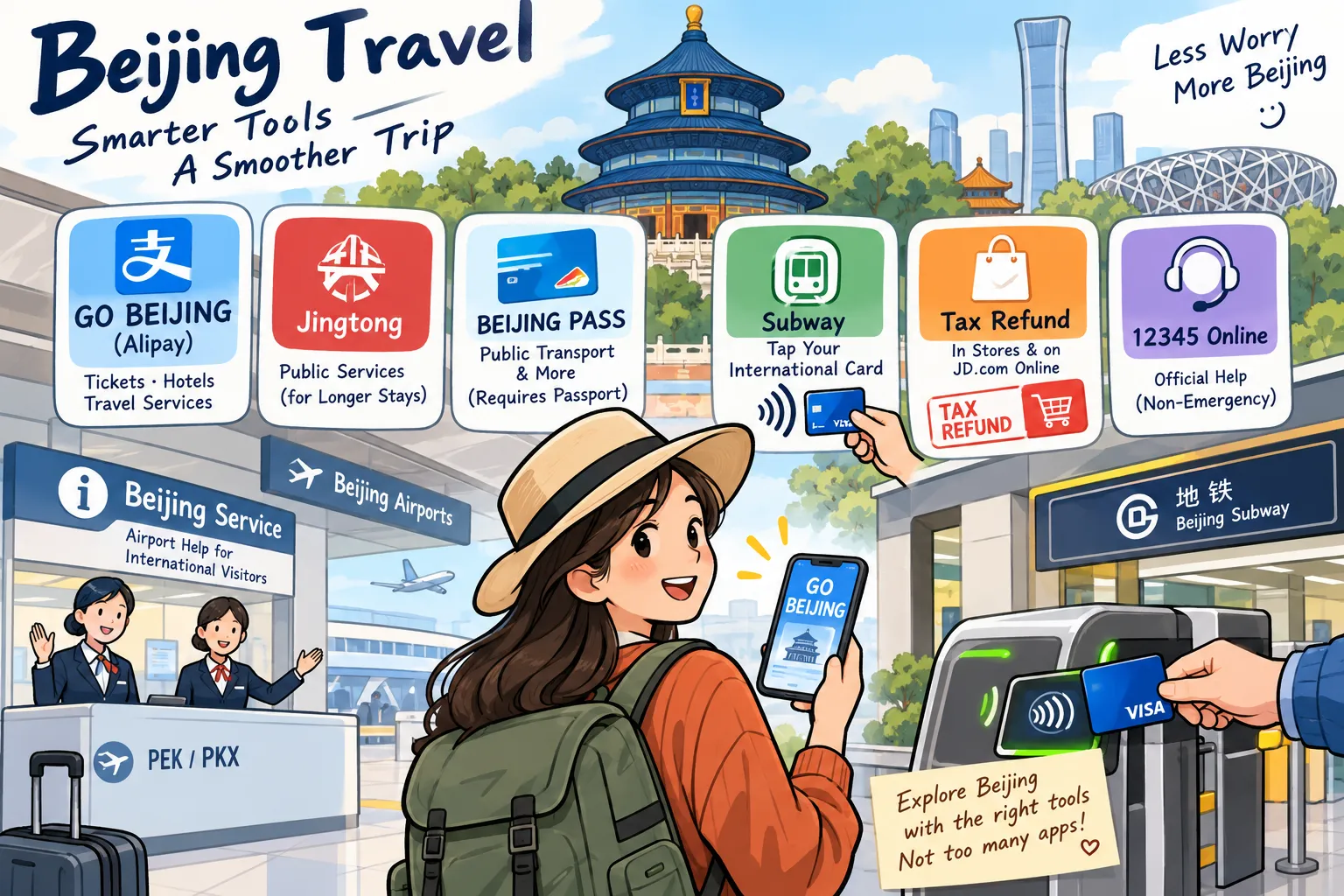
The table below shows what each Beijing-specific service actually does and whether a short-term visitor needs it.
| Tool or Service | What It Solves | Best For | Need Before Arrival? | TripChina Verdict |
|---|---|---|---|---|
| GO BEIJING | Travel services, booking, payments, multilingual help | Most international visitors | Worth knowing | Best Beijing-specific visitor tool |
| Foreign-card subway payment | Direct metro gate entry | Most subway users | No extra app | Extremely useful |
| BEIJING PASS | Stored-value transport and selected tourism payments | Travelers who prefer a physical card | No; passport required to buy | Useful alternative |
| Beijing Service counters | SIM, payment, transport and arrival help | First-time arrivals | No | Emergency safety net |
| Jingtong English services | Municipal and public services | Longer stays / special needs | Usually no | Optional for tourists |
| Digital tax refund | Departure VAT refund processing | Shopping-focused visitors | No | Useful if eligible |
| International Web Portal / 12345 Online | Verified information and non-emergency help | Anyone needing official support | Bookmark | Excellent backup |
In short: keep nationwide tools such as Alipay, WeChat and your main data setup as the foundation; use these Beijing services as local add-ons.
Beijing now organizes international visitor services around a four-platform ecosystem:
| Platform | Main Role | Best Stage of the Trip |
|---|---|---|
| GO BEIJING | Tourism and visitor services | Planning + sightseeing |
| Jingtong English | Municipal/public services | Longer stays + specific needs |
| International Web Portal of Beijing | Official multilingual information | Before and during the trip |
| Beijing Service airport counters | Face-to-face arrival assistance | Immediately after landing |
These four entry points are designed to complement one another.
Simple way to remember it: GO BEIJING is for the trip, Jingtong is for city services, the International Web Portal is for verified information, and Beijing Service is your in-person airport fallback.
For many first-time visitors, yes.
GO BEIJING (入京通 GO BEIJING) officially launched on April 28, 2026 as Beijing's one-stop service platform for overseas visitors.
As of September 2026, official Beijing information says it integrates 39 services and supports 16 languages, including English, Chinese, Russian, Korean and Arabic.
Services include:
• ride-hailing
• attraction tickets
• hotel reservations
• international-card payment services
• departure tax refunds
• multilingual travel information
• selected public services
It also includes Beijing's AI visitor assistant Jingjing (京京).
The value is having one Beijing-focused entry point rather than discovering a different local system for every task.
Current official guidance allows overseas visitors to access GO BEIJING through the international version of Alipay.
Search for GO BEIJING / 入京通 inside the current international Alipay interface and follow the live instructions.
Eligible overseas visitors can fund the Travel Wallet through cross-border remittance without linking a mainland Chinese bank card.
As of September 2026, Beijing says it supports registrations from 40 countries and regions.
The Travel Wallet does not charge a transaction fee for domestic spending within China.
Your bank, card issuer or remittance provider may still charge exchange-rate spreads or transfer/remittance fees.
For a short visit, the wallet is optional if your existing international-card payment setup already works.
No.
Use GO BEIJING for Beijing-specific visitor services and China's mainstream payment platforms for everyday spending.
If your payment setup is not ready yet, read TripChina's China Payment Guide for Foreign Visitors.
Beijing operates dedicated Beijing Service counters at both major airports.
| Airport | Main Beijing Service Location |
|---|---|
| Beijing Capital International Airport (PEK) | Terminal 3, across from the International Arrivals Exit |
| Beijing Daxing International Airport (PKX) | Level 1, across from the International Arrivals Exit |
Official Beijing guidance identifies the counters at the international-arrivals exits and describes them as one-stop service points for overseas travelers.
Depending on current on-site availability:
• SIM-card registration or collection
• airport WiFi assistance
• foreign-card cash withdrawal guidance
• currency and payment questions
• airport bus information
• tourism information
• multilingual assistance
If your SIM, payment setup and airport-transfer plan all fail together, this is the official place to ask for help.
Yes, but they are not all full Beijing Service counters.
Daxing also has multilingual passenger-assistance points on other terminal levels. Use these for translation or general airport assistance; for the integrated Beijing Service counter after an international arrival, Level 1 is the main reference point.
No.
If your data works, payments are ready and you know how to reach your hotel, keep moving.
For PEK and PKX transport decisions, use TripChina's Beijing Airport to City Center Guide.
Yes.
Beijing's urban rail network supports direct contactless fare-gate payment from five major card organizations:
| Card Network | Direct Contactless Fare-Gate Payment |
|---|---|
| China UnionPay | Yes |
| Mastercard | Yes |
| Visa | Yes |
| JCB | Yes |
| American Express | Yes |
At a compatible fare gate, tap your eligible contactless card at the designated sensor.
You do not need to download a Beijing metro app or buy a single-journey ticket first.
Your issuing bank may still charge foreign-transaction or currency-conversion fees, and individual cards can fail because of issuer settings.
TripChina Tip: Carry the physical contactless card even if you normally use a phone wallet.
For fares, station exits, airport lines and transfers, see TripChina's Beijing Subway Guide for Foreigners.
Foreign visitors need a valid passport or other accepted ID document to purchase a BEIJING PASS.
BEIJING PASS is a physical stored-value card designed partly around international visitors. It can be used for:
• Beijing subway
• buses and selected transport
• public transport in many other Chinese cities
• selected Beijing attractions
• some participating shops and supermarkets
A standard card currently costs RMB 20 as the non-refundable card cost, excluding whatever balance you add to it. Official Beijing guidance confirms both the passport requirement and the CNY 20 standard-card price.
Foreign visitors can buy one at designated airport, subway and Beijing Yikatong service points.
Yes, if your phone supports NFC.
The SilkPass app can read and recharge a physical BEIJING PASS by holding the card against the phone's NFC area.
For a short-term visitor, the physical card remains the simplest version to understand and use.
Usually not.
BEIJING PASS makes more sense if:
• your international card repeatedly fails
• you prefer prepaid transport spending
• you want transport expenses separated from your bank card
• you expect to use other supported transport or tourism services
It is an alternative, not a requirement.
Usually not essential.
Jingtong (京通) is a broad municipal-services platform rather than a tourist app.
Its English version provides 30+ services for international users, including:
• hospital appointment registration
• English-language maps
• SIM-card application appointments
• other public and administrative services
It also supports passport-image recognition to simplify identity entry.
If your phone's system language is English, the interface can automatically display in English.
| Feature | GO BEIJING | Jingtong |
|---|---|---|
| Core purpose | International visitor services | Municipal/public services |
| Best for | Short-term tourists | Longer stays / specific needs |
| Hotels & attraction services | More relevant | Secondary |
| Healthcare & administration | Limited | More useful |
| English support | Yes | Yes |
| Passport-oriented functions | Visitor-focused | Passport recognition supported |
If your itinerary is basically:
Forbidden City → Great Wall → roast duck → subway → hotel
you probably do not need Jingtong.
It becomes more valuable when you need a medical appointment, SIM appointment or municipal service.
The underlying refund still depends on eligibility, qualifying purchases and departure requirements, but the process became more digital in 2026.
Eligible overseas tourists can currently apply when they purchase at least RMB 200 of tax-refundable goods at the same participating store on the same day, subject to the other rules.
| Applicable VAT Rate | Refund Rate |
|---|---|
| 13% | 11% |
| 9% | 8% |
The amount ultimately received may be lower after the refund agency's service charge.
In April 2026, Beijing introduced One-Tap Smart Tax Refund at selected retailers.
Using Alipay, eligible travelers can complete functions such as:
• invoice issuance
• identity verification
• tax-refund application
• refund processing
Beijing reported that the first user completed the process in under two minutes, although processing time varies.
From July 1, 2026, the national system became substantially more paperless.
Eligible travelers can generate a personal departure tax refund service code on a phone browser.
The code can be used across participating tax-refund stores and departure ports. Electronic refund documents, invoices and processing information can also be linked through the digital workflow.
This is one of the biggest practical changes for shopping-focused visitors in 2026. Beijing's official international portal confirms the nationwide paperless upgrade.
In eligible cases, yes.
Beijing launched China's first online departure-tax-refund store in cooperation with JD.com in June 2026.
Travelers inside mainland China can use the JD app to buy eligible products carrying a “Departure Tax Refund / 离境退税” label.
The system can generate the electronic refund application and invoice from the travel-document and entry/exit information supplied during purchase.
This applies only to eligible products and travelers—not every JD.com order.
An instant or refund-upon-purchase service is not an ordinary retail discount.
You still need to meet the departure-tax-refund eligibility requirements and complete the required departure/customs process.
That is the one rule worth remembering; it does not need repeating in every tax-refund subsection.
For shopping areas and common buying mistakes, see TripChina's Beijing Shopping Guide.
Bookmark the International Web Portal of Beijing.
It publishes current information on transportation, tourism, shopping, payments, healthcare, public services, events and policy changes.
12345 Online is Beijing's official non-emergency channel for questions, suggestions and service complaints.
You can access it through:
• International Web Portal of Beijing
• GO BEIJING English service
• Jingtong English service
Use it when you need help with a Beijing-specific public or administrative issue and do not know which authority handles it.
Do not use it for emergencies.
You only need a short preparation list.
Before departure
• Configure your main China payment method.
• Make sure your phone will have mobile data.
• Carry an eligible contactless bank card.
• Know how to access GO BEIJING.
• Save your hotel's Chinese name and address offline.
After landing — only if needed
• Visit Beijing Service if something fails.
• Use Jingtong for a specific municipal-service need.
• Buy BEIJING PASS if it fits your transport habits.
• Explore tax-refund services if you shop.
• Use 12345 Online for non-emergency official help.
For connectivity preparation, see TripChina's China eSIM vs SIM Guide.
• Downloading city apps before knowing what they solve → Start with your essential China setup and add Beijing services selectively.
• Assuming GO BEIJING replaces Alipay or WeChat → Use it for Beijing-specific visitor functions.
• Buying BEIJING PASS before testing your foreign contactless card → Try your existing card first.
• Treating an instant tax refund as a normal store discount → Follow the eligibility and departure rules explained above.
• Following an old screenshot tutorial literally → Use the live official interface.
• Using Jingtong just because it exists → It is most useful when you actually need a municipal or public service.
| Traveler Profile | Recommended Beijing-Specific Setup |
|---|---|
| First trip, 3–4 days | GO BEIJING + eligible contactless subway card |
| Arrival with SIM/payment failure | Beijing Service airport counter |
| Longer stay | GO BEIJING + Jingtong |
| Heavy subway user | Contactless card; BEIJING PASS if preferred |
| Shopping-focused trip | GO BEIJING + current departure-tax-refund services |
| Official assistance needed | International Web Portal + 12345 Online |
| Already fully set up for China | Very few additional Beijing tools |
Yes, for supported users.
But if your normal international-card payment setup already works, there is little reason to activate another wallet purely for a short Beijing trip.
Do not rely on one physical card for two passengers entering together.
Each traveler should use an independent valid payment method or ticket so entry and exit records match correctly.
Yes.
A small RMB reserve is useful for dead-phone, network or card-payment failures.
No.
Beijing's municipal services work in China's domestic digital environment. Access to Google, WhatsApp or YouTube is a separate connectivity issue.
Save your hotel's Chinese name and address, airport transfer route, major booking confirmations and Chinese names of important destinations.
Those few screenshots are often enough to solve the most common temporary connectivity problems.
For a normal short visit, the useful Beijing layer is straightforward:
GO BEIJING for visitor services, an eligible contactless bank card for the subway, and Beijing Service as your airport fallback.
Use BEIJING PASS if you prefer prepaid transport, Jingtong when you need a municipal service, and the new tax-refund tools if shopping is a major part of your trip.
Beijing now gives foreign visitors more ways to solve practical problems without depending on a single app or payment method. The value is not having more tools—it is knowing which one to use when something specific comes up.
International Web Portal of Beijing — International Visitor Service Ecosystem
International Web Portal of Beijing — BEIJING PASS
International Web Portal of Beijing — Fully Paperless Departure Tax Refund
International Web Portal of Beijing — Online Departure Tax Refund Shopping
Updated September 7, 2026. This guide was checked against current Beijing municipal and international-service sources covering GO BEIJING, Jingtong, airport assistance, subway payments, BEIJING PASS and departure-tax-refund changes. The July 2026 paperless refund update and Beijing's online JD.com refund-shopping service were independently re-checked. Platform interfaces, card compatibility, airport desk locations and tax-refund procedures may change, so current official Beijing guidance should take priority over older screenshots or third-party tutorials.
TripChina.me creates practical China travel guides shaped by real local experience, helping independent travelers navigate transport, payments, food, neighborhoods, and the cultural details that make traveling in China easier and more meaningful. Find the guide for your destination at tripchina.me.