Our Location:
No. 99, Jiazi Road, Chengdu

 authorChris Lee
If the Terracotta Warriors feel like an army frozen in stone, Dazu feels more like a Tang–Song narrative scroll carved into cliffs: parents raising children, farmers tending animals, religious stories and flashes of ordinary life. The famous statues matter, but the human details are what make Dazu different. Most visitors rush past those quieter scenes — and miss the real Dazu entirely.
This guide shows you which sites are worth your time, how to reach them, what tickets actually cost, and how to avoid wasting a day on the wrong route.
Dazu was inscribed as a UNESCO World Heritage Site in 1999. The UNESCO property specifically recognizes five major clusters: Baodingshan, Beishan, Nanshan, Shimenshan and Shizhuanshan.
If Dazu is part of a longer stay, start with our full Chongqing Travel Guide to decide how it fits with the rest of your itinerary.
| Option | Best For | Time Needed | Main Advantage | Main Trade-Off |
|---|---|---|---|---|
| Baodingshan only | First visit, families, limited time | 3–4 hours | Most famous and coherent group of carvings | Misses Beishan's finer individual sculptures |
| Baodingshan + Beishan | Most first-time visitors | 5–6 hours | Best balance of scale, storytelling and detail | Requires an early start |
| All five UNESCO clusters | Art and history enthusiasts | 2 days | Shows Buddhist, Daoist and Confucian diversity | Private car or hired driver is strongly recommended |
| Baodingshan + museum | Visitors arriving late | 4–5 hours | Logistically simple | Less variety than adding Beishan |
| Guided day tour | Travelers who want minimal planning | Full day | Transport and interpretation handled for you | Less freedom and usually less time at each carving |
The three smaller sites — Nanshan, Shimenshan and Shizhuanshan — are currently priced at ¥30 each. Public transport between them is limited, so they make much more sense with a hired driver or private car.
Dazu's strongest appeal is not sheer size.
The carvings developed mainly between the 9th and 13th centuries, when Buddhist, Daoist and Confucian traditions increasingly mixed with local beliefs and everyday social life. UNESCO specifically highlights the site's secular as well as religious subject matter and the unusually clear window it offers into ordinary life.
It is more accurate to describe Dazu as having strong local and private patronage than to say it was entirely “funded by ordinary people.” Beishan, for example, began under the Tang military governor Wei Junjing, while later carvings were sponsored by officials, local elites, monks, nuns and ordinary residents. The official Beishan introduction describes this long sequence of patronage continuing from the late Tang through the Song period.
That mixed patronage is part of the reason Dazu feels less like a single imperial monument and more like layers of people, beliefs and stories accumulated over centuries.
This matters for interpretation: Dazu is not a single imperial commission like Longmen or Yungang, but a cumulative record of what different communities chose to carve, which is why the content feels more varied and personal.
Baodingshan is the site you should not skip.
Its main carving sequence stretches for roughly 500 meters around the U-shaped Dafo Bay. Much of the great Southern Song program is associated with the monk Zhao Zhifeng and was developed from the late 12th into the 13th century. Rather than isolated statues, the carvings often work as connected visual narratives.
The Thousand-Armed Guanyin is the immediate showstopper. After an eight-year conservation project completed in 2015, 830 arms were identified, with hands holding ritual objects and implements across a glittering gilded composition.
The Reclining Buddha is approximately 31 meters long. You never see the entire body in conventional sculptural form — the cliff itself seems to continue the figure beyond what is carved.
The Ox-Herding Pictures are easier to overlook but more rewarding if you slow down. Ten scenes use a herdsman and ox to describe the process of controlling and understanding the mind.
The Sutra on Parents' Kindness is where Dazu suddenly becomes intensely human: feeding children, caring for them and carrying the burdens of family life. You do not need to understand Buddhist doctrine to recognize the scenes.
Then there is the famous hen-raising woman in the hell tableau — sometimes nicknamed the “Smiling Chicken Lady.” That tiny domestic detail appearing amid scenes of karmic punishment is exactly the kind of contradiction that makes Dazu memorable.
Do not race through these carvings just because tour groups are moving quickly. Baodingshan rewards stopping and reading one scene at a time.
Yes — especially if you care more about sculpture than checklist sightseeing.
Beishan sits about 1.5 km north of Dazu's urban area and developed across several centuries from the late Tang onward. The official Dazu Rock Carvings Research Institute describes the broader Beishan group as containing nearly 10,000 carvings of different sizes, concentrated primarily around Fowan with additional groups nearby.
Compared with Baodingshan's unified visual storytelling, Beishan feels more like a dense historical gallery created by different patrons over generations.
The Zhuanlunjing Cave is the highlight. Its refined figures show why Beishan is often preferred by visitors interested in sculptural detail rather than spectacle.
Look closely at the Guanyin figures. Drapery that should feel heavy in stone can appear almost weightless, and faces that look similar at first begin to separate into individual expressions once you stop rushing.
Late afternoon is often a pleasant time to visit, although actual light varies with season and weather.
Normally, Beishan also operates a night tour.
However, this is one of the most important 2026 updates: the official operator suspended the night tour from July 20, 2026 for a comprehensive inspection and maintenance of the night-tour equipment. The official notice states that the program is scheduled to resume on September 21, 2026.
If you are traveling around that date, check again before building your itinerary around it.
When operating normally, the published night-tour hours are 19:30–23:00, with ticket sales ending at 21:00 and entry ending at 21:30.
Arrange your return transport before staying late. Ride availability can be much thinner late at night than during daytime.
Baodingshan also had a special night opening during a 2026 tourism event. Treat event-specific late openings as temporary programs rather than evidence that Baodingshan operates a regular nightly schedule.
Only if you have more than one day or a serious interest in Chinese religious art.
Nanshan is especially useful for understanding Daoist imagery. Its Sanqing complex gives you something substantially different from Baodingshan's overwhelmingly Buddhist narrative world.
The Sanqing upper hall and Sanqing ancient cave reopened on August 1, 2026 after conservation work was completed.
Shimenshan is one of the clearest places to see Buddhist and Daoist imagery sharing the same cultural landscape. It is compact, but that religious mixture is precisely the point.
Shizhuanshan is most important for the coexistence of Buddhist, Daoist and Confucian imagery. Its Confucius-related carving group makes it unusual even within Dazu.
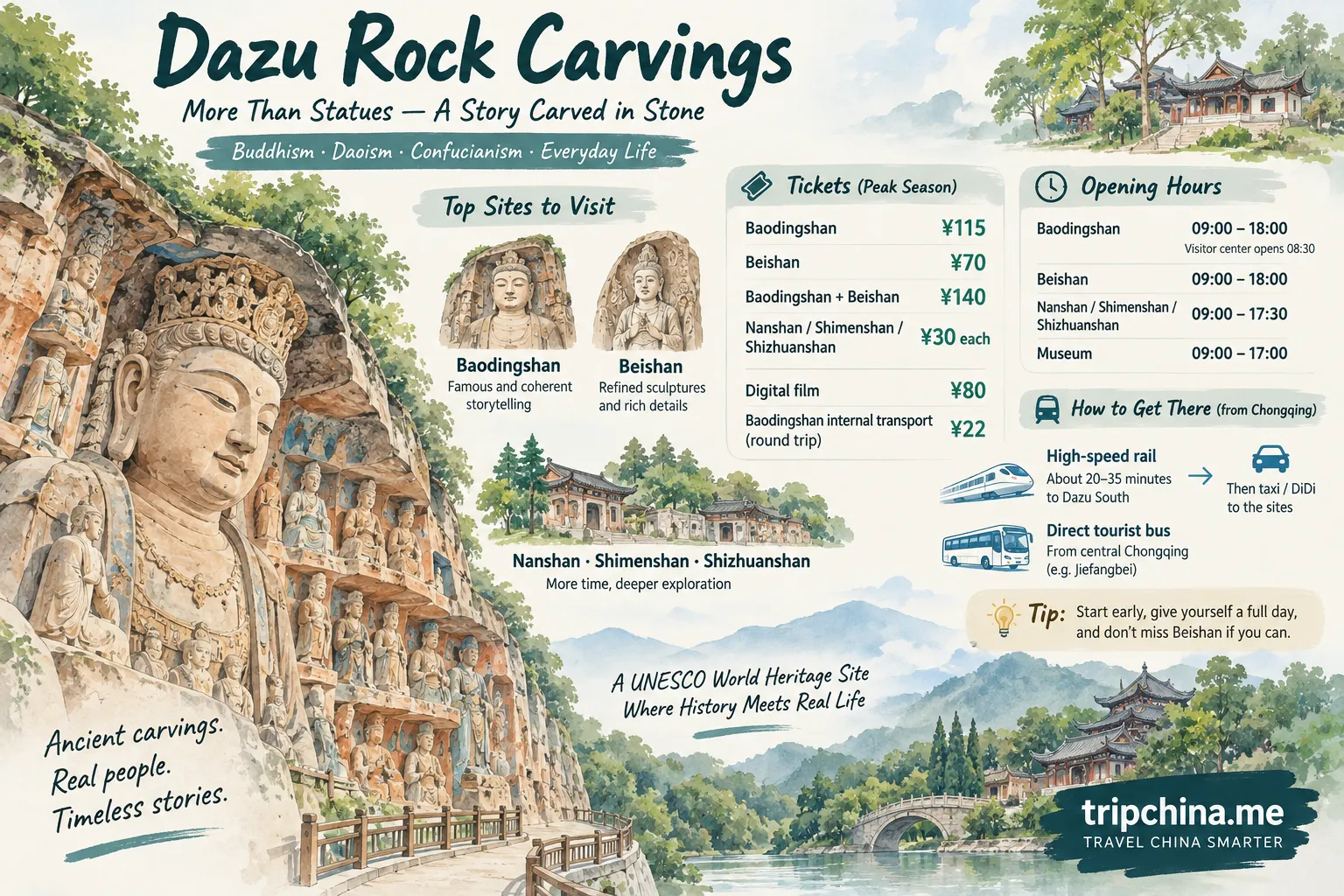
These three sites are open daily from 09:00 to 17:30 under the published schedule, with ticket sales ending at 16:00 and entry checks ending at 16:30. Each full-price ticket is ¥30.
As of September 2026, the official published prices are:
Prices are divided into peak season from March through November and low season from December through February.
| Ticket | Mar 1–Nov 30 | Dec 1–Feb 28/29 |
|---|---|---|
| Baodingshan | ¥115 | ¥100 |
| Beishan | ¥70 | ¥50 |
| Baodingshan + Beishan admission | ¥140 | ¥120 |
| Nanshan | ¥30 | ¥30 |
| Shimenshan | ¥30 | ¥30 |
| Shizhuanshan | ¥30 | ¥30 |
| Immersive digital theater show | ¥80 | ¥80 |
| Baodingshan internal transport, round trip | ¥22 | ¥22 |
| Baodingshan internal transport, one way | ¥12 | ¥12 |
The immersive digital theater show (8K dome + 4K widescreen presentations) costs ¥80, while Baodingshan’s shuttle is ¥22 round trip or ¥12 one way, per the official Dazu Rock Carvings Research Institute price table.
There are also bundled products. During peak season, Baodingshan + round-trip internal transport is currently listed at ¥130, while Baodingshan + Beishan + round-trip internal transport is ¥150.
This distinction matters: the ¥140 Baodingshan + Beishan admission ticket does not itself mean the Baodingshan transport is included.
Do not assume a universal one-day or two-day validity rule from old travel posts. Check the conditions shown for the exact ticket product you purchase.
The official reservation instructions specifically state that visitors using passports, Hong Kong/Macao travel permits or Taiwan travel permits should purchase tickets at the staffed visitor-center ticket counter.
Foreign visitors should carry the original passport. The current ticket policy says valid identification documents, including passports, must be presented in original form when required for entry or ticket concessions.
Chinese-ID holders can use the official “大足石刻” WeChat channel and approved online booking channels.
If you are unfamiliar with Chinese payment systems, set them up before leaving Chongqing. TripChina's foreign visitor payment guide explains Alipay, WeChat Pay, cards and cash.
The timing is slightly confusing because the visitor center, Baodingshan carving area and museum do not use identical hours.
As of September 2026:
| Area | Published Hours | Important Cutoff |
|---|---|---|
| Dazu / Baodingshan Visitor Center | 08:30–16:30 | Ticket sales end 16:00; check-in ends 16:10 |
| Baodingshan carving area | 09:00–18:00 | Enter through the visitor center; published final entry 16:30 on the current Chinese visitor page |
| Beishan daytime | 09:00–18:00 | Last check-in 17:00 |
| Nanshan | 09:00–17:30 | Last check-in 16:30 |
| Shimenshan | 09:00–17:30 | Last check-in 16:30 |
| Shizhuanshan | 09:00–17:30 | Last check-in 16:30 |
| Dazu Rock Carvings Museum | 09:00–17:00 | Last entry 16:30; closed Mondays except statutory holidays |
The current official Dazu Rock Carvings visitor pages list the museum at 09:00–17:00, with entry ending at 16:30; the English visitor page also states that the museum is closed on Mondays except statutory holidays.
You may find older or more general government tourism pages quoting 08:30–17:30 for “Dazu Rock Carvings.” For day-of-visit planning, use the current Dazu Rock Carvings Research Institute visitor schedule because it separates the visitor center, museum and individual carving sites.
Opening hours can shift seasonally and around public holidays. The visitor center and the core carving area operate on slightly different schedules, so always verify the cutoff time for entry processing — not just the nominal closing time.
TripChina's China Public Holidays Guide is useful here because holiday crowd levels can change the experience more than the season itself.
For independent travelers, it is usually the most flexible option.
As of September 2026, Chongqing West is the most reliable major departure station, while some direct trains also start from Shapingba. Current direct journeys take roughly 20–35 minutes.
Recent September 2026 searches show second-class fares generally around ¥40–43 from Chongqing West, while some Shapingba departures can be slightly cheaper. Train fares and available services vary by train and travel date.
Do not simply turn up at Chongqing North because an older guide says trains leave from there. Search your actual travel date first in 12306 or Trip.com; Chongqing North may require a transfer depending on the day's timetable.
For booking and passport rules, see the China train ticket guide for foreigners.
From Dazu South Station, Baodingshan is roughly 30 km away. DiDi or a metered taxi is usually the easiest final leg. A fare around ¥80–100 is a reasonable planning range, but traffic, demand and time of day can change the final amount.
If you have never used Chinese ride-hailing, set it up before the trip using TripChina's DiDi Guide for Foreign Travelers.
Do not accept an unlicensed ride simply because a driver tells you the buses have stopped or the attraction is “too far away.”
Use a regular metered taxi from the official taxi area outside Dazu South Station rather than negotiating a flat cash price with an unlicensed driver.
A slower public-transport option is to take local bus 206 toward Dazu's urban bus network and then transfer to bus 205 toward Baodingshan. Allow roughly 1.5 hours for the public-bus combination and confirm the current stop names with station staff because local bus routing can change.
Commercial tourist coaches frequently operate between central Chongqing and the Dazu visitor center, and they can be easier than train + taxi if the departure time works for you.
Recent 2026 listings have advertised seats from around ¥48 one way from the Jiefangbei area, but boarding points, return times and round-trip prices have changed during the year. Treat this as a service to verify when booking rather than a permanent timetable.
The trade-off is simple: less transfer hassle, but less flexibility. A fixed afternoon return can also make Baodingshan + Beishan feel rushed.
For Baodingshan alone, you do not need a car.
For all five UNESCO clusters, a car or hired driver becomes much more useful because the smaller sites are spread across the district and public transport between them is poor.
If this is your first trip to Chongqing, also read the Chongqing Travel Mistakes Guide before planning longer road transfers.
This route works best if you can reach the Baodingshan visitor center around opening time.
08:30–09:00 — Arrive at the visitor center. Handle tickets and passport checks first.
09:00–09:45 — Visit the Dazu Rock Carvings Museum if you want historical context before seeing the cliff carvings. Skip this first stop if it is Monday, unless a statutory holiday changes the normal closure arrangement.
09:45–10:00 — Take the internal transport toward Baodingshan.
10:00–12:30 — Walk the main Baodingshan carving sequence slowly. Start from the official route rather than accidentally trying to enter near the exit and seeing the story backwards.
12:30–13:30 — Lunch. If possible, eat in Dazu's urban area rather than automatically choosing the first restaurant beside the tourist exit.
14:00–14:30 — Transfer toward Beishan.
14:30–16:30 — Visit Beishan.
After 16:30 — Return to Chongqing, stay overnight in Dazu, or — after September 21 and only after checking current operation — consider the Beishan night experience.
If you cannot reach Baodingshan until around 11:00, do not turn the day into a race simply to tick off Beishan. Spend the time properly at Baodingshan instead.
The official immersive digital theater show — often described on older travel pages simply as the “digital film” — is currently priced at ¥80. The official schedule lists seven regular daytime screenings at 09:30, 10:20, 11:10, 12:00, 13:30, 14:20 and 15:10.
It is most useful if you arrive knowing almost nothing about Dazu. The presentation gives you scale, historical context and reconstructed perspectives that can make the carvings easier to understand.
If you already have a guide or have researched the site in depth, I would spend the extra time at the actual cliffs instead.
Moderate — and the difficulty is easy to underestimate from photographs.
Baodingshan's main carving sequence is only around 500 meters long, but the route includes stone surfaces, changes in elevation and narrow sections. Beishan involves more stairs.
The visitor center and museum provide modern visitor facilities, but the heritage cliff routes themselves cannot be treated as fully step-free environments.
Wheelchairs and other mobility assistance may be available through visitor services, but travelers with significant mobility limitations should contact the attraction before visiting rather than assuming that “wheelchair accessible” on a booking platform means the entire carving route is barrier-free.
Wear shoes with good grip, especially after rain.
Arriving when the visitor center opens gives you the best chance of reaching the core carvings before large tour groups.
Official holiday guidance has previously identified late morning through mid-afternoon as the busiest period during major holiday peaks, and special holiday schedules may open earlier or extend entry times.
Tuesday through Thursday is generally a better bet than weekends. Chinese public holidays are a different category entirely: expect larger groups, slower internal transport and less room to stop in front of individual carvings.
Beishan is usually calmer than Baodingshan and is particularly pleasant later in the afternoon.
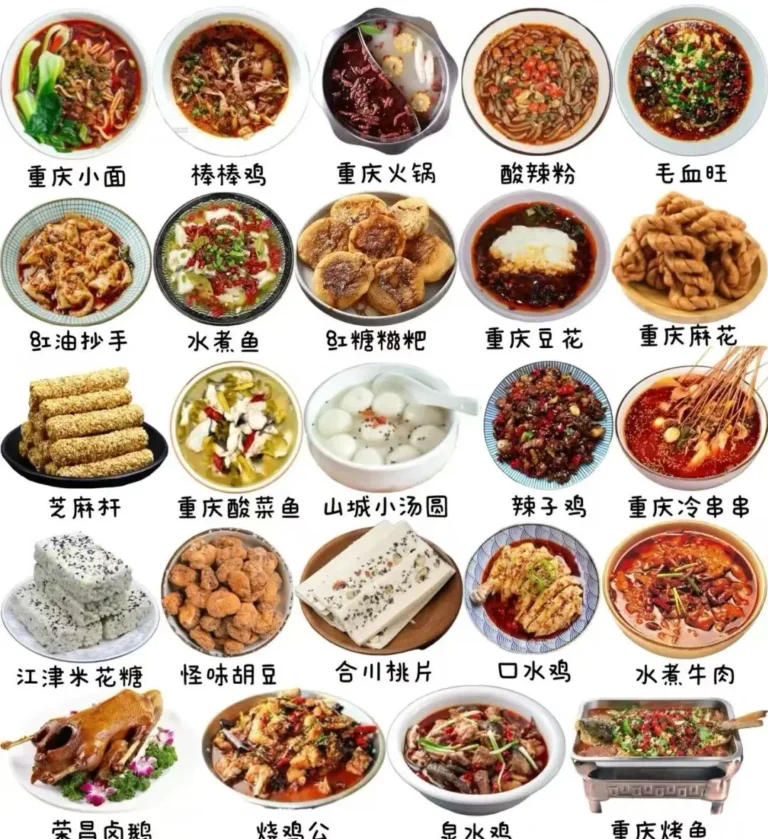
Dazu's food is unmistakably southwest Chinese: spicy, oily, salty and built for appetite after several hours of walking.
Youting Crucian Carp (邮亭鲫鱼) is the best-known local specialty, usually cooked with chili and Sichuan pepper.
Dingjiapo Potatoes (丁家坡洋芋) are a much simpler snack — soft potatoes mixed with chili, herbs and seasoning.
Dazu winter vegetable braised pork (宝顶冬菜扣肉) pairs fatty pork belly with the district's preserved vegetables.
Dazu Liangfen (大足凉粉) and douhua rice (豆花饭) are easier choices if you want something quicker.
Eat in Dazu's urban area rather than automatically settling for the Baodingshan exit food area — the city generally gives you more choice and better value.
For a broader explanation of what to order in the region, see the Chongqing Food Guide for Foreigners.
The attraction itself is straightforward. Most problems happen around transport, guides and tourist-facing sales.
Use app-booked rides or metered taxis rather than unlicensed cars around Dazu South Station.
Use the official guide service if you want a human guide. Unlicensed guides may give unreliable historical explanations or steer visitors toward commission-based purchases.
Do not buy tickets from people outside official sales channels promising “special access,” “discount tickets” or a private fast-entry route.
Be skeptical of roadside sellers claiming that an object is a locally excavated antique. Genuine cultural relics are not casual tourist souvenirs.
The Baodingshan visitor center is now the required entry point for ordinary visitors, and the current site management specifically warns travelers against illegal “black car” operators and aggressive roadside selling.
For first-time China travelers, setting up payments and transport before leaving your hotel eliminates most of these friction points.
Yes. Overseas visitors can generally link eligible international bank cards to Alipay or WeChat Pay and use QR payments in China.
Set up your account before the day trip and carry some RMB cash or another payment method as backup. That is more reliable than trying to troubleshoot identity verification or bank authorization at the attraction.
Staying overnight in Dazu makes sense if you want Beishan at a relaxed pace or plan to explore the three smaller sites the next morning.
If Dazu is only a day trip, keep your main hotel in central Chongqing. For help choosing a base, see Where to Stay in Chongqing and the full Chongqing Travel Guide Hub.
Yes — but not because it is simply another famous Chinese grotto.
Baodingshan gives you the grand visual story; Beishan gives you the detail. The scenes that stay with you are often not the biggest statues at all, but a parent holding a child, a farmer controlling an ox, or a woman calmly tending chickens beside a vision of hell.
That mixture of sacred ideas and ordinary life is the real Dazu — and it is what most rushed visitors miss.
Yes, because the appeal is different.
Dunhuang and Longmen impress through scale, chronology and monumental religious art. Dazu's late-Tang-to-Song carvings place unusually strong emphasis on narrative, local life and the meeting of Buddhism, Daoism and Confucianism. If you enjoy stories and human detail as much as monumental scale, it does not feel redundant.
Yes, if you’re combining it with Chongqing. Chengdu to Dazu is awkward as a standalone trip — you’d typically go Chengdu → Chongqing → Dazu, or Chengdu → Dazu South directly (some trains exist, but schedules are limited). The practical recommendation: visit Dazu as a day trip from Chongqing, not as a separate journey from Chengdu. If you’re already planning Chongqing, Dazu adds a genuinely different UNESCO experience (human-scale, narrative, people-funded) compared to the imperial grandeur of Longmen or Yungang.
Baodingshan only, and start at opening. The ¥115 ticket is worth it for the Thousand-Armed Guanyin, Reclining Buddha, and Ox-Herding Pictures alone. Skip Beishan, skip the museum, skip the digital theater. Walk the 500-meter cliff route slowly — half a day is enough to see the essentials without racing. If you arrive after 1 PM, reconsider whether the trip is worth it at all; you’ll be fighting the clock and the crowds simultaneously.
Yes. In fact, Dazu is one of the easier major Chinese grotto sites for non-specialists because so many scenes use recognizable human actions — parenting, farming, punishment, compassion and everyday work.
A little background helps, but you do not need to understand Buddhist theology to enjoy the site.
Yes, luggage-storage facilities have been built as part of the Dazu visitor-center services, making it possible to visit with bags rather than carrying them along the cliff route. The Dazu District government specifically lists a luggage-storage room among the visitor center's facilities.
Ask at the visitor-center information desk when you arrive, because operating hours, capacity and any service conditions can change, especially during major holidays.
No. Current visitor notices prohibit drones and other unauthorized flying devices inside the scenic area.
Leave the drone at your hotel or luggage storage rather than carrying it through the site expecting to fly it.
Very tight. If your layover is under 7 hours, skip it. The realistic time budget: airport to Chongqing West (metro/taxi, 45–70 min) + train to Dazu South (20–35 min) + taxi to Baodingshan (30–40 min) + site visit (minimum 2 hours for Baodingshan alone) + return trip. That’s 6–7 hours minimum, and you’d be rushing with zero buffer. If you have a full day between flights (10+ hours), store luggage at the airport, take a taxi directly to Chongqing West, and go.
Dazu Rock Carvings — UNESCO World Heritage Centre
Dazu Rock Carvings Research Institute — Official Visitor Guide, Hours and Ticket Prices
Dazu Rock Carvings Research Institute — Ticket Reservation Instructions
Dazu Rock Carvings Research Institute — Beishan Night Tour Temporary Closure Notice
Updated September 2026 using the Dazu Rock Carvings Research Institute, UNESCO documentation and current rail searches. Ticket prices, digital-theater pricing, opening hours, Monday museum closure, passport procedures and the temporary Beishan night-tour closure were cross-checked against current official Dazu sources. Current rail searches show Chongqing West–Dazu South second-class fares around ¥40–43, while transport fares and timetables remain market- and date-dependent and should be checked again in 12306 or Trip.com before travel.
TripChina.me creates practical China travel guides shaped by real local experience, helping independent travelers navigate transport, payments, food, neighborhoods, and the cultural details that make traveling in China easier and more meaningful. Find the guide for your destination at tripchina.me.