Our Location:
No. 99, Jiazi Road, Chengdu

 authorChris Lee
In China, choosing the right week can matter as much as choosing the right city. A normal Saturday in Beijing may simply feel busy; Labor Day or National Day can affect trains, hotels, attraction reservations and transport hubs at the same time.
Spring Festival is more complicated. Some big-city neighborhoods become unusually quiet while famous attractions remain packed.
The biggest travel mistake is assuming that good weather automatically means a good time to visit. The better strategy is to choose a comfortable season, identify China's major holiday periods, and plan around the dates when crowds and transport demand are hardest to manage.
For a typical first trip covering Beijing, Xi'an, Shanghai and Chengdu, mid-April to late April and mid-October to early November are useful starting windows, subject to local weather and events.
TripChina's simplest planning rule: Choose a good season first. Then remove the bad dates.
China has seven nationwide public-holiday categories. The official arrangements include extended breaks and adjusted working days, which can turn certain weekends into regular workdays.
The following dates follow the General Office of the State Council's official 2026 holiday schedule.
| Holiday | Official Holiday Period | Days Off | Tourist Crowd Risk | TripChina Advice |
|---|---|---|---|---|
| New Year's Day | Jan 1–3 | 3 | Moderate | Usually manageable |
| Spring Festival | Feb 15–23 | 9 | Very High / Uneven | Great culturally; complicated logistically |
| Qingming Festival | Apr 4–6 | 3 | High | Expect short-trip demand |
| Labor Day | May 1–5 | 5 | Extreme | Avoid if dates are flexible |
| Dragon Boat Festival | Jun 19–21 | 3 | High | Book transport earlier |
| Mid-Autumn Festival | Sep 25–27 | 3 | High | Short-break demand rises |
| National Day | Oct 1–7 | 7 | Extreme | Avoid headline attractions if possible |
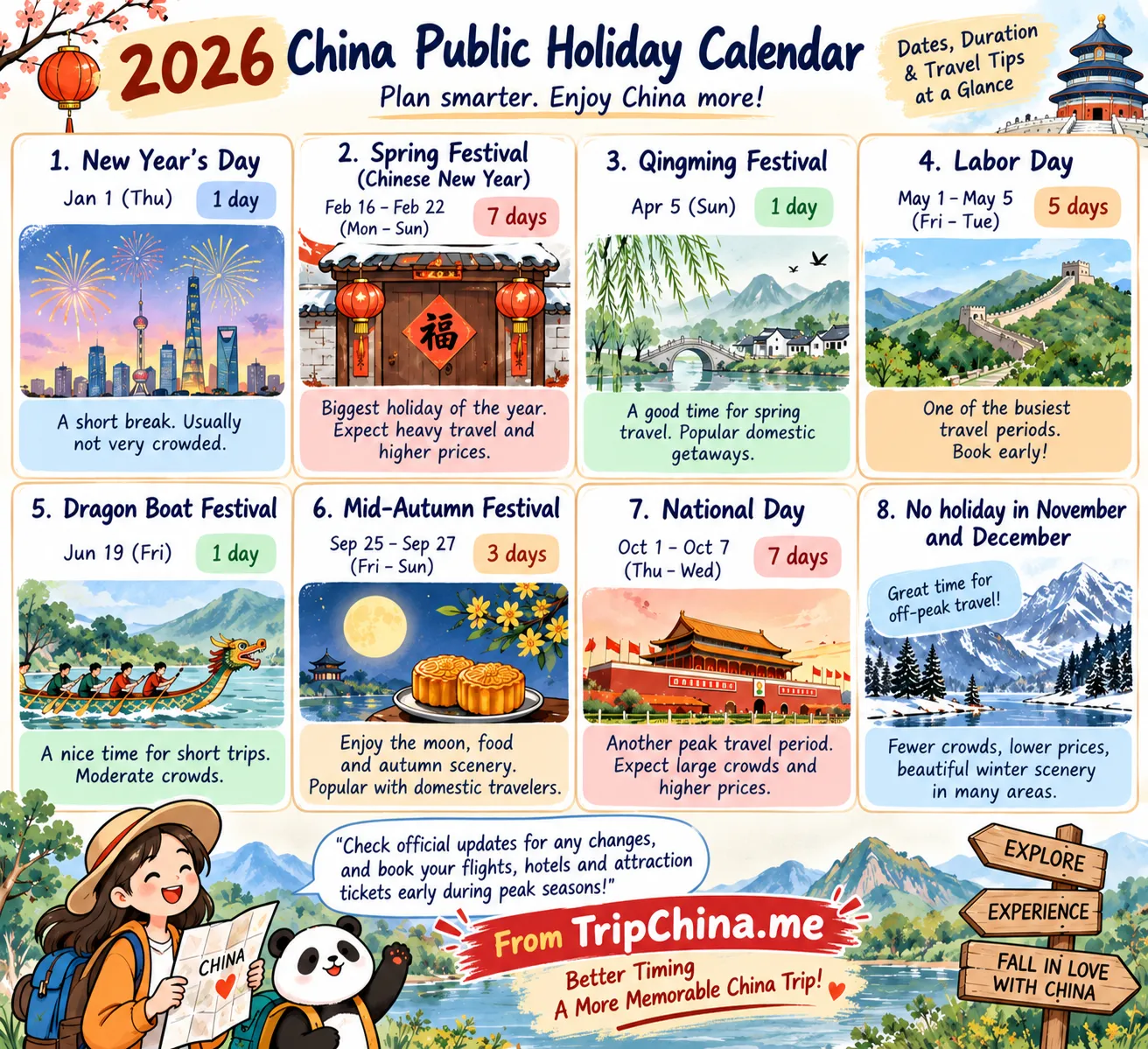
The crowd-risk ratings are TripChina's travel-planning judgments, not official government classifications. Conditions vary by city, attraction and travel route.
The official adjusted working days are:
These dates matter because an apparent weekend may function as an ordinary working day, changing commuter patterns and local visitor demand.
One unusual feature of the 2026 calendar is the short gap between Mid-Autumn Festival and National Day.
Mid-Autumn Festival runs from September 25 to 27, while National Day begins on October 1.
Only September 28–30 separate the two breaks.
Someone taking those three days as annual leave could create a 13-day break from September 25 through October 7. That creates the potential for extended trips beyond the official holiday periods.
For international visitors, the practical implication is simple: do not assume September 28–30 will behave like ordinary low-demand weekdays.
Planning for another year? China's official holiday dates and adjusted working days are announced annually. Use the dates above only for 2026 travel planning and check the State Council's schedule for your actual travel year.
Holiday crowds are not distributed evenly. The most difficult time for a high-speed train journey may be different from the most difficult day at a famous attraction.
A useful way to understand China's major holidays is to separate three types of pressure:
Outbound transport peaks → sightseeing peaks → return transport peaks
| Travel Phase | Main Problem | Better Strategy |
|---|---|---|
| Before the holiday | Departure traffic at airports, railway stations and expressways | Avoid tight connections and unnecessary transfers |
| Early holiday | Outbound journeys and rising attraction crowds | Stay in one city if possible |
| Middle days | Crowded landmarks, museums and scenic areas | Reserve attractions early and allow more time |
| Final days | Heavy return travel | Avoid important intercity transfers where possible |
These are typical patterns, not fixed predictions for every route or holiday.
Large numbers of people leave major cities for family visits or vacations.
Railway stations, airports and highways may become busy before the first official holiday date.
For visitors, the biggest risk is often a tightly scheduled journey with too little room for delays.
Sometimes, but only for certain types of travel.
Intercity transport can become easier on particular routes once the main outbound wave has passed. Tourist attractions may remain extremely crowded because travelers have already reached their destinations.
A quieter railway station does not necessarily mean a quieter Forbidden City.
Return traffic builds as travelers head home.
During the 2026 Spring Festival, Shanghai's railway stations recorded a strong return-travel peak on the final holiday day, February 23.
If your itinerary permits, arriving before the main departure wave or leaving after the principal return period can make travel more manageable.
Usually not compared with major national holidays.
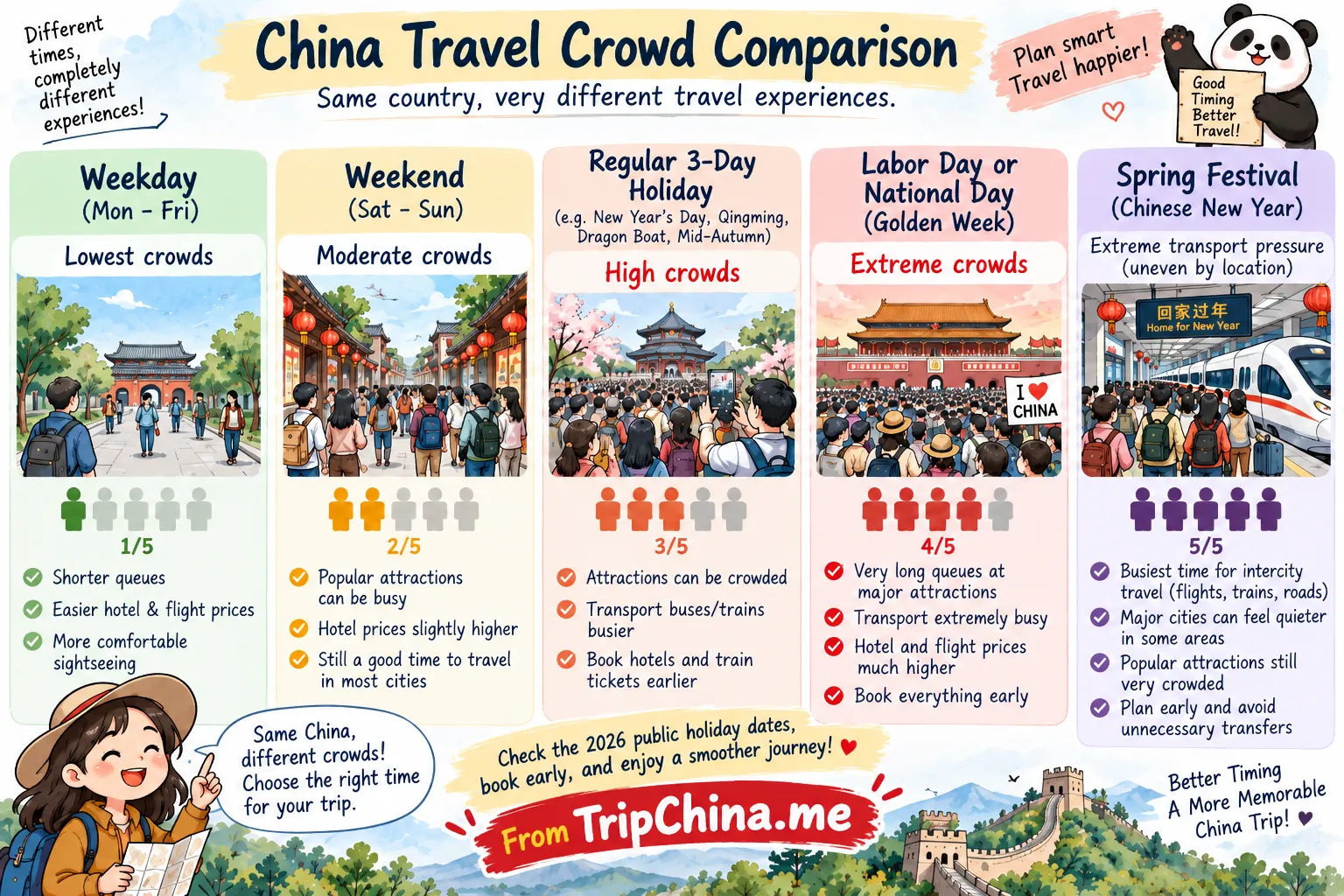
International visitors sometimes see dramatic Golden Week photographs and assume every Chinese Saturday looks the same. It doesn't.
| Travel Period | Typical Travel Pressure |
|---|---|
| Ordinary weekday | Lowest |
| Ordinary weekend | Moderate |
| Summer-vacation weekday | Moderate–High |
| Summer-vacation weekend | High |
| Three-day national holiday | High–Very High |
| Labor Day / National Day | Extreme |
| Spring Festival intercity travel | Extreme |
These are relative planning categories rather than guaranteed crowd levels.
There are important exceptions.
The Forbidden City, Terracotta Warriors, Zhangjiajie, Jiuzhaigou, Huangshan, West Lake and major theme parks can still become crowded on ordinary weekends.
Do not ruin an otherwise good itinerary just to avoid every Saturday. Pay much more attention to public holidays, school vacations and attractions with strict visitor quotas.
The answer is 调休 (tiáoxiū), China's system of adjusted rest and working days.
China sometimes converts weekends into working days to create longer continuous holiday breaks.
That means:
A Tuesday during National Day can be dramatically busier than an ordinary Saturday.
Check the official holiday calendar rather than relying only on the day of the week shown in your phone's calendar.
Surprisingly, it can be.
But Spring Festival requires understanding one of the most important distinctions in Chinese holiday travel:
City crowds and tourist crowds are not the same thing.
Many people who live and work in major cities travel elsewhere to reunite with family.
During the middle of the holiday, some neighborhoods in Beijing, Shanghai and other large cities may experience:
Shanghai provides a useful real-world example.
During the 2026 Spring Festival, Shanghai's average hotel occupancy rate was approximately 50.6%, even while the city received about 21.67 million tourist visits.
That does not mean half the hotels were empty or that every neighborhood had low room rates. It shows that citywide hotel capacity and visitor volumes can tell very different stories.
No.
This is the paradox of Spring Festival travel.
During the same holiday, Shanghai attracted millions of tourist visits, and Beijing recorded approximately 19.84 million visits.
You can encounter:
That is why two apparently contradictory statements can both contain some truth:
"China is empty during Chinese New Year."
"China is extremely crowded during Chinese New Year."
The difference is where you go, what you do and when you travel between cities.
For Beijing's most reservation-sensitive attraction, check the Forbidden City ticket booking rules for foreign visitors before committing to a date.
Spring Festival can work well when you:
A nine-day Beijing or Shanghai stay may be easier to manage than:
Beijing → Xi'an → Chengdu → Shanghai
during the same holiday.
If the Terracotta Warriors are part of your holiday itinerary, check the museum's real-name admission rules and foreign-passport booking process before traveling to Xi'an.
TripChina verdict: Spring Festival can be rewarding for travelers interested in culture and slower city exploration. It is much less forgiving for a fast-paced, multi-city sightseeing itinerary.
For most first-time international visitors, Labor Day and National Day are the two holidays most worth avoiding when planning ordinary sightseeing.
Spring Festival can be more complicated for transport, but its visitor patterns are less uniform.
The 2026 Labor Day holiday ran from May 1 through May 5.
According to China's Ministry of Culture and Tourism, approximately 325 million domestic tourist trips were recorded during those five days.
A Ministry of Transport estimate reported by People's Daily projected approximately 1.525 billion cross-regional passenger movements over the holiday. These are travel movements, not unique travelers or tourist visits.
The figures describe different measures of activity and should not be added together.
The practical problem is that holiday demand affects several systems simultaneously:
May itself can be an excellent month to visit China.
May 1–5 is the difficult part.
Yes, in some places.
In 2026, Ningbo linked a school spring break with the Labor Day holiday, creating a longer break for many families.
Travel interest in the area began extending into the days immediately before May 1.
These local arrangements do not apply nationwide, but they demonstrate why international visitors should not treat official holiday dates as the complete boundary of peak demand.
School calendars can widen the effective travel period.
October often has some of China's most comfortable sightseeing weather.
That makes the National Day holiday particularly challenging:
Good weather + seven days off + nationwide tourism demand
During Golden Week, famous destinations may experience concentrated demand for hotels, high-speed trains, cableways, museums and scenic-area transport.
For a typical first trip, October after Golden Week is usually a more comfortable planning choice than October 1–7.
The weather may still be excellent, but the nationwide holiday pressure has eased.
| Your Main Concern | Holiday to Watch Most Closely |
|---|---|
| Crowded landmark sightseeing | Labor Day and National Day |
| High-speed train availability | Spring Festival, Labor Day and National Day |
| Multi-city itineraries | All three major holiday periods |
| Chinese New Year cultural experiences | Spring Festival can be worthwhile |
| Comfortable October weather | Visit after National Day if possible |
| Summer family travel crowds | July–August school vacation |
There is no single worst holiday for every traveler. The answer depends on whether transport, accommodation, attraction crowds or cultural experiences matter most.
Often, yes. But there is no reliable nationwide percentage that applies to every city, hotel or travel date.
The bigger problem is usually a combination of higher prices and declining availability.
| Travel Product | Typical Peak-Period Problem |
|---|---|
| Hotels | Higher rates; well-located, good-value rooms sell first |
| Domestic flights | Cheaper fares and convenient departures become harder to find |
| High-speed trains | Popular departures can sell out |
| Attraction tickets | Limited dates and entry slots fill up |
| Private drivers and transfers | Availability may tighten around nature destinations |
| Small-group tours | Popular departures fill earlier |
A hotel does not need to be completely sold out for your trip to become more expensive.
The reasonably priced room in the right neighborhood may disappear long before the city's final available room.
For a known busy period, booking around one month ahead is a useful minimum planning point.
Three to six weeks is often a sensible starting range.
For National Day, Labor Day, Spring Festival, major trade fairs or popular resort destinations, earlier can be worthwhile.
One practical strategy is to reserve a well-located, refundable room early.
If rates rise, you have already secured accommodation. If prices fall, the cancellation terms may allow you to rebook.
Always check the cancellation deadline, payment terms and any conditions attached to the refundable rate.
Start monitoring fares several weeks ahead.
Airfares are dynamically priced, so booking exactly 30 days before departure is not a guaranteed way to get the lowest price.
But leaving a Golden Week flight until the last minute can be risky.
Compare:
Sometimes one additional hotel night makes more sense than paying significantly more for a peak-day flight.
Train tickets work differently from hotels.
You cannot simply reserve every train journey several months in advance.
The important strategy is to know the official sales window and prepare your booking details before tickets become available.
Foreign travelers can use the official 12306 platform, an established booking provider such as Trip.com, or staffed station counters when appropriate.
For the official platform, passport verification and ticket-release process, read How Foreigners Buy China Train Tickets on 12306.
During major holidays, being ready at the beginning of the ticket-sale window can matter more than spending hours comparing small price differences.
Not necessarily.
For many government-priced historic and public scenic attractions, availability is a bigger problem than holiday surge pricing.
Some attractions have published peak-season and off-season admission prices. That is different from increasing admission simply because a particular day falls during National Day.
Commercial theme parks and privately priced attractions may use different pricing models.
The most important question is often not:
"Will the ticket cost more?"
It is:
"Will there still be a ticket available?"
Booking windows vary by attraction.
The Forbidden City provides a particularly useful example.
The Palace Museum's official booking arrangements state that regular tickets are released at 20:00 Beijing time, seven days before the visit date, and normal same-day admission tickets are not sold.
Foreign visitors can book using passport information.
For popular dates, prepare your documents and attempt to reserve when the official booking window opens.
Other attractions use different booking periods. Never assume the Forbidden City's seven-day rule applies to every attraction in China.
Because entry is not the same thing as a good visit.
During extreme crowd periods, you may encounter:
The Forbidden City on a Golden Week day and the Forbidden City on a quiet November weekday are technically the same attraction.
They are not the same experience.
Crowd density has the greatest effect where space, entry capacity or transport is limited.
Examples include:
A large open urban park may still be pleasant when busy. A narrow mountain viewpoint or a crowded museum gallery offers far less room to adapt.
If tickets for a major attraction are already sold out, check official alternatives rather than assuming third-party sellers can secure legitimate admission.
Not every crowded travel period appears on China's national holiday calendar.
Several other patterns can substantially affect a trip.
This is one of China's most important non-public-holiday travel periods.
Family travel increases demand at major attractions, museums, theme parks and popular summer destinations.
Cities and regions often affected include Beijing, Xi'an, Shanghai, Chengdu, Zhangjiajie, Yunnan, Xinjiang and Inner Mongolia.
A normal weekday in July can therefore feel busier than a weekend in November.
Summer also brings heat, humidity and seasonal rain in many destinations, making early starts and flexible schedules especially valuable.
These do not affect the whole country equally.
But when local school breaks connect with national holidays, family travel demand can spread into the surrounding days.
This is particularly important when planning trips to family-oriented scenic areas or major theme parks.
Major trade events can increase accommodation demand without any national holiday.
Pay particular attention in Guangzhou, Shanghai, Shenzhen, Beijing and Hangzhou.
The Canton Fair is a good example. Hotel prices and room availability can change significantly in relevant parts of Guangzhou, even when the wider country is experiencing an ordinary working week.
One event does not make the whole country busy.
But it can make one city unusually expensive for a weekend.
Before booking a hotel near a major venue, check the local events calendar.
Some destinations operate according to their own seasonal demand patterns.
Harbin attracts winter visitors for its ice and snow activities. Sanya is popular as a winter beach destination. Inner Mongolia's grasslands attract summer travelers, while Xinjiang can be especially busy during its summer sightseeing season.
National crowd calendars are a starting point, not a substitute for destination-specific planning.
China is too large to have one universally ideal travel month.
A useful general starting point is:
| Period | General Travel Pattern | Main Consideration |
|---|---|---|
| January–February | Lower season in many cities; winter destinations can peak | Cold weather, Spring Festival |
| March–April | Strong spring sightseeing window | Mild weather, changing rainfall |
| May | Excellent weather in many destinations | Avoid Labor Day |
| June | Useful for northern and western routes | Rain develops in parts of the south |
| July–August | Summer school-vacation peak | Heat, rain and family crowds |
| September | Strong general sightseeing month | Check Mid-Autumn Festival |
| October | Comfortable weather in many regions | Avoid National Day |
| November | Useful shoulder-season travel | Cooler temperatures, fewer crowds in many places |
| December | Lower season in many cities | Winter tourism strengthens |
These are broad planning patterns, not weather forecasts.
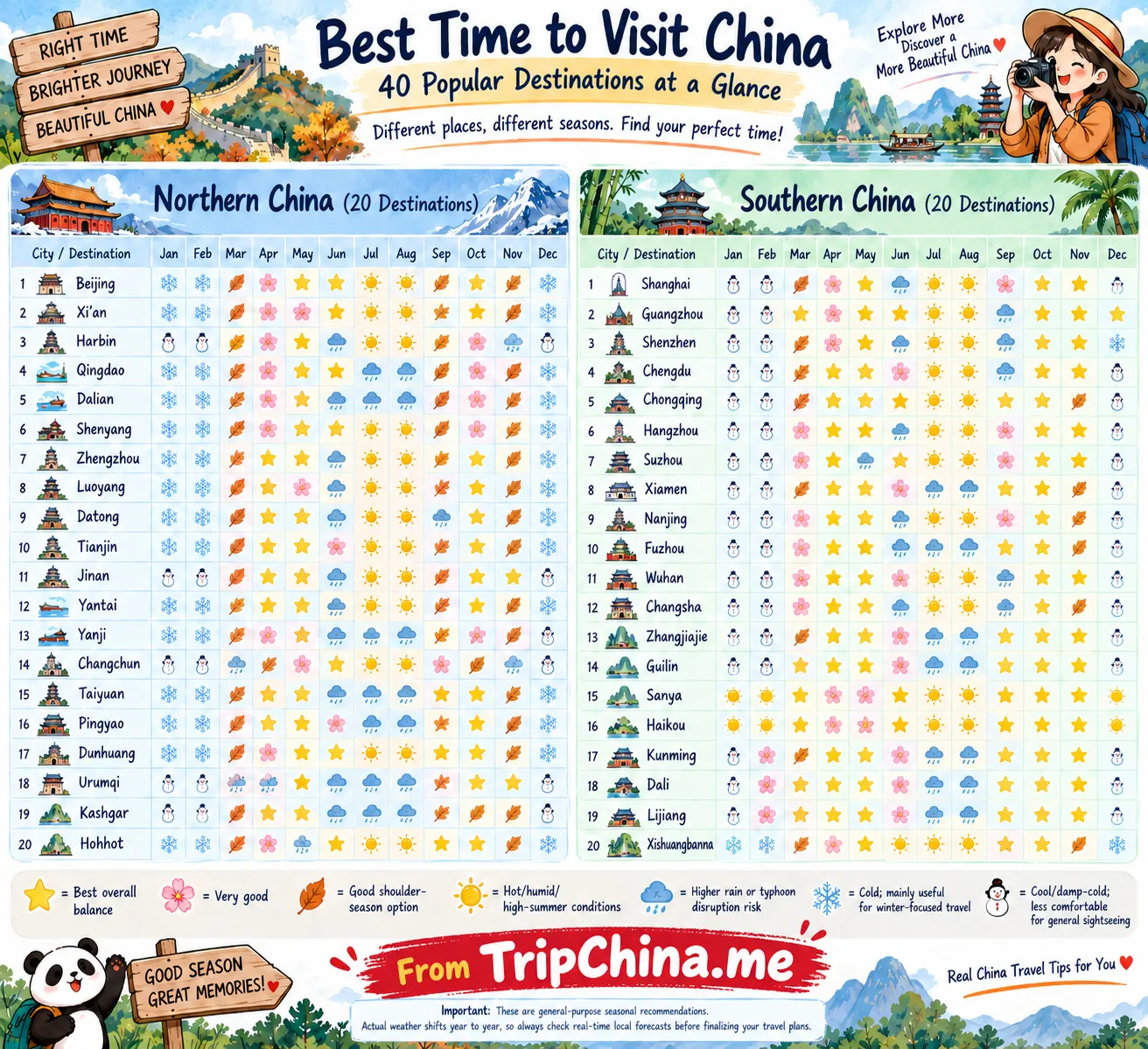
The recommendations below are TripChina's general sightseeing judgments, not official climate rankings. They balance typical weather, crowd pressure and the experiences most first-time international visitors are likely to seek.
Specialist trips, including skiing, winter festivals, grassland travel and seasonal photography, may follow different patterns.
| Destination | Best General Months | Main Seasonal Issue |
|---|---|---|
| Beijing | Apr–May, Sep–Oct | Summer heat, winter cold |
| Shanghai | Mar–May, Oct–Nov | Plum rain, summer heat |
| Xi'an | Mar–May, Sep–Oct | Summer heat |
| Chengdu | Mar–May, Sep–Nov | Humidity and summer crowds |
| Chongqing | Mar–Apr, Oct–Nov | Extreme summer heat |
| Zhangjiajie | Apr–May, Sep–Oct | Rain, fog and summer crowds |
| Guilin | Apr–May, Sep–Oct | Summer rain and heat |
| Hangzhou | Mar–May, Oct–Nov | Summer humidity |
| Suzhou | Mar–May, Oct–Nov | Summer heat |
| Guangzhou | Oct–Dec, Mar–Apr | Heat, rain, typhoons |
| Shenzhen | Oct–Dec, Mar–Apr | Heat and typhoon risk |
| Kunming | Mar–May, Sep–Nov | Rainy season |
| Dali | Mar–May, Sep–Nov | Summer rain |
| Lijiang | Mar–May, Sep–Nov | Rain and altitude |
| Dunhuang | May–Jun, Sep–Oct | Desert summer heat |
| Harbin | Dec–Feb for winter activities; Jun–Aug for milder travel | Extreme winter cold |
| Qingdao | May–Jun, Sep–Oct | Cold winter |
| Xiamen | Mar–May, Oct–Dec | Typhoon risk |
| Sanya | Nov–Mar | Summer heat and storms |
| Inner Mongolia grasslands | Jun–Sep | Long cold season outside summer |
⭐ = Best overall balance
🌸 = Very good
🍂 = Good shoulder-season option
☀️ = Hot/humid/high-summer conditions
☔ = Higher rain or typhoon disruption risk
❄️ = Cold; mainly useful for winter-focused travel
⛄ = Cool/damp-cold; less comfortable for general sightseeing
| Destination | Jan | Feb | Mar | Apr | May | Jun | Jul | Aug | Sep | Oct | Nov | Dec |
|---|---|---|---|---|---|---|---|---|---|---|---|---|
| Shanghai | ⛄ | ⛄ | 🌸 | ⭐ | ⭐ | ☔ | ☀️ | ☀️ | 🌸 | ⭐ | ⭐ | ⛄ |
| Beijing | ❄️ | ❄️ | 🍂 | 🌸 | 🌸 | ☀️ | ☀️ | ☀️ | ⭐ | ⭐ | 🍂 | ❄️ |
| Guangzhou | ⭐ | ⭐ | ⭐ | 🌸 | 🌸 | ☔ | ☀️ | ☀️ | ☔ | ⭐ | ⭐ | ⭐ |
| Shenzhen | ⭐ | ⭐ | ⭐ | 🌸 | 🌸 | ☔ | ☀️ | ☀️ | ☔ | ⭐ | ⭐ | ⭐ |
| Chengdu | ⛄ | ⛄ | 🌸 | ⭐ | ⭐ | 🌸 | ☀️ | ☀️ | ⭐ | ⭐ | ⭐ | ⛄ |
| Xi'an | ❄️ | ❄️ | 🌸 | ⭐ | ⭐ | ☀️ | ☀️ | ☀️ | ⭐ | ⭐ | 🍂 | ❄️ |
| Hangzhou | ⛄ | ⛄ | 🌸 | ⭐ | ⭐ | ☔ | ☀️ | ☀️ | 🌸 | ⭐ | ⭐ | ⛄ |
| Chongqing | ⛄ | ⛄ | 🌸 | ⭐ | 🌸 | ☀️ | ☀️ | ☀️ | 🌸 | ⭐ | ⭐ | ⛄ |
| Zhangjiajie | ⛄ | ⛄ | 🌸 | ⭐ | ⭐ | 🌸 | ☀️ | ☀️ | ⭐ | ⭐ | 🍂 | ⛄ |
| Suzhou | ⛄ | ⛄ | 🌸 | ⭐ | ⭐ | ☔ | ☀️ | ☀️ | 🌸 | ⭐ | ⭐ | ⛄ |
| Xiamen | ⭐ | ⭐ | ⭐ | ⭐ | 🌸 | ☀️ | ☀️ | ☔ | ☔ | ⭐ | ⭐ | ⭐ |
| Nanjing | ⛄ | ⛄ | 🌸 | ⭐ | ⭐ | ☔ | ☀️ | ☀️ | 🌸 | ⭐ | ⭐ | ⛄ |
| Qingdao | ❄️ | ❄️ | 🍂 | 🌸 | ⭐ | ⭐ | 🌸 | 🌸 | ⭐ | ⭐ | 🍂 | ❄️ |
| Harbin | ⭐ | ⭐ | ❄️ | 🍂 | 🌸 | ⭐ | ⭐ | ⭐ | 🌸 | 🍂 | ❄️ | ⭐ |
| Kunming | 🌸 | 🌸 | ⭐ | ⭐ | ⭐ | 🌸 | ☔ | ☔ | ⭐ | ⭐ | ⭐ | 🌸 |
| Guilin | ⛄ | 🍂 | 🌸 | ⭐ | ⭐ | ☔ | ☀️ | ☀️ | ⭐ | ⭐ | 🌸 | ⛄ |
| Sanya | ⭐ | ⭐ | ⭐ | 🌸 | 🌸 | ☀️ | ☀️ | ☀️ | ☔ | ⭐ | ⭐ | ⭐ |
| Dali | ⛄ | 🌸 | ⭐ | ⭐ | ⭐ | 🌸 | ☔ | ☔ | ⭐ | ⭐ | ⭐ | ⛄ |
| Lijiang | ⛄ | 🌸 | ⭐ | ⭐ | ⭐ | 🌸 | ☔ | ☔ | ⭐ | ⭐ | ⭐ | ⛄ |
| Dunhuang | ❄️ | ❄️ | 🍂 | 🌸 | ⭐ | ⭐ | ☀️ | ☀️ | ⭐ | ⭐ | 🍂 | ❄️ |
Important: These are general-purpose seasonal recommendations. Actual weather shifts year to year, so always check real-time local forecasts before finalizing travel plans.
The key is to combine each destination's seasonal pattern with the official holiday calendar.
For example, Beijing in October often offers comfortable walking weather, but October 1–7 can be exceptionally crowded.
Zhangjiajie is another case where weather and holiday timing both matter. Fog or rain can affect mountain views even in an otherwise favorable travel month. For route planning and weather flexibility, see the Zhangjiajie Travel Guide.
For a classic itinerary combining Beijing, Xi'an, Shanghai and Chengdu or Guilin, two useful windows are:
Mid-April to late April
Mid-October to early November
These periods often provide:
But a good month can contain a difficult week.
April 25 may be excellent. May 1 can feel very different.
October 15 may be excellent. October 1 can be among the busiest dates of the year for ordinary sightseeing.
The point is not to avoid May or October. It is to avoid assuming every week within those months offers the same experience.
You can still have a rewarding China trip during a major holiday.
The key is to avoid building an itinerary that depends on perfect transport connections, easy last-minute reservations and uncrowded attractions.
Reducing intercity movement is often the simplest improvement.
During National Day, five nights in Beijing may be easier to manage than:
Beijing → Xi'an → Chengdu
over the same short period.
A slower itinerary gives you more flexibility when attractions become crowded or transport plans change.
For National Day 2026, a practical planning approach is:
| Dates | Suggested Strategy |
|---|---|
| October 1 | Stay in your current city; avoid unnecessary long-distance transfers |
| October 2–5 | Visit reserved attractions, allowing extra time for queues |
| October 6–7 | Avoid important intercity transfers when possible because return traffic can intensify |
These are planning recommendations, not guaranteed daily crowd forecasts.
Do not build a fragile itinerary requiring three popular attractions and two cross-city transfers in one day.
During peak periods, a realistic schedule might include one major reserved attraction, followed by flexible neighborhood exploration, food or a quieter cultural stop.
A less ambitious itinerary often gives you a better experience.
Secure a convenient location before the most desirable rooms disappear.
A well-located hotel can reduce unnecessary transportation and make holiday crowding easier to manage.
Check cancellation rules carefully before confirming.
Do not assume all attractions in China use the same reservation window.
Some require advance real-name booking, while others offer different ticket products or entry sessions.
Before fixing your daily route, confirm the admission requirements for the attractions that matter most.
Holiday crowds are the wrong moment to discover that your payment app, mobile internet or booking account is not working.
For internet access, compare the practical options in China eSIM vs SIM Card for Foreign Travelers.
For payments, How to Pay in China Without a Chinese Bank Account explains how Alipay, WeChat Pay, international cards and RMB cash work together.
Set up the services you expect to use and keep a backup payment option available.
Small preparations before arrival can save considerable time during a busy holiday.
Absolutely.
The best date is not simply the quietest date.
A more useful planning formula is:
Good travel dates = acceptable weather + manageable crowds + reasonable prices + available transport + available attraction tickets
| Travel Risk | Destinations to Watch |
|---|---|
| Summer heat | Chongqing, Wuhan, Nanjing, Xi'an and much of eastern and southern China |
| Plum rain | Shanghai, Hangzhou, Suzhou and Nanjing |
| Typhoons | Guangdong, Fujian, Hainan, Zhejiang and other coastal areas |
| High altitude | Lhasa, Shangri-La and other plateau destinations |
| Mountain fog and visibility | Zhangjiajie, Huangshan and similar mountain destinations |
| Severe winter cold | Harbin and parts of northern and northeastern China |
A comfortable temperature is not enough if fog hides the mountain you traveled across China to see.
Likewise, a quiet winter city may not be the right choice if your main interests require long outdoor walks.
Weather and crowds should be considered together rather than treated as separate decisions.
Before booking international flights, check these six factors.
| Check | Why It Matters |
|---|---|
| 1. National public holidays | Largest predictable nationwide crowd spikes |
| 2. School vacations | Additional family-travel demand |
| 3. Hotel prices | Early indicator of local accommodation pressure |
| 4. Flight and train availability | Determines whether the itinerary is practical |
| 5. Local climate | Heat, rain, cold, typhoons and altitude |
| 6. Major local events | Can change a city's accommodation and transport demand |
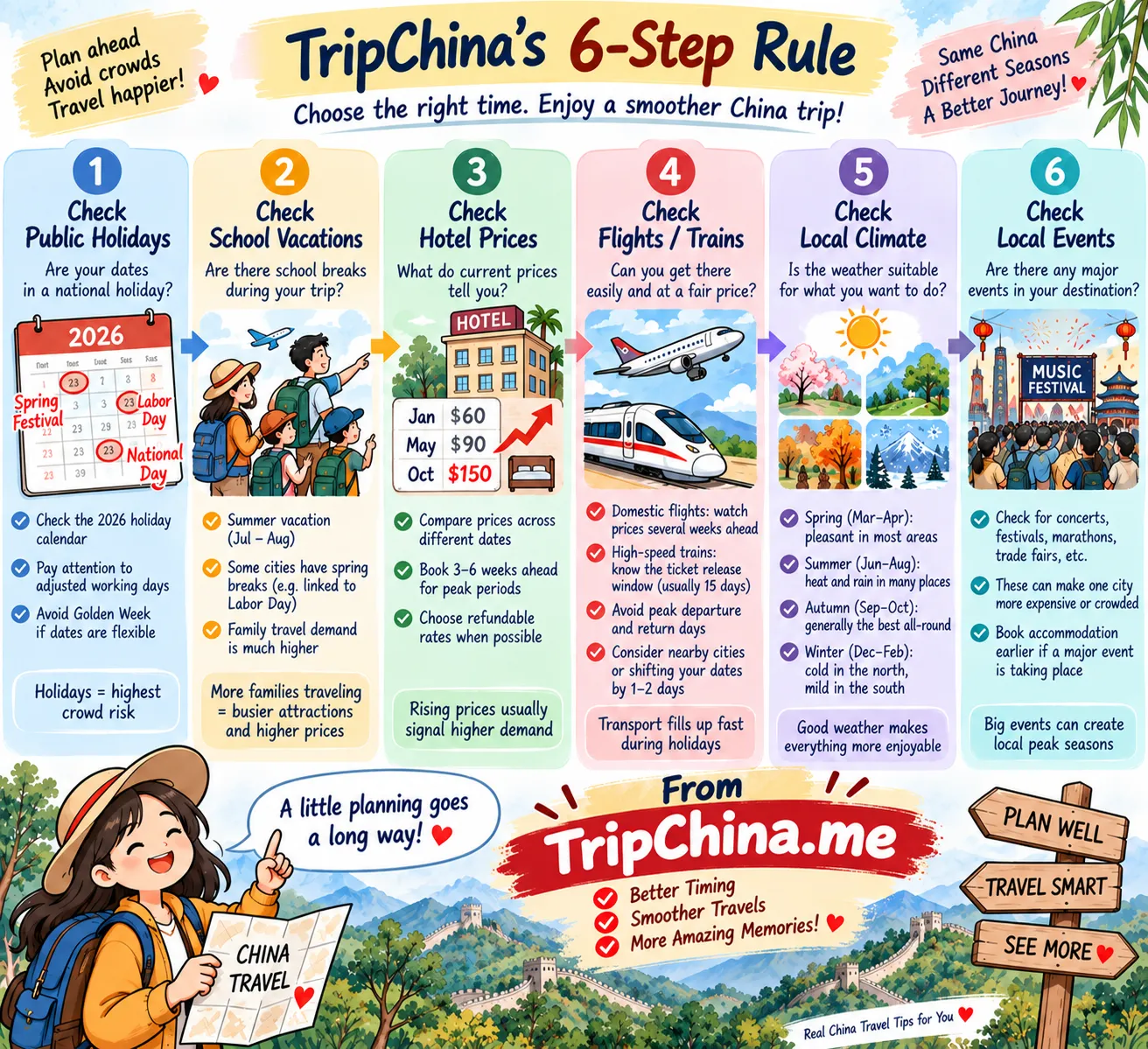
For most international visitors, the best dates for traveling in China are not simply the months with the best weather.
Choose a comfortable season, remove major public holidays, check school vacations and local events, then confirm hotel prices, transport availability and attraction reservations.
If your dates fall within a major holiday, reduce unnecessary city changes and reserve your most important attractions in advance.
For more information on preparing for independent travel, including payments, transport, hotels and practical arrival arrangements, see the China Basics Hub for Foreign Visitors.
Not necessarily.
Parts of both cities can become quieter as residents travel to visit family, while major attractions and festival venues remain busy.
Spring Festival works best for travelers who stay longer in one city, want to experience Chinese New Year culture and limit long-distance transfers.
No.
Business districts in major cities can sometimes offer reasonable rates when corporate travel declines.
Tourist districts, ski destinations and winter resorts may behave very differently.
Check the exact neighborhood and dates rather than assuming all hotels follow the same holiday pricing pattern.
One month is a useful starting point, but earlier can be safer for National Day, Labor Day, Spring Festival or highly popular destinations.
Refundable reservations are particularly useful because they help secure your preferred location while retaining some flexibility.
Not always.
Many government-priced attractions follow published admission rules rather than changing prices dynamically for a single holiday.
The bigger risk is often that tickets or entry slots sell out even though the official admission price remains unchanged.
Commercial attractions may use different pricing arrangements.
For some intercity journeys, the middle days can be easier than the main departure and return periods.
For famous attractions, however, those same days may remain extremely crowded.
Use the middle of a holiday for planned local sightseeing rather than assuming it will be quiet.
Keep your receipt, booking confirmation, screenshots and any written pricing information.
For tourism-market complaints, you can contact the local 12345 government service hotline or use China's national culture and tourism market complaint channels.
Language assistance varies by location, so hotel staff may be able to help you communicate or identify the appropriate authority.
Usually not at the same nationwide intensity as Labor Day or National Day, but summer can create prolonged crowd pressure at major tourist attractions.
School vacations increase family travel, and popular museums, theme parks and scenic destinations may stay busy across many consecutive weeks.
Treating a good month as automatically meaning a good date.
May and October are excellent sightseeing months in many parts of China.
Their major public-holiday periods can still be among the least convenient times for ordinary sightseeing.
China travel timing has several layers:
Season → Public holiday → School calendar → Transport peaks → Prices → Attraction availability
That is why both of the following statements can be true:
"October is a great month to visit China."
"October 1 can be a difficult day for an ordinary sightseeing itinerary."
You do not need to avoid every weekend or build your entire trip around escaping crowds.
You need to recognize the dates when several types of travel pressure overlap and give yourself room to adapt.
The most useful question is not simply "When should I visit China?"
It is:
"What is happening in China during the exact week I'm going?"
That one question can change the entire trip.
1. General Office of the State Council — Official 2026 Public Holiday Schedule — Nationwide holiday dates and adjusted working days.
2. Ministry of Culture and Tourism / Chinese Government — 2026 Labor Day Tourism Data — Domestic tourist trips and holiday spending.
3. Shanghai Municipal Government — Spring Festival Tourism and Hotel Data — Tourist visits, accommodation occupancy and holiday travel patterns.
4. Palace Museum — Official Website — Palace Museum visitor and reservation information.
This guide was checked against China's official public-holiday arrangements, government tourism statistics and attraction booking information. Crowd patterns distinguish nationwide transport pressure from local sightseeing demand, while city-specific seasonal recommendations are TripChina's editorial guidance based on climate, visitor experience and travel practicality. Holiday dates, booking rules, transport services and local events can change; travelers should confirm the arrangements relevant to their actual travel dates.
TripChina.me creates practical China travel guides shaped by real local experience, helping independent travelers navigate transport, payments, food, neighborhoods, and the cultural details that make traveling in China easier and more meaningful. Find the guide for your destination at tripchina.me.

Comments are closed.






[…] For actual dates, see our China public holidays and travel crowd guide. […]
[…] China travel seasons and public holiday planning guide explains the broader […]