Our Location:
No. 99, Jiazi Road, Chengdu

 authorChris Lee
Hangzhou is one of China's easiest cities to enjoy independently—but tourist trouble here usually starts with trust, not danger.
A friendly driver recommends a tea shop. A stranger offers to show you West Lake for free. A boat seller quotes a cheap fare without explaining the route. A beautiful box of Longjing tea is presented as proof of authenticity.
None of these situations automatically means fraud. But each can become expensive if you let someone else make the purchasing decision for you.
This guide explains the most important Hangzhou tourist traps and travel scams, from West Lake boats and mislabeled Longjing tea to taxi shopping commissions, Hefang Street souvenirs, silk purchases and outdated Lingyin Temple ticket advice.
More importantly, it shows you how to recognize the warning signs, check prices independently and know what to do when something goes wrong.
The most useful rule is simple: be cautious when someone approaches you first and then recommends where you should spend money.
Hangzhou is generally a comfortable city to explore, and most commercial interactions are ordinary. The problems worth preparing for are unclear pricing, unsolicited referrals, misleading product claims and outdated attraction information.
| Tourist Trap or Mistake | Warning Sign | Best Defense | Main Risk |
|---|---|---|---|
| Driver-recommended tea or silk shop | Driver insists on a particular merchant | Choose and compare shops independently | Misleading sales or commission-driven shopping |
| Unofficial West Lake boat | Unclear fare, route or duration | Use a marked dock and confirm terms | Overcharging or shortened service |
| Mislabeled Longjing tea | Seller claims premium origin without verifiable proof | Check official traceability information | Paying premium prices for misrepresented tea |
| Free guide or very cheap tour | Unrequested offer with unspecified shopping stops | Demand a clear itinerary and operator | Lost time and sales pressure |
| Street tea ceremony invitation | Stranger takes you to a specific tea house | Choose your own venue and confirm prices | Unexpected bill |
| Hefang Street food or souvenirs | Pressure to buy before checking the product | Compare prices and inspect goods | Poor value or inaccurate product |
| Silk shopping | High-value silk sold without reliable composition information | Buy from accountable retailers | Misrepresentation or inflated price |
| Lake-view hotel | Attractive marketing image without exact room details | Inspect guest photos by room category | Paying for a disappointing view |
| Lingyin Temple admission | Someone sells an old ticket or promises a special entrance | Use official reservation channels | Denied entry or unnecessary fees |
| Taxi or station tout | Person approaches you outside the official queue | Use a licensed taxi or recorded ride-hailing service | Unclear fare or unauthorized service |
These are risk categories, not measured crime rates. An expensive product is not automatically a scam, and a helpful recommendation is not automatically dishonest.
The goal is to keep control of your choices.
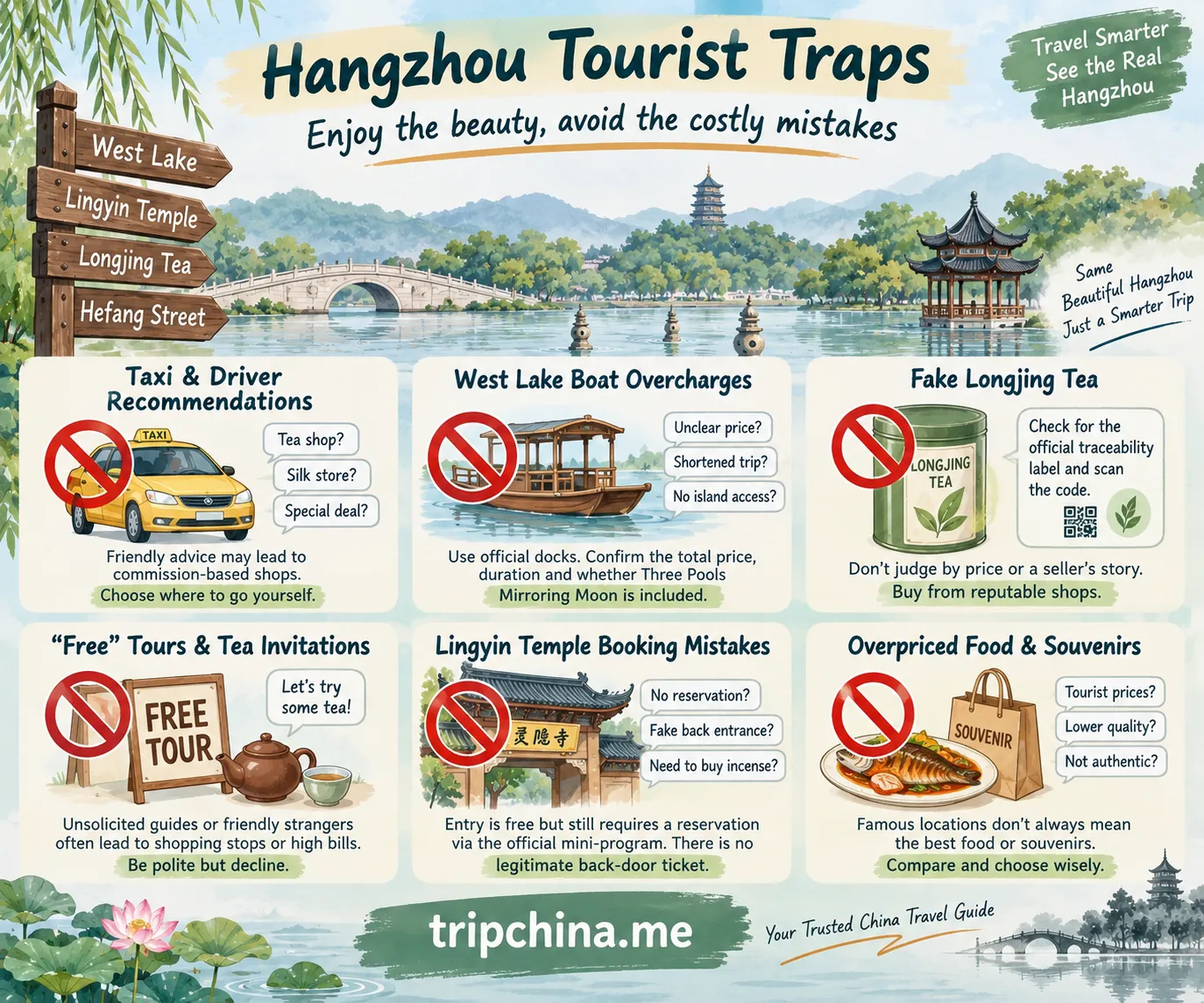
The warning sign is not the taxi itself. It is the unsolicited shopping recommendation.
A driver might offer useful travel advice and then suggest a supposedly special tea store, silk shop or restaurant. Some tourist-oriented businesses have used customer referrals and sales commissions to attract buyers.
A documented 2024 Longjing Village case helps explain the risk.
A Chinese travel blogger reported being told that drivers could receive commissions of up to 50% for bringing customers to a tea merchant. Separately, Hangzhou market regulators found that a merchant had repeatedly represented Longjing tea from Yuhang District as West Lake (Shifeng) Longjing.
The regulator's initial report identified transactions totaling ¥1,800. Subsequent reporting confirmed that the company was penalized ¥500,000 for false advertising.
The 50% commission figure came from the blogger's investigation, not the regulator's formal finding. It should not be treated as a standard commission rate among Hangzhou drivers.
The case demonstrates why a visitor should check the product independently rather than relying on the person who brought them to the shop.
A helpful response is simple:
“Thank you, but I'll choose a tea shop myself.”
That is enough. There is no need to accuse the driver of dishonesty.
For a recorded journey with an agreed destination and visible trip details, use a suitable ride-hailing service. Our guide to booking DiDi rides in China and avoiding first-ride problems explains how foreign visitors can prepare before arrival.
Busy transport terminals attract people offering taxis, private transfers or other services.
Do not follow an unsolicited driver merely because the official queue is long or the person promises a faster ride.
Use the signed taxi queue, official transfer counters or the ride-hailing pickup point shown by your booking app.
At Hangzhou East Railway Station, carefully distinguish the official taxi area from app-based pickup zones.
At Hangzhou Xiaoshan International Airport, follow airport transport signage and confirm the current pickup location rather than relying on strangers offering rides.
If a street-hailed licensed taxi refuses the normal metered arrangement or demands an unexplained fare, decline when safe to do so and choose another authorized option.
For station, airport and scenic-area transfers, see our Hangzhou public transport and taxi guide.
Preserve the vehicle plate number, payment receipt, route, pickup and drop-off points, and the quoted fare.
China's transport-service hotline 12328 handles transport-related complaints, although language assistance may vary.
If you need help explaining the incident in Chinese, ask your hotel reception to assist.
The biggest warning sign is someone offering a boat away from a clearly marked boarding point without explaining the product.
There are different legitimate West Lake boat services. A higher fare does not automatically mean someone is overcharging you.
The problem is when a seller misrepresents the service or does not deliver the agreed journey.
| Boat Type | Published Reference | What You Must Check |
|---|---|---|
| Regular Three Pools island boat | Around ¥55/person | Island entry and return arrangements |
| Deluxe or antique-style island boat | Around ¥70/person | Boat category and boarding dock |
| Hand-rowed boat | Historically ¥150/boat/hour | Start time, duration and overtime |
| Yao-lu traditional boat | Historically ¥180/boat/hour | Agreed route, duration and capacity |
| Other sightseeing cruises | Product-specific | Whether the boat lands on the island |
These figures are published reference rates, not live quotations. Always check the operator's displayed price.
Confirm three things before paying: total price, actual duration and whether island landing is included.
Not every West Lake boat visits Three Pools Mirroring the Moon.
If visiting the island is your goal, confirm that the ticket includes 三潭印月上岛.
A regular island boat and a private hourly boat are not interchangeable products.
In April 2023, passengers complained that hand-rowed boat services advertised at ¥150 for one hour sometimes ended after roughly half an hour.
Authorities canceled the West Lake operating qualifications of three boat workers involved in the initial investigation.
A subsequent regulatory case identified four instances from January to April 2023 in which paid boat services were not delivered for the promised duration. The operating company was fined ¥120,000.
This is a historical enforcement case, not proof that current official boat operators routinely shorten trips.
It does illustrate why the agreed duration matters.
For an hourly boat, note the boat number and start time, and keep your payment record. If the journey ends substantially earlier than agreed, use the complaint or supervision information displayed by the operator.
For the complete dock and route comparison, read our West Lake guide to walking routes, island boats and ticket costs.
Longjing tea is a genuine part of Hangzhou's culture.
The issue is that Longjing and West Lake Longjing are not interchangeable origin claims, and an attractive box does not prove where the tea was grown.
Be cautious when a merchant relies mainly on statements such as:
These statements may be true, but they are not sufficient evidence of origin or quality.
The price depends on growing area, harvest, processing, grade and producer. Premium early-spring tea can be expensive, but a high price alone does not prove authenticity.
For packaged protected-origin West Lake Longjing, check the official 西湖龙井防伪溯源专用标识 (West Lake Longjing anti-counterfeit traceability label).
The system distinguishes labels intended for tea farmers and authorized enterprises.
Depending on the current label and verification process, the consumer may use its QR information or the anti-counterfeit code revealed beneath a scratch-off coating.
The West Lake Longjing Tea Management Association provides an official 11-digit code-verification function.
Check whether the producer, origin, packaging and registration information are consistent.
A traceability label is stronger evidence than a seller's story, but it should be genuine, undamaged and associated with the product being sold.
Do not treat gold printing, attractive packaging or a premium price as sufficient authentication.
No.
Visiting a tea-producing area can be one of Hangzhou's most enjoyable cultural experiences.
The important difference is between choosing a reputable producer yourself and being delivered to one particular store by someone who may benefit from the sale.
Our Longjing Village routes and tea-buying guide covers the tea area's sightseeing routes and practical buying considerations.
Hefang Street is a real historic commercial district and is worth visiting.
But it is designed for visitors, and a crowded tourist street is not automatically the best place to eat an authentic local meal or buy expensive souvenirs.
Not necessarily.
Enjoy the street, browse its shops and try inexpensive snacks that genuinely interest you.
For more everyday food, explore nearby lanes and areas such as Da Ma Nong (大马弄), Zhongshan Middle Road (中山中路) and Wushan.
Before buying food sold by weight or in multiple-item packages, confirm the total price and what you are receiving.
No. West Lake Vinegar Fish (西湖醋鱼) is a traditional Hangzhou dish.
But its sweet-sour sauce and freshwater fish texture may not appeal to everyone.
The risk is less about the dish itself and more about choosing it solely because a tourist restaurant claims every visitor must try it.
If the dish interests you, choose a reputable Hangzhou restaurant and check recent food reviews.
Our Hangzhou food guide with local dishes and eating areas provides more detailed choices.
A documented May 2024 incident involved a shop selling two clay display models as packaged Beggar's Chicken.
The local market regulator determined that the business had sold imitation products as food. The operator was ordered to suspend business for 15 days, surrender ¥60 in illegal proceeds and pay a ¥600 fine.
This was a specific enforcement case, not evidence that Beggar's Chicken products generally are fake.
If buying packaged food as a souvenir, check the actual product, manufacturer, expiry information and packaging condition.
If the dish itself matters to you, consider a freshly prepared restaurant version rather than assuming a vacuum-packed souvenir offers the same experience.
Hangzhou has an established silk-making tradition, but the quality and composition of products sold to tourists vary.
A silk scarf, silk-blend fabric and a premium pure-silk garment are different products.
Check the actual fiber-composition label, care label, manufacturer, seller and refund conditions before paying a significant amount.
A merchant's verbal claim of “100% silk” is not enough.
For expensive purchases, favor retailers that provide itemized receipts and clear product information.
You may read about testing fibers by burning a thread. That is background knowledge, not a sensible action inside a shop.
Do not light fabric or perform a burn test in a retail store.
For market areas, product categories and buying decisions, consult our Hangzhou silk shopping guide and common purchasing traps.
One of the most expensive sightseeing mistakes can cost nothing in ticket fees but still waste half your day.
Since December 1, 2025, Lingyin Temple and the Feilai Peak Scenic Area have been free to visit under a real-name reservation system.
Free does not mean you can simply arrive without a booking.
Since February 1, 2026, the scenic area has used an online waitlist instead of the former on-site standby registration system.
Applications close at 8:00 PM on the day before entry. Successful next-day waitlist bookings cannot be canceled under the published special rule.
Do not pay anyone claiming to sell an unofficial “back entrance” or the old separate ¥30 incense admission ticket.
For passport registration, the seven-day release window, waitlists and entry verification, use our Lingyin Temple reservation guide for foreign travelers.
Not for ordinary individual admission under the policy introduced on August 21, 2026.
Individual visitors to the Southern Song De Shou Palace Site Museum (南宋德寿宫遗址博物馆) no longer need advance reservations.
Visitors can obtain an entry code using the on-site Alipay process. Foreign visitors with passports or other accepted identity documents can register at the venue.
Groups still need advance booking.
The museum's published regular hours are Tuesday–Sunday, 9:30 AM–5:00 PM, with last entry at 4:30 PM.
This is a good example of why old English travel instructions should not be followed without checking the current rules.
Not every free walking tour or low-cost tour is dishonest.
Legitimate businesses may offer discounted introductory tours or operate on voluntary tips.
The warning signs are an unsolicited street approach, an unclear business identity and refusal to disclose mandatory shopping stops.
A cheap tour may include the promised sightseeing but spend a disproportionate amount of time at commission-paying tea, silk or souvenir shops.
Before booking, ask:
If the seller cannot give clear answers, choose a more transparent product.
Costume photography or instant portraits can be a legitimate and enjoyable experience.
But a cheap headline price may exclude makeup, accessories, original JPG photographs, edited images or additional shooting time.
Ask for a written total covering all services you want before starting.
Check how the finished photos will be delivered, particularly if you will leave China before the editing is complete.
Foreign travelers should recognize one familiar type of social approach.
A stranger starts a friendly English conversation, perhaps saying they are a student or want to practice English. After a while, the stranger proposes visiting a nearby tea house.
The risk is not tea culture. Hangzhou has a genuine, rich tea tradition.
The warning sign is moving from an unsolicited conversation to a commercial venue the stranger selected, without knowing the prices.
If you want a tea experience, choose the establishment yourself.
Check the menu, per-person charges, service fees and total price before ordering.
There is no reliable single “standard scam price” for this situation.
The useful rule is much simpler:
Never let a person you have just met decide where you will spend money.
No.
A hotel may use “lake view” for a full panoramic room, a partial view or a room where the lake is visible only from a certain angle.
Do not rely on the property's promotional hero image.
Inspect recent guest photos of the exact room category and ask whether the view is full, partial or obstructed.
For a premium stay, clarify the floor, window orientation and any view limitations.
They can be beautiful, but they are not always the easiest base for a first-time visitor.
Late-night dining may be limited, and travel back to the property can be less convenient than staying near central West Lake or a metro line.
Choose a scenic stay because you value its surroundings, not because you assume every location labeled “near West Lake” is equally practical.
Before paying, read our China hotel booking checklist for foreign-passport holders to understand property details, booking restrictions and check-in requirements.
Not on every lakeside path.
Su Causeway and Bai Causeway are pedestrian-focused routes where cycling is prohibited under the applicable local restrictions.
Shared electric two-wheelers also face restrictions in designated scenic areas. Do not assume that a vehicle available for rental can legally be ridden along every West Lake route.
Cycle on roads where the posted rules allow it, and park before entering restricted paths.
The exact rule depends on the road, vehicle category and current signage.
No.
Buying a souvenir at a scenic-area stall may cost more because of location and convenience, but that does not automatically make the sale unfair.
For small inexpensive gifts, convenience may be worth paying for.
For premium tea, silk or larger purchases, compare shops and verify the product.
Hangzhou's weather can change the practical difficulty of a visit.
In spring, bring a light layer for cooler evenings.
During hot summer periods, avoid attempting a full West Lake circuit in the middle of the day.
During the plum-rain season, stone paths and steps can become slippery.
Mosquitoes can be troublesome in greener and wetter areas such as Nine Creeks and Hupao, especially in summer and early autumn.
These are ordinary travel-preparation issues, not tourist scams.
Keep your phone and wallet secure in busy places such as Hubin, Longxiangqiao and Hefang Street.
Avoid leaving a bag unattended while taking photographs or setting a phone on the edge of a crowded café table.
This is routine travel advice, not a claim that these areas have unusually high theft rates.
At night, use populated, well-lit routes. Quieter scenic paths west of the busiest lakefront may have fewer people and limited lighting.
If something goes wrong, do not argue for a long time without collecting evidence.
Save:
| Evidence | Why It Matters |
|---|---|
| Receipt or payment screenshot | Shows what you paid |
| Merchant's Chinese name and location | Identifies the business |
| Quoted price or product page | Shows what was promised |
| Chat history or booking confirmation | Documents the agreement |
| Boat number or vehicle plate | Identifies the operator |
| Photos of the displayed price list | Helps establish a pricing discrepancy |
| Product label or packaging | Useful in tea, silk or food disputes |
For help in China:
| Service | Number | When to Use |
|---|---|---|
| Police emergency | 110 | Immediate threat, crime or safety emergency |
| Transport complaints | 12328 | Taxi and transport-service disputes |
| Consumer/local government assistance | 12345 | Shopping, tourism and general complaints |
| Consumer complaint platform | 12315 | Consumer-rights complaints where supported |
English-language assistance is not guaranteed.
If you need to explain the problem in Chinese, ask your hotel reception for help. Keep the facts clear: what was promised, what happened, how much you paid and what resolution you want.
The Chinese phrase 我要投诉 means “I want to make a complaint.”
For payment questions, refunds and backup methods, see our guide to paying in China with Alipay, international cards and cash.
Hangzhou is generally a comfortable city for independent visitors. Most problems covered here involve misleading offers, unclear pricing or outdated information rather than violent crime. Use ordinary precautions, official booking channels and well-lit routes at night.
Be especially cautious with unofficial boat offers that do not clearly specify the price, duration and island access. Official boats themselves are not scams; confirm the exact service before paying.
Many shops sell legitimate tea. For premium protected-origin West Lake Longjing, check official traceability information and buy from accountable merchants. Neither an expensive price nor a seller's personal story proves authenticity.
It is worth visiting for its lively historic commercial atmosphere. You do not need to buy expensive souvenirs or have every meal there. Compare prices and inspect packaged products before purchasing.
Yes, but advance real-name reservations remain required for ordinary visitors under the current rules. Do not rely on outdated guides selling the former Feilai Peak and incense admission tickets.
Google Maps may have less useful local place and transport information than Chinese navigation services. For more reliable local routing, see our comparison of map apps for travelers in China.
Access to some overseas services depends on whether you use mainland Wi-Fi, a domestic SIM, roaming or an international travel eSIM. Compare China eSIM, physical SIM and pocket WiFi options before leaving home.
Cash remains legal tender, but mobile payment is common. Carry some RMB as backup and prepare a suitable mobile-payment method. Not all small vendors accept international bank cards directly.
Do not drink hotel tap water directly unless the property explicitly identifies it as potable. Use bottled, filtered or properly boiled water.
If the invitation comes from someone you just met, politely decline and choose a venue yourself. A legitimate tea experience should have transparent pricing and no pressure to buy products afterward.
Verify the exact room category, recent guest photos, location and refund rules. Be especially careful when paying extra for a lake view or a remote scenic property.
Preserve payment records, photos and the merchant's Chinese details. Ask for clarification, then use the appropriate complaint service if the problem is unresolved. Your hotel may be able to assist with Chinese-language communication.
Pay attention to who initiated the transaction.
The driver who suddenly knows the perfect tea shop.
The stranger who wants to practice English and then suggests a tea ceremony.
The guide who finds you before you have asked for a guide.
The person offering a special boat away from an official dock.
None of those situations alone proves fraud.
But they can move control of the decision away from you.
Hangzhou is not a city where visitors need to distrust everyone. Most interactions are ordinary and helpful.
The better rule is narrower:
When someone you did not approach turns a friendly conversation into a transaction, slow down and make the decision independently.
That one habit will help you enjoy Hangzhou without spending money on someone else's sales pitch.
This guide distinguishes confirmed historical enforcement cases from current visitor precautions and editorial risk assessments. The boat, Longjing tea and packaged-food cases demonstrate specific violations; they do not establish that comparable businesses throughout Hangzhou behave the same way. Published fares, attraction reservation rules, transport restrictions and commercial services can change. Check current operator notices, posted prices and official booking conditions before paying. TripChina does not independently audit every merchant, guide, hotel or tourist service mentioned in this article.
Avoiding mistakes is only the first step. TripChina.me Premium Travel Guides help independent travelers explore China with ready-to-follow routes, booking strategies, practical solutions, and local insights — so you can travel with confidence.