Our Location:
No. 99, Jiazi Road, Chengdu

 authorChris Lee
Hangzhou is one of the easier Chinese cities for independent travelers to navigate, but the best transport option changes depending on where you are going.
This guide shows foreign visitors how to choose the right transport for Hangzhou's airports, railway stations, West Lake, Lingyin Temple, Xixi Wetland and other major destinations.
This guide is part of the TripChina Hangzhou Travel Guide Hub for independent travelers.
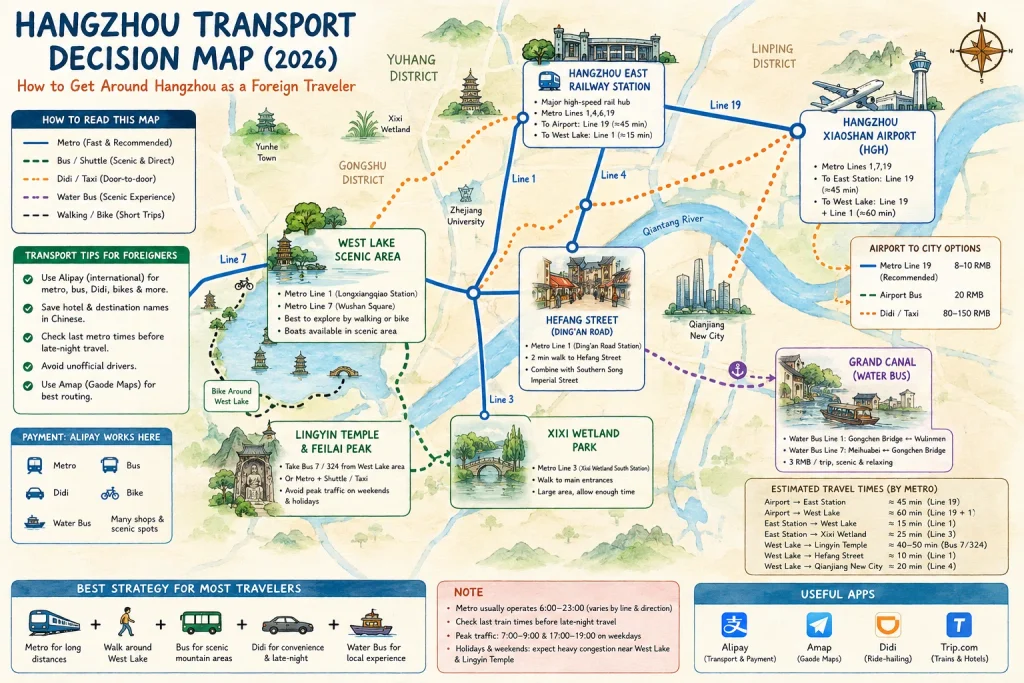
For most foreign travelers, Hangzhou Metro + Alipay is the best overall combination. The metro is inexpensive, traffic-free, easy to navigate with bilingual signage, and connects the airport, railway stations, central Hangzhou and many major visitor areas.
Use:
Alipay is the most useful digital payment tool for international visitors and can be used across many local transport and ride-hailing services after appropriate account setup.
You do not need to open a Chinese bank account to travel independently around Hangzhou.
| Situation | Best Choice | Why | Cost Level | Main Limitation |
|---|---|---|---|---|
| Airport → central Hangzhou | Metro, usually Line 19 + transfer | Fast and avoids traffic | Low | Last train depends on direction |
| Airport → hotel with heavy luggage | DiDi / official taxi | Door-to-door | Medium–High | Traffic |
| Central sightseeing | Metro + walking | Fast and predictable | Low | Final walk may be required |
| West Lake | Walk + metro + bike where permitted | Scenic and flexible | Low | Bikes are not suitable everywhere |
| Lingyin Temple | Bus / metro + bus or taxi | Better final access | Low–Medium | Heavy holiday congestion |
| Xixi Wetland | Metro + walking | Predictable | Low | Large site |
| Late-night travel | DiDi / official taxi | Works after metro | Medium | Higher demand prices possible |
| Grand Canal | Water bus | Scenic experience | Low | Limited timetable |
| Hangzhou → Shanghai | High-speed rail | Very fast | Medium | Popular trains can sell out |
| Hangzhou → Qiandao Lake | High-speed rail + local transfer | Efficient long-distance option | Medium | Station is not beside all attractions |
For a normal first trip, don't overcomplicate Hangzhou transport.
Metro for the long journeys + walking for sightseeing + buses for scenic areas + DiDi when convenience matters will cover almost everything most foreign visitors need.
Hangzhou Xiaoshan International Airport (HGH) is served by Metro Lines 1, 7 and 19.
For many international visitors, Line 19 is particularly useful because it provides fast connections toward major railway and transfer hubs.
Choose the metro if:
Do not assume all Hangzhou Airport metro services stop around 23:00.
Last-train times vary by line and direction. Some airport services currently finish before 23:00, while another direction on Line 19 continues shortly after midnight.
Always check your exact line and direction before relying on a late-night metro journey.
Choose DiDi or an official taxi when:
Save your hotel's Chinese name and address before arrival.
Avoid drivers who approach you personally inside or immediately outside the terminal. Follow official taxi or ride-hailing signs instead.
Airport coaches can still be useful for selected destinations, but their routes and timetables change more frequently than metro services.
Treat them as an alternative rather than your default plan.
Check the airport's current ground-transport information shortly before arrival instead of relying on an old list of stops.
Hangzhou has several major railway stations.
| Station | Best For | TripChina Advice |
| Hangzhou East Railway Station | Most high-speed rail trips | Best default for most travelers |
| Hangzhou Railway Station / Chengzhan | West Lake and old central Hangzhou | Very convenient if your train serves it |
| Hangzhou West Railway Station | Western Hangzhou | Useful only for certain routes/hotels |
| Hangzhou South Railway Station | Xiaoshan and southern Hangzhou | Usually less convenient for first-time visitors |
Hangzhou East Railway Station is the best default for most first-time visitors, but Hangzhou Railway Station (Chengzhan) can be more convenient for central Hangzhou and West Lake when a suitable train serves it.
Do not automatically select the cheapest train before checking its arrival station.
For most visitors, Hangzhou Metro should form the backbone of the transport plan.
TripChina tip: A hotel five minutes from a useful metro station can be more convenient than a hotel that looks geographically closer to West Lake but has poor transport access.
Yes.
Major stations use Chinese and English signage, making the network manageable even if you do not speak Chinese.
The bigger problem for tourists is often the exit, not the metro line.
Before leaving the train, check:
Choosing the wrong exit at a large station can easily add 10–20 minutes of unnecessary walking.
Buses are especially useful around scenic districts that do not have simple door-to-door metro access.
Examples include:
Several routes traditionally serve these areas, but bus operations and traffic management can change, particularly during holidays.
Rather than memorizing a bus number months in advance, check the current route on Amap or an official local transport service before departure.
During major Chinese public holidays, buses approaching West Lake and Lingyin can become crowded and slow.
Metro + walking or metro + final shuttle/DiDi may be more predictable.
Yes. DiDi is one of the most practical backup transport options for international travelers.
It is particularly useful for:
You can access DiDi through supported apps such as Alipay, depending on the current interface available to your account.
Its biggest advantage for non-Chinese speakers is that the destination is entered digitally rather than negotiated verbally.
Save:
At large malls, railway stations and airports, DiDi pickup points may be located on a specific floor or in a dedicated zone.
Do not assume a car is always faster.
West Lake roads can become heavily congested during:
For short trips, walking may genuinely be faster.
For longer journeys, metro to a nearby station followed by walking often saves time.
Always use an official taxi or recognized ride-hailing platform rather than accepting unsolicited offers from drivers near tourist attractions.
Shared bikes can be useful, but they should not be marketed as the only or automatically “best” way to circle West Lake.
Availability and account verification depend on the current bike operator and your payment setup.
They work best for:
They are poor choices for:
Parts of the wider West Lake area are pleasant for cycling, but bike restrictions, pedestrian-heavy areas and parking rules mean you should not assume every lakeside path allows shared bikes.
Use them selectively rather than treating the entire shoreline as one uninterrupted bike loop.
Yes — but as a local experience, not because it is the fastest transportation.Hangzhou's canal and river system provides a very different view of the city.
Water-bus services can be particularly interesting around the Grand Canal and historic neighborhoods.
Water buses are inexpensive, scenic and more local in character than commercial cruises, but departures are limited and they are much slower than the metro. If you only have one or two days, prioritize the metro.
If you have three or more days, the water bus can be a worthwhile addition to a Grand Canal itinerary.
West Lake is too large to have one correct station.
For many first-time visitors:
Line 1 → Longxiangqiao provides convenient access to the eastern lakefront.
Line 7 → Wushan Square is useful for the southern/eastern area and routes combining West Lake with Hefang Street.
Once you reach the lake, walking is usually the best sightseeing method.
Do not feel that you have to complete the entire lake loop. Choose the section that fits your time and priorities.
Related guide: Complete West Lake Travel Guide
This is one of the most important corrections for foreign visitors:
Lingyin Temple is not a simple “get off the metro and walk across the street” destination.
Do not plan around the assumption that a standard metro station directly delivers you to the temple gate.
For most visitors, the final journey involves:
From central Hangzhou, buses toward the Lingyin scenic area can work well when traffic is manageable.
During weekends and Chinese public holidays, congestion around Lingyin can become severe.
If you're traveling with elderly relatives or young children, factor the final connection into your plan before leaving your hotel.
Related guide: Lingyin Temple Reservation & Transport Guide
Metro is usually the most predictable way to reach the Xixi Wetland area.
However, Xixi is large.
Always check which:
you actually need.
The nearest station to “Xixi” on a map may not be the best station for your specific itinerary.
Related guide: Xixi Wetland Experience Guide
Ding'an Road on Line 1 is a useful central access point.
Hefang Street is best combined with:
Treat it as part of a walking route rather than taking a separate taxi there and back.
Metro is generally the easiest choice.
The Citizen Center area provides good access to modern Hangzhou's skyline and riverside architecture.
Evening metro travel is usually more predictable than road transport during busy periods.
Yes. Hangzhou is one of the best-connected high-speed rail hubs in the Yangtze River Delta. Shanghai is typically around an hour or less on many high-speed services, while Qiandaohu Railway Station provides rail access toward the Qiandao Lake area.
Remember that your railway station matters: Hangzhou East, Hangzhou Railway Station and Hangzhou West serve different routes.
Planning a rail trip? See our 12306 Train Ticket Guide for Foreigners.
| Mistake | Better Approach |
| Assuming every metro line stops at 23:00 | Check the exact last train for your direction |
| Taking a taxi for every West Lake trip | Walk or use metro where practical |
| Planning a direct metro ride to Lingyin Temple | Allow for a final bus/shuttle/taxi connection |
| Relying only on cash | Set up Alipay |
| Relying only on Alipay | Carry cash and a physical card |
| Forgetting your hotel address in Chinese | Save a screenshot offline |
| Accepting unofficial rides | Use DiDi or official taxis |
| Choosing the correct metro station but the wrong exit | Check exits before arriving |
| Treating shared bikes as an unrestricted West Lake loop | Check cycling and parking restrictions |
| Assuming airport coach routes never change | Verify them shortly before arrival |
| Using Google Maps as your only navigation tool | Cross-check local routing with Amap |
Do not use Google Maps as your only local navigation source in mainland China. Transport, walking, venue and location data may be incomplete or outdated compared with local mapping platforms.
Amap (Gaode Maps) is generally more reliable for detailed local navigation, station exits, pickup points and public-transport planning.
Its English experience may not always be as polished as Western mapping apps, but for local transport accuracy it is useful.
This article is part of the Hangzhou Travel Guide Hub.
A common mistake is searching for one perfect transport method.
There isn't one.
Hangzhou's geography is unusual:
The easiest trip comes from switching modes based on the destination rather than forcing every journey into the metro or a taxi.
Not for every transport method.
A Chinese phone number can make some local services easier, but many essential travel functions can be accessed by foreign visitors without opening a mainland phone account.
Reliable mobile data and a properly configured payment account matter more for most short-term tourists.
Yes.
For most first-time foreign visitors, renting or driving a car would make the trip more complicated rather than easier.
Metro, buses, walking, DiDi, taxis and high-speed rail cover nearly all typical tourist journeys.
Yes, mainstream public transport and recognized ride-hailing services are generally practical for international visitors.
The main concern late at night is availability, not personal security.
Know when your last useful metro connection leaves and have DiDi or an official taxi as backup.
For most independent travelers, yes.
Being within a short walk of a useful metro station makes:
much easier.
A convenient metro location can matter more than being physically closest to West Lake.
For elderly travelers, use:
Do not assume every scenic attraction has completely step-free access simply because the metro station does.
For Lingyin, West Lake and other large scenic areas, check the final walking distance as well as the transport route.
This guide was researched for independent international travelers using official Hangzhou airport and metro information, railway sources, current digital-service guidance, and practical route analysis.
For the September 2026 update, we reviewed airport connections, key metro routes, railway stations, and transport access to major attractions including West Lake and Lingyin Temple.
Routes, schedules, app interfaces and traffic conditions can change, so check official sources before time-sensitive journeys.
Official and primary sources used in this guide include:
Information reviewed: August 2026.
Transport becomes much easier once your airport arrival, mobile data, payment setup and attraction routes are prepared.
Continue with these TripChina guides:
TripChina.me creates practical China travel guides shaped by real local experience, helping independent travelers navigate transport, payments, food, neighborhoods, and the cultural details that make traveling in China easier and more meaningful. Find the guide for your destination at tripchina.me.




[…] this is your first Hangzhou trip, TripChina's Hangzhou transport guide explains metro, DiDi and payment options for getting around the […]