Our Location:
No. 99, Jiazi Road, Chengdu

 authorChris Lee
Xi'an is one of China's most rewarding historical cities—but some of its most frustrating tourist traps appear exactly where first-time visitors are most vulnerable: transport to the Terracotta Warriors, attraction tickets, the Muslim Quarter, low-price tours and souvenir shops. This guide focuses on what actually goes wrong, how to recognize it, and what I would do instead as a Chinese traveler familiar with the city.
Yes, Xi'an is absolutely worth visiting. The problem is not the city itself; it is making the wrong decision at the wrong place.
The five rules I would remember are:
• Buy major attraction tickets only through official channels. Never trust someone outside an attraction who promises “guaranteed tickets.”
• For the Terracotta Warriors, use official public transport, the metro-plus-ride-hailing option, or a legitimate booked transfer—not an unsolicited “tour bus” or black car.
• In the Muslim Quarter, explore Beiyuanmen for atmosphere but eat deeper inside Huifang, especially around Sajinqiao, Dapiyuan, Miaohou Street and Xiyangshi.
• Use DiDi or another app-based ride service when possible because the route and estimated fare are visible before or during the trip. Foreign visitors can follow this DiDi guide for travelers without a Chinese phone number.
• Be suspicious of extremely cheap day tours, jade sales pitches, unofficial “underground palace” experiences and anyone who approaches you first at a station or attraction entrance.
As of September 2026, Xi'an authorities continue to target unreasonable low-price tours, induced shopping, unlicensed transport and misleading tourist sales practices. Local tourism regulators regularly publish enforcement warnings via Xi'an's official culture & tourism bureau.
The rest of this guide shows you how to identify these traps on the ground—not just what to avoid.
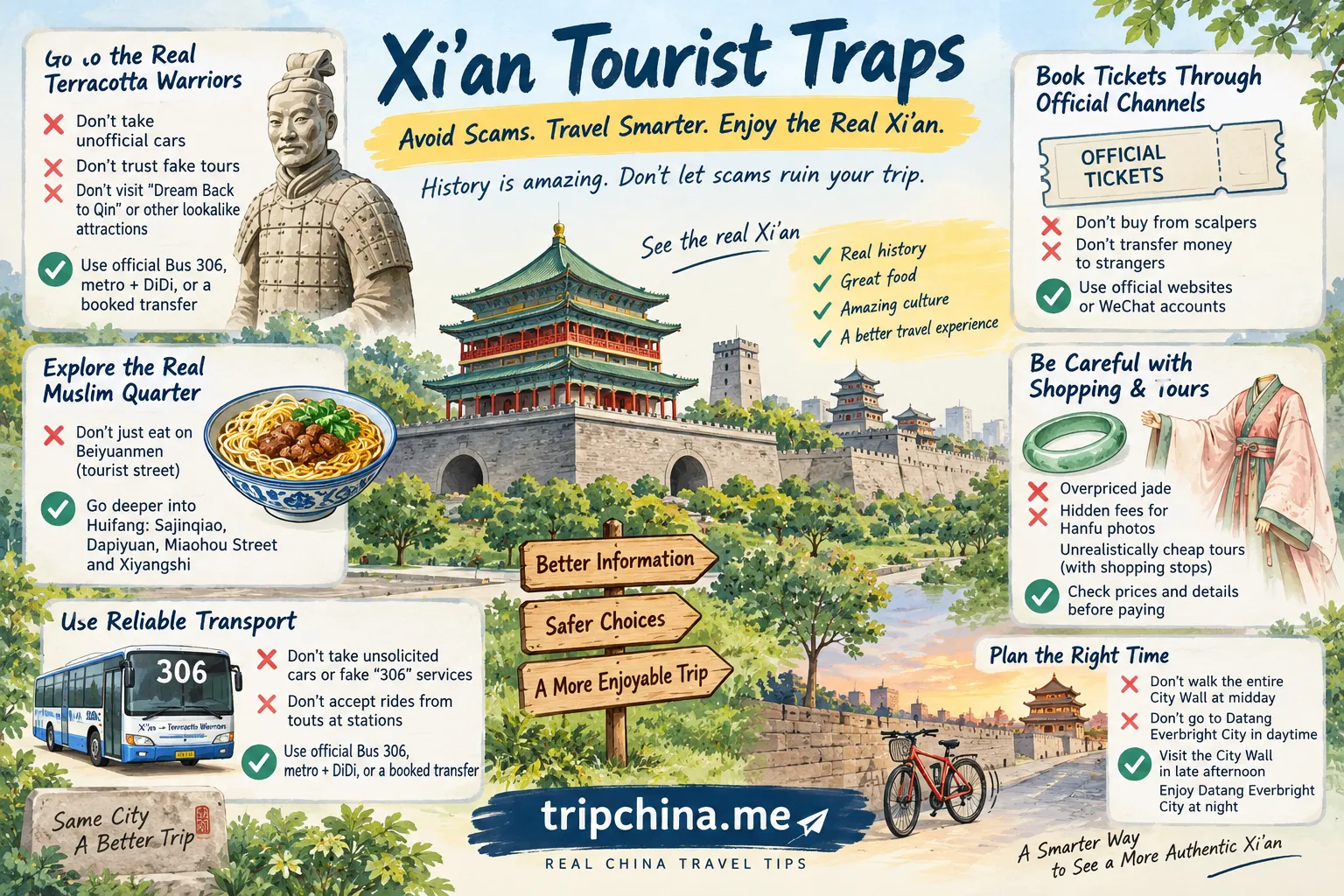
| Decision | What to Be Careful With | Better Choice | Main Risk |
|---|---|---|---|
| Terracotta Warriors transport | Unsolicited cars or fake “306” services | Official Bus 306, metro + DiDi, or booked transfer | Overcharging or diversion |
| Muslim Quarter food | Eating only on Beiyuanmen | Sajinqiao, Dapiyuan, Xiyangshi | Tourist pricing and generic food |
| Attraction tickets | Scalpers or unofficial sellers | Official reservation channels | Invalid booking or unnecessary fees |
| Terracotta Warriors extras | “Underground palace” / unofficial immersive pitches | Official museum exhibits | Paying for a private add-on you did not intend to visit |
| Xi'an City Wall | Full midday walk in summer | Cycle a shorter section near sunset | Heat and exhaustion |
| Hanfu photography | Very low headline price | Confirm complete package first | Hidden fees for makeup, costumes, edited photos and extra shooting time |
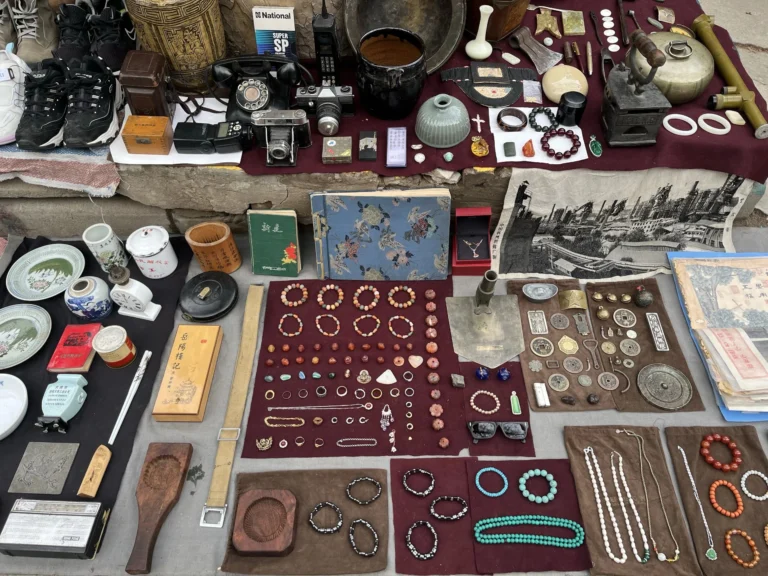
| Souvenirs | Jade and antiques at tourist stops | Established shops or supermarkets | Heavy markup / uncertain quality |
| Cheap tours | Unrealistically cheap packages | Licensed operator with clear itinerary | Mandatory shopping stops and unexpected optional paid add-ons |
The principle is simple: in Xi'an, convenience offered by a stranger is often less useful than the official option you can verify yourself.
The Terracotta Warriors are Xi'an's essential attraction, but Lintong is well outside the historic city center. That makes the journey there one of the easiest places for an unfamiliar visitor to make an expensive mistake.
Yes—but an important route change took effect in 2026.
As of August 29, 2026, the official Tourist Bus 5 / Bus 306 (游5/306) runs between Xi'an East Railway Station (西安东站) and the Terracotta Warriors. It no longer originates at Xi'an Railway Station East Square, as many older travel guides still claim. The current route should always be rechecked before travel because public transport arrangements can change. The latest adjustment was published by Xi'an Public Transport.
This distinction matters because the old “take Bus 306 from Xi'an Railway Station East Square” advice is now outdated.
The scam is not that Bus 306 is fake. The scam is a fake or unofficial service presenting itself as the real tourist bus.
At the official stop, board only the clearly marked public bus. Do not follow someone in a uniform-style jacket who intercepts you in a parking area or station forecourt and says:
“306 this way.”
“Terracotta Warriors bus.”
“Official tourist bus.”
“Faster bus—same destination.”
A legitimate public bus does not need a tout wandering around recruiting passengers.
For many foreign independent travelers, the easier alternative is to combine the metro with an official bus or app-based ride for the final section. If you are unsure which station or exit to use on the day, check Gaode/Amap rather than relying on an old screenshot or Google Maps. See our Xi'an transport guide for the current citywide options.
The important distinction is not “bus versus taxi.” It is official, traceable transport versus an unsolicited ride.
Be cautious when someone approaches you around a railway station, parking area or attraction entrance and says something like:
“Terracotta Warriors this way.”
“Official bus.”
“Museum closed—you need another ticket.”
“The main pits are under maintenance—visit this first.”
“Emperor's underground palace.”
“Special government exhibition.”
Do not follow the pitch simply because the person has a badge, lanyard or laminated card.
If someone claims the main Terracotta Warriors pits are closed or under maintenance, check the official museum website before changing your plan or buying another attraction ticket.
Xi'an authorities have repeatedly targeted illegal passenger transport and tourism-market misconduct. If someone approaches you first rather than directing you to a clearly marked official counter or bus stop, treat the offer cautiously.
This is one of the most important Xi'an traps to understand.
Some drivers, freelance guides and touts have taken visitors to separate commercial attractions instead of the real Terracotta Warriors site. One widely reported example is Dream Back to Qin (梦回大秦), a privately operated reconstructed attraction near the museum rather than the archaeological site itself. Visitors have reported being led to replica figures or reconstructed underground scenes while believing they were entering part of the official Terracotta Warriors complex.
A related problem involves XR, VR and “underground palace” attractions with Qin Dynasty themes. Some of these can be legitimate commercial entertainment experiences, but they are separate from the official archaeological museum.
The practical rule is simple:
The real museum's official Chinese name is: 秦始皇帝陵博物院
Copy those Chinese characters directly into Gaode/Amap if necessary.
If your driver stops at a different commercial attraction and tells you that you must visit it before seeing the Terracotta Warriors, check your map before buying anything.
The real museum includes the archaeological Terracotta Warriors pits and Lishan Garden. A private reconstructed attraction may be entertaining if you deliberately choose it—but it is not a substitute for the UNESCO-listed archaeological site.
The technology itself is not the problem. Xi'an is actively developing legitimate XR and immersive tourism products.
The red flag is when a driver, guide or salesperson presents a separate commercial experience as though it were part of the official Terracotta Warriors museum—or tells you it is the only way to see the unexcavated tomb.
Remember one fact: the central burial chamber of Qin Shi Huang has not been opened to ordinary tourists.
If someone sells you a separate “underground palace” experience, ask:
Is this included in my official museum ticket?
Who operates it?
Is it inside the official museum?
How much does it cost?
Can I simply skip it?
If the answers become vague, walk away.
One practical detail many first-time visitors underestimate is how commercial the surrounding area can feel after the archaeological site.
You may pass restaurants, souvenir stores and jade sellers while leaving. You do not need to buy anything simply because your walking route takes you through a commercial area.
If you want to leave quickly, open Gaode/Amap and navigate toward the main transport pickup area rather than accepting the first ride offered by someone standing near the exit.
When searching a specific local business or pickup landmark in a Chinese map app, copy the Chinese characters rather than relying on English transliteration.
That tiny trick is surprisingly useful throughout Xi'an.
As of September 2026, the official standard adult ticket is RMB 120, with the same price in peak and off-peak seasons. The museum uses real-name reservations, including for foreign visitors, and passports can be used for booking and entry. Ticket prices remain subject to future adjustment by official museum notice.
The official ticket covers the Emperor Qinshihuang's Mausoleum Site Museum system, including both the Terracotta Warriors Museum and Lishan Garden, with free shuttle transportation between the two areas.
Do not pay a stranger simply because they claim the RMB 120 ticket is “sold out but I can get you inside.”
For the actual passport and reservation procedure, use our step-by-step Terracotta Warriors ticket guide for foreign visitors.
The Muslim Quarter (回民街) is not one street. That misunderstanding is probably the biggest food mistake first-time visitors make.
Beiyuanmen (北院门), the famous central street most visitors call “Muslim Street,” is useful for atmosphere, lights and people-watching. But if food is your priority, keep walking.
The larger traditional neighborhood is Huifang (回坊), and streets such as Sajinqiao (洒金桥), Dapiyuan (大皮院), Miaohou Street (庙后街) and Xiyangshi (西羊市) give you far more choices.
Our dedicated Xi'an Muslim Quarter food guide maps out the difference between the tourist core and the streets where local eating culture is easier to find.
Yizhen Lou (一真楼): Known for yangrou paomo, the Xi'an specialty of bread soaked in lamb broth. Breaking the bread into tiny pieces yourself is part of the traditional experience.
Ziwulu Zhang Ji (子午路张记): A well-known option for roujiamo—meat stuffed inside crisp flatbread.
Pangzi Zenggao (胖子甑糕): Sweet steamed sticky rice with dates and beans. Morning is the better time to look for traditional zenggao stalls.
Aihua Kuda Mian (爱骅裤带面): Known for broad, belt-shaped wheat noodles.
Wei Jia Liangpi (魏家凉皮): A large local chain and an easy introduction to liangpi, Xi'an-style cold noodles.
For a broader introduction to what to order beyond Huifang, see the local Xi'an food guide.
You will also see photogenic pastries shaped like calligraphy brushes or mahjong tiles. They can be fun if you genuinely want them, but don't mistake every viral snack for an old Xi'an specialty. Ask the price before ordering or taking a staged photo.
Ticket systems change, and not every popular attraction follows the same rule. Do not apply one blanket “everything must be booked 3–7 days ahead” rule to the whole city.
Instead, check each high-demand attraction individually through the Xi'an attraction booking guide.
The museum uses real-name online reservations. As of September 2026, the standard adult ticket is RMB 120 and foreign visitors can reserve using passport information.
Official booking channels include the museum's official website and official WeChat services.
During weekends and Chinese public holidays, booking earlier is sensible even when tickets are not immediately sold out.
This is the part where you should ignore old screenshots.
As of September 2026, the Shaanxi History Museum Main Building allows reservations up to five days in advance, with the reservation system releasing tickets at 17:00 daily.
This 17:00 rule applies to the Main Building's free basic-exhibition reservation system—not only to paid special exhibitions. The museum's current Chinese reservation rules specifically state that basic-exhibition visitor information can be pre-filled in advance and that visitors must return at the 17:00 release time to complete the reservation. The current English visitor page also lists a five-day reservation window with slots released daily at 17:00. Reservation rules can still change, so check the official website or WeChat account shortly before booking.
General admission is free with a reservation. The museum's current English visitor information lists a daily free-reservation capacity of up to 12,000 visitors for the Main Building, with adjustments possible because of government requirements, renovations or operational conditions.
Most importantly, the often-repeated advice that “Shaanxi History Museum is closed every Monday” is not currently correct for the 2026 extended-opening period.
From March 15 through November 14, 2026, the Main Building's normal Monday closure has been suspended. Current opening hours are 8:30–19:00, with last entry at 18:00. After November 14, check the latest official notice before planning a Monday visit.
For passport booking and current reservation steps, use our Shaanxi History Museum ticket guide rather than relying on older social-media posts.
No.
Real-name reservation systems make the old-fashioned “I know someone inside” sales pitch particularly risky. A person standing outside a museum cannot simply bypass passport-linked admission rules because they promise they have a connection.
If official inventory is unavailable, change your date, choose another museum, or check whether an official paid exhibition provides an alternative. Do not transfer money to a stranger's personal WeChat account for a supposed guaranteed reservation.
Xi'an is unusually sensitive to timing. The same attraction can feel excellent at 7:30 PM and disappointing at 2:00 PM.
| Place | Better Timing | Common Mistake | Local Take |
|---|---|---|---|
| Datang Everbright City | Evening | Going mainly in daytime | Night atmosphere is the point |
| Xi'an City Wall | Late afternoon / sunset | Long midday summer walk | Cycle a selected section |
| Bell Tower area | Blue hour / evening | Assuming you must climb it for the view | Street-level views can be better |
| Tang Paradise | Evening if seeing shows | Treating it as equivalent to free Datang Everbright City | Worth it for performances/gardens |
| Terracotta Warriors | Opening time or later afternoon | Arriving with peak tour groups | Avoid the middle-of-day rush when possible |
Datang Everbright City (大唐不夜城) is primarily an evening experience. The lights, street atmosphere and performances are what make it distinctive.
Going during the day and deciding “this is overrated” misses the point.
It is free to walk through, but evening crowds can be enormous, especially during summer holidays and national public holidays.
Not inherently.
Tang Paradise (大唐芙蓉园) is a large reconstructed Tang-style cultural park. It makes more sense for travelers interested in garden architecture, staged performances and a more controlled scenic experience.
For budget travelers who mainly want nighttime Tang-style atmosphere, free Datang Everbright City may provide better value.
The two attractions serve different purposes, so calling Tang Paradise simply “a scam” or “not recommended by locals” is too simplistic. Our Xi'an Tang Dynasty attractions comparison explains which experience fits different travelers.
You can—but you probably don't need to.
The wall is roughly 13.7 kilometers around. A complete walk can take several hours and becomes tiring in summer heat.
For most first-time visitors, I prefer entering around South Gate (Yongningmen), renting a bicycle when conditions permit, and experiencing a selected section around late afternoon and sunset. The Xi'an City Wall guide explains the cycling and walking options in more detail.
Kaiyuan Shopping Mall has long been popular for elevated Bell Tower views, but access to individual viewing areas can change because of renovations, crowd control or management policies.
Check access when you arrive rather than treating an old social-media photo spot as guaranteed. Many visitors simply take excellent Bell Tower photos from street level around the square for free.
The most expensive mistakes in Xi'an are often optional purchases rather than entrance tickets.
Lantian jade (蓝田玉) is real; calling all of it “fake jade” is inaccurate.
The problem is quality and pricing. Tourist-oriented shops may sell low-grade, treated or heavily marked-up stone to visitors who cannot independently judge it.
Unless you understand jade grading and pricing, I would not make a major jade purchase during an attraction visit. Never let a guide's urgency—“special government shop,” “factory price,” or “today only”—make the decision for you.
Not necessarily, but the headline price may not be the final price.
Common extras can include upgraded clothing, makeup, accessories, additional shooting locations, extra retouched photographs or expedited delivery.
Before paying, confirm the total price, number of photos taken, number of edited photos included, makeup, costume level, shooting time and delivery terms in writing.
If Hanfu photography is one of your main Xi'an experiences, read our Xi'an Hanfu photoshoot pricing and hidden-fee guide before booking.
Price alone does not prove that a tour is fraudulent. But a price dramatically below the realistic cost of transport, tickets, guides and accommodation should make you ask how the operator earns money.
Shopping commissions and paid add-ons are common ways low headline prices are recovered.
Xi'an tourism regulators regularly publish enforcement and complaint information involving low-price solicitation, itinerary changes, added shopping stops and paid extras.
Before booking, ask for the full itinerary and identify every shopping stop and optional paid activity.
A few habits eliminate most avoidable problems:
• Accepting unsolicited transport: If someone actively recruits passengers outside a station or attraction, verify the service before getting in.
• Using an outdated map or screenshot: Routes, exits and pickup areas change. Gaode/Amap is generally more useful than Google Maps for navigation inside China.
• Following old Bus 306 advice: Since August 29, 2026, the official route runs from Xi'an East Railway Station to the Terracotta Warriors, not from Xi'an Railway Station East Square.
• Paying strangers for attraction tickets: Use official ticketing channels, especially where admission is linked to your passport.
• Transferring money to a personal account without understanding what you are buying: For normal travel payments, learn how foreign visitors can use Alipay, WeChat Pay, cards and cash in China.
• Treating Beiyuanmen as the entire Muslim Quarter: The deeper Huifang streets are part of the experience.
• Planning major attractions around outdated opening-day rules: Museum schedules and reservation policies change.
• Walking the entire City Wall at midday in summer: This is an endurance challenge, not necessarily a better sightseeing experience.
• Assuming every immersive “Qin Dynasty” experience is part of the Terracotta Warriors museum: Verify the operator and ticket separately.
• Buying expensive jade or Chinese medicine during a tour stop: Never make a high-value purchase under time pressure.
• Traveling during a major Chinese holiday without adjusting expectations: Check the 2026 China public holiday calendar and crowd periods before locking in your dates. The October 1–7 National Day holiday period is particularly crowded at major attractions, with stronger demand for hotels and transport.
A surprising number of “scams” become easier to avoid once your phone works properly.
Before landing in China, set up mobile payment, internet access, navigation and ride-hailing. If you arrive without working data, you become much more dependent on whoever happens to approach you outside the airport or station.
At minimum, prepare Alipay or WeChat Pay, DiDi and a Chinese navigation app. Our China travel survival guide to essential apps covers the basic setup.
If international internet access matters to you, also understand the difference between roaming, travel eSIMs and domestic Chinese SIM cards before arrival. See our China eSIM vs SIM guide for foreign travelers.
Mobile payment should be your main everyday tool, but I still recommend carrying a small amount of RMB cash—especially ¥10 and ¥20 notes—as backup for small vendors, older payment terminals or situations where your phone connection fails.
This preparation is not just digital convenience. It gives you the ability to independently check a route, price, attraction name or booking instead of trusting the person standing in front of you.
For more Xi'an travel tips, visit our Xi'an Travel Guide Hub.
Generally, yes. The main visitor areas are busy well into the evening, and serious violent crime against tourists is not what most travelers need to worry about. Your more realistic concerns are crowded areas, unsolicited transport, commercial pressure and keeping track of your phone and belongings in dense crowds.
Do not assume every small restaurant, market stall or taxi will accept a physical Visa or Mastercard. Mobile payment is much more useful for everyday travel; foreign visitors can link eligible international cards to Alipay and WeChat Pay. Carrying some RMB cash as backup is still sensible.
Internet access in mainland China differs from what many overseas visitors are used to, and several international services may be inaccessible through ordinary mainland internet connections. Prepare your connectivity solution before arrival rather than trying to solve it outside the airport. This China internet-access guide explains the practical options for Google, WhatsApp and other international services.
Spring and autumn generally offer more comfortable sightseeing weather than the hottest part of summer, but avoiding China's major public holidays matters more than choosing a supposedly perfect month. The October 1–7 National Day holiday and other peak travel periods can dramatically increase visitor numbers at the Terracotta Warriors, museums and central attractions.
No, but a good guide can add significant value because the archaeological context is more complex than simply looking at the figures. If you hire one, use an official or clearly licensed service with the price agreed in advance rather than automatically accepting someone who approaches you outside the entrance.
Yes, luggage storage is available at the Terracotta Warriors. The official museum provides free luggage storage after security inspection, located east of the ticket hall behind the LED screen wall. Valuable items such as passports, phones, computers, cash and jewelry should not be left there.
For Xi'an Railway Station, baggage-service arrangements can change, so check the station service desk or 12306 on the day rather than relying on an old locker map. If you are carrying a large suitcase to the Terracotta Warriors, the museum's official storage service is the more clearly documented option.
Xi'an Xianyang International Airport (XIY) is outside central Xi'an. Most independent travelers use the airport metro connection, an airport shuttle bus, or an official taxi/DiDi depending on arrival time, luggage and hotel location.
Do not accept an unsolicited ride from someone approaching you inside or outside the arrivals hall. For current metro connections, late-night options, pickup points and estimated travel times, use our Xi'an airport to city transport guide.
Xi'an's municipal water supply is routinely monitored, and 2026 official health inspections found sampled treatment-plant water and distribution-network tap-water samples compliant with China's drinking-water hygiene standards.
For travelers, however, I still recommend not drinking directly from an unfamiliar hotel or apartment tap. Building plumbing, storage tanks and local conditions occur after water leaves the municipal system. Bottled water or water that has been boiled is the simplest choice, and most Chinese hotels provide an electric kettle.
Xi'an does not need to be approached with paranoia. It needs preparation.
Book important attractions through official channels. Keep your phone connected. Use traceable transport. Walk beyond the obvious tourist street before deciding where to eat. Ask what an extra attraction actually is before paying for it. And never let someone else's urgency make a purchasing decision for you.
The best Xi'an is still easy to find: early-morning food stalls, neighborhood lanes inside Huifang, the City Wall as the light changes, and one of the world's greatest archaeological sites when you arrive knowing exactly where you are going.
The difference between an exhausting Xi'an trip and a great one is often not money. It is knowing which choices are actually worth making.
Emperor Qinshihuang's Mausoleum Site Museum — official ticket price, real-name booking, opening hours, shuttle and luggage storage
Shaanxi History Museum — five-day reservation window, daily 17:00 release time, free reservation rules and current visitor capacity
Shaanxi History Museum — 2026 extended opening hours and suspension of the normal Monday closure through November 14
Xi'an Public Transport — current Bus 306 / Tourist Bus 5 route adjustment:
This guide was reviewed and updated in September 2026 using current museum, transport and local-government information. The latest review confirmed the August 29 Bus 306 route change, the Shaanxi History Museum's five-day reservation window and 17:00 release time for basic-exhibition reservations, the RMB 120 Terracotta Warriors adult ticket, official museum luggage storage, and current Xi'an municipal drinking-water inspection results. Transport routes, attraction prices and reservation rules can change, so time-sensitive details should be rechecked shortly before travel.
TripChina.me creates practical China travel guides shaped by real local experience—helping independent travelers navigate transport, payments, food, neighborhoods, and the cultural details that make traveling in China easier and more meaningful. Find the guide for your destination at tripchina.me.